At 10:23 on a hot Saturday morning, a motorcycle that sounded more like loose farm equipment than a road machine coughed twice outside Apex Custom Choppers on Route 9 and died directly in front of the open service bay.
Everyone inside heard it.
Conversation stopped for half a second.
Then somebody laughed.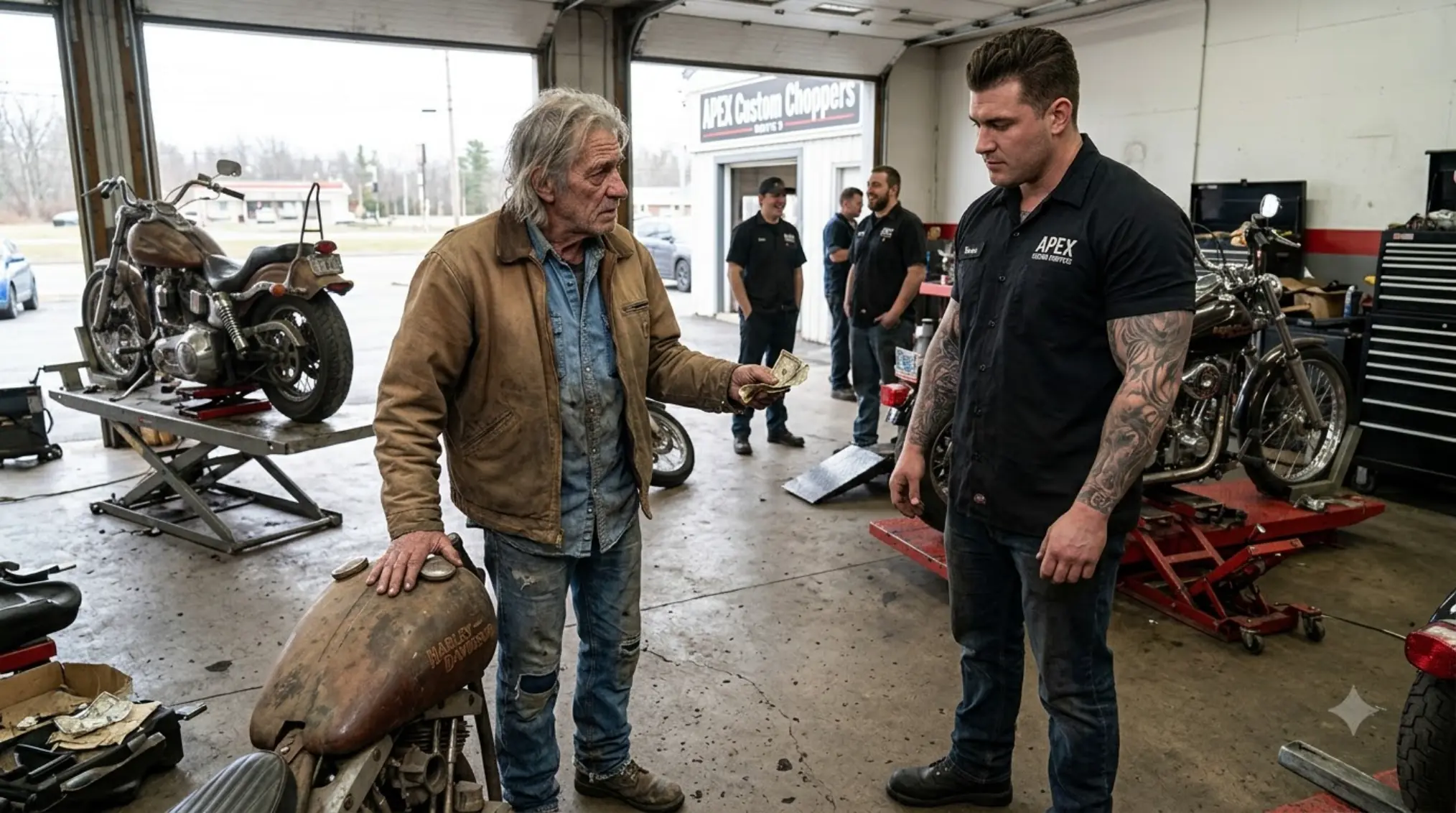
The old motorcycle rolled slowly through the doorway under the strength of a man who appeared almost as worn down as the machine itself. Its gas tank was brown with surface rust, the leather seat had cracked into a web of dark lines, the chrome had disappeared beneath years of oxidation, and one exhaust pipe was held against its bracket by a piece of old steel wire. The front tire was soft, the headlamp sat crooked, and an oily stain darkened the lower engine case.
Behind the handlebars walked Arthur Bennett, seventy-five years old.
He was thin without appearing fragile, the kind of thin produced by years of physical work rather than dieting. Deep lines crossed his weathered face. Long gray hair curled untidily above the collar of a torn brown work jacket, and beneath it he wore a faded blue denim shirt that had been repaired twice near the elbow. His jeans were old enough to have lost most of their original color, and the soles of his work boots were beginning to separate near the toes.
Arthur pushed the motorcycle until it stood beneath the fluorescent lights.
Then he stopped.
Four mechanics looked at it.
One whistled.
Another said, “That thing came here under its own power?”
Arthur wiped sweat from his forehead.
“Most of the way.”
A few men near the rear toolboxes chuckled.
Standing beside the main workbench was Mason Cole, forty-eight, senior mechanic and part owner of Apex Custom Choppers. He was six-foot-two, broad through the shoulders, with powerful arms covered almost completely in faded black-and-gray tattoos. His dark hair was swept back with streaks of silver beginning above both ears, and a short salt-and-pepper beard sharpened the lines around his mouth.
Mason wore a charcoal-gray riding jacket over a black work shirt, dark jeans, and heavy black boots.
Unlike the younger mechanics, he held nothing.
He simply stared at the motorcycle.
Then his eyes moved toward Arthur.
“You ride that here?”
Arthur nodded.
“Twenty-eight miles.”
Mason looked again at the leaking engine.
“How?”
Arthur smiled faintly.
“Slowly.”
One of the younger workers laughed.
Mason did too.
It was only a short laugh, more disbelief than cruelty, but Arthur heard it.
The old man lowered his eyes toward the motorcycle.
Mason noticed.
The laughter stopped.
Arthur reached inside his jacket.
He pulled out a small bundle of crumpled bills held together by a rubber band.
“Look,” he said quietly. “I know she ain’t pretty.”
Mason’s expression changed slightly.
Arthur began unfolding the money.
“Hundred and eighty-seven dollars.”
One mechanic at the rear glanced toward another.
Arthur continued.
“That’s what I’ve got after gas and breakfast.”
Mason looked at the bills.
Then at the motorcycle.
“What do you need done?”
Arthur rested one hand gently against the rusted fuel tank.
“Just make her start.”
Mason frowned.
“That’s it?”
“I don’t need paint.”
Arthur rubbed the tank with his thumb.
“Don’t need chrome.”
He looked toward the worn front tire.
“Don’t even need her pretty enough for anybody to look twice.”
His voice softened.
“I just need her to run one more time.”
Mason remained silent.
Arthur held the money toward him.
“It ain’t much, son, but if you can make her start, I’d be grateful.”
Mason looked at the crumpled cash.
Then he looked past Arthur toward the road.
“Where are you going?”
Arthur hesitated.
“North.”
“How far?”
“About seventy miles.”
Mason laughed again, but this time there was no humor.
“You’re not riding this seventy miles.”
“I am if she starts.”
“You might make seven.”
“Then I’ll push the rest.”
That answer quieted the entire shop.
Mason stepped closer.
“Why?”
Arthur looked down.
For several seconds, the only sound came from a pneumatic tool in another bay.
Then Arthur touched the motorcycle’s cracked seat.
“She was my boy’s.”
Mason’s eyes lowered to the bike.
“What happened to him?”
Arthur swallowed.
“Cancer.”
Nobody laughed anymore.
Arthur stared at the worn leather.
“Daniel was forty-two.”
His fingers trembled against the seat.
“He spent eighteen months fighting it, and every time the doctors told him to slow down, he told them motorcycles didn’t know how to go slow.”
A mechanic near the toolbox quietly set down a wrench.
Arthur continued.
“He rode this thing almost twenty years.”
Mason crouched beside the motorcycle.
“What is it?”
“Nineteen seventy-eight Shovelhead.”
Mason looked closer.
Under the rust, modifications began appearing.
Hand-shaped brackets.
Custom welds.
An old air cleaner.
A repaired primary cover.
This motorcycle had not been neglected because nobody loved it.
It had been kept alive because somebody loved it too much to replace it.
Arthur watched Mason inspect the engine.
“Daniel built most of her himself.”
“Your son was a mechanic?”
“Electrician.”
Mason smiled slightly.
“That explains some of the wiring.”
Arthur smiled too.
For the first time since entering the shop.
Mason stood.
“So what’s seventy miles north?”
Arthur’s smile disappeared.
“A cemetery.”
The shop became completely silent.
Mason looked at him.
Arthur removed an old folded photograph from his jacket.
It showed a younger man sitting on the same motorcycle.
The bike was black then.
Clean chrome.
Shining engine.
Behind the rider stood twenty or thirty other bikers.
Arthur handed the photograph to Mason.
“My boy’s memorial ride is today.”
Mason studied it.
Arthur continued.
“Every August.”
He pointed at the photograph.
“His friends ride from St. Matthew’s Cemetery to Pine Ridge Overlook.”
Mason looked at the time.
“What time?”
“Two.”
It was already 10:31.
“You waited until today to bring the bike?”
Arthur shook his head.
“I’ve been working on her six weeks.”
“What happened?”
“Got her running Thursday.”
“And?”
“Fuel line split yesterday.”
“That’s fixable.”
“Then starter stopped.”
“Also fixable.”
“And she’s losing oil.”
Mason looked underneath.
“Definitely.”
Arthur gave a tired smile.
“Figured that one out myself.”
Mason returned the photograph.
“Why didn’t you trailer it?”
“Don’t own a trailer.”
“Pickup?”
“Sold it.”
“Friend?”
Arthur looked away.
“I don’t ask people for much.”
Mason studied him.
There was more to that sentence than stubbornness.
“What happened to Daniel’s friends?”
Arthur folded the photograph carefully.
“Life happened.”
“Meaning?”
“Some moved.”
He put it back inside his jacket.
“Some got married.”
His voice dropped.
“Some stopped calling after Danny died because they didn’t know what to say to me.”
Mason understood that kind of silence.
People often disappeared from grief not because they lacked love, but because love made them uncomfortable.
Arthur continued.
“The ride got smaller every year.”
“How many last year?”
“Eleven.”
“The year before?”
“Seventeen.”
Arthur looked toward the motorcycle.
“This might be the last.”
Mason nodded slowly.
Arthur held out the bills again.
“So, hundred and eighty-seven.”
Mason looked at the money.
Then he gently pushed Arthur’s hand downward.
“Put it away.”
Arthur frowned.
“I’m not asking for charity.”
“I didn’t say you were.”
“I pay my way.”
“I believe you.”
“Then take it.”
Mason looked directly at him.
“Let me look at her first.”
Arthur hesitated.
Then returned the money to his jacket.
Mason rolled the motorcycle toward the lift.
“Tyler.”
A young mechanic looked up.
“Yeah?”
“Compression test.”
“Got it.”
“Luis, drain the oil.”
Another mechanic moved.
“Cam, pull the plugs.”
The shop suddenly became active.
Arthur stepped back.
“You don’t need four men.”
Mason answered without looking at him.
“You said two o’clock.”
“I did.”
“Then stop wasting my time arguing.”
Arthur smiled.
“Yes, sir.”
Thirty minutes later, the list was not encouraging.
Fuel line.
Battery.
Spark plugs.
Front tire.
Oil leak at the rocker box.
Loose exhaust mount.
Cracked throttle cable housing.
Rear brake badly adjusted.
Mason stood beside a rolling tool cart reading Tyler’s notes.
Arthur sat on an old stool near the wall.
“Well?” he asked.
Mason looked at him.
“You want the polite answer?”
“No.”
“The bike is trying to kill you.”
Arthur laughed.
“Danny used to say the same thing.”
“I’m serious.”
“So am I.”
Mason pointed at the front wheel.
“That tire is finished.”
Arthur looked at it.
“Still round.”
“That is not the standard.”
“You got one used?”
Mason stared.
Arthur added, “Cheap?”
Mason rubbed a hand across his beard.
“Do not start negotiating yet.”
Arthur crossed his arms.
“I told you what I have.”
Mason walked toward the parts rack.
“Tyler, check upstairs. I think we have a nineteen-inch Dunlop from the Lawson build.”
“That tire’s almost new.”
“I know.”
“You saving it?”
“Not anymore.”
Arthur stood.
“No.”
Mason kept walking.
Arthur followed him.
“No, no. I can’t buy that.”
Mason stopped.
“Who said buy?”
“I said no charity.”
Mason turned.
“You ever help somebody fix a fence?”
Arthur frowned.
“What?”
“You ever help a neighbor fix a fence?”
“Yes.”
“You charge him?”
“Depends how much I liked him.”
A few mechanics laughed.
Mason almost smiled.
“You ever jump somebody’s battery?”
“Sure.”
“Charge for that?”
“No.”
“Then stop calling every decent thing charity.”
Arthur became quiet.
Mason pointed toward the motorcycle.
“You pushed a seventy-eight Shovelhead twenty-eight miles into my shop because you made a promise to your dead son.”
His voice softened.
“Let us help you keep it.”
Arthur looked down.
For several seconds, his jaw moved as though he were trying to answer.
Nothing came.
Finally he said, “I can pay for parts.”
“We’ll talk later.”