“Give me the fat one!”
The words thundered across the crowded marriage agency attached to the Helena stagecoach station, silencing ten nervous women, two clerks, and every traveler waiting near the iron stove. Snow clung to the shoulders of the enormous mountain man standing in the doorway as he pointed directly toward the largest woman in the line.
The elderly matchmaker hurried between them. “She is a woman, not livestock—choose your words carefully.”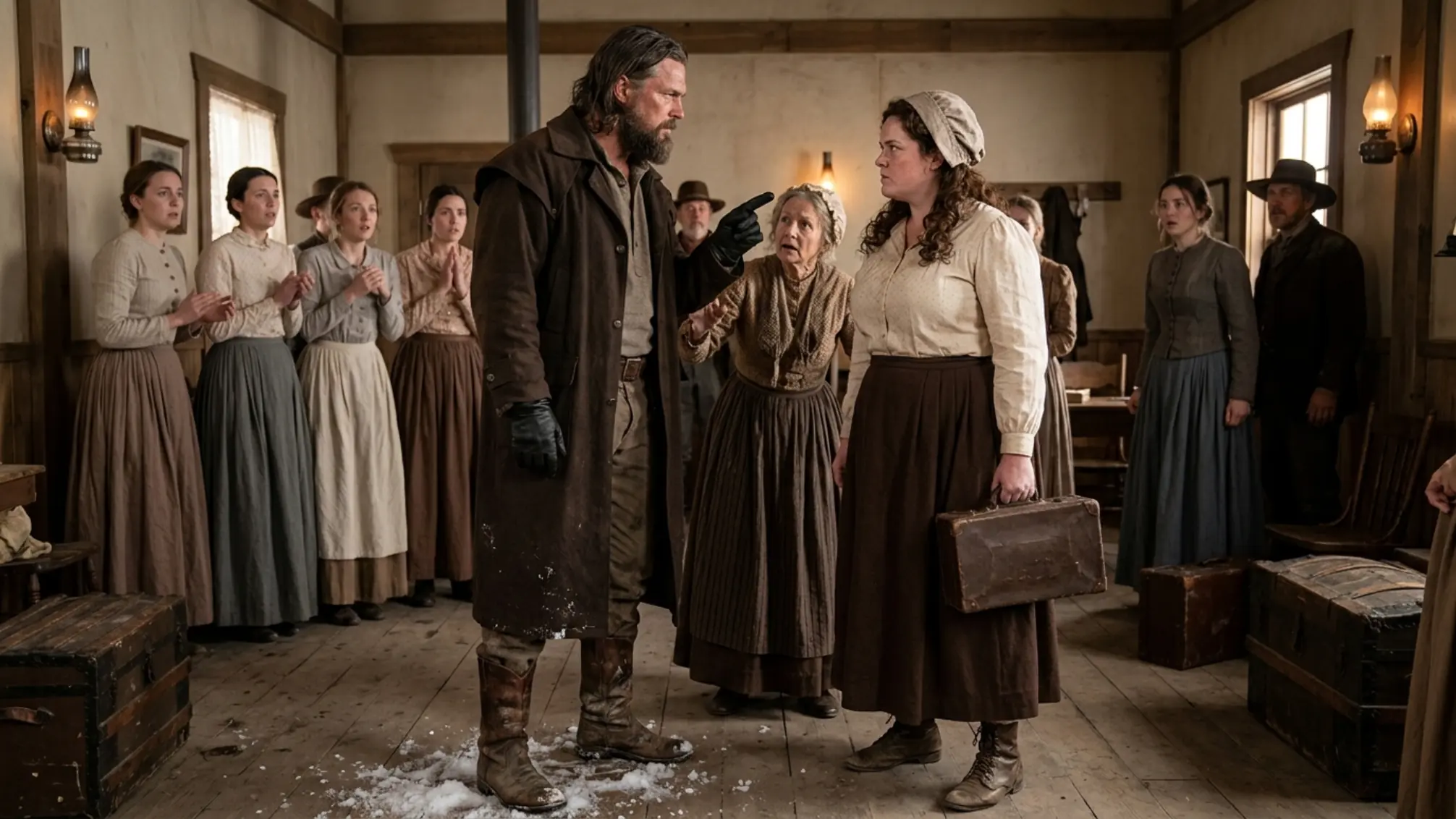
The woman stepped around him, gripping the handle of her travel case as she marched straight toward the stranger. “Say it again, and you’ll leave this station on your knees.”
The mountain man did not retreat. His intense gray eyes held hers as he lowered his hand.
“I chose the only woman here strong enough to survive what waits on my mountain.”
The woman’s name was Clara Bellamy.
She was thirty-two years old, with freckled fair skin, thick dark curls pinned beneath a plain bonnet, and a large, full-figured body that strangers had judged before she opened her mouth. She had traveled nearly two thousand miles from Pennsylvania after answering an advertisement seeking a capable frontier wife. The notice promised a respectable home, shared ownership of a mountain property, and a husband who valued practical ability over fashionable beauty.
Until that moment, Clara had believed the advertisement might have been written by an intelligent man.
Now she stared at the towering stranger and reconsidered every decision that had brought her to Montana.
He introduced himself as Elias Ward, forty-one, owner of a remote homestead above Frostpine Pass. His shoulder-length dark hair was damp with melted snow, and a thick beard covered most of his weathered face. Beneath his long buffalo coat, he wore a faded wool shirt, rough trousers, and boots scarred by years of rock and ice.
Clara looked him over slowly. “You wrote the advertisement?”
“I paid a schoolteacher to write it.”
“That explains why it sounded educated.”
Several women behind her covered their mouths to hide their laughter.
Elias accepted the insult without blinking. “Are you refusing?”
“I have not accepted anything.”
The matchmaker, Mr. Tobias Finch, squeezed between them again. He was a thin, anxious man with silver spectacles and a habit of rubbing his hands whenever money or scandal was involved.
“Perhaps we should discuss compatibility in my office,” he said. “Quietly.”
“No,” Clara replied. “He embarrassed me publicly. He can explain himself publicly.”
Elias glanced at the other brides. Nine women stood behind Clara in neat traveling dresses, each pretending not to listen while listening to every word.
“My cabin is twelve miles beyond the nearest maintained road,” he said. “Winter lasts seven months. The garden sits on a slope. Water has to be carried when the spring freezes, wood has to be split, and livestock has to be moved before storms close the valley.”
Clara folded her arms. “And you assumed the thinner women could not work?”
“I assumed most of them did not come dressed for it.”
The youngest bride looked down at her polished shoes.
Clara’s eyes narrowed. “That still does not excuse what you called me.”
“No.”
The immediate answer caught her off guard.
Elias removed his gloves and held them at his side. His hands were enormous, marked by old scars and cracked skin.
“I spoke badly,” he continued. “I am used to choosing horses, tools, and supplies by what will last. I looked at you and saw someone who looked strong enough to stand beside me. I used words no woman should have had thrown at her.”
“An apology usually includes the word sorry.”
“I am sorry.”
The station remained quiet.
Clara had expected excuses, not accountability. She had met men who turned cruelty into jokes and jokes into accusations that she lacked humor. Elias had insulted her more bluntly than any of them, yet he was also the first to admit the insult without demanding forgiveness.
That did not mean she intended to marry him.
“What waits on your mountain?” she asked.
Elias hesitated.
“My sister’s three children.”
Clara’s anger shifted, though it did not disappear. “Your advertisement said nothing about children.”
“My sister died in the spring. Their father disappeared before the youngest was born.”
“How old are they?”
“Four, seven, and eleven.”
“And you have cared for them alone?”
“Since May.”
Mr. Finch adjusted his spectacles. “Mr. Ward, the agreement you filed described a household requiring assistance, but it did not specifically disclose three dependents.”
“I told your clerk.”
“My clerk has a talent for losing information that complicates a contract.”
Clara looked toward the matchmaker. “You offered ten women to a man without telling any of us that he was raising three children?”
Finch’s face reddened. “The term offered is somewhat indelicate.”
“You lined us up.”
“I arranged an introduction.”
“You numbered our application cards.”
“For administrative efficiency.”
Clara turned back to Elias. “Do the children want a new mother?”
“No.”
The honesty arrived again without decoration.
“They want their mother,” he said. “I cannot give them that. I need someone who can help keep them alive until they stop believing every departure means another death.”
Clara felt the weight of her travel case pulling against her hand. She had once imagined marriage as a doorway out of loneliness. Elias spoke of it as a roof that two people might hold up together before a storm crushed the children beneath it.
“Do you want a wife,” she asked, “or an unpaid servant?”
“A partner.”
“Would the property belong to both of us?”
“Yes.”
“Written into the marriage agreement?”
“Yes.”
“Would I control household money?”
“Half.”
“Would I be free to leave if you became cruel?”
Elias looked directly at her. “I would take you back to Helena myself.”
Finch cleared his throat. “These terms could be formalized.”
Clara ignored him. “And if I decide, after meeting the children, that I cannot stay?”
“You leave without owing me anything.”
One of the women behind her whispered that Clara would be foolish to go anywhere with a man who had introduced himself through an insult.
Clara agreed.
But she had also crossed half the country because she was tired of allowing other people’s first judgments to decide the boundaries of her life. Returning east would mean moving back into her brother’s house, where his wife treated her as an inconvenient mouth at the table. Remaining in Helena would require work she did not yet have.
Frostpine Pass might be a mistake.
It would at least be her mistake.
“I will meet the children,” Clara said. “Nothing more is promised.”
Elias nodded once. “Fair.”
“And you will carry my case.”
He reached for it.
Clara pulled it back. “After you say my name.”
He glanced toward Finch.
The matchmaker whispered, “Clara Bellamy.”
Elias returned his attention to her. “Miss Bellamy, may I carry your case?”
“You may.”
The road into the mountains took the rest of the afternoon.
Elias drove a wide wooden sleigh pulled by two strong chestnut horses. Clara sat beside him beneath a heavy wool blanket while the stagecoach station disappeared behind falling snow. Neither spoke for the first mile.
Finally, Clara asked, “Is silence your natural condition?”
“Mostly.”
“It will need improvement.”
“I suspected that.”
The faintest trace of humor crossed his face.
The road narrowed as they climbed. Pine trees crowded the slopes, their branches bowed beneath fresh snow. Far below, a frozen river curved through the valley like a strip of dull silver.
Elias explained that his property consisted of one hundred and sixty acres, though only twelve were suitable for planting. He trapped in winter, repaired wagons in spring, and sold timber under a selective agreement that preserved most of the forest.
Clara asked detailed questions about income, debts, stored food, livestock, and the children’s health.
Elias answered every one.
He had no bank debt. The property taxes were paid through the following year. The cabin roof needed repair, one cow had stopped producing milk, and their flour supply would last approximately six weeks if rationed carefully.
“You count everything,” Clara observed.
“You survive longer that way.”
“Do you count people too?”
He looked at her.
“You counted ten brides,” she said. “Then selected the largest.”
A muscle tightened in his jaw. “I deserved that.”
“Yes.”
They continued upward.
Near dusk, the horses slowed before a narrow bridge crossing a ravine. A section of railing had collapsed beneath the weight of ice. Elias climbed down to inspect the boards, but Clara followed before he could tell her to remain seated.
“The left runner will slip if you take the center,” she said.
He looked at the bridge, then at her. “You know sleighs?”
“My father delivered coal for twenty years.”
Together they moved sacks of supplies to balance the load. Clara guided the horses while Elias walked beside the dangerous runner. They crossed safely.
Once they reached solid ground, Elias looked at her with new respect.
“What?” she asked.
“You were right.”
“Become comfortable saying that.”
The cabin appeared after dark, glowing faintly between the trees. It was larger than Clara expected, built from heavy logs with a stone chimney and a covered porch. A barn stood behind it, along with a smokehouse and a small fenced yard nearly buried beneath snow.
The front door opened before the sleigh stopped.
An eleven-year-old girl stood in the doorway holding an oil lamp. She had tangled brown hair, a narrow face, and eyes too guarded for a child. Behind her waited a seven-year-old boy and a smaller girl wrapped in an oversized blanket.
The eldest stared at Clara.
“You brought one.”
Elias climbed from the sleigh. “Her name is Miss Bellamy.”
“We do not need her.”
The boy whispered, “Lucy said you were buying a mother.”
Clara stepped down before Elias could answer.
“No one bought me,” she said. “And I am not here to replace anyone.”
The eldest girl lifted her chin. “Then why are you here?”
“To see whether your uncle’s cooking is as terrible as his manners.”
The boy smiled despite himself.
Elias carried Clara’s case inside.
The children were Lucy, eleven; Samuel, seven; and Rose, four. Their mother, Abigail, had died from fever eight months earlier. Elias had moved them from her small rented room in Helena to the mountain because no relative was willing to take all three together.
Lucy had decided that adults were divided into two kinds: those who left and those who lied about leaving.
She watched Clara through supper without touching much of her stew.
Elias’s cooking proved less terrible than Clara had predicted, though it consisted mostly of meat and potatoes boiled until they surrendered all recognizable character. Clara ate without complaint and helped Rose hold a spoon when the child’s tired hand began to shake.
After the children went to bed, Clara inspected the pantry.
“You have enough beans for two months,” she said. “More dried meat than necessary, almost no preserved fruit, and flour stored too close to damp stone.”
“I keep the roof above us.”
“Roofs do not prevent scurvy.”
“I know trapping, carpentry, and livestock.”
“Then you need someone who knows food, children, and the difference between a pantry and a graveyard for vegetables.”
Elias leaned against the table. “Are you staying?”
“Tonight.”
The following morning, a storm closed the pass.
Snow fell so heavily that the barn disappeared from the kitchen window. Elias explained that no sleigh could safely descend for at least three days.
Clara suspected the mountain had made its decision before she could make hers.
She began working because sitting still made her restless. She moved the flour, sorted spoiled onions, and discovered that Rose had a persistent cough. Samuel’s boots were too small, and Lucy had been secretly dividing her portions so the younger children could eat more.
Clara said nothing about the sacrifice at first.
Instead, she increased breakfast portions by adding oats, dried apples from her travel bag, and milk warmed with a little molasses. Lucy watched each movement suspiciously.
“You used your own food,” the girl said.
“Yes.”
“You will want it back when you leave.”
“I cannot recover an apple after your brother digests it.”
Samuel laughed so hard that oatmeal came through his nose.
The sound startled everyone.
It might have been the first real laughter the cabin had heard since Abigail died.
Over the next three days, Clara learned the rhythm of the household. Elias rose before dawn, cared for the animals, brought in wood, and returned with snow frozen into his beard. The children completed lessons from old schoolbooks while Clara repaired clothing and prepared meals.
Elias did not hover over her.
He also did not assume she knew everything simply because she was a woman. When she asked how to clean the chimney vent, he showed her. When he asked how to reduce Rose’s cough, Clara explained that the child needed steam, warm liquids, and less smoke leaking from the stove.
They worked side by side to seal the cracked stovepipe.
On the fourth evening, Lucy finally challenged her.
“Uncle Elias chose you because you are fat.”
The room went silent.
Clara set down the shirt she was mending.
“Yes,” she said. “He used that word.”
Elias stood near the stove, visibly uncomfortable.
Lucy looked from him to Clara. “Does it hurt?”
“It hurt the way he said it.”
“Are you ashamed?”
“No.”
The girl frowned. “The women in Helena called Mama thin and beautiful.”
“I am sure she was.”
“She still died.”
Elias turned away.
Clara understood then that Lucy’s cruelty was not truly aimed at her. The child was trying to understand why beauty had not protected the person she loved most.
Clara moved to the bench beside her.
“Bodies are not promises,” she said. “Large bodies can become sick. Thin bodies can be strong. Beauty cannot stop winter, fever, grief, or foolish men from speaking before they think.”
Elias cleared his throat. “That final part was directed at me.”
“Yes.”
Lucy’s mouth twitched.
Clara continued. “Your mother’s body did not fail because she was weak. She became ill. The illness took her. That was not her fault.”
Lucy stared at her hands. “If you stay, people will call you our mother.”
“They may.”
“You are not.”
“No.”
The answer made the child look up.
“I would never ask you to forget her,” Clara said. “And I would never take her name away from this house.”
Lucy’s eyes filled, but she blinked the tears back.
“You might still leave.”
“Yes.”
“Everyone says they will not.”
“I will not make a promise before I know whether I can keep it.”
That answer seemed to satisfy her more than reassurance would have.
The storm cleared after five days.
Clara could have asked Elias to take her back immediately. Instead, she requested one additional week. She told herself she needed to observe the property under normal conditions.
The truth was more complicated.
Rose had begun falling asleep against her side. Samuel followed her through the kitchen asking endless questions. Lucy still resisted affection but had started leaving torn clothing near Clara’s sewing basket without comment.
Elias changed too.
He apologized through actions more often than words. He built Clara a sturdy chair after noticing that the smaller chairs pressed painfully against her hips. He widened the packed path between the cabin and barn without mentioning why. When he introduced her to a neighboring rancher, he called her “Miss Bellamy, who has saved this household from my cooking.”
He never again referred to her body carelessly.
At the end of the week, trouble arrived from Helena.
Mr. Finch appeared in a hired sleigh with a well-dressed merchant named Arthur Pembroke. Pembroke claimed Clara’s marriage application had been assigned incorrectly.
He had originally requested a slender bride under twenty-five, but the younger woman selected for him had refused to leave the station. Finch, desperate to avoid refunding the merchant’s fee, now insisted that Clara’s application contract obligated her to return and accept another match.
Clara stood on the porch with Elias beside her.
“I signed no marriage contract,” she said.
Finch produced a folded paper. “You signed an agency agreement.”
“I signed a travel and introduction agreement.”
“The wording permits reassignment.”
Elias reached for the document, but Clara stopped him.
“I can read my own contract.”
Pembroke looked her over with obvious disappointment. “Finch described you as substantial but capable.”
Clara raised one eyebrow. “And he described you as respectable. We have both been misled.”
Elias looked away, hiding a smile.
Pembroke’s face tightened. “A woman in your position cannot afford excessive pride.”
“My position is standing on a porch while an unwelcome man insults me.”
“You came west seeking a husband.”
“I came west seeking a life.”
Finch insisted that Clara owed the agency forty dollars if she refused reassignment. It was more money than she possessed.
Elias offered to pay.
Clara refused.
“If you purchase my freedom from him,” she said, “then some part of both of you will believe I changed owners.”
She examined the agreement for nearly twenty minutes. Her father had taught her to read contracts after a coal company cheated him through a delivery clause printed in smaller ink.
At the bottom, she found what Finch had overlooked.
The agency could reassign a candidate only before transportation to an agreed household. Once a woman reached a prospective spouse’s property, any further arrangement required her written consent.
Clara held out the document.
“You have no claim.”
Finch read the clause, turned pale, and accused his former clerk of adding it.
“You signed beneath it,” Clara said. “Become comfortable with the consequences.”
Pembroke departed without her. Finch followed, muttering that no sensible mountain man would marry a woman who argued like an attorney.
Elias watched the sleigh disappear.
“He was wrong,” he said.
“About which part?”
“You do not argue like an attorney.”
Clara folded her arms.
“You argue like a judge.”
For the first time since arriving, she laughed without restraint.
Winter settled around the cabin.
Clara stayed through January, then February. She and Elias signed a private partnership agreement prepared by a retired schoolmaster in the valley. It granted her half ownership of all household income immediately and half ownership of the land upon marriage.
But they did not marry yet.
Clara insisted the children needed time, and so did she.
Elias accepted that boundary, though neighbors whispered that no decent man would share property with a woman before a wedding. He replied that no decent man would ask a woman to build a home she did not legally share.
By March, Rose’s cough had disappeared. Samuel’s new boots fit properly. Lucy began writing stories in the blank pages of old account books.
Clara planted seedlings beside the warmest cabin window. She planned a larger garden using terraces that would hold soil against the slope. Elias doubted the design until she reminded him how accurately she had judged the bridge.
“You were right once,” he said.
“Twice.”
“Once about the bridge.”
“And once when I told you to become comfortable saying I was right.”
He conceded the point.
Spring reached Frostpine Pass slowly.
When the snow finally melted, Clara saw the property beneath it: dark soil, tall pines, a clear stream, and distant peaks glowing beneath the morning sun. The mountain was harsh, but it was not empty.
The children scattered wildflower seeds near Abigail’s grave. Clara stood several steps away, giving them privacy. Lucy eventually reached back and took her hand.
That evening, Elias asked Clara to walk with him to the ridge.
He had washed, trimmed his beard, and put on the cleanest shirt he owned. The effort made him appear more nervous rather than more polished.
At the overlook, he removed his hat.
“I chose you badly,” he said.
Clara blinked. “That is an unusual marriage proposal.”
“I mean I spoke badly when I chose you. I looked at your strength before I considered your dignity.”
She waited.
“I thought I needed someone capable of surviving this mountain,” he continued. “I did. But that is not why I want you to stay now.”
“Why do you?”
“Because the children trust you. Because this house became warmer before winter ended. Because you challenge every foolish thought I speak aloud and several I have not yet spoken.”
“An impressive talent.”
“And because when you leave a room, I wait for you to return.”
The humor left her face.
Elias took a folded deed from inside his coat. Her name had already been added beside his as equal owner of the property, whether she accepted him or not.
“You promised shared ownership after marriage,” Clara said.
“I decided partnership should not depend on your answer.”
She studied the paper, then the man holding it.
“What exactly are you asking?”
“Clara Bellamy, will you marry me—not because I selected you from a line, not because I need labor, and not because this mountain is difficult?”
He drew a slow breath.
“Will you marry me because I love you, respect you, and would rather build beside you than command anyone beneath me?”
Clara let him wait.
“You once pointed at me before learning my name,” she said.
“I remember.”
“You called me fat in front of nine women.”
“I remember every face in that room.”
“You will apologize again whenever the story is told.”
“For the rest of my life.”
“And you will never claim you rescued me from spinsterhood.”
“I suspect you rescued me from starvation.”
She stepped closer.
“One more condition.”
“Name it.”
“When people ask how you chose your wife, you will tell them the truth.”
His face tightened with embarrassment, but he nodded. “The entire truth.”
Clara smiled.
“Then yes.”
They married in June beneath the pines beside the cabin. Mr. Finch was not invited. Lucy carried wildflowers, Samuel forgot the ring inside his boot, and Rose interrupted the ceremony to ask when they could eat the honey cake.
The marriage did not turn Elias into a graceful speaker.
It taught him to pause.
Clara never became smaller, quieter, or easier to command. She expanded the garden, opened a winter boarding room for stranded travelers, and established a small school inside the cabin twice each week.
Years later, newcomers still heard the story of the mountain man who entered a bride agency, looked at ten women, and shouted, “Give me the fat one.”
Elias never softened the words when he retold it.
He admitted that he had treated Clara’s body as a qualification before treating her as a person. Then he explained how she crossed a broken bridge, challenged a dishonest contract, protected three grieving children, and transformed an isolated cabin into the strongest household in Frostpine Pass.
People often said Elias had chosen the only woman strong enough to survive his mountain.
Clara always corrected them.
“The mountain was never the hardest thing I had to survive.”
Then she looked at her husband.
“The hardest thing was teaching this man some manners.”
Elias would bow his head while the children laughed.
And every time, he would answer the same way:
“She was right.”