What kind of worthless junk did you give me? My father said.
And then he slapped me in front of 30 guests holding champagne glasses on the night of his 55th birthday in a house I'd scrubbed on my hands and knees since sunrise.
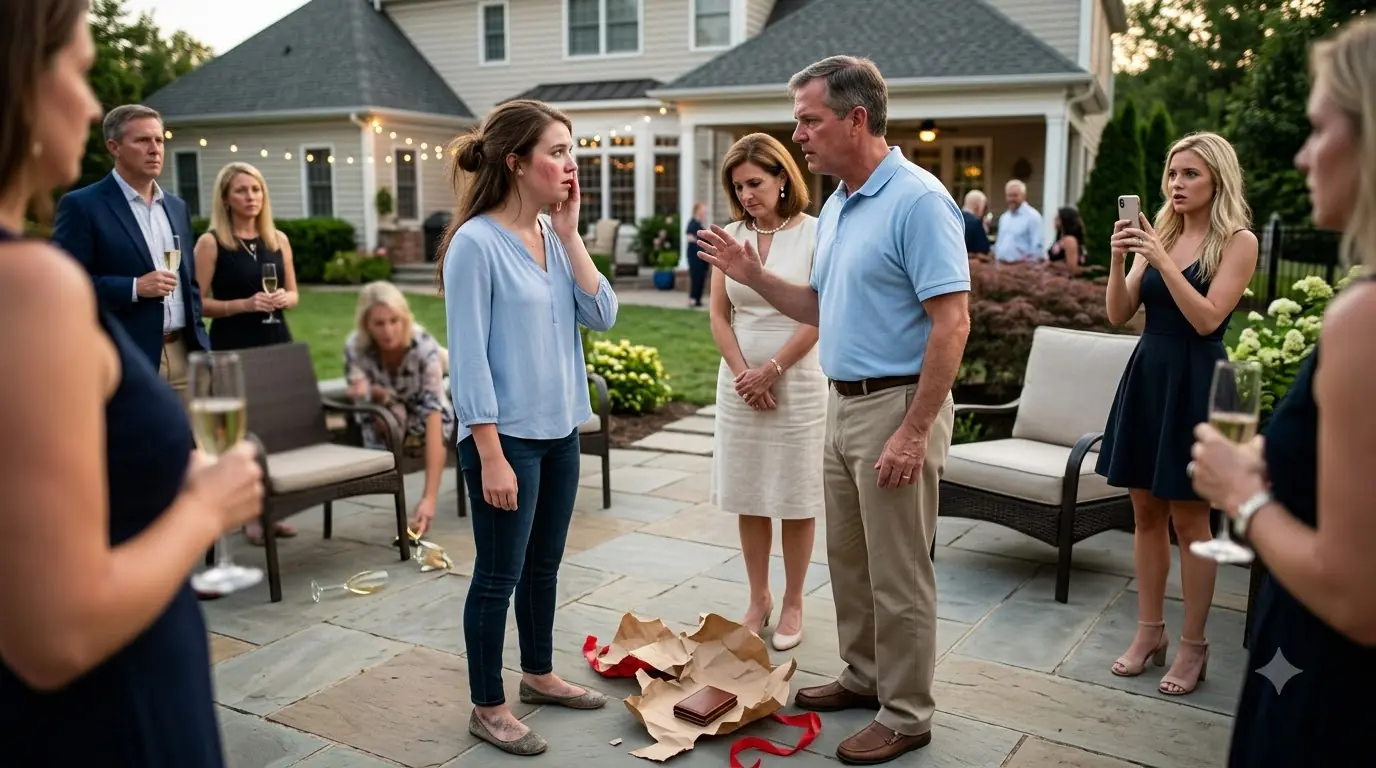
I ran out the front door with nothing but a backpack and a bruise on my cheek. I didn't know it then, but that slap was the last thing Gerald Talbot would ever do to me because by midnight, I'd be sitting in a black SUV across from a stranger who'd say five words that would unravel 18 years of lies.
My name is Hillary. Though for most of my life, I was forced to answer to Allison. I'm 21. Now, let me take you back to that Saturday morning, the day Gerald Talbot turned 55 and the last day I spent under his roof. I set my alarm for 5:00 a.m. that morning, same as every Saturday.
Except this Saturday came with a two-page handwritten list Donna had left on the kitchen counter the night before. Sweep the patio. Arrange the folding chairs, 32 of them, one for each guest on Gerald's list. Press the tablecloth. Slice the lemons. Wash the Pottery Barn serving platters by hand because the dishwasher leaves spots.
Their house sat on a quiet cul-de-sac in Henrico County, Virginia, a four-bedroom colonial with a manicured lawn Gerald hired someone to mow, but told the neighbors I did. Inside the dining table was solid oak, seats 12, polished weekly by me. On the counter, two cases of Napa Valley Cabernet and a three-tier cake from a bakery that charged more for fondant than I earned in a week. My room was downstairs, not the finished basement, the storage closet next to the water heater.
No window. A twin mattress Gerald had pulled from a curbside pile when I was nine. A wool blanket that smelled like damp cardboard no matter how many times I washed it.
Megan's room was upstairs. Queen bed, flat screen, a vanity mirror ringed with those Hollywood bulbs. She was 23 and still lived at home. Still had her credit card linked to Gerald's account.
Still hadn't learned how to boil an egg because that was what I was for. I'd spent three months saving for Gerald's gift, a leather wallet, real leather, from a department store downtown. $84, which doesn't sound like much unless you're earning $11 an hour scrubbing sheet pans at a restaurant called Rosie's Off Route One. I wrapped it in craft paper because I couldn't afford a gift bag. I didn't know, standing there in that kitchen at 5:00 in the morning with flour on my hands, that the wallet would be the last thing I ever gave that man.
Gerald came downstairs at 10:00. Polo shirt, Ralph Lauren, the one with the big pony logo, powder blue, khakis creased like knife edges, cologne so thick it reached me before he did. He walked the patio like a general inspecting his troops, moved one balloon cluster six inches to the left, stared at the lemon slices I'd arranged on the water pitcher, and said without looking at me, "They're uneven. Do them again." Donna appeared at noon, hair blown out, pearl studs, a linen dress from Ann Taylor she'd ordered online and made me steam.
She inspected the kitchen, ran a finger along the countertop, and whispered something to Gerald I wasn't supposed to hear, but did. She only got you something cheap. Just brace yourself.
Megan showed up last because of course she did. New dress, new highlights, new heels clicking across the floor I'd waxed at 6 a.m. She handed Gerald an Apple Watch, the Series 9, stainless steel, the one that retails for $700. She charged it to the supplementary credit card Gerald gave her for emergencies. Gerald opened it, beamed, and kissed her forehead. "This is my girl," he told the first guests walking through the door.
He had his arm around Megan. She always knows what her old man likes. He didn't look at me. He never did when other people were watching.
I was the girl who carried trays, refilled glasses, wiped condensation rings off the coffee table before they could set. When one of the guests, a woman from Gerald's office, asked Donna, "Shouldn't Allison sit down and eat with us?" Donna smiled the way she always smiled, warm as a closed door, and said, "Oh, she likes to help. It's her way of showing gratitude. You know how it is with adopted ones." I kept carrying trays.
It happened during the gift opening. Gerald sat at the head of the table like it was a throne. 30 guests arranged around him. Neighbors, church friends, a few co-workers from the insurance agency he managed.
Champagne flutes catching the patio string lights. Megan perched on the armrest of his chair filming on her iPhone. Donna stood behind him, one hand on his shoulder, radiating the image of a woman who had everything figured out.
I came forward with the craft paper package. I'd written on the front in my neatest handwriting, "Happy birthday, Allison." Gerald took it, weighed it in his hand. I remember thinking he might actually smile. He smiled sometimes when no one could accuse him of going soft, but then he tore the paper, pulled out the wallet, flipped it open, flipped it closed, and held it up like evidence at trial.
"What kind of worthless junk did you give me?" His voice cut through the chatter. Conversation stopped. Forks paused midair. Someone set down a glass too carefully.
I started to explain. I saved up for three months. 3 months and this is all you got? He stood. The chair scraped the flagstone.
Even the dog gets better treats. And then he hit me. Open palm right across the left side of my face. The sound was sharp and flat.
The kind that doesn't echo because it doesn't need to. My head snapped sideways. A champagne flute fell off the table and shattered on the patio floor. And for a second, that was the only sound in the world.
No one moved. Donna looked down at her plate. A man from Gerald's office studied his napkin. Megan bit her lip and kept filming.
One person stood. Ruth Kesler, the next-door neighbor, 70 years old and 5 feet tall. Gerald, that was uncalled for. stay out of my family business. Ruth sat back down, but she didn't look away from me, and I have never forgotten that.
I stood there with the taste of copper on my tongue and a wallet on the ground between us, and I thought, "That slap will be the best evidence the lawyers need." I didn't understand that thought yet. I wouldn't understand it for hours, but something inside me had already started counting.
I didn't go back to the party. I went to the storage closet, pulled the Jansport backpack off the nail on the wall, faded navy, fraying at the zipper, the only thing that had followed me from high school, and packed what I could. Two shirts, one pair of jeans without holes, a toothbrush, a phone charger, the envelope I'd found in the bottom of a box Gerald threw out last spring, the one with a state logo I didn't understand yet, and from inside a shoe box under my mattress, $340 in cash, mostly ones and fives, tip money from Rosie's that I'd hidden because Gerald checked my bank account, $340, a backpack, a bruise already blooming purple on my cheekbone. That was everything I owned in this world.
I walked through the living room on my way out. The party had resumed. Gerald was laughing at something someone said. Champagne in hand, the wallet nowhere in sight.
Megan was showing guests something on her phone, probably the video. Donna stood at the window and watched me cross the front yard. She reached for the curtain and pulled it shut. Nobody called my name.
Outside, the October air hit my face, and the sting on my cheek flared like a second slap. Henrico County at 9:00 p.m. is dark. Not city dark, where there is always a bodega lit up on the next corner, but suburb dark, where the street lights are spaced far apart and the silence between houses feels deliberate. I walked along Patterson Avenue, no destination, just away. Behind me, the music from the party got softer and softer until it was just bass notes and then nothing at all.
I'd made it maybe two miles when headlights slowed behind me. A black Cadillac Escalade, clean tinted windows, Virginia plates. It rolled to a stop 10 feet ahead. The rear door opened and I should have run.
Every instinct said run. But I was already so tired of running from things. I thought maybe just this once I'd see what was running toward me.
A man stepped out first. Mid-50s, tall, lean, wearing a charcoal peacoat I'd later learn was Brooks Brothers. Not flashy, just the kind of coat that fits like someone measured you for it. His hair was dark brown threaded with silver. and his eyes, hazel green, wide-set, catching the street light, were the exact same eyes I saw in my bathroom mirror every morning.
Behind him, a woman, shorter, red-haired, sharp featured, carrying a leather portfolio like she'd just left a courtroom. She kept her distance, professional, watchful. The man's hands were trembling. I could see that even in the dark.
I'm sorry to frighten you, he said. His voice cracked on the second word. My name is Richard Whitford and I believe I am your biological father. I took a step back. My shoulders hit a mailbox post.
That's not possible. My biological parents didn't want me. That's what I was told. You were told wrong.
He reached into the inside pocket of his coat and pulled out a photograph. Small, creased at the corners, clearly handled a thousand times. A woman holding a toddler. The woman had auburn hair and cheekbones like mine and a smile that leaned slightly to the left. The toddler had hazel green eyes.
"Her name was Catherine," he said. "She was your mother. She died in a car accident when you were two, and I have spent every single day since then trying to find you." I looked at the photograph, then at him, then at the photograph again because the woman in it had the same mouth I did. The same tilt of the head, and looking at her felt like finding a word you've been searching for your whole life.
The red-haired woman spoke, "My name is Margaret Hale. I'm Mr. Whitford's attorney, specializing in family law. We're not here to take you anywhere you don't want to go. We've been monitoring your situation through legal channels for several months. Tonight, when our investigators saw you leave the house, we made the decision to approach."
"You were watching the house?" Margaret nodded.
The birthday party, many guests. It was the safest opportunity to confirm your identity visually. She paused. We also saw you run.
I touched my cheek without thinking. The bruise pulsed under my fingertips. Richard Whitford looked at the mark on my face and something behind his eyes broke very quietly. We sat in the back of the Escalade.
Richard on one side, me on the other, Margaret in the front passenger seat with her portfolio open. The engine was running, the heat on low. It was the warmest I'd been all night.
Richard told me the story like a man who'd rehearsed it for 18 years and still wasn't ready. Catherine died on I-64 eastbound on a Tuesday morning in March. A delivery truck crossed the median. She was killed instantly. Richard was in the passenger seat.
Shattered pelvis, collapsed lung. Four months in the hospital. Hillary, me, was at home with a neighbor.
"While I was in the ICU," he said, "Child Protective Services placed you in emergency foster care. Standard procedure when there's no available parent." I understood that. What I didn't understand was why.