My fiancée left me for the “better man” her family had chosen.
She threw the engagement ring at my chest and told me to keep my cheap jewelry because I was pathetic.
Two years later, she saw me running a successful company and building a life with the woman I truly loved. 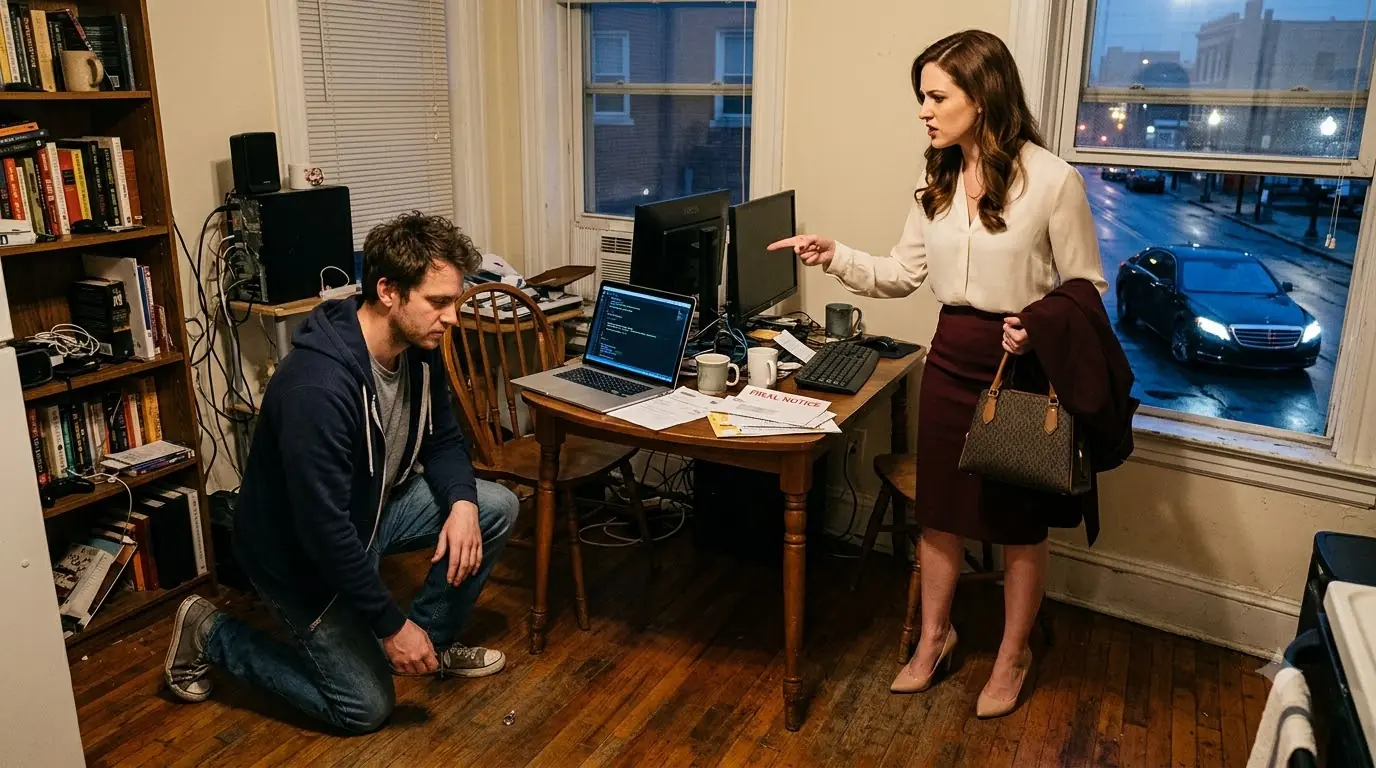
By then, the career of the man she had chosen over me was collapsing under the same technology I had created.
My name is Ethan Cole. I was twenty-nine when my fiancée, Brooke, ended our four-year relationship, called my dreams delusional, and went out with her new boyfriend on the same night.
Two years later, those dreams had become real. I was thriving, and the man Brooke had chosen was watching his professional world fall apart.
Brooke and I met in the most ridiculous way possible. I was sitting inside the university library at two in the morning, exhausted after coding for twelve straight hours, when a woman with perfectly styled hair tripped beside my table and spilled an entire latte across my laptop.
Most people would have become furious. I stared at the coffee running between the keys and said, “At least my code has some flavor now.”
Brooke laughed instead of running away. That laugh became coffee, then dinner, then four years together.
We had been engaged for eight months. I saved for six months to purchase the ring, and when I proposed, Brooke said yes with tears in her eyes.
She posted pictures online with captions about forever. At the time, I believed every word.
Brooke spent most nights inside my third-floor walk-up apartment. It was approximately six hundred square feet, and the building had what real estate agents politely called character, which meant everything was broken and the landlord never repaired anything.
We decorated the apartment with inexpensive string lights and posters I had collected through college. The elevator worked only when it felt charitable, the bathroom barely had enough room to turn around, and the pipes produced a different noise every night.
Still, it felt like home.
Then there was Python, my rescued tabby cat. Of course, I had named him Python.
He had an irritating habit of knocking objects from every available surface. Every night, without exception, he curled up between Brooke and me on the bed.
Brooke always claimed she preferred dogs, but I frequently caught her holding complete conversations with Python whenever she thought I was not listening.
Brooke’s parents never directly said they hated me. Their method was more refined.
They used the death-by-a-thousand-cuts approach.
Her mother gave me dismissive looks whenever I discussed my work. Her father asked about my “little computer project” in the same tone someone might use when asking a child about an imaginary friend.
Family dinners became a form of performance art in which I was both the audience and the joke.
Back then, Brooke appeared different from them. She rolled her eyes at their country-club drama and made jokes about how stiff and materialistic they were.
We would eat Chinese takeout on my futon and watch movies on a laptop that needed five minutes to load anything. Brooke would rest her head against my shoulder and tell me the money did not matter.
She said she wanted a life with me, not a wealthy last name or an impressive address.
Eventually, I learned that most of it had been an act.
The first serious crack appeared approximately six months before our relationship ended. Brooke’s college roommate was getting married, and because Brooke and I were engaged, I imagined the event would feel like a preview of our own future wedding.
I saved for months to rent a presentable tuxedo and purchase a respectable gift. I wanted Brooke to feel proud walking into the reception beside me.
The moment we arrived, I knew I had entered a world that did not belong to me.
The reception had elaborate ice sculptures, a live orchestra, and champagne that probably cost more per bottle than my monthly grocery budget. Everyone looked as though they had stepped from a luxury magazine.
Brooke fit into the environment effortlessly.
She moved from group to group, speaking with former classmates about investment-banking positions, consulting firms, expensive apartments, and international vacations. I stood near the edge of the room with a single drink, trying to converse with people who asked what I did and lost interest the moment I mentioned startups.
Brooke had specifically asked not to sit beside her college friends because, in her words, they could be overwhelming. Somehow, we ended up at a table with several of her parents’ wealthy friends instead.
They spent most of dinner discussing stock portfolios, investment properties, and retirement homes.
When someone asked about my work, I attempted to explain the company in terms they might understand. That was a mistake.
One man laughed openly.
“You are still playing with computers?” he asked. “When are you going to get a real job?”
He glanced toward Brooke.
“You are getting married now. It is time to grow up.”
I could have handled his insult. What hurt was Brooke’s reaction.
She did not defend me. She looked embarrassed and quickly changed the subject to the bride’s dress.
During the drive home, I told Brooke that the conversation had bothered me.
“You are being too sensitive,” she said. “You should have played along instead of making everything awkward.”
That sentence stayed with me.
The second incident happened several weeks later when Brooke’s mother invited me to meet her for coffee without Brooke.
We went to an upscale café in her neighborhood, the type of place where a basic latte cost eight dollars and everyone appeared to be conducting a confidential business meeting.
She arrived fifteen minutes late in designer clothing and offered no apology. After sitting down, she immediately began discussing what she called my situation.
“I have been thinking about your future,” she said. “I have several connections who may be able to help you find something stable.”
She placed a folder on the table.
Inside were printed listings for entry-level positions at banks, insurance companies, and large corporate offices. They were safe jobs with predictable hours, retirement plans, and no connection to anything I cared about.
“These are real careers,” she explained. “They provide benefits and growth opportunities.”
She slid the papers toward me.
“You could begin at the bottom and work your way upward, the way Brody did.”
I stared at the listings.
“You want me to abandon my company and become a claims adjuster?”
She looked at me as if I were a child refusing vegetables.
“I want you to be realistic about your future and Brooke’s future.”
Her voice remained perfectly controlled.
“She deserves security, not fairy tales.”
The conversation deteriorated from there.
She repeatedly used phrases such as when you are ready to grow up and Brooke needs a provider, not a dreamer. She never raised her voice, but every sentence was designed to make me feel small.
What bothered me most was Brooke’s reaction afterward.
When I told her that her mother had ambushed me with job applications, Brooke did not appear surprised or angry.
That was when I realized her family’s opinion was no longer remaining outside our relationship.
The poison had already entered.
The beginning of the end arrived through what Brooke described as a casual family dinner. She asked me to wear a blazer.
When I reached her parents’ estate, and the property was large enough to deserve that word, I realized it was not the intimate gathering she had promised.
The driveway resembled a luxury automobile dealership. There were BMWs, Mercedes, and several Audis.
My 2008 Honda Civic had a dented bumper and a check-engine light that had been glowing for so long that it felt like a permanent dashboard decoration. Parked among those vehicles, it appeared to have taken a wrong turn into another economic class.
The dinner included more than relatives.
Brooke’s father had invited several business associates and their sons. They were polished young men with elite educations, prestigious internships, influential families, and five-year plans they recited as confidently as weather forecasts.
They spoke about investment strategies, European vacations, and real estate portfolios. My most exciting recent financial achievement had been buying name-brand cereal instead of the store brand.
Then the questions began.
Brooke’s father looked across the table.
“You are still working on that little technology project?”
“It is a startup,” I corrected. “We are in early development, but we are making progress.”
I did not mention that our last investor meeting had been disastrous. My co-founder, Jake, and I had been working eighty-hour weeks trying to repair a prototype that crashed whenever someone uploaded a file larger than fifty megabytes.
Technically, we were progressing.
Financially, we were nearly finished.
One of Brooke’s father’s friends had perfect teeth and a winter tan that announced he spent February somewhere warm.
“Technology is extremely volatile,” he said with a small laugh. “Are you certain that is a wise use of your time?”
He took a drink.
“A backup plan would not hurt.”
The condescension was almost physical.
Again, Brooke said nothing.
She normally would have offered some small defense, perhaps mentioning my dedication or her belief in the company. That evening, she remained silent.
Then Brooke’s mother introduced Brody.
She presented him as if he were the solution to a problem nobody else had been able to solve.
“Brody was recently promoted to junior partner at a leading corporate law firm,” she announced. “Princeton for his undergraduate degree and Yale Law School.”
Brody was everything I was not.
He was tall, perfectly groomed, and dressed in a suit that had clearly been tailored for him. He spoke about his latest bonus as though it were ordinary conversation.
He mentioned the downtown condominium he had purchased and his five-year plan to become a full partner.
Brooke listened to every word.
She asked questions about his cases, laughed at jokes that were not particularly funny, and showed more interest in his career during that one dinner than she had shown in mine during the previous year.
Every question felt like a small betrayal.
I spoke perhaps ten times during the entire evening.
Whenever I tried to join the conversation, someone listened politely for a few seconds before returning attention to Brody’s accomplishments or another person’s investment success.
I watched Brooke become someone I did not recognize.
The woman who once mocked pretentious people was suddenly desperate to become one of them.
When we returned to my apartment, something had changed.
Brooke complained about the broken elevator that had been unreliable for months. She frowned when Python jumped onto the bed, even though he had done the same thing throughout our relationship.
She mentioned how small the bathroom was, as though seeing it for the first time.
That was when I knew our relationship was over.
I simply did not expect her to make it official so quickly.
One week later, Brooke came to my apartment after work. She still wore the business-casual clothing from her marketing position at a company owned by one of her father’s friends.
She had received the job without a formal interview, but that was another lesson about what the correct family name could accomplish.
Brooke sat across from me at the small IKEA dining table where we had shared countless takeout dinners, game nights, and late conversations about our future.
That evening would not be another ordinary conversation.
“We need to talk,” she said.
I could tell she had rehearsed everything.
“I have been thinking about us, about my future, and about what I need.”
She avoided my eyes.
I knew where the conversation was going, but I allowed her to continue.
“I love you, but I need stability.”
Her hands remained folded in front of her.
“I cannot continue waiting for you to figure everything out.”
“My family helped me understand that I need someone who is already established. Someone who can provide the life I deserve.”
“Someone like Brody,” I said.
Brooke did not even pretend to be surprised that I had understood.
“Yes,” she replied. “Someone like Brody.”
Then the final part of her polite mask disappeared.
“Look, I tried to make this work.”
She gestured around my apartment as if the worn furniture proved a character defect.
“I genuinely tried, but I cannot pretend this is the life I want.”
“Living inside a neglected building, constantly worrying about money, and dating someone who cannot afford to take me anywhere respectable.”
This was the same person who once said she loved our quiet evenings at home.
“You are twenty-nine years old,” Brooke continued, her voice growing sharper. “You are still playing with computers inside your bedroom like you are nineteen.”
“Brody owns a condominium downtown. He takes me to restaurants where people recognize him.”
She looked at my hand.
“He would not need to save for months to purchase a decent ring.”
The comment struck harder than anything else she had said.
I had worked extra shifts for six months to afford Brooke’s engagement ring. It was not enormous, but it was genuine, and I had been proud of what it represented.
“I did not know that was how you viewed it,” I said.
I looked at her carefully.
“Four years together, and you are finally saying this now?”
“Why did you waste so much time?”
Brooke’s expression hardened.
“I gave you four years to get your life together.”
She leaned forward.
“I gave you four years to become someone worth staying with.”
“You are still the same broke dreamer I met in college, except now you are older.”
Her eyes moved around the apartment again.
“It is pathetic.”
We argued.
Years of unspoken resentment emerged from both of us.
Then Brooke did something I would never forget.
She pulled the engagement ring from her finger and threw it toward me.
The ring struck my chest and fell onto the floor.
“Take your cheap ring back,” she said.
Her voice was filled with disgust.
“Brody has already mentioned buying me a real one from Tiffany.”
I stared at the ring.
It was the same ring Brooke had accepted with happy tears only months earlier. It had represented every future I believed we were building.
Now it sat beside the leg of an inexpensive dining table.
“You know what is pathetic?” I asked as I stood.
“Pretending to love someone for four years while secretly keeping score.”
Brooke’s face reddened.
“Pretending to be someone you are not because you are too frightened to admit how shallow you really are.”
“At least I am not wasting my life chasing an impossible dream,” she said.
“You are right.”
I bent down and picked up the ring.
“You are not wasting your life.”
I opened my hand and looked at it.
“You are wasting mine.”
Brooke grabbed her purse.
Now that she had delivered the speech, she seemed eager to leave.
“Brody is picking me up at eight.”
It was the final twist.
She wanted me to understand that she was going directly from ending our engagement to a date with the man she considered my replacement.
“Good for you,” I said.
I opened the apartment door.
“I hope you are both extremely happy.”
Two days later, Brooke and Brody made their relationship public online.
Not a week after our engagement ended, they appeared in matching outfits at a luxury resort in the Hamptons. His arm was wrapped around her waist, and Brooke smiled with the confidence of someone who believed she had upgraded her entire life.
Her caption said, “Found my forever.”
Meanwhile, I continued sleeping on the side of the bed we had once shared.
I kept finding Brooke’s hair ties inside drawers and beneath furniture. Half her belongings remained in the apartment because she had not yet found time to collect them.
The engagement ring sat on my dresser and reminded me every morning that I had believed promises meant something.
I wish I could say heartbreak immediately transformed me into a successful entrepreneur.
Real life was less satisfying.
I collapsed.
My startup failed exactly one month after the breakup.
Our investors withdrew after the prototype failed during what was supposed to be our major demonstration. The application crashed three times during the first five minutes.
When it finally operated, it moved so slowly that everyone inside the conference room began checking their phones.
Jake accepted a position at Microsoft two weeks later.
I did not blame him. He had student debt, living expenses, and a girlfriend who supported his career.
I was left alone with a failed company, an apartment I could no longer afford, and savings disappearing faster than free food at a university event.
Eventually, I gave up the apartment.
My friend Kai saved me.
Kai and I had known each other since our first year of college. He never understood what I saw in Brooke, but he supported me because he understood what friendship required.
His apartment was smaller than mine. It had one bedroom, and the living room also functioned as his office.
Still, Kai cleared half his closet before I even asked.
He allowed Python and me to move into the small spare room.
I arrived at his door carrying most of my life inside garbage bags.
Kai stared at me for a moment.
“I always knew she was demanding,” he said. “But she really called your ring cheap?”
He shook his head.
“That ring cost more than my car.”
After a pause, he glanced through the window toward the parking lot.
“My car is terrible, but the point still stands.”
That was friendship.
While I slept inside Kai’s spare room, Brooke’s new life continued unfolding online like a perfectly edited highlight reel.
There were vacations to places I had only seen in films. They ate at restaurants where prices did not appear on the menu.
Every photograph felt personal.
The message seemed clear.
This is what I deserve. This is what you could never give me.
My lowest moment came when I encountered Brooke and Brody at a downtown café.
I was collecting an order for a food-delivery application because that was how I was paying my bills.
The air conditioning inside my car had been broken for three months, and I could not afford the repair. I drove through ninety-degree heat with the windows open, sweating through whatever clean shirt I had left.
My phone battery was at fifteen percent after a ten-hour shift. I still needed to complete four more deliveries to reach the day’s income target.
Brooke and Brody sat at an outdoor table.
They looked like a couple from a lifestyle advertisement.
Brooke had a new haircut, one of those expensive styles designed to look effortless. Brody wore sunglasses that probably cost more than every item of clothing on my body.
They held hands and laughed together.
Brody noticed me first.
“Well, well,” he said loudly enough for the nearby tables to hear. “Still delivering food?”
His smile contained deliberate cruelty.
This was not a polite acknowledgment.
He was enjoying the difference between his position and mine.
Brooke looked toward me.
I stood in a wrinkled delivery shirt holding a bag of food that cost more than I had spent on groceries that week.
For a second, something moved across her face.
It might have been guilt.
Then she smiled.
It was a condescending smile.
I collected the order and walked away without responding.
Behind me, Brody spoke loudly enough to ensure I heard him.
“You avoided a serious mistake, did you not?”
Brooke laughed.
That moment broke something inside me.
I stood beneath the summer sun, exhausted and sweating, while my former fiancée and her wealthy boyfriend laughed at the failure of my life.
It was the last day I allowed myself to remain their joke.
That evening, I returned to Kai’s apartment and deleted every social-media application from my phone.
I told him what had happened.
Kai listened silently.
When I finished, he leaned back.
“Brody sounds like the type of person who believes mayonnaise is dangerously spicy.”
I laughed despite myself.
Kai pointed toward my laptop.
“It is time to show those privileged people what the real world looks like.”
I removed distractions, self-pity, and anyone who made my life smaller.
Then I began rebuilding as if survival depended on it.
Sleep became a luxury.
I managed approximately four hours most nights.
During the day, I delivered food. In the evenings, I stocked shelves at a grocery store.
Every remaining hour belonged to rebuilding a company from nothing.
This time, I approached it differently.
I stopped chasing investors with incomplete ideas and impressive presentations. I learned to build a useful product before asking anyone for money.
I stopped trusting people simply because they spoke confidently.
My circle remained small.
Kai and several other friends had already proved they would stay when life became ugly.
Kai was extraordinary during those months.
He brought coffee during late-night coding sessions and made certain I ate something other than protein bars. He never complained when I transformed his living room into a maze of computers, cables, notes, and empty cups.
He used professional connections from his job to introduce me to my first enterprise clients.
He asked for nothing in return.
He wanted to see me succeed.
For two years, I disappeared completely from Brooke’s world.
I had no idea what she was doing, whether she remained with Brody, or whether she was happy.
Eventually, I stopped caring.
While Brooke built a public life with him, I worked harder than I had ever worked before.
The new company emerged from the failure of the first.
Instead of attempting to build a revolutionary consumer application that would change everyone’s life, I focused on business software.
Specifically, I developed an artificial-intelligence platform for analyzing contracts for law firms.
Kai immediately understood the irony.
“You are building software that replaces part of what lawyers do.”
He smiled.
“You are improving the world and irritating Brody at the same time.”
Kai raised his coffee.
“That is impressive strategic revenge.”
The work was not glamorous.
Nobody posted photographs online of contract clauses, compliance reviews, or document-processing systems.
However, the software solved a real problem.
During my first startup, I had struggled through complicated legal documents without enough money to hire experienced counsel. Smaller law firms faced the opposite problem.
They were overwhelmed by paperwork.
Associates spent hours reviewing standard documents, searching for risky language, comparing clauses, and identifying obligations that software could recognize much faster.
Our program could examine contracts, flag unusual language, locate important provisions, and identify possible risks in seconds rather than hours.
More importantly, clients were willing to pay for it.
Growth began slowly.
An industry publication mentioned the product.
A satisfied client wrote a detailed testimonial, which led to several introductions.
Within legal circles, people began discussing a new platform capable of performing much of the basic document-review work traditionally assigned to junior associates.
Suddenly, I was no longer begging for meetings.
Firms were calling me.
The team grew.
The people who joined believed in the product and worked as hard as I did. They became family.
Jake contacted me during that stage.
He said Microsoft was stable, but he missed the energy of building something new. He wanted to return.
I told him the company no longer needed him.
It was not revenge.
The team I had was loyal, capable, and complete.
Within months, the company began expanding rapidly.
We secured a contract with one of the five largest law firms in the country. That agreement led to more contracts, more media coverage, and more investors asking for meetings.
The company that began in Kai’s living room opened offices in London and Singapore.
We were disrupting an industry that had operated the same way for decades.
The most satisfying irony was that our largest disruption occurred in corporate and financial-services law.
That was Brody’s field.
Our software automated much of the work junior associates performed while building their careers.
When I explained the connection to Kai, he nearly choked on his coffee.
“Wait.”
He placed the cup down.
“Your company is making privileged corporate lawyers obsolete, and Brody has no idea you are responsible?”
Kai began laughing.
“That is remarkable.”
The first time I saw Brooke again was at an industry conference.
I was not attending as a guest.
I was one of the featured speakers.
One year earlier, I could not have afforded the ticket. Now I stood on the main stage discussing how artificial intelligence was reshaping legal services before an audience of executives, investors, and senior partners.
After the presentation, people surrounded me to exchange business cards and request meetings.
Across the room, I noticed Brooke’s parents.
Her mother’s glass stopped halfway to her mouth.
Her father, who had once mocked my little computer project at his dinner table, gave me a slow and respectful nod.
Then I saw Brooke.
She stood near the side of the room, staring at me as if she had seen someone return from the dead.
Brooke still looked attractive, but the effortless confidence from her online photographs had disappeared.
She appeared smaller.
We did not approach each other.
We did not speak.
Still, I saw the precise moment when she understood that the pathetic dreamer she had abandoned was now more successful than nearly everyone inside her family’s social circle.
I told Kai about the encounter.
His response arrived immediately.
“Did she look like she finally realized how badly she miscalculated?”
Then he sent another message.
“Please tell me she looked exactly like that.”
After the conference, everything accelerated.
News traveled quickly through wealthy professional circles, especially when someone rose from failure to major success in two years.
I began receiving invitations to events I had never known existed.
Eventually, Brooke’s father personally invited me to one.
I accepted, not because I wanted his approval, but because I understood why he had reached out.
The family wanted to be connected to my success.
I arrived late enough to make an entrance.
Across the room, I immediately saw Brooke and Brody.
Brody looked different.
His shoulders remained tense, and he checked his phone constantly. His face carried the haunted expression of someone who knew his world was deteriorating but could not identify how to stop it.
His law firm was losing clients to technology companies like mine.
Traditional firms struggled to compete with platforms offering faster and less expensive analysis. Many senior partners attempted to adapt, but their institutions moved slowly.
Business shifted toward younger companies capable of delivering results in a fraction of the time.
Brody may not yet have understood that my company was connected to his professional problems, but he clearly felt the pressure.
Brooke knew who I was.
When our eyes met, I saw the same regret from the conference.
This time, it was stronger.
One week later, she contacted me.
I had deleted her number years earlier, but the message still appeared.
“Hello. It has been a long time. I was wondering whether we could meet and talk.”
I ignored it.
Then Brooke made a more desperate decision.
She came to my office.
Most of the team had already left for the evening, and I was finishing emails when the security desk called.
“There is a woman downstairs asking to see you,” the guard said. “She says the matter is important.”
I did not need a description.
For a moment, I considered asking security to turn her away.
Then I realized this was the conversation I had unconsciously anticipated since the day she walked out of my apartment.
I allowed her upstairs.
Brooke entered the corner office carefully.
She looked around at the modern furniture, awards, conference photographs, and city view.
The room was impossibly different from the cramped apartment we once shared.
Her old confidence had disappeared.
Brooke appeared genuinely nervous.
“Hello,” she said softly.
She offered a sad smile.
“It has been a while.”
I leaned back with my arms crossed.
I did not speak.
Brooke shifted beneath my gaze.
She inhaled slowly.
“I was wrong about everything.”
Her eyes moved toward the windows.
“I listened to my family and threw away something real.”
She looked at me again.
“I miss you.”
“I miss us.”
“Us?” I asked.
Hope appeared inside her expression.
“I know I hurt you, but perhaps we could begin again.”
She stepped closer.
“We could try another time.”
I stared at her for several seconds.
Then I laughed.
It was not angry laughter.
I found the suggestion genuinely absurd.
“Begin again?”
I shook my head.
“We ended the day you chose them over me.”
Brooke flinched.
I continued.
“You did not want me when I was struggling.”
“You did not believe in me when I had nothing.”
I stood.
“You called me pathetic and left me for someone with a better bank account.”
I gestured toward the office.
“Now that I succeeded, you want to return.”
Her face fell.
I buttoned my suit jacket.
“Brooke, I do not think about you.”
“I do not miss you.”
“And I do not need you.”
At that moment, the office door opened.
My girlfriend, Chloe, entered.
Chloe was a brilliant product designer I had met at a technology conference. She believed in the company while we were still working from Kai’s apartment.
She was intelligent, accomplished, warm, and unafraid of struggle. Chloe had supported the person I was before the awards, offices, and international contracts.
Brooke’s face turned white.
I smiled at Chloe, then looked back toward Brooke.
“You told me I needed someone in my league.”
I placed one hand gently against Chloe’s back.
“You were right.”
“It simply was not you.”
I walked Brooke to the elevator.
When the doors closed between us, I expected to feel triumphant.
Instead, it felt like closing a book I had finished reading years earlier.
That was not the end.
It was only the first move of the final stage.
Several weeks later, rumors spread through legal circles that Brody’s firm was in serious trouble.
Our artificial-intelligence platform was systematically replacing traditional document-review services.
We were faster, less expensive, and more consistent. The software completed in minutes work for which firms charged hundreds of dollars per hour.
Brody’s company was losing money while attempting to compete with technology its leadership did not understand.
Instead of adapting, many senior partners panicked. They made desperate decisions and lost additional clients.
Industry contacts told me that Brody was unraveling privately.
He worked more than ninety hours each week, shouted at junior associates, and desperately attempted to prevent important clients from leaving.
Kai summarized the situation perfectly.
“The man who mocked you for playing with computers is now being defeated by computers.”
Investors began withdrawing support from Brody’s firm.
The organization looked outdated inside a market it no longer controlled.
Brody still had not fully understood that my company was behind much of the disruption, but the truth was approaching him.
While Brody’s career deteriorated, Brooke’s parents entered full damage-control mode.
For years, they had treated me like an embarrassing failure who was not worthy of their daughter.
Now Brooke’s mother sent polite emails congratulating me.
Her father mentioned my name during interviews and described me as one of the decade’s most promising entrepreneurs.
They invited me to business gatherings and presented the invitations as networking opportunities.
I ignored everything.
Eventually, Brooke’s father called directly.
I answered from curiosity.
“I think we should speak, son,” he said warmly.
He began discussing business opportunities, partnerships, collaboration, and putting old disagreements behind us.
I allowed him to speak for several minutes.
Then he reached the real subject.
“Brooke made a mistake,” he said. “We all understand that.”
His voice softened.
“She has experienced a difficult period lately.”
“If the two of you could sit down together…”
I ended the call before he finished.
There was no apology and no acknowledgment of how the family had treated me.
It was pure damage control.
I never answered another call from them.
The moment Brody finally understood who was behind his professional decline happened at another industry conference.
I sat on a panel discussing the future of artificial intelligence in law.
The chief executive of a major firm praised our company publicly.
“These people are changing the industry,” he said. “Some of the largest traditional firms are struggling because they cannot match the efficiency.”
The event camera moved across the audience.
Brody sat several rows back.
His face lost all color.
Shock became recognition and then horror.
I watched the exact moment everything connected inside his mind.
I was no longer simply his girlfriend’s unsuccessful former fiancé.
I was the founder of the company replacing services on which his career depended.
That evening, Brody lost control.
A mutual contact messaged me afterward.
“Brody had a complete breakdown during a partner meeting.”
During a firm-wide strategy session, one senior partner reportedly used my company as the example of what they needed to compete against.
Brody began shouting that I was a fortunate fraud.
He insisted the company would collapse and traditional law would ultimately prevail.
The partners stared at him as though he had lost his judgment.
They understood something Brody could not accept.
He was not the future of the firm.
I was part of the future, and he represented the past.
Several months later, my company prepared its largest acquisition.
We purchased a smaller but influential legal-services firm that competed directly with Brody’s organization.
The transaction was business, but the consequences were personal.
After completing the acquisition, we secured several of Brody’s largest clients.
Within six months, his firm was forced to merge with a larger competitor to survive.
Brody lost his junior-partner status and became another employee inside the merged company.
The golden man who had been handed every advantage was now struggling to remain relevant inside an industry moving beyond him.
Brooke made one final attempt to return.
Three weeks after Brody’s firm announced the merger, she came to my office again.
This visit was different.
She was no longer nervous and hopeful.
She was desperate.
It was approximately seven on a Friday evening. Most of the team had gone out together, but I remained inside my office reviewing contracts.
The security guard called.
“Sir, there is a woman downstairs.”
He sounded uncertain.
“She is extremely upset and says she must see you immediately.”
“Send her up,” I replied.
I already knew.
When the elevator opened, I barely recognized Brooke.
Her hair was disorganized. Her makeup was smudged from crying.
She wore jeans and a wrinkled sweater, clothing more casual than anything I remembered seeing during our relationship.
“Thank goodness you are here,” she said.
She entered without waiting for an invitation.
“I have been calling and sending messages.”
“Why will you not answer me?”
I remained behind my desk.
“Because we have nothing to discuss.”
“Yes, we do.”
Her voice rose.
“I left him.”
“I left Brody. It is over.”
I raised one eyebrow but did not respond.
“His firm collapsed,” Brooke continued. “He lost everything he cared about.”
She began pacing.
“All he did was blame me.”
“He said everything happened because I left you.”
“He said I destroyed both our lives.”
Brooke stopped.
“I am finished with him.”
“Good for you,” I said.
She stared at me.
“You do not understand.”
Her voice filled with sudden hope.
“I am free now.”
“We can be together again.”
“We can begin over.”
I nearly laughed.
“Begin over?”
“I made a mistake,” Brooke said.
Her voice became higher and more urgent.
“The greatest mistake of my life.”
“I should never have left you.”
“You were right about my family, Brody, and all of it.”
She moved closer to the desk.
“But I am here now.”
“I am choosing you.”
Brooke’s eyes were wild with desperation.
“I know you still love me.”
“What we had was real.”
“Real love does not disappear.”
“You are right,” I said as I stood.
“Real love does not disappear.”
Relief flickered across her face.
Then I finished.
“What we had was not real love.”
Her expression collapsed.
“That is not true.”
“You left the moment you believed someone better had appeared.”
I stepped around the desk.
“That was not love.”
“That was convenience.”
“I was confused,” Brooke said. “My family pressured me.”
“I was young and foolish.”
“You were twenty-six,” I replied. “You were not a child.”
Brooke began sobbing.
It was not restrained crying.
“Please,” she said. “I am begging you.”
“I have nothing left.”
“My parents barely answer my calls.”
“You are all I have.”
“I am not your anything,” I said.
“I am also in a relationship.”
“You need to move forward.”
Brooke grabbed my arm.
Her fingers tightened desperately.
“I was wrong about the ring.”
“It was beautiful.”
“I was frightened and angry.”
I pulled away.
“Do not touch me.”
She continued.
“I will do anything.”
“I will work. I will change.”
“I will change everything about myself.”
Brooke stepped closer again.
“Please take me back.”
“I love you.”
“I have always loved you.”
“No, Brooke.”
I pointed toward the door.
“You need to leave.”
“No!”
She shouted loudly enough for her voice to echo through the empty office.
“You do not understand.”
“I made one mistake.”
“One mistake.”
“You cannot punish me forever.”
I reached for the telephone.
Brooke stared at my hand.
“What are you doing?”
“Calling security.”
She lunged toward the desk, attempting to take the phone.
“Do not.”
“You cannot throw me out.”
I moved the receiver beyond her reach and dialed.
“Security, I need someone to escort a visitor from my office.”
“You are heartless!” Brooke shouted.
“I loved you.”
“I gave you the best years of my life.”
Tony, the security guard, entered moments later.
“Ma’am,” he said calmly, “you need to come with me.”
“No, you do not understand,” Brooke protested.
Then she turned toward me.
“I am offering you everything.”
“My entire life.”
“How can you throw that away?”
I looked at her without answering.
Tony guided her toward the elevator.
Brooke continued shouting through her tears.
“Chloe is only with you because of the money.”
“When you are old and alone, and she takes everything, you will remember me.”
“You will remember that I was the one who truly loved you.”
The elevator doors closed.
Brooke disappeared.
I remained alone inside the silence of the office.
Then I sent a message to Kai.
“Brooke just had to be escorted out by security. She completely lost control.”
His response arrived immediately.
“Please tell me somebody recorded it.”
A second message followed.
“Entitled former fiancée has a breakdown inside technology company headquarters would receive millions of views.”
I laughed.
Even after the insanity, Kai knew how to place everything in perspective.
In the end, I did not need to destroy Brooke’s life.
She destroyed it herself by trading genuine loyalty for status and appearances.
When the status disappeared, she discovered that nothing meaningful remained beneath it.
The best revenge was never destroying Brooke or Brody.
It was building a life so complete that neither of them mattered.
Brody’s career had not collapsed because I secretly targeted him. His industry changed, and he refused to change with it.
Brooke lost me because she valued what a person possessed more than who that person was.
I had been the dreamer she considered pathetic.
She had been correct about one thing.
I did eventually find someone who belonged beside me.
It simply was not her.