The key would not turn.
Daniel stood on my front porch in his airport clothes, one hand on his suitcase and the other twisting the silver key again and again as if the lock itself had betrayed him. Melissa stood beside him with sunglasses on her head, shopping bags looped over one wrist, her smile slowly fading as my son tried the key harder. Across the street, I sat inside a rented moving truck with tinted windows, my purse in my lap, Frank’s wedding ring hanging on a chain beneath my sweater. I watched the house I had lived in for thirty-two years refuse to open for the son who thought he had already inherited it.
The house had not betrayed him.
I had.
Three weeks earlier, I still believed I might die in that house someday, just as my husband Frank had. It was a two-story colonial on Maple Hollow Road, with cream siding, green shutters, and a front porch Frank painted every spring even when the old boards no longer needed it. We bought it in 1991, when Daniel was four years old and the neighborhood still smelled like fresh lumber, wet grass, and young families pretending they knew what they were doing. Every corner of that house held something I had once mistaken for permanence.
There was a pencil mark on the laundry room wall showing Daniel’s height at six, nine, twelve, and seventeen. There was a dent near his old bedroom door from the night he kicked it after I grounded him for sneaking out. There was a cracked tile in the kitchen from the morning Frank dropped a cast-iron skillet and blamed the skillet for being “too dramatic.” There was also the spot by the sink where Frank collapsed two years before everything changed.
He died on a Tuesday morning in March.
I found him with a damp dish towel still in his hand and the faucet running. For one impossible second, I turned off the water before I called 911 because Frank hated waste, and grief does strange things to the body before the mind catches up. After the ambulance left, the kitchen seemed twice as large and half as alive. From that day on, the house stopped feeling full and started feeling like it was holding its breath with me.
Daniel and Melissa came around more often after the funeral, and everyone told me I was lucky.
My son brought groceries. My daughter-in-law brought soup in expensive paper containers and spoke in a soft, polished voice that made control sound like concern. She would place one hand on my shoulder and say things like, “Elaine, you shouldn’t have to manage all this alone.” At first, I believed them because grief had made me tender, and tenderness can be dangerous when the people around you are calculating.
The first comments came wrapped in care.
“This house is too much for one person,” Melissa said one Sunday while running her hand along the staircase banister. Daniel stood behind her and nodded as if he had not rehearsed the line with her in the car. “Stairs can become dangerous, Mom,” he added. “You should think ahead.”
I told them I was fine.
Melissa smiled sadly, as though I had proved her point by disagreeing. A week later, she sent me photos of senior communities with names like Willow Gardens and Harmony Village. The rooms were sunny, the lawns were manicured, and everyone in the brochures looked clean, cheerful, and emptied of history. I looked at those photos on my phone while sitting beside Frank’s leather chair and felt something cold move through me.
Daniel began talking about property taxes after that.
He said he only wanted to help me plan. He said the market was strong. He said selling while prices were high might be smart. Melissa started using phrases like “transition,” “safety,” and “estate simplification,” as if my life were a file cabinet they needed to organize before I became inconvenient.
I wanted to believe my son was worried about me.
I wanted to believe he saw a widow, not an asset.
Then I heard the voicemail.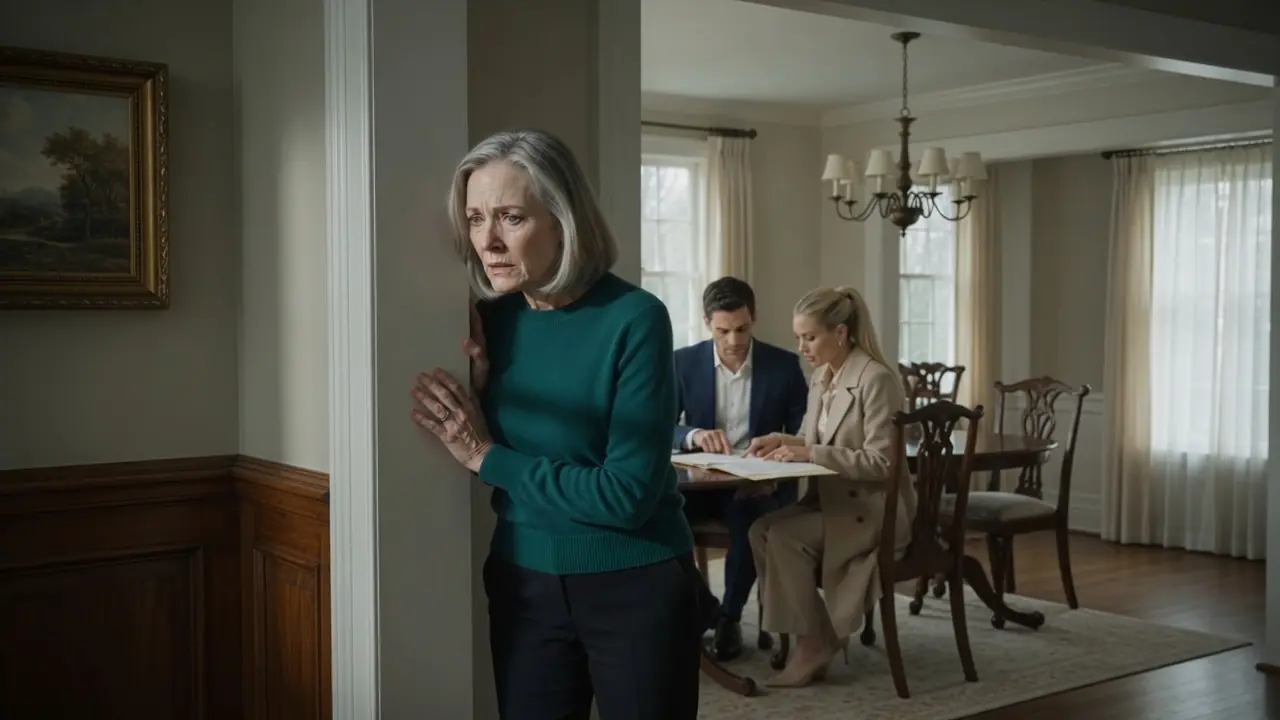
Daniel called me by accident the day before he and Melissa left for Europe. I was upstairs folding towels and missed the call. When I saw the voicemail, I pressed play expecting something ordinary, maybe a reminder about the mail or the alarm code. Instead, I heard a car door shut, Melissa laugh, and my son’s voice speaking freely because he did not know the line was still open.
“She’s a burden, Mel,” he said. “She doesn’t see it, but she is. We’ve put our lives on hold long enough.”
I sat down on the edge of the bed so suddenly the towels slid to the floor.
Handled.
Not sold. Not discussed. Not protected.
Handled.
I played the message three times.
Not because I had misheard it, but because part of me needed the wound to become undeniable before I could stop defending the person who made it. By the third replay, my hands were no longer shaking. Something inside me had gone quiet, and that quiet felt stronger than anger.
That night, I walked through every room in the house.
I touched the banister Frank had sanded smooth, the piano Daniel had refused to practice, the pantry door where I still kept old recipes taped inside. I stood in Daniel’s childhood bedroom and looked at the faded outline where a baseball poster had hung for ten years. I tried to remember the boy who used to crawl into my lap during thunderstorms and ask if the house could keep us safe. Then I heard his adult voice again: burden.
By morning, my tears were gone.
What replaced them was clarity.
I opened Frank’s file drawer after breakfast. Inside were insurance papers, the original deed, tax records, mortgage payoff letters, and a folder labeled Elaine, in case you need courage. That was Frank’s handwriting. I laughed when I saw it, then cried only once, because even dead, my husband knew I might someday need him to remind me who I was.
Inside the folder were copies of every ownership document, a list of trusted contacts, and a note.
Do not let fear make decisions for you. And do not confuse family with permission.
I pressed that note to my chest and called the first number on the list.
Her name was Grace Hollander, a real estate attorney Frank had known for years. I told her I wanted to sell the house quietly and quickly, but legally, cleanly, and without alerting my son. She did not ask me why until I finished speaking. Then she said, “Elaine, has someone been pressuring you?”
I looked at the phone, then at the framed photo of Frank on the desk.
“Yes,” I said. “And I am done being pressed.”
Grace moved fast.
Within two days, she had the property evaluated. Within four, she had a private buyer, a retired couple relocating from Boston who had already lost two houses in bidding wars and were willing to pay cash if the process stayed quiet. They did not want a sign in the yard, did not need open houses, and loved that the house had a history. When they walked through, the woman touched the pantry doorframe where Daniel’s height marks were and asked if I wanted to remove that piece before closing.
I almost said yes.
Then I shook my head.
“No,” I told her. “Leave it. Let the house remember everything honestly.”
During those three weeks, I packed my life while Daniel and Melissa posted photos from Europe. They stood in front of old churches, drank wine near canals, and smiled beside fountains while captions talked about “resetting before a big family transition.” I wondered if I was the transition. I wondered if they toasted to the house already.
I sold furniture I did not need. I donated books. I gave Frank’s tools to Mr. Greene next door because his son loved woodworking and because I could not bear the thought of Daniel selling them at an estate sale. I moved my important things into a furnished rental by the lake under a short-term lease, a quiet place with windows facing water and no memories in the walls. The first night there, I slept badly but freely.
On the morning of closing, I wore the blue dress Frank always said made my eyes look brighter.
Grace sat beside me while I signed the final papers. My hand trembled only once, and when it did, she paused without rushing me. The buyer signed. The money transferred. The keys changed hands. The house on Maple Hollow Road no longer belonged to me, and for the first time since Frank died, I did not feel trapped inside my own grief.
I asked Grace for one favor.
“Can the locks be changed today?”
She smiled faintly. “Already scheduled.”
Daniel and Melissa returned from Europe the next morning.
They thought they were coming home to my house because Daniel still had the spare key I had given him after Frank died. He had never asked whether he could keep it. He assumed. That had become the language of our family. Daniel assumed access, Melissa assumed influence, and I was expected to call it love.
From the moving truck across the street, I watched the key fail.
Daniel tried again. Melissa stopped laughing. He stepped back, looked at the door, then at the windows. His face darkened. He called my phone, and I watched my screen light up in my lap.
I did not answer.
He called again.
Then again.
Melissa began talking fast, pointing toward the lock, then toward the driveway. Daniel walked around to the side gate, but that lock had been changed too. He returned to the porch with the expression of a man discovering that a door he thought belonged to him had never been his.
Finally, I opened the truck door and stepped out.
Daniel froze when he saw me. Melissa turned slowly, her face draining of color.
“Mom?” Daniel said.
I crossed the street with my purse over my shoulder and Frank’s wedding ring beneath my sweater. My knees were stiff, but my steps did not falter. Mr. Greene had come outside by then, newspaper forgotten in one hand, watching from his walkway. I did not mind. Some truths deserve witnesses.
Daniel held up the key. “What is going on? The lock doesn’t work.”
“No,” I said. “It doesn’t.”
Melissa pushed her sunglasses onto her head. “Elaine, did you change the locks without telling us?”
I looked at my daughter-in-law carefully. “I did not change them. The new owners did.”
Daniel stared at me.
“What new owners?”
“The people who bought the house.”
His mouth opened, then closed.
Melissa’s hand tightened around her shopping bags. “You sold the house?”
“Yes.”
Daniel stepped toward me. “Without telling me?”
I looked at him, and the pain of motherhood moved through my chest like weather. For a moment, I saw him at four years old in dinosaur pajamas, running across this same porch into my arms. Then I saw him as he was now: a grown man with my key in his hand and his own words hanging between us.
“Yes,” I said. “Without telling you.”
His face hardened. “Mom, that house was part of our family.”
“No,” I said quietly. “It was part of my life with your father.”
Melissa gave a sharp laugh, but it sounded nervous. “This is irrational. You can’t just sell a major asset because you’re upset.”
I turned to her. “I sold my home because I heard exactly what you both intended to do with it.”
Daniel went pale.
I reached into my purse and pulled out my phone. The voicemail was saved, backed up, and sent to Grace weeks earlier. I pressed play.
“She’s a burden, Mel. She doesn’t see it, but she is. We’ve put our lives on hold long enough.”
Melissa’s voice followed.
“Once the house is finally handled, everything gets easier.”
Daniel lowered his eyes.
The morning went very still.
I stopped the recording and slipped the phone back into my purse.
“Handled,” I said. “That was the word that taught me what I needed to know.”
Daniel rubbed one hand over his mouth. “Mom, I was frustrated. We didn’t mean it like that.”
I nodded once. “No one ever means betrayal the way it sounds when it is recorded.”
Melissa stepped forward. “We were worried about you.”
“You were worried about the house.”
“That’s not fair.”
“No, Melissa. What was not fair was pretending concern while preparing to question my competence.”
Her face changed.
Daniel looked sharply at her, and for the first time, I saw something like panic flicker across her eyes. She had not expected me to know that part.
I opened my purse again and removed three folded pages. Copies, not originals. Printed emails from Daniel’s old study box. Notes about power of attorney, mental decline, resistance, safety concerns, and legal pathways for decision-making over elderly parents.
Daniel stared at them as if they had appeared from nowhere.
“Mom,” he whispered.
I held the papers out. He did not take them.
“You left these in the spare room years ago,” I said. “Or maybe Melissa did. Either way, I found them.”
Melissa’s voice went thin. “Those were just research.”
“Research into taking control of my life.”
Daniel turned toward her. “Melissa?”
She looked at him, then at me. “We had to understand options.”
I smiled, but there was no warmth in it. “And now you understand consequences.”
Daniel’s suitcase stood beside him like a prop from a life he had not earned. The house behind him looked calm, innocent, and unreachable. I had expected to feel triumph in that moment, but I did not. I felt grief. A clean, painful grief for the son I had loved and the man standing in front of me.
Daniel’s voice cracked. “Where are you living?”
“Somewhere safe.”
“Why didn’t you talk to me?”
That question nearly broke my composure.
I looked directly at him. “You stopped being someone I could talk to when you called me a burden.”
His eyes filled with tears, but I did not rush to comfort him. I had rushed toward his tears for forty years. I had kissed bruises, forgiven lies, paid bills, excused selfishness, and called it motherhood. That morning, I finally understood that love without boundaries becomes a house other people walk through without knocking.
“The sale proceeds are in my account,” I said. “My new address is private. Grace Hollander is handling all legal communication. Your key no longer opens anything in my life.”
Melissa’s mouth fell open. “Legal communication? Elaine, this is ridiculous.”
I turned to her. “If you contact any doctor, bank, attorney, or agency claiming I am unstable, Grace will respond with the voicemail, the printed documents, and the competency evaluation I completed last week.”
Melissa stopped breathing for half a second.
Daniel looked devastated. “You had yourself evaluated?”
“Yes,” I said. “Because I wanted no room for either of you to call grief confusion.”
He looked down at the key in his hand.
“What am I supposed to do now?”
The question was so honest and so selfish that it almost made me laugh. He stood outside a house he did not own, with a suitcase from a vacation he could afford, asking the woman he had called a burden how he should handle the consequences of his own cruelty.
“You are supposed to go home, Daniel.”
“This was home.”
“No,” I said. “This was mine.”
His face crumpled.
For a moment, he looked like a child again. But I was no longer willing to mother the child in him while the man avoided accountability.
“I love you,” I said.
He looked up, desperate.
“But love is not a key anymore.”
Melissa took his arm. “Daniel, let’s go.”
He pulled away from her slightly, still staring at me. “Can I see you?”
I thought about saying no. I thought about saying yes too quickly. Instead, I chose the only answer I could live with.
“Not yet.”
His tears fell then. Mine did too, but quietly. I let them fall because strength does not always mean a dry face. Sometimes it means crying and not changing your mind.
I walked back to the moving truck.
Daniel called after me once.
“Mom.”
I stopped but did not turn around.
He said nothing else.
Maybe he did not know how to apologize without asking for something at the end. Maybe he had finally realized that sorry would not reopen the door. Either way, I got into the truck, closed the door, and told the driver to take me home.
Home was the rental by the lake.
It was not grand. It had beige walls, rented furniture, and a small balcony that overlooked gray water. But when I walked in that afternoon, no one expected me to be smaller than I was. No one had plans spread across a dining table. No one held a spare key like a claim.
For the first week, I lived quietly.
I unpacked only what mattered. Frank’s photograph went beside the bed. His wedding ring stayed around my neck. I bought a blue mug from a thrift store and decided it would be mine, not ours, not his, not Daniel’s childhood memory. Mine.
Daniel called every day for nine days.
I did not answer until the tenth.
When I finally did, his voice sounded rough. “Mom.”
“Yes.”
“I’m sorry.”
I sat by the balcony door and watched the lake move under a pale sky. “For what?”
He went quiet.
That mattered.
A vague apology is a broom sweeping glass under a rug. I needed him to name what he had broken.
“I’m sorry I called you a burden,” he said finally.
I waited.
“I’m sorry I let Melissa talk about the house like it was already ours.”
I still waited.
“I’m sorry we looked into ways to take control. I told myself it was about safety, but it wasn’t. It was about making things easier for us.”
My hand tightened around the phone.
There he was.
Not fully. Not repaired. But honest enough to begin.
“Thank you for saying that,” I replied.
“Can I come see you?”
“No.”
His breath caught.
“Not yet,” I said. “You need to sit with what happened without rushing me to make you feel forgiven.”
“I don’t want your money,” he said quickly.
I closed my eyes.
“That is the first time you have mentioned money, Daniel.”
Silence.
Then a broken whisper. “I hate what I became.”
I looked toward Frank’s photograph. “Then become someone else.”
The months that followed were not easy. Melissa sent one message through Daniel claiming I had “overreacted under emotional strain.” Grace replied once. Melissa never contacted me again. Daniel and Melissa separated by winter, though I did not ask for details. I had learned not to confuse information with healing.
Daniel began therapy. He also began visiting Frank’s grave every Sunday, which I knew because Mr. Greene’s wife saw him there and told me gently. He did not ask for my address again. He wrote letters instead, real ones, handwritten, specific, uncomfortable. I read them all and answered only two.
By spring, I bought a small house by the lake.
Not a rental. Mine.
One story, two bedrooms, a kitchen with yellow light in the morning, and a porch just wide enough for a chair and a table. I paid in full from the sale of Maple Hollow Road. The rest went into investments, medical planning, and a small fund for women needing legal help against relatives who called control concern.
On the day I moved in, I hung Frank’s photograph in the hallway and placed his ring in a small wooden box on my dresser.
For the first time, I did not feel like I had abandoned our life.
I felt like I had carried it somewhere safer.
Daniel came to see me six months after the morning his key failed. I gave him the address only after Grace told me I was ready to decide for myself. He arrived alone, wearing jeans and a plain sweater, no suitcase, no Melissa, no assumptions. When I opened the door, he did not step forward until I moved aside.
That was the first good sign.
He looked around my little lake house with tears in his eyes. “It’s peaceful,” he said.
“It is.”
He saw Frank’s photograph and touched the frame carefully. “Dad would have liked it.”
“Yes,” I said. “He would have checked every window lock first.”
Daniel laughed once, then cried.
We sat at the kitchen table. I made tea, not because he expected it, but because I wanted tea. That difference mattered to me. He apologized again, but this time he did not ask for anything afterward. He simply placed his hands flat on the table and said, “I don’t know if I can fix what I did.”
“You cannot undo it,” I said.
He nodded.
“But you can live differently from it.”
He looked at me then, really looked at me, not as a mother, not as a future inheritance, not as a problem, but as a woman he had hurt.
“I want to try,” he said.
“That is a beginning.”
Not forgiveness.
Not yet.
But a beginning.
A year later, Daniel and I had dinner twice a month. He brought groceries sometimes, and at first I almost refused because the gesture felt too sharp against old wounds. Then I realized he was not bringing them because I needed them. He was bringing them because he finally understood that care is not a theory, a brochure, or a plan. It is bread, tea, repaired railings, listening without taking notes for court.
He never got a key to the lake house.
He never asked.
That may be the reason I began to trust him again.
As for Maple Hollow Road, I drove by once the following autumn. The new owners had planted lavender by the front walk and painted the door blue. For one second, grief pressed against my ribs, but it did not knock me down. The house looked loved. Different, but loved.
I parked across the street for only a moment.
The porch where Daniel’s key had failed was quiet. The windows caught the afternoon sun. Somewhere inside, another family was beginning its own story, and mine no longer had to stand guard at the door.
I touched Frank’s ring through my sweater and whispered, “I kept my promise.”
I had kept Clearwater Lane as long as it was mine to keep.
Then I kept myself.
That mattered more.
People think inheritance is what children receive after parents die. They are wrong. The most dangerous inheritance is the one children begin collecting while you are still alive: your time, your silence, your home, your obedience, your willingness to be useful at the cost of your dignity.
My son called me a burden.
So I sold the house he was counting on.
Not to punish him.
To save myself from becoming a woman who stayed where she was no longer loved, only awaited.
My name is Elaine Whitaker. I am a widow, a mother, a homeowner again, and no longer confused about the difference between being protected and being handled.
And the only key my son holds now is the one he must earn slowly, by learning how to love me without owning the door.