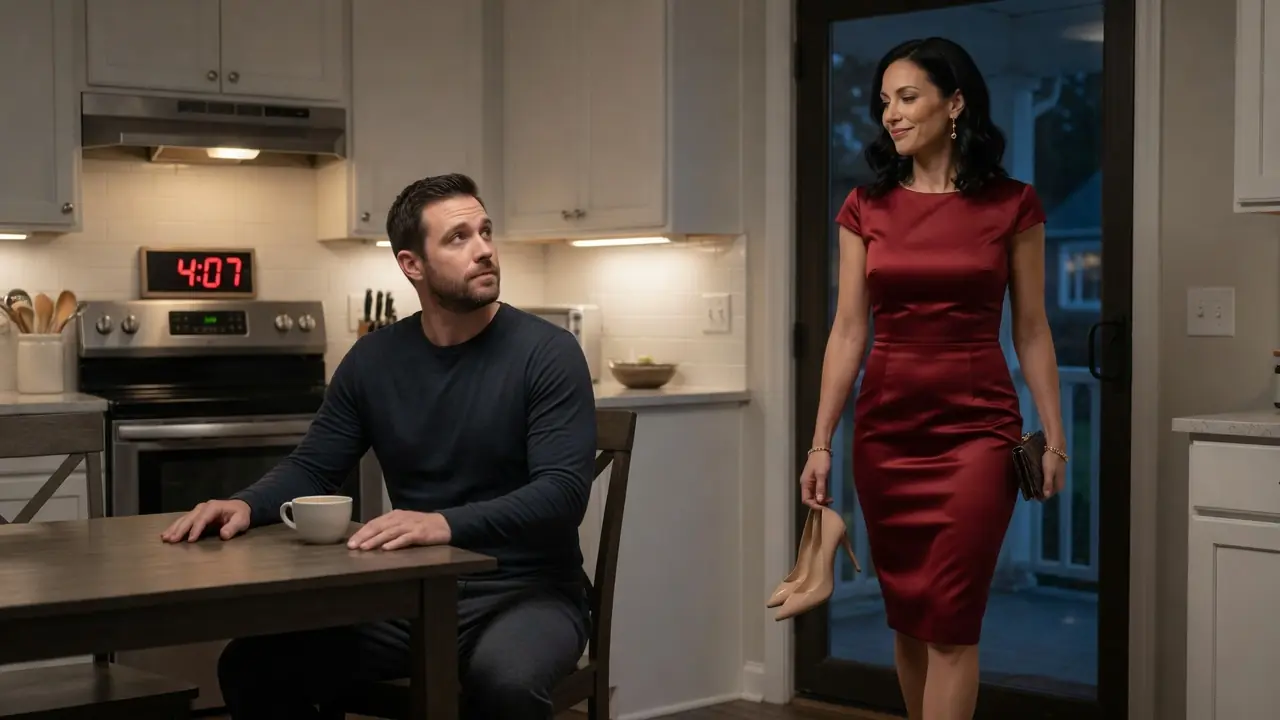
My wife stumbled home at 4:07 a.m., smelling like whiskey and another man’s cologne, then smirked at me and said, “Don’t ask, Roland.”
So I didn’t.
I let her walk past me like silence meant surrender.
I let her climb the stairs in the heels she had been carrying in one hand. I let her shut our bedroom door softly, as if courtesy mattered after betrayal. I let her sleep like she had won.
But the next morning, when she walked into the living room and saw her mother crying beside the man sitting on our sofa, he looked straight at her and said, “You don’t know me, but you know my son, Desmond.”
That was the moment Vanessa finally understood.
Her lover’s father had come to tell the truth.
We lived on Maple Ridge Court in Richmond, Virginia, in a quiet neighborhood where American flags hung beside brick porches, porch lights glowed through morning fog, and every lawn looked respectable before sunrise. From the outside, our house looked like a success story.
White shutters.
Trimmed hedges.
A two-car garage.
A wreath on the front door that Vanessa changed with every season because she believed appearances were not decoration, but language.
People who drove past our home saw stability.
They saw the kind of marriage that looked good in Christmas photos and neighborhood cookouts. They saw a husband who waved to neighbors, a wife who hosted wine nights, and a brick house that seemed too well-kept to hold anything ugly inside it.
They did not see me sitting alone in the kitchen at four in the morning, watching the clock like it had become a witness.
My name is Roland Pierce.
I was thirty-eight years old, an operations manager for a regional supply company, the kind of job that made me tired in practical ways. I spent my days solving shipping problems, calming angry clients, approving schedules, and making sure other people’s mistakes did not become disasters.
It was not glamorous work.
But it was honest.
And for most of my adult life, honest was enough for me.
I was not rich, but I worked hard. I paid bills on time. I kept my promises. I believed marriage was something you maintained the way you maintained a house: with patience, repair, and attention before the cracks became collapse.
My wife’s name was Vanessa.
Vanessa Pierce, formerly Vanessa Whitmore.
She was beautiful in the way people noticed immediately. Dark hair, careful makeup, sharp cheekbones, and a smile she could turn on and off like a light. She worked in marketing for a boutique real estate firm and loved being seen in rooms that looked expensive.
She liked rooftop bars, private events, glossy invitations, curated photos, and people who said things like “networking” when they really meant flirting with money nearby.
When we first married, I thought her brightness would bring life into my quiet.
For a while, it did.
Or maybe I had wanted to believe that so badly that I decorated warning signs and called them charm.
I met Vanessa at a friend’s engagement party eleven years earlier. She was twenty-six then, standing near the kitchen island in a green dress, telling a story with both hands while four people leaned in like she was the only person in the room worth hearing.
She had a laugh that made people turn around.
I was standing by the back door holding a paper plate of food, trying to decide whether leaving early would look rude.
Then Vanessa looked across the room and caught me watching.
Instead of looking away, she smiled.
Later that night, she found me on the patio and said, “You look like a man who knows where all the exits are.”
I told her, “I work in operations. Knowing exits is a professional habit.”
She laughed like that was the most interesting answer anyone had given her all night.
For the first few years, we balanced each other.
She pulled me into rooms I would have avoided.
I grounded her when excitement became chaos.
She made our life prettier. I made it safer. She chose paint colors, curtains, restaurants, vacations, and the kind of wine people pretended to understand. I managed insurance, taxes, repairs, schedules, and the invisible systems that kept our life from falling apart behind the scenes.
Back then, she called me dependable like it was love.
“You make everything feel steady,” she told me once, resting her head against my shoulder while rain hit the windows of our first apartment.
I held on to that sentence for years.
Long after she stopped meaning it.
Vanessa liked attention. That was not new. Even before our wedding, she had enjoyed making men look twice, then telling me I was too serious when I noticed. She said jealousy was unattractive. She said trust meant not asking questions. She said a confident husband did not need to keep score of glances, texts, or late nights.
At first, I believed her.
Then the late nights became more frequent.
The phone turned face-down.
The password changed.
The gym sessions ran two hours longer than usual.
The “client dinners” ended with her coming home cheerful, perfumed, and distant, as if some part of her had stayed behind in another man’s conversation.
And every time I asked, Vanessa turned the question against me.
If I asked why she came home late, I was insecure.
If I asked why her phone stayed face-down, I was controlling.
If I asked why she smelled like expensive cologne after “girls’ drinks,” I was destroying the marriage with suspicion.
She had trained me carefully, one accusation at a time.
Not by force.
By humiliation.
A man can be made quiet if every attempt to speak is treated like proof that he is small.
The man she told herself I would never ask about was Desmond Vale.
I first saw his name on a dinner receipt folded inside her purse. I was not searching through her things. Her purse had fallen off the passenger seat, spilling lipstick, keys, a compact mirror, and the receipt across the garage floor.
I picked them up because that was what husbands did when their wives dropped things.
The receipt was from The Sterling Room, a restaurant Vanessa once told me was “too romantic for work dinners.”
Two entrées.
Two cocktails.
One dessert.
A table for two.
Paid by Desmond Vale.
I stared at the name for a long time.
It was a sharp, clean name. The kind of name that sounded like money even before you knew anything about the man attached to it.
When I asked her about it, she laughed.
“Roland, you’re embarrassing yourself.”
“Who is Desmond?”
“A client.”
“You had dinner with a client and didn’t mention it?”
“I don’t give you a written report of every conversation I have.”
“It was at The Sterling Room.”
“So now I’m not allowed to eat?”
That was how she did it.
She never answered the question directly. She made the question sound ridiculous. Then she made my reaction the problem.
The next time I saw Desmond’s name was on a hotel parking garage charge connected to a credit card statement. Then in a reflection on a photograph posted by one of Vanessa’s coworkers. A man’s arm around her waist. A silver watch. A face half-visible in a mirror behind a group of laughing people.
Then came the texts.
I did not hack her phone.
I did not need to.
Vanessa became careless because she believed I had become harmless.
One evening, while she was in the shower, her phone lit up on the kitchen island.
Desmond: Last night was worth the risk.
Another message followed.
Desmond: Tell your husband whatever you always tell him.
I stood there in the kitchen with my hands at my sides, feeling something inside me go completely still.
There is a kind of heartbreak that hurts loudly, with anger and crying and slammed doors.
But there is another kind that arrives quietly.
It does not shout.
It simply turns the lights off inside you, one room at a time.
By the time Vanessa came home at 4:07 that morning, I already knew more than she thought I did.
The hotel receipt was in my desk drawer.
So were the parking garage photos.
So were the screenshots.
So was the printout from a private investigator I had hired after three months of being called paranoid by the woman who had made paranoia reasonable.
I had not hired him to catch her because I wanted revenge.
I hired him because I needed my own sanity back.
I needed proof that I was not inventing shadows just because the house had grown cold.
The investigator’s name was Curtis Lang.
He was a quiet man in his fifties with gray hair, tired eyes, and the patient misery of someone who had spent too many years watching people betray each other in parking lots. His office was above a tax preparation business on Broad Street. The carpet smelled like old coffee and rain.
When I first sat across from him, I felt ashamed.
Curtis saw it.
“People usually come here when they already know,” he said. “They just need the world to stop calling them crazy.”
I looked down at my hands.
“My wife says I’m imagining things.”
“They usually do.”
I did not like the word usually.
It made my pain feel ordinary.
But maybe that was its own mercy.
Over the next few weeks, Curtis gave me dates, locations, photographs, and a timeline I did not want but needed. Vanessa and Desmond at The Sterling Room. Vanessa and Desmond entering a parking garage under the Colton Hotel. Vanessa leaving a private apartment building near Libbie Avenue at 1:18 a.m., her hair loose, her dress different from what she had worn when she left our house.
Every piece of paper hurt.
Every photograph proved I had not been losing my mind.
That contradiction became its own kind of torture.
I was relieved to be right.
I was devastated by what being right meant.
That morning, the side door opened slowly.
Cold air slid into the kitchen before Vanessa did.
She stepped inside with one heel in her hand, her dress creased, her hair loose from whatever style she had worn when the night began. Her lipstick was faded, not from coffee. Her eyes were bright with whiskey and arrogance. Another man’s cologne clung to her skin so strongly that it reached me before she crossed the room.
I was sitting at the kitchen table.
The clock on the stove read 4:07.
She saw me awake and smiled.
Not sorry.
Not scared.
Amused.
“Don’t ask, Roland.”
That was all she said.
A command disguised as exhaustion.
A dare wrapped in disrespect.
I looked at her for a long moment.
Once, I might have asked.
Once, I might have stood up and demanded truth.
Once, I might have begged her to remember we were married.
But something in me had passed beyond begging.
So I did exactly what she told me.
I did not ask.
I watched her walk past the refrigerator, past the family photo from our vacation in Myrtle Beach, past the little wooden cross her mother gave us on our wedding day, and disappear upstairs like she had won.
She thought silence meant surrender.
It did not.
Silence was the only thing keeping me from showing her the folder already sitting in my desk drawer.
I waited until I heard the bedroom door close.
Then I sat there for another ten minutes, listening to the house settle.
At 4:21, my phone buzzed.
It was not Vanessa.
It was a number I did not recognize.
The message was short.
Mr. Pierce, my name is Leonard Vale. My son is Desmond. I believe we need to speak before your wife wakes up.
I stared at the screen.
For the first time that night, my hands began to shake.
I did not reply immediately.
I walked to my office, opened the drawer, and took out the folder. Desmond’s face stared back at me from one of the investigator’s photos. Tall, polished, expensive haircut, confident smile. The kind of man who looked like he had never been told no without taking it personally.
I looked from the photo to the message.
Leonard Vale.
His father.
I typed back.
How did you get my number?
The answer came a minute later.
From a letter my son wrote and never sent. Your name was in it. So was hers. I found enough to know you deserve the truth.
I sat down slowly.
Another message followed.
I am outside Richmond. I can meet at 9:00 a.m. I do not want money. I do not want trouble. I want this stopped.
I looked toward the ceiling.
Vanessa was upstairs sleeping like a woman who believed she had stepped over me and left no mark.
I typed one sentence.
Come at 8:30.
Then I added:
Her mother will be here.
I do not know why I wrote that last part so quickly.
Maybe because Vanessa’s mother, Diane Whitmore, had always treated our marriage like a personal achievement. She told everyone her daughter had married “a steady man,” which was her polite way of saying I was not exciting, but useful.
Diane loved appearances the way some women love religion. She believed in family dinners, church photos, monogrammed towels, thank-you notes, matching holiday pajamas, and the illusion that proper people did not make ugly messes.
But Diane also loved Vanessa.
And lately, she had begun to notice things.
Three weeks before that morning, Diane had called me privately.
“Roland,” she said, voice low, “is Vanessa all right?”
I remember standing in my office, looking out at the backyard.
“What do you mean?”
“She missed Sunday dinner again. She said she was sick, but I saw photos online from some event downtown.”
I said nothing.
Diane sighed.
“I know my daughter can be difficult.”
That was the first honest sentence she had ever said about Vanessa.
“Difficult is one word.”
“Has she hurt you?”
The question surprised me so much that I could not answer.
After a long silence, Diane said, “I’m sorry. I should not have asked.”
“No,” I said quietly. “Maybe someone should have asked a long time ago.”
She did not push then.
But I heard fear in her breathing.
So that morning, after Leonard Vale texted me, I called Diane before sunrise.
She answered on the third ring, alarmed.
“Roland? What happened?”
“I need you to come over at eight.”
“What is it?”
“Vanessa.”
Silence.
Then, “Is she hurt?”
“No.”
“Are you?”
I closed my eyes.
“Yes. But not in a way an ambulance can fix.”
Diane arrived at 7:52.
She wore a beige coat over a navy dress, her hair pinned neatly, her face already pale. She came through the front door carrying her purse with both hands, as if she were entering a hospital room and expecting bad news.
I had made coffee, though I had not drunk any.
The house was quiet.
Vanessa was still asleep upstairs.
Diane looked toward the staircase.
“Where is she?”
“Sleeping.”
Diane’s mouth tightened.
“She came home late?”
“Early,” I said. “Depends how you count.”
She looked at me then.
Really looked.
I saw the moment she understood that whatever I had called her for was not suspicion anymore. It had weight. It had shape. It had already happened.
“Roland,” she whispered, “what has she done?”
Before I could answer, the doorbell rang.
Diane flinched.
I walked to the door and opened it.
Leonard Vale stood on my porch.
He was in his early sixties, tall but slightly stooped, with a gray beard trimmed close and tired eyes that looked like they had not slept either. He wore a dark overcoat, polished shoes, and no expression of confidence.
In one hand, he held a brown leather folder.
In the other, he held a sealed envelope.
He did not look like a man coming to defend his son.
He looked like a man carrying shame.
“Mr. Pierce?” he asked.
“Yes.”
“I’m Leonard Vale.”
“I know.”
He looked past me into the house.
“I am sorry to come like this.”
“So am I.”
He accepted that.
I stepped aside.
Diane stood in the living room, staring at him.
Leonard stopped when he saw her.
“You must be Mrs. Whitmore.”
Diane’s face tightened.
“I am Vanessa’s mother.”
“I know.”
Those two words made her sit down.
Leonard took the armchair across from the sofa. I sat near the fireplace, though I did not remember choosing the chair. The coffee sat untouched on the table between us.
For a moment, no one spoke.
Then Leonard opened the leather folder.
“My son’s name is Desmond Vale,” he said. “He is thirty-two. He works in commercial development, though he tells people he is an investor. He is charming when he wants to be. He is cruel when charm stops working. And I am here because your wife is not the first married woman he has done this with.”
Diane pressed one hand to her mouth.
I felt something cold move through me.
Leonard continued.
“I will not pretend Vanessa is innocent. I am not here to insult your intelligence or protect her reputation. She made choices. But my son has a pattern. He targets women who are bored, dissatisfied, ambitious, or angry at their husbands. He makes them feel chosen. He encourages them to mock the men they married. He collects messages. Photos. Financial information. Then he uses whatever he has gathered when the relationship stops serving him.”
I stared at him.
“Blackmail?”
Leonard’s face darkened.
“Sometimes. Sometimes not directly. Sometimes he simply enjoys having power over people. He learned long ago that humiliation can be more useful than money.”
Diane began to cry silently.
Leonard removed several pages from the folder and placed them on the coffee table.
“I found these last night.”
They were printed messages.
Some from Vanessa.
Some from Desmond.
I saw my name in them immediately.
Vanessa: Roland is so predictable. He just sits there looking wounded. It is exhausting.
Desmond: Men like him are useful. They pay bills and wait at home.
Vanessa: Don’t make me laugh. He still thinks I care what he feels.
Desmond: Then stop pretending.
Vanessa: Soon.
My hands curled into fists.
Diane whispered, “Oh, Vanessa.”
Leonard slid another page forward.
“This is why I came.”
It was a message from Desmond to someone named Marla.
Desmond: Vanessa thinks she is special. She is not. But she has access to Roland’s accounts, the house, and her mother’s trust documents. Keep her comfortable a little longer.
The room changed.
Diane lifted her head sharply.
“My trust documents?”
Leonard nodded grimly.
“My son has been pressuring Vanessa for information about your assets. He has debts. Serious ones. He has been involved with men who do not accept late payment politely.”
I stared at the page.
Everything shifted again.
This was no longer only betrayal.
It was exposure.
Vanessa had not only risked our marriage. She had brought a predator near her mother’s finances, our home, and everything I had built.
Diane’s voice shook.
“I gave Vanessa copies of some paperwork last month because I was updating my will.”
I looked at her.
“Did she ask for them?”
Diane closed her eyes.
“She said she wanted to help organize things. I thought she was finally being responsible.”
Leonard’s face filled with pity.
“I am sorry.”
Diane wiped her tears with a tissue, then looked at me.
“Does Vanessa know he came?”
“No.”
At that exact moment, a floorboard creaked upstairs.
We all looked toward the staircase.
For several seconds, there was silence.
Then we heard Vanessa’s bedroom door open.
I imagined her waking slowly, maybe with a headache, maybe pleased with herself, maybe expecting me to be in the kitchen pretending not to know. I imagined her checking her phone and finding whatever messages Desmond had sent after leaving her.
I imagined her rehearsing the same bored expression she used whenever she wanted me to feel foolish.
Her footsteps came down the stairs.
Diane was crying openly now.
Leonard sat very still.
I did not move.
Vanessa appeared in the living room doorway wearing a silk robe, her hair loosely tied back, her makeup washed away but not enough to hide the previous night. She stopped when she saw her mother.
“Mom?”
Then she saw Leonard.
Her expression changed from confusion to irritation.
“Who is this?”
Leonard stood.
He looked straight at her.
“You don’t know me, but you know my son, Desmond.”
The color left Vanessa’s face.
For once, she had no quick answer.
No laugh.
No accusation.
No polished excuse.
Her eyes moved to me, then to the papers on the coffee table, then back to Leonard.
“What is this?” she asked.
Diane sobbed once.
Vanessa stiffened.
“Mom, why are you crying?”
Diane looked at her daughter like she was seeing a stranger wearing her child’s face.
“Because I read what you wrote about your husband.”
Vanessa swallowed.
“I don’t know what he showed you, but—”
Leonard interrupted.
“My son showed me enough. Your messages. His messages. The hotel records. The plans involving your mother’s trust.”
Vanessa’s eyes sharpened.
“Plans? What plans?”
Her confusion looked real.
That did not save her.
Leonard lifted one page.
“Desmond discussed using you to access financial information.”
Vanessa shook her head.
“No. That’s not true.”
“It is.”
“He wouldn’t—”
“He has before.”
Vanessa looked almost offended by the idea that Desmond might have used her while she was using me.
That was the ugliest part.
Not her guilt.
Her shock that she had not been the only one playing someone.
She turned to me.
“Roland, you believe this?”
I stood slowly.
“For months, you told me not to believe my own eyes.”
“That’s not fair.”
“Fair?” I repeated.
The word almost made me laugh.
“You came home at 4:07 this morning smelling like whiskey and him. You looked at me and said, ‘Don’t ask.’”
Diane looked at Vanessa sharply.
Vanessa’s face tightened.
“I was drunk. I said something stupid.”
“No,” I said. “You said something honest.”
She crossed her arms.
“Fine. You want to talk? Let’s talk privately.”
“No.”
Her eyes flashed.
“No?”
“No. You had no problem humiliating me in private for months. You had no problem letting your mother believe this marriage was healthy. You had no problem bringing this man’s influence near her finances. So no, Vanessa. We are done doing this where only I have to carry the truth.”
She stared at me like I had struck her.
Leonard spoke quietly.
“My son is not coming for you.”
Vanessa turned toward him.
“What?”
“He left Richmond early this morning. I believe he is headed to Charlotte. He has done this before when exposure comes.”
“No,” Vanessa said. “I spoke to him last night.”
“I am sure you did.”
“He said—”
Leonard’s face hardened.
“He lies beautifully. That is the one skill I cannot deny.”
Vanessa grabbed her phone from the pocket of her robe and called Desmond.
The room waited.
It rang.
Then went to voicemail.
She called again.
Voicemail.
She typed something quickly.
No reply.
Her hand started to shake.
Diane watched her daughter with tears streaming down her face.
“Vanessa,” she whispered, “how could you?”
Vanessa snapped, “Mom, you don’t understand.”
“Then explain.”
For once, Diane’s voice was not soft.
It was broken, but firm.
“Explain why you wrote that Roland was useful. Explain why you let another man talk about your husband like a servant. Explain why you took documents from my house and gave him access to them. Explain why you have been lying to everyone who loves you.”
Vanessa’s mouth opened.
No words came.
Then she did what she always did when cornered.
She attacked the person closest.
“You have no idea what this marriage was like,” she said, looking at me. “You think being a good husband means paying bills and sitting there quietly. You were boring, Roland. You were predictable. You made me feel trapped.”
The words hit, but not the way they once would have.
Once, I would have searched them for some hidden truth I could fix.
Now I heard them for what they were.
A person trying to turn betrayal into self-defense.
“I may have been boring,” I said. “I may have been predictable. I may have worked too much, talked too little, and failed in ways I still need to understand. But I did not make vows with you and then spend months mocking you in another man’s bed.”
Her face twisted.
“That’s different.”
“No,” Diane said.
Vanessa froze.
Diane stood slowly.
“No, it is not different.”
“Mom—”
“Do not Mom me right now.”
I had never heard Diane speak to Vanessa that way.
Neither had Vanessa.
Diane stepped closer, trembling but upright.
“I raised you to expect good things. Maybe I raised you to expect them too much. Maybe I protected you from consequences until you mistook comfort for entitlement. But I did not raise you to be cruel.”
Vanessa’s eyes filled now, but the tears looked angry.
“You’re taking his side?”
“I am taking the side of decency.”
That silenced her.
Leonard placed the sealed envelope on the coffee table.
“What is that?” I asked.
“My son’s letter,” he said. “The one he wrote and never sent. It contains names, including Vanessa’s. It contains enough to show intent. I made a copy. I will be giving the original to my attorney.”
Vanessa stared at the envelope.
“What are you going to do?”
Leonard looked at her.
“Stop enabling him.”
The sentence seemed to cost him something.
He turned to me.
“Mr. Pierce, I cannot undo what my son did. I cannot undo what your wife chose. But I can give you everything I found, and I can testify if needed that this pattern existed before her.”
I nodded once.
“Thank you.”
Vanessa looked from him to me, panic beginning to replace pride.
“Roland, wait. We need to slow down.”
I almost smiled.
For months, she had raced toward destruction and called me insecure for noticing.
Now that consequences had arrived, she wanted patience.
“No,” I said. “We are finally moving at the speed of truth.”
Her face crumpled.
“Are you saying you want a divorce?”
“I wanted a marriage,” I said quietly. “You ended that before I said the word.”
Diane sat down again, covering her face.
Vanessa looked at her mother.
“Mom, please.”
Diane did not look up.
That broke through Vanessa more than anything I had said.
For the first time, she seemed to understand that she had not merely been caught by a husband. She had been seen by her mother. Fully. Without the filter of beauty, charm, or excuses.
She turned back to me, her voice softer.
“Roland, I made mistakes.”
“No,” I said. “A mistake is forgetting an anniversary. A mistake is saying something harsh during an argument. A mistake is overdrawing an account. What you did required planning, lying, gaslighting, and contempt. Do not shrink it now because the room is full of witnesses.”
She flinched.
Good.
Some truths should hurt.
Leonard gathered his folder.
“I will leave you to your family.”
“No,” Diane said suddenly.
He paused.
Diane looked at him through tears.
“Thank you for coming.”
Leonard’s face tightened with sorrow.
“I wish I had come sooner.”
“Don’t we all,” she whispered.
He left a few minutes later.
The room felt heavier after the door closed.
Vanessa stood in the middle of the living room as if unsure where to place herself. The house she had walked through so confidently at 4:07 now looked unfamiliar to her. The couch, the family photos, the wedding cross, the coffee table covered with proof. All of it seemed to accuse her.
I walked to the desk in the corner and took out my folder.
Vanessa watched me.
“What is that?”
“The part you thought I didn’t have.”
I placed it on the coffee table.
Hotel receipt.
Parking garage photo.
Screenshots.
Investigator’s report.
Dates.
Times.
Locations.
The story of a marriage collapsing in documents.
Diane looked away, unable to bear it.
Vanessa stared at the pages.
Her voice dropped.
“How long have you known?”
“Long enough.”
“Why didn’t you say anything?”
I looked at her.
“You told me not to ask.”
Her face went pale.
That line landed exactly where I wanted it to.
Not loud.
Not cruel.
Just true.
“I need to sit down,” she whispered.
“No,” I said.
She looked up.
“What?”
“You need to pack a bag.”
Diane gasped softly.
Vanessa’s eyes widened.
“You’re kicking me out?”
“I’m asking you to leave the house for now. You can go to your mother’s, if she allows it. You can go to a hotel. You can call one of the friends who helped cover for you. But you are not sleeping upstairs tonight like this is just another fight.”
Vanessa turned to Diane.
“Mom?”
Diane looked old in that moment.
Older than I had ever seen her.
“You cannot stay with me until I speak to my attorney about my accounts,” she said.
Vanessa recoiled.
“You think I would steal from you?”
Diane cried harder.
“I think I do not know what you would do anymore.”
That was the second blow Vanessa did not expect.
Not from me.
From the woman who had spent her life defending her.
Vanessa went upstairs in silence.
Diane and I remained in the living room.
I heard drawers open.
I heard footsteps.
I heard a closet door slide.
Diane wiped her face.
“I am sorry, Roland.”
I sat across from her.
“You didn’t do this.”
“No,” she said. “But I excused too much. I called it personality. I called it confidence. I called it Vanessa being Vanessa.”
I looked toward the staircase.
“We all called it something easier than the truth.”
Diane nodded.
When Vanessa came back down, she had a small suitcase in one hand and her phone in the other. She looked smaller without her anger. Still beautiful, still proud, but shaken in a way I had never seen.
At the door, she stopped.
“Roland.”
I waited.
“I did care about you once.”
That sentence might have destroyed me a year earlier.
Now it only made me tired.
“I know.”
Her eyes filled.
“I don’t know what happened to me.”
I looked at her for a long moment.
Then I said, “You chose what happened to you. Over and over. That is the part you need to face.”
She looked like she wanted to argue.
But Diane was there.
The proof was there.
Desmond was gone.
So Vanessa said nothing.
She walked out of the house at 10:12 a.m.
Not smirking.
Not commanding.
Not victorious.
Just carrying a suitcase through the same side door she had entered at 4:07, finally understanding that silence had never meant I did not know.
It meant I was done begging for respect.
The weeks that followed were ugly in the way aftermaths always are.
Vanessa called first with tears, then anger, then apologies, then blame. Sometimes all in the same voicemail. Desmond never returned her calls. Leonard’s attorney contacted mine. Diane discovered that Vanessa had forwarded images of portions of her trust paperwork to Desmond, though no money had been moved before everything came out.
That was the only mercy.
I filed for divorce.
Vanessa fought at first, not because she wanted the marriage, but because she hated losing control of the story. She wanted to tell people we had grown apart. She wanted vague phrases. Private struggles. Mutual mistakes. A difficult season.
I refused to lie.
I did not post online.
I did not humiliate her publicly.
But when people asked me directly, I told the truth plainly.
She had an affair. There were financial concerns. We are divorcing.
That was all.
It was enough.
The neighborhood whispered, of course. Maple Ridge Court had always been hungry for drama hidden behind good landscaping. But I learned something during those months: shame only belongs to the person who earned it if you refuse to carry it for them.
For a while, I had carried Vanessa’s shame like it was mine.
I stopped.
Diane and I developed an unexpected kind of alliance. She changed her legal documents, froze access, and apologized to me more times than I needed. Sometimes she came by for coffee, sitting at the same kitchen table where I had once waited for Vanessa to come home.
One afternoon, she looked around the house and said, “It feels different.”
“It is quieter.”
“No,” she said. “It feels honest.”
I understood what she meant.
The house no longer had Vanessa’s perfume in the hallway or her late-night lies hanging in the kitchen. The silence was no longer humiliation. It was peace arriving awkwardly, unsure whether it was welcome yet.
Three months after the divorce was finalized, I received a handwritten letter from Leonard Vale.
Mr. Pierce,
I wanted you to know that Desmond has entered a treatment program after legal pressure and family intervention. I do not know if he will change. I have learned not to confuse regret with transformation.
I also wanted to tell you that I am sorry again. Not only for what my son did, but for the years I spent explaining him instead of confronting him. Men like him are not born in a day. They are permitted, excused, polished, and protected until their charm becomes a weapon.
You did not deserve what happened.
I hope your home becomes yours again.
Leonard Vale
I kept the letter for a while.
Then one Saturday morning, I burned it in the fire pit in the backyard.
Not because I hated him.
Because I did not need to keep another man’s guilt in my house.
A year later, I repainted the living room.
Vanessa had chosen the old color, a cold gray she said looked sophisticated. I chose a warm cream instead. I replaced the sofa where Leonard had sat with a deep blue one that did not remind me of that morning. I took down the wedding cross, not because faith had failed, but because the symbol belonged to a promise Vanessa had broken.
In its place, I hung a framed photograph from a hiking trip I took alone in the Blue Ridge Mountains.
Sunrise over fog.
No people.
No performance.
Just light coming back slowly after darkness.
That was what healing felt like.
Not dramatic.
Not instant.
Just light returning a little at a time.
Vanessa tried to come back once.
It was eighteen months after the morning Leonard Vale walked into my house. She called first, but I did not answer. Then she appeared at the door on a rainy evening, wearing a black coat and the expression of someone who had rehearsed humility in the mirror.
I opened the door but did not invite her in.
She looked past me into the living room.
“You changed everything.”
“Some things needed changing.”
Her mouth trembled.
“I heard you got promoted.”
“I did.”
“I’m glad.”
“Thank you.”
Rain fell behind her, soft and steady.
For a moment, I remembered the woman I married. Not the woman who stumbled home at 4:07. Not the woman in the messages. The younger Vanessa who laughed at street musicians, danced barefoot in our first apartment, and once told me she felt safe with me.
Maybe that version had been real.
Maybe it had only been the version she needed me to believe.
Either way, she was gone.
“I’m sorry, Roland,” she said.
This time, she sounded like she meant it.
I nodded.
“I hope you are.”
Her eyes filled.
“Can we talk?”
“We just did.”
“That’s it?”
“That’s it.”
She looked stunned by the gentleness of it. I think she had expected anger. Anger would have given her something to push against, something to call bitterness, something to make me look wounded and unreasonable.
Peace gave her nothing.
“I loved you,” she whispered.
“I loved you too,” I said. “That was never the problem.”
“What was?”
“You loved being wanted more than you loved being faithful.”
She closed her eyes.
The sentence landed.
I did not say it to wound her.
I said it because it was true.
She left a few minutes later.
I watched her walk down the porch steps, not with hatred, not with longing, but with the strange sadness of seeing someone finally understand a lesson after the life it could have saved was already gone.
That night, I slept deeply.
No clock watching.
No side door.
No whiskey smell.
No command not to ask.
Just rain against the windows and a house that belonged to me again.
People sometimes think betrayal ends at the discovery.
It does not.
Discovery is only the moment the lights come on.
After that, you still have to walk through the room and see what was broken. You have to pick up the pieces that belong to you and stop cutting your hands on the ones that do not. You have to learn the difference between being calm and being silent, between forgiveness and permission, between love and self-erasure.
Vanessa taught me many painful things.
But the most important lesson came from the morning she thought she had won.
At 4:07 a.m., she told me not to ask.
So I did not.
By 8:30, the truth came to my door carrying a leather folder.
By 10:12, she left with a suitcase.
And by the time I stood alone in my living room that afternoon, looking at the papers on the coffee table and the empty staircase beyond them, I understood something I wish I had known much earlier.
A person who mistakes your silence for weakness has no idea how loud your self-respect will sound when it finally arrives.
Vanessa thought she had trained me not to question her.
But all she had really done was teach me to stop wasting questions on someone committed to lying.
The truth did not need me to chase it.
It came in, sat on my sofa, looked her in the eyes, and said her lover’s name.
And for the first time in months, I did not feel like the fool at the table.
I felt free.