My wife, Amy, looked me straight in the eye and confessed, “Yes, I’m seeing a younger coworker, but I still love you.”
I thought that was the worst part.
Then she added, “I want to keep seeing him. Nothing between us has to change.”
For several seconds, I could only hear the refrigerator humming and rain tapping against the windows of our townhouse outside Richmond, Virginia.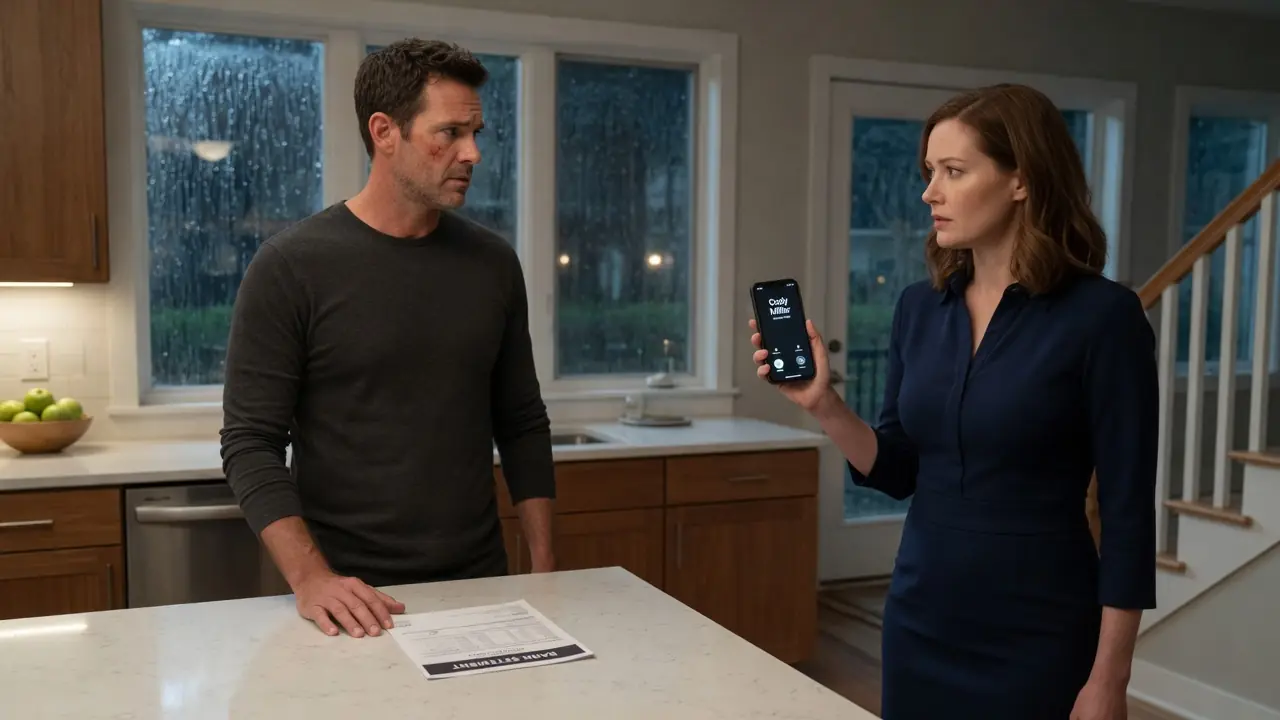
Amy stood across from me in the kitchen, still wearing the navy dress she had worn to work, watching my face as though she had suggested a minor change to our weekend plans.
Her makeup was perfect.
Her hair was still pinned neatly at the back of her neck.
Her wedding ring still shone under the kitchen lights.
That small detail nearly made me laugh. Not because anything was funny, but because there was something almost theatrical about it. My wife stood there wearing the ring I had placed on her finger eleven years earlier while calmly explaining that she intended to continue betraying the promise it represented.
“His name is Cody,” she said. “He’s twenty-seven, he works in marketing, and this has been going on for four months.”
Cody.
My wife’s younger coworker.
I had already met him twice at company events. He had shaken my hand, praised the barbecue in our backyard, and called me “a lucky man” while Amy stood beside him smiling. He was tall, tan, and smooth in the way young men become smooth when they learn women notice them.
At the summer company cookout, he had stood near my grill with a beer in his hand and said, “Man, Amy talks about your ribs all the time.”
I had smiled.
“Only good things, I hope.”
He looked at Amy then.
“Very good things.”
I remembered that look now.
I remembered Amy glancing down, pretending to adjust her bracelet.
At the time, I thought I was watching harmless workplace friendliness.
Now I understood I had been standing in my own backyard while my wife and her lover performed politeness over paper plates.
“My name is Nathan Caldwell,” I should say now, because every story like this eventually needs the person telling it to stop hiding behind the word husband.
I was forty-one years old.
I worked as an operations director for a regional logistics company in Richmond. It was not glamorous work, but it was stable, demanding, and honest. My job was to notice problems before they became disasters. Delayed shipments. Broken processes. Missing numbers. Small patterns that suggested bigger trouble.
At work, people trusted me because I stayed calm.
At home, Amy had apparently mistaken that same calm for something else.
Weakness.
I asked why she was telling me now.
Amy folded her arms and said she was tired of hiding, but the relief in her voice made it clear she was not confessing because she regretted anything. She was confessing because she believed I would eventually accept the arrangement if she presented it calmly enough.
“I love the life we built,” she said. “I love this house, our friends, Sunday mornings, all of it. Cody is separate.”
Separate.
The word landed harder than the confession itself because Amy said it as though love, loyalty, and humiliation could be placed into different drawers.
Cody in one.
Marriage in another.
Mortgage in another.
My dignity somewhere she would not have to look at too often.
She wanted the home we had paid for together, the insurance through my job, the family holidays, the birthday dinners, the vacations with our friends, the stocked pantry, the retirement plan, the comfort of knowing I would still be waiting whenever she returned from whatever separate thing she had decided belonged only to her.
Then she reached across the kitchen island and touched my hand.
“Nothing has to change,” she repeated. “You don’t need to lose me.”
That was the moment something inside me became unexpectedly quiet.
Not peaceful.
Not forgiving.
Quiet.
There are moments when pain becomes so sharp it stops making noise. I did not yell. I did not ask whether Cody was better looking, more exciting, or more interesting. I did not ask if she loved him more, because she had already shown me what her love was worth when it needed another person to carry the cost.
I simply moved my hand away.
Then I asked Amy what, exactly, she expected Monday morning to look like.
She blinked.
“What do you mean?”
“I mean Monday morning,” I said. “Do you plan to make coffee for me before driving to work and sitting beside Cody in meetings?”
“Nathan…”
“Do you expect me to kiss you goodbye while you text him from the driveway?”
Her mouth tightened.
“You’re being dramatic.”
“Am I?”
“Yes. You’re making it sound uglier than it is.”
I nodded slowly.
“Then help me understand the clean version.”
She looked irritated now, as if my questions were ruining the generosity of her honesty.
“This happens in modern marriages,” she said. “People adjust. They redefine boundaries.”
“Did we redefine boundaries before or after you started sleeping with him?”
Her face flushed.
“That is not fair.”
“No, Amy. It is the first fair thing said in this kitchen tonight.”
She looked away.
Eleven years earlier, Amy had promised that whatever happened, we would face it on the same side. We had stood beneath an arbor in her aunt’s backyard, with her father crying openly and my mother pretending not to, and Amy had squeezed my hands while saying she wanted a life built on truth.
Now she was asking me to stand quietly on the other side while she kept every benefit of my devotion.
“What does Cody think happens next?” I asked.
Amy hesitated.
Not long.
Long enough.
That pause told me Cody knew about me, knew about our marriage, and had probably been told I would never leave. Somewhere along the way, my patience had been rewritten as weakness in a story the two of them were telling each other.
I nodded.
“All right,” I said. “I understand what you’re asking.”
Relief crossed her face so quickly that it almost made me laugh.
She stepped closer and whispered, “Thank you for not destroying everything.”
That sentence stayed with me.
Thank you for not destroying everything.
As if I were the dangerous one.
As if the destruction had not already happened quietly in hotel rooms, office parking garages, lunch breaks, text messages, and whatever little smiles they traded while I existed in the background like furniture.
Amy went upstairs believing she had saved both relationships.
She did not see me walk into my home office, close the door, and stand in the dark for nearly five minutes with both hands on the desk.
She did not see the shaking begin after she left the room.
She did not see me open the locked drawer beneath my desk and remove the folder containing our mortgage records, bank statements, insurance documents, and the estate paperwork from when my father died six years earlier.
And she did not hear me call a Richmond number I had not used in years.
The woman answered on the third ring.
“Rebecca Monroe.”
“Rebecca, it’s Nathan Caldwell.”
There was a brief pause.
“Nathan. It’s been a long time.”
“I know. I’m sorry to call this late.”
“It’s all right. What happened?”
I looked toward the ceiling, where Amy was moving around our bedroom as though nothing had changed.
“My wife just told me she’s been seeing another man for four months, and she wants to keep seeing him while staying married to me.”
Rebecca said nothing for a moment.
Good attorneys know when silence is more useful than reaction.
Then she asked, “Are you safe?”
That question made me close my eyes.
“Yes.”
“Is she safe?”
“Yes.”
“Good. Then do not confront anyone else tonight. Do not threaten her. Do not send emotional messages. Do not move assets recklessly. We will discuss the house and finances carefully.”
“I need to know what Amy is allowed to take if she walks away.”
Rebecca’s voice changed.
“Before we discuss the house,” she said, “are you aware of the transfers Amy has been making from your joint account?”
I stopped breathing for half a second.
“What transfers?”
Another pause.
“Nathan, I still have limited access to the estate folder we created after your father passed. You had me review your household accounts back then for asset planning. I remember the bank relationship. I can’t see everything without updated authorization, but I received an automated notice months ago when a linked joint account triggered unusually large outgoing transfers. I assumed you were aware.”
“How large?”
“I do not want to guess. Bring the records tomorrow morning. All of them.”
“What kind of transfers, Rebecca?”
Her voice stayed steady.
“Nathan, listen carefully. Your marriage issue may not only be personal. It may be financial.”
The room seemed to shrink.
I looked at the desk, at the old folder, at the neat labels Amy used to tease me about because I liked paper copies even in a digital world.
“How soon can you see me?”
“Eight tomorrow morning.”
“I’ll be there.”
“And Nathan?”
“Yes?”
“Sleep in another room tonight if you can do it calmly.”
I almost said our guest room still had boxes in it.
Then I remembered the couch.
“I can.”
“Good. Say as little as possible. Gather documents. Do not let her know you are looking.”
I hung up and sat in the dark.
Upstairs, the shower turned on.
The sound was ordinary.
That made it worse.
When Amy came downstairs twenty minutes later in soft pajamas, she found me on the couch with a blanket.
She stopped in the living room doorway.
“Nathan?”
“I’m sleeping down here tonight.”
Her face changed.
“I thought you said you understood.”
“I do.”
“Then why are you acting like this?”
I looked at her.
“Understanding a wound does not mean lying down beside it.”
She stared at me, confused and annoyed.
“You’re punishing me.”
“No,” I said. “I’m keeping myself from saying something I cannot take back.”
That answer seemed to unsettle her more than anger would have.
She stood there for a few seconds, waiting for me to soften.
I did not.
Finally, she turned and went upstairs.
I slept maybe two hours.
By six-thirty, I was already at the kitchen table with coffee, our laptop, bank statements, and a growing sense that Amy’s confession had been only the visible edge of something deeper.
The transfers were not obvious at first.
That was the trick.
Amy had not emptied the account in one dramatic act. She had moved money carefully over months. A few thousand here. Eight hundred there. Reimbursements that looked like work expenses. Payments to a consulting company I did not recognize. Larger transfers to a savings account in her name only.
Then I found the one that made my hands go cold.
Fourteen thousand dollars wired to Riverlight Lofts.
Riverlight Lofts was a luxury apartment building downtown.
I stared at the name until the letters seemed to rearrange themselves.
There were also payments to Cody Lane Creative LLC.
Cody.
My wife had been moving joint money toward the man she described as separate.
When Amy came downstairs at seven, I had already closed the laptop.
She wore workout clothes and carried her phone in one hand.
“You’re up early,” she said.
“So are you.”
“I’m going for a run.”
Of course she was.
Running gave her a reason to leave the house before I asked new questions.
I nodded.
She lingered by the counter.
“I know last night was hard.”
I looked at her.
“Was it?”
Her face tightened.
“For both of us.”
That was the first time I almost lost control.
For both of us.
As though confession had placed equal weight on both sides of the kitchen island.
Instead, I took a sip of coffee.
“Have a good run.”
She seemed to expect more.
When she did not get it, she left.
I watched through the front window as she walked down the sidewalk, phone already in hand, probably texting Cody about how well or badly her plan was going.
At eight o’clock, I sat in Rebecca Monroe’s office with a folder thick enough to make her expression sharpen before she opened it.
Rebecca was in her late fifties, silver-haired, calm-eyed, and precise in a way that made disorder feel embarrassed. She had handled my father’s estate after he died of a sudden heart attack at sixty-eight. My father had left me part of the down payment for the townhouse, a modest investment account, and one final lesson about keeping documents organized.
I had not expected that lesson to save me from my wife.
Rebecca read quietly.
Bank statements.
Mortgage records.
Joint account activity.
Screenshots.
The Riverlight transfer.
The Cody Lane Creative payments.
She took notes as she went.
Finally, she removed her glasses.
“How long has Amy been seeing him?”
“Four months, according to her.”
“These transfers started six months ago.”
I sat back.
Six months.
Two months before the affair supposedly began.
That meant the story had been prepared before the confession.
Or the confession had been edited.
“Could the business payments be legitimate?” I asked.
“Possibly. But not if they are connected to him personally and not disclosed. We need more information.”
She tapped the Riverlight Lofts statement.
“This concerns me.”
“An apartment?”
“A deposit, likely. Maybe first month. Maybe more. We will confirm.”
“She told me nothing had to change.”
Rebecca looked at me over the desk.
“People often say that when they have already begun changing the parts that benefit them.”
I laughed once, quietly.
It was not humor.
“What do I do?”
“First, you open an individual account and redirect your paycheck. You do not drain marital funds beyond what we can defend. Second, you preserve every financial record. Third, you schedule a full consultation for a separation agreement. Fourth, you do not discuss strategy with Amy.”
“She thinks I’m going to adjust.”
“She may continue thinking that for a little while.”
“What about the house?”
Rebecca looked at the mortgage folder.
“The down payment included inherited funds from your father, correct?”
“Yes. About sixty thousand.”
“And we documented it?”
“You insisted.”
“I did.”
For the first time that morning, something like relief entered her face.
“That may matter.”
By noon, I had a new bank account.
By two, my paycheck had been redirected.
By four, Rebecca had requested deeper financial records through proper channels.
By five, I was back home before Amy.
The house looked the same.
That became a theme.
The betrayal changed everything, but the house kept pretending otherwise. The same gray sofa. The same framed photo from our trip to Charleston. The same bowl of keys near the door. The same rosemary plant in the kitchen window that Amy always forgot to water and I always rescued.
Amy arrived at six-thirty carrying takeout.
Thai food.
My favorite.
The old Amy would have brought it because she knew I had a long day.
This Amy brought it like a peace offering purchased on the way back from damage control.
“I thought we could eat together,” she said.
“Sure.”
She watched me too carefully through dinner.
I asked normal questions.
How was work?
How was traffic?
Did she hear back from the plumber about the downstairs bathroom?
She answered cautiously, then relaxed as the meal went on. By the time we finished, she seemed almost encouraged.
“I really think we can handle this,” she said.
I set my fork down.
“What does handling this look like to you?”
She took a breath.
“Honesty. No more sneaking. No more pretending.”
I looked at her.
“So you plan to tell me when you’re going to see him?”
She hesitated.
“I don’t want to be cruel.”
“But you do want to continue.”
“Yes.”
“And you want to sleep in this house afterward?”
Her jaw tightened.
“You keep making it sound dirty.”
“It is not my language doing that.”
She stood abruptly and began gathering plates.
“You are being rigid.”
“No,” I said. “I am being newly informed.”
She paused.
“What does that mean?”
“It means I am listening carefully.”
She studied me, searching my face for something.
Maybe anger.
Maybe surrender.
She did not find either.
That night, I slept on the couch again.
Over the next week, I became very good at silence.
Amy mistook it for processing.
I let her.
She called Cody from the driveway, from the upstairs bathroom, from the back patio while pretending to water plants. She no longer hid quite as carefully because she believed the hard part had passed. Once, I heard her say, “He’s upset, but he’s not leaving. I told you he wouldn’t.”
There it was.
Not leaving.
The phrase that seemed to have become the foundation of her courage.
I documented everything.
Not obsessively.
Professionally.
Dates.
Times.
Financial records.
Screenshots from the shared tablet where her messages sometimes synced before disappearing from her phone. Receipts. Calendar entries. Notes.
One evening, while Amy was showering, the family tablet lit up on the kitchen island.
A message from Cody appeared.
Did he ask about Riverlight yet?
My pulse slowed.
Then another message.
You said you’d handle the savings before he got weird about it.
I took photos with my phone.
Amy’s reply appeared seconds later.
Relax. Nathan is hurt, but he’s practical. He won’t blow up his life over this. I can keep the house stable and still have us.
Us.
I photographed that too.
Cody replied:
As long as the money is safe. I don’t want to be stuck with that deposit if he freezes things.
A strange calm came over me.
Not because it hurt less.
Because the situation had finally told me its full name.
Amy was not confused.
She was not trapped between love and desire.
She was planning.
She wanted me as infrastructure.
Cody as excitement.
Our house as stability.
Our money as flexibility.
And my patience as the glue holding the whole insult together.
I sent the screenshots to Rebecca.
Her response came quickly.
Do not confront. Call me tomorrow.
The next morning, Rebecca looked almost satisfied in the grim way attorneys become satisfied when lies put themselves in writing.
“This helps,” she said.
“It makes me want to throw the tablet through a window.”
“Do not do that.”
“I won’t.”
“Good. Property damage rarely improves a case.”
Despite everything, I smiled.
Only briefly.
Rebecca leaned back.
“She is dissipating marital assets, planning to maintain a relationship outside the marriage, and attempting to preserve financial benefit from you while doing it. We will file.”
The word made the room quieter.
File.
Not threaten.
Not consider.
File.
Divorce had existed in my mind as a far-off disaster.
Now it became a document with margins, signatures, deadlines, and consequences.
I thought I would feel fear.
Instead, I felt grief.
That surprised me.
I had already been angry. Already humiliated. Already betrayed. But the decision to file did not feel like revenge. It felt like standing at the edge of a life I had built carefully and admitting it could no longer hold weight.
“I loved her,” I said.
Rebecca’s expression softened.
“I know.”
“I still do, in some broken way.”
“That does not obligate you to remain available for harm.”
I looked at the folder.
“She thinks I won’t leave.”
“Then let the filing educate her.”
The papers were served the following Friday.
Amy had gone to work that morning wearing a cream blouse and a light gray skirt. She kissed my cheek before leaving, something she had resumed doing as if our marriage were a room she could repaint without repairing the foundation.
“Dinner tonight?” she asked.
“Sure.”
She smiled.
“Thank you for trying.”
I watched her leave.
At 2:17 p.m., Rebecca texted me.
Served.
At 2:31, Amy called.
I did not answer.
At 2:32, she called again.
At 2:34, a text came through.
What did you do?
I read it.
Did not answer.
By three o’clock, she had called seven times.
At four, Cody called from an unknown number.
I did not answer him either.
At five-thirty, Amy came through the front door like a storm wearing heels.
She dropped her purse on the entry table and marched into the living room, holding the papers in one hand.
“You filed for divorce?”
I was sitting in the armchair with a glass of water.
“Yes.”
Her voice shook with outrage.
“You let me go to work and get served there?”
“I did not choose the exact moment.”
“You embarrassed me.”
I looked at her.
“You introduced me to Cody at a company event while sleeping with him. Let’s be careful with the word embarrassed.”
She flinched, then recovered.
“You said you understood.”
“I understood what you were asking. I never said yes.”
“You acted like we could talk about it.”
“We are talking.”
“This is not talking. This is betrayal.”
I stood slowly.
That word.
From her mouth.
“No, Amy. This is consequence. Do not confuse the two because you met yours later.”
Her face twisted.
“You are blowing up our life.”
“No. I am refusing to fund the version you designed without my consent.”
She looked confused for a second.
Then afraid.
“What does that mean?”
I walked to the kitchen island and placed several printed pages on the counter.
Riverlight Lofts.
Cody Lane Creative LLC.
Transfers to her individual savings account.
Screenshots from the tablet.
Cody asking whether the money was safe.
Amy stared at the pages.
Her face changed by degrees.
Anger.
Panic.
Calculation.
Then softness.
The order told me everything.
“Nathan,” she whispered.
“No.”
“You don’t understand.”
“I understand more than you intended.”
She reached for the Riverlight statement.
“That apartment was not what you think.”
“What do I think?”
She opened her mouth.
Closed it.
“You and Cody needed a place.”
“It was temporary.”
“For what?”
She had no answer ready.
I supplied one.
“For the part of your life you wanted separate.”
Her eyes filled.
“It wasn’t like that.”
“Then explain it in a way that does not insult both of us.”
Silence.
The refrigerator hummed.
Rain started again outside, tapping against the windows like the night she first confessed.
Amy sat slowly at the island.
“He said you would never accept it unless I had some independence.”
I looked at her.
“There it is.”
She shook her head.
“I was confused.”
“No. You were confident. Confusion does not wire fourteen thousand dollars to an apartment building.”
Her tears came then.
I believed some of them.
Not all.
People cry for many reasons. Regret, fear, exposure, lost control, real sorrow. Sometimes all at once.
“I didn’t want to lose you,” she said.
“You wanted to keep me.”
“That’s not the same?”
“No.”
The word seemed to hit her.
Keeping someone can be possession.
Loving someone requires respect.
Amy had wanted the benefits of my presence without the burden of my humanity.
The next two months were ugly in ways quiet people rarely describe well.
Amy moved into the Riverlight apartment because, as Rebecca put it, “She may as well live in the evidence.” Cody visited twice in the first week. Then less often. Then not at all.
The reason became obvious quickly.
Once the money transfers were documented and the joint accounts protected, Cody’s enthusiasm dimmed. Amy had thought he loved her boldness. What he loved was the story she told him: stable husband, available money, nice townhouse, no real consequences.
When that story collapsed, so did Cody’s patience.
He sent her a message she accidentally forwarded to me during one of her frantic attempts to prove he had manipulated her.
I didn’t sign up for some bitter divorce drama. You said he’d adjust.
There it was again.
You said he’d adjust.
I almost felt sorry for her.
Almost.
But pity is dangerous when someone is still trying to use it as a bridge back into your life.
Amy’s company became involved after another employee reported the relationship. I did not contact them. I did not need to. People who conduct secret lives at work often forget that offices are made of glass in more ways than one.
Cody was transferred out of Amy’s department.
Amy took leave.
Then resigned.
She told mutual friends she needed space after “a difficult marital transition.” I heard that phrase from my neighbor, Carol, who looked embarrassed as soon as she said it.
“A difficult marital transition,” I repeated.
Carol winced.
“I’m sorry, Nathan.”
“Don’t be. It’s almost elegant.”
Friends divided themselves naturally.
Some asked questions.
Some avoided me.
Some tried to stay neutral, which often meant making the betrayed person swallow a little more discomfort so the dinner table could remain polite.
My closest friend, Ben, did not stay neutral.
He came over one Saturday with coffee, a socket wrench set he claimed I had once lent him, and a face full of anger.
“She really asked to keep both of you?”
“Yes.”
“What did you say?”
“I asked what Monday looked like.”
Ben stared at me.
“That is the most Nathan answer possible.”
“It was a practical question.”
“It was also terrifying. Remind me never to betray you.”
“That would be ideal.”
He sat with me for three hours while I sorted books, financial papers, and the strange debris of a marriage that had become a legal process. He did not offer easy advice. He did not tell me to start dating. He did not tell me everything happened for a reason.
He only said, “You are allowed to grieve even if leaving is the right decision.”
That helped more than anything.
The house became the central fight.
Amy wanted it sold and the equity split evenly.
Rebecca argued that my inherited down payment should be credited properly, and that Amy’s undisclosed transfers should count against her share. The records helped. My father’s estate paperwork helped. My stubborn habit of keeping documents helped.
At mediation, Amy sat across from me wearing a black blazer and no wedding ring.
It was the first time I had seen her without it.
The absence hurt.
Not because I wanted her wearing it.
Because it reminded me that the ring had outlasted the vow by months.
Her attorney opened with polished language about mutual unhappiness, evolving needs, and a marriage that had grown emotionally distant.
Rebecca let him finish.
Then she placed the transfer summary on the table.
“Before we discuss emotional evolution,” she said, “we need to address the fourteen thousand dollars wired to Riverlight Lofts, the payments to Cody Lane Creative LLC, and the repeated transfers to Mrs. Caldwell’s separate account beginning two months before the admitted affair timeline.”
Amy looked down.
Her attorney stopped smiling.
Mediation lasted six hours.
By the end, the shape was clear.
I would keep the townhouse, refinancing Amy’s adjusted share after credits and deductions. She would retain her separate account, minus the marital portion already accounted for in settlement. No spousal support. No claim against my inherited funds. Retirement divided according to the law and documented contributions.
It was not victory.
Divorce rarely is.
But it was fair enough to let me breathe.
During a break, Amy found me near a vending machine at the end of the hallway.
“Nathan.”
I turned.
She looked tired. Not beautifully tired, the way she used to look after work when I would rub her shoulders and pour her wine. This was different. Smaller. Plainer.
“Cody left,” she said.
I said nothing.
“He said he couldn’t handle everything.”
Still nothing.
“I think I ruined my life for someone who never intended to stay.”
I looked at her for a long moment.
“No,” I said. “You risked your life for what he represented. He was just the face you gave it.”
She began crying.
“Can we ever come back from this?”
The hallway smelled of stale coffee and vending machine plastic.
Not a romantic place for final truths.
Maybe final truths should happen in ugly places.
It makes them harder to decorate later.
“No,” I said.
Her face crumpled.
“I still love you.”
“I believe you love parts of what I gave you.”
“That’s cruel.”
“No. It is precise.”
She wiped her face.
“I know I hurt you.”
“You also underestimated me.”
Her eyes lifted.
That landed differently.
Maybe because betrayal can be excused in the mind as passion, confusion, loneliness, need.
But underestimation is harder to romanticize.
“You thought I would remain in place because I always had,” I said. “You thought I would calculate the cost of leaving and decide my dignity was too expensive.”
She whispered, “I was wrong.”
“Yes.”
I walked back into the mediation room before she could say more.
The divorce finalized nine months after the kitchen confession.
I kept the townhouse.
For the first few weeks after Amy moved the rest of her things out, the house felt less like mine and more like a stage after a play had closed. Her side of the closet empty. Her favorite mug gone. The framed photo from Charleston still on the bookshelf because I could not decide whether removing it would hurt more or less than seeing it.
One evening, I finally took down the wedding photograph from the stair landing.
I expected anger.
Instead, I felt exhaustion.
In the picture, Amy and I were laughing, foreheads pressed together, rice in her hair, my tie crooked. We looked young, not in age but in belief. We believed promises were strong because we meant them when we made them.
I sat on the stairs with the frame in my lap.
I did not hate the people in the photograph.
That surprised me.
I hated what happened to them.
There is a difference.
The first Sunday morning alone was the hardest.
Amy had mentioned Sunday mornings in her confession. She loved them, she said. Coffee, sunlight, crossword puzzles, the smell of toast, music playing low in the kitchen. She wanted to keep those things while seeing Cody separately.
For months, I avoided Sunday mornings because I could hear her sentence inside them.
Then one morning, I made coffee.
I opened the windows.
I made toast.
I put on music.
Not our old playlist.
Something new.
I sat at the kitchen island where she had first told me nothing had to change, and I let the house become quiet without letting it become haunted.
Nothing has to change.
She had been wrong.
Everything had to change.
That was the only reason I could survive it.
A year later, I saw Amy at a bookstore in Richmond.
She was standing near the memoir section, holding a paperback and wearing a green coat I did not recognize. Her hair was shorter. She looked older, though only twelve months had passed. I probably did too.
“Nathan,” she said.
“Amy.”
For a moment, we were strangers with too much history.
“How are you?” she asked.
“Good.”
It was not entirely true every day, but it was true enough.
“You?”
“I’m getting there.”
I nodded.
She looked down at the book in her hand.
“I moved to Charlottesville.”
“I heard.”
“Smaller place. Different job. No marketing department.”
That almost made me smile.
She did not.
“I’m sorry,” she said.
The words were quiet.
No performance.
No tears offered as currency.
“I know I said that before, but I don’t think I understood what I was apologizing for then.”
I waited.
She took a breath.
“I thought confession made me honest. It didn’t. It just made me less inconvenienced by lying.”
That sentence stayed with me.
Maybe therapy had given it to her.
Maybe pain had.
Either way, it was true.
“I wanted you to absorb what I had done so I wouldn’t have to lose anything,” she continued. “That was cruel.”
“Yes,” I said.
She nodded.
“I hope you’re happy, Nathan.”
“Not every day.”
Her eyes softened.
“But more often than before?”
I thought about that.
Coffee in the kitchen.
Ben stopping by without calling.
New locks.
Fresh paint in the bedroom.
A trip I took alone to Asheville because Amy and I had always meant to go back and I decided memory did not own the mountains.
“Yes,” I said. “More often.”
“I’m glad.”
I believed her.
That helped in a way I did not expect.
We parted without hugging.
Some people think forgiveness must look like warmth.
Sometimes it looks like two people leaving the same aisle in opposite directions without wanting the other one destroyed.
I never saw Cody again.
I heard he left the company and moved to Charlotte. Someone told someone who told Ben, who told me only after asking whether I wanted to know. I said no, then yes, then regretted both answers.
Apparently, Cody started a branding consultancy that lasted six months.
That was all I learned.
That was all I needed.
For a long time, I thought Cody had stolen my wife.
Then I understood he had only revealed what Amy was willing to trade.
That distinction mattered.
It kept me from building my healing around hating a twenty-seven-year-old man who had never made vows to me.
Amy had.
The deeper wound was not that she wanted someone else.
It was that she wanted me to remain useful while she did.
It was the assumption that my loyalty could be stretched into humiliation and still keep its shape.
It was the belief that because I had been patient, I would be endlessly patient.
Because I had been calm, I would accept anything calmly.
Because I loved her, I would keep paying the emotional mortgage on a house she was inviting another man to visit.
No.
Love is not a lease agreement someone else can keep modifying without your signature.
Two years after the divorce, I refinanced the townhouse fully into my name.
On the day the final documents came through, I stood in the kitchen with the email open on my phone. Rain tapped lightly against the windows, just like it had the night Amy confessed.
For a second, I heard her voice again.
Nothing has to change.
I looked around.
The kitchen was different now.
New stools.
Different curtains.
A small herb garden by the window.
The rosemary plant had finally died, but I had replaced it with basil, thyme, and mint. I had painted the downstairs bathroom blue. I had turned the guest room into an office that did not hold boxes from an old life anymore.
Everything had changed.
And because of that, I was still standing.
That evening, I called Rebecca Monroe.
She answered with her usual crisp calm.
“Rebecca Monroe.”
“It’s Nathan Caldwell.”
“I know. Congratulations on the refinance.”
“You already saw?”
“I received the notice.”
I smiled.
“Of course you did.”
“How do you feel?”
I looked around the kitchen.
“Like the house stopped holding its breath.”
“That is a good answer.”
“Thank you,” I said.
“For the legal work?”
“For asking about the transfers before asking about the house.”
She was quiet for a moment.
Then she said, “Sometimes the money tells the truth before the people do.”
She was right.
Amy had confessed to the affair.
The transfers confessed to the plan.
I slept well that night.
Not perfectly.
Not like a man with no scars.
But well.
And that was enough.
My wife once looked me in the eye and said she was seeing a younger coworker, but still loved me.
Then she said she wanted to keep seeing him, and nothing between us had to change.
She believed she was offering honesty.
What she was really offering was a life where I stayed useful, quiet, insured, mortgaged, and waiting.
For a moment, I could only hear the refrigerator humming and rain tapping against the windows of our townhouse outside Richmond.
Then something inside me went quiet enough to think.
I did not shout.
I did not beg.
I did not chase Cody.
I did not throw clothes onto the lawn or give the neighbors a show.
I moved my hand away from hers and asked what Monday morning was supposed to look like.
That question saved me.
Because once I asked it, I understood the answer.
Monday morning was supposed to look like me making coffee while she carried on with another man.
It was supposed to look like me smiling at friends who did not know I had been reduced to a convenience.
It was supposed to look like our house, our insurance, our holidays, and our routines staying intact while my dignity quietly moved into the guest room.
Instead, Monday morning became the beginning of the end.
The attorney.
The bank records.
The Riverlight transfer.
The messages.
The filing.
The mediation room.
The empty closet.
The new locks.
The quiet kitchen.
The house breathing again.
Amy was right about one thing.
I did not need to lose her.
I needed to stop losing myself.