My wife skipped my birthday for a client dinner. I texted, "Say hi to the man in suite 1408. Some rooms you check into thinking you're in control." She flew home, mascara everywhere, dress still on. That was the easy part. What came next she never saw coming.
My name is Elliot Harrington. I'm 47 years old. I own a commercial plumbing and HVAC company out of Columbus, Ohio. 31 employees, two service trucks, more pipe under this city than most people will ever know about. I built that business from a single van and a tool belt when I was 26.
I married Naomi when we were both young enough to believe that love was a plan, not just a feeling. We had two kids, Tyler, 20 now, finishing his second year at Ohio State, and Avery, 19, studying graphic design out in Denver. Good kids, sharp kids. They got that from either of us, I think. Maybe from somewhere in between.
For 21 years, I thought we had what most men my age quietly envy in other people's marriages. Not perfect, nothing's perfect, but solid, real, the kind of thing you stop worrying about because it's just there, the way you stop checking the foundation of a house after you've lived in it long enough. I stopped checking too soon.
My birthday falls on the third Thursday of April. I'd made the reservation at Brickstone Grill 3 weeks in advance, corner table, the one near the window that Naomi always claimed was the best seat in any restaurant she'd ever been in. I even called ahead and asked them to hold a bottle of the Barolo she liked, the one we had on our 15th anniversary that she said tasted like a Tuesday that turned into something worth remembering. I remembered. I always remembered.
I got there at 7:15, early like I always am. The hostess seated me, poured water, handed me the wine. I sat and watched the door. 7:30 came and went. Then 7:45. I ate bread I didn't want, checked my phone twice. Told myself she was caught in traffic on I-71.
At 8:00, the text arrived. Last minute client emergency. I'm so sorry. Al, don't wait up. Love you. Not even a happy birthday. Not one word. I sat with that for a moment. Just sat there, bread untouched, Barolo half gone, candle burning between two place settings that would never both be used.
I paid for the wine, left a tip that was probably too generous for a table I'd barely occupied, and walked outside into an April night that had no business being as cold as it was. My phone buzzed before I reached my car. A charge notification from our shared travel card. The one we kept open for hotels and flights because it earned triple miles.
The charge read, Pinnacle Suites Downtown Columbus, Suite 1408. Richard Vaughn. A name I knew. Naomi had worked with him on a major corporate account 8 months ago. Smooth guy. Late 50s, silver-haired. The kind of man who wore a watch that cost more than my first service truck, and made sure you noticed. He'd shaken my hand at a firm event once, and said, "Your wife is the sharpest mind in the room." At the time, I'd taken it as a compliment.
Suite 1408. Something about that number sat wrong with me. Like a door you know better than to open, but reach for anyway. The kind of room that looks like everything you want until the walls close in, and there's no way back out. I didn't go home. I drove downtown.
Parked across the street from the Pinnacle, cut the engine, and waited. I wasn't shaking. I wasn't crying. I was completely, unnervingly still, the way a job site goes quiet right before something structural gives. 11 minutes later, the revolving door turned, and there she was.
The dress. Deep burgundy, sleeveless. The one I'd bought her specifically for tonight. Still on. Her hair, which had been pinned up when she left the house that morning, was loose now, deliberately loose, the way women arrange it when they want to look accidentally beautiful. She was laughing at something he'd said, and her hand was on his forearm like it belonged there.
I raised my phone. One photo, clear enough to matter. Then I opened our text thread and typed six words. Say hi to the man in 1408. I hit send, watched the screen for exactly 3 seconds, then I put the car in reverse and drove home without looking back.
I wasn't angry, not yet. I was something colder than anger, a kind of clarity that settles over you when the last piece of a puzzle clicks into place and the picture is exactly as bad as you feared. I'd built a business on reading structural problems before they became disasters. Turns out I was better at reading pipes than people, but I was a fast learner.
She made it home in 14 minutes. I know because I checked the clock on the microwave when I heard her tires hit the driveway. 11:43 p.m. And I'd sent that text at 11:29. For a woman who'd been at a client emergency, she covered ground fast.
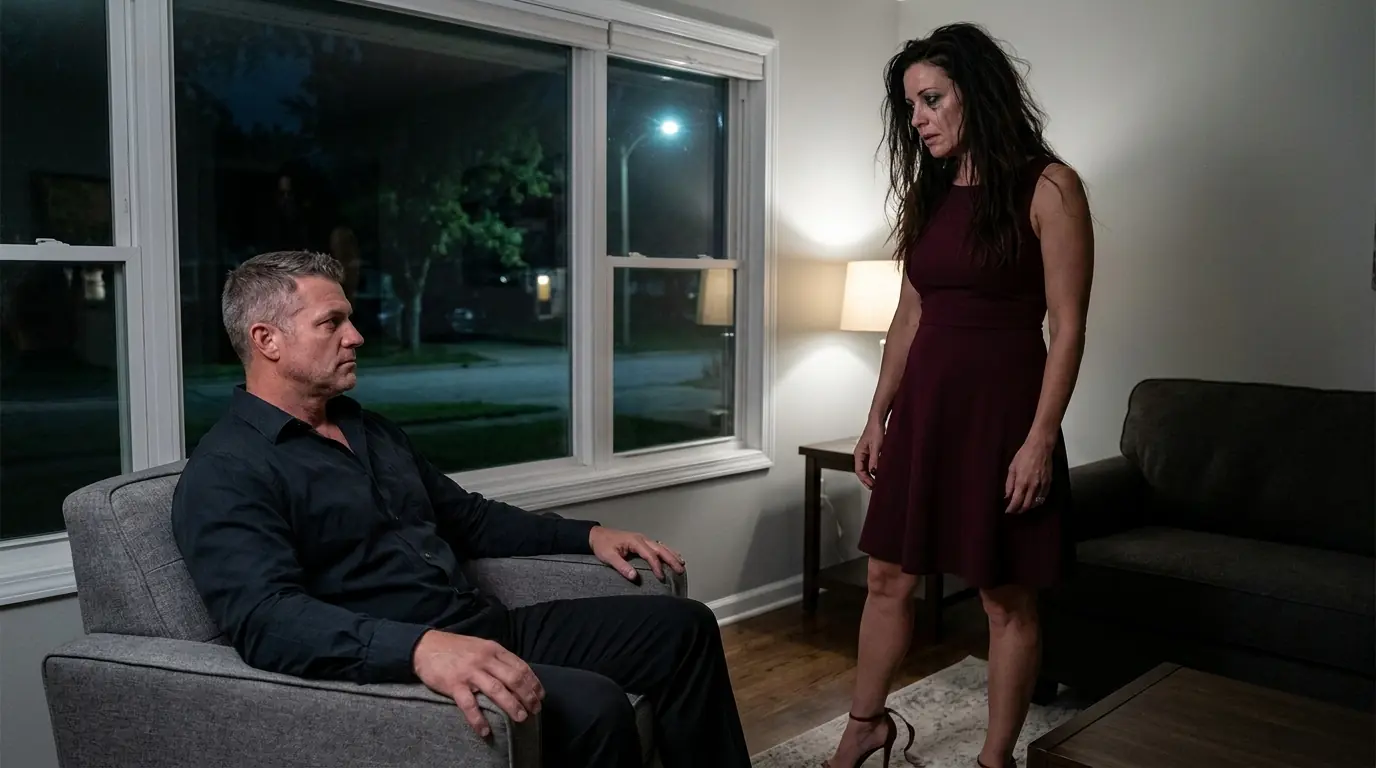
I was sitting in the armchair in the living room when the front door opened. No lights on except the lamp by the bookshelf. The TV was off. I had a glass of water in my hand and nothing on my face that she could read.
Naomi stood in the doorway, still wearing the burgundy dress. One heel strap had come loose, dangling at her ankle like an afterthought. Her mascara had run in two thin lines beneath her eyes, and her hair, which had been carefully arranged when she left, was loose now in a way that looked less like style and more like haste.
She was clutching her phone with both hands the way you grip something when you're trying to keep your story from falling apart. "Al," she said. Her voice came out thin and high. I took a sip of water, didn't answer.
She wasn't prepared for the version that had gone somewhere past loud into something quieter and considerably more permanent. "It wasn't what it looked like." Naomi tried again, moving toward the couch. "Richard and I were just"
"Naomi." I said her name once, level and flat. "I saw you walk out of that elevator. I saw the dress. I know the suite number. I have the credit card record." I paused. "We both know what it was."
She sat down hard on the couch edge, phone still in her hands. The practiced calm she'd been holding started to slip. "You were watching me?" "I was eating my birthday dinner alone," I said. "Then I wasn't."
That landed. Her jaw tightened, then loosened as something that might have been shame moved across her face, but didn't stay long. With Naomi, shame rarely stayed long. "I made a mistake," she said softly. "A terrible one. But you can't just We’ve been together 21 years, Elliot. You can't throw that away over one night."
I looked at her for a moment, really looked. She was still beautiful in the way that certain things are beautiful even after you know exactly what they cost. "You didn't say happy birthday," I said. "Not once today. Not a text. Not a voicemail. Not when you walked in just now." I stood up slowly. "21 years and you couldn't find eight words."
Her mouth opened, closed. I walked down the hallway and stopped at the guest room door, pushing it open. The light was already on. I'd turned it on before she got home, left a bottle of water on the nightstand. "This is where you'll be until you find somewhere else," I said.
Naomi came down the hall after me. Heels clicking unsteady on the hardwood. "You're being dramatic. Let's just talk about this." "You wore that dress for him," I said, turning to face her. "I bought that dress 3 weeks ago. I picked it out because you once told me burgundy was the color that made you feel like yourself." I kept my voice even. "You saved it for him. On my birthday."
The color drained from her face. "I'm not yelling," I continued. "Because yelling would mean I still believe there's something here worth fighting for. And I stopped believing that about 45 minutes ago in a parking lot across the street from the Pinnacle Suites."
She tried the tears next. They came fast and genuine looking. The kind that had worked on me for two decades. Her shoulders curved inward. And her voice broke on my name like it was something precious she'd just dropped. I watched it all without moving.
"Oh, please," she whispered. "I will do anything. Counseling, whatever you need. Just don't do this tonight. Not like this." The guest room has clean towels, I said. Good night, Naomi.
I walked into the master bedroom and closed the door. No slam. Just a soft, decisive click. The kind of sound a well-built door makes when it shuts properly. I sat on the edge of the bed in the dark for a long time. Not crying. Just thinking about 21 years. And what they'd actually added up to. And what I was going to do about it starting first thing in the morning.
Outside, I heard her footsteps pause in the hallway for nearly a full minute. Then the guest room door opened. And closed. The house settled into silence. I set my alarm for 6:00.
I was at the bank by 9:00. Not our bank, mine. The one where I kept a separate business account since the day I incorporated Harrington HVAC 20 years ago. The joint accounts were at First Midland. Three blocks east. That's where I was headed second.
Claire Mercer had managed our accounts at First Midland for going on 7 years. She was sharp, professional, and had the particular gift of making you feel like your financial problems were entirely solvable without actually promising you anything. She was already at her desk when I walked in, and whatever she read in my face told her this wasn't a routine visit.
"Elliot," she said, standing to shake my hand. "What can I do for you?" I need to remove an authorized user from the joint card, I said, settling into the chair across from her. And I need to separate the household savings account. Transfer my half to a new individual account. My name only.
Claire sat back down slowly and folded her hands on the desk. "Of course. I'll need photo ID and the account numbers." She paused just briefly. "Is there anything else I should flag while we're making changes?"
Pull up the travel card transaction history for the last 18 months, I said. I want to see everything she booked. It took Claire 12 minutes to print the records and lay them out. I went through them line by line.
Hotels in three cities, restaurant charges that didn't match any trip we'd taken together. Two spa visits in February when Naomi had told me she was at a conference in Cincinnati. The numbers told a story that was older and wider than one birthday dinner at the Pinnacle Suites.
I thanked Claire, signed what needed signing, and walked out with a new debit card and a very clear picture of exactly how long I'd been the last to know. My next stop was Frank Doyle's office on High Street.
Frank was 58, built like who played linebacker in college and never entirely stopped, and he had the kind of legal mind that made opposing counsel visibly uncomfortable. I'd used him twice for business contracts. He once told me, over bourbon at a firm event, that the most expensive thing a man could do was get divorced without preparation. I'd laughed at the time. I wasn't laughing now.
His assistant showed me in without an appointment. I'd called ahead. Frank was already standing when I came through the door, hand extended. "Tell me," he said. I told him, all of it. The credit card alert, the hotel, the dress, the text. Then I opened the folder I brought and slid it across his desk.
Account statements, property documents, the prenuptial agreement Naomi had signed 11 years ago over a dinner she called unnecessary but fine. She treated it like a formality. I treated it like insurance. Frank read through everything without a word.
When he got to the prenup, he set it down flat and looked at me with something close to professional admiration. "The infidelity clause is solid," he said. "Witnessed, notarized, filed correctly. Her attorney will challenge it, but they'll lose." He tapped the property pages. "The HVAC business, fully premarital. Founded 2 years before we met." I confirmed.
"The lake house." Held in a land trust I set up after my father passed. "Conditional living trust, clause 4C. Infidelity by either party, occupancy and beneficiary rights revert to the grantor immediately." I leaned forward. "That's me."
Frank was quiet for a moment. Then he set down his pen and looked at me directly. "Elliot, you built a better legal wall around this marriage than most men build around their businesses." "I build things for a living," I said. "I know what happens when you skip the load-bearing parts."
He nodded slowly. "How do you want to move?" "Quietly," I said. "Certified mail on the trust. Asset separation notices on everything she's touched. No courtroom drama, no shouting." I sat back. I wanted to feel like the ground disappeared under her feet, because that's exactly what happened to me.
Frank picked up his pen again. "I'll have the trust notice drafted by Thursday." I drove home through lunch traffic thinking about the 18 months of credit card statements spread out on Claire's desk. The conferences that weren't conferences, the February spa visits, the number of times I'd accepted an explanation because it was easier than the alternative.
There's a particular kind of anger that doesn't announce itself. It doesn't raise its voice or throw things or demand an audience. It just settles into your chest like a stone and stays there, cold and certain. And you carry it with you while you do ordinary things, while you drive and eat and talk to clients and sign paperwork. And it doesn't weigh you down so much as it holds you steady.
That's what I had by the time I pulled back into my driveway. Naomi's car was gone. She left while I was out, which suited me fine. I went inside, changed into work clothes, and spent the rest of the afternoon doing what I always did when I needed to think straight.
I drove out to a job site in Westerville where my crew was running new HVAC lines in a three-story office building. And I worked alongside them for 3 hours without saying a word about anything except pipe diameter and airflow calculations.
By 6:00, the certified mail had been scheduled, the bank changes had processed, and Frank Doyle had left a voicemail confirming the trust notice would go out Thursday morning. I stopped at the grocery store on the way home, picked up a ribeye, a russet potato, a bottle of Barolo, the same one I'd opened alone at Brickstone two nights ago.
I cooked myself dinner, ate at the kitchen table with the TV off and the house quiet. It was the best meal I'd had in months. The call came on a Wednesday morning. I was between site visits, parked outside a coffee shop in Dublin with a large black coffee and a folder of subcontractor invoices I'd been meaning to review for a week.
My phone buzzed on the passenger seat and the screen read, "Roy Caldwell." I stared at it for a second. Roy was Naomi's father, 72 years old, 31 years with the Columbus Fire Department before his retirement. The kind of man who shook your hand like he was checking your structural integrity. We'd always gotten along.
He told me once, early in my marriage, that I was the first man Naomi had brought home who looked him in the eye when he asked a direct question. I'd taken that as high praise. I answered on the third ring. "Elliot," he said. His voice was the same as always, low, unhurried, the voice of a man who'd walked into burning buildings and learned not to rush anything.
"Roy," I said, "how are you?" "Seen better weeks," he replied. "Heard about your birthday. She called me 2 days ago. Looking for sympathy, I expect." A pause. She didn't get it. I waited.
"I want you to know something," Roy continued, "and I'm telling you this as a man, not as her father, though I am her father, and this is harder than I'm making it sound." Another pause, shorter this time. "You were the best thing that happened to her. She was always chasing the next shiny object, even as a kid. You were the first thing she held onto that was actually worth holding."
He stopped. "I'm sorry she didn't know that until she'd already let go." I sat in that parking lot with my coffee going cold and said nothing for a long moment. There was something about hearing it from Roy, a man who'd spent three decades running toward disasters instead of away from them, who had no reason to take my side except that he believed it was the right side.
That hit differently than anything else had in the past 72 hours. "I appreciate that, Roy," I said finally. "I mean it." "I'm going to come down next week," he said. "Talk to her myself. Not to fix anything. I know better than that. But she needs to hear some things from someone who's known her longer than you have."
His voice roughed slightly at the edges. "She didn't get this way on her own. Her mother and I made some mistakes raising her. Probably should have let her hear no a few more times than we did." "Roy, you don't have to." "I know I don't," he cut in, not unkindly. "That's why I'm doing it."
We talked for another few minutes. Nothing heavy, just the ordinary conversation of two men who respected each other and were both dealing with the fallout of something they hadn't caused. He asked about Tyler and Avery. I told him they didn't know yet, that I was waiting for the right moment, that I wanted to have the facts settled before I brought the kids into it.
"Smart," Roy said. "Give them something solid to stand on, not just wreckage." After I hung up, I sat there a while longer. The invoices stayed unread. The coffee stayed cold. I thought about what Roy had said. The first thing she held onto that was actually worth holding, and I felt the strange double weight of it. The grief of knowing it had been true, and the quiet resolution that comes when you stop trying to save something that the other person has already decided to let go of.
I drove to my next site visit, checked welds on a rooftop unit in Gahanna, talked to my foreman about a scheduling issue, approved a materials order. Normal things. The stone in my chest was still there, cold and steady.
Thursday morning, right on schedule, the certified trust notice went out by certified mail. I didn't tell Naomi it was coming. I didn't need to. Tyler called me on a Thursday afternoon, 3 days after I'd sent the trust notice.
I was at my desk reviewing a materials bid when his name lit up my phone. I picked up on the second ring, the way I always did with my kids. A habit I'd kept since they both left for college, because unanswered calls from your children have a way of aging you in the minutes before you call back.
"Hey Dad." His voice was flat in a particular way that meant he was working up to something. Tyler was like me. He buried the lead, circled around it, made sure he had the right words before he committed to them. "Hey bud," I said. "What's going on?"
A pause. "I saw something on LinkedIn, about a firm called Kellerman Associates. There was a post. Some woman put up a long thing about a client conflict and professional misconduct." He stopped. "Mom's name wasn't in it, but I know people at her firm, that it wasn't hard to figure out." I set down my pen.
"Tyler, is it true?" he asked, not angry yet, just careful, the way you're careful when you're standing on ice and you're not sure how thick it is. I could have softened it. I could have said it's complicated or let me talk to your mom first or any of the things parents say when they're buying time they don't have.
But Tyler was 20 years old and he'd asked me a direct question and I'd spent his entire childhood teaching him that direct questions deserve direct answers. "Yes," I said, "it's true." The silence on the other end lasted about 4 seconds. Then, he exhaled, long, slow, the sound of something deflating that had been holding pressure for a while.
"How long have you known?" "A week," I said. "I've been handling the legal side before saying anything to you or your sister. I didn't want to give you noise before I had something solid. Avery doesn't know." "Not yet," I said. "I was going to call her tonight."
Another pause. "Do you want me to come home?" That question, quiet and immediate, no hesitation, did something to my chest that I hadn't expected. "No," I said, "stay at school. Keep your grades where they are. That's what I need from you right now."
"Dad." He said it the way his grandfather used to say my name, like a full sentence. "I'm okay, Tyler," I told him. "I mean that." We talked for another 20 minutes. I gave him the facts without editorializing, let him process at his own pace, answered what he asked and didn't volunteer what he didn't.
By the end, he was steadier. Not okay. You don't get to okay in 20 minutes, but steady. Avery was a different conversation. She called me before I could call her, which told me Tyler had reached out to his sister the moment we hung up.
She came in fast and defensive, voice tight and bright in a way that meant she'd been crying before she dialed. "Tell me it's not what Tyler said," she started. "Avery." "Just tell me." "I can't," I said quietly, "because it is."
The sound she made wasn't quite a sob. It was shorter and sharper, like something had knocked the air out of her. Then came the part I'd been dreading. "Dad, she made a mistake. People make mistakes. You and Mom have 21 years. You can't just"
"Avery." I kept my voice even. "I need you to listen to me. Not argue with me. Can you do that?" A pause. "Yeah."
This wasn't a surprise that happened to us both. It was a choice your mother made. More than once. Over a period of time. I didn't raise my voice. I didn't need to. I'd already begun the legal process. That decision is made. What I need from you now is to focus on your semester. And let me handle this end.
Silence. Long enough that I thought the call might have dropped. Then, "Are you okay? Actually okay. Not just saying it." "I'm functional," I said. "Which is the most honest answer I can give you right now."
She flew home that weekend anyway. I didn't argue. She showed up Saturday afternoon with a carry-on bag and her mother's stubbornness and her grandfather Roy's directness. And she walked straight past Naomi, who had come downstairs the moment she heard the door, without saying a word. And hugged me in the kitchen for a long time without speaking.
Then she went into the living room. Sat down across from Naomi. And said, "I want to hear your side." I stayed in the kitchen. Not eavesdropping. Just present. The conversation lasted 40 minutes.
I don't know everything that was said, but I know how it ended. Because I heard Avery's footsteps come back down the hall. And I heard her pause outside the living room door. And I heard her say, quietly and without drama, "I love you, Mom. But I think you know what you did."
Then she came into the kitchen. Picked up her bag. And looked at me. "I'm going back Sunday night," she said. "I've got a project due Monday." She paused. "You're going to be all right." It wasn't a question. She said it the way Roy said things, like a conclusion she'd already reasoned out and was simply filing as fact.
I walked her to her car Sunday evening. We stood in the driveway in the last of the April light and I told her I was proud of her, which I was, more than I'd ever known how to say properly. She drove away without looking back.
That night, the house was quieter than it had been in years. Naomi stayed in the guest room. I stayed in mine and somewhere between 9:00 and midnight, I heard Naomi crying softly through the wall. Not performing, not angling for sympathy, just crying the way people cry when there's no audience and no point to it except that you can't help it.
I lay in the dark and listened and felt nothing except a distant, tired kind of pity and then I went to sleep. The post went live on a Monday. I found it the same way everyone else did, through a colleague who forwarded it with a three-word message, "You should see this."
Sandra Vaughn had no profile photo. The account was 11 days old, which meant she'd created it specifically for this purpose. The post itself was long, 11 paragraphs, single spaced, the kind of thing someone writes and rewrites over several days until every word is precisely where she wants it.
She didn't use names. She didn't have to. Anyone in Columbus' corporate consulting world who read past the third paragraph knew exactly who and what she was describing. The post laid out timeline, a client relationship that had become personal, a hotel suite bill to a corporate expense account, internal firm communications that showed a pattern of preferential treatment and ethical compromise.
It ended with a single line, "The people who are supposed to uphold professional standards should be held to them." Within 48 hours, it had been shared 400 times. I read it once, closed my laptop and went back to reviewing a subcontractor invoice.
I had a job site in Gahanna that needed my attention and a crew in Westerville waiting on a materials approval. The post wasn't my problem to manage. I hadn't written it, hadn't encouraged it, hadn't even known it was coming.
Naomi found out about it at 7:30 that same morning. I know because I heard her on the phone in the guest room at 7:32. Her voice going from carefully controlled to something harder and more brittle within the first 30 seconds of whatever conversation she was having.
She appeared in the kitchen doorway at 8:00. Still in her robe, hair undone, phone clutched at her side. She looked like a woman who'd woken up to find her house had been rearranged while she slept. "Did you know about that post?" she demanded.
I poured a second cup of coffee without turning around. "Good morning, Elliot. Did you have anything to do with that?" I turned and looked at her steadily. "No," I said. "I imagine Sandra Vaughn had everything to do with it."
She made a sound, not quite a word, not quite anything, and pressed her fingers against the bridge of her nose. "This is going to destroy me professionally. That post is being shared by people I've worked with for 15 years. My boss called me before 7:00 this morning."
"What did he say?" "He said HR wants a meeting." Her voice had gone thin and tight. "He said it looks like I created a liability for the firm." I nodded once. "You did."
The look she gave me was the kind that 6 months ago would have made me walk it back, soften the edges, find something more diplomatic to say. Instead, I picked up my coffee cup and waited. "I need you to tell them we were having problems," she said. "Tell HR we were separated, that this wasn't what it looks like, that it was a personal situation that got complicated. Please, just give me a buffer. Help slow this down."
I set the cup down on the counter with a quiet click. "You want me to lie to your employer so you keep your job." "I want you to help me," she said, and her voice broke slightly on the last word in a way that sounded genuine. "I know I don't deserve it. I know that, but I'm asking anyway."
I looked at her for a long moment. She was still beautiful in the wreckage of herself, and that fact no longer moved me the way it once had. "No," I said. She blinked.
"I supported you through two job changes, three salary negotiations, and a licensing renewal that took 8 months." I continued, keeping my voice level. "I proofread your presentations at 11:00 at night. I moved our vacation twice so you could close accounts. And when I needed you to show up for one evening, my birthday, you were 4 miles away in someone else's suite."
I picked up my keys from the counter. "Your career is not my responsibility to protect." She didn't answer. The fight had gone out of her somewhere in the middle of that, and what was left was something raw and less polished. A woman in a bathrobe standing in a kitchen that was slowly becoming someone else's.
I walked past her and out the door. By Thursday, the HR investigation had expanded. By Friday afternoon, Naomi had been placed on unpaid administrative leave pending review.
Her boss, a careful man who had spent 20 years keeping his firm out of headlines, had no appetite for the story Sandra Vaughn's post was telling. I heard Naomi on the phone again that evening. Different tone this time, quieter, less sharp. She was calling a lawyer.
"Good," I thought. She was going to need one. The certified envelope arrived on a Thursday morning. I know the exact time because I was sitting at the kitchen table with my second cup of coffee when I heard the mail slot open, and the sound of the envelope landing on the hardwood floor was different from the usual soft flutter of bills and circulars. Heavier, deliberate, the sound of something official announcing itself.
I didn't move. Naomi was still asleep in the guest room. She'd been keeping late hours. I could hear her on the phone until well past midnight. The muffled cadence of damage control conversations. The kind where every sentence is a negotiation and none of them end cleanly.
She contacted a lawyer 3 days earlier. Good. She was going to need one. I heard her wake up at 8:40. The guest room door, the bathroom, the shuffle of slippered feet on the hallway floor. Then a pause. She must have seen the envelope from the hallway.
And then the sound of her picking it up. I refilled my coffee. The silence that followed lasted almost two full minutes. Then came the sound I'd been waiting for without quite realizing it. A sharp, involuntary intake of breath like someone stepping off a curb they didn't see coming.
Then footsteps, faster now, and Naomi appeared in the kitchen doorway holding the open envelope with both hands. The letter inside it partially unfolded. "What is this?" Her voice had lost all its usual composure. Raw edges where the polish used to be.
"It's a formal notice from the trustee of the Harrington Land Trust," I said. "Clause 4C has been triggered. Occupancy and beneficiary rights on the lake house revert to me effective immediately. You have 10 days to remove any personal belongings stored on the property."
She stared at the letter, then at me, then back at the letter as if reading it again might change the language. "The lake house?" she said slowly. "You're taking the lake house?"
"I'm not taking anything," I said, keeping my voice even. "The trust document has a clause for this specific situation. You signed a marriage settlement agreement that acknowledged the trust terms. This is the clause activating. I didn't write it last week. I wrote it 11 years ago."
She set the letter on the table pressing both palms flat against it as if she could hold the words down. "You built a legal trap and waited for me to walk into it." "I built a contingency," I said. "The same way I build contingencies into every contract I sign because I understand what happens to structures that don't account for failure points."
I looked at her steadily. "You called that overly cautious once. You said only paranoid men plan for marriages falling apart." Her jaw tightened. "You were planning for me to cheat on you."
"I was planning for the possibility that either of us might make a catastrophic mistake," I said. "Turns out the planning was necessary." She picked up the letter and turned away, moving to the window. Her shoulders were rigid, her breathing audible.
Outside, the April morning was doing what April mornings do in Ohio, gray sky, light wind, the neighborhood going about its business without any awareness of what was happening inside this kitchen. "That place is mine, too," she said finally. The anger had gone out of her voice, and what was left was quieter and more honest. Not a woman mounting a defense, but a woman arriving at the real cost of something.
"I spent every summer there for 15 years. I planted those hydrangeas along the south fence. I picked out every piece of furniture in that living room." "You did," I agreed. "And I paid the property taxes every year. I fixed the roof in 2019. I replumbed the entire water system the summer before last because I knew what deferred maintenance does to a structure."
I paused. "You planted the hydrangeas. I kept the foundation solid. We both know which one of those things the house actually needed." She turned around. Her eyes were bright with tears she was working hard not to shed.
And for a moment, just a moment, I saw the woman I'd married in the set of her jaw and the stubborn angle of her chin, and it cost me something quiet and private that I didn't intend to show. "You're not going to give an inch," she said, not accusing, almost wondering.
"No," I said, "I'm not." She left the kitchen without another word. An hour later, I heard her on the phone with her attorney, voice tight and clipped, asking about contesting trust documents.
Her attorney must have given her the answer Frank Doyle had already anticipated because the conversation ended quickly and quietly. That afternoon, I drove to the lake house alone. It was a 2-hour drive northeast through Columbus suburbs that gave way to flat farmland and then to the particular green gray of an Ohio lake district in early spring.
I parked in a gravel drive, unlocked the front door, and walked through each room slowly. The furniture Naomi had chosen was still there. The linen sofas, the reclaimed wood dining table, the gallery wall of framed photographs that stopped just short of being sentimental. All of it solid and well chosen. I'd give her that.
I walked down to the dock and stood at the end of it for a long time. The water was steel colored and flat. A heron stood motionless in the shallows 20 yards out, patient and perfectly still, waiting for the right moment. I understood the posture.
I drove back to Columbus as the light was failing, stopped for gas, picked up a bag of groceries, cooked dinner. Naomi's car was gone when I got home. She'd gone to her sister's for the night, which suited us both.
I ate alone in a quiet house, and the quiet felt less like absence and more like room to breathe. Richard Vaughn came to my door on a Saturday morning. I'd half expected it, the way you half expect certain kinds of weather. Not because you've checked the forecast, but because you've lived long enough to know how these things tend to move.
He was the type of man who believed that every problem yielded to a direct conversation, preferably initiated by him, at a time and location of his choosing. I was in the driveway when he pulled up, washing my truck, sleeves rolled, radio playing low from the open garage door.
I watched him park his Audi at the curb, straighten his jacket as he got out, and walk up the drive with a measured stride of a man composing himself as he moved. He was taller than I remembered, silver-haired, well-dressed, the kind of tan you get from actual travel rather than a booth.
He stopped 6 ft away and extended his hand. "Elliot," he said, "I'd like to talk, man to man." I looked at the hand for a moment, then looked back at his face. I didn't take it.
I turned back to the truck and ran the sponge across the hood. "Say what you came to say," I told him. He lowered his hand without missing a beat. I'd grant him that, he had composure.
"I know there's nothing I can say that makes this right," he started. "I'm not here to make excuses. What happened was wrong, and I take responsibility for my part in it." I kept washing.
"I'd like to offer some form of restitution," he continued. "Financial, if that's" "I'm not trying to insult you. I just want to" "Stop," I said. He stopped.
I turned around, sponge in hand, and looked at him directly. "You came here because you're used to problems having a price. You find the number, you write the check, you move on." I kept my voice flat and conversational, the way I'd talk to a subcontractor who'd made an error I wasn't going to accept.
"I don't have a number, and if I did, you couldn't cover it." I turned back to the truck. "You should go." He stood there for another few seconds. I could feel him recalculating, looking for another angle. There wasn't one.
"For what it's worth," he said quietly, "she talked about you, more than you'd probably want to know." "I'm sure she did," I said. "Doesn't change anything."
His footsteps retreated down the driveway. The Audi door opened and closed. He pulled away from the curb cleanly, no drama, no delay. Whatever he'd come hoping to walk away with, he hadn't found it.
I finished washing the truck. The following Tuesday, I made a call to the dealership where I leased two of her vehicles. One was mine, the F-250 I used for site visits. The other was a black Lexus SUV registered under Harrington HVAC LLC, which Naomi had been driving for 3 years as part of what she'd always referred to, with comfortable vagueness, as a family arrangement.
It wasn't a family arrangement. It was a company asset, leased under a corporate account, insurance paid by the business, maintenance scheduled through my fleet account. Her name appeared nowhere on the documentation.
I called the fleet manager, arranged a voluntary return, and had the vehicle picked up from Naomi's sister's address, where it had been parked since her move. No confrontation, no conversation. A driver and a transport car arrived, collected the keys from the building's front desk where I'd arranged to have them left, and the Lexus was gone by 2:00 in the afternoon.
I transferred the lease equivalent savings for the remaining term into Tyler's education fund. $4,100, moved quietly, the way I prefer to move things. Naomi called at 4:17. I let it go to voicemail. She called again at 4:31. I listened to that one.
Her voice in the message was somewhere between fury and disbelief. The kind that comes not from genuine shock, but from a specific outrage of someone who assumed an arrangement was permanent and has just discovered it was always conditional.
She used the word unfair twice and the phrase you can't just once. I could, in fact, just. I deleted the voicemail, put my phone face down on my desk, and returned to the materials estimate I'd been working on.
I had a large commercial retrofit coming up in Dublin, a 12-unit complex that needed full HVAC replacement, and the bid was due Friday morning. I worked until 7:00, made a sandwich, took a walk around the block as the sun went down, hands in my pockets, the neighborhood settling into its evening routines all around me.
Lawn mowers finishing up, kids called in for dinner, porch lights coming on one by one like small decorations of ordinary life continuing. I thought about the hydrangeas along the fence of the lake house. Naomi had planted them the summer after Tyler was born in the good years when everything still felt like it was building towards something.
They were beautiful plants. I'd water them every year. I'd keep watering them. The call from Kellerman Associates came on a Tuesday. I found out about it the same way I found out about most things that involved Naomi's professional life in those weeks, through the absence of information rather than the presence of it.
She stopped mentioning work entirely, which told me more than any update would have. When a person who spent 15 years making her career the centerpiece of every dinner conversation goes suddenly quiet on the subject, the silence has a shape.
Dennis Carver told me the rest. Dennis and I had known each other since our early 30s. We met through a trade association, stayed friends through the ordinary accumulation of shared history that turns acquaintances into something more durable.
He ran a commercial electrical contracting firm in Hilliard, knew half of Columbus's business community by first name, and had the kind of social radar that picked up professional gossip before it had fully formed.
He called me on a Wednesday afternoon and asked if I had time to talk. I told him yes. He drove over, sat at my kitchen table, and said what he had to say without dressing it up.
"I saw Naomi with Richard Vaughn in October," he said, "at the Capital Club. They were having dinner, and it wasn't a business dinner." He looked at me steadily. "I told myself I wasn't sure. I told myself I might be misreading it." A pause. "I've been telling myself that for 6 months."
I looked at him across the table. "6 months, Dennis." "I know." He didn't look away. "I was wrong to wait. I'm not going to pretend otherwise."
I stood up, walked to the window, looked out at the backyard for a moment. The apple tree Naomi had planted the spring after we moved in was beginning to bud, small, pale green, indifferent to everything.
"We've been friends for 16 years," I said. "We have," he agreed. "And you sat on that for 6 months." "I did." He didn't flinch from it. "I thought I was protecting the marriage. I was actually just protecting myself from a hard conversation."
I turned around. There was real accountability in his face, not performance, not an angle, just a man who'd made a wrong call and was willing to own it completely. That counted. It didn't erase 6 months, but it counted.
"I need some time," I said. He nodded, stood, put on his jacket. "I'll be here when you're ready." He left without asking for forgiveness, which was the right instinct. Forgiveness, when it came, would come on my schedule.
3 days later, Naomi's firm made it official. HR had completed its review. The expense report irregularities, the ethical conflict with the Vaughn account, the LinkedIn fallout. Taken together, they'd built a case that our managing partner apparently had no appetite to defend.
Her access was revoked on a Friday morning. Her name disappeared from the firm's website by noon. She came home that afternoon carrying a small cardboard box, the kind of box that fits exactly one desk worth of a professional life, and set it on the kitchen counter without saying anything.
I was making coffee. I glanced at the box, then at her. She looked hollowed out, not the performed vulnerability she'd been using in our conversations, but genuine, bone-deep exhaustion. The face of a woman who'd watched everything she'd built professionally dissolve inside of 3 weeks.
"They let me go," she said. "I know," I said. She pulled a photo from the box, the two of us at a company event years ago, me in a jacket I'd long since given away, her in the kind of confidence smile she wore when everything was going according to plan.
She sat on the counter, then picked it up again, then put it face down without looking at it. "I don't expect you to feel sorry for me," she said. "Good," I replied quietly, "because I don't. But I don't feel glad, either. There's a difference."
She nodded slowly, picked up the box, and carried it to the guest room. I heard the door close. That evening, I called Tyler, told him what had happened. He was quiet for a moment, then said, "Is she okay?"
Which was exactly the response I'd expected from him. Practical concern, no drama. I told him she was managing. He told me he'd check in with her. I told him that was up to him, not me. Then I called Avery.
She was quieter about it, in the way she was quiet when she was processing something she hadn't fully resolved. Before she hung up, she said, "You know what I keep thinking about, Dad? You made that reservation 3 weeks ahead. You called about the wine." A pause. "You were trying."
"I was," I said. "That matters," she said. "Even if it's too late to matter the way it was supposed to." I sat with that for a long time after we hung up.
8 months later, on the third Thursday of April, I made a reservation at Brickstone Grill. Same table, corner, by the window. I called ahead about the Barolo. Tyler drove down from Columbus. Avery flew in from Denver. She'd booked the flight 2 weeks earlier without telling me.
Showed up at the house Friday morning with a duffel bag and the quiet confidence of a young woman who decided that some things were worth showing up for. We got to the restaurant at 7:15. The hostess led us to the corner table, and Tyler held out the chair across from him for his sister with the automatic courtesy that told me, not for the first time, that I'd done something right somewhere in the middle of everything else.
The Barolo arrived. Three glasses this time. Tyler lifted his. "To the old man," he said, "who apparently had a lawyer on speed dial before any of us knew we needed one." Avery snorted. "You're such a disaster," she told her brother, which was the most affectionate thing she ever said to him.
I raised my glass, didn't make a toast, just drank. The tiramisu came at the end of the meal, one portion, not divided. The waiter set it in the center of the table, and the three of us demolished it with three spoons and no ceremony whatsoever.
And it was better than anything I'd eaten alone at that table 12 months earlier. The divorce had been finalized 7 weeks prior. Frank Doyle had been efficient, thorough, and mercifully undramatic about the whole process.
The prenuptial agreement had held exactly as written. The lake house remained mine. The business had never been in question. Naomi had retained a modest cash settlement and the furniture from the guest room, which struck me as appropriate. She'd chosen it. She could keep it.
She'd moved to Cincinnati 3 months after her termination, which was where her sister lived and where, I gathered through Tyler, she was working as an independent consultant, smaller accounts, less prestige, a professional life rebuilt from a narrower foundation.
I wished her no particular harm. I also wished her no particular help. Roy Caldwell called me on my birthday that morning, just to say he was thinking of me. We talked for 10 minutes about nothing important, his garden, my Dublin project, the Buckeyes spring depth chart.
Before he hung up, he said, "You raised those two right, Elliot. Whatever else happened, you got that part right." I thought about that at the restaurant, watching Tyler explain something to Avery with the animated hand gestures he'd had since he was 7 years old, watching her listen with the focused attention she'd had since she was five.
Roy was right. I got that part right. The bill came. Tyler grabbed it before I could. "My treat," he said. "Don't argue." I didn't argue.
We walked out into an April night that was warmer than last year's by a reasonable margin, which felt less like symbolism and more like plain good weather. And I decided that was fine. Not everything needed to mean something. Some things were just better than they'd been.
I drove home with the windows down and the radio on low, and when I pulled into the driveway and cut the engine, I sat for a moment in the quiet of an ordinary evening. The neighborhood settling in, lights on and windows up and down the street, a dog barking somewhere two blocks over.
47 years old, business solid, kids good, house mine. That was the whole inventory, and it was more than enough to build from.