Rain hammered Oakmont so hard that the streetlights looked smeared across the windshield of Kenneth Harrison’s black Audi A8. At fifty-five, Kenneth had spent nearly three decades inside courtrooms and currently served as Chief Judge of the Fourth District Court, but that night he looked like any exhausted professional driving home late from work. His black judicial robe hung neatly inside a protective cover across the back seat, while a brown leather briefcase filled with emergency court documents rested beside him. He should have been heading home, but an urgent call from the night clerk had sent him back toward downtown to review an injunction that could stop the illegal demolition of an entire residential block before sunrise.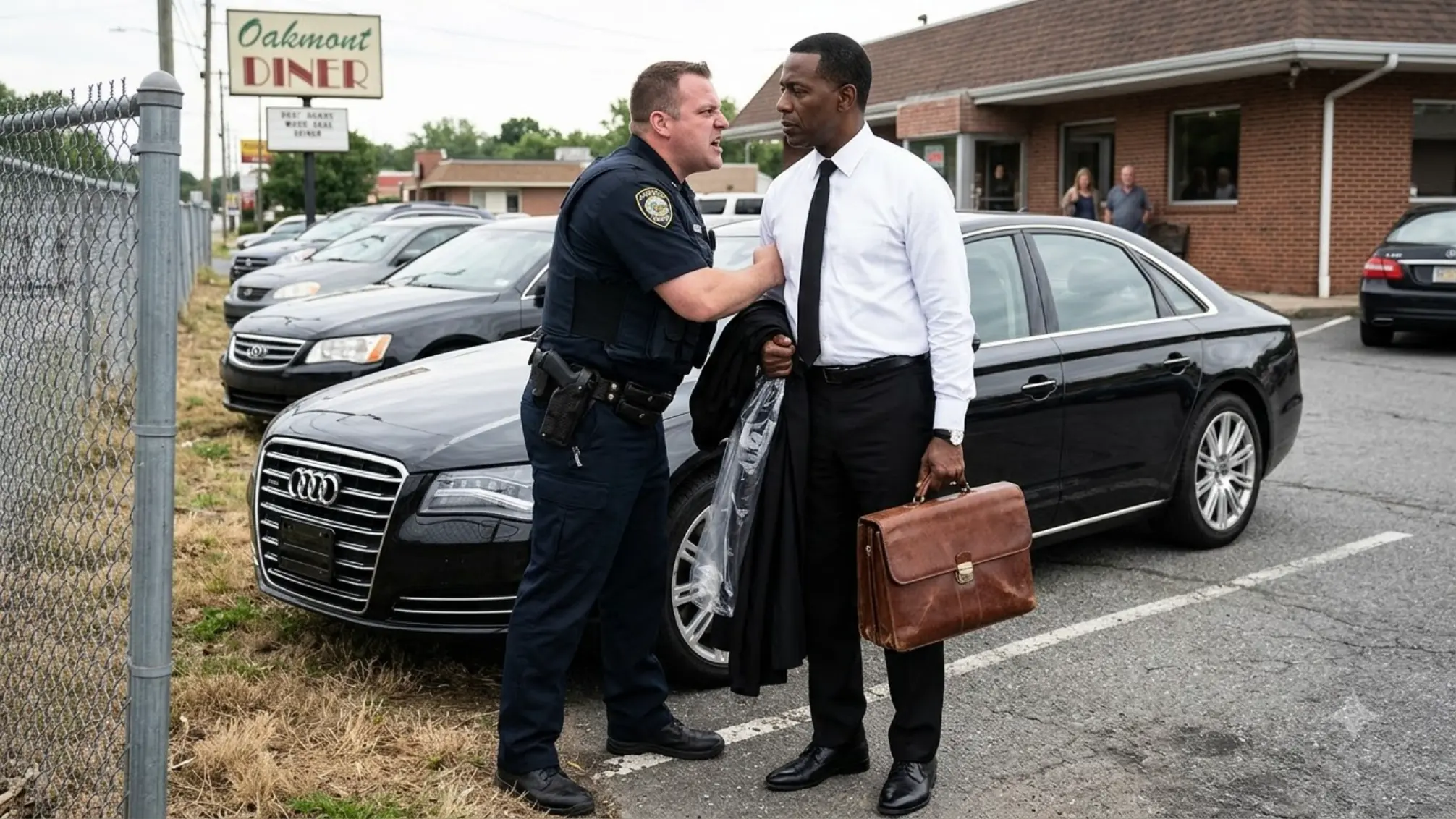
Kenneth had just left a charity gala and had removed his suit jacket because the wet August air made the car uncomfortable. He wore a crisp white dress shirt, narrow black tie, tailored trousers, and polished shoes, with his courthouse identification tucked inside the front compartment of his briefcase. As he turned onto Grand Avenue, red-and-blue lights suddenly exploded across his mirrors. Kenneth immediately slowed, activated his hazard lights, and pulled into the illuminated parking lot of an all-night roadside restaurant.
He placed both hands on the steering wheel and waited. A broad white officer in his early forties approached from behind, rain running down the shoulders of his dark navy uniform and tactical vest. His nameplate read BRENT CALLOWAY, and his expression suggested he had already decided what kind of stop this was going to be. Calloway stopped beside the driver’s window, looked through the luxury interior, then stared at Kenneth as though the combination did not make sense to him.
“License and registration,” Calloway said sharply. Kenneth lowered the window and answered calmly, “Of course, Officer. They’re in my wallet and glove compartment.” Calloway leaned closer and looked toward the back seat. His eyes landed on the black robe hanging beneath plastic, and a short laugh escaped him.
“What’s that supposed to be?” Calloway asked. Kenneth followed his gaze. “My court robe.” The officer’s smile widened. “Nice costume.”
Kenneth looked back at him without changing expression. “It isn’t a costume.” Calloway tilted his head and looked again at the Audi, the leather briefcase, and Kenneth’s clothing. “Sure it isn’t.”
Kenneth handed him his driver’s license and registration. Calloway stared at the license for several seconds, then asked, “Where did you get this car?” Kenneth’s eyes narrowed slightly. “From the dealership where I purchased it.” Calloway looked unimpressed.
“I’m asking who owns it.” Kenneth pointed toward the registration already in Calloway’s hand. “The document you’re holding answers that question.” The officer’s jaw tightened. “You want to be smart with me?”
Kenneth had spent his entire career watching people destroy themselves because they could not control a moment of anger. He understood authority, procedure, and exactly how dangerous it could become when someone carrying a badge interpreted calm disagreement as disrespect. He kept both hands visible and said, “I’m answering your questions. May I ask why you stopped me?”
Calloway glanced toward the license plate. “Vehicle matching the description of one involved in suspicious activity.” Kenneth waited. “What description?”
“Black sedan.” Kenneth looked across the wet parking lot. Three black sedans were visible without him turning his head. “Anything more specific?”
Calloway’s face hardened. “You don’t conduct the investigation.” Kenneth nodded once. “Then conduct it.” The words were quiet, but Calloway heard a challenge anyway.
The officer stepped backward and ordered Kenneth out of the vehicle. Kenneth asked whether he was being detained. Calloway replied that he could either step out voluntarily or be removed. Knowing escalation would accomplish nothing, Kenneth opened the door slowly and stood beneath the restaurant’s awning while rain blew sideways across the pavement.
Calloway immediately ordered him to place his hands on the roof. Kenneth complied. “Officer, I have court materials in the vehicle that are time-sensitive,” he explained. “I would appreciate resolving this quickly.” Calloway laughed again.
“Court materials?” He opened the rear door without asking and pulled the protective plastic away from the robe. “This your little judge costume?” Kenneth turned his head slightly. “Do not damage that.”
Calloway grabbed the robe by one shoulder and held it up. “What, you doing courtroom parties now?” Kenneth’s expression finally hardened. “Place the robe back in the vehicle.” Calloway looked at him and deliberately dropped it across the seat.
The officer then reached for the brown leather briefcase. Kenneth immediately said, “That contains privileged judicial documents. You do not have permission to open it.” Calloway turned toward him. “You don’t tell me what I’m allowed to inspect during a traffic stop.”
“I absolutely do when you are attempting to search sealed court materials without consent or legal justification.” Calloway’s face flushed. “Turn around.”
Kenneth remained still. “For what purpose?” Calloway stepped close enough that his chest nearly touched Kenneth’s shoulder. “Turn around before I do it for you.”
Kenneth slowly faced him. Calloway seized his arm, twisted it backward, and pushed him toward the Audi. The restaurant customers near the windows began staring. One woman raised her phone and started recording.
“Do not resist,” Calloway shouted. Kenneth’s cheek nearly touched the wet roof. “I am not resisting.”
“Stop talking.” A handcuff closed around Kenneth’s right wrist. “You are escalating this unnecessarily,” Kenneth said.
The second cuff snapped shut. Calloway leaned close. “People like you always think you can talk your way out of consequences.” Kenneth looked over his shoulder. “People like me?”
Calloway paused. “People who think money makes them important.” Kenneth said nothing.
A second patrol vehicle entered the parking lot. Officer Lisa Moreno, a thirty-six-year-old patrol supervisor, stepped out and immediately took in the scene: expensive sedan, handcuffed man in formal clothing, Calloway standing beside an open rear door, and a judicial robe lying across the seat. Her expression changed before she said anything.
“What happened?” she asked. Calloway answered quickly. “Possible stolen vehicle. Suspect became argumentative and obstructive.” Kenneth looked toward her. “The registration matches my identification.”
Moreno looked at Calloway. “It does?” Calloway hesitated. “The car checks clean, but something’s off.”
“What?” she asked. He gestured toward Kenneth. “Look at the setup. Luxury car, fake judge robe, expensive briefcase. Doesn’t add up.”
Moreno’s eyes moved slowly toward the robe. Then she looked at Kenneth. “Sir, what is your name?”
“Kenneth Harrison.” Something flickered across her face. “Kenneth Harrison?”
“Yes.”
Calloway laughed. “Don’t tell me you recognize him from some television courtroom show.” Moreno ignored him. “What do you do, Mr. Harrison?”
Kenneth met her eyes. “I am Chief Judge of the Fourth District Court.”
Calloway burst out laughing.
“Of course you are.” He grabbed the robe again and held it toward Moreno. “See? Costume.”
Moreno did not laugh. She had worked courthouse security details early in her career. She had attended warrant hearings in the Fourth District. She had never personally spoken to Kenneth Harrison, but the name was impossible to forget.
“Brent,” she said carefully, “take the cuffs off.”
Calloway stared at her. “What?”
“Remove the cuffs.”
“He’s lying.”
Moreno pulled out her phone. “Then give me thirty seconds.”
Kenneth stood beside the Audi in silence while Moreno contacted dispatch. Calloway shook his head, irritated that she was taking the claim seriously. Across the parking lot, the woman recording moved closer.
Dispatch answered through Moreno’s radio. “Unit twelve, go ahead.” Moreno gave Kenneth’s name and date of birth from the license.
There was a brief pause.
Then the dispatcher’s voice changed.
“Supervisor, confirm the subject is Kenneth Elijah Harrison?” Moreno looked at Kenneth. “Confirmed.”
Another pause followed. “Be advised, Kenneth Elijah Harrison is listed through state judicial security records as Chief Judge, Fourth District Court. Additional caution notice indicates protected judicial official.”
The parking lot went silent.
Calloway stopped moving.
Moreno looked directly at him. “Take the cuffs off.”
Calloway’s face changed from confidence to disbelief. “That doesn’t mean he’s actually—”
The radio interrupted. “Unit twelve, courthouse security is requesting immediate confirmation of Judge Harrison’s status. They’ve been trying to contact him regarding an emergency injunction hearing.”
Kenneth closed his eyes briefly.
The demolition.
He looked toward Moreno. “Officer, I need my phone.”
Moreno removed the handcuffs herself. Red marks had formed around Kenneth’s wrists. She apologized quietly and handed him the phone from the car.
Three missed calls appeared from the night clerk.
Kenneth dialed immediately.
“Judge Harrison?” the clerk answered. “Where are you?”
“I’ve been delayed.”
“The demolition contractor moved equipment onto Brookfield Street twenty minutes ago. They’re claiming the city permit overrides the preservation petition.”
Kenneth glanced at Calloway. The officer had suddenly become very interested in the wet pavement.
“Send the petition and emergency supporting exhibits to my secure account,” Kenneth said. “Contact Judge Albright as backup and tell counsel I will review remotely until I reach chambers.”
“Yes, Judge.”
Kenneth ended the call.
Calloway finally spoke. “Look, Judge, I didn’t know who you were.”
Kenneth slowly turned toward him.
“That is the least important thing you have said tonight.”
Calloway frowned.
Kenneth stepped closer, no longer restrained and no longer willing to make himself smaller to protect the officer’s comfort. “The problem is not that you failed to recognize a judge.”
Rain struck the pavement between them.
“The problem is that you believed I deserved different treatment before you knew I was one.”
Calloway opened his mouth.
Kenneth raised one hand.
“No.”
The single word stopped him.
“You stopped a legally registered vehicle, accused me of stealing it without evidence, searched the interior after I denied consent, handled protected documents, called my robe a costume, handcuffed me after I complied with every lawful instruction, and then told your supervisor something about me simply did not ‘add up.’”
Calloway looked toward Moreno. “I had reasonable suspicion.”
“Then articulate it.”
Calloway’s jaw tightened.
Kenneth waited.
“What specifically did I do?”
Silence.
“What traffic law did I violate?”
Calloway did not answer.
“What description did my vehicle match beyond being a black sedan?”
Still nothing.
Kenneth’s voice became quieter.
“Exactly.”
Moreno stepped between them before the confrontation became worse. “Judge Harrison, I need to notify my lieutenant.”
“You need to preserve Officer Calloway’s body-camera footage.”
Her eyes met his.
“Yes, sir.”
“Not because I’m a judge.”
Moreno nodded slowly.
“Because that is what should happen for anyone making this complaint.”
Kenneth retrieved the judicial robe from the back seat and carefully straightened the plastic covering. He checked the briefcase next, confirming the seal remained intact. Then he photographed his wrists.
Calloway watched him.
“You planning to sue me?”
Kenneth looked at him.
“I’m planning to make sure the facts survive the night.”
That sentence frightened Calloway more than any threat could have.
Kenneth reached the courthouse forty-two minutes later. He entered through the private judicial garage, changed into his robe, and walked directly into chambers. By 1:16 a.m., he had reviewed photographs, property records, demolition permits, historic preservation filings, and sworn statements submitted by residents of Brookfield Street.
The demolition authorization was deeply flawed. A city inspector had issued final clearance despite a pending preservation appeal, and the contractor intended to begin before residents could obtain judicial review. Kenneth signed a temporary emergency injunction electronically and ordered service before any structure could be touched.
At 1:43 a.m., the first demolition excavator shut down.
By sunrise, twenty-three families who had expected to wake to machinery outside their homes still had homes.
Kenneth did not think about Officer Calloway again until the next afternoon.
Then his judicial security liaison entered chambers carrying a sealed packet.
“Judge, Internal Affairs contacted court administration.”
Kenneth removed his glasses. “About last night?”
“Yes.”
The liaison hesitated.
“There’s more.”
He placed the packet on Kenneth’s desk.
Calloway had been the subject of eleven citizen complaints in five years. Seven involved traffic stops. Four involved Black drivers.
Kenneth’s expression did not change.
“Disposition?”
“Eight cleared internally.”
“And the others?”
“Two counseling memos. One pending.”
Kenneth looked through the summaries.
The language repeated itself.
Driver appeared nervous.
Driver became verbally confrontational.
Officer perceived inconsistent answers.
Vehicle appeared inconsistent with subject’s stated employment.
Kenneth stopped reading.
That last phrase appeared twice.
He looked up. “Pull the actual footage.”
“We don’t control police evidence.”
“Then ask Internal Affairs whether they preserved it.”
The liaison nodded.
Kenneth leaned back.
One bad traffic stop could be incompetence.
Eleven complaints demanded a different question.
Three days later, Oakmont’s police chief requested a private meeting.
Chief Samuel Greene entered Kenneth’s chambers carrying a binder. He was sixty, tired-looking, and serious enough not to begin with excuses.
“We have a problem,” Greene said.
Kenneth closed a case file.
“I know.”
“No. I mean larger than Calloway.”
Greene opened the binder.
Internal Affairs had reviewed random samples of Calloway’s traffic stops after the incident. The pattern was difficult to ignore. Black drivers were searched at a significantly higher rate than comparable white motorists despite producing fewer recoveries of illegal items.
Kenneth read the numbers twice.
Greene continued. “We also found supervisors repeatedly accepting vague justification language without requesting supporting facts.”
“Meaning?”
“Meaning Calloway learned that if he wrote ‘suspicious behavior,’ nobody asked him to define suspicious.”
Kenneth’s mouth tightened.
The chief looked embarrassed.
“We trained officers on constitutional standards.”
“Training is not accountability.”
“No.”
“You had complaints.”
“Yes.”
“You had video.”
“Yes.”
“You had supervisors.”
Greene lowered his eyes.
“Yes.”
Kenneth closed the binder.
“Then the system had information and chose comfort.”
The chief did not argue.
Calloway was placed on administrative leave while Internal Affairs expanded its review. The body-camera recording from Kenneth’s stop became central because it captured almost everything clearly: the clean registration, Kenneth’s calm responses, Calloway’s comments about the robe, the unauthorized search, and the complete absence of threatening behavior before the handcuffs appeared.
Then investigators found something more damaging.
Calloway’s written report stated Kenneth had “repeatedly refused commands” and “attempted to interfere with vehicle verification.”
The video showed neither.
Moreno confirmed it.
So did dispatch.
So did the restaurant witness whose phone recording had captured the arrest from another angle.
The incident changed from poor judgment into possible falsification.
Kenneth refused every interview request during the investigation. Television crews parked outside the courthouse, commentators argued about policing, race, privilege, and judicial authority, and social media turned fragments of the body-camera recording into endless debates. Kenneth released one written statement.
It contained three sentences.
My position should not determine whether my rights are respected. The concern is not that an officer failed to recognize a judge, but that ordinary compliance was treated as suspicious until status proved otherwise. Any review should focus on whether every resident of Oakmont receives the same presumption of dignity and lawful treatment.
Nothing more.
Six weeks later, a disciplinary hearing began.
Kenneth did not preside.
He insisted the matter remain completely separate from his court and recused himself from any proceeding that could involve Calloway. An outside review panel handled the administrative case, while state investigators examined the allegedly false report.
Moreno testified.
The restaurant witness testified.
Dispatch logs were introduced.
Then Calloway testified.
His attorney argued that officers make rapid decisions under uncertain conditions. That was true, and Kenneth had spent his career respecting that reality.
But uncertainty was not the same as invention.
Calloway admitted the Audi had returned clean before Kenneth was handcuffed. He admitted he had no specific stolen-vehicle report matching the plate, year, or model. He admitted he had interpreted Kenneth’s questions as “attitude.”
Then the panel played the body-camera footage.
Kenneth’s voice came through clearly.
May I ask why you stopped me?
Then:
The document you’re holding answers that question.
Then:
That contains privileged judicial documents. You do not have permission to open it.
No shouting.
No threats.
No physical resistance.
Calloway’s own voice sounded far more aggressive.
When the footage ended, nobody needed a dramatic speech.
The evidence had already spoken.
Calloway was dismissed from the department following findings involving misconduct, improper detention, unauthorized search practices, and false statements in official documentation. State prosecutors later negotiated a resolution on the report-falsification allegation that included probation and permanent loss of law-enforcement certification. Kenneth neither celebrated nor objected.
He returned to work.
But Chief Greene did not allow the department to return to normal.
Oakmont established automatic supervisory review whenever an officer searched a vehicle without contraband being recovered. Traffic-stop reports involving vague phrases such as “suspicious behavior” required officers to describe the specific observable conduct supporting that conclusion.
Complaint files could no longer disappear into local supervisory chains without external auditing.
Body-camera preservation periods increased.
Statistical disparities became review triggers rather than public-relations inconveniences.
Moreno was promoted months later to lead a new professional standards unit.
The first time she visited Kenneth’s chambers afterward, she looked uncomfortable.
“You know people say you got me promoted.”
Kenneth smiled faintly.
“I did not.”
“You wrote a recommendation.”
“I wrote that you corrected another officer when doing so was professionally inconvenient.”
“That helped.”
“It should.”
Moreno looked toward the black robe hanging near the chamber door.
“Do you ever think about that night?”
Kenneth leaned back.
“Yes.”
“Angry?”
“Sometimes.”
“At Calloway?”
Kenneth considered the question.
“Less than you would expect.”
Moreno seemed surprised.
Kenneth continued. “One officer can be removed. A habit inside an institution is harder.”
He pointed toward the binder containing the department’s reform reports.
“If everyone decides Calloway was simply one terrible man, nothing important changes.”
Moreno nodded.
“He wasn’t the only problem.”
“No.”
Kenneth looked through the chamber windows toward Oakmont.
“He was simply the problem standing closest to me that night.”
Months passed.
The Brookfield Street demolition case eventually exposed forged inspection certifications and undisclosed financial relationships between a developer and two municipal employees. The historic block was preserved while the city rewrote its demolition review procedures.
Kenneth sometimes thought about the strange connection.
If Calloway had delayed him another hour, the contractor might have begun demolition before the injunction arrived.
A wrongful traffic stop had nearly helped another abuse of authority succeed elsewhere in the city.
Power did not always announce itself with a badge or robe.
Sometimes it was a permit.
Sometimes a form.
Sometimes a sentence in a report nobody bothered questioning.
One rainy evening nearly a year later, Kenneth left the courthouse carrying the same brown leather briefcase. His judicial robe hung over his arm because he intended to have it cleaned before Monday. He walked toward his Audi and noticed a young courthouse officer staring at the robe.
The officer smiled.
“Long day, Judge?”
Kenneth looked at the robe.
“Long year.”
The officer laughed softly.
Kenneth placed the robe carefully across the rear seat.
Before closing the door, he noticed the repaired plastic garment cover.
A tiny tear remained near one shoulder from the night Calloway had yanked it from the car.
Kenneth had deliberately never replaced it.
Not because he wanted a souvenir.
Because reminders had uses.
He drove home through Oakmont with the rain beginning again. Near the old restaurant, another patrol car had stopped a young driver in a battered sedan.
Kenneth slowed slightly.
The officer stood several feet from the vehicle, speaking calmly.
The driver handed over documents.
The officer checked them.
Two minutes later, the lights switched off.
The sedan pulled away.
Nothing happened.
No shouting.
No cuffs.
No crowd.
Kenneth watched it disappear through his mirror and smiled faintly.
That was what reform looked like most of the time.
Not headlines.
Not dramatic apologies.
Not judges standing in courtrooms delivering grand speeches.
It looked like the confrontation that never happened because someone checked the facts before deciding what a person must have done.
Kenneth continued home.
His robe remained in the back seat.
The same robe one officer had once called a cheap costume because he could not imagine the Black man driving the luxury sedan had legitimately earned the authority it represented.
But Kenneth had never needed the robe to prove who he was.
The badge had not made Calloway automatically right.
The robe had not made Kenneth automatically worthy of respect.
That was the lesson Oakmont eventually had to learn.
Dignity could not depend on discovering that the man in handcuffs was powerful.
It had to exist before anyone knew his title.