Seventeen years of service.
Three combat deployments.
A chest full of medals.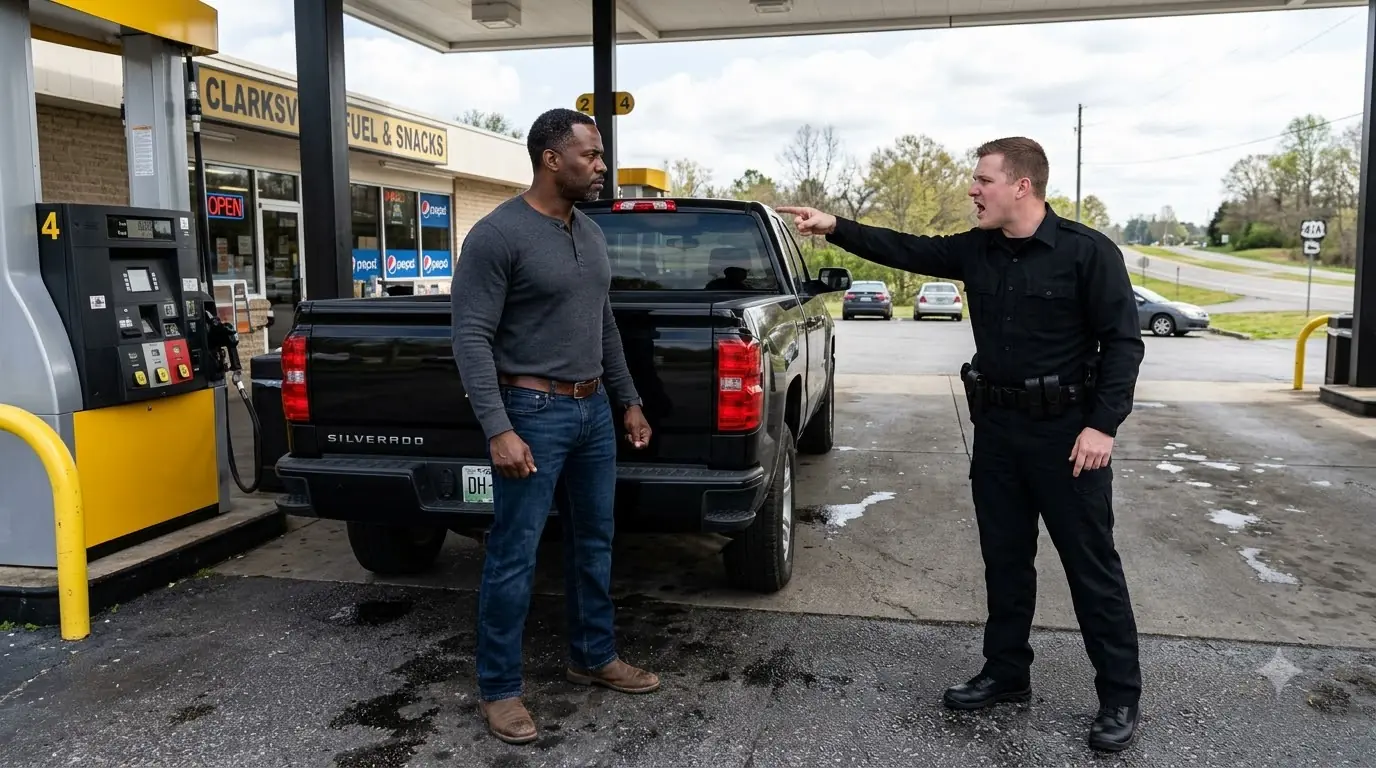
The Navy Cross. The Bronze Star with Valor. The Purple Heart.
Each one represented a moment most people would never survive and could not imagine living through.
This was a man who had jumped from aircraft over enemy territory in total darkness. A man who had held his breath underwater for four minutes while armed hostiles walked six feet above his head. A man who had carried a wounded brother on his back for two miles through hostile ground without ever stopping.
And on a random Tuesday afternoon, standing at a gas pump in his full dress uniform, every ribbon, every badge, every decoration catching the afternoon sun, a police officer looked at all of that and saw one thing.
A threat.
What that officer did not know was that someone was already recording.
And the next forty-seven minutes would end his career, bring down a sitting state senator, and force an entire nation to sit with one brutal, uncomfortable question.
What does this country actually think of the men who bleed for it?
The morning of September 14 began the way most of Senior Chief Petty Officer Darnell Hayes’s mornings did, before the sun had any real business being up.
By 5:15 a.m., he had already completed a six-mile run along the eastern edge of Fort Campbell, the kind of run most people would consider a punishment.
Darnell considered it prayer.
It was the time of day when his mind was quiet, when the noise of the world had not yet crowded in, when he could exist simply as a body moving through cool air, a heartbeat, and a pair of lungs working in rhythm.
In those early morning miles, Darnell Hayes was not a husband, not a son, not a statistic, and not a symbol.
He was just a man who loved his country with the kind of stubborn, aching devotion most people only feel for their children.
At thirty-nine years old, Darnell had served in the United States Navy for seventeen years. He had been a SEAL for twelve of them, assigned to SEAL Team 3 out of Coronado, California, before his recent transfer to joint training operations at Fort Campbell in Kentucky.
He had completed three combat deployments, two in Afghanistan and one in Iraq, and had participated in four classified operations that he would carry to his grave.
His dress uniform bore the Navy Cross, the Bronze Star with Valor, the Purple Heart, and a row of additional ribbons and badges that, to the trained eye, told the story of a man who had placed himself between danger and the people he served more times than could be counted.
He stood six feet two inches tall, built like something carved rather than grown. His close-cropped hair carried just the first faint dusting of gray at the temples, a detail his mother, Patricia Hayes, liked to point out with a mixture of pride and sorrow every time she saw him.
“That’s wisdom showing up, baby,” she would say, touching his face with both hands the way she had when he was seven years old. “That’s the weight of everything you’ve carried.”
Patricia Hayes was a retired schoolteacher from Memphis, Tennessee. She had raised Darnell alone after his father, Robert Hayes, died of a heart attack when Darnell was eleven.
She had worked two jobs through most of his adolescence. She had driven him to every swim practice. She had sat in the front row of his BUD/S graduation ceremony in Coronado with tears streaming down her face and a hand pressed flat against her sternum, like she was physically holding her heart inside her chest.
Darnell was driving back to Fort Campbell that Tuesday afternoon from a speaking engagement at a middle school in Clarksville.
It was something he did several times a year, quietly, with no press, no cameras, and no agenda. Just him in a classroom full of kids who did not necessarily believe their lives could amount to anything extraordinary, and him standing there as evidence that they could.
He always wore his dress uniform to these visits, not out of vanity, but because he had learned after years of doing it that children needed to see it. They needed to see what belonging to something larger than yourself looked like when it was draped across a real human body.
The school visit had gone well.
A twelve-year-old named Jalen had asked him, with wide and absolutely serious eyes, whether SEALs were afraid of sharks.
Darnell had crouched down to his level and said with equal seriousness, “The sharks are afraid of us.”
The room had erupted.
It was the best moment of his week.
He was forty minutes from base when the low-fuel light blinked on. He pulled off Route 41A into a BP gas station on the edge of Clarksville.
A normal Tuesday afternoon.
A normal errand.
A man in uniform stopping for gas.
Nothing about what followed was normal.
The BP station on Route 41A sat at the intersection of two quiet roads, the kind of gas station with four pumps, a small attached convenience store, and a hand-painted sign advertising boiled peanuts that had been faded by the sun for so long nobody could read it anymore.
A rusted blue pickup was parked near the air pump. A teenager in a red hoodie sat on the curb eating chips. An older white woman in a sun hat was loading grocery bags into the back of a minivan.
Darnell pulled his black Ford F-150 to pump number three, stepped out, and slid his card into the reader.
The whole interaction, from the moment he stepped out of the truck to the moment he first heard the police cruiser’s door open behind him, lasted exactly sixty-three seconds.
He knew this because later it would be established by the gas station security camera footage, which recorded with a timestamp.
Sixty-three seconds of a man standing at a gas pump in full military dress uniform, medals catching the afternoon light, back straight, waiting for his tank to fill.
Sixty-three seconds before Officer Brett Callaway of the Clarksville Police Department stepped out of his cruiser and walked toward him.
Brett Callaway was twenty-six years old. He had been with the Clarksville Police Department for two years and seven months.
He was white, average height, with the kind of face that forgot itself the moment you stopped looking at it.
According to colleagues who later spoke on background to journalist Ashley Kamura of the Nashville Banner, Callaway was not widely regarded as either a bad officer or a good one.
He was, in the language of people who work in bureaucracies, a middle-of-the-pack guy.
He had two minor complaints filed against him in his first year, one for an aggressive stop of a Latino family on Route 79, and one for using unnecessarily rough language with a teenager during a curfew check.
Neither complaint had resulted in formal disciplinary action.
What Brett Callaway saw when he pulled into that BP station, where he had stopped to grab a coffee and a gas station sandwich, as he did most Tuesday afternoons, was a large Black man standing at a pump.
He told himself later that it was the man’s posture that concerned him, that something about it seemed aggressive. He told himself he was just doing his job.
He told himself a lot of things.
The security camera told a different story.
It showed a man standing still, doing nothing, waiting for his gas to fill. A man who had not moved, had not made any gesture, and had not so much as turned his head toward the approaching cruiser.
Callaway approached from behind.
“Hey. Hey, stop. Don’t move.”
Darnell Hayes turned slowly, deliberately, the way a man turns when he has been trained so completely that his reflexes are under conscious command.
He looked at the officer.
His face was neutral.
His hands were visible, loose at his sides.
“Good afternoon,” he said.
Callaway looked him up and down. His eyes moved over the uniform, the medals, the rank insignia, the trident pin of a naval special warfare combatant, and seemed to register none of it.
“Can I see some ID? Step away from the vehicle.”
Darnell did not step away from the vehicle.
Not immediately.
He looked at the officer with the measured, assessing gaze of a man accustomed to reading threats for a living, and he said calmly, “May I ask what this is about?”
“I said step away from the vehicle and show me some ID.”
“I’m a United States Navy Senior Chief Petty Officer currently assigned to Fort Campbell. I stopped to get gas. Can you tell me what the problem is?”
Callaway’s jaw tightened.
“Sir, I’m not going to ask you again.”
What happened next was witnessed by four people: the teenager in the red hoodie, who later posted about it on social media; the woman with the sun hat, whose name was Carol Westbrook and who would later provide a statement to investigators; the station attendant, a Pakistani American man named Faisal Qureshi, who watched through the convenience store window with his hand pressed over his mouth; and the security camera, which did not blink, did not look away, and did not lie.
Callaway grabbed Darnell Hayes by the arm.
Darnell went absolutely still.
Any trained fighter will tell you that there are two kinds of stillness.
There is the stillness of surrender.
And there is the stillness of a man who could end this in three seconds and has decided consciously, painfully, deliberately not to.
Darnell Hayes was very still.
“I am not resisting,” he said in a voice so controlled it barely sounded like a voice at all. “I am not resisting. My hands are visible. I am a United States military service member in uniform. I need you to state clearly why I am being detained.”
Callaway was already reaching for his radio.
Within four minutes, two more Clarksville PD cruisers had pulled into the BP station.
One of them belonged to Corporal Danny Reyes, a seven-year veteran of the department, who would later describe arriving at the scene and immediately feeling, in his words, like something had gone very, very wrong.
Reyes was Latino, compact, with dark eyes that took in a scene the way a camera does all at once, cataloging details. He parked, stepped out, and looked at Darnell Hayes standing with his hands raised slightly from his sides in the universal posture of de-escalation.
He looked at the uniform.
He looked at the medals.
He looked at the trident.
He felt something cold move through him.
The second cruiser belonged to Officer Sandra Pratt, twenty-nine, in her first year out of field training.
She stayed near her vehicle. She would later say she was not sure what she was supposed to do.
Callaway, now emboldened by backup, had Darnell’s arm in a grip and was insisting he place his hands on the hood of the truck.
“I need you to tell me why I am being asked to do this,” Darnell said, still with that terrifying calm, still with that iron precision. “I have not committed any crime. I have not made any threatening gesture or statement. I am asking you clearly and directly to tell me the legal basis for this detention.”
“You were acting suspicious.”
“I was standing at a gas pump.”
“You matched the description of a suspect in a robbery that occurred on this block this morning.”
It was the first time Callaway had mentioned this.
It was, as would later be proven beyond any doubt, a lie.
There had been no robbery on that block that morning. There had been no robbery anywhere in Clarksville that morning.
The police dispatcher logs, subpoenaed three weeks later by Ashley Kamura through a public records request, showed no robbery call, no BOLO, and no suspect description consistent with anything Callaway later claimed.
Corporal Danny Reyes heard the statement, and something moved across his face.
A flicker of something that looked like it might have been shame.
He said nothing.
He would carry that silence for a long time.
The teenager on the curb had his phone out now. He had been recording for two minutes already.
His name was Brandon Tilman, fifteen years old, the son of an Army mechanic stationed at Fort Campbell. He had grown up around military families. He knew what the trident pin meant. He knew what the Navy Cross meant.
He was watching a man who had been to war and back be held at a gas pump in his dress uniform, and something in Brandon Tilman, fifteen years old, chip bag forgotten on the curb beside him, burned with a fury he had no words for yet.
He kept recording.
Carol Westbrook had stopped loading her minivan. She stood with a bag of groceries in her arms and watched. Her face had gone white.
She said loudly enough to be heard, “This is wrong. This is wrong, what you’re doing.”
Callaway glanced at her.
“Ma’am, please stay back.”
“I will not stay back. That man is in uniform. What is wrong with you?”
Faisal Qureshi had come to the door of the convenience store.
He was filming, too.
Darnell Hayes placed his hands on the hood of his truck.
Not because he was required to.
Not because he had done anything wrong.
Because he had done the math that Black men in America too often learn to do, the calculation between dignity and survival.
And he had chosen, in that moment, survival.
He would deal with dignity later.
His medals pressed against the cool metal of the truck hood as Callaway conducted a pat-down.
The Navy Cross.
The Bronze Star with Valor.
The Purple Heart.
All of it pressed against a gas station truck hood while the afternoon sun slanted through the pumps and Brandon Tilman filmed from the curb.
Corporal Reyes stood three feet away and did not stop it.
That would haunt him for years.
The figure that stepped out of the black government SUV that pulled into the BP station eleven minutes into the detention was not, at first, recognized by anyone except Darnell Hayes.
Because Darnell Hayes, still leaning forward with his hands on the hood of his truck while Callaway ran his information through dispatch, heard the door and lifted his eyes.
He felt something shift in his chest that he had not felt in a long time.
He recognized the shoes first.
The gait.
The way the man moved through space like he owned the square footage of air around him.
Commander Steven Whitmore, United States Navy.
Darnell’s commanding officer at Fort Campbell’s Joint Training Division.
A stocky, silver-haired white man from outside Boston, with a face like a topographic map of every difficult decision he had ever made and a voice that sounded like it had been cured in smoke and authority.
Whitmore had been driving back from a meeting at the base when he received a call from the base’s duty officer, who had received a call from Brandon Tilman’s father, who had been called by Brandon himself.
Somehow, in the middle of everything, Brandon had managed to dial his father’s number and say, “Dad. Dad, they’ve got a guy in uniform at the BP. Dad, I think he’s a SEAL. Dad, you need to call somebody.”
Airman First Class Calvin Tilman had looked up the duty officer’s number with shaking hands and made the call.
Whitmore had diverted immediately.
He walked into that gas station with the squared shoulders and absolute composure of a man who had coordinated extractions in active combat zones.
He looked at Brett Callaway, and his voice, when it came, was so quiet and so precise that every person in that BP station fell silent just to hear it.
“Officer, what is the basis of this detention?”
Callaway turned.
He took in the uniform, the silver eagle insignia of a Navy commander.
He straightened slightly, reflexively.
“Sir, this individual was acting—”
“This individual,” Whitmore said, “is Senior Chief Petty Officer Darnell Hayes, United States Navy. Holder of the Navy Cross, Bronze Star with Valor, Purple Heart, and Distinguished Service Medal. He is currently assigned under my direct command. He has more documented combat hours than you have days in this uniform.”
He paused.
His eyes moved from Callaway to Reyes to Pratt, and back.
“I’m going to need you to tell me very clearly, on the record, what the legal basis for this detention is, because there are cameras and there are witnesses, and I promise you, the next phone call I make is to the Secretary of the Navy.”
The silence at that BP station was the loudest silence anyone there had ever heard.
Brett Callaway opened his mouth.
Closed it.
Opened it again.
“He was acting suspicious.”
“He was pumping gas.”
“There was a report of a—”
“There was no report.”
Whitmore had already pulled out his phone.
“I’ve been on the phone with your department’s dispatch for the last six minutes. There was no robbery. There was no BOLO. There was no suspect description. There was nothing.”
Callaway’s face had gone a shade of red that was trying to decide whether to become anger or fear.
Reyes had taken two steps back. He would later describe this moment as the one where he realized he had made a choice he could not unmake.
Whitmore turned to Darnell.
Their eyes met.
Something passed between them, the language of men who had been through the kind of things that could not be explained in words. A language built from shared experience and mutual respect and the particular grief of having to keep fighting battles that should have been won long ago.
“You all right, Senior Chief?”
Darnell Hayes straightened up from the hood of his truck, smoothed his jacket, and adjusted the line of his medals.
“Yes, sir,” he said. “I’m all right.”
But he was not.
Not really.
And Whitmore knew it.
And that knowledge settled between them like a stone.
What nobody at the BP station knew, what nobody would know for another seventy-two hours, was who had been sitting in the silver sedan parked at the far end of the station lot since before any of this began.
State Senator Howard Greer of Tennessee had pulled in to use the restroom before a campaign stop.
He was up for reelection in November. He was publicly a vocal supporter of law enforcement and a critic of what he called anti-police rhetoric. He had built a significant portion of his political identity around backing the blue, around speeches in church halls and county fairs about how officers were being unfairly maligned and how the media was manufacturing a narrative.
He had watched the entire incident from his car.
His aide, a young woman named Cassidy Farum, had been sitting beside him.
She had said, “Senator, should we?”
And he had said, “Let’s just see how this plays out.”
He had watched Brett Callaway grab Darnell Hayes. He had watched a Navy SEAL in full dress uniform, medals and all, be pushed against his own truck and patted down like a criminal.
He had watched Commander Whitmore arrive. He had watched the confrontation.
Then he had started his car and attempted to leave.
He did not make it out of the parking lot before Ashley Kamura of the Nashville Banner stepped directly in front of his car.
Ashley Kamura was twenty-eight years old, Filipino American, five feet three inches tall, and afraid of almost nothing.
She had been following the Clarksville Police Department’s complaint history for six months, working a background story on patterns of racially biased stops in Montgomery County. She had a police scanner in her car, and she had been four blocks away when the dispatch traffic spiked.
She arrived with her recorder and her phone camera just in time to see Whitmore’s confrontation with Callaway, and she caught every word of it on audio.
She had also recognized State Senator Howard Greer’s silver sedan immediately because she had seen it in parking lots at three campaign events she had covered.
She stood in front of his car, recorder in hand, and said, “Senator Greer, did you observe this incident from beginning to end?”
Greer’s window came down three inches.
“Miss, I don’t think this is the time.”
“Senator, you have been a visible and vocal supporter of the Clarksville Police Department. A decorated Navy SEAL was just detained without cause at this gas station. Did you see it?”
A pause lasted four and a half seconds, long enough to be its own answer.
“I observed a police officer doing his job.”
“Did you observe that officer fabricate a robbery report as justification for a stop that had none?”
Another pause.
“I think you’d better speak to the department directly.”
“Senator, with respect, I’m speaking to you. You were here. You saw the whole thing, and you were about to drive away.”
Greer’s window went back up.
But by then, three other people had phone cameras pointed at his car.
The story, when it broke thirty-six hours later under Ashley Kamura’s byline, ran with a subheading that read:
State senator watched entire incident. Said nothing. Tried to leave.
It got two million views in the first four hours.
Brandon Tilman posted his video at 4:47 p.m. while he was still sitting on the curb of the BP station.
He added no caption.
He added no commentary.
He just let it run.
Sixty-one seconds of Darnell Hayes, Navy Cross gleaming on his chest, hands on the hood of his truck while Brett Callaway stood behind him.
The medals were clearly visible.
The expression on Darnell’s face, that terrible controlled stillness, was visible.
The moment Callaway’s hand pushed between Darnell’s shoulder blades to keep him in place was visible.
That was the moment.
That was the eleven seconds that would change everything.
By 6:00 p.m., the video had one hundred forty thousand views. By 9:00 p.m., it had broken 1.2 million.
By the following morning, the clip was on CNN, Fox News, MSNBC, and every major print outlet in the country.
Brandon Tilman’s fifteen-year-old face appeared on morning shows. He sat next to his father, Calvin, and answered questions with a seriousness that made the anchors visibly emotional.
“I just knew it was wrong,” Brandon said. “I could see his medals. Everybody could see his medals. I don’t understand how you look at that and decide he’s a threat.”
The military community reacted with an outrage that cut across every demographic line.
Veterans of every branch, every age, every background, posted in solidarity.
Active-duty service members, carefully and in ways that did not violate the UCMJ, made their feelings clear.
The hashtag #StandWithSeniorChiefHayes trended nationwide for forty-eight hours.
Naval Special Warfare Command released a formal statement expressing their profound concern and their full support for Senior Chief Petty Officer Hayes.
The Secretary of the Navy made a personal phone call to Darnell’s phone.
He missed it because his phone was off.
Because in the hours after the incident, Darnell Hayes had driven back to base, changed out of his dress uniform, folded it carefully, set it on a chair, sat on the edge of his bed, and stared at the wall for a long time.
He called his mother.
“Mama,” he said when she picked up.
Patricia Hayes heard the sound of his voice and went quiet in the way mothers do when they have been dreading a phone call for years and finally understand they were right to dread it.
“Tell me,” she said.
And he did.
When he finished, she was silent for a moment.
Then she said, “Baby, I want to tell you something, and I need you to hear it.”
“I’m listening.”
“They could not take a single thing from you today. Not one medal, not one mission, not one moment of who you are. You understand? They could grab your arm. They could push you down. But everything that matters, every single thing that makes you Darnell Hayes, they could not touch.”
Her voice broke slightly and rebuilt itself in real time.
“I raised you to be unbreakable. And you were. You held it together even when you didn’t have to. That’s not weakness, Darnell. That is the strongest thing I have ever seen.”
He did not say anything for a long time.
He just listened to his mother breathe.
“Come home soon,” she said.
“Yes, ma’am.”
The consequences came the way consequences always come when the world is paying attention.
Fast and without mercy.
The Clarksville Police Department placed Officer Brett Callaway on administrative leave within eighteen hours of the video going viral.
Chief Raymond Stubbs, a heavyset man in his mid-fifties who had been with the department for twenty-three years and was nine months from retirement, called a press conference that Friday afternoon.
He stood before a room bristling with cameras and said, in a voice that carried the weight of a man choosing his words on a very narrow ledge, that the department had serious concerns about the stop, that the officer’s stated justification was inconsistent with dispatch records, and that a full investigation had been launched.
A reporter from the AP asked directly, “Chief Stubbs, did Officer Callaway lie about the reason for the stop?”
Stubbs looked at the cameras for a long moment.
“The investigation will establish the facts,” he said.
The investigation established the facts in eleven days.
There was no robbery.
There was no BOLO.
There was no call.
The dispatch records were clean.
Callaway’s own in-car camera, which he had claimed was malfunctioning, was later found by department technicians to have been manually disabled twelve minutes before he pulled into the BP station.
He had driven past the station twice before stopping, which the traffic cameras on Route 41A caught.
He had watched Darnell pull in.
He had waited.
The internal affairs report, which Ashley Kamura obtained and published in its entirety six weeks later, concluded that Callaway had conducted a pretextual stop with no lawful basis, subsequently fabricated a justification, and intentionally disabled his in-car recording equipment in advance.
The report further noted that this was consistent with a documented pattern, referencing the two earlier complaints and three additional incidents that had never risen to the level of formal complaints but were noted in his personnel file.
Brett Callaway was terminated from the Clarksville Police Department on a Friday, three weeks and two days after the incident.
He was informed of his termination by a written notice delivered to his home address.
He did not come to the door when it was delivered.
His wife, Linda, accepted it in the doorway with an expression that people who saw her later described as the look of someone who had known this was coming for a long time.
The Montgomery County District Attorney, a woman named Barbara Howell, had been in office for eleven years and did not make decisions lightly.
Two weeks after the termination, she announced that she was convening a grand jury to consider criminal charges against Callaway for filing a false police report and civil rights violations.
The grand jury returned an indictment in thirty-one days.
Brett Callaway was arraigned on a Tuesday morning exactly four weeks after that Tuesday afternoon at the gas pump.
He entered a plea of not guilty.
His attorney, a local defense lawyer named Gary Pitts, told reporters outside the courthouse that the charges were politically motivated and that his client had been sacrificed on the altar of public opinion.
Ashley Kamura wrote a four-thousand-word feature on the indictment.
It won a Tennessee Press Association award.
The consequences did not stop with Callaway.
Corporal Danny Reyes submitted a formal written statement to Internal Affairs two weeks after the incident.
In it, he stated that he had arrived at the scene, observed the detention, assessed it immediately as unjustified, and failed to intervene.
He wrote, “I am not able to say that I did not know better, because I did. I recognized that officer’s uniform. I recognized his rank and his decorations. I stood there and said nothing, and I have to live with that.”
He also resigned from the Clarksville Police Department eight days later.
Not because he was forced to. The internal affairs report did not recommend his termination.
He resigned because, as he said in the handwritten letter he left on Chief Stubbs’s desk, “I don’t know how to be the kind of officer I want to be inside a system where this was possible and where I responded to it the way I did. I need to figure that out somewhere else.”
Reyes moved back to San Antonio. He enrolled in a social work program at UTSA the following spring.
Officer Sandra Pratt, who had stood by her cruiser and done nothing, was placed in mandatory counseling and retraining. She remained on the force.
In a department memo that was never meant to be public but found its way to Ashley Kamura’s inbox through an anonymous source, Pratt had written, “I keep seeing his face, the way he just stood there. I knew it was wrong, and I was scared, and that’s not good enough.”
It was not.
But it was honest.
State Senator Howard Greer’s political troubles began the same week the Nashville Banner published the video of him being questioned by Ashley Kamura in his car.
The clip of his window going up, of him choosing silence over accountability, of him driving away, played on loops in political coverage across the state.
His primary challenger, a younger candidate named Patricia Ortega, who had served as a public defender for eight years, began closing the gap in polls almost immediately.
By October, she had pulled ahead by six points.
Greer lost the election on the first Tuesday in November. He carried thirty-eight percent of the vote, twelve points below his previous cycle.
In his concession statement, he made no mention of the incident. He said only that he was proud of his service and wished his successor well.
Nobody believed him.
His aide, Cassidy Farum, quit three days after the Nashville Banner story ran and was hired six months later as a communications director for a veterans advocacy organization.
Senior Chief Petty Officer Darnell Hayes did not watch the video.
Not once.
Not the original sixty-one-second clip.
Not the news segments.
Not the compilations.
Not the reaction videos.
He was told about all of it. He understood the scope of what had happened.
He did not watch it.
He returned to duty the Monday after the incident.
He went to the gym. He swam. He briefed his team. He ate in the mess hall and read after lights out and did all the ordinary things that form the architecture of a military life.
Commander Whitmore checked in with him daily for the first week.
Not with fanfare.
Not with speeches.
He would appear in the doorway of whatever room Darnell was in and say something like, “How’s your PT?” or “You eating enough?” or, once memorably, “Your mother called the base.”
And Darnell would say something like, “I’m good, sir,” and mean it about seventy percent of the time.
Whitmore would nod and leave, and neither of them would say what they meant, because men who have been through hard things together do not always need to.
Darnell agreed after two weeks, and after a conversation with Patricia Hayes that lasted two hours, to give one interview.
It was with Ashley Kamura.
They met at a diner in Clarksville on a Wednesday afternoon.
Ashley arrived early. Darnell arrived on time in civilian clothes: jeans, a gray pullover, white sneakers.
Without the uniform, he looked like a man who was working very hard to be ordinary.
They talked for three hours.
Ashley’s recorder ran the whole time.
She ordered coffee.
He ordered coffee and a slice of pie that he ate half of.
The profile she wrote, published six weeks later in The Atlantic as well as the Nashville Banner, was titled “The Weight of What You’ve Earned.”
It opened with a description of his medals and then moved through his life: his mother, his father’s death, BUD/S, his deployments, his visits to middle schools, and arrived at the afternoon at the BP station with the precision of someone who understood that the story’s meaning lay not in the incident itself, but in the eighteen years of sacrifice that made the incident so unbearable.
The piece went viral twice.
Once when it was published, and once the following month when it was read aloud by a veteran podcaster with a seven-million-person audience, who stopped midway through the reading and had to take a break to collect himself.
Darnell called Ashley after the piece came out.
He said, “You got it right.”
She said, “I tried.”
He said, “I know.”
They both went quiet for a moment.
Then he said, “Thank you.”
And she said, “Thank you for talking to me.”
And that was that.
Three months after the incident, on a cold December morning, Darnell Hayes drove back to the BP station on Route 41A.
He did not entirely know why.
The gas station had no particular significance to him beyond what had happened there. It was not a meaningful place. It was not somewhere he had ever had a reason to stop before.
It was just a BP station with four pumps and a faded sign about boiled peanuts.
But he drove there anyway, pulled up to pump number three, and stood in the cold morning air while his tank filled.
The station was different now.
Faisal Qureshi had printed out a photograph, the one that had circulated the most, showing Darnell standing with his medals caught in the afternoon light, and mounted it in a simple black frame behind the counter with a small handwritten note taped beneath it.
American hero.
Always welcome here.
Darnell did not know about the photo until he went inside to pay cash.
He stood at the counter and looked at himself, at the version of himself from that afternoon in full dress uniform, impossibly still.
For a moment, he did not say anything.
Faisal Qureshi watched him from behind the counter with the careful, compassionate attention of a man who had thought about another person’s pain many times and was now in the presence of it.
“That’s a good man in that picture,” Faisal said quietly.
Darnell looked at him.
Something shifted in his face.
Something released just slightly, like a door that had been held closed for a long time with great effort.
“I appreciate that,” he said.
He paid for his gas.
He shook Faisal’s hand.
Then he drove back to base through a winter morning that was gray and bright and quiet.
His teammate, Senior Chief Tyrell Banks, who had served beside him for six years, who had been in the water with him in conditions that did not bear naming, who knew Darnell Hayes the way you can only know a man you have trusted with your life, was waiting outside the barracks when he got back.
“You all right?” Banks asked.
Darnell thought about it.
The real version of thinking about it.
The kind where you actually check where you put your hand on the thing and see if it is still standing.
“Yeah,” he said finally. “I’m all right.”
Banks nodded.
“Good, because Whitmore wants us in the briefing room in twenty minutes, and he’s already in a mood.”
And Darnell Hayes laughed.
A real laugh.
Sudden and full.
The kind of laugh that sounds surprised by itself.
They walked into the building together.
Brett Callaway’s trial began the following March on a morning so cold and gray that the courthouse steps were glazed with a thin skin of overnight frost.
People arrived early anyway.
They lined the hallway outside the courtroom an hour before the doors opened. Veterans in unit hats, community members in winter coats, and a handful of reporters balancing coffee cups and press credentials.
Not all of them could get seats.
The ones who could not stood in the corridor and followed the proceedings through the murmur that filtered through the heavy wooden doors.
Inside, the courtroom had the particular feeling of a room that understood its own importance.
The light through the tall windows was flat, wintry, and unforgiving. The kind of light that stripped away pretense and left things exactly as they were.
The prosecution was led by Assistant DA Renee Chambers, sharp, methodical, and unhurried.
She had tried seventeen civil rights cases in her career and had learned through hard experience that juries do not always vote with their hearts when they are asked to convict a police officer.
Emotion was a door that could swing both ways.
So she did not appeal to it.
She built her case the way a carpenter builds a frame.
Piece by piece.
Joint by joint.
Nothing ornamental.
Everything load-bearing.
She gave them the dispatch logs.
Clean.
No robbery call.
No BOLO.
No suspect description.
Nothing.
She gave them the traffic camera footage from Route 41A, Callaway’s cruiser passing the BP station twice before pulling in, the timestamps three minutes apart.
She gave them the in-car recorder, which department technicians had confirmed was manually disabled twelve minutes before Callaway arrived at the station.
Not malfunctioning.
Disabled.
The distinction mattered, and Chambers let it sit in the room without commentary. She let the jury do the arithmetic themselves.
She gave them the two prior complaints from Callaway’s personnel file, and the three additional incidents that had never risen to the level of formal grievance but existed in the record like old bruises.
Then she gave them people.
Faisal Qureshi took the stand in a dark sport coat that he had pressed carefully, and he described in measured and precise language what he had seen through the convenience store window that afternoon.
He did not editorialize.
He did not perform.
He simply told the truth in the order it had happened, and the truth was enough.
Carol Westbrook sat in the witness box in her Sunday clothes and held the arms of the chair as though steadying herself against something.
When she spoke, her voice shook not with fear, but with the kind of fury that had been sitting in a person for months, looking for an authorized exit.
“He was in full uniform,” she said. “He had more medals on his chest than I’ve ever seen on a person, and that officer treated him like he was nothing.”
The courtroom was very quiet after that.
Commander Steven Whitmore took the stand in his dress uniform, silver and squared and immovable, and was asked simply to describe what he had found when he arrived at the gas station that afternoon.
He described it without passion, without theater, in the flat and documented voice of a man accustomed to writing incident reports in conditions that did not allow for emotion.
He listed what he had seen, what he had said, and what he had been told by dispatch in the minutes before he arrived.
He named Darnell’s decorations by their full titles.
He described the position Darnell’s hands were in, the placement of Callaway’s hand on Darnell’s shoulder blades, and the expression on Callaway’s face when he turned and saw the uniform of a superior officer.
It was the detachment of it that devastated the room.
There was no grief in Whitmore’s voice because he had caged it somewhere far back, and the cage was visible, and that was worse than tears would have been for the defense.
Gary Pitts tried several angles.
He argued that Callaway had been acting on a genuine perceived threat. He argued that the video had poisoned the jury pool beyond the possibility of fairness.
He called a use-of-force expert who worked methodically through a framework that attempted to characterize Callaway’s behavior as consistent with departmental training guidelines.
Renee Chambers cross-examined him for forty minutes.
She was not aggressive.
She was not theatrical.
She simply worked through his testimony with the exhausted efficiency of a surgeon performing a familiar procedure.
And when she was done, the framework he had constructed had been dismantled so thoroughly and so quietly that several jurors were looking at their notepads rather than the witness.
Darnell Hayes did not testify.
He had made that decision calmly after a long conversation with his own attorney, grounded in the belief that the facts did not need his voice to give them weight.
He sat in the gallery on the first day of the trial, and he sat there on the last.
He wore civilian clothes both times, dark jeans and a simple jacket.
Nothing to signal or announce himself.
He watched with the same controlled attention he brought to everything.
He did not look away.
On the final day, when the jury filed back in after nine hours of deliberation, Callaway sat at the defense table and did not look at Darnell.
He looked at his hands.
He looked at the table.
He looked at the particular nowhere that people look at when they already know what is coming and are trying to decide how to survive the moment it arrives.
The foreperson stood.
The courtroom inhaled.
“Guilty on both counts. Filing a false police report and interference with constitutional rights under color of law.”
The room did not erupt.
There were no cheers.
No dramatic outbursts.
What happened instead was something quieter and more complete.
A collective exhale.
The sound of people releasing something they had been holding for months.
Someone near the back was crying. A veteran near the aisle pressed his fist to his mouth.
Callaway was sentenced to twenty-eight months in federal prison, three years of supervised probation, and a permanent ban from serving in law enforcement.
He did not speak during sentencing.
His attorney spoke for him in language that was measured and hollow, and made very little impression on anyone in the room.
Darnell Hayes heard the verdict and felt not triumph, not the clean release he might have imagined during the long months of waiting.
He felt something more complicated and more honest than satisfaction.
A grief that was not only his own.
A weight that extended backward through time to every man who had stood where he stood without a video, without a commander arriving in a government SUV, without a teenager on a curb with the courage to press record.
The ones whose names were not hashtags.
The ones whose cases were not verdicts.
He felt them in the room with him, and he held that weight, and he did not put it down.
He carried it out of the courthouse into the pale spring afternoon, where Tyrell Banks was already at the curb, truck idling, engine warm.
Banks looked at him.
He did not ask for a speech.
“How do you feel?” he said.
Darnell stood for a moment in the thin sunlight and let the air touch his face.
“Like it’s not over,” he said.
Banks thought about it, then nodded slowly.
“You’re right,” he said. “It ain’t.”
They drove back to base.
The river ran alongside the highway, silver and indifferent, moving in the only direction water knows how to move.
Senior Chief Petty Officer Darnell Hayes served three more years in the United States Navy before receiving an honorable discharge at the age of forty-two.
He settled in Memphis, close to his mother.
He now runs a nonprofit organization co-founded with Commander Steven Whitmore, who retired the year after Darnell. It is called the Trident Foundation, and it provides legal resources, counseling, and advocacy for military veterans who have experienced discrimination or rights violations.
Brandon Tilman, the teenager on the curb, received a personal letter from Darnell six months after the verdict.
In it, Darnell told him that courage does not require a SEAL title, age, or rank, and that what Brandon had done, standing up, pressing record, refusing to look away, had mattered more than he knew.
Brandon is now enrolled at Tennessee State, studying journalism.
His professor in his first media ethics class keeps a printout of the original video still on her office door with a note that reads:
This is why it matters.
Faisal Qureshi’s photo is still on the wall behind the counter of the BP station on Route 41A.
The frame is a little dustier now, but the man in it is just as still, just as decorated, just as unbroken.
Patricia Hayes keeps a copy of Ashley Kamura’s Atlantic profile on the coffee table in her living room in Memphis.
She has read it more times than she can count.
She reads it when she is proud and when she is afraid and when she needs to be reminded that she raised someone who held himself together when everything in the world was trying to tell him he was not worth the effort.
He always was.
What happened at that BP station on Route 41A was not just one man’s story.
It was a mirror held up to something much larger.
A test of who we are and what we refuse to look away from.
Darnell Hayes carried seventeen years of sacrifice into a gas station and was made to feel like a criminal.
And yet he never cracked.
He never lowered himself to the level of what was being done to him.
He stood straight, kept his hands visible, and trusted that the truth would do its job if people were watching.
And people were watching because a fifteen-year-old kid had the courage to press record.
That is the lesson.
Courage does not always look like a Navy SEAL.
Sometimes it looks like a teenager on a curb with a half-eaten bag of chips, holding up a phone, refusing to look away.