The red 1948 Farmall sat in the center of Miller Equipment like a stubborn old king refusing to bow. Its hood had been polished until the shop lights shone across it in clean white lines, and its black tires looked almost too new for a machine that had once pulled plows through wet spring fields and dusty autumn rows. Around it stood five mechanics, three open toolboxes, two empty coffee cups, and a pile of replaced parts that had cost more than some farmers made in a month. Still, every time they turned the key, the tractor coughed, shook, and died.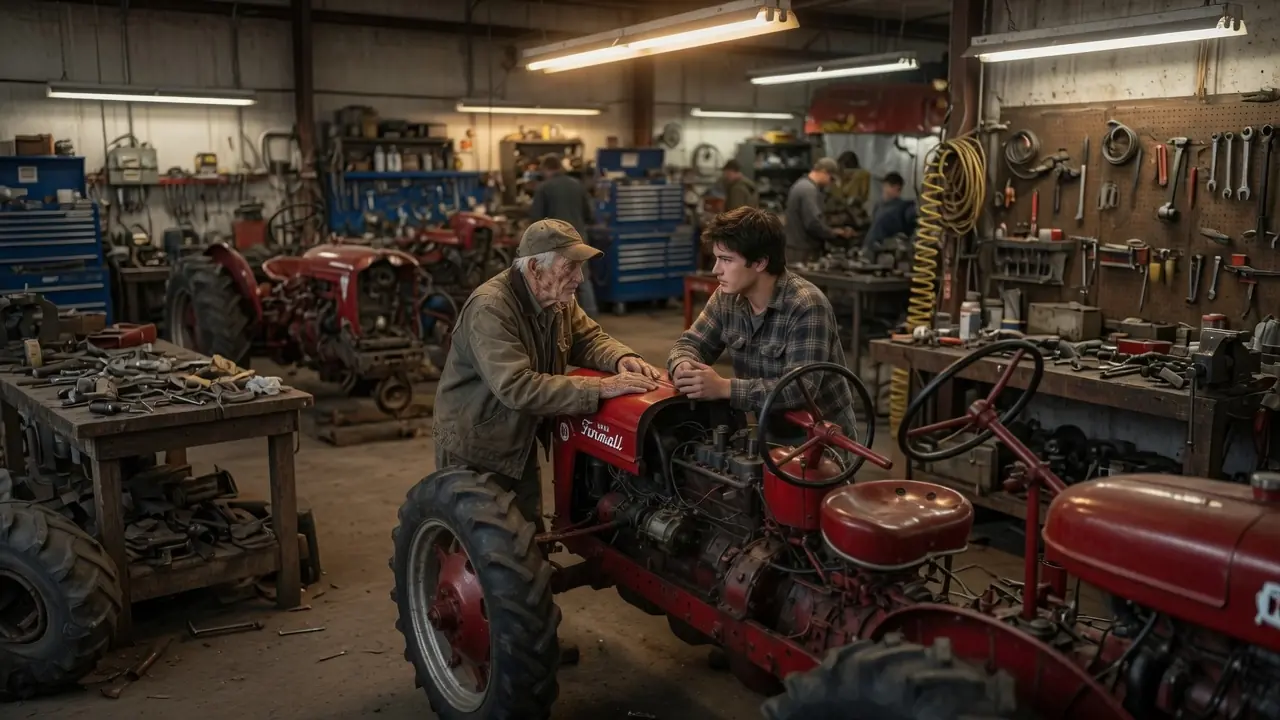
Ray Miller, the head mechanic, stood beside the engine with his sleeves rolled up and his jaw tight. He was forty-six, proud, sharp-eyed, and known around Clay County as a man who could fix anything with wheels, gears, or a motor. That reputation had built his shop. It had also made him the kind of man who hated being watched while something beat him.
The tractor belonged to a widow named Clara Benton, whose late husband had restored it piece by piece before he passed. Clara had brought it to Miller Equipment two weeks earlier and asked Ray to get it running for the county heritage parade. It was not just an old tractor to her. It was the last machine her husband had touched with hope in his hands.
Ray had promised her it would be ready. At first, he said the job would take two days. Then four. Then a week. By the tenth day, the whole shop had grown quiet whenever Clara called for an update.
They had replaced the spark plugs, cleaned the fuel line, adjusted the timing, rebuilt the carburetor, checked the coil, replaced wires, drained the tank, changed the battery, and argued over compression. Every mechanic had taken a turn standing beside that red machine, convinced he would be the one to solve it. Every one of them walked away with grease on his hands and embarrassment on his face. The Farmall had beaten them all.
On Friday morning, just after the shop doors opened, Walter Hayes walked in. He was seventy-nine years old, thin but strong in the way old fence posts were strong, with a faded cap, a worn brown jacket, and hands permanently marked by soil, oil, and time. He had farmed outside Clay County for more than fifty years before selling most of his land to his nephew. These days, he came into Miller Equipment for small parts, coffee, and the kind of conversation younger men did not know they needed.
Walter stopped near the front bay and looked at the Farmall. He did not smile. He did not speak. He only listened as Ray tried to start the tractor again.
The starter turned. The engine caught for half a breath, coughed twice, and died with a dry, hollow sound. One of the younger mechanics muttered something under his breath. Another threw a rag onto the bench. Ray slapped the side of the hood and cursed softly.
Walter took one step closer. His eyes narrowed, not with judgment, but with memory. He had heard thousands of engines in his life: tractors at dawn, combines at dusk, trucks in winter, pumps in dry summers, and old machines that told the truth if a man had patience enough to listen. This one was saying something.
Ray noticed him then. “Morning, Walter,” he said, trying to sound normal. “Need something?”
Walter kept his gaze on the tractor. “That Clara Benton’s Farmall?”
Ray’s mouth tightened. “Yes.”
“She hoping to drive it in the parade tomorrow?”
“That was the plan.”
Walter nodded slowly. “Start it again.”
One of the younger mechanics laughed before he could stop himself. Ray turned toward Walter, irritation rising in his face. “We’ve started it fifty times.”
“Then one more won’t hurt it.”
Ray wiped his hands on a rag. “Walter, I know you mean well, but five trained mechanics have been through this tractor front to back.”
Walter looked at him calmly. “I know.”
Ray stepped closer, pride burning in his eyes. “Five mechanics failed, old man. You think your farm ears are special?”
The shop went silent. Even the man at the back workbench stopped turning his wrench. Walter did not flinch. He placed one weathered hand on the red hood of the Farmall as if greeting an old friend.
“Special?” Walter said. “No. Just not deaf from pride.”
Ray’s face hardened. “This is my shop. Don’t lecture me over an engine.”
Walter’s eyes stayed locked on his. “Then start it again, and this time, listen to the breath it doesn’t take.”
For a moment, no one moved. Ray wanted to tell Walter to leave. He wanted to laugh, dismiss him, push him back toward the parts counter where old farmers belonged in the minds of men who thought age meant irrelevance. But something in Walter’s voice unsettled him.
Ray turned the key again.
The starter whined. The engine caught, coughed, shook, and died. This time, Walter closed his eyes while he listened. When the sound faded, he opened them and looked down at the engine.
“There,” he said.
Ray threw up one hand. “There what?”
Walter pointed toward the side of the engine, not at the carburetor, not at the plugs, not at the fuel line. “She’s not breathing.”
Ray stared at him. “We checked the air intake.”
“You checked the parts you could see.”
“We cleaned the filter.”
“I didn’t say the filter.”
One of the younger mechanics, Billy, leaned closer. “Then what are you saying?”
Walter walked slowly around the tractor. He did not hurry, and that irritated Ray even more. The old man moved like someone in a field looking for a buried stone he knew was there because the plow had jumped in the same place for forty years. He bent near the side panel and ran two fingers along a narrow section of metal near the intake path.
Ray crossed his arms. “We already rebuilt the carburetor.”
Walter ignored him. “Who restored this?”
“Clara’s husband,” Billy said. “Henry Benton.”
Walter’s expression softened for the first time. “Henry always painted clean. Too clean sometimes.”
Ray frowned. “What does paint have to do with it?”
Walter straightened. “Maybe nothing. Maybe everything.”
Ray let out a short, humorless laugh. “That’s useful.”
Walter looked at him. “You boys ever restore something so pretty you forget it still has to work?”
The words landed hard in the shop. Ray stepped forward, anger flashing. “Careful.”
Walter’s voice stayed quiet. “I am being careful. That’s why I’m not letting you tear apart a good engine because your pride keeps blaming the loudest part.”
Ray looked at the Farmall, then at the pile of replaced parts on the workbench. He hated that the old man’s words felt too close to the truth. They had been chasing the engine for two weeks because that was where the failure seemed to be. The cough, the shake, the stall — it all sounded like engine trouble.
But Walter was listening for what was missing.
“Pull that side cover,” Walter said.
Ray did not move. “You don’t give orders in my shop.”
“No,” Walter replied. “The tractor does. I’m just old enough to hear them.”
Billy looked at Ray, waiting. Two other mechanics exchanged glances. Ray saw it, and his pride stung worse. Still, he reached for a wrench and removed the side cover himself.
The panel came loose with a small metallic pop. Behind it sat a narrow intake passage and a section of fitted pipe, painted red like the rest of the tractor. At first, nothing looked wrong. Ray leaned in with a flashlight and frowned.
Walter pointed with one finger. “There.”
Ray angled the light. “I don’t see anything.”
“Look at the seam.”
Billy leaned beside him. “Wait.”
Ray moved the light closer. A thin line of hardened paint and sealant had collected around a small vent opening, almost invisible under the fresh restoration color. It was not fully blocked, not obviously damaged, not the kind of problem a mechanic hunting broken parts would notice quickly. But it was enough.
Ray scraped lightly with a pick. A small flake broke loose. Behind it, the opening was nearly sealed. Someone had painted over the tiny breather path during restoration, then dust and old residue had finished the job.
Billy whispered, “No way.”
Walter nodded. “Way.”
Ray’s face went still. “That little thing wouldn’t kill it.”
Walter looked at him. “Start a man breathing through a straw and ask him to plow eighty acres.”
No one laughed.
Ray removed more of the hardened paint, then checked deeper. The passage was blocked farther inside than it first appeared. Not enough to prevent the engine from catching. Enough to starve it the moment it tried to run under its own pull. The engine had not been failing.
It had been choking.
The shop changed around that realization. The younger mechanics gathered closer, suddenly quiet in the presence of a lesson none of them had expected to receive. Walter stepped back and let them work. He did not gloat. That almost made it worse for Ray.
Ray cleaned the passage thoroughly, checked the connected fittings, and reassembled the cover. His hands moved carefully now, without the angry speed he had been using all morning. When he finished, he stood beside the tractor and stared at the ignition.
Walter folded his arms. “Well?”
Ray glanced at him. “You want to do the honors?”
Walter shook his head. “It ain’t my machine.”
Ray swallowed his pride and turned the key.
The Farmall coughed once, then caught. This time, before the engine settled, there came a small, clean intake sound — a tiny breath almost no one would have noticed unless they knew it had been missing. Then the engine smoothed into a steady, confident rhythm.
The red tractor ran.
For a few seconds, nobody spoke. The sound filled the shop like something alive waking from a long sleep. Billy grinned. Another mechanic slapped the workbench. Someone near the back laughed with relief.
Walter only closed his eyes.
Ray stood beside the tractor, listening to the engine he had doubted, blamed, and nearly torn apart. The steady rhythm embarrassed him and humbled him at the same time. He had thrown parts at the problem. Walter had heard it.
The front office door opened, and Clara Benton stepped in. She wore a gray coat, her hair pinned back, her hands clasped tightly around her purse. Her face showed the fear of someone expecting another apology. Then she heard the engine.
Her mouth opened slightly. “Is that Henry’s tractor?”
Ray turned toward her. “Yes, ma’am.”
Clara walked slowly into the bay. The mechanics stepped aside. Her eyes filled as she approached the red Farmall, now running under the bright shop lights like it had been waiting all along for someone to listen properly.
She touched the hood with trembling fingers. “Henry said it would run again.”
Walter looked down.
Clara turned toward Ray. “What was wrong?”
Ray hesitated. The easiest thing would have been to explain the blockage in technical language and let the shop take credit as a group. He could have said they finally traced it. He could have hidden behind the team. Instead, he looked at Walter.
“Mr. Hayes heard what we missed,” Ray said.
Clara turned to Walter. “Walter?”
Walter shifted uncomfortably. “Wasn’t much.”
Ray exhaled. “It was everything.”
The admission hung in the air. Walter looked at Ray then, and something passed between them that was not quite apology but close enough to begin one. Ray wiped his hands again, though there was no need.
“I was out of line,” Ray said.
Walter tilted his head. “You were proud.”
“That supposed to make it better?”
“No. Just makes it common.”
Clara gave a small laugh through her tears. She stood beside the tractor as the engine idled, and for a moment the shop was not just a place of tools and repairs. It felt like a chapel for old work, old love, and the machines that carried both.
Ray looked at Clara. “It’ll be ready for the parade.”
She nodded, unable to speak at first. Then she placed one hand over her heart. “Henry would have liked hearing it.”
Walter smiled faintly. “Henry always did like making noise.”
Clara laughed again, softer this time. She stayed until Ray shut off the tractor, then asked if she could sit on it for a minute. Ray helped her up onto the seat. She held the steering wheel with both hands and looked down at the red hood, seeing not metal but the man who had spent evenings sanding, painting, tightening, and dreaming.
Walter stepped toward the doorway to leave. He did not like being thanked too much. He had learned long ago that praise could feel heavier than criticism when a man was used to work speaking for itself. But Ray followed him before he could reach the parts counter.
“Walter,” Ray said.
The old farmer stopped.
Ray looked back at the tractor, then at him. “How did you know?”
Walter rubbed his thumb against a grease mark on his palm. “I didn’t know. I listened.”
“That’s it?”
“That’s most of fixing things.”
Ray looked down, absorbing the answer. “We checked everything.”
“No,” Walter said gently. “You checked everything you expected to be wrong.”
Ray had no reply.
Walter continued, “Machines are like fields. If you go in already certain what the problem is, you’ll miss what the land is trying to tell you.”
Ray glanced toward the younger mechanics, who were pretending not to listen while clearly listening. “I guess we needed the lesson.”
Walter’s eyes sharpened with a hint of humor. “You needed the humility. Lesson came free.”
Ray laughed despite himself.
By noon, word had spread through town that Clara Benton’s Farmall was running. By late afternoon, three farmers had stopped by Miller Equipment just to hear the story, though each pretended to need a part. Ray told it honestly every time. He said five mechanics replaced half the obvious parts, and an old farmer found the hidden breath they missed.
At first, Billy thought Ray was being too hard on himself. “Boss, we fixed it after Walter pointed it out,” he said.
Ray shook his head. “No, Billy. We repaired it after he diagnosed it. There’s a difference.”
That sentence became the second lesson of the day.
The next morning, the county heritage parade rolled down Main Street under a clean blue sky. Old tractors, restored trucks, horses, flags, school bands, and families lined the road. Clara Benton drove the red Farmall herself, sitting tall in the seat with a photograph of Henry tucked safely near the steering column.
The tractor ran beautifully. Its engine had a steady, honest sound that made older farmers along the street turn their heads and smile. Some of them clapped not because it was loud or perfect, but because they knew what it meant to bring an old machine back without erasing its soul.
Walter stood near the feed store, half-hidden behind a group of men in caps. He watched Clara drive past and lifted two fingers in a quiet salute. Clara saw him and smiled through tears. Ray Miller saw him too from beside the shop truck in the parade.
After the parade, Ray parked the shop truck and walked over to Walter. “You should’ve ridden with Clara,” he said.
Walter shook his head. “That was Henry’s place.”
“Henry wasn’t here.”
Walter looked at the Farmall idling near the courthouse lawn. “Sure he was.”
Ray followed his gaze and understood.
For weeks afterward, Miller Equipment changed in small ways. Ray began making the younger mechanics stop and listen before reaching for tools. He told them to write down symptoms before replacing parts. He made them start old engines with their eyes closed sometimes, not as a joke, but as practice.
Billy complained the first time. “Feels stupid.”
Ray pointed toward the bay doors. “So does being beaten by a plugged breather while an old farmer watches.”
Nobody argued after that.
Walter kept coming into the shop. At first, Ray acted normal, but the younger mechanics treated Walter differently. They asked him questions about old carburetors, hand clutches, magnetos, and the strange habits of tractors built before most of their fathers were born. Walter answered when he felt like it and grunted when he did not.
One afternoon, Ray found Walter standing near the Farmall again. Clara had left it there for a week so the shop could tune it before she stored it. Walter rested one hand on the hood, quiet and thoughtful.
“Thinking about buying it?” Ray joked.
Walter shook his head. “Thinking how many things get called broken when they’re just not being heard right.”
Ray leaned against the workbench. “You talking about tractors?”
“Mostly.”
Ray smiled. “Mostly?”
Walter looked at him. “Men too.”
Ray did not answer immediately. He thought of his own father, who had founded Miller Equipment and had died before Ray ever felt ready to run it. He thought of how many years he had spent trying to prove he knew enough, worked hard enough, and did not need old advice anymore. Maybe that was why Walter’s correction had cut so deep.
“I hated that you were right,” Ray admitted.
Walter nodded. “Most men do.”
“You ever hate being wrong?”
“Still do. I just recover faster now.”
Ray laughed, then grew quiet. “I almost charged Clara for all those parts.”
Walter turned his head.
Ray held up a hand. “I didn’t. I took them off the bill. Only charged labor for the actual repair.”
Walter looked satisfied. “Good.”
Ray sighed. “You always this judgmental?”
“No. Sometimes I’m asleep.”
The old farmer’s dry humor spread slowly through the shop over the next few months. He never became an employee, not officially, but Ray started calling him whenever an old machine came in with a problem that seemed to hide behind its own history. Walter never solved all of them. Sometimes he simply listened and said, “I don’t know.” Ray came to respect that answer almost as much as the right one.
Because Walter never guessed just to look smart.
The Farmall story became part of Miller Equipment’s reputation. Customers liked hearing how the shop learned from an old farmer. Ray did not mind telling it anymore. In fact, he found that honesty brought more trust than pretending perfection ever had.
One winter afternoon, Clara Benton returned with a framed photograph. It showed Henry years earlier, standing beside the Farmall when it was still dull, rusty, and half-restored. On the back, in Henry’s handwriting, were the words: She’ll run when someone listens long enough.
Clara gave the photograph to Ray. “I think it belongs here.”
Ray hung it in the repair bay near the office door. Under it, Billy added a small wooden sign that read: Listen First. Wrench Second. Ray pretended to be annoyed by the sign, but he never took it down.
Walter saw it the next time he came in. He read the words, looked at Ray, and nodded once. That was the closest thing to approval Ray had ever received from him.
Years later, when young mechanics passed through Miller Equipment, they all heard the story of the red 1948 Farmall. Ray told them about the five mechanics who kept replacing parts because they assumed the engine was the problem. He told them about Walter Hayes, who listened for ten seconds and heard the tiny missing breath. He told them how pride can be louder than any engine if a man lets it run unchecked.
The tractor itself still appeared in the heritage parade every year. Clara drove it as long as she was able, and after that, her grandson drove it with her sitting proudly on a wagon behind. Each time the Farmall passed Miller Equipment, Ray and Walter stood outside together, older each year, quieter each year, but always listening.
The engine never sounded perfect. Old machines rarely do. It had little rattles, small hesitations, and a rhythm shaped by decades of work. But it breathed cleanly, and that was what mattered.
Walter Hayes never called himself the man who beat the tractor. He said the tractor had been telling the truth the whole time. The only problem was that everyone had been too busy proving what they knew to hear what it needed.
And in a repair shop full of bright lights, scattered tools, young pride, and one old farmer’s patience, that lesson ran longer than any engine they ever fixed.