Sylvie Beckett pressed both gloved hands into the hard red clay, holding the fragile apple sapling upright while Leonard Fitch laughed from the other side of the barbed-wire fence. Two neighboring farmers stood near his dusty pickup, watching as though they had stopped to witness a public mistake rather than a planting. Behind Sylvie stretched forty acres of eroded Tennessee hillside, scarred by gullies, exposed roots, and pale patches where decades of careless clearing had washed the topsoil into the creek below. To everyone else, the sapling looked like a thin stick being buried in a grave.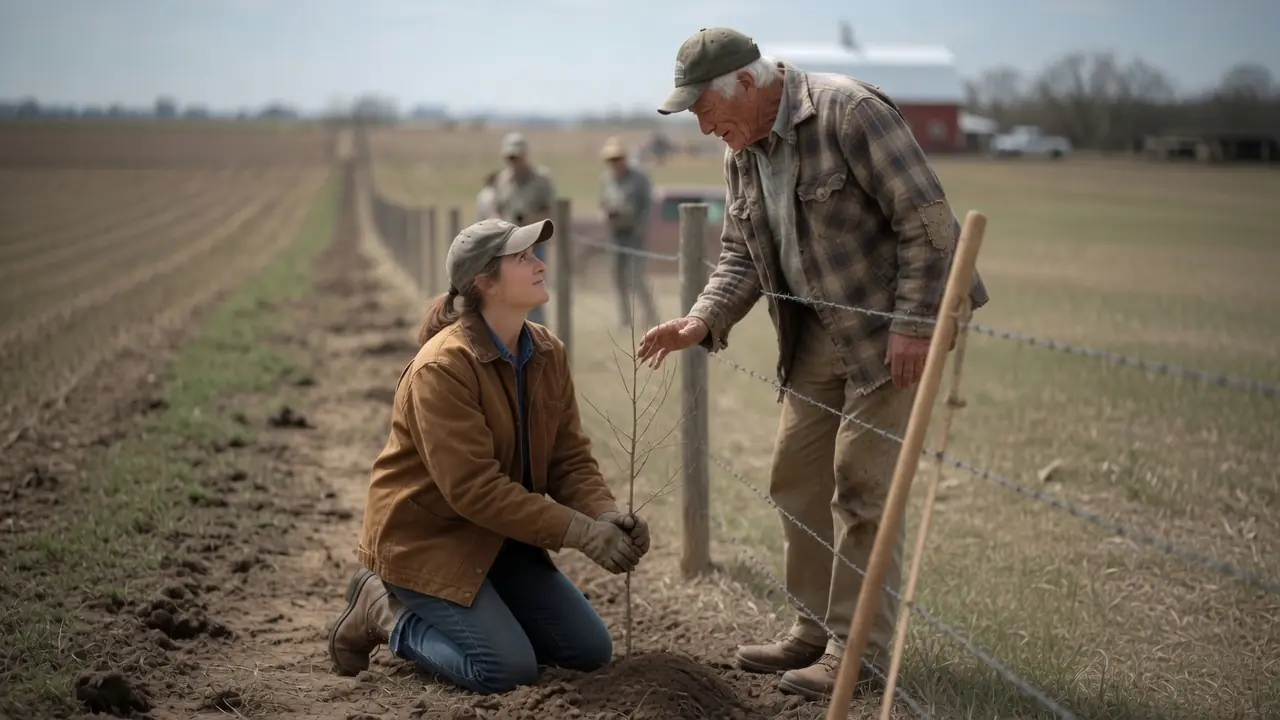
Sylvie saw the beginning of a forest.
She was twenty-six years old, with weather-touched fair skin, determined hazel eyes, and chestnut-brown hair tied beneath a faded work cap. Her charcoal denim jacket carried clay stains across both elbows, and the knees of her black work pants were already soaked from kneeling in the damp ground. She owned no tractor, no hired crew, and no savings beyond what remained after purchasing the hillside. What she possessed instead was a wooden crate filled with her grandmother’s handwritten notebooks.
Leonard leaned farther over the fence. “The county classifies this land as unsuitable for cultivation.”
“The county described what happened to it,” Sylvie said. “Not what it can become.”
“You paid eleven thousand dollars for gullies and rocks.”
“I paid for water, slope, clay, and time.”
“That sounds clever until the bank takes it.”
Sylvie straightened the sapling, spread its roots carefully, and continued packing compost around them. She did not argue further because she had learned that people who laughed at beginnings rarely listened until results became too large to ignore. The men climbed back into Leonard’s truck and drove away, leaving a cloud of dust over the fence line. Sylvie waited until the engine disappeared before whispering to the tree, “You and I are going to be very patient.”
The hillside had once belonged to a timber contractor named Amos Duval. He had purchased it after a logging company stripped away most of the hardwoods, believing another harvest might eventually grow. Instead, storms carved channels through the exposed ground, dragging nutrients, seeds, and loose soil downhill. By the time Sylvie walked the property, only scrub cedar, dying alder, broom sedge, and stubborn weeds remained.
Amos made no attempt to disguise the damage.
“She’s rough,” he told Sylvie during the first inspection. “I wouldn’t blame you for walking away.”
Sylvie walked the entire boundary.
She studied the ridge, the hollow, the creek, and the direction in which rainwater had carved through the clay. She noticed that the lower creek still ran cold and clear, suggesting the broader watershed remained healthy. The center hollow collected water after storms, while the upper slope shed it too quickly. The land was not empty of potential; it was simply designed badly for what previous owners had demanded from it.
Her grandmother, Willa Beckett, had taught her to read those differences.
Willa farmed twelve acres on Pharaoh Road for nearly forty-five years. Her property looked disorderly to neighbors who preferred straight rows and bare soil, but every plant served several purposes. Fruit trees offered food, shade, mulch, and habitat for beneficial insects, while chickens controlled pests and fertilized the ground. A pond held irrigation water, raised fish, cooled the surrounding air, and supported frogs that consumed insects.
Willa called it cascade farming.
Nothing performed only one job.
Nothing useful was allowed to become waste.
When Willa died, Sylvie inherited the farmhouse, twelve acres, and dozens of notebooks filled with observations. There were records of rainfall, bloom dates, bee behavior, fungal growth, soil texture, and the movement of water during storms. Willa rarely wrote instructions as direct rules. Instead, she documented relationships and trusted Sylvie to recognize the pattern.
One sentence appeared repeatedly:
Stop demanding that land become what it is not. Discover what it is already trying to become.
Sylvie had spent fourteen months reading those words before purchasing the ruined hillside.
Her plan began with water.
Instead of allowing rain to rush downhill, she would dig shallow contour trenches called swales. The trenches would slow runoff and allow moisture to sink into the clay. Along the raised banks, she would plant fruit and nut trees whose roots would stabilize the slope. Their leaves would fall, decompose, and gradually rebuild the soil.
The hollow would become a pond.
The upper ridge, too steep for conventional cultivation, would be planted with perennial cover and allowed to return partly to woodland. In the shaded areas, Sylvie would grow mushrooms on cut hardwood logs. Chickens would move between young trees, eating insects, scratching weeds, and adding manure. Each piece would strengthen several others.
On paper, the system looked elegant.
On the hillside, it looked like a young woman digging ditches alone.
Sylvie worked weekdays as a bookkeeper for a feed-supply company in Knoxville. Every Friday evening, she drove four hours to the hillside and slept inside a secondhand travel trailer parked near the upper gate. She spent Saturdays and Sundays digging, hauling compost, repairing fencing, and setting survey stakes. On Monday mornings, she returned to her office with cracked hands and clay beneath her fingernails.
The first swale required three weekends.
She cut it with a mattock and moved the clay using a borrowed wheelbarrow whose left wheel squealed every few feet. The trench followed the natural contour of the lower slope, curving instead of running straight. Passing farmers slowed to inspect it, then continued down the road shaking their heads.
From a distance, it resembled a muddy scar.
Sylvie knew it was a promise waiting for rain.
The storm arrived in June.
Thunder rolled across Harland County, followed by a downpour powerful enough to flood roads and flatten newly planted cornfields. Sylvie stood beneath the trailer’s small awning, watching water rush toward the first swale. The trench filled, spread the runoff across the hillside, and held it long enough for the ground to begin absorbing it.
On Leonard Fitch’s adjoining field, water raced down straight furrows.
It carried soil through the lower fence and deposited a layer of brown sediment against Sylvie’s swale. When the rain ended, Leonard walked the boundary with his boots sinking into the mud. He stared at the dark strip of topsoil trapped above the young apple saplings.
Sylvie approached from the trailer.
“You said your topsoil would end up beneath my trees,” she reminded him.
Leonard looked toward his washed rows. “One storm doesn’t make a farm.”
“No.”
“You’ll need a hundred more.”
Sylvie examined the full trench. “That’s the plan.”
The trees survived their first summer.
Not all of them.
Twenty-seven died during an August heat wave, and another eleven were destroyed by deer before Sylvie improved the fence. She recorded every loss, studied the patterns, and replanted the following spring. Willa’s notebooks had taught her that failure was information only when someone paid attention to it.
Money became the greater threat.
Sylvie needed several hundred additional seedlings, mushroom spawn, fencing, and a small excavator to deepen the hollow. Her bookkeeping salary barely paid taxes, fuel, and living expenses. She prepared a detailed business plan and scheduled an appointment with Harland County Agricultural Bank.
The loan officer was Leonard Fitch.
He had recently retired from farming after transferring his land to his sons and had spent fifteen years evaluating agricultural loans. He welcomed Sylvie politely, though his expression changed when she placed drawings of swales, ponds, mushroom logs, and mixed orchards across his desk. Conventional lenders preferred predictable fields, familiar equipment, and harvests that could be compared against local averages.
Sylvie’s plan provided none of those comforts.
“You’re proposing fruit trees in degraded clay,” Leonard said.
“On rebuilt soil above water-holding swales.”
“Fish in the hollow.”
“A pond already wants to form there.”
“Chickens around the pond.”
“They fertilize the water and control insects.”
“And mushrooms on logs.”
“In shaded sections where crops won’t grow.”
Leonard removed his glasses. “You are describing five small businesses instead of one reliable farm.”
“I’m describing one system with five incomes.”
“The county rates the land Class Six and Seven.”
“The rating assumes conventional cultivation.”
“The bank cannot lend against what the land might become in ten years.”
Sylvie looked at the plan. “It will become nothing if everyone waits for someone else to begin.”
Leonard folded his hands. “I cannot recommend approval.”
The denial letter arrived two weeks later.
Sylvie read it inside Willa’s old kitchen, then carried the wooden cider press from the barn. It was made of oak and cast iron, polished by generations of hands. Selling it felt like removing part of her grandmother from the property, but the press could either remain a memory or become three hundred living trees.
A restaurant owner from Nashville purchased it.
Sylvie used the money for apple, pear, persimmon, pawpaw, chestnut, and black-walnut seedlings. She planted all three hundred over one long March weekend, kneeling in cold clay from sunrise until darkness. By Sunday evening, her hands were swollen and her knees could barely bend.
She walked the final row with a lantern.
The seedlings looked painfully small against forty damaged acres.
“You don’t have to prove anything quickly,” she whispered. “You only have to live.”
During the second year, Sylvie hired a bulldozer operator for two days—not to clear the hillside, but to shape the pond. He deepened the natural hollow, reinforced the downhill bank, and created an overflow channel connected to the creek. The work consumed nearly all her remaining savings.
The pond filled slowly through autumn rain.
At first, it was brown and unattractive. Neighbors called it a mud hole. Leonard’s sons joked that Sylvie had purchased fish before creating water fit for them.
She waited.
Cattails established themselves along the edges. Frogs arrived without invitation. Insects gathered, followed by birds. Sylvie stocked the pond with channel-catfish fingerlings and built a small chicken coop on the upper bank.
The chickens became Harland County’s favorite joke.
Men at the Route 11 diner described the operation as a children’s farm. They mocked the muddy trenches, small trees, wandering hens, and piles of oak logs stacked beneath shade cloth. Serious farmers, they said, planted corn, soybeans, or tobacco—not “water, bugs, and sticks.”
Sylvie heard the jokes through customers at the feed store.
She never responded.
Under the surface, the hillside was changing.
Each swale captured sediment and organic matter. Compost accumulated around the trees. Earthworms appeared in places where a shovel had once struck clay as hard as brick. Fallen leaves remained on the ground instead of being burned or removed, creating a dark layer of material that held moisture through summer.
The mushroom logs produced their first crop during Sylvie’s third autumn.
She discovered them early one October morning—thick brown shiitake caps pushing from the oak bark in clusters. She knelt beside the logs and laughed until tears filled her eyes. The sight was not spectacular to anyone else, but to Sylvie it was the first clear answer from the system she had spent years building.
The first harvest weighed twelve pounds.
The second produced eight more.
A Knoxville chef purchased every mushroom and asked when she could deliver again. The price per pound exceeded Sylvie’s expectations, especially because the logs occupied land unsuitable for ordinary crops. Combined with egg sales and income from Willa’s original farm, the mushrooms covered that year’s taxes.
It was not wealth.
It was proof.
Sylvie expanded from sixty logs to one hundred and fifty. She learned to soak selected logs in cold pond water, encouraging them to fruit on staggered schedules. By winter, when most local farms had little to sell, she delivered fresh mushrooms to three restaurants.
The jokes changed slowly.
At first, people still laughed but asked how much chefs paid.
Then they asked where she purchased the spawn.
By the fifth year, the trees had grown high enough to cast narrow strips of shade. The swales remained damp several weeks after rain, and grass returned to areas once covered only by broom sedge. Sylvie began harvesting pawpaws and persimmons in small quantities.
A late frost destroyed most apple blossoms one spring.
The mushroom crop remained strong.
A dry summer reduced pond levels the following year.
Eggs, walnuts, and fruit kept the farm stable.
The strength of the system was not that nothing failed. It was that one failure never destroyed everything.
Leonard’s sons experienced the opposite.
They had expanded conventional production using loans for equipment, seed, and fertilizer. When commodity prices fell during two consecutive seasons, nearly one-third of their revenue went toward debt payments. Their fields produced more pounds per acre than Sylvie’s mixed plantings, but their expenses consumed much of the difference.
One afternoon, Leonard stopped beside Sylvie’s gate.
He had not visited since the bank meeting.
The lower terraces were covered with apple and pear blossoms. Chickens moved between the trees, while the pond reflected the surrounding green canopy. Beneath the shaded slope stood rows of mushroom logs, and Sylvie’s small packing shed held labeled crates bound for restaurants in Knoxville and Chattanooga.
Leonard removed his hat.
“I attended the county agriculture luncheon,” he said.
Sylvie waited.
“They discussed your mushroom contracts.”
“Yes.”
“Your walnut buyer too.”
“Yes.”
“I checked the bank records. Your taxes have been paid every year.”
“They have.”
“You never borrowed from another lender?”
“No one offered.”
Leonard looked across the hillside, his expression carrying the discomfort of a man whose caution had once felt like wisdom. “I thought the pieces couldn’t support one another.”
“They couldn’t at first.”
“You knew they eventually would.”
“I believed they could.”
“That’s different.”
“Very.”
He walked a few feet along the fence. “I was wrong about this land.”
Sylvie looked toward the orchard. “The land wasn’t wrong. Everyone kept asking it to become a flat field.”
Leonard nodded slowly.
“And I was wrong about you,” he added.
Sylvie said nothing for several seconds.
The apology did not return the cider press or erase the years when she worked without support. Yet it mattered because Leonard offered no excuse, no claim that he had acted reasonably with the information available.
He simply admitted the failure.
“If you ever want financing for cold storage or expansion,” he said, “come see me.”
“Would the bank approve it now?”
“I would.”
Sylvie smiled faintly. “I don’t think I need it anymore.”
By the eleventh year, the hillside generated more net income than several neighboring farms with better soil. Its strength came not from one extraordinary crop but from diversity, low expenses, and products harvested through different seasons.
Mushrooms sold through winter and spring.
Eggs moved all year.
Fruit arrived from summer through autumn.
Walnuts and preserved products extended sales after harvest.
The farm never became an industrial operation. Sylvie refused to clear the woodland or replace diversity with the single most profitable crop. She expanded gradually, purchasing two adjoining parcels that other farmers considered marginal.
Both were cheaper because nobody wanted them.
She built a timber-framed barn using wood milled from trees removed during restoration. A root cellar was cut into the hillside, where the earth maintained a stable temperature without expensive refrigeration. Solar panels powered pumps and lighting, while pond overflow irrigated lower beds.
Visitors began arriving.
Some came from universities.
Others were local farmers who pretended they had been passing nearby.
They asked how to find contour lines, how deep to dig swales, how often to soak mushroom logs, and whether chickens damaged young tree roots. Sylvie answered without reminding anyone of the jokes.
She knew how difficult it was to imagine a system before seeing it operate.
One of Leonard’s sons, Aaron, approached her after losing part of a cornfield to erosion. He stood near the same fence where his father once laughed.
“Would a swale help my upper field?”
“Yes.”
“How much would it cost?”
“If you dig it yourself, less than the soil you lost last week.”
“Could you show me?”
Sylvie collected two surveying tools.
Together, they marked a curved line across his slope.
Within five years, contour plantings appeared across several nearby farms. Some farmers added ponds. Others experimented with mushrooms, chestnuts, or mixed orchards. Nobody copied Sylvie’s property exactly because she taught them the central lesson her grandmother had left behind.
Every piece of land required its own answer.
Decades passed.
The sapling Sylvie planted while Leonard mocked her grew into a broad apple tree beside the original fence. Its roots held the soil where red runoff once crossed into the lower field. Children visiting the farm rested beneath its branches during tours.
Sylvie never removed the old barbed wire.
She also preserved the first denied loan letter, Willa’s notebooks, and a photograph taken during the farm’s second year. In the image, muddy swales crossed a barren hillside while tiny trees stood nearly invisible against the clay.
Visitors often struggled to believe it showed the place beneath their feet.
At sixty-seven, Sylvie walked the terraces more slowly but still touched the bark, inspected leaf color, and watched how water moved after rain. Her niece Emma had completed agricultural school and returned with formal knowledge of soil science, ecological design, and farm management.
Emma once asked why Sylvie had never built a nationally recognized brand.
“You could have expanded everywhere,” she said.
“I did expand.”
“You stopped at sixty-two acres.”
Sylvie looked across the hillside. “More land would have required more people, more machines, and more debt. The farm was built to support a life, not consume one.”
They stopped beside the original apple tree.
Its branches carried a heavy autumn crop.
“Was this the first one?” Emma asked.
“The first one people laughed at.”
“Did you know it would survive?”
“No.”
“You sounded certain.”
“I was certain it deserved a chance.”
Rain began lightly.
Water moved down the ridge, entered the swales, and spread slowly beneath the trees. The soil accepted it without releasing streams of red clay toward the creek. Fallen leaves shifted across the dark ground, and droplets collected along the pond’s surface.
Across the old boundary, Aaron Fitch stood in his own field examining contour rows planted with chestnuts.
Leonard had died years earlier, but before his death he visited Sylvie one final time. He carried a wooden crate inside which rested Willa’s cider press, restored and polished. Leonard had located it through the Nashville restaurant owner and purchased it himself.
“I thought this belonged here,” he said.
Sylvie ran her hand across the oak frame.
“I sold it because the bank rejected me.”
“I know.”
“You didn’t have to do this.”
“No,” Leonard said. “But I wanted one decision of mine to help plant something.”
The press now stood inside the barn, used every autumn during community harvest days.
Sylvie’s farm never became successful because the dead hillside suddenly transformed through luck. The work took years of labor, loss, observation, and stubborn patience. Some trees died, markets changed, storms damaged structures, and crops failed.
Yet the land improved because every season’s output became another season’s foundation.
Roots held the slope.
Leaves built soil.
Water fed trees.
Chickens fed ponds.
Ponds supported fish, frogs, and irrigation.
Shade produced mushrooms.
Nothing stood alone.
The farmers who mocked Sylvie had looked at ruined clay and seen the end of a story. She saw a hillside trying to tell her what it could support if someone stopped fighting its shape.
Her greatest harvest was not apples, mushrooms, eggs, walnuts, or fish.
It was the proof growing across the county.
On hills once considered useless, curved plantings slowed rain. Small ponds occupied damaged hollows. Fruit trees stabilized slopes, while farmers sold products that required fewer machines and less debt.
Sylvie never demanded that anyone admit she had been right.
The landscape did it for her.
Every storm delivered the evidence.
Rain fell on Leonard’s former field and carried soil downhill until contour plantings finally slowed it. Rain fell on Sylvie’s orchard and disappeared quietly into ground that had once rejected water.
The difference was visible from the road.
Years earlier, Leonard had offered to dig graves for her saplings.
Now one of those trees stood taller than the fence where he mocked her, its branches heavy with fruit and its roots wrapped firmly around the hillside.
The tree had survived winter.
The farm had survived ridicule.
And the woman everyone called foolish had taught an entire county that dead land sometimes needed only one person patient enough to listen.