"You destroyed forty acres of good ground for pretty flowers because you’re too soft to farm for profit.”
Hank Kors stood beside the weathered fence separating the Whitfield farm from County Road 9, waving a soybean price sheet as though it were proof of Dana Whitfield’s failure. At fifty-six, Hank had farmed the same Iowa soil for more than thirty years, and nearly everyone at the local cooperative treated his opinion like a weather forecast. His graying mustache lifted with a confident smile as several neighboring farmers watched from beside their trucks.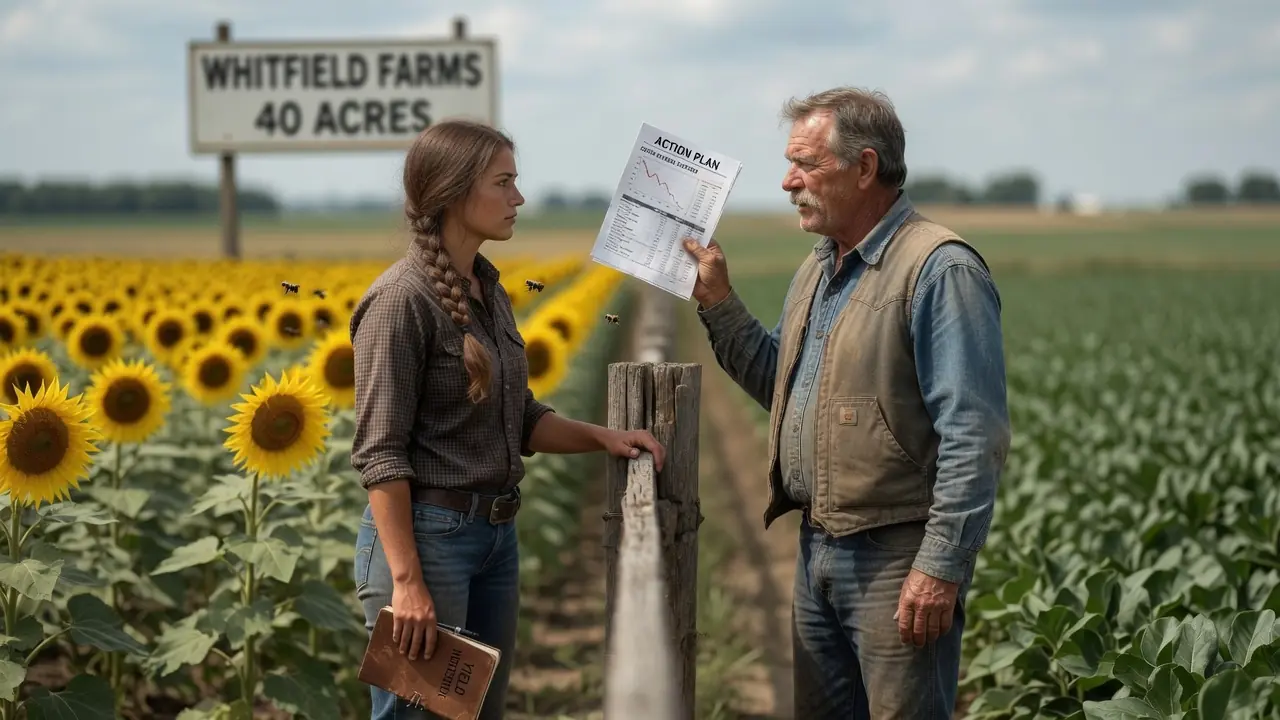
Dana rested one hand against the wooden fence and met his eyes without blinking. She was twenty-four, sun-kissed from long days outside, with sharp hazel eyes and thick chestnut hair braided over one shoulder beneath a wide-brimmed black hat. Her dark-brown checkered shirt was fitted but practical, its sleeves rolled above strong forearms marked with soil and scratches. Faded jeans, a leather belt, and dusty ranch boots completed the appearance of someone who had spent far more time working the land than posing beside it.
“I planted every row to make money,” she said. “You’re just too outdated to understand how.”
A few of the men stopped smiling.
Hank tore the corner from her printed yield estimate and let it fall into the dirt. “When harvest fails, your father will sell this land to cover your stupidity.”
Dana stepped closer until only the fence separated them.
“Come back with your record book in September,” she said. “I’ll bury your name with the first truckload.”
Hank laughed first, and the others followed because laughing felt safer than admitting they did not understand what she was doing. Behind Dana, forty acres of young sunflower plants stretched in neat rows across the Whitfields’ best ground. The plants were only waist-high, their green leaves turned toward the morning light, but to the men along the road they already looked like an expensive mistake.
For three generations, the Whitfield farm had produced corn and soybeans. Dana’s grandfather cleared the original acreage with borrowed machinery and spent decades turning difficult soil into productive ground. Her father, Russell Whitfield, expanded the farm to two hundred ten acres and survived years when crop prices fell so low that every mortgage payment felt like a personal negotiation with disaster.
Russell believed in rotation, patience, and machinery that could be repaired instead of replaced. He trusted what he could measure in grain bins, fuel bills, and acres harvested before the weather changed. His daughter had returned from agricultural college carrying knowledge about soil biology, native pollinators, flowering windows, and ecological systems that did not fit neatly into the traditions he understood.
Dana never expected him to trust her immediately.
She asked only for forty acres to manage independently.
Russell agreed after weeks of discussion, partly because Dana had worked every summer on the farm and partly because he believed failure might teach her something success could not. He expected her to plant a new soybean variety, experiment with cover crops, or adjust fertilizer rates. He did not expect an invoice for thousands of sunflower seeds.
“The whole forty acres?” he had asked at the kitchen table.
“Yes.”
“You know sunflowers don’t pay like soybeans.”
“I know what they pay.”
Russell waited for an explanation, but Dana closed her notebook. She understood her father’s silence differently from the neighbors’ mockery. Russell doubted her because he feared losing the farm; the others doubted her because the idea came from a young woman they still remembered as a girl carrying lunch to the tractor.
Dana had learned that explaining an unfamiliar plan too early often gave critics more material to attack. She wanted plants, insects, and harvest numbers to speak before she did. Until then, she would endure the laughter.
The idea began two years earlier during Dana’s final semester at Iowa State University. A retired extension researcher named Wendell Marsh taught a field seminar on pollinator behavior and crop resilience. Wendell was seventy-two, soft-spoken, and unimpressed by students who repeated textbook answers without understanding the systems beneath them.
During one lecture, he displayed satellite maps showing farms with large flowering corridors beside commercial crops. The farms produced stronger yields in certain soybean varieties even though soybeans were generally capable of self-pollination. Increased insect traffic improved flower fertilization, pod set, and seed weight in ways that most traditional growers underestimated.
“Bees do not read property lines,” Wendell told the class. “Give them a reliable food source, and they will work everything around it.”
Dana remained after class.
“What crop keeps them close the longest?” she asked.
“Sunflowers, if the bloom is staggered correctly.”
“How large would the field need to be?”
Wendell studied her for a moment. “Large enough for everyone nearby to call you foolish.”
That sentence remained with her.
Over the next two years, Dana studied sunflower varieties, soybean flowering periods, soil moisture, hive placement, and seed markets. She identified a hybrid soybean capable of showing significant improvement under heavy pollinator activity. She also found a regional oil processor willing to offer a conditional contract for sunflower seed if her crop reached minimum quality and volume standards.
The flowers themselves could produce a profit.
The neighboring soybeans were where the true opportunity waited.
Dana designed the sunflower field like an engine. She planted three varieties with overlapping bloom periods, ensuring nectar remained available for weeks rather than days. Twenty acres of hybrid soybeans sat directly beyond the tree line, positioned where bees leaving the sunflower rows would naturally pass across their flowers.
She placed native flowering strips along field margins to support insects before and after the sunflowers reached peak bloom. She reduced certain chemical treatments that could harm pollinators and scheduled necessary spraying during hours when bees were least active. Every decision appeared inside her notebook with dates, costs, projected losses, and potential returns.
Nothing was based on beauty.
Beauty was simply what the neighbors noticed.
Within days of the confrontation with Hank, Dana became the favorite subject at Marlene’s Diner. Farmers discussed her field over eggs, coffee, and plates of biscuits. Some said college had filled her head with expensive theories, while others claimed she wanted to turn the farm into a tourist attraction.
Hank sat at the center booth and repeated that flowers belonged in gardens, not on prime Iowa ground. His father had set the county soybean yield record twenty-eight years earlier, and Hank treated the number like a family title. He believed real farming meant repeating proven methods more efficiently than the person before you.
Dana heard every insult secondhand.
Her cousin Beth found her loading mineral supplements at the feed store and approached carefully.
“People are saying you’ll miss the farm payment.”
“People aren’t responsible for the payment.”
“Aunt Carol thinks your father has lost control of the operation.”
Dana lifted another bag into her truck. “My father gave me forty acres.”
“Why won’t you explain the plan?”
“Because they already decided the answer before asking.”
“Then prove them wrong.”
Dana looked toward her. “That is what I planted.”
June brought trouble sooner than expected.
Rain disappeared for nearly four weeks. Dust rose behind every truck, corn leaves curled by afternoon, and the topsoil hardened beneath a sky that offered clouds without moisture. Dana walked her sunflower rows each evening, digging small holes to feel the earth and recording moisture levels at different depths.
The plants began showing stress.
Sunflowers developed deep roots, but young plants needed enough early moisture to establish them. Dana had calculated rainfall risk, yet seeing leaves wilt under the afternoon sun created a fear no spreadsheet could calm. Forty acres of theory stood exposed beneath the heat, and every neighbor waited for failure.
Russell found her kneeling between rows at ten one night. A flashlight rested in the soil beside her notebook.
“You’ll lose part of the stand if this continues,” he said.
“I know.”
“You could replant soybeans if you turn the field over soon.”
“And lose the entire strategy.”
“You may lose the field anyway.”
Dana looked up. “I didn’t come home to repeat what everyone else already does.”
Russell stared across the dark rows.
“I can run an irrigation line from the south pond.”
She knew the labor and fuel would be expensive. “You said this was my experiment.”
“It is.”
“Then why help?”
He adjusted his cap. “Because letting you manage forty acres doesn’t mean watching you fight alone.”
The irrigation line kept the plants alive until rain finally arrived eight days later. The storm struck hard enough to flatten small sections of the field, but the sunflowers recovered quickly. Their stems strengthened, leaves lifted, and the field began growing with renewed force.
Then the deer came.
Dana arrived one morning to find nearly two acres damaged along the eastern edge. Hoofprints covered the wet soil, stalks lay broken, and young flower heads had been bitten away. The loss was not enough to destroy the crop, but it was large enough to weaken her projected profit.
For the first time, she wondered whether the county had been right.
Not about the science.
About her ability to survive every unexpected problem long enough to prove it.
She stood alone beside the damage until frustration became movement. Then she drove to the hardware store, bought reflective tape, motion-activated sprinklers, and portable lights. She worked for three evenings along the tree line, installing each deterrent herself.
Hank passed in his truck on the second evening.
“Heard the deer found your garden,” he called through the open window.
Dana continued tightening a sprinkler connection. “They found two acres.”
“That is how failure starts. Small enough to ignore.”
“That is also how fear starts.”
He frowned. “What does that mean?”
“You damaged more of your own future laughing at mine than those deer damaged in a night.”
Hank drove away without replying.
By mid-July, the first sunflower heads opened.
Gold spread through the field in long, bright rows, each flower turning gradually toward the sun. Cars slowed along Route 9, and families began taking photographs from the shoulder. Dana placed signs asking visitors not to enter the field, but she did not object to the attention.
The flowers were beautiful.
That still was not the point.
Bees arrived in numbers Dana had never seen.
Honeybees moved over the field like living currents. Large native bumblebees crawled across flower centers, their legs dusted with pollen, while smaller insects traveled between the sunflower rows and flowering plants along the margins. The air carried a constant low vibration.
Dana had quietly partnered with Otis Reyes, a beekeeper who maintained hives two miles away. She allowed him to place twelve colonies beside the field in exchange for access to basic activity records and hive-weight measurements. At first, Otis worried the agreement sounded too generous.
“You want no percentage of the honey?”
“I want the bees.”
“You’re growing flowers for insects?”
“I’m growing insects for the crops.”
By late July, Otis called her almost daily. The colonies were producing exceptional honey stores, and the bees rarely traveled beyond the Whitfield property because the sunflower field offered such a consistent reward.
Russell noticed them crossing the tree line.
One evening, he entered the neighboring soybean field and began opening pods. He checked one plant, then another, then walked fifty yards deeper and repeated the process. The pods were fuller than expected for that stage of development.
He called Dana immediately.
She found him crouched between the soybean rows holding several opened pods.
“Explain this,” he said.
Dana looked at the beans and allowed herself a small smile. “The engine is working.”
“What engine?”
“The sunflowers.”
She finally showed him the entire notebook.
They sat in the machine shed while Dana explained the staggered bloom periods, bee traffic, soybean variety, hive locations, and oil-seed contract. She showed Russell data from previous seasons and projected gains based on current pod counts. The forty acres of sunflowers were not replacing forty acres of profit.
They were improving sixty acres at once.
Russell turned pages slowly.
“You carried this plan for two years?”
“Yes.”
“Why didn’t you tell me?”
“I tried explaining pieces before. Everyone heard flowers and stopped listening.”
“I’m not everyone.”
“No. But you were scared enough to sound like them.”
The words hurt because they were true.
Russell closed the notebook. “Your grandfather would have called this foolish.”
“What do you call it?”
He looked toward the open shed, where bees moved across the afternoon light.
“I’m waiting for harvest.”
Dana nodded. It was the fairest answer he could give.
August tested the field again.
A windstorm snapped several rows near the western edge and damaged part of Otis’s hive shelter. Dana, Russell, and Otis worked through the night securing the colonies and lifting fallen flowers away from the access road. By morning, Dana had lost another acre.
Hank stopped near the fence later that week.
“The field is getting expensive,” he said.
“So is fertilizer.”
“Beans don’t attract deer, photographers, and every storm in the county.”
“No. They only attract men who think one crop is a personality.”
Hank’s face hardened. “Your mouth won’t fill a grain bin.”
Dana closed her notebook. “Neither will your confidence.”
September arrived with cooler mornings and sunflower heads heavy with seed. The tall stalks no longer faced the road proudly; they bowed beneath the weight of what they had produced. Dana walked the rows and calculated moisture, test weight, and harvest timing.
The oil processor confirmed the contract.
For the first time, she told Russell the final guaranteed price.
He stared at the number. “You had this arranged before planting?”
“Conditionally.”
“And if the crop failed?”
“I carried the loss.”
Russell shook his head. “Not alone.”
Dana looked at him.
“This farm would have carried part of it,” he continued. “That’s what family land does.”
Harvest began on a cool Monday morning.
The custom harvester adjusted his combine for sunflower heads and entered the field while several vehicles slowed along Route 9. Dana stood near the grain truck, watching the yield monitor through the cab window.
The sunflower production exceeded her conservative estimate.
Truck after truck filled with seed bound for the oil processor. Even after subtracting deer damage, irrigation costs, and equipment adjustments, the field generated a healthy profit. The beauty everyone mocked had paid for itself.
Then they entered the soybean field.
The first yield numbers made the combine operator check his monitor.
He slowed, recalibrated the system, and harvested another pass. The number remained high. He called Russell into the cab, then asked Dana to bring her notebook.
“What did this field produce last year?” he asked.
Russell gave him the number.
The operator stared at the screen. “You’re running nearly twenty bushels above it.”
Dana felt her pulse accelerate.
They harvested deeper into the field.
The numbers rose.
By afternoon, the county extension office had sent a representative to verify moisture levels, acreage, and equipment calibration. Word spread before the first truck reached the elevator. Farmers began arriving along the road, no longer laughing, simply watching.
Hank came last.
He parked near the same fence where he had torn Dana’s yield estimate months earlier. In his hands, he carried the old county record book—the one containing his father’s name.
The extension representative completed the calculations after sunset.
Dana Whitfield’s soybean field had broken the county record.
Not by a fraction.
By enough that no one could dismiss the result as equipment error, weather luck, or exaggerated reporting. Pod counts, seed weight, and field measurements all supported the final number.
Russell stood beside his daughter while the representative announced it.
For a moment, Dana heard nothing except the distant combine cooling in the darkness. She thought of the diner laughter, dry June soil, broken stalks, deer tracks, late-night irrigation, and every page of research she had carried without recognition.
Hank approached slowly.
He held the record book toward her.
“My father’s name stood for twenty-eight years,” he said.
Dana accepted the book.
“You told me you’d bury it with the first truckload.”
“I was angry.”
“You were right.”
Several farmers waited nearby, expecting Dana to humiliate him. She could have repeated every insult publicly, reminded him that he called her soft, or forced him to admit that his experience had become arrogance.
Instead, she opened the book.
“Your father earned this record,” she said. “Breaking it doesn’t erase what he did.”
Hank looked at her.
“But laughing at new ideas won’t protect his legacy either.”
He nodded slowly. “I owe you an apology.”
“Yes, you do.”
“I treated your plan like decoration because I didn’t understand it.”
“You treated me like a child because understanding me would have required questioning yourself.”
His eyes lowered.
“That too.”
Dana handed the book back. “Write the new number yourself.”
Hank stared at her before taking it.
With several neighbors watching, he entered Dana Whitfield’s name beneath his father’s. His handwriting shook slightly, not from age, but from the weight of surrendering a certainty he had carried for decades.
The story spread across Iowa.
Agricultural reporters visited the Whitfield farm. Extension agents studied the field layout, pollinator counts, and crop records. Dana repeatedly warned them not to treat sunflowers as magic.
The success came from crop selection, timing, field placement, hive management, soil conditions, and disciplined observation. Planting flowers without understanding the surrounding system would not automatically produce record yields. The method worked because every piece supported another.
By spring, three neighboring farms had planted pollinator corridors.
Hank installed flowering strips along two soybean fields and asked Dana to review his plan. He did not pretend the idea had been his. At the next cooperative meeting, he stood before the same men who once laughed with him.
“I was wrong,” he said. “Dana saw value where I saw wasted ground.”
The room remained quiet.
“She didn’t farm softer than us. She farmed smarter than I did.”
Russell sat beside Dana at the back of the room. He leaned toward her.
“You enjoying this?”
“A little.”
“You should enjoy it more.”
Dana smiled.
The following season, the sunflowers returned on different acreage as part of a broader rotation. Nobody called them a garden. Nobody questioned whether Dana understood profit.
Trucks still slowed on Route 9 when the flowers opened.
Children still posed beside the golden field, couples still took pictures, and people still described it as beautiful. Dana no longer resisted the word.
Beauty had never been the insult.
The insult was believing something beautiful could not also be powerful, calculated, and profitable.
Years later, the county record book still carried Dana’s name. Other farmers eventually came close, and she hoped one of them would surpass it. Progress meant proving that old achievements could become foundations rather than ceilings.
The black hat, long braid, and notebook became familiar across agricultural workshops throughout the Midwest. Dana spoke about pollinators, resilience, and the danger of confusing tradition with truth. She always ended with the same lesson.
The field had not defeated the men who mocked her.
Their assumptions had defeated them before the first flower opened.
They saw a beautiful farm girl planting sunflowers and assumed softness, inexperience, and sentiment. Dana saw interconnected crops, reliable nectar, stronger pollination, a seed contract, and a harvest nobody else believed possible.
They laughed through spring.
They doubted her all summer.
Then September came—and the numbers spoke louder than every one of them.