At seventy-nine years old, Edward Lawson still kept the porch light on every night.
His neighbors in Asheville, North Carolina, often teased him about it when they passed his small white house at the edge of Willow Creek Road.
“Ed, nobody’s coming by after nine,” old Mr. Pelham would call from across the fence.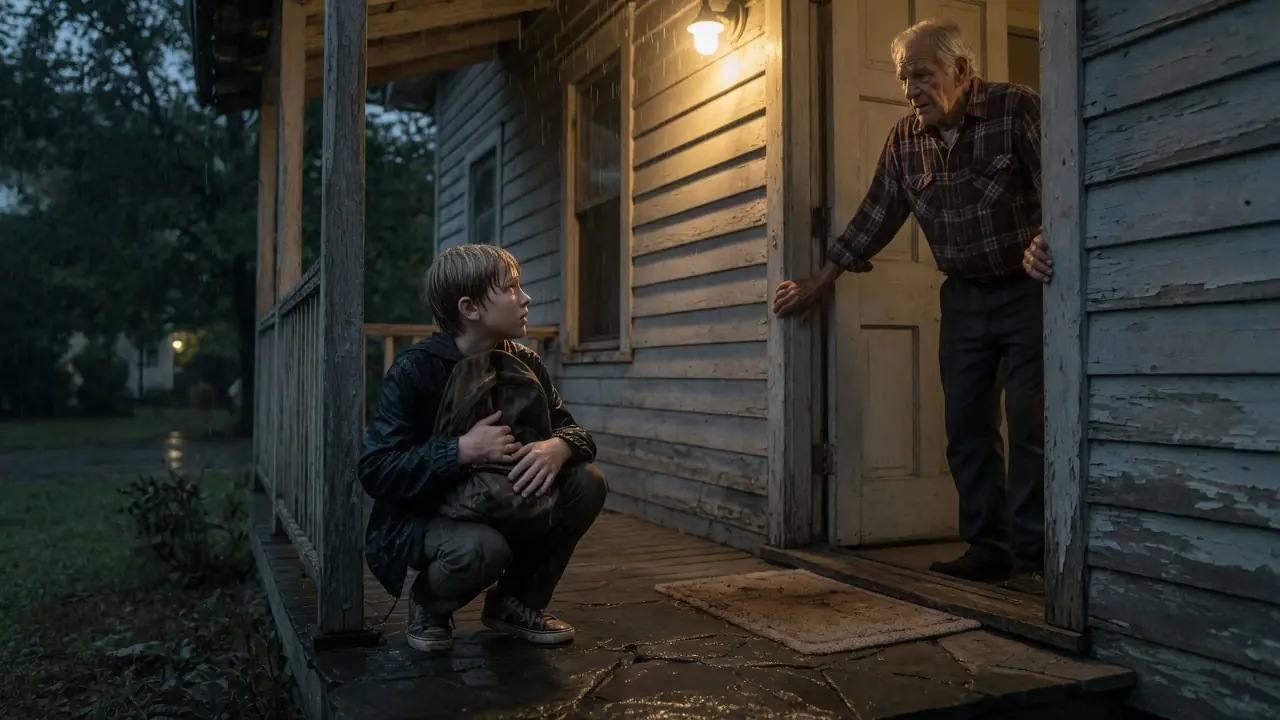
Edward would only smile, lift one hand, and say, “A light doesn’t hurt anybody.”
But the truth was, the porch light had never really been his habit.
It had belonged to Margaret.
Margaret Lawson had turned on that small yellow light every evening before dinner, even when Edward was already home, even when their children were grown, even when no guests were expected. She said a lit porch made a house look forgiving.
Edward never knew exactly what she meant by that.
He only knew that after she died, the house felt too dark without it.
So every evening at dusk, no matter how tired his knees were, no matter how stiff his fingers felt, he walked to the front door and flipped the switch. The light beside the door blinked once, then glowed softly against the porch boards.
It made the house feel less empty.
Edward had been a carpenter for most of his life. He had built kitchen cabinets, front steps, barns, rocking chairs, bookshelves, porch swings, church pews, and once, a tiny wooden cradle for his first grandchild.
His hands were broad, scarred, and permanently rough from wood, nails, sawdust, splinters, and weather. Even now, with age tightening his knuckles and arthritis settling into his wrists, he could still tell by touch whether a board was good.
He could run one thumb along a plank and feel the difference between strong grain and trouble.
His own house was full of things he had made.
The kitchen table, dark oak and worn smooth at the edges.
The porch swing where Margaret used to sit in the evenings with tea.
The bookshelves in the living room.
The cedar chest at the foot of his bed.
The little wooden stool in the corner of the workshop, the one he kept meaning to finish but never quite did.
Edward’s daughter, Linda, lived in Raleigh with her husband and two busy teenagers. His son, Paul, lived in Arizona, where the weather was dry and, according to Edward, “too proud of itself.”
They called.
They visited when they could.
They worried.
Linda especially worried.
“Dad, that house is too much for you,” she told him every few months.
“It’s one story,” Edward said. “How much house can one story be?”
“The gutters need cleaning. The steps need repair. You should not be on ladders anymore.”
“I have lived seventy-nine years without being bossed by my own daughter.”
“You raised me to be bossy.”
“That was your mother’s side.”
Linda always laughed, but Edward heard the fear beneath it.
He understood.
Aging turned ordinary things into arguments. Stairs, bathtubs, icy sidewalks, light bulbs too high to reach, jars too tight to open. Children saw those things and imagined danger. Parents saw those things and remembered independence.
Edward refused to leave.
“This house still has good bones,” he always said.
He did not add what he thought afterward.
So do I.
One rainy October evening, Edward was in his workshop behind the house, sanding the edge of a small wooden stool. Rain tapped on the metal roof and ran down the windows in silver lines. The electric heater hummed near his feet, and the smell of cedar and pine shavings filled the room.
The stool was for Mrs. Pelham across the road, though she did not know it yet. She had trouble reaching the top shelf of her pantry, and Edward had seen her standing on an overturned bucket two weeks earlier.
“Fool woman will break her neck,” he had muttered.
Then he began making the stool.
He had just switched to a finer grit of sandpaper when he heard something near the shed.
At first, he thought it was a raccoon.
Raccoons had no respect for property lines, garbage cans, or craftsmanship.
Then he heard it again.
A cough.
Not an animal cough.
A child’s cough.
Edward set down the sandpaper and listened.
There it was again, small and wet, swallowed quickly as if the child had tried to hide it.
He stood slowly, one hand pressing against the workbench until his knee settled under him. Then he opened the workshop door and looked into the rain.
A boy was crouched beneath the narrow roof overhang of the shed, trying to stay dry.
He looked about eleven years old, with dark blond hair flattened by rain, pale cheeks, and a backpack hugged tightly against his chest. His jacket was soaked across the shoulders. His sneakers were muddy, and one lace dragged through the wet grass.
When the boy saw Edward, he jumped to his feet.
“I’m sorry,” he said quickly. “I was just waiting for the rain to stop.”
Edward stood in the doorway, rain misting his face.
“In my shed?”
“I didn’t go inside.”
“I can see that.”
“I wasn’t stealing anything.”
“I didn’t say you were.”
The boy looked toward the road.
Edward knew that look.
He had seen it in stray dogs, young men leaving courtrooms, and once in the mirror after Margaret’s funeral. It was the look of something preparing to run because staying had never been safe.
Edward softened his voice.
“What’s your name?”
The boy hesitated.
“Caleb.”
“Caleb what?”
“I’m Edward Lawson.”
The boy nodded toward the house.
“I know. Your mailbox says Lawson.”
“So it does.”
Rain fell harder, drumming against the shed roof and splashing in puddles along the narrow path. The boy shivered, then straightened quickly as if he had not.
Edward noticed.
“You live nearby, Caleb?”
“Not far.”
“That’s not an address.”
The boy’s jaw tightened.
“I’m fine.”
Edward gave a small sigh.
“Son, I have been alive seventy-nine years. I’m fine usually means the opposite.”
Caleb looked down.
Edward stepped aside and opened the workshop door wider.
“Come inside. You can stand near the heater while the rain lets up.”
Caleb shook his head.
“I can’t.”
“Why not?”
“I don’t have money.”
Edward almost laughed.
Not because it was funny.
Because the sentence broke something tender in him.
“I don’t charge admission to my workshop.”
“I shouldn’t be here.”
“Probably not,” Edward said. “But here you are.”
The boy stared at him, unsure what to do with an adult who did not shout.
Edward pointed toward the small electric heater near the bench.
“Five minutes. Door stays open if that makes you feel better.”
Caleb hesitated.
Then he stepped inside.
The workshop smelled of cedar, pine, varnish, and rain-damp clothes. Caleb stood near the heater, still clutching his backpack. His eyes moved across the tools hanging on the wall, the stacks of lumber, the clamps, the old radio, the half-finished stool on the bench.
“You make things?” he asked quietly.
“When the wood cooperates.”
“Does it?”
“Not often.”
For the first time, Caleb almost smiled.
Edward took a clean towel from a shelf and held it out.
“For your hair.”
Caleb took it carefully.
“Thank you.”
“Hungry?”
The boy’s face closed immediately.
“No.”
His stomach growled loud enough to answer for him.
Edward lifted one eyebrow.
Caleb’s face turned red.
“I have soup in the house,” Edward said. “And cornbread, unless the old man next door ate it all.”
“You live alone.”
Edward paused.
“Yes.”
“So there’s no old man next door?”
“I am the old man next door. Sometimes I blame myself for missing food.”
Caleb stared at him.
Then a surprised little laugh slipped out before he could stop it.
Edward smiled.
“Come on.”
Caleb stayed frozen.
“I can’t go in your house.”
“That is a smart rule,” Edward said. “Here is what we’ll do. I’ll call someone safe first. Your mother, father, whoever is looking for you. Then you can decide whether to sit at my kitchen table or keep negotiating with your stomach.”
At the word mother, Caleb’s face changed.
Edward saw it immediately.
“Caleb,” he said gently, “who is looking for you?”
The boy lowered his eyes.
“My mom.”
“Does she know where you are?”
“No.”
“Where is she?”
“At the hospital.”
Edward went still.
“Is she sick?”
Caleb shook his head quickly.
“No. She works there. Laundry department.”
“And why aren’t you home?”
The boy swallowed.
“We had to leave.”
“Leave where?”
“Our apartment.”
Edward waited.
He had learned through decades of carpentry that if you forced something before it was ready, it split.
Caleb rubbed the towel between his hands.
“The landlord changed the locks this morning. Mom said he wasn’t supposed to, but he did. She had to go to work because if she missed another shift, she’d lose the job. She told me to stay with Mrs. Allen downstairs until she got off.”
“What happened?”
“Mrs. Allen’s daughter came over with her kids. There wasn’t room anymore. They said I could wait in the hallway, but the landlord came back and told me to get out.”
Edward’s jaw tightened.
“What time does your mother finish work?”
“Midnight.”
It was not even seven.
“You were going to stay outside until midnight?”
Caleb said nothing.
Edward looked at the soaked jacket, the thin shoulders, the backpack held like the last piece of home.
This child was not fully homeless.
Not yet.
But the world had pushed him outside for one dangerous night.
One night could change a child.
One night could teach him nobody was coming.
Edward reached for the old landline mounted near the workshop door.
“Do you know your mother’s phone number?”
Caleb nodded.
Edward handed him the phone.
The boy dialed with shaking fingers.
No answer.
He tried again.
No answer.
“She can’t keep her phone on during shift,” Caleb said quickly. “But she checks it on break.”
Edward nodded.
“Then we leave a message.”
He took the phone gently when the voicemail beep sounded.
“Ms. Turner, my name is Edward Lawson. Your son Caleb is safe at my house on Willow Creek Road. He is cold, but he is all right. I will keep him here until you can call or come. My number is…”
When he hung up, Caleb stared at the floor.
“She’ll be mad.”
“No,” Edward said. “She’ll be scared.”
“I shouldn’t have left Mrs. Allen’s.”
“You were told to leave.”
“I should’ve found somewhere better.”
“You are eleven.”
“Almost twelve.”
“Still not old enough to outthink a bad landlord in the rain.”
Caleb looked away, but his eyes had gone wet.
Edward pretended not to notice.
Pride had bones, too.
And children’s pride broke differently.
He led Caleb across the wet yard toward the house. The porch light glowed yellow through the rain, shining across the steps and front door. Caleb glanced at it as they passed.
“Why is that on?”
“My wife liked it that way.”
“Where is she?”
Edward unlocked the door.
“Gone.”
Caleb understood enough not to ask more.
The kitchen was warm and simple. A round wooden table sat near the window. A pot of vegetable beef soup rested on the stove, and the smell filled the room, rich and steady. A blue dish towel hung over the oven handle. Margaret’s old recipe box sat in the corner, though Edward knew most of those recipes by heart.
Caleb stood just inside the doorway, dripping onto the mat.
Edward pointed to a chair.
“Sit.”
“I’ll get it wet.”
“Chairs dry.”
Caleb sat carefully, still holding his backpack.
Edward gave him soup, cornbread, a glass of milk, and a folded napkin. The boy stared at the bowl as though it might disappear if he looked too hungry.
“That’s too much.”
“No,” Edward said. “Too much would be dessert before soup.”
Caleb looked up.
“There’s dessert?”
“Depends how well you behave around cornbread.”
The boy almost smiled again.
He ate slowly at first.
Then faster.
Edward turned toward the sink and washed a clean mug that did not need washing, giving Caleb the dignity of not being watched while hunger took over. When the bowl was empty, Edward filled it again without asking.
Caleb whispered, “Thank you.”
“You’re welcome.”
After dinner, Edward gave him dry socks and one of his old flannel shirts. It hung loose on Caleb’s thin frame, sleeves rolled several times. He placed Caleb’s shoes near the heater and set his wet jacket over a chair to dry.
Caleb returned to the kitchen table with his backpack still on his lap.
“You can put that down,” Edward said.
“It has our papers.”
“What kind of papers?”
“Birth certificate. Mom’s work stuff. Lease. Some pictures. She told me not to lose them.”
Edward looked at the backpack differently.
Not a school bag.
A family archive.
A boy carrying proof that his life existed.
“You did well keeping it safe,” Edward said.
Caleb blinked.
“I did?”
“You did.”
The boy’s shoulders lowered a little.
At 8:15, the phone rang.
Edward answered.
A woman’s voice came through, frantic and breathless.
“Mr. Lawson? This is Rachel Turner. Is Caleb there? Is he okay?”
“He is safe.”
A broken sob came through the phone.
“Oh God. Caleb.”
Edward handed the phone to the boy.
“Mom?”
The moment Caleb heard her voice, his face crumpled.
“I’m sorry,” he whispered. “Mrs. Allen couldn’t keep me. I didn’t know where to go. I didn’t lose the papers.”
Edward stepped into the living room to give him privacy.
He stood beneath the framed photograph of Margaret on the wall. She was smiling in that picture, standing on the porch in a yellow sweater with one hand resting on the railing Edward had built the summer before.
He looked at the picture and murmured, “You always did say the light was for somebody.”
Rachel Turner arrived just after midnight.
She came in a faded hospital laundry uniform beneath a thin coat, her hair pulled into a messy bun, her face pale with exhaustion and fear. The moment Caleb opened the door, Rachel dropped to her knees and pulled him into her arms.
“I’m sorry,” she cried. “I’m so sorry, baby.”
Caleb clung to her.
“I kept the papers.”
“I don’t care about the papers.”
“You said they were important.”
“You are important.”
Edward stood quietly in the hallway.
Rachel looked up at him with tears running down her face.
“Mr. Lawson, thank you. I don’t know what would have happened if you hadn’t…”
“Don’t finish that sentence,” Edward said softly. “He’s safe.”
Rachel tried to stand, but exhaustion made her sway. Edward reached for a chair and pulled it close.
“Sit down before you fall down.”
“I can’t stay. We need to figure out where to go.”
“You already have.”
She looked confused.
“You and Caleb can stay here tonight,” Edward said.
“No. Sir, we can’t.”
“You can.”
“I can’t pay you.”
“I didn’t ask.”
“We’re not homeless,” she said quickly, shame rising in her voice. “I mean, we have money coming. I have a job. The landlord wasn’t supposed to lock us out. I just need a few days to fix it.”
Edward’s face softened.
“I believe you.”
Rachel stopped.
“You do?”
“Yes.”
That simple answer nearly broke her.
She covered her mouth and cried.
Not loudly.
Not theatrically.
Just the silent, shaking cry of someone who had been holding herself upright too long because a child needed her to.
Edward gave Rachel soup. She tried to refuse twice, then ate as if her body had finally overruled her pride. Caleb sat beside her, leaning against her arm, heavy with relief.
The house felt different that night.
Edward did not say it.
But he felt it.
There were voices in the kitchen again.
Small sounds upstairs.
The careful creak of someone else using the hallway.
The old house seemed to breathe deeper.
He put Rachel in his daughter’s old room and Caleb in his son’s. Before bed, he left towels on the dresser and placed the wet backpack near a heating vent where it would dry without being out of reach.
Caleb stood in the doorway of the guest room.
“Mr. Lawson?”
“Yes?”
“Do I lock the door?”
Edward paused.
“If it helps you sleep, yes.”
Caleb nodded.
“Will you be mad?”
“No.”
The boy closed the door.
Edward heard the lock click.
He stood in the hall for a moment, one hand on the wall.
Then he went downstairs and turned off every light except the porch light.
One night became five.
Then two weeks.
Edward helped Rachel call a tenant advocate. He drove her to the county office when she needed forms printed. He made copies of her lease and pay stubs. He contacted a retired attorney named Gloria Benton, who owed him a favor after he rebuilt the front steps of her home ten years earlier.
Gloria came to Edward’s kitchen with a red coat, a leather folder, and the brisk authority of a woman who had spent her life making dishonest people uncomfortable.
She read Rachel’s lease at the kitchen table while Caleb did homework nearby.
“Illegal lockout,” Gloria said. “Clear as day.”
Rachel’s hands trembled around her coffee.
“He said I owed rent.”
“You may have owed rent,” Gloria replied. “That does not give him the right to change the locks without a court order.”
“I didn’t know what to do.”
“That is why men like him count on women like you being too tired to fight.”
Edward nodded toward Gloria.
“She’s like this all the time.”
Gloria ignored him.
“Good news is, Ms. Turner, you have documents. You have pay stubs. You have a witness that your son was forced out. That matters.”
Rachel glanced toward Caleb.
“I told him to keep the papers safe.”
Caleb sat a little straighter.
Gloria looked at him over her glasses.
“You did excellent work, young man.”
Caleb looked down, trying not to smile.
Edward noticed.
He had not known until that moment how starved the boy was for someone to tell him he had done something right.
Within a week, Gloria had filed a complaint. The landlord, Victor Harlan, who had expected a tired laundry worker to disappear quietly, suddenly received legal letters, calls from the housing office, and a visit from a city inspector.
He did not become kind.
Men like that rarely changed quickly.
But he became nervous.
That was enough.
Rachel recovered some belongings he had tried to keep. A church housing fund helped with a deposit for a small apartment. The hospital connected her to an employee emergency assistance program no one had told her about until Gloria began asking questions in the correct tone.
Rachel did not need rescue from laziness.
She needed time, witnesses, and someone who knew which doors to knock on.
Edward gave her those.
Caleb stayed in the small guest room that had once belonged to Edward’s son during summer visits. At first, he kept his backpack on the bed beside him. Then, on the third night, he placed it on the chair. By the seventh night, he put his schoolbooks on the desk.
Edward noticed.
He said nothing.
Every morning, Rachel left before sunrise for her shift at the hospital laundry. Edward made Caleb oatmeal, packed him a lunch, and drove him to school in the old blue pickup with a toolbox rattling behind the seat.
The first morning, Caleb kept his hands folded tightly in his lap.
“You don’t have to drive me,” he said.
“Bus stop is three blocks out.”
“I can walk.”
“In the rain?”
“I’ve walked in rain.”
“That is not an argument for doing it again.”
Caleb looked out the window.
“People will ask questions.”
“People ask questions because silence makes them itch.”
At school drop-off, Caleb opened the truck door, then paused.
“Mr. Lawson?”
“Yes?”
“If my mom finds somewhere, we won’t bother you anymore.”
Edward looked at the boy.
“You have not been bothering me.”
Caleb swallowed.
“Okay.”
The word was small, but it was a beginning.
In the afternoons, Caleb sat in Edward’s workshop while his mother worked extra hours. At first, he did homework at the old desk by the window and said very little. Then he began asking questions.
“What’s that tool?”
“A block plane.”
“What does it do?”
“Shaves wood.”
“Why?”
“Because wood, like people, sometimes needs smoothing before it fits where it belongs.”
Caleb frowned.
“You always talk like that?”
“Unfortunately.”
Soon he asked to try sanding. Edward gave him a scrap of pine and a square of sandpaper.
“With the grain,” Edward said.
“What happens if I go against it?”
“You make scars you then have to spend twice as long fixing.”
Caleb stared at the board.
“Still talking about wood?”
“Mostly.”
By the second week, Caleb was sweeping the workshop without being asked. By the third, he helped Edward build a simple shelf for the pantry.
Edward showed him how to measure twice before cutting once.
Caleb measured three times.
“Worried?” Edward asked.
“Careful.”
“There’s hope for you.”
Rachel moved into the new apartment near the end of November.
It was small, but clean. Two rooms, working locks, a landlord who answered the phone, and a bus stop close enough for Rachel to reach the hospital without walking alone in the dark. Caleb had his own corner in the bedroom with a narrow bed, a desk Edward had refinished, and a lamp Margaret once used for sewing.
On moving day, Rachel stood in Edward’s kitchen unable to speak.
She had packed their few things into boxes Edward found behind the hardware store. Caleb held his backpack in one hand, though it was no longer stuffed with every important paper they owned.
“I don’t know how to thank you,” Rachel said.
Edward reached for his coat.
“You can start by not crying on my clean floor.”
That made her laugh through tears.
Caleb stood in the workshop doorway later, looking at the tools hanging neatly on the wall.
“You’ll forget us,” he said.
Edward looked at him.
“No.”
“People say things.”
“I build things,” Edward replied. “I know the difference between words and structure.”
Caleb looked down.
Edward opened his hand.
In his palm lay a small wooden keychain shaped like a house. He had carved it from cedar and sanded it smooth, then burned the word HOME into one side with an old wood-burning pen.
“Put your new key on it,” Edward said.
Caleb took it carefully.
“I’ll pay you back one day.”
Edward smiled.
“For soup?”
“For not making me feel like we were nothing.”
Edward’s throat tightened.
“You were never nothing, son.”
Caleb and Rachel did not disappear.
Every Saturday, Caleb came to Edward’s workshop. Sometimes Rachel dropped him off before her shift. Sometimes Caleb rode his bike after he saved enough money from helping a neighbor rake leaves. Edward taught him how to use hand tools first, then power tools under strict supervision.
“Tools are not dangerous because they’re sharp,” Edward told him. “They’re dangerous because people get careless.”
Caleb nodded seriously.
He took rules seriously when they made sense.
At thirteen, he built a birdhouse.
It was slightly crooked, but the roof held.
At fourteen, he fixed a loose stair tread in Rachel’s apartment building after asking Edward to supervise.
At fifteen, he built a small table from reclaimed oak. He sanded it for so long Edward said the wood would soon start charging rent.
At seventeen, he built a cedar chest for Rachel.
The chest took months.
He saved money for the hinges.
He made three mistakes on the lid and started over twice.
When Rachel saw it in Edward’s workshop, finished and glowing beneath a coat of oil, she pressed both hands over her mouth.
“You made this?”
Caleb nodded.
“Mr. Lawson helped.”
Edward grunted.
“Barely. He’s getting bossy.”
Rachel ran her hands over the smooth cedar.
“You built me something that will last.”
Caleb’s eyes softened.
“You kept us alive. I figured you deserved a box that could keep things safe.”
Rachel cried then.
Edward turned away and pretended to adjust a clamp.
Years passed.
Caleb grew tall, thoughtful, and quiet. His hair darkened. His shoulders filled out. He remained serious in the way children become when life teaches them early that adults are not always dependable.
But the workshop gave him steadiness.
Wood made sense.
Measurements mattered.
A joint either fit or it did not.
A cut was either clean or needed correction.
Problems did not disappear because someone ignored them. They waited until a person came back with the right tool.
That idea stayed with him.
In high school, Caleb became interested in architecture and construction management. Not luxury buildings. Not glass towers or vacation homes. He wanted to design apartments where working families could live without fear.
Safe stairs.
Working locks.
Legal tenant notices.
Storage lockers for important documents.
Laundry rooms that did not flood.
Common rooms where children could wait after school if parents worked late.
Edward teased him at first.
“You plan to save the world with better hallways?”
Caleb shrugged.
“Bad hallways can ruin a life.”
Edward had no answer for that.
When Caleb graduated high school, Edward sat in the front row beside Rachel. Linda had driven in from Raleigh to attend because, as she put it, “any boy Dad talks about this much must be family whether he admits it or not.”
Caleb walked across the stage in his cap and gown, receiving not only his diploma but a scholarship to study architecture and construction management at North Carolina State.
Rachel cried openly.
Edward wiped one eye and claimed the auditorium was dusty.
After the ceremony, Caleb handed him a small wrapped box.
Inside was the original cedar keychain, worn smooth from years of use.
Edward ran his thumb over it.
“You kept it all this time?”
Caleb pulled a new keychain from beneath his collar, one he had made himself from walnut.
“I replaced it,” he said. “But I wanted you to have the first one back.”
“Why?”
Caleb looked toward Rachel, then back at Edward.
“It reminded me there was always a door somewhere that would open.”
Edward looked down quickly.
“Go build better doors,” he said.
Caleb did.
College changed him, but it did not erase him. He learned design software, building codes, structural systems, zoning laws, funding models, and the political language people used when they wanted affordable housing to sound like a threat.
He worked part-time in the campus woodshop and sent Edward pictures of every project.
Edward responded with critiques.
The left rail is uneven.
Good grain choice.
Sand before you stain, boy.
Caleb called every Sunday evening.
Sometimes they talked for an hour.
Sometimes Caleb was exhausted and Edward simply listened while he ate instant noodles or complained about professors who used too many words to describe obvious things.
After college, Caleb took a job with a nonprofit housing developer in Asheville. He worked first as an assistant project coordinator, then project manager, then director of community rebuilding.
By twenty-eight, he was managing projects that turned abandoned buildings into safe apartments for working families. He insisted on details other developers ignored.
Mailboxes that locked.
Hallways with proper lighting.
Storage spaces for documents.
Community rooms where children could do homework.
Legal support offices near the entrance.
“If a building can hurt a family,” Caleb once told a city board, “then a building can also protect one.”
Edward saw the video online because Linda sent it to him.
He watched Caleb stand before the board in a gray suit, steady and clear, and felt a pride so sharp it almost hurt.
“That boy still measures three times,” Edward told Margaret’s photograph.
He was eighty-six by then.
The years had done what years do.
Edward’s hands shook when holding small screws. His knees resisted cold mornings. He could no longer spend all day in the workshop without needing a chair by noon. He had stopped climbing ladders after Linda made him sign a paper, which he called “a ridiculous daughter contract.”
Still, he refused to move.
The house had good bones.
But houses with good bones still needed care.
The porch sagged slightly at the left corner. The workshop roof leaked after heavy storms. The gutters pulled away from the fascia. The property taxes rose. Insurance grew more expensive. A developer began buying older lots along Willow Creek Road, offering elderly homeowners cash prices that sounded generous until you understood what was being taken.
Edward ignored the letters at first.
Then came the storm.
A late spring thunderstorm rolled over Asheville with heavy rain and strong wind. Edward woke at 3:00 a.m. to the sound of something tearing. By morning, a section of the workshop roof had peeled back, water dripping onto the workbench where he had taught Caleb to sand with the grain.
Edward stood in the doorway, cane in hand, and felt something inside him sink.
He could repair small things.
This was not small.
The first estimate was too high.
The second was worse.
The third man told him gently, “Mr. Lawson, honestly, with your age and the taxes on this place, you might consider selling.”
Edward closed the door before the man finished.
For the first time, he imagined the porch light turned off forever.
He did not tell Caleb.
Rachel did.
Mothers, Edward decided, had been placed on earth specifically to betray old men’s secrets for their own good.
One week later, Caleb arrived at Edward’s porch carrying rolled blueprints, a leather folder, and the expression of someone who had already made decisions.
Edward opened the door and sighed.
“Your mother talks too much.”
“She learned from the best.”
“That sounds like an insult.”
“It’s a compliment.”
Caleb stepped inside and glanced around the house.
Edward saw his eyes catch everything. The water stain near the hallway ceiling. The uneven porch board. The stack of unpaid estimates on the kitchen counter. The way Edward leaned too hard on his cane when turning.
“Don’t start,” Edward said.
“I haven’t said anything.”
“You’re thinking loudly.”
Caleb smiled faintly.
“You used to say that to me.”
“I was usually right.”
“At the kitchen table, Caleb unrolled the plans.
Edward saw his own house drawn in careful lines.
But restored.
The porch rebuilt, not replaced beyond recognition.
The workshop roof repaired and reinforced.
The spare rooms updated.
The bathroom modified with safety bars Edward immediately disliked on principle.
The backyard cleared and made accessible.
The workshop expanded with better lighting, safer tool storage, and a ramp.
Then Caleb unrolled another page.
Edward stared at it.
It was not just a renovation plan.
It was a purpose.
The workshop would become a community carpentry and housing support center. Teenagers from unstable housing situations would learn woodworking and construction basics. Families facing illegal lockouts or sudden displacement could receive referrals, help organizing documents, and emergency guidance. A supervised temporary room would be available for children who needed a safe place to wait while a parent finished work or while an advocate arranged help.
At the top of the design was a sign.
The Edward Lawson HomeWorkshop
Good Bones. Open Doors.
Edward stared at the words for a long time.
“No.”
Caleb sat across from him.
“Yes.”
“I don’t need my name on a sign.”
“I know. That’s why it belongs there.”
“I just let you stay a few nights.”
Caleb’s face changed.
All the adult polish fell away, and for a moment Edward saw the eleven-year-old boy standing in his workshop with rain in his hair and a backpack full of papers.
“You did not just let me stay,” Caleb said quietly. “You believed my mother. You made calls when no one else would. You gave me a room where I could lock the door. You taught me that damaged things can still have good bones.”
Edward looked away.
“I’m old, Caleb.”
“I know.”
“I can’t run something like this.”
“You won’t run it alone. The nonprofit will administer the programs. Rachel has agreed to help with family intake twice a week after she retires next year. Gloria Benton already said she would train volunteers on tenant document basics.”
“You talked to Gloria?”
“Yes.”
“She is worse than your mother.”
“I needed the best.”
Edward shook his head.
“And what exactly am I supposed to do?”
Caleb smiled.
“Sit in the workshop and tell teenagers when they’re sanding wrong.”
Edward considered that.
“That I can do.”
The renovation began in July.
Edward complained immediately.
He complained about the noise.
The dust.
The workers moving his clamps.
The new porch supports.
The safety rails.
The ramp.
The way everyone acted like a man with a cane could not step over extension cords when he had been stepping over things for eighty years.
Caleb ignored every complaint related to safety.
He did, however, preserve what mattered.
Margaret’s porch light stayed exactly where it was.
The kitchen table remained.
The porch swing was repaired instead of replaced.
The original workbench stayed in the workshop, its scars sanded just enough to be smooth but not enough to erase history.
The cedar keychain Caleb had returned was framed near the entrance.
Below it, Caleb placed a small brass plaque.
The first door that opened.
Edward saw it and had to sit down.
On opening day, the late afternoon sun poured across Willow Creek Road. The house looked like itself, only steadier. Fresh paint. Rebuilt porch. Workshop doors open wide. The porch light glowed even though it was not yet dark because Edward had turned it on early.
A crowd gathered on the lawn.
Neighbors.
Families.
Teenagers from local shelters.
Volunteers.
Linda and Paul.
Rachel, standing beside Edward with tears already in her eyes.
Gloria Benton, wearing a red jacket and looking ready to file legal action against anyone who failed to clap properly.
Caleb stood in front of the workshop.
He had become a man with calm eyes and steady hands, but when he looked at Edward, his voice caught.
“When I was eleven,” Caleb began, “my mother and I were locked out of our apartment illegally. She had to work or lose her job. I had nowhere to go for one night.”
The crowd quieted.
“I ended up in the rain behind this workshop. Edward Lawson found me under the shed roof. He asked if I was hungry, and I lied. Then my stomach told the truth.”
Laughter moved gently through the crowd.
Edward lowered his head.
“He gave me soup. He called my mother. He gave us a safe place to sleep. Then he helped my mother fight for our home, our documents, and our dignity.”
Caleb looked toward Rachel.
“My mother kept us alive. Edward gave us a place to breathe.”
Rachel wiped her eyes.
Caleb continued.
“He taught me carpentry, but more than that, he taught me structure. He taught me that good bones matter. He taught me that a door can change a life if the right person opens it.”
His voice grew steadier.
“This place will now do for others what Edward did for us. It will teach skills. It will protect families. It will help children wait somewhere safe until the adults who love them can come.”
He turned toward Edward.
“And every evening, the porch light will stay on.”
Edward cried then.
Not much.
But enough that Linda took his hand and did not say a word.
The first class began the following week.
Eight teenagers showed up.
Only three wanted to be there.
One boy named Jamal rolled his eyes at every instruction. A girl named Kayla refused to touch the sanding block because she said splinters were “a scam invented by wood.” Another boy named Peter kept checking the door as if expecting someone to come drag him away.
Edward sat at the bench and watched them ruin three pieces of scrap pine before clearing his throat.
“You all sanding wood or punishing it?”
Jamal looked up.
“What’s the difference?”
“Come here and find out.”
By the end of the hour, Jamal had learned to sand with the grain. Kayla had decided splinters were avoidable if adults gave proper warnings. Peter had stopped looking at the door.
Edward went to bed exhausted that night and slept better than he had in years.
The HomeWorkshop grew.
Teenagers learned basic repairs, measuring, tool safety, refinishing, and patience. Families met with volunteers to organize papers. A local church donated meals twice a week. Gloria trained advocates to recognize illegal lockouts and predatory leases. Rachel became one of the most trusted intake volunteers because she never spoke to desperate mothers like they were foolish for being desperate.
Caleb came every Thursday.
Sometimes in work clothes.
Sometimes in a suit.
Always with sawdust on him by the time he left.
Edward’s children stopped asking him to move.
Linda admitted the house was safer now than before.
Paul flew in from Arizona twice that year and helped build storage cubbies for the kids.
One rainy evening in November, Edward sat by the workshop window, cleaning a small hand plane while Caleb reviewed paperwork at the desk. The porch light glowed through the wet glass.
A knock came at the open workshop door.
A boy stood there, maybe ten years old, soaked through, backpack in his arms. Beside him stood a little girl of about six, her hand tucked into his sleeve.
The boy’s voice shook.
“My mom’s at work,” he whispered. “We got locked out.”
The room went still.
Caleb slowly stood.
For one second, Edward saw the past standing in the doorway with different faces.
Then Caleb looked at Edward.
Edward nodded.
Caleb walked to the door and crouched so he would not tower over the children.
“What’s your name?”
“Isaiah.”
“And your sister?”
“Mia.”
Caleb’s voice was gentle.
“I’m Caleb Turner. This is Mr. Lawson. You’re safe here.”
Isaiah looked down.
“We don’t have money.”
Edward pushed himself up with his cane.
The words came back to him from years ago, but this time they landed differently.
“I didn’t ask for money.”
The boy began to cry.
Caleb brought them inside.
Rachel was called.
Gloria was called.
Their mother was reached at the nursing home where she worked the late shift.
The children sat at the kitchen table with soup, cornbread, dry socks, and warm towels. Mia fell asleep against Rachel’s side while Isaiah kept one hand on his backpack.
Edward noticed.
He said nothing at first.
Then he reached into the drawer and pulled out a small cedar keychain shaped like a house.
He placed it beside Isaiah’s bowl.
“For when you get your door back.”
Isaiah stared at it.
“Will we?”
Caleb stood behind Edward, one hand resting on the back of the chair.
“Yes,” Caleb said. “We know how to fight for doors around here.”
Outside, rain continued to fall.
Inside, the house held.
Years later, the Edward Lawson HomeWorkshop became one of the most trusted places in Asheville. Teenagers learned carpentry there. Families received housing guidance there. Children in temporary crisis found a safe chair, a warm meal, and a phone call there.
Edward came every morning until his legs no longer allowed daily visits.
Then Caleb brought him on Sundays.
He sat at the old bench, ran his fingers over the wood, and told any teenager within hearing distance that rushing was the enemy of good work.
When Edward passed away at ninety-one, the porch light stayed on that night.
And the next.
And every night after.
Caleb stood on the porch after the funeral, now a grown man with gray beginning at his temples, holding the original cedar keychain in his palm. Rachel stood beside him. Linda and Paul stood nearby. Inside the house, teenagers, volunteers, neighbors, and families moved quietly through rooms that had once held only silence.
Caleb looked at the glowing porch light.
“He said a light doesn’t hurt anybody,” Linda whispered.
Caleb smiled through tears.
“No,” he said. “But sometimes it saves somebody.”
Long ago, Edward Lawson thought he was sheltering one boy for one rainy night.
He thought it was soup, dry socks, and a phone call.
But kindness, like good wood, carries weight long after the first cut.
One porch light became a signal.
One open door became trust.
Trust became family.
Family became purpose.
And the boy who once had nowhere to go returned years later to make sure Edward’s door stayed open for every child who needed one safe night before morning.
Every evening at dusk, the light still glowed on Willow Creek Road.
Small.
Yellow.
Forgiving.
Waiting for whoever needed to find it.