Benjamin Hayes was seventy-eight years old and still kept the porch light on every rainy night.
His house sat at the end of a quiet road outside Ashford, Vermont, half-hidden behind maple trees and an old stone wall that leaned more each year.
It was a small white farmhouse with green shutters, a wide front porch, and a red barn in the back that no longer held animals, only tools, old boxes, and memories he had not found the courage to sort through.
Benjamin had lived there for fifty-two years.
He had married his wife, Clara, in the little church downtown and brought her home to that house in a borrowed pickup truck with tin cans tied to the bumper. They had raised two children there.
They had planted apple trees, painted the porch together, argued over wallpaper, hosted Thanksgiving dinners, and sat through a thousand quiet evenings listening to rain on the roof.
Clara had been gone for seven years.
Since then, the house had become both his comfort and his burden.
The roof needed patching. The barn door sagged. The heating system made strange knocking sounds when winter came.
The porch steps had softened near the bottom. Benjamin’s son lived in Oregon. His daughter lived in Boston. They loved him, called often, and worried constantly.
“Dad, that house is too much for you,” his daughter, Rachel, said almost every week.
Benjamin always answered, “It’s been too much for me since 1974. I’m used to it.”
But he knew she was right.
His knees hurt when he climbed stairs. His hands shook slightly when he carried firewood. The old place needed more repair than he could afford on his pension.
Still, every morning, he woke before sunrise, made coffee, fed the birds, checked the stove, and walked from room to room as if greeting old friends.
The house was not just wood and nails.
It was Clara’s laugh in the kitchen.
His children’s pencil marks on the pantry door.
A dent in the living room floor from the Christmas tree that fell in 1989.
The porch swing where Clara had once told him, “If you ever become a grumpy old man, at least be useful.”
Benjamin had taken that as a lifelong instruction.
He was grumpy.
But he tried to be useful.
That was why, on a cold October night when rain came down hard enough to blur the road, Benjamin noticed the young man walking alone.
It was nearly nine o’clock.
The storm had started before sunset and grown worse by the hour. Rain struck the porch roof in heavy sheets. Wind pushed wet leaves across the yard. The narrow road beyond Benjamin’s mailbox had turned glossy black under the weak light of the old streetlamp.
Benjamin was in the kitchen, washing a mug, when he saw movement through the window.
At first, he thought it was a branch.
Then he saw the figure again.
A young man walked along the side of the road with no umbrella, one hand holding a backpack over his head, the other pressed against his side. His jacket was soaked through. His shoes splashed through puddles. Cars were rare on that road, and none passed now.
Benjamin turned off the sink.
He watched the young man stop near the mailbox and look around.
Then the young man’s shoulders dropped.
Not from tiredness alone.
From defeat.
Benjamin knew that posture.
He had seen it in people after funerals, after bad news, after the world had asked too much in one day.
He grabbed his coat, took the flashlight from the counter, and stepped onto the porch.
The cold rain hit his face immediately.
“Hey!” Benjamin called. “You lost?”
The young man startled and turned toward the porch light.
For a second, he looked ready to run.
Then he seemed too tired to do even that.
“I’m sorry, sir,” he called back through the rain. “I’m not trying to bother anyone.”
“That wasn’t my question.”
The young man hesitated.
“Yes. I guess I’m lost.”
Benjamin walked down the steps carefully, one hand on the railing.
“Where are you headed?”
“Ashford bus station.”
Benjamin frowned.
“That’s seven miles the other way.”
The young man closed his eyes.
“Of course it is.”
The words were quiet, but Benjamin heard them.
He came closer, shining the flashlight low so he would not blind him. The young man looked about twenty-four. He had dark hair plastered to his forehead, a pale face, and the kind of thin jacket that had been chosen for autumn, not a night like this. His jeans were soaked. His backpack dripped steadily onto the road.
“What’s your name?” Benjamin asked.
“Ethan.”
“Ethan what?”
“Ethan Cole.”
“I’m Benjamin Hayes.”
Ethan nodded, shivering.
“Nice to meet you, Mr. Hayes. I’ll get out of your way.”
“And go where?”
“I’ll find the road back.”
“You just found the wrong one in heavy rain. That does not inspire confidence.”
A weak laugh escaped Ethan, then disappeared quickly.
“My phone died. I missed the last bus after my ride canceled. I thought if I followed the road, I’d reach town.”
“You followed the wrong road.”
“Yes, sir. I understand that now.”
Benjamin looked at him more carefully. Ethan was trying to stand straight, trying to sound respectful, trying not to look as frightened and exhausted as he was.
“You eaten?” Benjamin asked.
Ethan blinked.
“What?”
“Food. Today. Did you eat?”
“I had a sandwich this morning.”
“That is not today anymore.”
“I’m okay.”
“People who say they’re okay while looking like drowned laundry are usually lying.”
Ethan lowered his eyes.
“I don’t want to cause trouble.”
Benjamin looked back at his house.
The porch light glowed warmly through the rain. The kitchen window showed the yellow light over the table. The old house had been too quiet all evening.
He heard Clara’s voice, soft and firm.
At least be useful.
Benjamin sighed.
“Come inside.”
Ethan looked up quickly.
“No, sir. I can’t.”
“You can.”
“I don’t know you.”
“That is true.”
“You don’t know me either.”
“Also true.”
“I could be dangerous.”
Benjamin looked at him from his soaked hair to his trembling hands.
“You could be. But right now, you mostly look wet, hungry, and bad at navigation.”
Despite the cold, Ethan almost smiled.
“I really don’t want to impose.”
“Son, you’re standing in my road during a storm seven miles from where you meant to be. Imposing has already started. Come inside before you turn blue.”
Ethan hesitated one more second.
Then thunder rolled across the hills.
That decided it.
He followed Benjamin up the driveway and onto the porch. Benjamin opened the front door and pointed at the mat.
“Shoes off there. Backpack by the heater. Don’t drip on the rug Clara liked.”
Ethan froze.
“Clara?”
“My wife.”
“Oh. I’m sorry.”
“Don’t be. Just respect the rug.”
“Yes, sir.”
Inside, the house smelled of coffee, old books, wood polish, and the vegetable soup Benjamin had made for dinner. Ethan stood awkwardly near the door, dripping onto the mat, arms wrapped around himself.
Benjamin handed him two towels.
“Bathroom is down the hall. Dry off. I’ll find clothes.”
“You don’t have to—”
Benjamin raised one eyebrow.
Ethan stopped.
“Yes, sir.”
The clothes Benjamin found were his son’s old sweatpants and a flannel shirt from a drawer in the guest room. The shirt was too broad in the shoulders, but dry. That was what mattered.
When Ethan returned to the kitchen, barefoot and embarrassed, Benjamin had heated soup, buttered bread, and made tea.
Ethan stared at the table.
“I can’t take all this.”
“You can, unless soup has recently become illegal.”
“I mean, I don’t have money.”
“I don’t sell dinner out of my kitchen.”
Ethan sat slowly.
His hands trembled as he picked up the spoon.
Benjamin pretended not to notice.
The first few bites were careful.
Then hunger took over.
Ethan ate like someone who had spent too long trying to convince himself he was not hungry. Benjamin set another piece of bread on the plate without asking.
For a while, the only sounds were rain against the windows, the heater clicking, and Ethan’s spoon against the bowl.
Finally, Benjamin sat across from him with his own tea.
“So,” he said, “why were you trying to get to Ashford bus station tonight?”
Ethan looked down.
“I was trying to get to Burlington by morning.”
“What’s in Burlington?”
“A job orientation.”
Benjamin waited.
Ethan swallowed.
“It’s at a construction training program. Not a big job yet. Just a paid apprenticeship. But if I show up tomorrow, I get placed on a crew, and they help with certification classes.”
“Good work.”
“If I make it.”
“You will.”
Ethan gave a short, humorless laugh.
“You don’t know that.”
“No. But you’re in my kitchen now, and my truck starts most mornings. That gives you better odds.”
Ethan looked up.
“You’d drive me?”
“To the bus station in the morning. Not to Burlington. I’m old, not foolish.”
For the first time, Ethan smiled properly.
“Fair.”
Benjamin leaned back.
“What happened to your ride?”
“A friend said he’d take me to the station after my shift. Then he got called into work and forgot to tell me until it was too late. I tried to catch another bus, missed it by five minutes, then my phone died. I didn’t want to lose the spot, so I started walking.”
“In the wrong direction.”
“Yes, sir.”
“Repeatedly saying sir will not improve your geography.”
Ethan laughed softly.
Then his face grew serious.
“I can’t lose this program. I’ve been staying in a cheap room above a garage. I was doing dishwashing and day labor, whatever I could find. This apprenticeship is the first thing that feels like a way out.”
Benjamin studied him.
“You got family?”
Ethan’s expression closed slightly.
“Not really.”
“That means yes, but not useful.”
Ethan looked at him with surprise.
Benjamin said nothing.
After a moment, Ethan nodded.
“My mom passed when I was sixteen. My stepfather and I didn’t get along. I left at eighteen. I’ve been figuring things out since.”
“Figuring things out is a hard profession.”
“Doesn’t pay well.”
“No.”
They sat quietly.
The storm softened slightly, but rain still beat steadily against the windows.
Benjamin stood and took Ethan’s empty bowl.
“You’ll sleep in the guest room.”
Ethan stood quickly.
“Mr. Hayes, I can sleep on the couch.”
“You can sleep in the guest room.”
“I don’t want to take—”
“It has been empty for six months. You are not stealing it from royalty.”
Ethan looked overwhelmed again.
“I don’t know how to thank you.”
“You can start by not dripping on Clara’s rug.”
“I already tried.”
“And by showing up to that orientation tomorrow.”
Ethan nodded.
“I will.”
Benjamin gave him a spare toothbrush, pointed him toward the guest room, and told him breakfast would be at six-thirty.
“Six-thirty?” Ethan repeated.
“You wanted a future. Futures start early.”
That made Ethan smile.
The guest room was small, with a patchwork quilt, a wooden dresser, and a framed picture of the mountains above the bed. Ethan stood in the doorway for a moment after Benjamin left.
He had slept in worse places than a floor.
He had slept in bus stations, storage rooms, a friend’s car, and one freezing stairwell during a winter he still tried not to think about.
A warm bed in a stranger’s house felt impossible.
He sat on the edge of it and put his face in his hands.
Down the hall, Benjamin cleaned the kitchen slowly.
He washed Ethan’s wet clothes and hung the jacket near the heater. He placed the shoes by the back vent. He packed a paper bag with two sandwiches, an apple, and a thermos of coffee for the morning.
Then he stood by the kitchen window, looking into the rain.
“Clara,” he said softly, “I hope I did right.”
The house creaked.
The heater knocked.
Somehow, that felt like an answer.
By morning, the storm had passed.
The world outside was washed clean and silver. Leaves clung to the driveway. Mist hung over the fields. Ethan came into the kitchen at six-twenty, wearing his own clothes, now mostly dry. His hair was still damp from a quick shower, and he looked embarrassed by being cared for.
Benjamin placed eggs, toast, and coffee in front of him.
“Eat.”
Ethan did not argue this time.
Progress, Benjamin thought.
At seven, they got into Benjamin’s old pickup and drove toward town. The roads were wet, but clear. Ethan held the paper bag of food in his lap.
“You didn’t have to pack this,” he said.
“I know.”
“I mean it.”
“So do I.”
At the bus station, Ethan stepped out and turned back before closing the door.
“Mr. Hayes.”
“Benjamin.”
“Benjamin,” Ethan said carefully. “I’ll pay you back someday.”
Benjamin shook his head.
“No.”
“I will.”
“You can send a postcard when you learn how to build something that doesn’t leak.”
Ethan looked at him, then laughed.
“I’ll do that.”
Then he hesitated.
“Why did you help me?”
Benjamin looked past him at the station entrance, where people hurried in with bags, tickets, and lives waiting.
“Because you were standing in the rain trying not to ask.”
Ethan’s eyes changed.
Benjamin added, “And because my wife would have opened the door before I did.”
Ethan nodded slowly.
“She sounds kind.”
“She was. Also bossy.”
“The best people are.”
Benjamin smiled.
“Get inside.”
Ethan did.
The bus left at 7:25.
Benjamin watched until it disappeared down the road.
Then he drove home to the quiet farmhouse, the empty guest room, and the rug Clara had loved.
Three weeks later, a postcard arrived.
On the front was a picture of Burlington’s waterfront.
On the back, in careful handwriting, it said:
Benjamin,
I made it to orientation. I’m on a framing crew now. You were right. Futures start early.
Thank you for the soup, the room, the ride, and for not letting me keep walking the wrong way.
Ethan Cole
Benjamin read it three times.
Then he placed it on the refrigerator with a magnet shaped like an apple.
More postcards came over the years.
At first, short ones.
Passed my first safety course.
Got my own tool belt.
Built my first wall that stood straight.
You’d still say it leaks, probably.
Then longer letters.
Ethan finished the apprenticeship. He joined a residential construction company. He learned framing, roofing, foundations, repairs, and later project management. He worked hard, asked questions, and became known as the young man who showed up early and stayed until the job was done right.
Benjamin wrote back.
His letters were brief.
Good. Measure twice.
Roofs matter. People notice leaks too late.
Do not trust shortcuts. They charge interest later.
Eat breakfast. Coffee is not a meal.
Ethan kept every letter.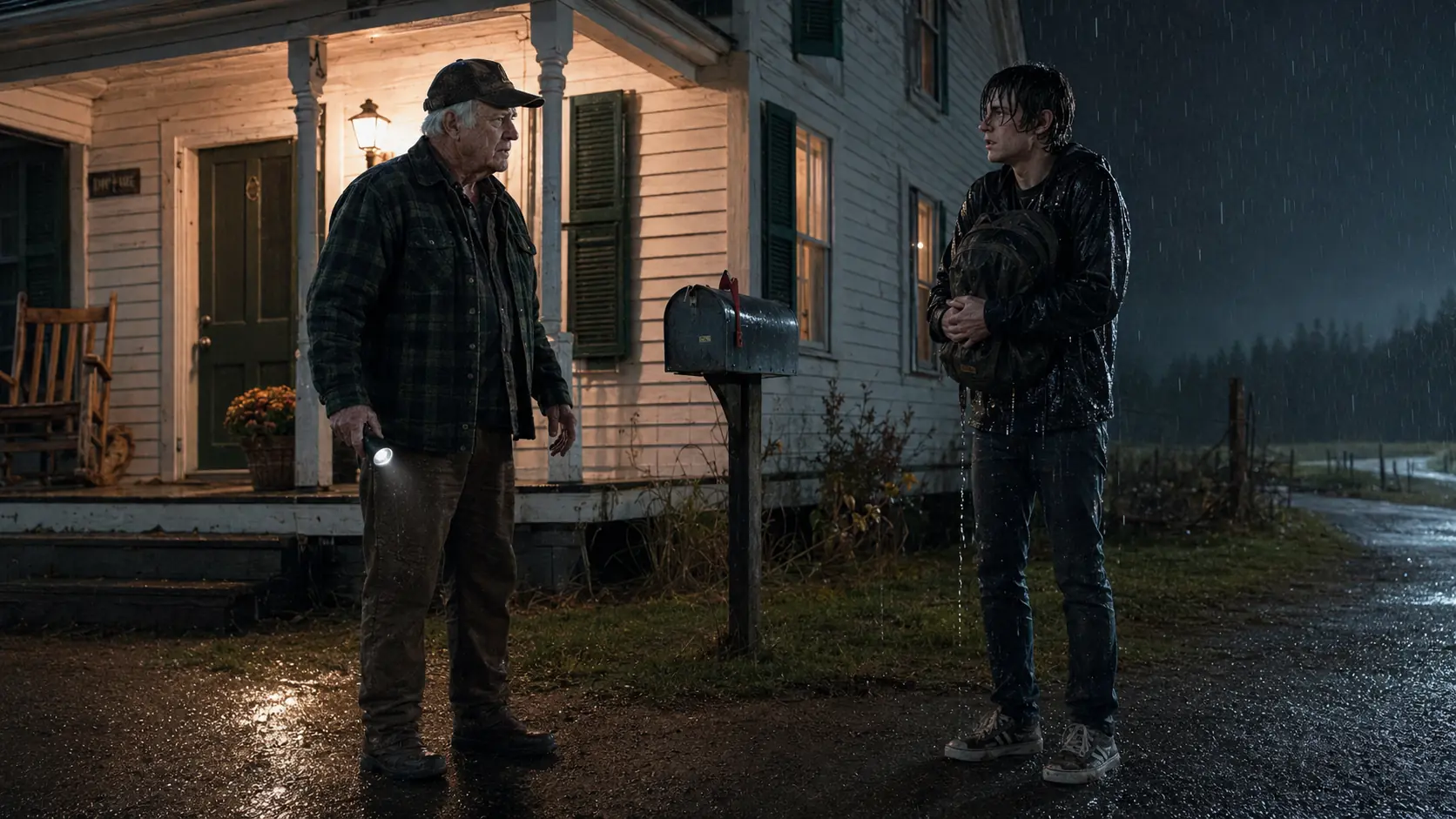
He visited once after three years, arriving in a used pickup with a toolbox in the back. Benjamin was older, but still stubborn. Ethan repaired the porch step that had gone soft.
Benjamin protested.
“It was fine.”
“It moved when I stepped on it.”
“It has character.”
“It has rot.”
“Different name for character.”
Ethan fixed it anyway.
Over time, Ethan became family in the way some people do without paperwork or explanation. He came for Thanksgiving once when Benjamin’s children could not. He called on rainy nights. He helped stack firewood. Benjamin taught him how Clara made apple butter, though the first batch came out too sweet and Benjamin called it “jam with ambition.”
Ethan laughed harder than the joke deserved.
Years passed.
Ethan’s career grew.
He started his own small construction company in Burlington: Cole & Crew Home Repair. Not luxury builds. Not showy renovations. Practical work. Roofs, porches, accessible bathrooms, old-house repairs, ramps, storm damage, safe steps, honest estimates.
He hired men and women who needed second chances, the way he once had.
“You can learn skill,” he told them. “But first, you show up.”
When asked why he focused on old houses, Ethan always said, “Because old houses deserve someone who listens before tearing things out.”
He had learned that from Benjamin, though Benjamin would have denied being philosophical.
Meanwhile, Benjamin’s farmhouse grew older with him.
The roof leak above the hallway returned.
The barn door finally gave way in a winter storm.
The furnace needed replacement.
The porch railing loosened.
Property taxes rose after several vacation homes were built near the lake.
Benjamin tried to keep up.
He patched what he could.
Ignored what he could not.
Told his children everything was fine.
It was not fine.
One spring, after weeks of rain, a section of the kitchen ceiling stained brown. Then the stain spread. Then plaster began to crack near the corner above Clara’s old hutch.
Benjamin stood beneath it with a bucket and felt something inside him finally bend.
The house was asking for more than he had left.
A contractor came from town and gave an estimate that made Benjamin sit down at the kitchen table.
Roof repairs.
Structural work near the porch.
Furnace replacement.
Drainage around the foundation.
Electrical updates.
The number was impossible.
His daughter Rachel drove up from Boston the next weekend.
“Dad,” she said softly, holding the estimate, “you can’t live like this.”
“I know.”
That frightened her more than an argument.
He always argued.
“Maybe it’s time to sell,” she said.
Benjamin looked toward the kitchen window. Outside, the maple trees were bright with spring leaves. The driveway curved toward the road where he had once found a soaked young man walking the wrong way.
“I don’t want to.”
Rachel sat beside him.
“I know. But wanting doesn’t fix a roof.”
“No,” he said quietly. “It doesn’t.”
He did not tell Ethan.
He meant to.
Then he didn’t.
Pride was sneaky that way. It disguised itself as not wanting to bother people.
But Ethan knew him too well.
He called one evening after a long job and heard something different in Benjamin’s voice.
“What’s wrong?” Ethan asked.
“Nothing.”
“You taught me that word usually means something expensive.”
Benjamin sighed.
“You became difficult.”
“You trained me.”
A week later, Ethan drove to Ashford unannounced.
Benjamin opened the door and frowned.
“You could have called.”
“I did. You lied.”
“That is an accusation.”
“That is a summary.”
Ethan stepped inside and saw the bucket in the hallway.
Then the ceiling.
Then the estimate on the kitchen table.
His face changed.
“Benjamin.”
“I was going to tell you.”
“When? After the roof joined us for dinner?”
Benjamin looked away.
“It’s too much.”
Ethan picked up the estimate and read it carefully.
The number was high, but not dishonest.
The house needed real work.
He sat across from Benjamin.
“Do you want to sell?”
Benjamin’s jaw tightened.
“No.”
“Then we don’t start there.”
“It’s not that simple.”
“No. It’s not. But neither was walking seven miles in the wrong direction in a storm.”
Benjamin looked at him.
Ethan’s voice softened.
“You took me in for one night when you didn’t know me. You gave me soup, dry clothes, a bed, breakfast, a ride, and enough dignity to keep going.”
“That was one night.”
“That night changed my life.”
Benjamin shook his head.
“You built your life.”
“I did. After you got me to the place where I could start.”
The kitchen was quiet.
Ethan placed the estimate on the table.
“Let me look.”
Benjamin almost smiled.
“That sounds like something I say when the sink leaks.”
“Then you know it’s useful.”
Ethan spent the next three hours inspecting the house.
He checked the attic, roofline, porch, foundation, drainage, furnace, wiring, barn, and basement. He took notes. He took pictures. He asked Benjamin questions. He called two specialists he trusted. Then he sat down with Rachel, who had returned that afternoon, and explained.
The house could be saved.
Not cheaply.
Not quickly.
But honestly.
Some work was urgent. Some could wait. Some could be done by Ethan’s crew. Some needed licensed specialists. Some materials could be donated or discounted through supplier relationships. Some costs could be reduced through a state program for elderly homeowners preserving historic rural properties.
Benjamin hated the word program.
Ethan filled out the paperwork anyway.
“I don’t want charity,” Benjamin said.
“It’s not charity. It’s a preservation grant.”
“That sounds like charity wearing a tie.”
“It’s your tax dollars coming home.”
Benjamin considered that.
“Better.”
Ethan built a plan.
Not only to repair the house, but to keep it alive.
The farmhouse had a large barn that, once stabilized, could become a small training space for Ethan’s apprentices during summer. They could learn old-house repair, porch restoration, basic carpentry, and weatherproofing on real structures under supervision. Benjamin could teach what he knew about maintaining old homes, even if he claimed he knew nothing.
The state grant liked the educational part.
Rachel liked that Benjamin would not be alone.
Benjamin liked very little, officially.
Unofficially, he started making lists.
The work began in June.
Ethan arrived with a small crew of four.
A quiet woman named Grace who could frame a wall straighter than most men twice her age.
A young man named Malik who was learning roofing.
A former cook named Owen who measured everything three times because he did not trust numbers the first two times.
And a nineteen-year-old named Peter, who reminded Benjamin painfully of Ethan the night he first arrived: thin, nervous, trying too hard not to look lost.
Benjamin disliked having people in his house.
For about two days.
Then he began supervising from the porch.
“That board is not level.”
“It is,” Ethan said.
“Level enough is not level.”
Grace checked.
Benjamin was right.
Ethan looked at him.
Benjamin looked smug for the rest of the afternoon.
The roof was repaired first.
Then the porch.
Then drainage around the foundation.
Then the furnace.
The barn was stabilized.
The railing was replaced, though Benjamin insisted on keeping the original newel post because Clara had once tied Christmas garland around it.
Ethan preserved it.
During the work, Benjamin cooked for the crew. Soup, sandwiches, coffee, apple pie from Clara’s recipe. He claimed it was cheaper than letting young people faint from hunger.
The crew understood it was love in work clothes.
Peter, the nervous apprentice, stayed late one evening to help Benjamin carry firewood.
“You don’t have to do that,” Benjamin told him.
“I know.”
“You all say that now.”
Peter smiled.
“Ethan says you said it first.”
Benjamin looked toward the driveway, where Ethan was unloading tools.
“What else does Ethan say?”
Peter shrugged.
“That you found him in the rain when he was walking the wrong way.”
Benjamin said nothing.
Peter added quietly, “He says everybody needs someone to notice before they disappear.”
Benjamin looked at the young man more closely.
“You disappearing?”
Peter stiffened.
“No, sir.”
“That sounded like yes.”
The boy looked down.
Benjamin sighed.
“Come inside. There’s soup.”
And so, without planning to, Benjamin opened the house again.
By late autumn, the farmhouse looked like itself, only stronger.
The roof no longer leaked. The porch steps were safe. The furnace ran quietly. The barn doors opened smoothly. The foundation drainage worked through the first hard rain. Clara’s hutch stayed dry.
Ethan handed Benjamin a folder with invoices, grants, receipts, warranties, and a maintenance schedule.
Benjamin stared at it.
“You made a folder.”
“Yes.”
“I dislike folders.”
“I know.”
“This one is thick.”
“So was the roof problem.”
Benjamin looked at the final cost.
Far less than the original estimate.
Still more than he liked.
Ethan had written PAID beside several labor sections.
Benjamin frowned.
“No.”
“Yes.”
“I said no charity.”
“It isn’t charity.”
“You marked labor paid.”
“Because it was paid.”
“By who?”
Ethan looked at him.
“By the night you gave me.”
Benjamin’s throat tightened.
“That is not accounting.”
“It is mine.”
Rachel, standing near the sink, wiped her eyes.
Benjamin pointed at her.
“Do not encourage him.”
“I’m absolutely encouraging him,” she said.
Ethan reached into his coat pocket and pulled out a key.
It was old.
Benjamin recognized it immediately.
The spare key he had given Ethan years ago, after the young man began visiting regularly.
Ethan placed it on the table.
“I want to return this.”
Benjamin’s heart sank.
“Oh.”
Ethan smiled.
“Not because I’m leaving.”
He placed another key beside it.
New brass.
Attached to a small wooden tag carved from a piece of the old porch step.
Engraved on it were the words:
The Door Stayed Open
Benjamin stared at it.
“What is that?”
“The new barn classroom key.”
“Barn classroom?”
“That’s what the grant paperwork calls it.”
“I did not approve that name.”
“You signed the paper.”
“I sign many things under pressure.”
Ethan laughed softly.
“The barn will host two training weekends every summer. Old-house repair. Practical carpentry. Weatherproofing. Safe steps. Good rails. Things people need.”
Benjamin looked toward the window, where the barn stood in the late afternoon light.
“You expect me to teach?”
“I expect you to complain while people learn.”
Benjamin’s mouth twitched.
“That I can do.”
The first training weekend happened the following May.
Benjamin claimed it was unnecessary.
Then woke at five to make coffee.
Ethan arrived with six apprentices and two instructors. They set up workbenches in the barn, displayed tools, and began with porch-step repair. Benjamin sat on a stool near the open door, cane beside him, watching.
At first, he said nothing.
Then one apprentice held a board wrong.
Benjamin stood.
“No.”
Everyone turned.
He walked over slowly, took the board, and showed the young man how to read the grain.
“Wood tells you how it wants to be used,” he said. “Ignore that, and it will punish you later.”
Ethan smiled from across the barn.
Benjamin saw him and scowled.
“What?”
“Nothing.”
“Good. Keep it that way.”
By the end of the day, Benjamin had taught more than anyone expected.
By the end of the summer, the barn had become a place young workers came to learn not just how to fix old homes, but how to respect them.
And somehow, Benjamin’s house was no longer lonely.
Ethan visited often. Rachel came more because she worried less. Apprentices came for training weekends. Neighbors stopped by when they needed advice about old windows, loose steps, or stubborn doors. Benjamin kept soup ready more often than he admitted.
On his eighty-third birthday, Ethan and Rachel organized a small dinner on the porch.
Benjamin said he did not want a party.
They called it “a maintenance meeting with cake.”
He attended.
The porch was full of people: Rachel, her children, Ethan, Ethan’s crew, Peter, Grace, Malik, Owen, and two neighbors who had somehow become part of everything. The repaired porch rail glowed in the evening light. The maple trees rustled softly.
After dinner, Ethan stood with a small envelope.
Benjamin narrowed his eyes.
“No speeches.”
“One short one.”
“That is how long speeches begin.”
Everyone laughed.
Ethan opened the envelope and pulled out a framed postcard.
The first one.
Burlington waterfront.
I made it to orientation. Futures start early.
Benjamin stared.
“You kept that?”
“I kept all of them.”
“Why?”
Ethan’s voice softened.
“Because that was the first time I had somewhere to write back to.”
The porch went quiet.
Benjamin looked down.
Ethan continued, “You took me in for one night. You thought you gave me a room. But you gave me a place in the world where I could be remembered.”
Benjamin blinked hard.
“I didn’t do much.”
“You opened the door.”
Benjamin looked at the repaired house, the porch full of voices, the barn in the distance, the young workers laughing near the steps, the old mailbox at the road where he had first seen Ethan in the rain.
For years, he had thought the house survived because he stayed.
Now he understood something else.
A house stayed alive when it had reasons to open.
Later that evening, after everyone left, Benjamin and Ethan sat on the porch swing. Rain began softly, tapping the roof in a gentle rhythm.
“You remember that night?” Ethan asked.
“I remember you dripping on Clara’s rug.”
Ethan laughed.
“I tried not to.”
“You failed.”
“I was scared.”
Benjamin looked at him.
“I know.”
“I didn’t know where I was going.”
“You were going the wrong way.”
“I mean bigger than that.”
Benjamin nodded slowly.
“I know that too.”
Ethan looked toward the road.
“You helped me stop walking alone.”
The rain fell softly beyond the porch.
Benjamin held the little key tag in his hand.
The Door Stayed Open.
He looked at Ethan.
“You saved my house.”
Ethan shook his head.
“You gave it to me first.”
“No, I didn’t.”
“Yes,” Ethan said. “For one night.”
Benjamin sat with that.
Then he smiled faintly.
“Clara would have liked you.”
“I wish I could’ve met her.”
Benjamin looked toward the warm kitchen window.
“In a way,” he said, “you did.”
Years earlier, Benjamin Hayes had found a young man walking alone in the rain, lost, hungry, soaked, and too proud to ask for help. He brought him inside, gave him dry clothes, soup, a bed, breakfast, and a ride to the bus station in the morning.
He thought he was only offering shelter for one night.
But one safe night can become the bridge between a person and the rest of his life.
Ethan crossed that bridge. He built a career, a company, and a life from the chance Benjamin helped him reach. And when Benjamin’s old farmhouse was the one standing in the storm, Ethan returned with tools, workers, grants, plans, and gratitude strong enough to keep the roof above him.
What Benjamin received was not only a repaired home.
He received proof that usefulness does not end with age.
He received young hands on the porch, laughter in the barn, a chosen son in Ethan, and a house that no longer held only memories, but new beginnings too.
And from then on, whenever rain fell hard over Ashford and Benjamin saw someone slow near his mailbox, he would turn on the porch light, reach for his coat, and mutter,
“Well, Clara, let’s see who the storm brought us tonight.”