The rain began falling over rural Kentucky just before sunset, soft at first, then heavy enough to blur the road into a long gray ribbon between dark fields.
By the time headlights started glowing along Route 17, the storm had settled in like it intended to stay all night.
Cars moved slowly past Miller’s Gas & Mart, their tires hissing through puddles, their wipers beating hard against the glass. Water ran from the roof of the gas pump canopy in uneven streams.
The old fluorescent lights above the pumps flickered whenever the wind pushed too hard across the open road.
Inside the gas station, seventy-six-year-old Ruth Miller stood behind the counter with a cup of weak coffee warming between her hands.
She had owned the little station for almost forty years.
It was not much to look at from the outside. The paint on the siding had faded from cream to something closer to dust. The sign above the door was missing one corner. The ice machine rattled.
The soda cooler hummed louder than it should. The restroom key still hung from a wooden block shaped like a fish, even though Ruth’s grandson had told her no one used keys like that anymore.
But to people who lived along Route 17, Miller’s Gas & Mart meant something.
It was the last place to buy gas before the highway.
The first place to get coffee after the county line.
The only place for miles where someone would answer the phone after nine.
Ruth kept the station open late because her husband, Frank, had always kept it open late.
Frank used to say, “Someone always needs light on a bad road.”
At the time, Ruth had thought he meant drivers.
Now she understood he had meant people.
Frank had been gone for nine years.
Heart trouble took him one cold morning in January, right there behind the counter, while he was counting change and humming along to an old country song on the radio. Ruth had found him before the coffee finished brewing.
For a long time afterward, she had thought she would close the station.
Her daughter begged her to sell.
Her son said the place was too much work.
Her doctor said the long hours were not good for her.
Even her church friends said she deserved rest.
But every evening, when the sky darkened and the road outside grew empty, Ruth would look at the gas pump lights shining across the wet pavement or summer dust, and she would hear Frank’s voice again.
Someone always needs light on a bad road.
So she stayed.
She opened every morning at six.
She closed most nights at ten.
And on stormy nights, she stayed a little later.
That Thursday in November was one of those nights.
The weather had turned ugly after five. Most people hurried home early. A truck driver came in for coffee and a ham sandwich. A nurse bought gas on her way to the night shift. A young man asked if the road toward Brookfield was flooding yet. Ruth told him to take the higher route past the grain silos.
By eight o’clock, the store was quiet.
Rain hit the front windows so hard it sounded like handfuls of gravel. The wind made the old door tremble in its frame. Ruth wiped the counter, checked the coffee pot, and looked toward the road.
She was thinking about closing early.
Then the bell above the door rang.
Two children stepped inside.
Ruth looked up from the register.
The older one was a boy, maybe eleven or twelve. He had wet brown hair, a thin face, and eyes that tried to look calm but could not hide panic. He wore a dark green hoodie under a jacket that was too light for the weather. His jeans were wet at the knees, and his sneakers left muddy prints on the floor.
Beside him stood a little girl about seven years old.
She wore a pink coat with one missing button and a small backpack shaped like a purple owl. Her curly hair was damp around her face, and she hugged a stuffed rabbit against her chest so tightly its ears bent under her chin.
They both stood just inside the door, dripping water onto the rubber mat.
The boy looked around quickly, as if checking for danger.
The little girl looked at the shelves of chips, candy, and microwavable sandwiches with wide, hungry eyes.
Ruth set down her coffee.
“Well, now,” she said gently. “You two came in with half the storm.”
The boy stiffened.
“We’re not stealing,” he said quickly.
Ruth lifted both hands a little.
“I didn’t say you were.”
“We’re just waiting.”
“For someone?”
The boy hesitated.
The little girl looked up at him.
He gave her a warning glance, but she answered first.
“Our aunt.”
The boy closed his eyes for half a second.
Ruth noticed.
She had spent forty years behind a counter. She knew when a child was telling the truth. She also knew when a child was protecting a larger truth by offering only a piece of it.
“What are your names?” she asked.
The little girl whispered, “I’m Emily.”
The boy said, “Noah.”
“Noah and Emily,” Ruth repeated. “I’m Ruth Miller.”
Emily looked at the name patch sewn onto Ruth’s red store vest.
“It says Ruth.”
“So it does.”
Noah moved slightly in front of his sister. “Is it okay if we wait here for a little while?”
Ruth looked at the rain pouring against the windows.
“Children are allowed to wait where it’s dry.”
Noah’s shoulders lowered slightly, but he did not relax.
Emily’s eyes drifted toward the hot food warmer near the counter. Two wrapped chicken sandwiches sat under the light, along with a few sausage biscuits that should have been sold hours earlier.
Ruth saw the look.
Hunger had a way of making children look ashamed of wanting ordinary things.
“Have you two eaten dinner?” she asked.
Noah answered too fast.
“Yes.”
Emily looked down.
Ruth leaned against the counter.
“What did you have?”
Noah opened his mouth, but no answer came.
Emily whispered, “Crackers.”
Noah looked at her sharply.
She hugged the rabbit tighter.
Ruth felt the ache in her chest deepen.
“Crackers are not dinner,” she said.
Noah’s face flushed. “We have money.”
He dug into his pocket and pulled out coins. A quarter, two dimes, three nickels, and several pennies. They clattered onto the counter, wet from his hand.
Ruth looked at the coins.
Then at the two children.
“That is a very respectable pile of money,” she said.
Noah looked uncertain.
“But tonight,” Ruth continued, “dinner is on the house.”
Noah immediately shook his head. “No.”
“Yes.”
“We can pay.”
“I can see that. But I already made too many sandwiches.”
Emily looked at the food warmer. “You made them?”
Ruth smiled. “I put them in the warmer, which is almost cooking if you are old enough.”
Emily almost smiled.
Noah did not.
“We’re not supposed to take things,” he said.
“You’re not taking. I’m giving.”
“We can’t owe people.”
Ruth’s expression softened.
“Food given to hungry children is not a debt.”
Noah stared at her, as if that idea did not fit with what life had taught him.
Ruth moved slowly so she would not spook him. She took two chicken sandwiches from the warmer, added two small bags of chips, two apples from the basket near the register, and two cartons of milk from the cooler.
Then she looked at Emily.
“You like hot chocolate?”
Emily’s eyes widened.
Noah said, “She doesn’t need—”
“Yes,” Emily whispered.
Ruth gave Noah a look. “The girl was asked a serious question.”
Emily nodded harder. “Yes, ma’am.”
Ruth made two cups from the small machine behind the counter, though she watered Noah’s down a little so it would not be too hot. She placed everything on the small table near the window where truckers sometimes sat with coffee.
“Sit,” she said.
Noah remained standing.
Emily looked at him.
“Please,” she whispered.
That one word did what Ruth’s kindness could not.
Noah led his sister to the table. They sat side by side, still wearing their wet coats. Emily placed the stuffed rabbit on the table beside her milk carton.
Ruth pulled two clean towels from behind the counter and brought them over.
“Dry your hair.”
Noah took one reluctantly.
Emily accepted hers and whispered, “Thank you.”
They ate carefully at first.
Too carefully.
Noah took small bites, watching Ruth between them. Emily tried to imitate him, but hunger won quickly. She finished half her sandwich in a minute and then looked embarrassed.
Ruth turned away and began wiping a shelf that did not need wiping.
When children were hungry, watching them eat could feel like stealing their dignity.
After a few minutes, Emily spoke with her mouth still partly full.
“This is really good.”
Noah nudged her gently.
Ruth smiled without turning. “Gas station chicken improves during thunderstorms.”
Emily giggled softly.
The sound warmed the store.
Noah looked embarrassed by the laugh, but he did not stop eating.
Ruth waited until they had both finished most of their food before she asked another question.
“Where are you two headed tonight?”
Noah froze.
Emily looked at him.
He wiped his hands on the napkin. “We’re waiting for our aunt.”
“You said that.”
“She’s coming.”
“What time?”
“She was supposed to come already.”
Ruth nodded slowly.
“What is your aunt’s name?”
Noah looked toward the front windows.
“Lisa.”
“Lisa what?”
He swallowed.
“I don’t know her last name.”
Ruth did not react, though the answer worried her.
Emily whispered, “It’s Mom’s friend, not our real aunt.”
Noah’s jaw tightened.
Ruth kept her voice calm.
“All right. Your mom’s friend Lisa.”
Noah looked down at the table.
Emily reached for the stuffed rabbit and tucked it under her chin.
Ruth walked back behind the counter, giving the children space. She checked the clock.
8:24.
Outside, the rain had grown heavier.
The stretch of road beyond the pumps looked almost empty now, except for the occasional truck or car moving too fast for the weather.
Ruth looked at the children again.
They did not look like children waiting for a short ride.
They looked like children trying to survive a plan that had already gone wrong.
She came back to the table with a small trash bag.
“Wet socks?” she asked.
Emily looked down at her shoes.
Noah said, “We’re fine.”
Ruth looked at him over her glasses.
“Noah, I have been alive seventy-six years. I know the difference between fine and soaked.”
Emily whispered, “My socks are squishy.”
Ruth nodded. “That is a medical diagnosis.”
Emily almost laughed again.
Ruth went to the back room and found two pairs of thick socks from the emergency bin she kept for winter travelers. They were adult socks, too large for children, but dry. She also found an old store sweatshirt left behind by her grandson years ago.
She handed the sweatshirt to Emily.
“It might swallow you whole, but it’s dry.”
Emily looked at Noah.
Noah hesitated, then nodded.
Ruth pointed toward the restroom. “You can change in there. Door locks. Noah can stand right outside if you want.”
Emily took the sweatshirt.
While she changed, Noah stood near the restroom door with his arms crossed, trying to look older than he was.
Ruth stood at the counter, pretending to count cigarette inventory.
When Emily came back, the sweatshirt hung almost to her knees. The dry socks bunched at her ankles. She looked smaller and safer somehow.
Noah’s expression softened when he saw her.
“Better?” he asked quietly.
Emily nodded.
Then Ruth handed him another pair of socks.
Noah stared.
“I’m okay.”
“You’re not.”
He looked like he wanted to argue, but his wet shoes squeaked when he shifted his feet.
He took the socks.
After he changed, Ruth placed their wet socks and Emily’s coat near the old heater in the back office.
Then she returned to the counter.
“Do either of you know a phone number for your mother or this Lisa?”
Noah’s face closed again.
“Our mom’s phone is off.”
“Do you know the number?”
“Yes.”
Ruth slid the landline phone across the counter.
“You can call.”
Noah hesitated.
“If she answers, she’ll be mad.”
Ruth leaned on the counter.
“Why would she be mad?”
“Because we were supposed to stay with Lisa.”
Emily whispered, “But Lisa wasn’t there.”
Noah looked at her.
Ruth waited.
The story came slowly.
Their mother’s name was Tessa Clark. She worked at a nursing home about twenty miles away. She had been called in for a double shift because another aide had not shown up. Noah and Emily were supposed to stay with a family friend named Lisa in Brookfield until Tessa finished work the next morning.
But Lisa lived near the old trailer park outside town, and when the children arrived with a neighbor who had dropped them off, Lisa’s trailer was dark.
The neighbor had not waited.
Noah had knocked until his knuckles hurt.
No one answered.
Then the rain started.
Noah decided they should walk toward the main road to find a place with a phone. He remembered Miller’s Gas & Mart from a time his mother had stopped there for gas. He knew it had lights. He knew there were people.
So he and Emily walked.
Nearly two miles.
In rain.
Beside a dark road.
Ruth felt cold anger rise in her chest, but she kept it away from her face.
Children did not need adult outrage in moments like that.
They needed steady hands.
“You did well bringing your sister somewhere with lights,” Ruth said.
Noah looked up quickly.
“I did?”
“Yes.”
He looked down again.
“I should’ve stayed at the trailer.”
“With no one answering and no phone?”
He did not answer.
Ruth softened her voice.
“Noah, being brave does not always mean making a perfect choice. Sometimes it means choosing the safest bad option.”
His mouth trembled.
Emily leaned against him.
Ruth pushed the phone closer.
“Call your mother.”
Noah dialed from memory.
It rang five times.
Then voicemail.
He swallowed and tried again.
No answer.
Ruth took the phone gently.
“What nursing home?”
“Rose Hill Care Center.”
Ruth found the number taped near her counter, because Rose Hill workers often stopped for gas after late shifts. She called and asked for Tessa Clark.
The receptionist placed her on hold.
Noah stood near the counter, rigid.
Emily held the stuffed rabbit against her chest and watched the rain.
After several minutes, a tired supervisor came on the line.
Ruth explained the situation.
Her voice was calm, but firm.
Two children.
A failed pickup.
Stranded in the storm.
Safe now at Miller’s Gas & Mart.
The supervisor’s voice changed immediately.
“Tessa Clark is here,” she said. “She was told her children were with Lisa. Hold on.”
The next voice on the phone came shaking and breathless.
“Hello? This is Tessa. Are my babies there?”
Ruth looked at Noah and Emily.
“They are safe.”
A sob broke through the line.
“Oh God. Oh God. I’ve been trying Lisa all evening. Her phone is going straight to voicemail. I thought maybe it was just bad signal. Are they okay?”
“They’re wet and frightened, but they’ve eaten. They are safe.”
Noah reached for the phone.
“Mom?”
Ruth handed it to him.
Noah turned away, but she heard his voice break.
“We went to Lisa’s, but she wasn’t there. I didn’t know what to do. I brought Emily to the gas station. I’m sorry.”
Emily began crying the moment she heard her mother’s voice through the receiver.
Noah held the phone between them.
Tessa’s voice was too quiet for Ruth to hear clearly now, but the children’s faces changed. Fear loosened, but exhaustion rushed in behind it.
After a few minutes, Noah handed the phone back.
Ruth spoke to Tessa.
The situation was worse than she expected.
Tessa could not leave the nursing home immediately. She was the only aide covering several residents until the replacement arrived. Her car was in the shop. The coworker who usually drove her home was also stuck there. Lisa, the family friend, had not answered any calls. Tessa had no nearby family. The children’s father was out of their lives.
“I can call the police to bring them somewhere,” Tessa said, voice full of panic and shame. “I don’t know what else to do.”
Ruth looked at the children.
Emily’s eyelids were heavy. Noah looked like he was standing only because he refused to fall apart in front of his sister.
Ruth made a decision.
“They can stay with me tonight.”
There was silence.
Then Tessa said, “No. Ma’am, no. I can’t ask you to do that.”
“You didn’t ask.”
“I don’t even know you.”
“My name is Ruth Miller. I own Miller’s Gas & Mart on Route 17. I’ll call the sheriff’s office and give them my information. I’ll call Rose Hill back in the morning. You can speak to the children again before bed.”
“I can’t pay you.”
“I didn’t ask for money.”
Tessa began crying again.
“I’m not a bad mother.”
The words came out broken, desperate, and familiar.
Ruth closed her eyes for one moment.
How many mothers had she heard say that while trying to do the impossible?
“I did not think you were,” Ruth said softly.
Tessa went quiet.
Then she whispered, “You didn’t?”
“No.”
“I thought they would be safe with Lisa. She’s helped before. I don’t know why she wasn’t there. I swear I didn’t just leave them.”
“I believe you.”
That sentence seemed to undo Tessa completely.
She cried so hard she had to take the phone away from her mouth.
Ruth waited.
Then she said, “Let me keep them warm tonight. You get through your shift. In the morning, we’ll figure out the rest.”
Tessa agreed because love sometimes meant trusting a stranger when all other choices were worse.
Ruth called the sheriff’s office next. She gave her name, the station address, the children’s names, their mother’s workplace, and her own home address behind the gas station. The deputy on duty knew Ruth. Everyone knew Ruth.
“Frank’s Ruth?” he asked.
“That is still my legal identity in this county, apparently.”
The deputy chuckled, then grew serious. He took the information and said he would log it. He also promised to have a patrol car check on Lisa’s trailer if the roads were safe enough.
Ruth locked the station at ten.
Noah stood near the door, watching the rain.
“Where are we going?” he asked.
“My house.”
He tensed.
“It’s attached behind the store. You can call your mother again from there. The sheriff’s office knows. Your mother knows. You are not disappearing.”
He looked embarrassed.
“I didn’t mean…”
“I know,” Ruth said gently. “Careful children ask careful questions.”
That answer seemed to steady him.
Ruth led them through the back door into the narrow hallway connecting the store to her house.
The house was small but warm. The kitchen light glowed over a round wooden table. A faded floral curtain hung above the sink. There were framed family photos along the wall: Ruth and Frank young and laughing beside a gas pump, two children in Halloween costumes, grandchildren holding fishing poles, Frank in a faded cap standing by the old station sign.
Emily stopped near one photograph.
“Is that your husband?”
Ruth nodded.
“That’s Frank.”
“Where is he?”
“He passed away.”
Emily’s eyes softened.
“My grandma passed away too.”
“I’m sorry, sweetheart.”
Emily looked at the photo again.
“Does it hurt forever?”
Noah whispered, “Emily.”
But Ruth answered.
“It changes,” she said. “Some days it hurts sharp. Some days it feels like carrying a warm stone in your pocket.”
Emily seemed to think about that.
Then she nodded.
Ruth made them both wash their hands, then gave them another small meal because growing children and fear used a great deal of energy. She heated soup, made toast, sliced two bananas, and gave Emily another hot chocolate.
Noah tried to refuse more food.
Ruth pointed at the chair.
“Sit.”
He sat.
“You argue like my grandson,” she said.
“I wasn’t arguing.”
“That is also what my grandson says.”
Emily giggled into her mug.
After dinner, Ruth called Tessa again from the kitchen phone. The children spoke to her for ten minutes. Tessa told them she loved them, that they had done the right thing, that she was coming as soon as she could the next morning.
Emily cried softly.
Noah kept saying, “We’re okay,” in the voice of a child trying to comfort his mother from miles away.
That was what nearly broke Ruth.
When the call ended, Ruth set up the living room for them. Emily took the couch, wrapped in a quilt. Noah insisted on sleeping on the rug beside her.
“There’s a guest bed,” Ruth said.
“I’m staying here.”
She did not argue.
Some children needed to guard before they could rest.
She gave him a pillow and another quilt.
Before turning off the lamp, Emily looked at Ruth.
“Will the lights stay on?”
Ruth followed her gaze toward the front of the station, where the pump lights still glowed through the rain.
“Yes,” Ruth said. “I leave them on during storms.”
“Why?”
Ruth looked toward Frank’s photograph.
“Because someone might need to find the place.”
Emily hugged her rabbit.
“We did.”
“Yes,” Ruth said softly. “You did.”
That night, Ruth slept very little.
She woke once to check on the children and found Noah sitting up in the dark, staring toward the hallway.
“You all right?” she whispered.
He looked embarrassed.
“I heard a truck.”
“That happens on the road.”
“I thought maybe Mom came.”
“She’ll come in the morning.”
“What if she can’t?”
Ruth lowered herself into the armchair.
“Then we make another plan.”
He stared at the quilt.
“I hate making plans.”
“I know.”
“Plans break.”
Ruth thought about Frank. About the retirement trips they never took. About the heart attack no one planned for. About running the gas station alone when she had imagined growing old with someone beside her.
“Yes,” she said. “Sometimes they do.”
“What do you do then?”
“You look for the next light.”
Noah looked toward the window.
“The gas station?”
“Sometimes. Sometimes a person. Sometimes a phone. Sometimes a warm place to sit while you think.”
Noah was quiet.
Then he whispered, “I was scared Emily would cry too loud and someone would get mad.”
Ruth’s eyes filled.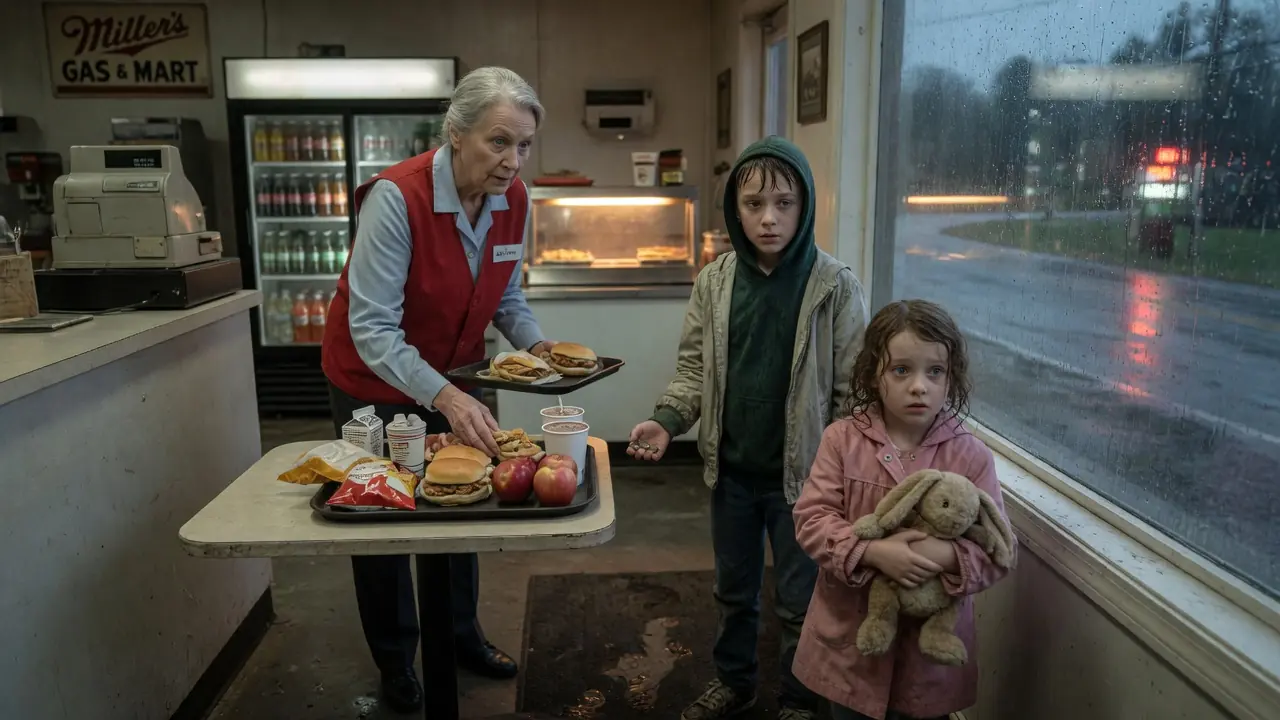
“In this house, children are allowed to cry.”
He looked at her.
“Really?”
“Yes.”
He looked down fast, but not before she saw tears.
Ruth did not move closer.
She simply stayed.
After a while, Noah lay back down beside his sister and fell asleep.
In the morning, the storm had softened to a gray drizzle.
Ruth made pancakes because children who survived storms deserved pancakes. She also made scrambled eggs because Noah looked like a boy who would pretend pancakes alone were enough.
Emily woke first, hair messy, rabbit still under her arm.
“Is Mom here?”
“Not yet,” Ruth said. “But she called at six. She’s on her way as soon as her ride arrives.”
Emily nodded sleepily.
Noah woke at the sound of his mother being mentioned.
“What time?”
“Soon.”
That word did not satisfy him, but breakfast distracted Emily, and Emily’s eating distracted Noah.
At 8:43, a beat-up blue sedan pulled into the gas station lot.
Noah saw it first.
“Mom!”
He ran toward the back door so fast Ruth barely had time to unlock it.
Tessa Clark stepped from the passenger side before the car fully stopped.
She was thirty-four, with tired hazel eyes, dark blond hair pulled into a messy bun, and a nursing home uniform wrinkled from a double shift. Her face looked pale from exhaustion, and her hands shook as she opened the gate near Ruth’s back porch.
Emily ran into her arms first.
Then Noah.
Tessa dropped to her knees in the wet gravel and held both children so tightly that all three of them cried.
“I’m sorry,” she whispered over and over. “I’m so sorry.”
Noah buried his face against her shoulder.
“I got us to the lights.”
“I know. You did so good.”
“Lisa wasn’t there.”
“I know.”
“I didn’t know what else to do.”
“You did right, baby. You did exactly right.”
Ruth stood on the porch, one hand against the doorframe, eyes wet.
The woman who had driven Tessa was a coworker from Rose Hill. She looked exhausted too and gave Ruth a grateful nod before waiting in the car.
Tessa finally stood and faced Ruth.
For a moment, she looked too ashamed to speak.
Then she said, “Mrs. Miller, thank you. Thank you for keeping my babies safe.”
Ruth stepped down from the porch carefully.
“They kept each other safe first.”
Tessa looked at Noah, then Emily.
“I know.”
The sheriff’s office called while Tessa was still there. A deputy had checked Lisa’s trailer the night before but found no one home. Later, they learned Lisa had left unexpectedly after a family emergency of her own and had dropped her phone in water. She had thought another neighbor was bringing the children back to Tessa, while the neighbor assumed Lisa was home.
It was the kind of chain of misunderstandings that nearly turned into tragedy.
Tessa sat at Ruth’s kitchen table, listening to all of it, her hands wrapped around a mug of coffee.
“One broken link,” she whispered. “That’s all it takes.”
Ruth nodded.
“Yes.”
“I should have had a better plan.”
“You had a plan,” Ruth said. “The plan failed.”
Tessa looked up.
“That still feels like my fault.”
“Most mothers blame themselves for the weather too, if given enough time.”
Tessa gave a broken laugh.
Ruth leaned forward.
“You work nights taking care of other people’s parents. You found someone you trusted to watch your children. The person was not there. Your son found a lit place and asked for help. That is not failure. That is survival.”
Tessa’s eyes filled again.
Noah sat beside Emily, listening.
Ruth hoped he heard every word.
Before Tessa left, she tried to pay for the food.
Ruth refused.
Tessa insisted.
Ruth closed Tessa’s fingers around the folded bills.
“Buy gas.”
“I don’t want charity.”
“Then don’t call it charity. Call it one woman refusing to take dinner money from children who walked through a storm.”
Tessa stared at her.
Then she nodded.
That should have been the end of it.
But life rarely ends the stories that matter in one morning.
A week later, Tessa returned with Noah and Emily.
This time, it was daylight.
No rain.
Tessa brought a homemade casserole wrapped in foil and a thank-you card Emily had decorated with stickers.
Noah carried a small flashlight.
“For emergencies,” he said, handing it to Ruth.
Ruth smiled. “Is this for me?”
He nodded.
“So you can see if the lights go out.”
Ruth took it carefully.
“That is a thoughtful gift.”
“It has batteries.”
“Even better.”
From then on, they stopped by whenever they could.
At first, Tessa came because she felt she owed Ruth.
Then she came because Ruth made coffee and listened without judgment.
Then, somewhere along the way, visiting Miller’s Gas & Mart became part of their family rhythm.
If Tessa worked late and needed a safe place for the children between rides, they came to Ruth.
If Noah’s school bus dropped him early, he came to Ruth.
If Emily had a cold and Tessa could not miss work, Ruth watched her on the couch behind the store with soup and cartoons.
Ruth always told Tessa, “You’re not bothering me.”
Tessa always apologized anyway.
Noah became fascinated with the station.
He liked the way Ruth knew which drivers were local and which were passing through. He liked the maps, the old cash register, the tire gauge, the emergency shelf behind the counter, and the phone numbers taped beside the landline.
He learned how to check oil, how to read mile markers, how to give directions clearly, how to tell a tired driver not to take the flooded road, and how to make gas station coffee slightly less terrible by cleaning the machine properly.
Emily loved the lights.
Whenever they arrived near sunset, she watched Ruth flip the switches that lit the pumps, the front sign, and the little lamp near the window.
“Do they have to stay on all night?” she asked once.
“Not all night,” Ruth said. “Just late enough.”
“How do you know what late enough is?”
Ruth looked out at the road.
“You don’t always. That’s why I stay a little longer in bad weather.”
Emily nodded solemnly.
When Noah was thirteen, he helped Ruth make a better emergency board for the station. He wrote numbers clearly in black marker: sheriff’s office, tow truck, hospital, nursing home, church pantry, school district office, domestic support line, motel, bus service, and three trusted neighbors.
Ruth watched him tape the board behind the counter.
“You have neat handwriting.”
Noah shrugged.
“Messy numbers waste time.”
“That sounds like experience talking.”
He looked toward the window.
“Maybe.”
At fourteen, Noah started keeping a small notebook at the counter called The Light Log.
Whenever someone came in needing help, he wrote what happened and what helped.
Flat tire.
Called Roy’s towing.
Mother delayed.
Child waited inside.
Elderly driver lost.
Gave map, called daughter.
Storm warning.
Three travelers waited until road cleared.
Ruth asked why he kept it.
“So we remember what to do next time,” he said.
Ruth thought of Frank.
Someone always needs light on a bad road.
“He would have liked you,” she said.
“Who?”
“Frank.”
Noah looked at the photograph near the register.
“I wish I met him.”
Ruth smiled softly.
“You did, in a way.”
Emily grew into a bright, tender-hearted girl with a sharp eye for sadness. She noticed people who sat alone. She gave candy to crying children. She kept coloring books behind the counter for kids who had to wait.
At twelve, she made a sign for the little table near the window.
KIDS WAIT HERE. SNACKS IF YOU ASK.
Noah told her the sign needed to sound more professional.
Emily added a heart.
Ruth kept it exactly as it was.
Years passed.
Tessa’s life grew steadier, though never easy. She became a senior aide at Rose Hill, then helped train new workers. She bought an old car, then later a better one. She moved with the children into a small rental house in town, closer to school and work.
Still, Miller’s Gas & Mart remained their second home.
Ruth went to Noah’s middle school science fair.
She went to Emily’s choir concert.
Tessa spent Thanksgiving with Ruth twice because her shifts made traveling impossible.
On Christmas Eve, Ruth always left two small wrapped gifts behind the counter.
One for Noah.
One for Emily.
They always protested.
She always ignored them.
When Noah turned seventeen, he built Ruth a better light switch panel for the station because the old one shocked her if her hands were damp.
She scolded him for making her feel ancient.
Then she hugged him for so long he got embarrassed.
When Emily was sixteen, she wrote an essay about the night at the gas station. She called it The Lights That Did Not Close.
Ruth read it alone in the back office and cried so hard she had to sit down.
The essay ended with one sentence:
Sometimes a home is not where you live, but where someone keeps the lights on because you might need them.
Ruth folded the paper carefully and placed it in the same drawer where she kept Frank’s old pocketknife and wedding ring.
Noah graduated high school first.
He received a scholarship to study emergency management and community systems. His senior project was called Lighted Places, a rural safety network built around gas stations, diners, churches, pharmacies, libraries, and small stores that could serve as safe waiting points during storms, missed pickups, stalled cars, or family emergencies.
Ruth sat in the audience beside Tessa and Emily, wearing her best blue dress and a sweater because school auditoriums were always too cold.
When Noah walked across the stage, Ruth clapped until her hands hurt.
After the ceremony, Noah handed Ruth a framed copy of the Light Log’s first page.
The first entry read:
Two children arrived in storm. Bought dinner. Called mother. Lights stayed on.
At the bottom, Noah had written:
For Ruth Miller, who taught me safety starts with noticing.
Ruth held the frame to her chest.
“I only fed you dinner.”
Noah shook his head.
“You made the road less dark.”
Two years later, Emily graduated too.
She studied social work, focusing on children and families in temporary crisis. Her graduation gift to Ruth was a painted sign, small enough to hang behind the counter.
It read:
If the road feels too dark, come inside.
Ruth said it was too pretty for a gas station.
Emily said that was exactly why it belonged there.
College took Noah and Emily away from Route 17 for a while.
Noah moved to Lexington, then Nashville, working with emergency response teams, rural transportation programs, and disaster planning groups. Emily worked with family resource centers, school counselors, and shelters for children who needed safe short-term support.
They called Ruth often.
Noah asked about the station.
Emily asked if Ruth was eating properly.
Ruth lied and said yes.
Tessa visited weekly and told the truth.
Ruth was aging.
At eighty-six, her knees hurt badly during long shifts. Her hands shook when making change. Her eyesight made night driving impossible, though she still drove short distances in daylight. The station roof leaked near the back door. The pumps needed expensive upgrades. The sign flickered more often.
Her daughter renewed the old argument.
“Mom, sell the place.”
Her son said, “You’ve done enough.”
Even Tessa said gently, “Ruth, you don’t have to carry the whole road.”
Ruth looked out at the pumps glowing in the evening.
“I know.”
But she did not know how to stop.
Then one December storm changed everything.
A line of freezing rain hit the county overnight. The next morning, the station canopy sagged under ice, and one of the old pump lights shattered. The roof leak became a steady drip. The repair estimate came two days later.
Too much.
Far too much.
Ruth sat behind the counter with the estimate in her hand, feeling the station grow heavy around her.
She looked at Frank’s photograph.
“I kept it as long as I could,” she whispered.
For the first time in forty years, she considered turning the lights off for good.
She did not call Noah or Emily.
Tessa did.
A week later, Noah and Emily walked into Miller’s Gas & Mart together.
Noah was thirty now, tall, serious, wearing a dark coat and carrying a rolled set of plans. Emily was twenty-seven, warm-eyed, confident, with a folder full of documents and the same stuffed rabbit keychain hanging from her bag.
Ruth looked up from the register.
“You two came to scold me.”
Noah said, “Yes.”
Emily said, “Lovingly.”
Ruth sighed. “That makes it worse.”
Noah placed the repair estimate on the counter.
“You were going to close?”
“I was going to consider closing.”
Emily looked around the store. “That means you were going to close and tell us afterward.”
Ruth looked away.
“I’m tired.”
The honesty quieted them.
Ruth’s voice softened.
“I’m tired, children. The pumps are old. The roof is old. I’m old. Frank is gone. People drive past now. They have apps and bigger stations and phones that tell them everything. Maybe the road doesn’t need this place anymore.”
Noah leaned forward.
“I needed it.”
Emily nodded.
“So did I.”
“That was years ago.”
Noah looked toward the window, where rain from a new storm had begun tapping against the glass.
“People are still getting lost in storms.”
Emily opened her folder.
“We have a plan.”
Ruth narrowed her eyes.
“Plans from young people are dangerous.”
“This one has funding,” Emily said.
“Worse.”
Noah unrolled the drawings on the counter.
Ruth saw the station.
But restored.
The roof repaired. The canopy reinforced. The pumps upgraded. The old sign rebuilt with the original lettering preserved. The windows replaced. The restroom fixed. The back storage room transformed into a warm waiting area with comfortable chairs, phone chargers, emergency blankets, snacks, children’s books, a first-aid kit, and a direct phone line to local services.
Then Noah turned to another page.
Miller’s Gas & Mart would become the first official location of a rural family safety network called Lights On Route.
The network would train small businesses along county roads to become safe waiting points during storms, missed rides, breakdowns, lost children, medical emergencies, and transportation failures.
Emily’s nonprofit would coordinate family support.
Noah’s emergency management team would build the procedures.
Tessa had already spoken to Rose Hill.
Roy’s towing had agreed to participate.
The sheriff’s office supported it.
The church pantry would provide supplies.
Ruth stared at the drawings.
At the top of the page was the new sign.
MILLER’S GAS & MART
Lights On Route Family Station
And below it, in smaller letters:
Someone Always Needs Light On A Bad Road.
Ruth’s hand flew to her mouth.
Frank’s words.
Noah’s voice softened.
“We kept his words.”
Emily wiped her eyes.
“And yours.”
Ruth could not speak.
Noah pointed to the waiting room design.
“It will be called Ruth’s Room.”
Ruth shook her head immediately.
“No.”
Emily smiled through tears.
“Yes.”
“No. I don’t need my name on a room.”
“You already have one,” Emily said. “We just drew it properly.”
Ruth looked at both of them.
“I bought you gas station dinner.”
Noah’s eyes filled.
“You bought us time.”
Emily added, “You bought us safety.”
Ruth looked toward Frank’s photograph.
“I was just keeping the lights on.”
Noah nodded.
“That is exactly what saved us.”
The renovation began in spring.
Ruth complained from the first day.
The new pump lights were too bright.
The waiting room chairs were too soft.
The emergency phone was too modern.
The children’s books had too many animals wearing clothes.
The volunteers moved the coffee filters to the wrong shelf.
Noah listened calmly.
Emily laughed at her.
Tessa told Ruth she sounded like Frank.
That made Ruth stop complaining for almost an hour.
They preserved everything that mattered.
Frank’s photograph stayed near the register.
Lorraine’s old hot chocolate machine was replaced, but the first cup from the new machine was given to Emily.
The original Light Log was framed in the waiting room.
Emily’s childhood sign, KIDS WAIT HERE. SNACKS IF YOU ASK, was placed beside the snack shelf.
The gas station dinner receipt from that stormy night, found folded in Ruth’s drawer, was framed near the entrance.
It read:
Two chicken sandwiches.
Two milk cartons.
Two apples.
Two hot chocolates.
Paid: Ruth Miller.
On opening day, the station lot was full.
Neighbors came. Truckers came. Rose Hill workers came. Sheriff’s deputies came. Church volunteers came. Ruth’s children came with their families. Tessa stood beside Ruth, crying before anyone spoke.
Noah stood under the restored canopy while rain clouds gathered in the distance.
Somehow, the weather felt right.
“When my sister and I were children,” Noah said, “we walked through a storm after a plan failed. We were scared, hungry, and lost. We found the lights of this gas station, and Ruth Miller opened the door.”
Ruth lowered her head.
“She bought us dinner. She let us call our mother. She kept us warm. She gave us a safe place to sleep. She did not judge our mother. She did not treat us like trouble. She did what every child hopes an adult will do when the world becomes too big.”
Emily stepped beside him.
“I remember asking if the lights would stay on,” she said, voice trembling. “Ruth said yes. And they did. All night. For us.”
Tessa cried openly.
Emily continued.
“This station will now keep lights on for every family caught in the hard space between where they are and where they need to be.”
Then Ruth’s son pulled the cover from the new plaque beside the door.
RUTH MILLER’S LIGHTS ON ROUTE FAMILY STATION
In honor of Ruth and Frank Miller, who believed someone always needs light on a bad road.
Ruth cried so hard Emily had to hold her.
Years later, people no longer called it only Miller’s Gas & Mart.
They called it Ruth’s Lights.
Truckers still bought coffee there.
Farmers still filled gas cans.
Teenagers still bought chips.
But now, children waited safely in Ruth’s Room when parents were delayed. Elderly drivers rested there during storms. Lost travelers called family from the emergency phone. Stranded mothers warmed bottles for babies. School counselors kept the number on hand. The sheriff’s office directed families there when the roads were unsafe.
Noah’s network expanded to seven counties.
Emily helped build family support rooms in gas stations, diners, and libraries.
Tessa became a coordinator for Rose Hill’s worker safety program, making sure no aide had to leave children in uncertain care without backup.
And Ruth still came to the station every morning.
She no longer worked ten-hour days. She no longer lifted boxes or counted inventory late at night. But she sat behind the counter in Frank’s old chair, drank coffee, and watched the road.
One rainy evening, years after the reopening, a minivan pulled into the lot with a flat tire.
A young father stepped out, soaked and panicked. Two children sat in the back seat, one crying, one silent with fear.
Noah happened to be visiting that night.
Emily was there too, sorting donated children’s books in Ruth’s Room.
Ruth stood slowly.
The father opened the door and said, “I’m sorry. I don’t know if you’re still open.”
Ruth looked toward the pump lights glowing against the rain.
“We are.”
“I don’t have much money.”
Ruth smiled gently.
“I didn’t ask for money.”
The two children were brought inside. Emily gave them hot chocolate. Noah called towing. Ruth handed the father a towel and pointed him toward the chair near the window.
“Sit down,” she said. “Bad roads are easier when you stop shaking.”
The father sat.
The children stopped crying.
The lights stayed on.
Later that night, after the family had been helped and the rain had softened, Ruth stood outside beneath the canopy with Noah and Emily.
The air smelled of wet pavement, gasoline, and distant fields.
The restored sign glowed above them.
Emily slipped her hand into Ruth’s.
“Do you remember what you told me that night?”
Ruth looked at her.
“I told you many things. Old women are known for that.”
Emily smiled.
“I asked why the lights stayed on.”
Ruth looked toward the road.
“And I said someone might need to find the place.”
Noah nodded.
“We found it.”
Ruth’s eyes filled.
“Yes,” she whispered. “You did.”
A truck passed slowly, its lights shining through the rain.
For a moment, Ruth could almost feel Frank beside her. Not in a ghostly way. Not in a frightening way. Just in the quiet presence of a life shared so deeply that love continued to speak through the things left behind.
A sign.
A counter.
A cup of coffee.
A warm room.
Lights on a dark road.
Ruth had once thought she was only buying dinner for two lost children at a gas station.
Two sandwiches.
Two cartons of milk.
Two apples.
Two cups of hot chocolate.
But kindness is never only what it costs.
It is what it starts.
That dinner became a phone call.
The phone call became a safe night.
The safe night became a memory.
The memory became a mission.
The mission became a network of lights across dark roads for children, parents, drivers, and anyone caught between fear and home.
And Ruth Miller, who had almost closed the station after Frank died, lived long enough to see the old gas station become exactly what he had always believed it was.
Not just a place to buy gas.
Not just a store with bad coffee and stubborn doors.
A light.
A promise.
A safe place on a bad road.
And every stormy night, when the rain blurred Route 17 and travelers looked for somewhere to stop, the lights of Miller’s Gas & Mart stayed on.