Mabel Dawson was seventy-seven years old and still opened Dawson’s Diner every morning before sunrise, even though most people in town thought she should have stopped years ago.
The diner sat on a quiet corner in Cedarville, Ohio, with a red awning, cracked front windows, and a faded sign that read
Dawson’s Diner — Breakfast, Coffee, Pie, Since 1974.
Her husband, Earl, had painted that sign himself when they were young, proud, and foolish enough to believe hard work could solve nearly everything.
Earl had been gone for eight years, but Mabel still touched the counter every morning and whispered, “Morning, sweetheart,” before turning on the coffee machine.
The diner was not fancy, and Mabel had never wanted it to be. The red vinyl booths had small tears along the seams, the floor tiles were worn near the register, and the pie case hummed louder than it should.
But the place was clean, warm, and full of smells that made people slow down when they walked inside. Coffee, bacon, biscuits, cinnamon, fried potatoes, and apple pie drifted through the air like a promise that the day might still become decent.
Years ago, Dawson’s Diner had been busy from dawn until late afternoon. Factory workers came before shifts, teachers stopped for coffee, families came after church, and children pressed quarters into the jukebox while their parents pretended not to enjoy the songs.
Mabel knew every regular by name, knew who liked extra butter, who took coffee black, who needed quiet, and who needed someone to ask how they were twice before they answered honestly.
She believed a diner was not only a place to eat. It was a place where people could be seen without having to explain why they were tired.
But Cedarville had changed. The factory had closed, the highway exit had moved farther east, and a bright new breakfast chain opened near the shopping plaza.
Younger customers wanted delivery apps, iced drinks, and places with polished floors and perfect lighting. Dawson’s Diner kept its loyal regulars, but the numbers grew smaller each year. The bills, however, did not grow smaller at all.
Mabel’s daughter, Caroline, called from Indianapolis every Sunday evening and tried to sound gentle.
“Mom, you could sell the diner and move closer to me,” she would say.
“You’ve done enough.”
Mabel always answered the same way: “People still get hungry.”
Caroline would sigh, because she knew her mother meant more than food. Mabel knew too, but she also knew the roof leaked, the freezer was old, and the bank letters had become harder to ignore.
One rainy Tuesday afternoon in November, the diner was nearly empty. A cold rain tapped against the windows, and the street outside looked gray and tired.
Mabel had served only seven customers since lunch, and two of them had ordered coffee they nursed for over an hour. She was wiping the counter when the bell above the door gave a weak little jingle.
Two children stood just inside the doorway. The older one was a boy, maybe twelve, thin and serious, with dark hair wet from the rain and a jacket too small for his arms.
Beside him was a little girl around eight, wearing a pink sweater under a worn blue coat, her brown curls damp and tangled around her cheeks. They both stood still, as if stepping farther inside required permission from the whole world.
Mabel looked at them carefully.
They were soaked at the shoulders, pale around the mouth, and trying very hard not to stare at the food on the plates of the only customer sitting near the window.
The boy held a small plastic grocery bag in one hand, twisted tight around something inside. The little girl kept both hands tucked under her arms, and her eyes moved from the pie case to the floor as if looking too long would be rude.
Mabel set down her towel. “You two looking for someone?” she asked.
The boy straightened quickly. “No, ma’am. We’re sorry. We just wanted to get out of the rain for a minute.”
Mabel glanced outside. The rain had turned heavier, blowing sideways against the glass. “A minute in this weather won’t dry a shoelace,” she said. “Come in properly before you flood my doorway.”
The children stepped closer but stopped near the first booth. The boy looked embarrassed, and the little girl stayed half behind him.
“What are your names?” Mabel asked.
“I’m Jacob,” the boy said. “This is my sister, Lily.”
“Jacob and Lily,” Mabel repeated. “I’m Mabel Dawson. This is my diner, which means if you drip on the floor, I get to complain about it.”
Lily’s mouth twitched, almost a smile. Jacob lowered his eyes. “We can leave if we’re causing trouble.”
“You haven’t caused trouble yet,” Mabel said. “But the day is young.”
She walked behind the counter and took two clean towels from a shelf. Then she came around and handed one to Jacob and one to Lily. The little girl accepted hers with both hands and whispered, “Thank you.” Mabel noticed how carefully she used it, dabbing her sleeves and hair as if the towel were something precious.
“Where are your folks?” Mabel asked.
Jacob’s shoulders tightened. “Our aunt is supposed to pick us up near the bus stop.”
“Supposed to?”
“She got delayed,” he said quickly. “We’re waiting.”
Mabel had heard enough polite lies in her life to know when one was built to protect pride. She did not push. Instead, she nodded toward a booth near the heater. “Sit there. It’s warmer.”
Jacob hesitated. “We don’t have money to order.”
“I didn’t ask you to order.”
He looked at her with suspicion and hope fighting across his face. “We can just sit for a minute?”
“You can sit for several minutes if you stop negotiating like a small lawyer.”
Lily giggled softly, then covered her mouth. Jacob looked at her, and something in his expression softened. He guided her into the booth, sitting on the outside as if protecting her from the room. Mabel went back behind the counter, but she did not stop watching them.
The little girl’s stomach growled loudly enough for Mabel to hear over the coffee machine. Lily’s face turned red, and she folded her arms tighter. Jacob looked down at the table as though the sound had embarrassed him more than it embarrassed her. That settled it.
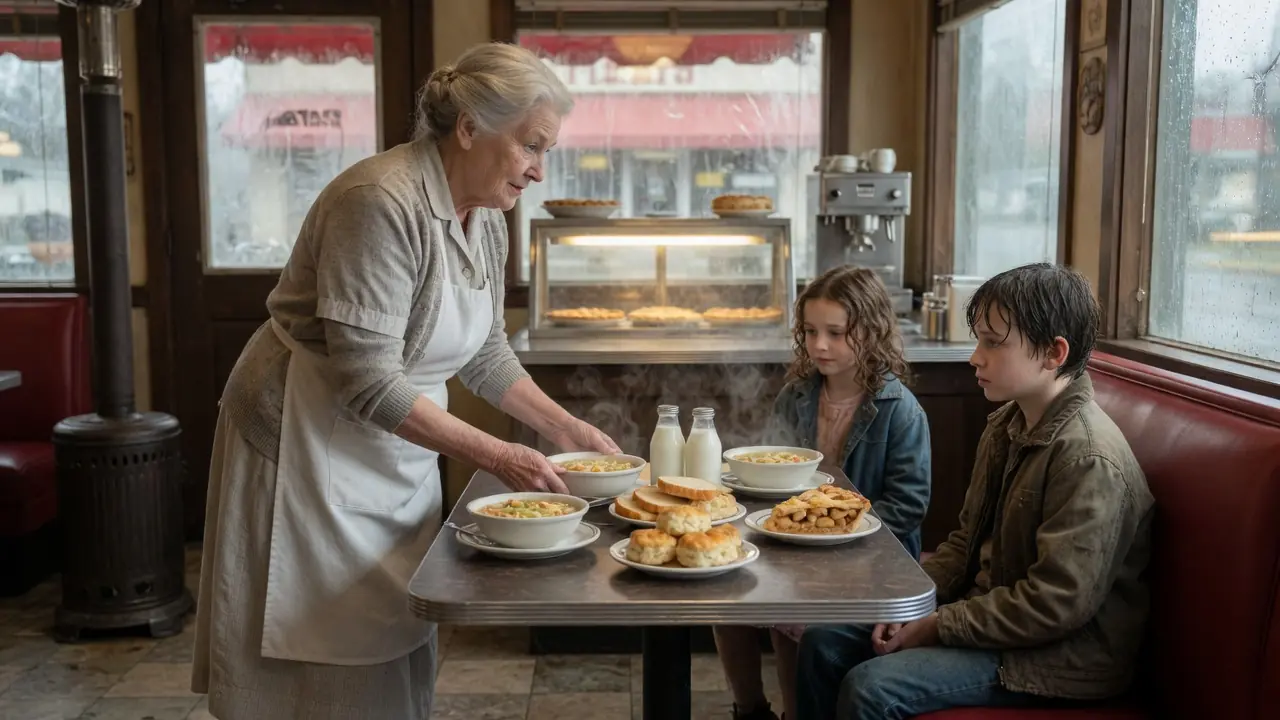
Mabel took two bowls from the shelf and ladled chicken noodle soup into them. She added thick slices of buttered bread, two small cups of milk, and a plate with four warm biscuits left from breakfast. Then she carried everything to the booth and set it down.
Jacob froze. “Ma’am, we can’t pay for that.”
“I know.”
His face changed. “Then we can’t take it.”
Mabel slid the soup closer. “You can.”
“No, ma’am. My mom says we don’t take things from people.”
“Your mom taught you manners. Good. Now I’m teaching you not to faint in my diner.”
Lily looked at the soup, then at Jacob. “Jake,” she whispered.
His jaw tightened. He was hungry too. Mabel could see it in the way his hand had already moved toward the spoon before he forced it still.
She sat down across from them. “Listen to me, Jacob. This is not charity. This is soup that was made too early, biscuits that will be stale by tomorrow, and an old woman who refuses to throw away food while two children sit in front of her looking like the rain chewed them up.”
Jacob swallowed hard. “But we really can’t pay.”
Mabel leaned forward. “Then pay me by making sure your sister eats while it’s hot.”
That got him. His eyes filled, but he blinked quickly and looked away. Then he nodded to Lily. “Eat.”
Lily picked up the spoon carefully and took one bite. Her face changed at once, not with joy exactly, but with relief so deep it looked painful. She took another bite, then another, and soon she was eating with the quiet seriousness of a child who had learned not to waste anything. Jacob waited until she had eaten several spoonfuls before touching his own bowl.
Mabel pretended not to notice. She got up and refilled coffee for the customer by the window, then returned to the counter and kept herself busy. But she watched Jacob tear his bread in half and put the bigger piece on Lily’s plate. She watched Lily push one biscuit back toward him when she thought he was not looking. She watched two hungry children try to take care of each other with scraps of dignity.
When the bowls were empty, Mabel brought two small slices of apple pie. Jacob immediately shook his head. “No, ma’am. Really. We can’t.”
“This pie cracked on top,” Mabel said. “Can’t sell cracked pie to the public. Very dangerous.”
Lily looked at the pie, then at Mabel. “It looks good.”
“It is good. The crack is emotional, not structural.”
Lily laughed, and the sound warmed the booth more than the heater. Jacob gave up trying to argue. They ate the pie slowly, as though stretching sweetness might make it last longer.
After a while, the front door opened and a woman hurried inside, wet and breathless. She was in her early thirties, wearing a work uniform from the grocery store and a name tag that read Denise. Her face was tight with panic until she saw the children in the booth.
“Jacob. Lily.” She rushed to them, dropping her umbrella near the door. “I’m so sorry. The bus was late, and my phone died, and I couldn’t leave the shift early.”
Lily climbed out of the booth and hugged her hard. Jacob stood quickly. “We were okay, Mom.”
Mom. Mabel’s heart tightened.
Denise looked at the empty bowls, the pie plates, the towels, and then at Mabel. Her face filled with embarrassment. “Oh no. Ma’am, I’m sorry. I’ll pay you Friday. I promise. I didn’t know they came in here.”
Mabel waved one hand. “They did not rob me. They ate soup.”
“I don’t want them bothering people.”
“They didn’t bother me.”
Denise opened her purse with shaking hands. “I have three dollars.”
“Put that away.”
“No, please. I don’t want—”
Mabel’s voice softened but stayed firm. “Your children were cold and hungry. I fed them. That is not a debt.”
Denise’s eyes filled immediately. She looked exhausted in a way Mabel recognized from mothers who carried too much and slept too little. “It feels like one.”
“Then let it feel like a blessing until Friday,” Mabel said. “Feelings change.”
Denise covered her mouth for a second. Jacob watched her with worry far too old for his age. Lily clung to her coat.
Mabel packed the remaining biscuits into a small paper bag and added two containers of soup from the pot. Denise started to protest, but Mabel gave her a look over the top of her glasses.
“Do not argue with a woman holding hot soup,” Mabel said.
Denise almost laughed through tears. “Thank you.”
Mabel handed the bag to Jacob. “You carry this carefully.”
“Yes, ma’am.”
“And you,” she said to Lily, “come back when the rain is not trying to drown the sidewalk. I’ll show you how to crimp pie crust.”
Lily’s eyes widened. “Really?”
“Really. But only if you stop calling cracked pie dangerous in public.”
Lily nodded seriously. “I won’t.”
Denise gathered the children and turned toward the door. Before leaving, Jacob looked back at Mabel. His eyes were still guarded, but something had changed in them.
“I’ll pay you back someday,” he said.
Mabel shook her head. “Don’t make promises just because you’re grateful.”
“I mean it.”
“I believe you. But for now, grow up decent. That will be enough.”
Jacob nodded, holding the bag of soup like it mattered more than anything in his hands. Then they stepped back into the rain, huddled close beneath Denise’s umbrella.
Mabel watched them walk away until they turned the corner.
The customer by the window cleared his throat. “You do that often?”
Mabel picked up the towel from the counter. “Feed people?”
“Yes.”
She shrugged. “It’s a diner.”
The next week, Denise came back with Jacob and Lily. She brought six dollars and placed it on the counter with stubborn dignity. Mabel looked at the money, then at her.
“I told you it wasn’t a debt.”
Denise lifted her chin. “And I’m telling you I need to pay something.”
Mabel understood pride well enough not to crush it. She took three dollars and pushed three back. “Then we split the argument.”
Denise smiled weakly. “Fair.”
After that, they came sometimes. Not often, because money was always tight, but enough that Mabel learned pieces of their lives. Denise worked long shifts at the grocery store and cleaned offices twice a week. Their apartment was small, the rent too high, and the world rarely gentle. Jacob took care of Lily after school. Lily loved drawing flowers on napkins. Jacob liked numbers and could add the cost of a meal in his head faster than some adults.
Mabel began keeping extra soup on Tuesdays. She never said it was for them. She simply made too much.
Sometimes Denise paid full price. Sometimes she paid what she could. Sometimes Mabel invented reasons food could not be sold: cracked pie, uneven biscuits, soup that needed “responsible testing,” pancakes that had “lost their confidence.” Jacob saw through most of it, but he accepted because Mabel never made him feel small in front of Lily.
Years passed in the quiet way years do.
Jacob grew taller. His serious face sharpened into a young man’s face, still watchful, still protective. Lily became lively, clever, and artistic, filling diner napkins with sketches of pie slices, coffee mugs, flowers, and once a portrait of Mabel that made her look like “a queen of pancakes,” according to Lily.
Denise’s life improved slowly. She got promoted to assistant manager at the grocery store. Then she took a better job at a medical office. The children stopped coming in soaked and hungry, but they never stopped coming. Dawson’s Diner became one of the places where their childhood had not felt entirely hard.
When Jacob graduated high school, he brought Mabel a folded program. She kept it by the register for a week. He had earned a scholarship to study business and accounting at a state university.
“I knew you’d do something with all that math in your head,” Mabel said.
Jacob smiled. “You used to make me calculate tax on pancakes.”
“You needed practice.”
“You made me do inventory on ketchup once.”
“You were twelve and bossy. I gave you a useful direction.”
He laughed, then grew serious. “I haven’t forgotten what you did.”
Mabel wiped the counter. “Good. Forgetting is rude.”
“I mean it, Mabel.”
She looked at him then.
The boy from the rain was still there, but now he stood straighter. “I know,” she said softly.
Lily went on to study design. She said she wanted to create places that felt safe and warm, “like the booth by the heater.” Mabel pretended not to cry when Lily told her that. She blamed onions, even though no onions were being chopped.
The diner, however, kept struggling.
The freezer finally failed one summer and ruined a week of food. The roof leak spread above the back hallway. The grill needed repair. A new landlord bought the building and raised rent. Mabel took out a small loan to cover repairs, then another to replace equipment. Customers still came, but not enough.
Caroline begged her to close before the diner swallowed everything she had left.
“Mom, I know you love it,” she said. “But love doesn’t pay bills.”
Mabel sat in the empty dining room after closing, staring at the red booths and the old counter. “No,” she whispered. “But it paid for a lot before the bills came.”
The final notice arrived in March, nearly twenty years after that rainy afternoon.
If Mabel did not catch up on rent and loan payments within ninety days, Dawson’s Diner would close. The landlord was already speaking to a restaurant group that wanted to renovate the space into a modern brunch spot. They would keep “some vintage diner elements,” according to the letter, as if Mabel’s whole life could become decoration on someone else’s wall.
She folded the notice and placed it beneath Earl’s old recipe book.
For two weeks, she told no one.
Not Caroline. Not the regulars. Not Jacob or Lily, who now lived in different cities but still visited whenever they came home.
But Lily noticed first.
She came in on a Friday afternoon with flowers and found Mabel sitting in the back booth with the lights dimmed. The pie case was empty. The chalkboard menu had not been updated.
“Mabel?” Lily asked.
“I’m resting.”
“You don’t rest in the dark.”
“I’m trying new hobbies.”
Lily sat across from her. She was twenty-eight now, polished but still warm, with curls pinned back and a sketchbook always in her bag. “What happened?”
“Nothing useful.”
“That means something painful.”
Mabel looked away, but Lily saw the letter beneath the recipe book when she went behind the counter to make tea. She read it, and her face went pale.
“They’re closing you?”
“They are giving me ninety days to perform a financial miracle.”
Lily sat down hard. “Jacob needs to know.”
“No.”
“Mabel.”
“No. Your brother has his own life.”
“He is a financial consultant who helps small businesses restructure.”
“That sounds expensive and unpleasant.”
“It also sounds exactly relevant.”
“I don’t want pity.”
Lily’s eyes filled. “You never gave us pity. You gave us dinner.”
Mabel looked down at her hands. “That was different.”
“No,” Lily said softly. “It was the beginning.”
Jacob arrived two days later.
He came in wearing a dark coat, carrying a laptop bag, his face tense in the way it had been when he was twelve and trying not to show fear. Lily came with him, holding a folder and rolled design plans. Denise came too, older now, dignified and worried, her hands folded around a paper cup of coffee.
Mabel stood behind the counter like a woman facing a jury.
“I told Lily not to make a fuss.”
Jacob set his bag down. “Good thing she didn’t listen.”
“You are too busy for this.”
“No,” he said. “I was busy because of this.”
Mabel frowned. “That does not make sense.”
Jacob looked around the diner. “I learned what a business could mean here. Not from textbooks. From watching you feed people without making them feel poor.”
Mabel’s throat tightened.
He opened his laptop and folder. “I looked at your numbers. The problem is serious, but not hopeless.”
“You looked at my numbers?”
“Lily had copies of the notices.”
Mabel glared at Lily.
Lily lifted both hands. “I regret nothing.”
Jacob continued. “The diner needs restructuring, a rent negotiation, a community campaign, and a new revenue model. You have loyal customers, a strong story, and a brand people trust. You don’t need to become a trendy brunch place. You need to become more of what you already are.”
“That sounds like something from a brochure.”
“It’s still true.”
Lily spread her design plans across the counter. She had sketched the diner exactly as it was, but repaired and brighter. The red booths restored, not replaced. The counter polished. The pie case fixed. The back room converted into a small community meal prep area. A wall display titled The Warm Booth Project, showing stories of people who had been helped at Dawson’s over the years.
Mabel stared at the drawing of the booth by the heater.
“That was your booth,” she said.
Lily smiled through tears. “I know.”
Jacob explained the plan. Dawson’s Diner would stay open as a breakfast and lunch diner, but once a week it would host a pay-what-you-can family supper funded by donors, local farms, and sponsor meals from regular customers. Jacob would negotiate with the landlord and restructure the debt. Lily would redesign the space and build an online presence. Denise would help organize volunteers. Caroline would manage a family fundraiser without making Mabel feel like “a sad story,” because Mabel absolutely refused to become one.
Mabel crossed her arms. “I don’t want charity.”
Jacob nodded. “Neither do we.”
“I mean it.”
“So do I. This is not charity. This is a community buying meal tickets in advance, sponsoring dinners, and preserving a business that has been feeding them for decades.”
“That sounds like charity with extra paperwork.”
“Most useful things have paperwork.”
Mabel looked exhausted. “Why are you doing all this?”
Jacob’s face softened. “Because you told me to grow up decent.”
She looked away quickly.
“And because,” Lily added, “you fed us when we were too little to repay you and too proud to ask.”
The room went quiet.
Denise wiped her eyes. “You gave my children dignity when I could not give them enough food that day.”
Mabel sat down slowly.
For the first time, she had no argument ready.
The next months were hard.
Jacob met with the landlord and bank. He was calm, precise, and relentless in the quiet way Mabel remembered from his childhood. Lily worked late nights on the redesign, painting walls, choosing fabrics, creating menus, photographing pies, and preserving every old detail Mabel loved. Caroline came from Indianapolis and helped organize paperwork, supplier calls, and the fundraiser.
The town responded more strongly than Mabel expected.
Former customers sent donations in the form of prepaid meal cards. Local farmers offered discounted produce. The church sponsored the first family supper. Teachers shared stories of students Mabel had fed over the years. A retired factory worker wrote, “Dawson’s was where I went when my wife died and I didn’t know how to cook for one.”
Mabel read that note three times.
Then she placed it in Earl’s recipe book.
The landlord, seeing the attention and a realistic payment plan, agreed to a new lease with better terms. The bank accepted a restructure. The freezer was replaced. The roof was repaired. The grill was fixed. The pie case stopped humming like an angry lawn mower.
The grand reopening took place on a bright Saturday morning in September.
The diner looked like itself, only loved back to health. The red awning was repaired. The sign was repainted in Earl’s original style. The booths were restored. The counter shone. The old jukebox worked again. The booth by the heater had a small brass plaque that read:
The Warm Booth
For Anyone Who Needs A Place To Sit
Mabel objected to the plaque immediately.
“It’s too sentimental,” she said.
Lily smiled. “Yes.”
“It will make people cry.”
“Probably.”
“That is bad for pancakes.”
“No, it isn’t.”
By noon, the diner was full.
Old regulars came. New customers came. Families came. Former factory workers came. Teachers came. People who had moved away sent flowers. The first pay-what-you-can supper was already fully sponsored before it happened.
At three o’clock, Jacob stood near the counter and tapped a spoon against a coffee cup.
Mabel narrowed her eyes. “No speeches.”
“One,” Jacob said.
“Too many.”
“Necessary.”
The diner quieted.
Jacob stood beside Lily and Denise, his hand resting on the back of the booth where he and Lily had once eaten soup in wet clothes.
“Nearly twenty years ago,” he began, “my sister and I walked into this diner on a rainy afternoon with no money, wet shoes, and empty stomachs.”
Mabel looked down.
“We told Mabel we were just getting out of the rain. She knew better. She gave us towels, soup, biscuits, milk, and apple pie. More than that, she gave us a booth where we could eat without feeling ashamed.”
Lily’s eyes filled.
Jacob’s voice tightened, but he continued. “I promised her I would pay her back someday. She told me to grow up decent. I have been trying ever since.”
Soft laughter moved through the room.
“This diner has done for Cedarville what it did for us. It has fed people, noticed people, and made room for people. Today, Dawson’s Diner stays open because kindness given here came back through every person who remembered being fed.”
The applause rose gently at first, then filled the whole room.
Mabel wiped the counter with a towel and blamed dust.
No one believed her.
Jacob handed her a small box.
“I dislike boxes,” she said.
“I know.”
Inside was a key attached to a small brass tag shaped like a soup bowl.
Engraved on it were the words:
Grow Up Decent
Mabel closed her fingers around it.
Her eyes filled.
“I said that because I didn’t know what else to say.”
Jacob smiled. “It was enough.”
Years passed, and Dawson’s Diner became stronger than it had been in decades.
It did not become fancy. It became beloved. The weekly family supper brought people together without shame. Some paid full price. Some paid less. Some paid nothing. No one knew who was who because Jacob designed the system carefully and Mabel enforced dignity like it was health code.
Lily’s Warm Booth Project became a wall of stories, not all sad and not all sweet. There were notes from customers who found jobs after breakfast meetings, widows who came for coffee, children who learned to love pie, and families who had once needed a quiet meal more than anyone knew. Mabel worked shorter hours, but she still came in every morning to check the coffee, inspect the biscuits, and tell Jacob that financial spreadsheets were “cold little menus with no butter.”
On Mabel’s eighty-fifth birthday, Jacob, Lily, Denise, Caroline, and half the town organized a dinner in the diner after closing.
Mabel said she did not want a party.
They called it “a menu review with cake.”
She attended.
The tables were full of soup, biscuits, fried chicken, mashed potatoes, green beans, and apple pie. Earl’s photograph sat near the register with fresh flowers beside it. Denise stood and thanked Mabel not only for feeding her children, but for letting a struggling mother keep her dignity on one of the hardest days of her life.
Mabel cried then.
Openly.
Just a little.
Then she told everyone to eat before the food got cold.
Later that night, after everyone left, Mabel sat in the Warm Booth with Jacob and Lily. Rain tapped softly against the windows, just like it had all those years before.
“You saved my diner,” Mabel said.
Jacob shook his head. “You saved us first.”
“I fed you soup.”
Lily smiled. “It was more than soup.”
Mabel looked around at the red booths, the repaired counter, the glowing pie case, the old sign, the stories on the wall, and the two children who had grown into adults strong enough to return.
Years earlier, Mabel Dawson had fed two hungry children in a rainy diner because they were cold, proud, and trying not to ask for help. She thought she was only giving them soup, biscuits, and a warm booth.
But kindness served with dignity does not stay small.
It grows.
It becomes memory.
It becomes character.
It becomes two grown children coming back with plans, skills, love, and gratitude strong enough to keep the lights on.
What Mabel received was not only a saved diner.
She received proof that every quiet meal mattered.
She received a son and daughter of the heart in Jacob and Lily, a community gathered around her tables, and the deep comfort of knowing Earl’s counter would keep serving people long after one rainy afternoon had passed.
And whenever two hungry children came through Dawson’s Diner with wet shoes, empty pockets, or fear hidden behind manners, Mabel would point toward the booth by the heater and say,
“Sit down. Soup tastes better when you stop pretending you don’t need it.”