At seventy-seven years old, Nora Whitfield still kept a spare blanket on the chair beside her front door.
Her daughter always said it was unnecessary.
“Mom, why do you need a blanket by the door?”
Nora always gave the same answer.
“Because someone might come in cold.”
Her daughter, who lived two states away in North Carolina, would sigh softly over the phone and say, “You worry about everyone.”
Nora did not deny it.
She had spent most of her life worrying usefully. She had been a school nurse for thirty-eight years in Harrisburg, Pennsylvania, where she learned that children came to school carrying more than backpacks. Some came with fevers. Some came with bruised knees. Some came with empty stomachs. Some came with secrets sitting heavy behind their eyes.
Nora had retired twelve years ago, but the habit of noticing never left her.
Her husband, William, had been gone for nine years. Their old house on Alder Street had become quiet after that, almost too quiet. The kitchen table had four chairs but only one was ever pulled out. The upstairs bedrooms were neat, unused, and full of sunlight no one woke up to enjoy. The backyard swing moved in the wind even when no child sat on it.
Still, Nora stayed.
William had planted the maple tree by the front walk. Her daughter had taken her first steps in the living room. Every corner of the house held a piece of a life she was not ready to pack into boxes.
On a bitter January afternoon, snow began falling before sunset.
By five o’clock, the sidewalks were covered. By six, the streetlights glowed through white mist. Nora had just finished making vegetable soup when she heard a faint knock at the front door.
Not a normal knock.
A small one.
Careful.
Almost embarrassed.
Nora turned off the stove and walked slowly through the hallway. Her knees ached in winter, so she used the wall for balance. When she opened the door, cold air rushed in.
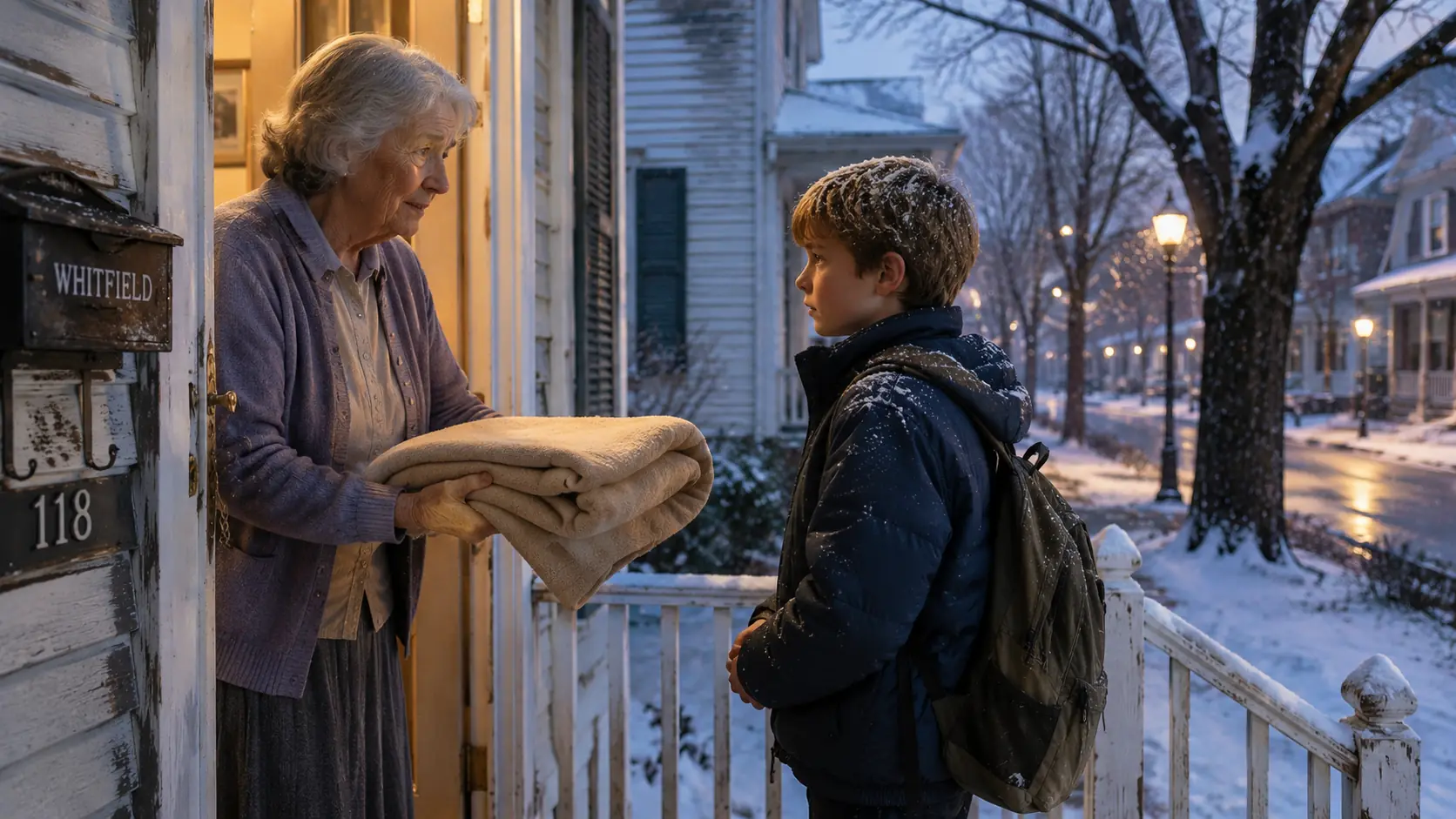
On her porch stood a boy.
He looked about ten years old, with sandy brown hair flattened by snow, pale cheeks, and a thin navy jacket zipped to his chin. His backpack hung from one shoulder. His hands were red from the cold, and his lips trembled though he was trying very hard to keep them still.
He immediately stepped back.
“I’m sorry,” he said. “Wrong house.”
Nora looked past him at the empty street. No adults. No car. No one calling his name.
“Are you looking for someone, sweetheart?”
He shook his head. “No.”
“Are you lost?”
“No.”
“Are you cold?”
He hesitated.
That was answer enough.
Nora opened the door wider. “Come inside for a minute.”
The boy stepped back again. “I can’t.”
“Why not?”
“I’m not supposed to go inside strangers’ houses.”
“That is a very good rule.”
He looked confused. “Then why are you asking?”
“Because another good rule is that children should not stand on porches in snow until their fingers turn red.”
He looked down at his hands quickly, as if they had betrayed him.
“What’s your name?” Nora asked.
He hesitated.
“Ethan,” he said.
“Ethan what?”
“Ethan Brooks.”
“I’m Nora Whitfield.”
He glanced at the small mailbox beside the door. “I know. It says Whitfield.”
“So it does.” She smiled gently. “Now we are slightly less strange.”
His mouth almost moved into a smile, but worry pulled it back.
Nora reached for the blanket from the chair beside the door and held it out.
“You don’t have to come all the way inside. Just stand in the entryway and wrap this around your shoulders.”
Ethan stared at the blanket.
“I don’t have money.”
Nora blinked. “For the blanket?”
“For anything.”
“I didn’t ask for money.”
“I can pay you back later.”
“You are ten.”
“Almost eleven.”
“Ah,” Nora said. “Practically a businessman.”
For the first time, he gave a tiny laugh.
Then he took the blanket.
Once he stepped into the entryway, Nora saw how badly he was shaking. Snow clung to his sleeves. His sneakers were soaked. His backpack dripped onto the rug.
She closed the door against the wind.
“What happened, Ethan?”
He looked toward the floor.
“I lost my key.”
“Your house key?”
He nodded.
“Where do you live?”
“Two blocks over. Pine Street.”
“Is anyone home?”
“My mom is at work.”
“Can you call her?”
He swallowed. “Her phone is off during her shift.”
“What time does she get home?”
“Eleven.”
Nora looked at the clock.
6:12.
“You were going to wait outside until eleven?”
“I tried the neighbor,” he said quickly. “Mrs. Doyle usually lets me wait. But she’s not home. I didn’t know where else to go.”
So he had knocked on doors until he found an old woman with a light on.
Or maybe he had only knocked once and nearly run.
Nora looked at the snow melting on his shoes.
“You did the right thing by asking for help.”
His face tightened. “I wasn’t asking.”
Nora understood pride even in children.
“All right,” she said. “You were conducting research into available warm porches.”
He looked up at her, unsure whether to laugh.
She pointed toward the kitchen. “I made soup. You can sit at the kitchen table while we figure this out.”
“I shouldn’t.”
“Probably not,” Nora said. “But I am going to call the police station’s non-emergency number, give them my name and address, and let them know you are here safe until we reach your mother. Then everything is proper.”
His eyes widened. “Police?”
“Not because you did anything wrong. Because when a child is waiting somewhere, adults should know exactly where that child is.”
He looked frightened.
Nora softened her voice. “You will not be in trouble.”
“My mom might be.”
“For working?”
“For not being home.”
Nora looked at him for a long moment.
“Ethan, adults can be poor, tired, late, unlucky, and still love their children fiercely. I am not interested in getting your mother in trouble. I am interested in keeping you warm.”
His eyes filled, but he looked away before tears could fall.
Nora called the non-emergency line, then the front office of the nursing home where Ethan’s mother worked. After several transfers, a supervisor confirmed that Marissa Brooks was on shift and could be given a message during her break.
Then Nora poured soup into a bowl, toasted bread, and set a mug of hot chocolate beside it.
Ethan stood in the kitchen doorway.
“That’s too much,” he whispered.
“No,” Nora said. “Too much would be giving you coffee. You’d be awake until Tuesday.”
He sat carefully.
At first, he ate slowly, trying to seem polite. Then hunger took over. He finished the soup, the bread, and half the hot chocolate before looking embarrassed.
“Sorry.”
“For eating soup?”
“For eating fast.”
“Soup likes enthusiasm.”
That made him smile.
After dinner, Nora gave him dry socks from a drawer and placed his sneakers near the heating vent. Ethan sat at the kitchen table with his homework, but he kept glancing at the clock.
“Your mother will come,” Nora said.
“I know.”
But his voice said he was not always sure adults came when they promised.
At 7:20, the phone rang.
Nora answered.
A woman’s voice rushed through the line, breathless and panicked. “Mrs. Whitfield? This is Marissa Brooks. Is Ethan really there? Is he okay?”
“He is safe. Cold when he arrived, but warm now. He’s eaten. His shoes are drying.”
“Oh my God.” The woman’s voice broke. “I told him to keep the key on the string inside his backpack. I can’t leave until my replacement comes. I tried, but they said if I leave again—”
Her voice collapsed.
Nora glanced at Ethan, who was pretending not to listen.
“He can stay here until you finish,” Nora said.
“No, ma’am. I can’t ask you to do that.”
“You didn’t ask.”
“I don’t even know you.”
“That is true. But your son knocked on my door because he needed help, and I have soup.”
A weak laugh came through the phone, followed by a sob.
“I’ll come as soon as I can.”
“Drive carefully.”
When Nora hung up, Ethan looked down at his homework.
“She’s mad?”
“No. She’s worried.”
“She works a lot.”
“I believe you.”
“She’s not bad.”
“I never thought she was.”
He looked up, surprised by the simplicity of that answer.
For the next few hours, Nora helped him with fractions. She learned that Ethan loved drawing buildings, especially houses with wide porches and big windows. He said small apartments felt like people were stacked in boxes.
Nora gave him printer paper and colored pencils.
“Draw your dream house,” she said.
He hesitated. “That’s baby stuff.”
“Architects do it all day and charge a great deal of money.”
That seemed to impress him.
He drew a house with a porch, a bright kitchen, a room for his mother, a room for himself, and a small office “in case Mom wants to do paperwork without the table being messy.”
Nora looked at the drawing and felt her throat tighten.
“What does your mother do?” she asked.
“She’s a caregiver at the nursing home. She helps old people.”
Nora smiled. “Then she does holy work.”
Ethan looked at her. “It doesn’t pay like holy work.”
“No,” Nora said softly. “It often doesn’t.”
At 11:18, Marissa Brooks arrived.
She came through the snow wearing scrubs under a worn black coat, her hair pulled back messily, her face pale with fear and exhaustion. The moment Ethan opened the door, she dropped to her knees on Nora’s porch and hugged him.
“I’m sorry,” she cried. “I’m so sorry, baby.”
“I lost the key,” Ethan said.
“I don’t care about the key.”
“I tried Mrs. Doyle.”
“I know. You did right. You did right.”
Nora stood back, eyes wet.
When Marissa finally came inside, she apologized before removing her coat.
“I’m sorry for bothering you. I’m sorry he knocked so late. I’m sorry about the rug. I can clean it.”
Nora held up one hand.
“Marissa, sit down before you apologize to the furniture.”
Marissa blinked.
Ethan laughed quietly.
Nora warmed soup for Marissa too. The young mother tried to refuse, then gave in after Nora pointed at the chair with the authority of a retired school nurse.
Over soup, Marissa explained.
She worked long shifts at a nursing home. Ethan’s father had left years earlier. Their apartment was safe enough, but the landlord charged fees for every lockout, and Marissa was already behind after her car repair. She had no family nearby. Most days, she managed. That day, the key had slipped from Ethan’s backpack somewhere between school and home, and one small accident had become a crisis.
“I keep thinking if I can just get through this month,” Marissa said, staring into her bowl. “But every month says the same thing.”
Nora nodded.
Hard months had a way of repeating themselves until someone stepped in to break the pattern.
Before they left, Nora gave Ethan a small keychain shaped like a blue house.
“Put your next key on this,” she said.
He held it carefully. “I’ll pay you back.”
Marissa began to protest, but Nora smiled.
“For a keychain?”
“For everything,” Ethan said.
Nora looked at him.
“You can pay me back by not standing outside in the snow next time. You knock.”
He nodded.
And he did.
Not because he kept losing his key.
Because Nora’s house became a safe place.
At first, Ethan came only when Marissa’s shift ran late. Then he came twice a week after school to do homework at her kitchen table. Nora always had a snack ready. She claimed she had “accidentally bought too many crackers” or “misjudged the banana situation.”
Ethan stopped believing this after a month.
He kept eating anyway.
Marissa resisted help longer than Ethan did. She was grateful, but guilt sat heavy on her shoulders. Nora never pushed. She simply made room.
On Wednesdays, Marissa came for dinner after work. Sometimes she was too tired to speak. Nora would pour tea and let silence do what words could not.
One evening, Marissa whispered, “I hate that he has to be so responsible.”
Nora looked toward the living room, where Ethan was drawing another house.
“Then we give him places where he doesn’t have to be.”
Marissa wiped her eyes.
Years passed.
Ethan grew taller, sharper, and more certain with a pencil in his hand. He became fascinated with architecture, housing, and why some buildings made people feel safe while others made them feel trapped. Nora encouraged him. She bought used books about design. She took him to the public library. She helped him enter a youth design contest, where he won second place for a drawing of affordable family townhomes with shared gardens and homework rooms.
He called the project Keys For Home.
Nora framed the certificate.
Marissa got a better position at the nursing home, then became a supervisor. She moved them into a better apartment, but Ethan still came to Nora’s house every Thursday.
He mowed her lawn when he was old enough.
Fixed her porch light.
Carried groceries.
Changed smoke alarm batteries.
Nora accused him of becoming useful without permission.
He said, “You started it.”
At seventeen, Ethan was accepted into a summer architecture program. The fee was more than Marissa could afford. Ethan decided not to go and did not tell anyone.
Nora found the brochure in his backpack.
“Why is this in the trash?”
He shrugged. “It’s too expensive.”
“Did you apply?”
“Yes.”
“Were you accepted?”
He did not answer.
Nora picked up the phone.
“Nora, no,” he said.
“Nora, yes.”
She called the program. Then a church scholarship fund. Then her old school district contact. Then a retired architect she knew from a community board. By the end of the week, the fee was covered.
Ethan stood in her kitchen, furious and crying.
“I didn’t want you to fix it.”
“I know.”
“I was handling it.”
“You were giving up quietly. That is not the same thing.”
His tears fell then.
Nora took his hand. “Ethan, you do not have to earn every open door by suffering in silence.”
He never forgot that.
When he graduated high school, Nora sat beside Marissa in the front row. Ethan received a scholarship to study architecture and urban planning. After the ceremony, he handed Nora a framed copy of the first house drawing he had made at her kitchen table on the night he lost his key.
At the bottom, he had written:
For Nora, who opened the first door.
She cried so hard Marissa had to give her tissues.
College took Ethan away, but not really.
He called every Sunday. He sent sketches. He mailed postcards of buildings. He asked Nora’s opinion about designs, though she insisted she knew nothing about architecture.
“You know whether a place feels kind,” he said.
“That is not a professional qualification.”
“It should be.”
Ethan became an architect focused on affordable housing and community-centered design. He worked on family housing, senior housing, and shelters that did not feel like punishment. He said every person deserved a door that locked, a window with light, and a place to put their keys.
Nora told everyone, “My Ethan builds homes that remember people are human.”
No one corrected her.
But Nora’s own home began to fail.
At eighty-six, the roof leaked. The porch steps shifted. The heating system groaned through winter. Property taxes rose. Her daughter urged her again to move closer.
“Mom, that house is too much for you now.”
Nora looked at the blue house keychain hanging by her door, the one Ethan had kept using until it finally broke and he returned it to her as a keepsake.
“It still has room,” she said.
But room did not pay bills.
One rainy afternoon, Nora received a notice from the city about repairs she could not afford. Then a letter from a real estate company offering to buy the property quickly. The amount was enough to tempt fear, not enough to buy peace.
She hid the letters in a drawer.
Ethan found out from Marissa.
Two days later, he arrived at Nora’s door with rolled plans under his arm.
He was thirty now, tall, calm, wearing a dark coat damp from rain. For one strange second, Nora saw the shivering boy on her porch again.
She opened the door and sighed.
“Your mother talks too much.”
“She loves too loudly,” Ethan said.
“That sounds familiar.”
He smiled and stepped inside.
At the kitchen table, he unrolled the plans.
Nora saw her house.
But restored.
The roof replaced. The porch rebuilt. The stairs made safer. A downstairs bedroom added. The kitchen widened. The backyard transformed into a shared garden. The unused upstairs bedrooms redesigned into safe short-term rooms for young caregivers and children needing after-school support through a local nonprofit.
At the top of the plan was a sign.
THE NORA WHITFIELD HOUSE
A Warm Place When The Key Is Lost.
Nora stared at the words.
“No.”
“Yes.”
“I don’t need my name on a house.”
“It is already your house.”
“You know what I mean.”
Ethan sat across from her.
“When I was ten, I lost my key and thought I had to stand outside in the snow until nearly midnight. You opened your door. You fed me. You called my mother without judging her. You gave me a place where I could be a child instead of a backup adult.”
Nora’s eyes filled.
“I only gave you soup.”
“You gave me the feeling of a safe door,” he said. “I’ve been designing that feeling ever since.”
The renovation took nearly a year.
Nora complained about the noise, the workers, the dust, the new railing, the bathroom tile, and the fact that everyone kept telling her to sit down.
Ethan listened and ignored every complaint that might endanger her knees.
But he protected what mattered. William’s maple tree stayed. The kitchen table stayed. The blanket remained by the front door. The blue house keychain was framed in the hallway.
When the project opened, families from the neighborhood came. Children came after school for homework help. Young caregivers came for support. Seniors came for tea. The upstairs rooms were used carefully, legally, and safely through the nonprofit for short-term emergencies.
Nora did not run the place.
She simply sat at the kitchen table, asked children whether they had eaten, and pointed to the blanket by the door when someone came in cold.
On opening day, Ethan gave a speech in the backyard under the maple tree.
“When I was a boy,” he said, “I believed losing a key meant losing safety. Nora Whitfield taught me that sometimes home is not the door you expected. Sometimes it is the person who opens another one.”
Nora wiped her eyes.
“This house will stand for every child who has ever waited outside, every parent working late, every family one accident away from crisis. It exists because one old woman kept a blanket by the door.”
The crowd applauded.
Nora shook her head and cried.
Years later, the Nora Whitfield House became a quiet anchor in the neighborhood. It was not dramatic. It was not grand. It was simply warm. Children did homework there. Parents found resources. Seniors found company. Families found one safe evening before the next difficult morning.
One snowy night, many years after Ethan first knocked, a little girl stood on Nora’s porch, shivering, with a backpack in her arms.
Nora, older now and slower, opened the door.
The girl whispered, “I lost my key.”
Nora smiled gently and reached for the blanket on the chair beside the door.
“Then you came to the right house.”
Across the hallway, Ethan stood watching, his eyes wet.
The girl looked down. “I don’t have money.”
Nora wrapped the blanket around her shoulders.
“I didn’t ask for money.”
Ethan looked at the framed blue keychain on the wall.
Long ago, one lost key had brought him to this house.
One warm bowl of soup had shown him what safety felt like.
One old woman’s door had become the blueprint for his life.
And now, because Nora had opened it once, the door would stay open for many others.