Evelyn Harper was seventy-six years old and still left the back porch light on every night.
Her farmhouse sat outside Willow Falls, Iowa, surrounded by empty fields, old fences, and a line of cottonwood trees that shivered whenever the wind came across the land.
The house had white siding, blue shutters, a narrow back porch, and a kitchen window that faced the gravel road.
That kitchen had been the heart of Evelyn’s life.
It was where she had baked bread for her husband, Samuel, when the farm still had cattle. It was where her children had done homework with muddy boots under the table. It was where neighbors once came after church with casseroles, gossip, and trouble they needed to talk through.
Now the kitchen was quieter.
Samuel had been gone for eight years. Her children lived far away. Her oldest son worked in Nebraska. Her daughter lived in Chicago. They called often, worried constantly, and told her gently that the farm was too much for one woman her age.
Evelyn always gave the same answer.
“This house has kept me all my life. I’m not leaving it just because it needs keeping now.”
But keeping it had become harder.
The barn roof sagged. The well pump was old. The furnace rattled in winter. The porch railing had loosened. The property taxes had risen again after a new road project made the area more attractive to developers.
Letters came in the mail every month.
Cash offer for your land.
Sell your farm fast.
No repairs needed.
Evelyn tore them up.
The farm was not just land.
It was Samuel’s hands in the fence posts. It was her children’s laughter in the yard. It was the apple tree he planted the year their daughter was born. It was the kitchen table with knife marks, coffee rings, and one carved initial Samuel had made before she scolded him for ruining furniture.
She would stay as long as she could.
On a bitter November night, the first hard cold of the season settled over Willow Falls.
Rain had fallen all afternoon, then turned to sleet after sunset. By nine o’clock, the gravel road outside Evelyn’s house shone under a thin coat of ice. Wind pressed against the windows. The old furnace clicked and groaned. Evelyn stood at the sink, washing one soup bowl, when she saw a shape moving near the ditch.
At first, she thought it was a deer.
Then the shape stumbled.
Evelyn leaned closer to the window.
A young man was walking along the road with a backpack over one shoulder and his arms wrapped around himself. He had no hat. No gloves. His jacket was soaked through. He stopped near her mailbox, bent forward, and placed one hand on his knee as if he might fall.
Evelyn turned off the sink.
For a moment, she simply watched.
A woman living alone learned caution.
But she had also lived long enough to know the difference between danger and desperation.
The young man straightened, looked down the empty road, and kept walking.
In the wrong direction.
There was nothing for miles that way except fields and a closed grain facility.
Evelyn dried her hands, grabbed Samuel’s old coat from the hook, and opened the back door.
Cold wind rushed into the kitchen.
“Young man!” she called.
He startled so hard he almost slipped.
Evelyn stepped onto the porch.
“You lost?”
The young man turned toward the light. His face was pale, his dark hair wet, his lips nearly blue from cold.
“I’m sorry, ma’am,” he called back. “I’m not trying to bother you.”
“That wasn’t my question.”
He hesitated.
“Yes. I think I’m lost.”
“Where are you trying to go?”
“Willow Falls bus depot.”
Evelyn frowned.
“That’s six miles behind you.”
The young man closed his eyes.
For a second, he looked so defeated that Evelyn felt the cold reach past her coat and touch her heart.
“What’s your name?” she asked.
“Noah.”
“Noah what?”
“Noah Bennett.”
“I’m Evelyn Harper.”
“Nice to meet you, Mrs. Harper. I’ll get out of your way.”
“And go where?”
He looked down the icy road.
“I’ll turn around.”
“You’ll freeze before you get there.”
“I’ll be okay.”
Evelyn’s eyes narrowed.
“Young man, I have raised two children, buried one stubborn husband, and kept chickens alive through Iowa winters. Do not stand in my yard and lie badly.”
Despite everything, Noah gave a weak, surprised laugh.
“I really don’t want to cause trouble.”
“Trouble is walking six miles in sleet with wet shoes. Come inside.”
He stared at her.
“I can’t.”
“You can.”
“You don’t know me.”
“That is true.”
“I could be…”
He stopped, too tired to finish.
Evelyn looked at him carefully.
“You could be many things. Right now, you are cold, hungry, and heading away from help. That is enough information for tonight.”
Noah’s jaw trembled, whether from cold or emotion, she could not tell.
Another gust of wind pushed sleet across the porch.
Evelyn pointed toward the door.
“Inside. Before I change my mind and make you listen to a lecture out here.”
That moved him.
He walked carefully up the drive, slipping twice before reaching the porch. Evelyn opened the door wider and stepped back.
“Shoes off on the mat. Backpack by the stove. Don’t drip on the braided rug. My husband hated that rug, and I kept it out of spite.”
Noah blinked, then nodded quickly.
“Yes, ma’am.”
“Evelyn.”
“Yes, Evelyn.”
Inside, the kitchen was warm and yellow with lamplight. A pot of vegetable soup sat on the stove. The table was small and square, with two chairs, a jar of dried flowers, and a folded newspaper Evelyn had not finished reading.
Noah stood near the door, soaked and shivering, looking as if he did not know what to do with kindness when it came without conditions.
Evelyn handed him a towel.
“Bathroom is through that hallway. Dry yourself. I’ll find clothes.”
“You don’t have to—”
“I know. Go.”
She found old sweatpants and a flannel shirt that had belonged to her son years earlier. They were too big for Noah, but they were dry. She also found thick wool socks from Samuel’s drawer.
When Noah returned, his wet clothes bundled in his arms, he looked embarrassed by the softness of the socks.
“Put those near the stove,” Evelyn said. “Not too close unless you want your jacket to smell like burnt regret.”
He obeyed.
Evelyn ladled soup into a bowl and placed bread beside it.
Noah stared at the food.
“I can’t take your dinner.”
“It’s soup, not a family inheritance.”
“I don’t have money.”
“I don’t run a restaurant out of my kitchen.”
He sat slowly.
The first spoonful seemed to steady him.
Then hunger took over.
He ate quietly, carefully at first, then faster. Evelyn poured tea and set it near his hand. He whispered thank you after nearly every bite until she finally said, “If you thank me again before that bowl is empty, I’ll give you more soup just to keep your mouth busy.”
He smiled into the bowl.
A real smile this time.
When he finished, Evelyn gave him another serving.
This time he did not argue.
She sat across from him with her own tea.
“So, Noah Bennett,” she said, “why were you trying to reach the bus depot tonight?”
He looked down.
“I’m supposed to get to Des Moines by morning.”
“What’s in Des Moines?”
“A culinary training program.”
Evelyn raised her eyebrows.
“You cook?”
“I want to.”
“That wasn’t my question.”
He paused, then nodded.
“Yes. I cook.”
“What kind?”
“Bread mostly. Soups. Simple food. My grandmother taught me when I was little.” His voice softened. “She worked in a school cafeteria for thirty years. She said feeding people was the most honest work there was.”
Evelyn liked that.
“She was right.”
Noah looked surprised.
“Most people don’t think cooking is much.”
“Most people have never been truly hungry.”
He went quiet.
Evelyn studied him.
“What happened tonight?”
“My ride canceled after my shift. My phone died. I missed the last local bus to the depot. I thought if I walked, I could still make the midnight bus to Des Moines.” He gave a bitter little laugh. “Then I took the wrong road.”
“You took a very wrong road.”
“Yes.”
“Where were you working?”
“Diner outside town. Dishwashing. Prep when they let me. I’ve been saving for this program for almost a year. If I don’t arrive tomorrow, they give my spot to someone else.”
Evelyn looked toward the window. Sleet still tapped against the glass.
“You’ll sleep here tonight.”
Noah looked up quickly.
“No, Evelyn. I can’t.”
“You can.”
“I can sleep in the chair.”
“You will sleep in the spare room.”
“I don’t want to make you uncomfortable.”
“You already did that by nearly freezing in front of my mailbox.”
His mouth opened.
Then closed.
Evelyn stood and took his bowl.
“I’ll drive you to the depot at dawn. There’s a bus at six-ten. It connects to Des Moines. You’ll make it.”
Noah’s face changed slowly.
Hope was painful when a person had been trying not to feel it.
“You’d do that?”
“Yes.”
“Why?”
Evelyn looked at him for a long moment.
“Because Samuel and I once got stranded in a snowstorm when we were newly married. A farmer took us in, fed us eggs, gave us a dry bed, and pulled our truck out at sunrise. Samuel always said we lived the rest of our marriage under that man’s roof for one night.”
Noah listened silently.
“I suppose tonight is my turn,” she said.
His eyes filled.
“I’ll pay you back someday.”
Evelyn shook her head.
“People always want to pay back kindness like it’s a bill. It isn’t. You carry it forward, or you carry it home. That’s enough.”
He looked down at his hands.
“I don’t really have a home.”
The words came quietly.
Evelyn did not rush to fill the silence.
Finally, she said, “Tonight you have a room.”
Noah covered his face with one hand.
Evelyn pretended to wipe the counter.
Some gratitude needed privacy.
The spare room was small, with a quilt Evelyn had made from old shirts, a wooden dresser, and a framed picture of the farm in summer. Noah stood in the doorway for a long moment before stepping inside.
“This is too nice,” he said.
“It’s a bed. Don’t flatter it.”
He laughed softly.
“Breakfast at five,” Evelyn said.
“Five?”
“You wanted a future. Futures are inconvenient.”
He smiled.
“Yes, Evelyn.”
That night, Evelyn slept lightly.
Not from fear.
From memory.
The house had not held a young person’s breathing in years. She heard the floor creak once when Noah got up, likely to check his clothes by the stove. She heard the furnace knock, the wind settle, the sleet soften to rain.
At four-thirty, she rose.
By five, the kitchen smelled of coffee, eggs, toast, and fried potatoes.
Noah came in wearing his own clothes, still slightly damp at the cuffs but warm enough. He looked younger in morning light.
Evelyn packed him two sandwiches, an apple, a thermos of coffee, and a small container of soup.
“I can’t take all that.”
“You can. You’re too thin.”
“I’m not.”
“You are from the side. Sit and eat.”
He did.
At five-thirty, they drove toward town in Evelyn’s old green pickup. The roads were icy in patches, but she handled them with steady confidence.
Noah held the food bag in his lap.
“You drive better than anyone I know,” he said.
“I drive like someone who wants to arrive.”
At the bus depot, gray light touched the sky.
Noah stepped out, then turned back.
“Evelyn.”
“What?”
“I mean it. I’ll come back someday.”
“You’d better come back with good bread.”
A smile broke across his face.
“I will.”
“And don’t let one bad night decide what kind of man you become.”
His smile faded into something deeper.
“I won’t.”
He hesitated, then hugged her carefully.
Evelyn stiffened for half a second, then patted his back.
“Go on. You’ll miss the bus after all this drama.”
He laughed, wiped his eyes, and went inside.
Evelyn watched until the bus pulled away.
Then she drove home to the quiet farmhouse, the empty spare room, and the bowl he had washed and left drying neatly beside the sink.
Three months later, a letter arrived.
The envelope was addressed in careful handwriting.
Inside was a note and a small photograph of Noah in a white kitchen apron, standing beside a tray of bread.
Evelyn,
I made it. The training program is hard, and I’m tired all the time, but I’m still here. I baked my first sourdough loaf this week. It was too dense, but the instructor said the crust was good.
You told me to come back with good bread. I’m working on it.
Thank you for giving me a room when I didn’t have a home.
Noah
Evelyn read the letter twice.
Then she placed it on the refrigerator beside a photo of her grandchildren.
More letters came.
Noah wrote about burns on his arms, long days, early mornings, ruined dough, good soup, bad instructors, kind classmates, and the first time someone paid him to bake bread. Evelyn wrote back in short, firm letters.
Dense bread is still bread. Try again.
Do not skip breakfast. Coffee is not breakfast.
If soup tastes flat, add acid before you add more salt.
Buy good shoes. Pride does not protect feet.
Noah kept every letter.
After two years, he visited.
He arrived in a used car with a box on the passenger seat. Evelyn opened the door and found him standing on the porch, older, healthier, wearing a clean jacket and holding a round loaf wrapped in brown paper.
“Is that the good bread?” she asked.
“I hope so.”
She took it, cut a slice, and tasted it at the kitchen table.
Noah watched like he was waiting for a verdict from a court.
Evelyn chewed slowly.
Then nodded.
“Good crust.”
His face lit up.
“Just good crust?”
“Good bread,” she said.
He sat back, laughing with relief.
That day, Noah fixed the loose porch railing before he left.
Evelyn told him not to.
He ignored her politely.
Over the years, he visited whenever he could. Sometimes with bread. Sometimes with soup. Sometimes with tools. He helped clean gutters, repair a fence gate, stack firewood, and patch the barn door.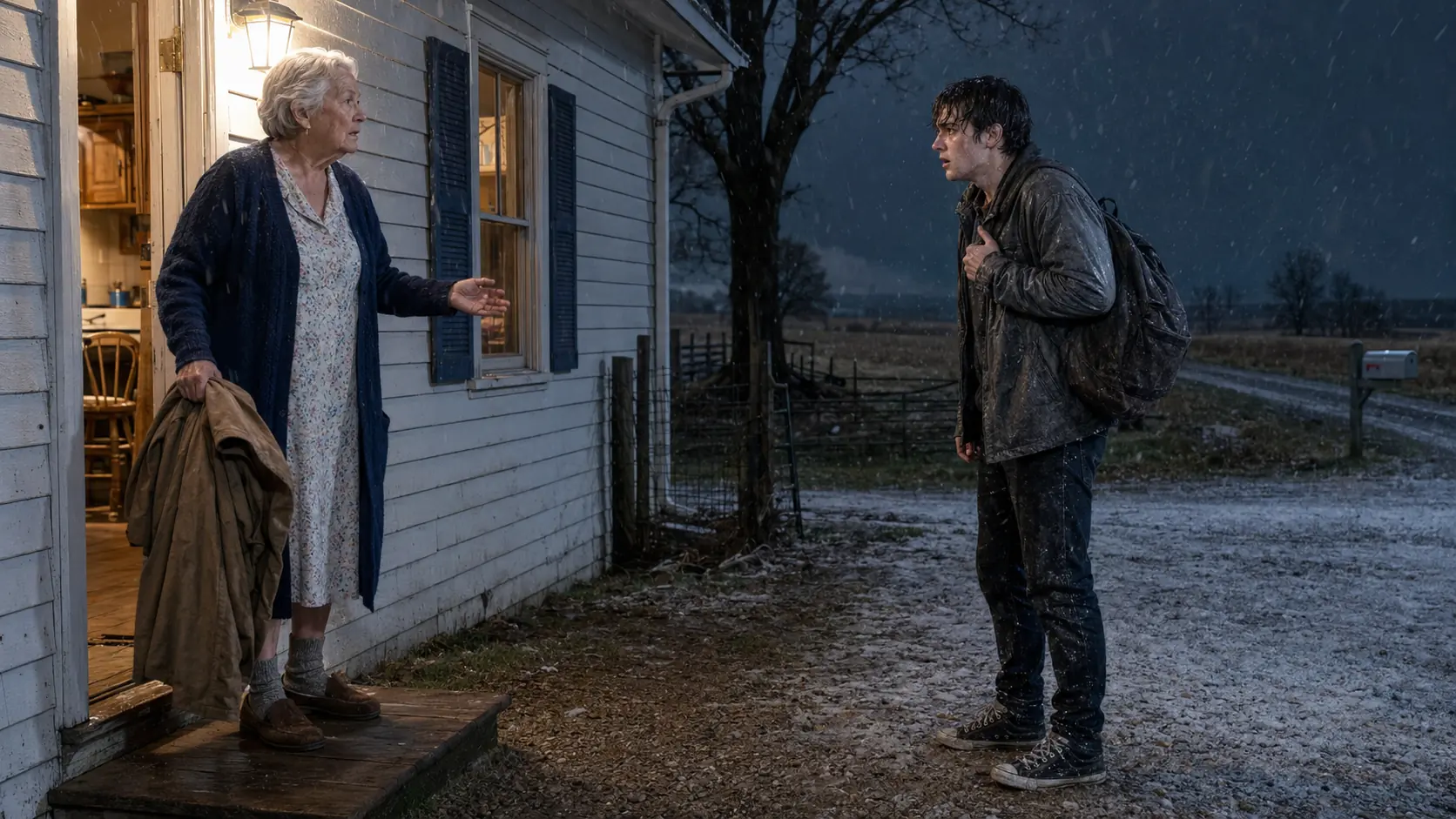
He became successful slowly.
First, he worked in a bakery.
Then a restaurant kitchen.
Then he became head baker at a small café.
Then, at thirty-two, he opened his own place in Des Moines called Second Hearth Bakery.
The name came from that night at Evelyn’s house.
He never told her at first because he knew she would call it too sentimental.
But when the bakery opened, he sent her a photograph of the sign.
She called him immediately.
“Second Hearth?” she said.
“Yes.”
“That is sentimental.”
“I know.”
“Is the bread good?”
“Yes.”
“Then fine.”
Noah’s bakery became known for simple, excellent food: sourdough, rye, cinnamon rolls, biscuits, vegetable soup, chicken stew, apple hand pies, and thick slices of bread with butter. He hired people who needed chances, trained them carefully, and never forgot what it felt like to arrive at a door with nothing but wet clothes and shame.
On the wall near the kitchen entrance, he framed one sentence:
Tonight You Have A Room.
Customers asked about it.
He always said, “Someone once gave me one.”
As Noah’s life grew, Evelyn’s farm became more fragile.
The well pump failed one summer and had to be replaced. The barn roof sagged worse. The furnace needed major repair. The porch floorboards softened. The old apple tree split during a storm. Property taxes rose again.
Then came the letter from the county.
A section of the farmhouse foundation needed repair after inspection, and the back porch steps were considered unsafe. Her insurance company demanded repairs before renewal.
The estimate was larger than Evelyn’s savings.
At the same time, a developer sent another offer to buy the land.
This one was high.
High enough that her children begged her to consider it.
“Mom,” her daughter said gently over the phone, “you can’t keep fighting the house.”
Evelyn sat at the kitchen table, the estimate in one hand and the developer’s offer in the other.
Outside, the fields lay golden under late afternoon light.
“I know,” she whispered.
That frightened her daughter.
Evelyn had always argued before.
She did not tell Noah.
She told herself he was busy.
That he had a bakery, employees, a life.
That one night years ago did not give her the right to call him into her trouble.
But Noah noticed anyway.
He called one evening, and her voice gave her away.
“What’s wrong?” he asked.
“Nothing.”
“Evelyn.”
“You learned that tone from me.”
“Yes. That’s how I know it works.”
She tried to laugh.
It did not sound right.
Three days later, Noah arrived at the farmhouse unannounced.
Not alone.
Behind his car was a white van with the Second Hearth Bakery logo, and behind that was a pickup carrying two men and a woman.
Evelyn stood on the porch.
“What is this?”
Noah stepped out.
“This is me not accepting ‘nothing’ as an answer.”
“I did not invite you.”
“You invited me years ago. You never revoked it.”
“That is legally questionable.”
“I brought bread.”
“That improves your case.”
He hugged her, then looked at the porch floor.
His face changed.
“It’s worse than you said.”
“I didn’t say anything.”
“Exactly.”
Noah’s team included his bakery manager, Claire, whose husband was a licensed contractor; a carpenter named Joel, who supplied the bakery’s wooden shelves; and a young woman named Mara, who worked at the bakery and had grown up on a farm.
They spent the day inspecting.
Foundation.
Porch.
Barn.
Furnace.
Well.
Drainage.
Roof.
Noah listened carefully, asked questions, took notes, and sat with Evelyn at the kitchen table that evening.
“I don’t want charity,” she said before he opened his mouth.
“I know.”
“I mean it.”
“So do I.”
“I helped you one night. That does not make you responsible for my house.”
Noah looked around the kitchen.
At the stove.
The table.
The window facing the gravel road.
The back porch light.
“This house is why I have a bakery,” he said.
“No. Your work is why you have a bakery.”
“My work started because I made it to Des Moines. I made it to Des Moines because you opened the door.”
“That was one night.”
He leaned forward.
“Evelyn, when a person has no home, one night is not small.”
She looked down.
Noah opened his folder.
“I have a proposal.”
“I hate folders.”
“I know. This one has bread in it.”
He pulled out a wrapped loaf and placed it on the table.
Evelyn looked at it.
“That is unfair.”
“Yes.”
His plan was practical.
Second Hearth Bakery had grown enough that Noah wanted to expand into farm-to-table baking classes, seasonal preserves, and rural food retreats. He did not want a polished commercial farm. He wanted a real place with history, a kitchen, a barn, and land.
Evelyn’s farm could become Harper Hearth Farm, a small partner site for weekend bread classes, soup dinners, apple harvest events, and training programs for young cooks who needed a place to learn outside the pressure of restaurant kitchens.
Noah would lease the barn and part of the property for seasonal events, paying enough to cover taxes and repairs. The bakery would fund urgent safety work as part of the long-term lease. Grants for rural preservation and food education could help with additional repairs. Evelyn would remain owner and live in her home. She would teach what she wanted, complain as needed, and approve every use of her kitchen.
Evelyn stared at him.
“You want to bring strangers into my barn to make bread?”
“Not strangers. Students.”
“Worse. They ask questions.”
“You like answering questions when you can sound annoyed.”
“That is not the point.”
“It is partly the point.”
She turned the pages.
There were sketches.
The barn stabilized and cleaned.
A long table for bread classes.
The farmhouse porch repaired.
The kitchen preserved, not remodeled.
The apple tree replaced with two new trees.
A sign near the road:
Harper Hearth Farm
Bread, Soup, Shelter, Second Chances
“No,” Evelyn said immediately.
Noah smiled.
“I knew you’d hate the last part.”
“It is too sentimental.”
“It is true.”
“Truth should not be allowed on signs without supervision.”
He laughed.
Then grew serious.
“You once told me kindness isn’t a bill. You carry it forward, or you carry it home.”
Evelyn remembered.
“I was trying to stop you from crying in my kitchen.”
“It worked poorly.”
“It did.”
He touched the folder.
“I carried it forward. Now I’m carrying some of it home.”
The work began the following spring.
Evelyn complained every day.
She complained about contractors.
She complained about the new porch boards.
“The old boards had history.”
“The old boards had holes,” Noah said.
“History sometimes has holes.”
She complained about the barn repairs.
“It smells too clean.”
“It smelled like damp raccoon.”
“That was character.”
“It was a health hazard.”
She complained about the new furnace.
“It’s too quiet.”
“Do you miss the knocking?”
“I knew where I stood with the knocking.”
Her children came home to help. At first, they were cautious. Then they saw the plan, the repairs, the care Noah took not to erase their father’s work or their mother’s life.
Evelyn’s son ran his hand along the repaired porch rail.
“He kept Dad’s notch,” he said quietly.
Noah nodded.
“Evelyn said Samuel made it fixing the rail in 1996.”
Evelyn looked away.
Noah had listened.
That mattered more than the repairs.
The first Harper Hearth Farm weekend happened in October.
The air was crisp. The fields were gold. The new porch steps were safe. The barn doors opened wide. Inside, long wooden tables held flour, bowls, towels, apples, butter, and jars of soup.
Ten students came.
Young cooks.
A tired mother who wanted to learn breadmaking.
A retired teacher.
Two teenagers from Noah’s training program.
One man who said he was “bad at dough” and proved it within twenty minutes.
Evelyn sat at the end of the table with her apron on.
“I am not teaching,” she announced.
Noah smiled.
“She says that before teaching.”
“I am supervising.”
“She supervises loudly.”
The class began with bread.
Noah taught mixing, kneading, resting, shaping. Evelyn corrected people who attacked the dough.
“Bread is not an enemy. Stop punching it like it owes you money.”
The students laughed.
Then listened.
At noon, they ate vegetable soup from Evelyn’s recipe and thick slices of fresh bread. In the afternoon, they made apple hand pies with fruit from the old tree’s last harvest and the first crop from the new saplings.
By evening, the farmhouse glowed with life.
Not too much.
Not overwhelming.
Just enough.
Laughter in the kitchen.
Footsteps on the porch.
Bread cooling on racks.
A young woman standing at the back door with tears in her eyes because the smell reminded her of her grandmother.
Evelyn saw her and quietly wrapped two rolls in a towel for her to take home.
Noah saw that too.
He said nothing.
After everyone left, Evelyn and Noah sat at the kitchen table.
The same table where he had once eaten soup in borrowed clothes.
“You were right,” she said.
Noah looked up.
“About what?”
“The barn could be useful.”
He smiled.
“That’s a big admission.”
“I’m old. My admissions move slowly.”
Years passed, and Harper Hearth Farm became a small but beloved place.
Not a resort.
Not a tourist attraction.
A working old farmhouse with bread classes, soup nights, harvest weekends, and training days for young cooks learning discipline, patience, and practical care. Noah’s bakery supplied ingredients and staff. Evelyn approved recipes, corrected posture, and told anyone who wasted food that they needed “a better relationship with hunger.”
The lease income paid taxes.
The repairs kept the house safe.
The barn stood straight again.
The porch light still came on every night.
On Evelyn’s eighty-second birthday, Noah and her children organized a dinner at the farm.
She said she did not want a party.
They called it “a bread evaluation.”
She attended.
The barn was filled with long tables, lanterns, soup, bread, apple pies, and people who had found something there: students, neighbors, her children, her grandchildren, Noah’s staff, and several former trainees who now worked in kitchens of their own.
After dinner, Noah stood with a small wooden box.
Evelyn narrowed her eyes.
“If that is a speech, sit down.”
“It’s a key.”
“Keys can be emotional. I’ve seen it happen.”
He opened the box.
Inside was an old brass key on a wooden tag.
The tag was carved from one of the original porch boards they had replaced. Burned into the wood were the words:
Tonight You Have A Room
Evelyn stared at it.
Her eyes filled before she could stop them.
Noah spoke quietly.
“This opens the barn kitchen. But it belongs to the whole house.”
She touched the key.
“You kept that sentence all these years?”
“It kept me.”
The room went silent.
Evelyn closed her fingers around the key.
“I only gave you a bed.”
“No,” Noah said. “You gave me a place to become someone who could build one.”
Later that night, after everyone left, Evelyn and Noah sat on the back porch.
The new boards were smooth beneath their feet. The porch light glowed above them. The gravel road was quiet. The fields moved softly in the dark.
“You remember that night?” Noah asked.
“I remember your shoes dripping by the stove.”
“They were terrible shoes.”
“They were tragic shoes.”
“I was scared.”
“I know.”
“I didn’t want to ask for help.”
“I know that too.”
He looked at her.
“You asked without words.”
She smiled faintly.
“I suppose I answered the same way.”
The wind moved through the cottonwoods.
For a while, neither spoke.
Then Evelyn said, “You saved my farm.”
Noah shook his head.
“You saved my road first.”
“I just brought you inside.”
“That was the whole thing.”
Evelyn looked toward the kitchen window.
For years, she had feared the house was becoming only a museum of what she had lost. But now it held new voices. Young hands. Bread rising. Soup simmering. People learning. People staying for one night, one class, one meal, one chance.
Samuel’s house still remembered the past.
But it no longer lived only there.
Years earlier, Evelyn Harper had seen a freezing young man walking the wrong way in sleet. She opened her door, gave him dry clothes, soup, a warm bed, breakfast, and a ride toward his future.
She thought she was only offering shelter for one night.
But one night of shelter can become a lifetime of direction.
Noah built his life from that safe room, and when Evelyn’s farm was the thing standing cold, tired, and nearly lost, he returned with bread, plans, repairs, students, leases, and gratitude strong enough to keep the porch light burning.
What Evelyn received was not just a repaired house or a saved farm.
She received proof that home is not diminished when shared.
It grows.
It gathers.
It feeds.
It becomes a place where lost people can stop walking the wrong way.
And every stormy night after that, when sleet touched the kitchen window and headlights slowed near the road, Evelyn would turn on the porch light, set a pot of soup on the stove, and whisper,
“Well, Samuel, let’s see who needs a room tonight.”