Dorothy Miller first saw the boy at Gate 12 of the Greyhound station in Kansas City, Missouri, just after midnight.
The station was almost empty, except for a few tired travelers sleeping with their coats pulled over their faces, a janitor pushing a squeaking mop bucket, and a vending machine humming in the corner. Outside, freezing rain tapped against the glass doors, turning the sidewalks slick and silver beneath the streetlights.
Dorothy was seventy-six years old, with short white hair tucked beneath a knitted burgundy hat, soft brown eyes, and hands that had grown thin but still steady after decades of sewing, cooking, cleaning, and holding on through difficult years. She wore a long gray coat, black shoes with careful soles, and carried a worn leather handbag that had belonged to her late sister.
She was traveling to St. Louis to see her niece after a small surgery. Dorothy hated traveling at night, but the daytime ticket had been too expensive, and she had lived long enough to know that pride did not lower prices.
She sat near the gate with a paper cup of coffee she did not like, watching the clock.
That was when she noticed the boy.
He stood near the ticket counter, holding a backpack against his chest. He was about eleven, maybe twelve, with messy brown hair, a thin navy hoodie beneath an oversized jacket, and sneakers soaked from the rain. His face was pale from cold and worry. He kept looking from the ticket clerk to the glass doors, then down at the few crumpled bills in his hand.
The clerk shook his head.
“I’m sorry, kid. It’s not enough.”
The boy swallowed. “How much more?”
“Twenty-eight dollars.”
The boy looked at the money in his hand as if staring harder could make it multiply.
“I can stand,” he said. “I don’t need a seat.”
The clerk sighed. “That’s not how bus tickets work.”
“I need to get to Springfield.”
“Then you need the full fare.”
The boy’s shoulders tightened.
Dorothy slowly stood.
A man in a business jacket nearby muttered, “Where are this kid’s parents?”
Dorothy glanced at him, then walked to the counter.
“What’s your name, sweetheart?” she asked.
The boy turned quickly. His eyes were sharp with suspicion.
“I’m not doing anything wrong.”
“I didn’t say you were.”
“I have money.”
“I can see that.”
The boy held the bills tighter. “I’m not begging.”
Dorothy’s expression softened. “No. You look like someone trying very hard not to.”
The boy looked away.
The clerk leaned toward Dorothy. “Ma’am, he’s been here nearly an hour.”
Dorothy nodded. “And how much is he short?”
“Twenty-eight dollars.”
Dorothy opened her handbag.
The boy immediately shook his head. “No. Don’t.”
Dorothy paused. “Don’t what?”
“I can’t take money from you.”
“Then don’t take money,” she said gently. “Take a ticket.”
His mouth opened, then closed.
Dorothy placed thirty dollars on the counter. “One ticket to Springfield.”
The clerk looked relieved and printed it quickly.
The boy stared at the ticket as if it were dangerous.
“I’ll pay you back,” he said.
Dorothy smiled. “Children always say that when adults should have helped sooner.”
“I’m serious.”
“So am I.”
The ticket clerk slid the ticket across. Dorothy picked it up and held it out.
The boy did not take it.
“What’s your name?” she asked again.
After a long pause, he said, “Lucas.”
“Lucas what?”
“Lucas Harper.”
“Well, Lucas Harper, my name is Dorothy Miller. This is not charity. This is an old woman refusing to let a child stand alone in a bus station during freezing rain.”
He stared at her.
“Why?” he whispered.
Dorothy looked toward the dark windows, where rain blurred the reflection of the waiting room.
“Because once, a long time ago, someone bought me a train ticket when I needed to get home.”
Lucas took the ticket slowly.
His fingers trembled.
“Thank you,” he said.
Dorothy nodded. “Where in Springfield are you going?”
The question changed him immediately.
His body stiffened. He looked toward the doors again.
“My aunt’s house.”
“Does she know you’re coming?”
He nodded too quickly.
Dorothy had raised no children of her own, but she had taught Sunday school for thirty-two years and had known enough children to recognize a lie when fear shaped it.
“What’s your aunt’s name?”
He hesitated. “Karen.”
“Karen what?”
Another pause. “Harper.”
Dorothy studied him. “Lucas, are you running away?”
His eyes flashed. “No.”
“Are you safe at home?”
He looked down.
That answer was louder than words.
The announcer called the Springfield bus.
Lucas clutched his backpack. “I have to go.”
Dorothy stepped slightly aside, not blocking him.
“Lucas, listen to me. I won’t stop you. But if you are going somewhere unsafe, or if no one is expecting you, you need an adult who knows where you are.”
“I know where I’m going.”
“Do you?”
He glared at her, but his eyes were wet.
“My grandma lives there,” he said finally.
Dorothy’s heart softened. “I thought you said your aunt.”
“She died,” he whispered.
“Your aunt?”
“My grandma.”
The bus station seemed to fall quiet around them.
Lucas swallowed hard. “She died last month. But her house is there. I know the address. I thought maybe…”
His voice broke.
Dorothy understood then.
He was not running to someone.
He was running to memory.
“Who is at your home now?” she asked carefully.
“My mom’s boyfriend.”
“And your mother?”
“She works nights. She says he’s trying, but he gets mad. He didn’t hit me tonight. He just threw my backpack out and told me if I missed Grandma so much, I should go live with her ghost.”
Dorothy’s hand went to her chest.
Lucas looked ashamed for saying it.
“I shouldn’t have told you.”
“Yes,” Dorothy said softly. “You should have.”
The bus driver called again. “Springfield boarding now.”
Lucas stepped back. “I have to go.”
Dorothy looked at the ticket in his hand, then at the boy’s thin face.
She could let him board. She could tell herself she had done enough. She could go back to her seat, drink her bad coffee, and continue toward St. Louis.
But kindness that stopped halfway could become another kind of abandonment.
Dorothy picked up her suitcase.
“All right,” she said.
Lucas frowned. “What?”
“I’m going with you.”
“No.”
“Yes.”
“You can’t.”
“I already have a ticket to St. Louis. Springfield is on the way.”
“That’s not true.”
“It is true enough for tonight.”
He looked panicked. “I don’t need help.”
Dorothy gave him the kind of look only elderly women have perfected, gentle but immovable.
“Lucas, I am seventy-six years old. I did not stand up from that chair just to let you ride alone into grief.”
He stared at her.
The bus driver called, “Last call.”
Dorothy lifted her suitcase. “Come along.”
Lucas hesitated, then followed her.
They sat two rows from the front. Lucas took the window seat, his backpack still pressed to his chest. Dorothy sat beside him and placed her handbag on her lap. The bus smelled of wet coats and old upholstery. The heater rattled loudly beneath the floor.
For the first thirty minutes, Lucas said nothing.
Dorothy did not force him.
She took a pack of crackers from her purse and placed it between them.
He looked at it.
“I’m not hungry.”
His stomach growled immediately.
Dorothy looked straight ahead. “That was a very persuasive stomach.”
Lucas gave a tiny, unwilling smile.
He took the crackers.
After a while, he whispered, “My grandma used to make chicken dumplings.”
Dorothy turned slightly. “What was her name?”
“Evelyn.”
“That’s a beautiful name.”
“She let me stay with her summers. She had a garden. Tomatoes, beans, sunflowers.” His voice softened. “She used to say sunflowers were brave because they kept looking for light.”
Dorothy smiled sadly. “She sounds wise.”
“She was.”
“What happened?”
“Stroke.” He pressed his forehead lightly against the glass. “Mom cried for two days. Then everything got worse.”
Dorothy waited.
Lucas continued, “Mom works at a nursing home. Nights mostly. Darren moved in after Grandma died because he said we needed help. But he drinks. He yells. He says I’m too sensitive. He sold Grandma’s old sewing machine because he said dead people don’t need furniture.”
Dorothy’s jaw tightened.
“My mom didn’t know until after,” Lucas said quickly. “She got mad. They fought. Then she had to go to work.”
“And tonight?”
Lucas hugged the backpack tighter. “He said he was tired of looking at my sad face.”
Dorothy closed her eyes for one moment.
When she opened them, she said, “You are not a burden because you are grieving.”
Lucas wiped his face quickly with his sleeve. “I know.”
But he did not sound like he knew.
They reached Springfield just before three in the morning.
The station was smaller than the one in Kansas City, nearly silent except for a sleepy security guard and a vending machine with flickering lights. Dorothy checked her phone. Her niece had sent three worried messages. Dorothy replied that she was safe and would explain later.
Then she turned to Lucas.
“Address?”
He recited it from memory.
Dorothy called a taxi.
The house was on a quiet street lined with bare trees and older homes. When the taxi stopped, Lucas leaned forward, pressing one hand against the window.
“There,” he whispered.
It was a small yellow house with a screened porch, dark windows, and a FOR SALE sign in the yard.
Lucas went completely still.
Dorothy paid the driver and stepped out with him.
The rain had stopped, but the air was bitterly cold. Lucas walked slowly toward the porch. Dead leaves had gathered along the steps. The flower beds were empty. A lockbox hung on the front door.
He stood at the bottom step, staring.
“I thought…” he said.
Dorothy stood beside him.
He tried to breathe, but the sound broke apart.
“I thought maybe it would still feel like her.”
Dorothy gently touched his shoulder.
That was all it took.
Lucas sat on the bottom step and cried.
Not quietly. Not neatly. He cried like a child who had been holding grief inside too long because no adult around him had room for it. Dorothy sat beside him despite the cold, despite her aching knees, and placed her coat around his shoulders.
She let him cry.
When he finally grew quiet, she said, “Do you know any neighbors?”
He shook his head.
“Any relatives here?”
“No.”
Dorothy looked at the dark house, then at the boy.
“All right,” she said. “Then we are going to a motel for the rest of the night. In the morning, we are calling your mother.”
Lucas panicked. “No. She’ll make me go back.”
“We will not make decisions at three in the morning on an empty heart.”
“I can’t go back with Darren there.”
“I understand.”
He looked at her. “Do you?”
“Yes,” Dorothy said. “More than you think.”
At the motel, Dorothy bought one small room with two beds and placed Lucas near the heater. She called the front desk for extra blankets. Lucas fell asleep still wearing his jacket, one hand gripping his backpack.
Dorothy stayed awake in the chair.
At sunrise, she called Lucas’s mother using the number he reluctantly gave her.
The woman answered after the fourth ring, voice hoarse with terror.
“Lucas?”
“This is Dorothy Miller,” Dorothy said gently. “Your son is safe.”
A sound came through the phone, half sob, half breath. “Oh God. Where is he?”
“Springfield.”
“Springfield? How did he—”
“He was trying to reach his grandmother’s house.”
Silence.
Then crying.
“I knew he was hurting,” his mother whispered. “I knew it, but I didn’t know how bad. I came home and he was gone. Darren said he was probably hiding for attention. I called everyone. I called the police. I…”
Dorothy kept her voice steady. “Mrs. Harper, your son is cold, exhausted, and grieving. He is also afraid to come home while Darren is there.”
The woman sobbed harder. “Darren is gone. I made him leave last night after I found out what he said. I swear he is gone.”
Dorothy looked toward Lucas, still asleep.
“Then come to Springfield,” she said. “We will talk in person.”
Lucas’s mother, Megan Harper, arrived before noon, driven by a coworker. She ran into the motel room and dropped to her knees beside the bed.
Lucas woke and immediately began crying again.
“I’m sorry,” he said.
“No,” Megan cried, pulling him into her arms. “No, baby. I’m sorry. I should have listened better. I should have seen.”
Dorothy stood near the door and let them hold each other.
When Megan finally looked up, shame filled her face.
“Mrs. Miller, I don’t know what to say.”
“Say you’ll choose your son over any man who makes him feel unwanted.”
Megan nodded through tears. “I will. I already did.”
It would have been easy for Dorothy to judge her harshly. But when Megan sat at the little motel table and explained, Dorothy heard exhaustion, poverty, grief, and fear tangled together. Megan had been working nights to cover rent after her mother’s funeral expenses. Darren had offered help, then slowly taken control. Megan had missed pieces because she was always working, always tired, always trying not to collapse.
“I thought if I could just get through this month,” Megan whispered, “things would get better.”
Dorothy had lived long enough to know how often people survived by telling themselves that.
She stayed with them until the afternoon bus back to Kansas City. Before they left, she bought Lucas a hot meal at the diner next to the station. Pancakes, eggs, and orange juice. Megan tried to pay, but Dorothy refused.
Lucas looked at her across the table.
“Why are you still helping?” he asked.
Dorothy stirred her tea.
“Because grief is heavy,” she said. “And children should not carry it alone.”
He looked down.
Dorothy reached into her handbag and pulled out a small notepad. She wrote her phone number and address.
“You may call me any time. Both of you.”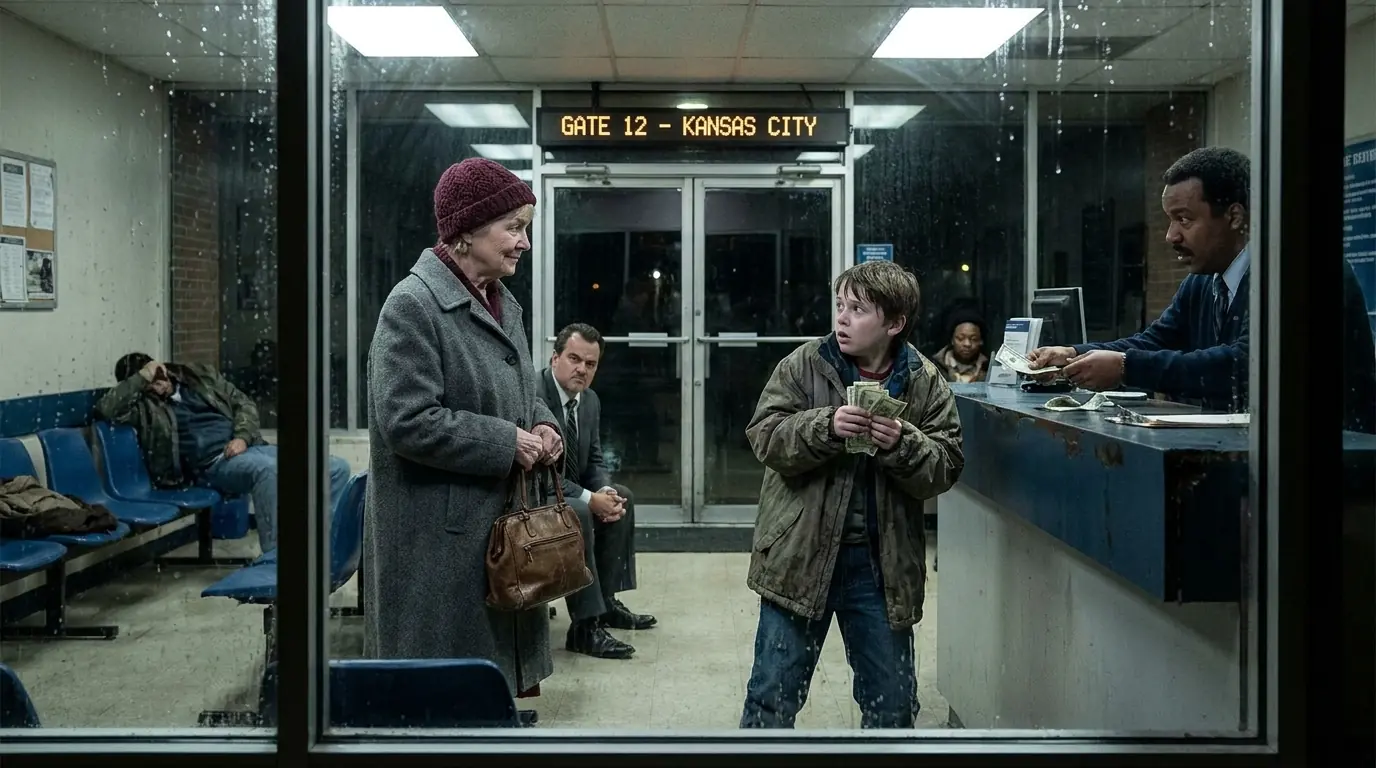
Megan took the paper with trembling fingers. “You’ve already done too much.”
“No,” Dorothy said. “I did what someone should have done sooner.”
At the bus gate, Lucas hugged her suddenly.
Dorothy froze for half a second, then wrapped her arms around him.
“You’re going to be all right,” she whispered.
“Promise?”
Dorothy looked toward Megan, who was watching her son with red eyes and a steadier face.
“I promise you won’t be alone in it.”
That was how Lucas Harper entered Dorothy Miller’s life.
At first, the calls were occasional.
Megan would call with updates. Darren was gone for good. She had changed the locks. A counselor at school was helping Lucas. They had begun attending a grief support group together. Money was still tight, but home was quieter.
Then Lucas started calling on Sundays.
At first, he only wanted to tell Dorothy small things. His math test. A book he read. A dream about his grandmother’s garden. Dorothy listened carefully to every word.
“Sunflowers,” she reminded him one day. “Keep looking for light.”
“That was Grandma’s saying,” he said.
“Then it’s worth keeping.”
Spring came. Dorothy visited Kansas City again for a church event and invited Megan and Lucas to lunch. Lucas had grown a little taller. His hair had been cut. He still looked too serious for his age, but when Dorothy arrived, he smiled.
A real smile.
Over the next year, Dorothy became Grandma Dorothy without anyone officially deciding it.
Lucas sent her school drawings. Megan sent holiday cards. Dorothy mailed homemade cookies, scarves, and used books with notes tucked inside. On Lucas’s thirteenth birthday, she traveled to Kansas City and brought him a wooden box for keeping seeds.
“Seeds?” he asked.
“For the garden you’ll plant one day.”
“I don’t have a yard.”
“Not yet.”
He kept the box anyway.
Years passed.
Lucas grew into a thoughtful teenager with a quiet determination. He became interested in plants, then landscaping, then urban gardens. He volunteered at a community garden in high school and discovered he loved bringing green life into neglected places. He said empty lots reminded him of people who had been forgotten too long.
Dorothy encouraged him.
She sent books about soil, seeds, and landscape design. She saved newspaper clippings about city gardens. She visited when she could, and when travel became harder, Lucas visited her in St. Louis, where she had eventually moved to be closer to her niece.
On one summer visit, when he was sixteen, Lucas helped Dorothy repair the small flower bed outside her apartment building. He planted marigolds, lavender, and three sunflower seeds.
“For Grandma Evelyn,” Dorothy said.
Lucas nodded. “And for you.”
Dorothy pretended to be busy wiping dirt from her hands so he would not see her tears.
Lucas earned a scholarship to study landscape architecture. Megan cried so hard at his graduation that Dorothy had to hand her three tissues and a peppermint.
Before leaving for college, Lucas visited Dorothy.
He was eighteen, tall now, with kind eyes and hands that already looked like they belonged in soil more than classrooms.
“I don’t know how to thank you,” he said.
Dorothy smiled. “By becoming someone who helps things grow.”
He looked at her carefully. “I mean it.”
“So do I.”
He hugged her.
“You bought me a bus ticket,” he whispered.
“No,” Dorothy said softly. “I bought you time until morning.”
College took Lucas into new places, but he never disappeared. He called. He wrote. He sent pictures of gardens he designed and projects he worked on. After graduation, he joined a nonprofit that transformed vacant lots into community gardens and safe play spaces for children.
Dorothy bragged about him to everyone.
At church, at the doctor’s office, at the grocery store, to strangers in elevators.
“My grandson designs gardens,” she would say.
No one corrected her.
As Dorothy grew older, life narrowed.
Her knees worsened. Her eyesight weakened. Her niece moved to Texas after her husband changed jobs. The apartment building Dorothy lived in was sold to a new company that raised rent and ignored repairs. The elevator broke often. The heating system failed twice in winter. The little flower bed Lucas had planted was ripped out by maintenance workers who said it looked messy.
Dorothy cried that day.
Not loudly. Not in front of anyone.
She stood at the window and looked down at the bare dirt where the sunflowers had been.
She did not tell Lucas.
He was busy. His work mattered. She did not want to become one more problem in his life.
But Megan noticed during a phone call.
“You sound tired,” Megan said.
“I am old. Tired comes included.”
“Dorothy.”
The tone was too familiar. It reminded Dorothy of herself.
“I’m fine.”
She was not fine.
That winter, a pipe burst in Dorothy’s apartment. Water soaked the carpet in her bedroom. Management took three days to send someone. Mold appeared along the baseboard. Dorothy began sleeping in the living room recliner.
She mentioned it casually during a Sunday call with Lucas, trying to make it sound small.
There was silence on the line.
“What do you mean you’re sleeping in the recliner?”
“It’s comfortable.”
“Grandma Dorothy.”
She closed her eyes.
No one said her name like that unless they were about to refuse her nonsense.
“It’s temporary,” she said.
“Send me pictures.”
“No.”
“Then I’m coming.”
“You will do no such thing.”
“I’ll be there tomorrow.”
And he was.
Lucas arrived in St. Louis the next afternoon, now twenty-seven, strong and steady, wearing a work jacket, boots, and the expression of a boy who had once learned fear and never forgot how to recognize it.
He walked into Dorothy’s apartment and saw everything immediately.
The damp smell.
The stained carpet.
The broken heater vent.
The bare flower bed outside.
His face tightened.
“Why didn’t you tell me?”
Dorothy tried to smile. “I did tell you.”
“You minimized it.”
“That is an old woman’s right.”
“No,” Lucas said quietly. “Not with me.”
She looked away.
He knelt beside her chair.
“You bought my ticket when I had nowhere safe to go,” he said. “You rode with me when you didn’t have to. You sat beside me while I cried on a porch in front of a house that wasn’t mine anymore. Do not ask me to look away now.”
Dorothy’s eyes filled.
“I didn’t want to burden you.”
Lucas took her hand.
“You taught me that needing help does not make a child a burden. It doesn’t make you one either.”
Within a week, Lucas had spoken to tenant advocates, building inspectors, and city officials. The management company suddenly became much more responsive when legal letters arrived. Dorothy’s damaged apartment was repaired, but Lucas was not satisfied.
“This building is not safe for you long-term,” he said.
“I can’t afford somewhere else.”
“I know.”
His voice carried something she did not understand then.
Three months later, Lucas asked Dorothy to come with him to Kansas City for a weekend.
“I’m too old for surprises,” she said.
“That has never stopped me.”
Megan arrived too, smiling suspiciously. They drove Dorothy to an old neighborhood not far from where Lucas had grown up. The area had changed over the years. Some buildings were renovated. Others still waited for care. They stopped in front of a small yellow house with a screened porch.
Dorothy’s breath caught.
It was Evelyn’s house.
Lucas’s grandmother’s house.
The FOR SALE sign was gone. The porch had been rebuilt. The siding had been painted a soft sunflower yellow. Raised garden beds filled the front yard. Along the fence, young sunflowers lifted their faces toward the sky.
Dorothy stared.
“Lucas,” she whispered.
He helped her out of the car.
Megan was crying already.
“What is this?”
Lucas took a folded document from his jacket.
“A deed.”
Dorothy looked at him, confused.
He smiled through tears. “I bought it last year.”
“You bought your grandmother’s house?”
“Yes. With help. Grants, savings, a community land trust partnership, and too much paperwork. It’s not just a house now.”
He led her up the walkway.
A wooden sign stood near the porch.
THE EVELYN HOUSE
A temporary home and garden space for children and parents in crisis.
Dorothy covered her mouth.
Lucas continued, voice trembling. “Families can stay here short-term when they have nowhere safe to go. There’s a garden program for kids. Counseling partners. Meals. Transportation help. And one room upstairs for visiting elders who need rest, safety, or just a place where someone checks on them.”
Dorothy could not speak.
Lucas placed the deed in her hands.
“The land trust owns the property so it can’t be sold for profit. But the first honorary life deed is in your name.”
“My name?”
He nodded. “Dorothy Miller, founding guardian.”
She shook her head, tears spilling. “No, Lucas. I didn’t do this.”
“Yes, you did.”
“I bought a bus ticket.”
“You bought me a future,” he said.
They stepped inside.
The house smelled of fresh paint, wood, and bread. The living room was bright, with soft chairs, shelves of children’s books, and framed photographs. One showed Evelyn in her garden. Another showed Dorothy and Lucas planting sunflowers outside her apartment years earlier.
In the kitchen, a large table stood beneath a window overlooking the backyard garden. The table was long enough for many people.
Dorothy touched its edge.
Lucas said, “This was where Grandma Evelyn used to make dumplings.”
Megan smiled. “We found one of her old recipe cards tucked behind a cabinet.”
Dorothy laughed through tears.
Upstairs, Lucas showed her a small room with pale curtains, a quilt on the bed, and a vase of fresh sunflowers on the dresser.
“This room is yours whenever you visit,” he said.
“I can’t accept that.”
“You don’t have to accept it. It’s already true.”
She sat on the bed slowly.
For a moment, she was back at Gate 12, watching a frightened boy count bills beneath fluorescent lights. She had thought she was helping him reach a destination.
But really, she had stepped onto the road with him.
That afternoon, the Evelyn House opened with a small gathering. Neighbors came. Social workers came. Families came. Children ran carefully between the garden beds while volunteers served soup and bread.
Lucas stood beside Dorothy on the porch.
“I want to say something,” he told the crowd.
Dorothy groaned softly. “Must everyone give speeches around old women?”
Megan laughed and squeezed her hand.
Lucas looked at the faces gathered in the yard.
“When I was eleven, I stood in a bus station trying to reach a house that no longer had my grandmother inside it. I was grieving, scared, and convinced I had to handle everything alone. A woman I didn’t know bought my ticket, sat beside me, and refused to let me disappear into the night by myself.”
His voice thickened.
“She did not solve every problem that night. But she stayed until morning. Sometimes that is what saves a life. Someone staying until morning.”
Dorothy lowered her head.
Lucas continued, “This house exists because children and parents need safe mornings. They need a door, a meal, a ride, a garden, a place where grief can breathe. My grandmother Evelyn taught me to look for light. Dorothy Miller helped me survive long enough to find it again.”
He turned toward her.
“So today, this house belongs to every family who needs shelter, every child who needs someone to sit beside them, and to the woman who taught me that one ticket can become a road home.”
The crowd applauded.
Dorothy cried openly.
That evening, after everyone left, Dorothy and Lucas sat on the screened porch. The sky glowed soft blue after sunset. The sunflowers moved gently in the yard.
“I don’t deserve my name on anything,” Dorothy said.
Lucas looked at her. “That’s exactly why you do.”
She shook her head. “You became a good man because of your mother. Because of your grandmother. Because of your own heart.”
“And because of you.”
Dorothy looked out at the garden. “I was afraid that night.”
“You were?”
“Of course. I was an old woman traveling alone, and I followed a strange boy onto a bus in the middle of the night.”
Lucas laughed softly.
“But you came anyway,” he said.
“Yes,” Dorothy replied. “Because you looked more afraid than I was.”
They sat quietly for a while.
Then Lucas reached into his pocket and pulled out something small.
It was the original bus ticket.
Old now, faded, preserved inside a clear sleeve.
Dorothy stared. “You kept it?”
“Every day.”
“Why?”
“Because when I thought no one wanted me, this proved someone chose to sit beside me.”
Dorothy’s hand trembled as she touched the sleeve.
Inside the house, Megan was humming in the kitchen. Volunteers were washing dishes. Somewhere upstairs, a child staying with his mother laughed in one of the bedrooms. The garden outside waited for morning.
Dorothy leaned back in her chair, feeling old, tired, and full.
She had thought her life was narrowing to doctor visits, quiet rooms, and memories.
But here, in a house once filled with grief, her small act of kindness had become walls, beds, soup, soil, and sunflowers.
Years later, children staying at the Evelyn House would learn the story of the bus ticket.
They would hear about an old woman who noticed a boy in trouble and refused to let him travel through sorrow alone. Some children would plant sunflower seeds in the yard and write their names on wooden markers. Some parents would cry at the kitchen table because, for once, no one was asking them to explain their exhaustion before offering help.
And whenever Dorothy visited, the children called her Grandma Dot.
She pretended to mind.
She did not mind at all.
On her eighty-fourth birthday, Lucas brought her to the garden behind the house. The sunflowers had grown taller than the fence. Their bright faces turned toward the afternoon light, just as Evelyn had once said they would.
A group of children stood waiting with handmade cards.
One little girl handed Dorothy a folded paper and said, “Thank you for helping make this house.”
Dorothy looked at Lucas.
He smiled.
She opened the card. Inside was a drawing of a bus, a yellow house, and a garden full of flowers.
Beneath it, in careful child handwriting, were the words:
THANK YOU FOR STAYING UNTIL MORNING.
Dorothy pressed the card to her chest.
That night, as Lucas drove her back to St. Louis, she looked out the window at the dark road passing by.
“Lucas,” she said softly.
“Yes?”
“Do you ever think about that night at the station?”
“Every time I see a bus.”
She smiled.
“I thought I was too old to begin anything important.”
Lucas glanced at her. “You began the most important thing in my life.”
Dorothy’s eyes filled, but she kept her gaze on the road.
Outside, the highway lights stretched ahead like a trail.
Long ago, an old woman had bought a frightened boy a ticket because she could not bear to leave him alone. She had not known what would come of it. She had not expected repayment. She had not imagined a house, a garden, a deed, or children calling her Grandma Dot.
She had simply chosen to stay.
And sometimes, that is how the greatest journeys begin.
Not with certainty.
Not with wealth.
Not with strength.
But with one person noticing another at the edge of the night and saying, “You are not riding alone.”