At dawn on the fifth day, one thousand eight hundred motorcycles lined Dorothy Williams’s street like a river of steel and chrome.
Engines rumbled beneath the pale Oklahoma sky, flags snapped in the morning wind, and every neighbor who had once turned away from her stood frozen on their porches, unable to understand how one forgotten old woman had brought an army to their quiet block.
But to understand why they came, you have to go back five days, to the morning Dorothy stood on her crumbling porch with an eviction notice trembling in her hands.
Dorothy Williams was eighty years old, widowed, and tired in the quiet way people become tired after surviving more than anyone knows.
The paper from Riverside Bank said she had exactly five days to leave the house where she had lived for fifty-three years.
Five days to pack five decades of memories, five days to say goodbye to the porch her husband had built with his own hands, five days before the bank claimed the last thing she had left.
Her fingers traced the faded paint on the porch railing. The wood was soft with rot, crumbling under her touch like old bones.
The roof leaked in seven places, and she had counted them all last winter while sleeping in the kitchen because it was the only room warm enough to endure the cold.
Her pension check was only three hundred seventy-two dollars a month, and the mortgage payment of eight hundred forty dollars had become impossible nearly eighteen months earlier.
She had tried everything. She called the bank seventeen times, each call ending with the same cold voice. “Mrs. Williams, we’ve been patient. The foreclosure is final.” She had written letters, begged for extensions, asked about assistance programs, and even offered to pay what little she could. Every answer came back wrapped in professional politeness and final refusal.
Across the street, Patricia Henderson watched from behind her curtains with crossed arms and a satisfied smile. Patricia had started a petition six months earlier called the Dangerous Property Removal Initiative. She claimed Dorothy’s house was an eyesore, that it brought down property values, that the whole neighborhood deserved better than a crumbling porch, peeling paint, and an old woman who could no longer afford repairs.
Thirty-seven neighbors signed that petition without hesitation. Some had known Dorothy for decades. Some had eaten her pies, left their children in her care, borrowed sugar from her kitchen, and waved to her every Christmas when she delivered cookies wrapped in wax paper. But when Patricia brought the clipboard to their doors, almost every one of them signed.
That morning, the sky looked wrong. Dorothy had lived through sixty tornado seasons in Oklahoma, and she recognized the copper-green color pressing against the horizon. The air felt thick and charged, making the skin along her arms prickle. Her old radio crackled from the kitchen with urgent warnings.
“Meteorologists are tracking a severe storm cell. An EF5 tornado is possible. Seek shelter immediately.”
Dorothy looked toward the basement door. The hinges were rusted orange and screamed whenever she pulled them. The wooden stairs were broken, with the third step missing entirely and the fifth cracked down the middle. But the basement was deep and strong, built in 1947 when her husband, Thomas Williams, was still young and broad-shouldered, before war and years took pieces of him he never fully got back.
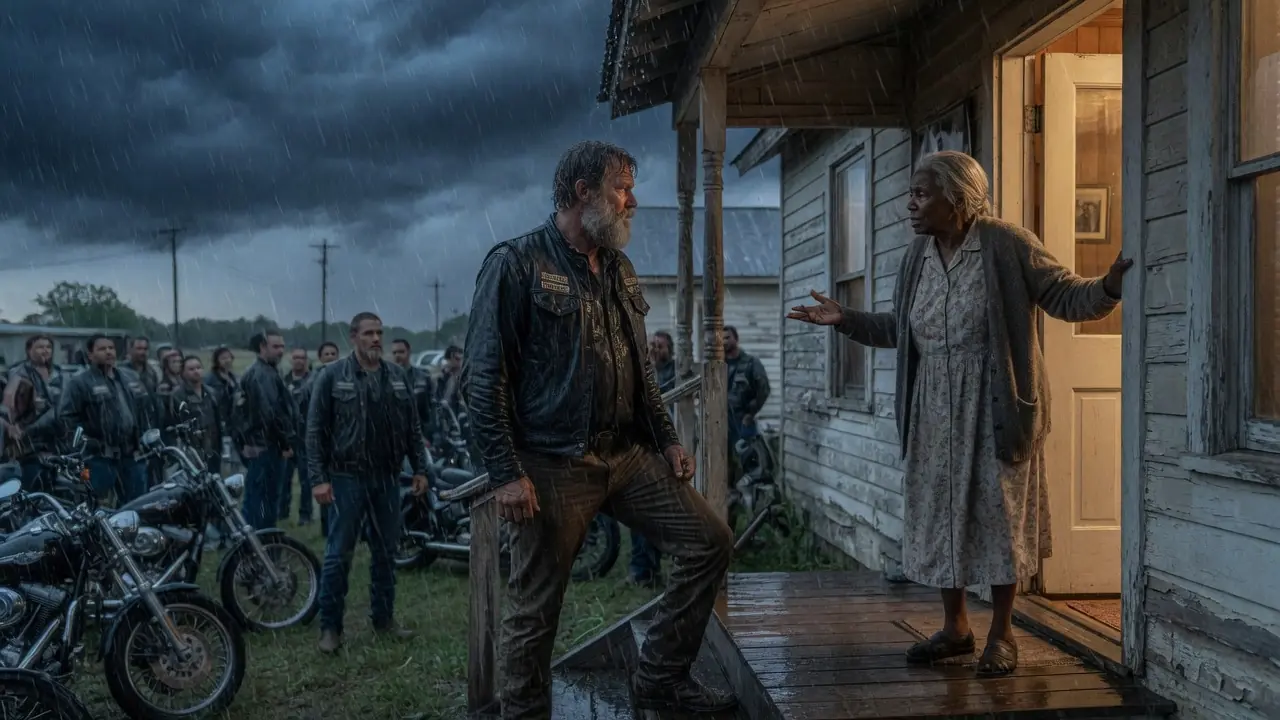
She heard the motorcycles before she saw them. A deep rumble rolled through the street, growing louder with every heartbeat. Twenty-five riders rounded the corner, their engines roaring like caged thunder, their dark leather jackets wet with the first drops of rain. Chains clinked, chrome flashed, and skull patches gleamed across their backs beneath the words Steel Pilgrims.
Patricia Henderson rushed inside and slammed her door so hard the frame shook. Other neighbors pulled curtains closed, locked windows, and disappeared behind walls. One by one, the street emptied as if fear itself had swept across it.
The lead rider stopped directly in front of Dorothy’s house. He was massive, at least six foot four, with arms as thick as porch posts and a gray beard braided with leather cords. Tattoos covered his arms in patterns Dorothy could not read, but his eyes were surprisingly gentle. He removed his helmet and looked up at her porch.
“Ma’am,” he said, his voice softer than his appearance suggested. “We’re caught out here. Storm’s coming fast. Is there anywhere we could shelter?”
Before Dorothy could answer, the tornado sirens began their awful cry. That rising, falling sound meant run, hide, pray. Dorothy did not hesitate. She did not calculate whether these men were dangerous, whether Patricia would judge her, or whether opening her door might bring trouble.
She only saw human beings who needed help.
“Basement,” she said firmly. “Through the kitchen. Stairs are broken. Watch your step on the third and fifth.”
The biker’s eyes widened. “Ma’am, there are twenty-five of us. We can’t all—”
The twenty-five bikers filed through Dorothy’s kitchen like a parade of leather, rain, and heavy boots. Their footsteps thundered across the worn linoleum, filling the little house with the smell of wet jackets, gasoline, and road dust. The leader, Marcus Stone, went last, his huge hand surprisingly gentle on Dorothy’s elbow as he helped her down the broken basement stairs.
The basement had never been meant for twenty-six people. It was built for jars of canned vegetables, Christmas decorations, and emergency supplies Thomas had insisted on keeping. The bikers stood shoulder to shoulder, leather creaking, breathing shallow, their bodies pressed into the cramped space while their motorcycles remained outside under the violent sky.
Through the small basement window, the clouds turned nearly black, swirling like water circling a drain. Marcus lowered himself beside Dorothy and bowed his head respectfully. “I’m Marcus,” he said. “These are my brothers from Steel Pilgrims Motorcycle Club. Ma’am, we can’t thank you enough.”
Dorothy waved one wrinkled hand. “Hush now. Storm’s here.”
The sound started low, like a freight train in the distance. Then it grew louder, heavier, until the whole house began to tremble. Dust rained from the ceiling in thin streams, making the men cough. The single bulb hanging from a wire swung wildly, throwing broken shadows across tattooed faces.
One of the younger bikers, a man who could not have been more than twenty-five, looked absolutely terrified. His hands shook so badly his rings rattled. His breath came in short gasps, and he pressed his back against the wall as if trying to hold the basement together by force.
“Jake,” Marcus called, his voice calm. “Breathe, brother. We’re safe here. Dorothy’s got us.”
Dorothy saw Jake’s shaking hands and made her way through the cramped space. Without a word, she took his tattooed hand in her small, wrinkled one. His hand could have crushed hers, but in that moment, it trembled like a child’s.
“First tornado, sweetheart?” she asked gently.
Jake nodded, unable to speak.
“Close your eyes,” Dorothy told him. “Think about something beautiful. Your mother’s face. A sunrise you saw once. Your favorite song. Anything but this noise. Just breathe with me.”
Above them, the world exploded into violence. Glass shattered. Wood splintered. Metal shrieked as something was twisted loose and carried away. The tornado’s roar became so loud it stopped being sound and became pressure, pressing against their ears and chests until breathing itself felt difficult.
The house groaned overhead. Something massive crashed. Maybe the roof, maybe a wall, maybe the life Dorothy had known for more than half a century. Plaster dust filled the air so thick they could taste it. Dorothy held Jake’s hand tighter and closed her eyes.
She thought of Thomas. She thought of his strong hands building this basement after he came home from Vietnam, still waking from nightmares he never explained. She remembered him telling her that if a storm ever came, this basement would keep her safe. Even after thirty-two years in the grave, Thomas was still keeping his promise.
The tornado lasted four minutes and thirty-seven seconds. It felt like four hours. It felt like an entire life being ripped apart overhead.
When silence finally came, it was absolute. No birds, no wind, no passing cars. Only breathing, heartbeats, and twenty-six people realizing they were alive.
Marcus was first up the stairs. He pushed against the basement door, but it would not open. Three more bikers joined him, shoulders pressed together, muscles straining. On the count of three, they shoved with everything they had.
The door burst open, and debris cascaded down the stairs. Wood, shingles, insulation, and pieces of Dorothy’s life tumbled past them. When they climbed out, what they saw stopped them cold.
Dorothy’s kitchen was gone.
Where her roof had been, there was open sky, blue and innocent above devastation. One wall stood intact, covered in family photographs that had somehow survived. The rest of the house had been scattered across the yard in pieces too small to recognize. Her refrigerator sat embedded in a tree a hundred feet away, the door hanging open. Her kitchen table stood upright in the middle of the street like someone had planted it there.
Marcus helped Dorothy through the wreckage. She stood among the ruins of fifty-three years, silent and still. Her wedding photo, the one where Thomas looked young and proud in uniform, lay crushed beneath a support beam. His Purple Heart, the one he had never liked to discuss but had kept carefully wrapped in cloth, was somewhere beneath mud, glass, and broken boards.
But that was not what made Marcus’s blood run cold.
Across the street, Patricia Henderson stood in her perfect untouched yard. Her colonial house had not lost a single shingle. Not one window was broken. The tornado seemed to have passed it by completely.
Patricia was holding up her phone, filming.
“You let those criminals into the neighborhood,” Patricia called, her voice loud enough for every house to hear. “And look what happened. This is what you get for harboring dangerous people. Those bikers brought this curse on all of us.”
Marcus’s jaw clenched. Behind him, his brothers stirred, muttering with anger. But Dorothy raised one fragile hand.
“It’s all right,” she whispered. “Let her talk.”
It was not all right. Nothing about it was all right.
One by one, doors opened along the street. Neighbors who had known Dorothy for decades stepped onto their porches. The Hendersons, the Martinez family, the Chens, the Johnsons, the Petersons. People Dorothy had fed, helped, comforted, and served in quiet ways too ordinary to be remembered by anyone but her.
Not one crossed the street.
Not one asked if she was hurt.
Not one said, “Dorothy, are you okay?”
A black SUV pulled up, tires crunching over debris. The Riverside Bank logo shone on the door in gold letters. A thin man in a gray suit stepped out carefully, avoiding puddles as if compassion might stain his shoes.
Richard Knowles was the same bank officer who had called Dorothy for eighteen months. His voice on the phone had always been cold and mechanical. In person, he was even worse.
“Mrs. Williams,” he said, barely looking at her. “I’m very sorry about this situation, but the eviction notice stands. Given the extensive damage and safety hazards, we are accelerating the timeline. You have forty-eight hours to vacate the lot. A demolition crew will arrive Monday morning at six o’clock sharp.”
Dorothy swayed. Marcus caught her elbow.
“Sir,” Marcus said, his voice tight with controlled fury, “her house just got destroyed by a tornado. She nearly died. We all nearly died.”
“Which makes the structure a safety hazard and liability issue,” Knowles interrupted. His eyes lingered on the bikers with open disgust. “The bank cannot allow hazardous structures to remain on foreclosed properties. Forty-eight hours, Mrs. Williams. Non-negotiable.”
He climbed back into the SUV and drove away without asking where Dorothy would sleep, whether she was hurt, or whether she had anyone left in the world. Dorothy stood in the wreckage with no home, no possessions, no time, and the entire neighborhood watching.
Marcus Stone looked at her and felt something inside him shift. He had spent twenty years riding across the country, believing he understood honor, brotherhood, and loyalty. But that day, watching an eighty-year-old woman stand in ruin with more dignity than everyone around her combined, he understood something deeper.
“Brothers,” he said quietly.
All twenty-four men turned.
“We need to talk. Now.”
The Steel Pilgrims gathered fifty feet away, voices low. Dorothy could not hear every word, but she saw their faces. She saw Jake wiping his eyes with the back of his hand. She saw an older biker with a gray scar down his cheek nod solemnly. She saw Marcus pull out his phone.
“Yeah,” he said into it. “It’s urgent. She saved twenty-five of our lives. Opened her basement while her own world was ending. House destroyed. Neighbors turned on her. Bank is forcing her out. We need the full brotherhood.”
He hung up and walked back to Dorothy with purpose in every step.
“Ma’am,” he said, “we need to leave now. Emergency crews, storm chasers, media, city inspectors, it’s going to get chaotic. But I promise you, I swear on my father’s grave, we’re not done here. This isn’t over.”
“Son,” Dorothy said softly, “you don’t owe me anything. You needed help. I helped. That’s what people are supposed to do.”
Marcus’s eyes burned with purpose. “Ma’am, you saved twenty-five lives today without hesitation. You’re family now. And Steel Pilgrims protect family. That’s not a courtesy. That’s a blood oath.”
The motorcycles roared to life, shaking the street. Twenty-five bikers rode away through debris and broken branches. Patricia lowered her phone with a satisfied smile, believing the dangerous strangers were finally gone.
She had no idea that two hundred miles away, Marcus Stone was making phone calls that would shake the entire state. She had no idea that word was spreading through motorcycle chapters across the country like fire across dry grass. She had no idea a promise had been made, the kind of promise men like Marcus would rather die than break.
Dorothy spent that night in a Red Cross shelter on Fifth Street. Cot number forty-seven was squeezed between a family of six with crying babies and an elderly man who coughed all night. She had seven dollars and thirty-two cents left from last month’s pension check. Everything she owned in the world fit inside one plastic bag.
A shelter worker named Linda handed her donated toiletries and clothes two sizes too large. “You can stay three days maximum,” Linda said, not unkindly. “After that, we can help you apply for temporary housing programs, but I have to be honest. The wait list is about eight months.”
Eight months.
Dorothy lay on the thin cot, springs pressing into her hip, staring at water-stained ceiling tiles. Fifty-three years of life had been reduced to seven dollars, a donated toothbrush, and a plastic bag of clothes that smelled like someone else’s laundry detergent.
She thought of Thomas building the house board by board after coming home from war. He had laughed the first time the roof leaked and said, “Should’ve hired a real carpenter, Dorothy.” She had wrapped her arms around his waist and answered, “You’re the only carpenter I need.”
Thomas had died thirty-two years earlier, clutching his chest at breakfast. A heart attack took him at fifty-seven, far too young, before the ambulance could arrive. Since then, Dorothy had kept the house because it was the last place on earth that still felt touched by him.
Now even that was gone.
The next morning, Dorothy walked back to the lot, hoping to salvage something. A photograph, a keepsake, her mother’s ring, anything to prove her life had mattered. The demolition notice had already been posted on a metal stake driven into the ground.
Hazardous structure demolition scheduled. 0600 Monday. Stay clear.
Patricia Henderson stood in her spotless yard with three other neighbors, each holding a coffee cup like a badge of judgment.
“Morning, Dorothy,” Patricia called sweetly. “I called the city inspector myself yesterday. I had to. You understand. That pile of wood and nails is dangerous. Children play here. We have standards.”
Dorothy said nothing. She stepped carefully over broken boards and began searching through the ruins.
“Found anything valuable?” Patricia continued. “Though I suppose at your age, memories are worth more than money. Such a shame you wasted your last dollars feeding those bikers instead of paying your mortgage. Choices have consequences, Dorothy.”
The other neighbors laughed.
Dorothy kept looking. Beneath a broken picture frame, her fingers brushed metal. She pulled it free from the mud and froze.
Thomas’s Purple Heart.
The ribbon was dirty, the metal scratched, but it was intact. Dorothy pressed it against her chest, and only then did the tears come. Not because of Patricia’s cruelty. She had learned long ago that small people needed someone beneath them to feel tall.
She cried because she remembered Thomas’s face when he first showed her the medal. He had said it was not for bravery, just for surviving when better men had not.
“You survived too, Thomas,” she whispered. “You survived the war. You built our home. You raised our babies here. You deserved better than this ending.”
Two hundred miles away, Marcus Stone sat inside the Steel Pilgrims clubhouse, surrounded by brothers who had ridden through the night from three neighboring states. The room smelled of coffee, leather, rain, and purpose. Maps covered tables. Phones rang constantly.
By midnight Sunday, six hundred bikers knew Dorothy Williams’s name. By three in the morning, twelve hundred. By dawn Monday, one thousand eight hundred.
And they were coming.
Patricia Henderson was having her morning coffee on the porch when she first heard it. A low rumble in the distance, like thunder rolling over the plains. But the sky was clear. The sun was rising clean and pale, and not a cloud crossed the horizon.
She frowned and set down her cup. Probably cleanup equipment, she thought. The demolition crew would arrive in two hours, and by noon, Dorothy’s eyesore would be gone. Patricia had already called three real estate agents to discuss making an offer on the empty lot.
The rumble grew louder.
Sarah Peterson stepped outside next door with her baby on her hip. “Patricia, do you hear that?”
“Construction equipment,” Patricia said, annoyed by the interruption. “Don’t worry yourself.”
But it did not stop. It built and swelled, rhythmic and alive, like a heartbeat too large for one body. Windows began to rattle. Patricia looked down at her coffee and watched small ripples spread across the surface.
“That is not construction,” Sarah whispered.
Other neighbors emerged. The Martinez family, old Mr. Chen with his cane, the Johnsons, the Yamadas, the Kowalskis. Everyone stepped outside searching for the source of that growing roar.
Then the demolition truck rounded the corner and stopped dead in the middle of the street. The driver stepped out wearing a yellow hard hat, staring ahead with his mouth open.
Patricia followed his gaze.
Two blocks away, the street seemed to disappear behind a wall of dark shapes and chrome. As the wall moved closer, details emerged.
Motorcycles.
Hundreds of them.
No, thousands.
They stretched from curb to curb, building to building, a river of steel and leather flowing toward Dorothy’s ruined lot. Flags snapped from handlebars. American flags, POW/MIA flags, military unit insignia, and Steel Pilgrims banners moved together in the wind. The riders came in perfect formation, not chaotic, not random, but organized with almost military precision.
The sound was overwhelming now, one thousand eight hundred engines turning the street into a living thunderclap. Patricia felt it through her shoes. It shook her legs, her ribs, her porch railing, her carefully constructed certainty.
The lead rider stopped in front of Dorothy’s lot and raised one gloved hand.
In perfect synchronization, one thousand eight hundred engines shut off.
The silence that followed was somehow louder than the roar.
Seventeen families stood frozen in their yards. The lead rider removed his helmet. Marcus Stone looked directly at Patricia Henderson, and her face went pale.
“I’m Marcus Stone,” he said, his voice carrying across the block. “President of Steel Pilgrims, Central Region. We’re here for Dorothy Williams.”
Patricia’s voice came out thin. “She doesn’t live here anymore. You need to leave. I have a restraining order.”
“We know exactly where she is,” Marcus said. “And we know what you did. What all of you did.”
He turned to face the neighborhood. “Five days ago, during the worst tornado in thirty years, Dorothy Williams saved twenty-five of our brothers. She opened her basement while the world came apart. She gave shelter to strangers when everyone else closed their doors.”
His eyes moved across the porches, the windows, the faces that could no longer look away.
“And what did you do? Her neighbors, people she baked for, helped, watched over, and treated like family. You turned your backs. You filmed her suffering. You signed petitions. You accelerated her eviction while she slept in a shelter.”
Patricia wanted to speak, but no words came.
Marcus reached into his jacket and pulled out a faded photograph. “Dorothy’s late husband, Sergeant Thomas Williams, United States Army, saved my father’s life in Vietnam fifty-two years ago. Pulled him from a burning vehicle under fire outside Da Nang. My father spent thirty years searching for Sergeant Williams, trying to say thank you. He never found him.”
He held up the photograph. Even from the porch, Patricia could see two young soldiers, one dragging another away from flames.
“My dad passed away five years ago with that debt unpaid. Yesterday, we found out who Sergeant Williams was. Today, we’re paying it.”
Another biker stepped forward, older, with scars along one cheek. “Ray Morrison, Oklahoma City chapter,” he said. “We have one thousand eight hundred members here right now. More across the country are monitoring this situation. In twenty-six hours, we raised seventy-three thousand dollars. We have licensed contractors, electricians, plumbers, roofers, framers, painters, and supply trucks arriving in less than an hour.”
Jake, the young biker Dorothy had comforted in the basement, stepped forward next. His voice shook with emotion. “We’re rebuilding her house from the foundation up. Better than before. Code compliant, storm resistant, built to last another fifty years. And we’re paying off every cent she owes.”
The demolition foreman approached cautiously, hard hat in his hands. “Listen, I have orders to demolish this structure at six.”
“Cancel them,” Marcus said. “There is nothing to demolish. This property is under new ownership as of eight o’clock this morning. Steel Pilgrims’ legal team bought the mortgage from Riverside Bank. One hundred fourteen thousand dollars, paid in full, signed and filed with the county clerk at dawn. Dorothy Williams owns this land free and clear.”
Patricia stepped off her porch. “You can’t just do that.”
“It’s done,” Ray said, pulling folded papers from his jacket. “Notarized, filed, public record. You can verify it when the clerk’s office opens.”
Mr. Martinez stepped forward, shame written across his face. “Is Dorothy safe?”
Marcus’s expression softened. “She’s safe. She’s on her way here now.”
Sarah Peterson started crying. “I should have helped her,” she whispered. “She watched my kids for free when I lost my job. I signed that petition without even thinking. What did we do?”
One by one, the neighbors’ faces changed. Their righteous certainty dissolved into guilt. The Johnsons looked at the ground. The Chens clutched each other. Even the newer families, people who barely knew Dorothy but had signed Patricia’s petition because everyone else did, looked sick with shame.
Patricia stood alone, watching her victory collapse.
“Why?” she whispered. “Why would you do all this for one old woman? She’s nobody.”
Marcus turned sharply. “Because she did it for us. When the storm came and everyone else saw strangers and danger and reasons to close their doors, she saw human beings who needed help. That is called humanity, Mrs. Henderson. That is called grace. That is what you should have done.”
A white van pulled up behind the motorcycles. The Red Cross logo was painted on the side. Linda climbed out first, then helped Dorothy Williams step onto the curb.
Dorothy wore donated clothes two sizes too large and held a plastic bag in one hand. Inside it were seven dollars and thirty-two cents and Thomas’s Purple Heart. She looked at the motorcycles filling her street, at the bikers standing at attention, at her neighbors frozen in shame, and finally at Marcus.
“Son,” she asked softly, “what have you done?”
Marcus walked toward her slowly, respectfully, as if approaching something sacred. “Ma’am,” he said, “we’re paying a debt. One that is fifty-two years overdue.”
Dorothy blinked in confusion. “I don’t understand. I never met you before that tornado.”
Marcus pulled out the faded photograph and handed it to her. “That’s your husband,” he said. “And that’s my father, James Stone. Highway 1 outside Da Nang. April 1973. Your Thomas saved my dad’s life. He pulled him out while danger was still coming and the vehicle could have gone up any second.”
Dorothy’s fingers trembled over the photograph. Thomas’s face looked impossibly young. Before gray hair, before quiet years, before nightmares he never explained. Back when he was the hero she had only known through letters written in short, careful sentences.
“Thomas never talked about the war,” she whispered. “He said he was only doing his job.”
“He gave my father forty-one more years of life,” Marcus said, his voice breaking. “He gave me a dad who taught me honor, brotherhood, and paying debts no matter how long it takes. Now I finally get to pay that debt to you.”
Dorothy’s legs weakened. Jake and two other bikers caught her gently and helped her into a folding chair. She held the photograph to her chest and wept.
For fifty-three years, she had carried Thomas’s memory alone. She had believed his sacrifices were remembered only by her. Now an entire brotherhood stood in her ruined street because one act of courage had traveled through time and found its way back home.
Ray knelt beside her chair. “We bought the mortgage this morning. The house, the land, everything. It’s yours. No payments. No debt. No bank.”
“But I can’t pay you back,” Dorothy whispered.
“You don’t owe us,” Marcus said firmly. “This is what Thomas Williams earned. This is what you earned when you opened your door. You’re Steel Pilgrims family now, and family doesn’t let family sleep in shelters.”
Then the trucks arrived. Flatbeds loaded with fresh lumber, steel beams, roofing supplies, wiring, plumbing materials, and tools that gleamed in the sun. Licensed contractors climbed out, many wearing Steel Pilgrims patches beneath their work gear. Every one of them had volunteered.
A woman biker stepped forward, her hair tied back, blueprints tucked beneath one arm. “Mrs. Williams, I’m Angela Chen. Licensed architect. Twenty-three years of experience. I drew up plans for your new house based on photographs we collected. Same footprint as Thomas’s original design, but stronger. Reinforced storm shelter, impact-resistant windows, solar panels, safe flooring, and everything up to current code. Would you like to see?”
She unrolled the blueprints on a portable table.
Dorothy stared at the drawings. Thomas’s house, reborn. Familiar, but stronger. Old love wrapped in new protection.
“How long?” she whispered.
“Fourteen days,” Angela said. “Working in eight-hour shifts around the clock. We have more than four hundred volunteers with construction skills taking rotations. Electricians, plumbers, framers, roofers, finish carpenters. All licensed. All insured. All here because you earned it.”
“I don’t deserve this,” Dorothy said.
Marcus knelt before her and took her wrinkled hands in his scarred ones. “Ma’am, you opened your basement door when everyone else closed theirs. You held Jake’s hand when he was terrified. You showed grace when you had every reason to be bitter. If you don’t deserve this, then nobody in this world deserves anything good.”
Patricia Henderson watched from her porch, her certainty collapsing around her. She had spent six months collecting signatures and seven thousand dollars on legal pressure. She had spent months convincing herself she was protecting the neighborhood. Now, in less than thirty hours, the Steel Pilgrims had raised money, bought the mortgage, gathered permits, mobilized volunteers, and brought one thousand eight hundred people to honor a woman Patricia had tried to erase.
Sarah Peterson approached Dorothy first, baby Emma on her hip, tears streaming down her face. “Mrs. Williams, I’m so sorry. You watched my kids when I had nothing. You never asked for anything. And when you needed me, I signed that petition. I betrayed you.”
Dorothy reached up and touched Sarah’s cheek. “We all make mistakes, honey.”
“It isn’t all right,” Sarah sobbed. “I don’t deserve your forgiveness.”
“Maybe not,” Dorothy said gently. “But I’m giving it anyway. Grace isn’t about deserving. It’s about choosing love when anger would be easier.”
One by one, neighbors came forward. The Martinez family brought homemade tamales. The Johnsons brought tools. The Chens brought bottled water for the workers. Old Mr. Chen, eighty-two years old, insisted on helping carry light supplies, saying he owed Dorothy for ten years of borrowed sugar and kind words after his wife died.
Marcus eventually walked to Patricia’s porch. “Mrs. Henderson,” he said calmly, “you can’t stop this. You can call lawyers, file petitions, and make more complaints, but Dorothy Williams is getting her home back.”
“This is intimidation,” Patricia said weakly. “I’ll call the police.”
“We have every permit required,” Marcus answered. “Construction permits, assembly permits, noise permits, all filed and approved. The police have been notified. The mayor’s office sent a letter of support. You have no legal recourse. What you have is a choice. Help or stand alone.”
By noon, the debris was cleared. By three in the afternoon, foundation work had begun. By sunset, the first framing beams rose against the orange sky.
Neighbors who had signed the petition found themselves working beside bikers, hammering, carrying, sorting, and sweating in the hope of earning back what their signatures had cost. Dorothy sat in a folding chair, watching her home rise from ruin like something pulled back from the edge of death.
Jake brought her lemonade every hour. Angela showed her paint samples and tile choices. Marcus sat beside her in silence at sunset, both of them watching a miracle neither could fully explain.
“Your Thomas was a good man,” Marcus said.
“The best man,” Dorothy replied. “He would have liked you very much.”
Marcus smiled faintly. “My father said Sergeant Williams taught him everything about honor in less than a minute.”
“Some lessons only take moments to teach,” Dorothy said. “But lifetimes to understand.”
That night, Dorothy slept in a hotel. Not a shelter. A real hotel with clean sheets, hot water, and a room where no one coughed through the night. She stood beside the bed for a long moment before lying down, unsure how to accept comfort that came without conditions.
The house rose over fourteen days like a promise kept. By day seven, the walls stood strong. By day ten, the roof was finished and windows installed. By day fourteen, the exterior was complete, painted the exact shade of yellow Thomas had chosen fifty-three years earlier. Angela had matched it from an old photograph Dorothy carried in her purse.
Inside, everything was new but familiar. The kitchen had modern appliances Dorothy had only seen in magazines. The bathroom had a walk-in shower and safety rails designed to look like elegant fixtures. The floors were slip resistant but looked like polished hardwood. The storm shelter beneath the house was reinforced with steel and stocked with water, lights, and supplies.
In the living room, Thomas’s restored Purple Heart was displayed in a custom case on the mantel. Above it hung their restored wedding photograph. His reading chair, destroyed in the tornado, had been recreated from old family pictures. The coffee table he had built in their garage one winter had been rebuilt by hand.
It was not just a house. It was memory repaired.
On day fourteen, Marcus called everyone together. One thousand eight hundred bikers, hundreds of volunteers, and seventeen neighborhood families stood in front of Dorothy’s new home.
“My father carried two weights his entire adult life,” Marcus said. “Gratitude for being saved by a stranger, and guilt for never finding that stranger to say thank you. He died still searching for Sergeant Thomas Williams.”
His voice tightened. “I inherited that debt. And when I met Dorothy Williams, when I saw her show kindness under pressure and grace under cruelty, I knew my father had guided me to the right place.”
He looked at Dorothy. “Ma’am, my father can’t thank your husband face to face. But I can thank you. Not only for saving my brothers from that storm, but for showing us what Thomas Williams’s legacy really was. Not medals. Not a house. You. Your grace. Your kindness. That is what survives.”
Dorothy stood slowly and walked to him. She was tiny beside him, this eighty-year-old African American woman and this massive biker with a gray braided beard, yet in that moment, everyone saw them as equals in a bond older than the day they met.
She reached up and held his face in both hands. “Your father and my Thomas are together now,” she said with absolute certainty. “Probably sharing a beer and laughing about all this fuss. And do you know what Thomas would say? He’d say, ‘That Marcus Stone is a good man. His daddy raised him right.’”
Marcus broke down.
This man who had faced danger, grief, and hard miles without flinching wept in Dorothy’s arms. Around them, bikers bowed their heads. Some cried openly. Others stood silent, understanding they had witnessed something greater than charity.
It was honor passing between generations.
The next morning, Dorothy moved home. The sunrise painted the sky gold and pink, the kind of morning Thomas would have loved. The Steel Pilgrims lined both sides of the street in ceremonial formation. Dorothy stood across from the house with Marcus beside her.
“Ready, ma’am?” he asked gently.
Dorothy could only nod.
They walked together up the path. Two weeks earlier, she had owned nothing but donated clothes and a plastic bag. Now she owned her land free and clear, a new storm-resistant home, a trust fund established for her living expenses, erased medical bills, and a family of bikers across the country who had proven they would move mountains for her.
Inside, on the kitchen counter, sat a leather-bound book. Dorothy opened it with trembling hands. There were hundreds of signatures inside, each one with a note.
Welcome home, Dorothy. You’re my hero. — Jake Rodriguez, Dallas Chapter.
Your husband saved lives. So did you. — Angela Chen, Phoenix.
Family forever. You’ll never be alone again. — Ray Morrison, Oklahoma City.
Page after page said the same thing in different words.
You matter.
You are valued.
You are protected.
You are loved.
Dorothy sank into Thomas’s recreated chair and wept, not from grief, but from the overwhelming knowledge that one act of courage Thomas performed decades earlier had rippled through time to find her when she needed it most.
The Steel Pilgrims later established the Dorothy Williams Emergency Fund for elderly people facing eviction, medical crisis, or housing loss. Within one year, it helped ninety-seven people across thirty-two states. Patricia Henderson became one of its largest donors, spending the rest of her retirement trying to earn a redemption she never fully believed she deserved.
The Riverside neighborhood changed too. People who had once shut their curtains began knocking on each other’s doors. Block parties became monthly traditions. Neighbors learned names, histories, needs, and sorrows. When someone’s roof leaked, five families showed up with ladders. When someone was ill, meals appeared before they could ask.
And Dorothy lived again.
She visited Steel Pilgrims chapters across the country, speaking about kindness, community, and what happens when ordinary people choose courage over comfort. Biker children called her Grandma Dorothy. Men with skull patches and leather jackets lined up for her hugs like boys at Sunday school. She found purpose in her eighties that loneliness had almost stolen from her.
When Dorothy Williams passed away peacefully five years later at eighty-five, more than two thousand Steel Pilgrims attended her funeral. They lined the streets for miles, engines silent, helmets held against their chests, honoring her the way warriors honor a queen.
Marcus Stone gave the eulogy. His voice shook, but he did not break.
“Dorothy Williams opened a basement door during a storm,” he said. “But what she really opened was something larger. She reminded us that grace is stronger than judgment, that family can be chosen, and that kindness given freely never truly disappears. It waits. It travels. It returns.”
They buried Dorothy beside Thomas. Her funeral cost nothing because hundreds of people insisted on contributing. Her legacy, though, was beyond price.
The house still stands today, maintained by the Steel Pilgrims as a living symbol. They call it Dorothy’s Place. Young bikers visit to hear the story and learn why their brotherhood exists, not for intimidation, but for protection, loyalty, and service.
Every year on the tornado’s anniversary, motorcycles line that street again. Not always one thousand eight hundred, sometimes more, sometimes fewer, but always enough to remind the neighborhood what happened there. Enough to remind them that an old woman opened her door when everyone else closed theirs.
Thomas Williams saved one man in Vietnam.
Dorothy Williams saved thousands through simple, relentless kindness.
The ripples continue moving through people who never knew their names but feel their impact whenever they choose compassion over convenience. Whenever they open doors instead of closing them. Whenever they remember that honor, love, and grace are the only things strong enough to survive storms, time, and death.
That is what happens when you choose kindness during a storm.
You do not just save people.
You transform the world, one open door at a time.