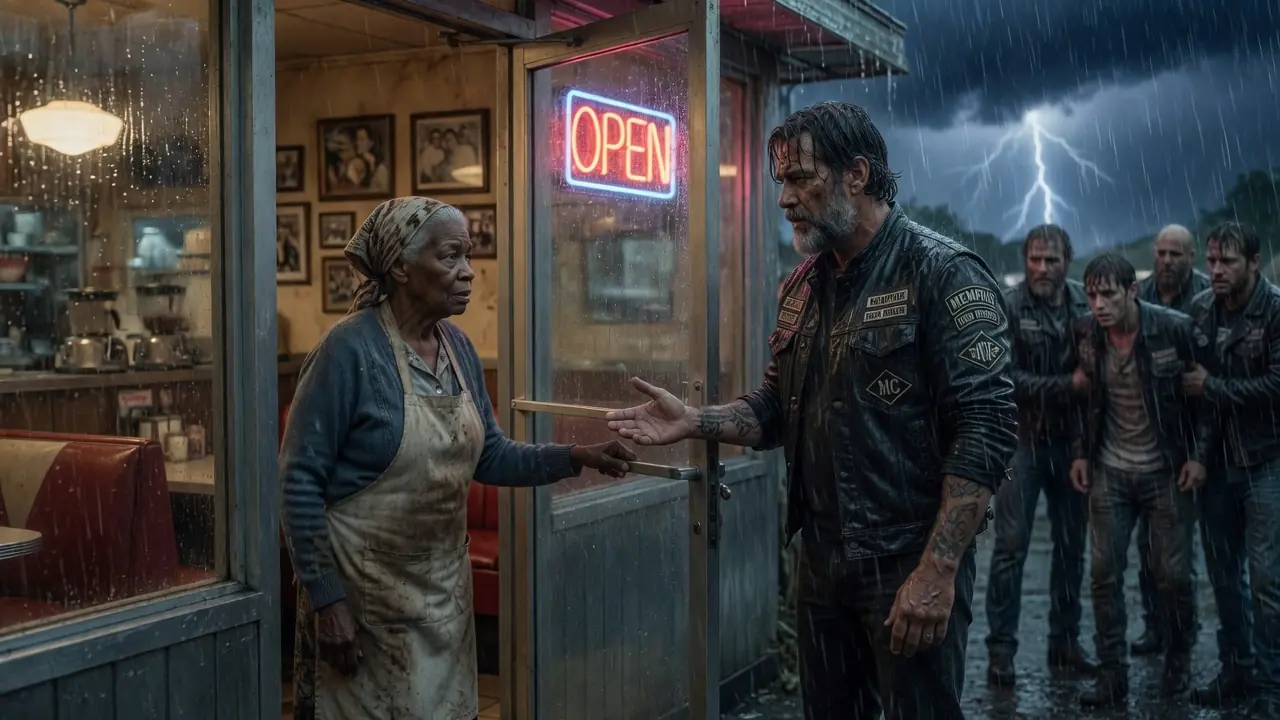
The thunder cracked sharply as nine leather-clad bikers knocked against the rain-streaked glass of Mama Ruth’s Kitchen.
It was midnight in Memphis, and seventy-three-year-old Ruth Washington stood frozen behind her counter, her heart hammering against her ribs.
These were not ordinary travelers caught in a storm.
Skull patches gleamed on wet leather. Beards dripped with rainwater. Tattooed arms told stories Ruth did not want to imagine. Her hand hovered over the phone. Every instinct screamed for her to run. Every warning she had ever heard about motorcycle clubs flooded her mind.
She was alone. Vulnerable. One elderly woman standing in a struggling diner against nine men who looked like they could tear the place apart without trying.
But something in their eyes stopped her cold.
It was not menace she saw through that rain-soaked glass.
It was desperation.
Ruth had no idea that the man with the skull tattoo standing in her doorway was not just any biker. What happened next would transform this struggling grandmother’s life forever.
But to understand what happened that night, you need to know who Ruth Washington really was.
At five in the morning, Memphis was still sleeping, but Ruth’s 1992 Honda coughed to life in the pre-dawn darkness.
She had been making this drive for forty years. Same route. Same determination. Same quiet fear that today might be the day she could not keep going.
Mama Ruth’s Kitchen sat on the corner of Elm and Third, a faded green building that had seen better decades. The paint peeled like old skin. The neon sign flickered the word Open in stuttering pink letters.
Ruth turned the key and stepped into her world.
The smell hit her first.
Bacon grease from yesterday. Coffee that had been brewing in these walls for four decades. Hope mixed with desperation.
This was not just a diner.
It was Ruth’s entire life compressed into nine hundred square feet of checkered linoleum and cracked vinyl booths.
She flipped the lights. Six tables had out-of-order signs on them. Torn seats she could not afford to fix. The coffee machine wheezed like an old man climbing stairs.
Ruth patted its side gently.
“Come on, baby,” she whispered. “Just one more day.”
Her morning routine was a ritual now.
Check the register. One hundred twenty-seven dollars from yesterday. Count the bills on the counter. Rent notice, three months overdue. Electric company warning in red letters. Food supplier demanding payment before the next delivery.
Ruth did the math in her head.
It was the same every morning.
The numbers never added up.
She opened the refrigerator. Half a gallon of milk, two days past expiration. Three eggs. Leftover meatloaf from Sunday.
Ruth had been stretching everything.
Watering down the coffee. Cutting portions smaller. Eating almost nothing herself so customers could have more.
The bell jingled.
Mr. Jenkins shuffled in, counting quarters in his weathered palm. He was eighty-seven years old, and Social Security did not stretch far.
“Morning, Mama Ruth. Coffee and toast.”
Ruth smiled. It was genuine despite everything.
“Coming right up, honey. You want butter on that toast?”
She knew he would say yes. She knew he had exactly seventy-five cents. She knew the coffee and toast should cost one dollar and fifty cents.
She had never charged him full price.
Not once in fifteen years.
“Here you go, sugar.”
She set down the plate. The coffee cup was fuller than it should have been.
“What do I owe you, Mama Ruth?”
“Seventy-five cents is just fine, Mr. Jenkins.”
He dropped the quarters on the counter with shaking fingers. Ruth pretended not to notice the relief in his eyes.
This was who Ruth Washington was.
A woman who gave away what she could not afford to lose.
The breakfast rush, if four people could be called a rush, trickled in.
Maya brought her twins, an eight-year-old boy and girl who did homework at table six while she worked her cleaning job downtown. Ruth slid them each a cookie.
“Fifty cents,” she said, though the cookies cost her twice that to make.
Maya counted out two quarters, looking guilty.
“I get paid Friday, Mama Ruth. I can—”
“Hush now, baby. Those children need their snacks.”
By noon, Ruth had served twelve people, made eighty-three dollars, and spent ninety-five on supplies and utilities.
She was losing money every single day.
But she could not stop.
This diner was not just her business. It was the neighborhood’s heart.
Ruth walked to the trophy case by the window. Samuel’s military commendation gleamed behind dusty glass. Her husband’s Purple Heart. His Bronze Star. His smile in their wedding photo from 1972.
Next to his medals sat a faded photograph she did not often share.
A skinny teenage boy, maybe sixteen, sitting at the counter with tears in his eyes.
On the back, Ruth had written in careful script:
Tommy, 2014. Hope you made it home safe.
Ruth touched the glass gently.
“Samuel,” she whispered, “I don’t know how much longer I can keep this going.”
The diner had been their dream from day one.
Samuel worked construction during the day. Ruth served tables at night. They saved every penny for ten years to buy this place.
“We’re going to feed the whole neighborhood,” Samuel used to say. “Going to be a place where everybody belongs.”
He had been right.
For thirty years, this diner was exactly that.
Birthday parties in the back booth. Job celebrations over coffee and pie. Teenagers with nowhere else to go, getting free meals and life advice. Families struggling through hard times, knowing Ruth would never let them leave hungry.
But the neighborhood changed.
Young families moved to the suburbs. Small businesses closed. New developments rose where familiar storefronts had once stood. The community that sustained Ruth’s Kitchen slowly scattered to the winds.
Could not abandon them.
Mr. Jenkins needed his morning coffee. Maya’s twins needed their after-school cookies. The few customers who still came needed to know this place would be here tomorrow, even if tomorrow looked impossible.
Ruth opened her purse and counted the bills inside.
Forty-three dollars.
Her life savings.
She looked at her wedding ring, the only valuable thing she owned. The gold caught the afternoon light streaming through dirty windows.
“Not yet, Samuel,” she whispered to his photograph. “I’m not giving up on our dream yet.”
But as she closed the register and watched another potential customer walk past without entering, Ruth Washington wondered if dreams were enough to keep the lights on.
The storm warning on her radio crackled to life.
Severe weather approaching Memphis. Take shelter immediately.
Ruth decided to stay open late that night.
In a storm, someone might need a warm place.
Someone might need help.
She had no idea how much help she was about to provide, or how much trouble that kindness would cost her.
The storm warning had not exaggerated.
By nine that night, Memphis looked like it was under attack from the sky. Rain hammered the diner’s windows. Lightning turned everything electric white every few seconds. Thunder shook the building down to its foundation.
Ruth should have closed hours ago.
She should have gone home to her small apartment above the Korean grocery store. She should have been safe and warm in bed.
Instead, she was wiping down tables that did not need wiping, brewing fresh coffee nobody had come to drink, and watching the storm turn her neighborhood into a blur of water and wind.
The weather service kept broadcasting the same warning.
Tornado watch in effect. Flash flood warning. Seek immediate shelter. Do not attempt to travel.
Ruth knew people were out there.
People with nowhere to go.
People who might need help.
She had always been this way. Samuel used to tease her about it.
“Ruth, you’d give shelter to the devil himself if he showed up looking cold and wet.”
Maybe tonight she was about to find out if he had been right.
At eleven-thirty, Ruth was cleaning the grill when she heard it.
A sound that cut through the storm.
Motorcycles.
Not just one.
Multiple engines rumbling in formation despite the chaos outside.
Ruth froze, dish rag in hand, as the sound grew closer.
Through the rain-streaked window, she saw headlights cutting through the storm. The engines grew louder, then stopped suddenly.
For a moment, there was only rain and thunder.
Ruth’s heart started hammering.
She moved toward the window, each step heavy with dread. Her reflection stared back from the dark glass, and behind it, shapes moved through the storm.
Nine motorcycles.
Harley-Davidsons by the look of them. Chrome gleaming even in the dim light.
Nine men in leather climbing off those bikes.
Ruth’s hand found the phone. Her fingers hovered over 911.
Every instinct screamed danger.
Then she saw the patches.
Hell’s Angels.
The words sent ice through her veins.
These were not just bikers. These were the bikers people whispered about, the ones you crossed the street to avoid, the ones who seemed to carry their own rules with them.
But what she saw next stopped her from dialing.
They were not spreading out like men looking for trouble. They were not checking doors or windows. They were clustered around one man, protecting him, shielding him from the rain with their bodies.
Something was wrong.
The lead biker approached the door. He had massive shoulders, a salt-and-pepper beard, and tattooed arms like tree trunks. His leather jacket was soaked through. His face was grim, but his eyes were desperate.
He cupped his hands against the glass and peered inside.
He saw Ruth standing there, dish rag still in her trembling hand.
Their eyes met through storm and glass.
He mouthed something.
Ruth could not hear over the thunder, but she could read his lips.
Please.
The word hit her like a physical blow.
Please.
Not a demand.
Not a threat.
A plea.
Behind him, Ruth could see the other men more clearly now. They were holding someone up, someone injured, someone who needed help.
The lead biker knocked on the glass.
Not pounding.
Not demanding.
Just knocking like any customer might.
“Ma’am,” his voice carried over the storm. “We’re not looking for trouble. We’ve got a man down. Medical emergency.”
Ruth’s mind raced.
This could be a trick. Could be a setup. Could be the worst decision of her life.
But what if it was not?
“Roads are flooded out there,” the biker continued. “Can’t get him to a hospital. He’s hurt bad.”
Ruth looked closer.
The man they were supporting was young, maybe mid-twenties. His face was pale as paper. His jeans were soaked near one thigh, the fabric dark and heavy with rain and injury.
“Please, ma’am. We just need shelter until we can get help.”
Samuel’s voice echoed in Ruth’s memory.
Sometimes angels come disguised as the people we’re most afraid of.
Ruth studied these men through the glass.
They were huge, intimidating, covered in tattoos and leather that screamed danger.
But they were not acting like predators.
They were acting like people in trouble.
The injured man’s head tilted to one side. Ruth could see his lips had gone pale. He was fading fast.
Ruth Washington made the decision that would change everything.
She walked to the door.
Her hand shook as she reached for the deadbolt. The metal felt cold as ice under her fingers. She looked back at Samuel’s photograph one last time.
His smile gave her strength.
“Samuel,” she whispered. “I hope you’re watching over me now.”
The deadbolt clicked open.
The door swung wide.
Rain and wind blasted into the diner like a living thing.
The nine Hell’s Angels stood in the doorway, water streaming from their leather, looking like something out of Ruth’s worst nightmares.
“Bring him in,” Ruth said, stepping back and gesturing toward the nearest booth. “Hurry now.”
What Ruth did not know was that she had just opened her door to a miracle disguised as a nightmare.
By morning, nothing in her life would ever be the same.
The nine Hell’s Angels filed into Ruth’s diner like a scene from a bad dream. Leather dripped rain onto her checkered floor. Boots thudded across the linoleum. The smell of wet leather and motor oil filled the air.
Ruth’s heart pounded so hard she was sure they could hear it.
But what happened next surprised her.
“Thank you, ma’am.”
The lead biker removed his helmet, revealing a weathered face with kind eyes.
“Thank you so much.”
“Yes, ma’am,” another voice said. “We’re grateful.”
“Much obliged, ma’am.”
One by one, they nodded respectfully.
These intimidating men with skull tattoos and chains hanging from their belts were saying ma’am like they were speaking to their grandmothers.
Ruth blinked and refocused.
The injured man needed help.
“Put him right here,” she said, clearing the nearest booth with quick, efficient movements. Years of running a diner had taught her how to handle emergencies. “Careful now.”
They laid the young man down gently. He was conscious, but pale. The wound on his thigh looked deep, and the wet fabric around it made Ruth’s stomach tighten.
“What’s his name?” Ruth asked, grabbing clean towels from behind the counter.
“Tommy,” said the lead biker. “His name’s Tommy.”
Something flickered in Ruth’s mind.
Tommy.
The name felt familiar somehow, but there was no time to think about it.
“What happened to him?”
“The bike slid out on the wet road about five miles back. Hit a guardrail. We got him this far, but…”
Ruth examined the injury. Deep, but not hopeless if treated properly. Samuel had worked construction for years. Ruth had seen enough cuts, breaks, and bad falls to know basic first aid.
“Tommy, honey, can you hear me?”
Her voice was gentle, grandmotherly.
The young man’s eyes fluttered open. Blue eyes, striking even through the haze of pain. He looked at Ruth with confusion, then something that felt almost like recognition.
“Ma’am, I…” His voice was weak. “I’m sorry to bother you.”
“Hush now, baby. You’re not bothering anybody. I’m going to take care of you.”
Ruth turned to the bikers. Her fear was evaporating, replaced by purpose.
“I need you boys to move those tables. Make space. And somebody bring me towels from the kitchen. Clean ones.”
They moved like a trained unit.
No questions.
No hesitation.
Just immediate action.
“Thunder, get the towels. Bear, move those chairs. Captain, I need you to hold his shoulders steady.”
Ruth noticed how they followed orders.
This was not chaos.
This was organization.
“What’s your name, honey?” Ruth asked the lead biker as she cleaned Tommy’s wound.
“They call me Captain, ma’am.”
“Well, Captain, you and your boys did well getting him here. This wound is deep, but he’s going to be all right if we keep him steady.”
Captain watched Ruth work with growing amazement. She was not just helping. She was taking charge.
This elderly woman who had been terrified minutes ago was now commanding nine Hell’s Angels like she had been doing it her whole life.
“Ma’am, we can’t pay you much, but—”
“I don’t want your money,” Ruth said without looking up from Tommy’s leg. “Are you boys hungry?”
The question caught them off guard.
They were used to people staring, avoiding, assuming, judging.
This woman was asking if they were hungry.
“We don’t want to impose,” said a biker with arms like telephone poles.
“Baby, you’re already here with one of your boys lying in my booth. The least I can do is make sure y’all get fed.”
Ruth stood and wiped her hands on a towel.
“I’ve got leftover meatloaf. Some cornbread that’s only a day old. Coffee that’s been sitting too long, but it’s hot.”
She looked around at nine dangerous-looking men who suddenly looked like lost children.
“Now sit yourselves down while I get you something to eat.”
What followed was the strangest dinner service of Ruth’s life.
Nine Hell’s Angels sat in her diner, dripping wet and speaking in quiet voices. They used napkins. They said please and thank you. When one started to put his boots on a chair, another stopped him with just a look.
Ruth served them everything she had.
Meatloaf.
Cornbread.
Green beans.
Coffee.
She did not charge them.
She did not even mention money.
“This is the best meal we’ve had in months,” Captain told her.
“Yeah, right,” Ruth said, waving him off. “Day-old cornbread and leftover meatloaf.”
“No, ma’am. I’m serious. It’s not just the food. It’s…”
He searched for words.
“It’s being treated like human beings.”
Ruth poured him more coffee and studied his face.
Underneath the beard and tattoos, she saw something unexpected.
Pain.
Loneliness.
The look of someone who had been judged too many times.
“What’s your real name, Captain?”
He hesitated.
“Michael, ma’am. Michael Rodriguez.”
“Well, Michael, everybody’s human. Everybody deserves a hot meal and a little kindness.”
As the hours passed, Ruth tended to Tommy, changed his bandages, brought him water, and checked his temperature. The wound was clean, but he had developed a fever.
Around three in the morning, Tommy’s condition worsened.
He was burning up, drifting in and out, his words tangled and confused.
Ruth recognized the signs of infection.
“We need to get him to a hospital,” she announced.
“Roads are still flooded,” Michael said. “Ambulances can’t get through.”
Ruth looked out the window. The storm had lessened, but standing water covered the streets.
“Then we go to the hospital.”
“Ma’am—”
“I said we’re going. I’m not losing this boy on my watch.”
Ruth grabbed her purse and keys.
“Michael, your bike has room for a passenger?”
The bikers exchanged glances.
This seventy-three-year-old grandmother had just volunteered to ride a Harley through floodwater to save someone she had met three hours ago.
“Ma’am, that’s dangerous.”
“Honey, everything worth doing is dangerous.” Ruth put on her coat. “Now let’s go save this boy’s life.”
The ride through Memphis at dawn was something Ruth would never forget.
She sat behind Michael on his Harley, arms wrapped tightly around his leather jacket, holding steady as they navigated flooded streets. Eight other motorcycles escorted them through the storm.
Ruth had never been on a motorcycle before, but she was not scared.
She was focused.
Determined.
This boy needed help, and she was going to make sure he got it.
At Memphis General, Ruth did not leave Tommy’s side.
She held his hand while doctors cleaned and stitched his wound. She stroked his forehead while nurses started an IV. She called him baby and honey like he was her own grandson.
The bikers waited respectfully in the lobby, looking completely out of place among the clean hospital furniture.
When the doctor emerged, Ruth was the first person he addressed.
“Your grandson is going to be fine. Good thing you got him here when you did.”
Ruth did not correct him.
Tonight, Tommy was her grandson.
Tonight, these nine dangerous-looking men were her boys.
Tonight, family was whoever showed up when you needed them most.
As the sun rose over Memphis, painting the sky pink and gold, Tommy was stable and sleeping peacefully.
Ruth Washington had just made the most important decision of her life.
She just did not know it yet.
By seven in the morning, Tommy was stable and resting. The storm had passed, leaving Memphis looking washed and wounded. Broken tree branches littered the streets. Power lines dangled in the distance. But the sun was shining, and Tommy was going to be all right.
That was when Michael approached Ruth in the hospital waiting room.
“Ma’am, we owe you more than we can ever repay.”
Ruth looked up from the magazine she had been pretending to read. These nine men had been nothing but polite and grateful all night. Whatever she had expected from Hell’s Angels, this was not it.
“You don’t owe me anything, honey. I just did what anybody would do.”
Michael reached into his leather jacket.
Ruth tensed for just a second, then relaxed as he pulled out a thick roll of bills.
“This is for you. For the food, for staying with Tommy, for everything.”
Ruth counted quickly.
It had to be two thousand dollars, maybe more.
More money than she had seen in months.
Money that could pay her rent, her electric bill, buy groceries, fix the broken booth seats.
Money that could save her diner.
She pushed it back toward Michael without hesitation.
“I don’t want your money.”
“Ma’am—”
“I said I don’t want it. You keep that for Tommy’s medical bills.”
The other bikers exchanged glances.
They were not used to people refusing money, especially people who clearly needed it.
“Ma’am, you opened your door to us in a storm. You fed us when you didn’t have to. You rode through flooded streets to help our brother.”
“And I’d do it again tomorrow.”
Ruth stood, all five feet two inches of her.
“You were in trouble. I helped. That’s what decent people do.”
Another biker tried.
“At least let us pay for the food.”
“The food was leftovers anyway. It would have gone bad if nobody ate it. The coffee was going to be thrown out at closing time.”
Michael tried a different approach.
“Ma’am, we know you’re struggling. We saw the bills on your counter, the out-of-order signs on your tables. Please let us help.”
Ruth’s spine stiffened. Pride flared in her eyes.
“My business troubles are my business, sugar. Not yours.”
It was Tommy who broke the stalemate.
“Ma’am.”
His voice was weak but clear.
“Can I talk to you for a minute?”
Ruth immediately went to his bedside.
“What do you need, baby?”
Tommy reached up and unclasped a silver chain from around his neck. A simple cross pendant hung from it, worn smooth by years of wear.
“My grandmother gave me this when I was little. She passed away when I was thirteen. She was…”
Tommy’s voice caught.
“She was a lot like you. Always helping people. Always putting others first.”
He pressed the chain into Ruth’s palm.
“I want you to have it.”
Ruth’s eyes filled with tears.
The cross was small and simple, but it felt heavy with love and history.
“Tommy, I can’t take this. This was your grandmother’s.”
“And now it’s yours. She would have liked you a lot.”
Ruth fastened the chain around her neck. The cross settled against her heart, still warm from Tommy’s skin.
Michael pulled out a business card. Plain white, expensive paper, just a phone number embossed in simple letters.
“Ma’am, if you ever need anything, and I mean anything, you call this number.”
Ruth took the card and studied it. The paper felt expensive, the kind successful businesses used.
Strange for a motorcycle club.
“What kind of business are you in, Michael?”
“Oh, we’ve got our hands in a lot of things. Import, export, manufacturing.”
It was a non-answer, but Ruth did not press.
These men had been nothing but respectful. She would give them the same courtesy.
“Well, Michael, you take care of that boy. And you boys ride safe.”
“Yes, ma’am. We will.”
One by one, the bikers approached Ruth. Each removed his helmet and nodded respectfully, like soldiers acknowledging a superior officer.
“Thank you, ma’am.”
“Much obliged.”
“You’re a saint, Mama Ruth.”
They filed out of the hospital, leaving Ruth alone with Tommy for a few more minutes.
“You’ve got good friends,” she told him.
Tommy smiled weakly.
“Yeah. They’re like family. We all look out for each other.”
“Family is important, even when it’s not blood family.”
“Yes, ma’am. That’s something I learned a long time ago.”
There was something in the way he said it, something familiar.
But before Ruth could think about it, the nurse came to check Tommy’s vitals.
Ruth kissed his forehead like she had done for dozens of neighborhood children over the years.
“You heal up good, Tommy. And don’t you go riding in any more storms.”
“Yes, ma’am. Thank you for everything.”
Ruth walked out of Memphis General into the morning sunlight, touching the cross pendant at her throat.
She felt good about what she had done.
Proud, even.
She had no idea that her act of kindness was about to cost her almost everything she had left.
But she also had no idea it was about to give her more than she had ever dreamed possible.
Ruth drove back to her diner Monday morning feeling lighter than she had in months.
She had helped people.
Really helped them.
For once, her kindness had made a difference.
That feeling lasted three hours.
By lunch, the whispers started.
Mrs. Patterson cornered Ruth outside the grocery store.
“Ruth, honey, I saw those motorcycles at your place. You know what kind of people they were, don’t you?”
Ruth shifted her grocery bag, full of generic brands and day-old bread.
“They were people in trouble. Nothing more.”
“But Ruth, they were Hell’s Angels. My Harold says those people are dangerous.”
Ruth walked away, but the damage was already done.
By Tuesday, the breakfast crowd was half its usual size. Mr. Jenkins still came, but Maya did not bring her twins. Construction workers who used to grab lunch looked nervous passing her windows.
Wednesday brought three customers all day.
Ruth sat behind the counter watching potential customers approach, then change their minds and hurry past.
Fragments of street gossip reached her ears.
“Heard she got mixed up with bikers.”
“My wife won’t let me eat there anymore.”
“Something strange going on over there.”
Each whisper cut deeper.
Thursday’s earnings were twenty-eight dollars.
Friday’s were nineteen.
Ruth stared at the nearly empty register, fighting panic.
She could not afford basic supplies now.
But strange things kept happening.
Tuesday afternoon, a flower delivery arrived. Beautiful, expensive flowers with no card, just gratitude written in elegant script.
Ruth studied them suspiciously.
Were they some kind of signal?
Payment for something she had unknowingly agreed to?
Wednesday brought premium coffee beans. No sender information.
The delivery man shrugged when Ruth asked who had sent them.
“Paid online. Sorry, lady.”
Ruth examined the coffee. Expensive stuff. The kind that raised questions she did not want to answer.
Wrong numbers started calling. People asking for Captain or the Memphis location. When Ruth said they had the wrong number, they hung up quickly.
Too quickly.
A sedan appeared regularly across from her diner. Different times, same car. Someone inside took pictures of her building.
Ruth called the number on Michael’s business card.
A professional voicemail answered.
“You’ve reached Rodriguez Enterprises. Please leave a detailed message.”
Rodriguez Enterprises.
What motorcycle club had corporate voicemail?
Friday evening, Ruth sat alone in her empty diner.
The eviction notice had arrived that afternoon.
Fifteen days to pay four thousand eight hundred dollars or lose everything.
Savings account balance: seventy-three dollars.
Ruth touched Tommy’s cross pendant hanging next to Samuel’s wedding ring. Then she pulled out the faded photograph of the teenage boy she had helped years ago.
Something about his eyes reminded her of Tommy from that stormy night.
“Samuel,” she whispered to his photograph, “I think I’m in more trouble than I realized.”
Outside, the sedan drove slowly past one more time.
Two weeks passed since that stormy night.
Two weeks since Ruth opened her door to nine strangers who changed everything.
It was three in the afternoon on what might be her last day of business.
Ruth sat in her empty diner, staring at the eviction notice taped to her front window.
Fifteen days had become zero days.
She had nineteen dollars in the register and a broken heart.
The coffee machine wheezed its last breath that morning. The refrigerator made sounds like a dying animal. Ruth could not afford to fix either one.
She walked through her diner one final time, touching each table, each picture of Samuel.
This place had been her whole world for forty years.
Tomorrow, it would belong to someone else.
Ruth picked up the phone to call her landlord and surrender the keys. Her finger hovered over the numbers.
That was when she heard it.
The rumble of motorcycles.
Ruth’s blood turned cold.
Were they back?
Had her nightmare finally arrived to collect whatever debt she unknowingly owed?
But this was not nine bikes.
This was fifty.
Maybe more.
The sound grew louder, closer, until it shook the windows of her dying diner.
Ruth peered through the glass, and her knees nearly buckled.
A procession of motorcycles stretched down the block, Harleys gleaming in the afternoon sun. Behind them were SUVs, news vans, and dozens of cars. It looked like a small army assembling outside her failing restaurant.
Neighbors emerged from buildings. People pointed and stared. Mrs. Patterson clutched her purse like she was witnessing an invasion.
Ruth’s hands shook as she recognized the lead rider.
Michael.
Captain.
Whatever his real name was.
But now he was not alone.
People in expensive business suits stepped out of the SUVs. Camera crews set up equipment. A woman with a microphone and perfect hair spoke rapidly to a cameraman.
Ruth’s terror spiked.
This was it.
This was where they revealed whatever mistake she had made. Whatever price she had to pay for one night of kindness.
Michael removed his helmet and approached her door. His companions followed, leather and suits mixing in an impossible combination.
Ruth’s hand trembled as she unlocked the door. Every instinct screamed for her to run.
But where would she go?
This was all she had.
This was all she had ever had.
“Mama Ruth,” Michael said, his voice warm despite the crowd surrounding him. “I owe you an explanation for everything that’s happened these past two weeks.”
Ruth stepped back, letting them enter. Her small diner filled with an impossible mix of bikers and businesspeople. Camera crews hovered at the edges.
“Michael, I don’t understand what’s happening.”
Michael smiled gently.
“Ma’am, my name is Michael Rodriguez, and I’m the CEO of Rodriguez Manufacturing, one of the largest motorcycle and automotive parts companies in the country.”
Ruth blinked.
“CEO?”
“Yes, ma’am.”
“But you’re a biker. Hell’s Angels.”
“Yes, ma’am, I am. These men with me were all military veterans who ride together once a month. But we’re also business owners, executives, professionals.”
A man stepped forward, removing his leather jacket to reveal an expensive suit underneath.
“Ma’am, I’m David Parker. I run West Coast Logistics for the company. We’re all successful businessmen who happen to love motorcycles.”
Ruth’s head spun.
“I don’t understand.”
That was when Tommy stepped forward.
But this was not the injured young man from that stormy night. This was someone in a tailored business suit, clean-shaven, looking every inch the successful executive.
Ruth stared at him.
Something familiar.
Something that had been nagging at her for two weeks.
“Ma’am,” Tommy said, his voice steady but emotional. “Do you remember a scared sixteen-year-old boy who used to sleep in your back booth?”
Ruth’s hand flew to her mouth.
The photograph.
The teenager she had helped years ago.
The boy who reminded her of someone.
“Tommy,” she whispered. “Little Tommy who ran away from home.”
“Yes, ma’am. I’m Thomas Rodriguez. This is my father.”
The world tilted sideways.
Ruth grabbed the nearest chair to steady herself.
“But you… you were just a boy. Skinny as a rail. So frightened.”
Michael’s voice broke slightly.
“Ma’am, ten years ago, my son disappeared. For two weeks, I didn’t know if he was alive or gone forever. I hired private investigators. Called people in five states. I thought I’d lost him.”
Ruth looked between father and son.
Pieces clicked together like tumblers in a lock.
“He told me about his daddy,” Ruth whispered. “Said you’d been fighting, that he felt like he wasn’t good enough.”
Thomas stepped closer, tears in his eyes.
“Mama Ruth, you didn’t just feed me those two weeks. You listened to me. You told me running away doesn’t solve problems, it just creates new ones. You made me call home.”
Michael continued, “When Thomas came home, he told me about an angel who ran a diner in Memphis. The kindest woman in the world, he said. I’ve been searching for you ever since.”
Ruth’s knees weakened.
She sat heavily in the nearest booth, overwhelmed.
“These past two weeks,” Michael explained, “we weren’t spying on you. We were confirming you were the same person. Every act of kindness we witnessed proved what Thomas always said about you.”
“The flowers,” Ruth said, her voice small. “The coffee.”
“We were trying to honor you,” Thomas said. “But we see now that our secrecy caused you pain. We heard about customers staying away, about your financial troubles.”
Ruth looked around at the cameras, the suited executives, the impossible scene in her dying diner.
“I lost everything,” she whispered. “I lost my customers, my income. I was just trying to help, and I…”
Michael turned to one of his companions.
“Call the landlord immediately. Pay the back rent in full. Call the utility company. Clear all outstanding balances.”
He turned back to Ruth.
“Ma’am, we caused this damage. We’re going to fix it.”
“But more than that,” Thomas said, pulling out his phone to show Ruth photos, “graduation, wedding, children. Every good thing in my life traces back to those two weeks you cared for a stranger’s son.”
Ruth stared at the photos.
The scared teenager she once helped was now a successful businessman with a family of his own.
“I just… I never knew.”
“And that’s exactly why,” Michael said. “We want you to be our partner in something bigger than any of us imagined.”
Ruth sat in stunned silence, watching this impossible scene unfold in her dying diner.
Successful businessmen in leather jackets.
Camera crews capturing every moment.
Her world turned completely upside down.
Michael opened a tablet and placed it in front of her.
“Mama Ruth, I want to show you something.”
The screen displayed architectural renderings, beautiful detailed drawings of what looked like her diner, but transformed. Expanded. Gleaming with new equipment, while keeping every detail she loved.
“This is what we want to do with Mama Ruth’s Kitchen,” Michael explained. “A complete renovation and expansion, but keeping the soul of what you built here.”
Ruth stared at the images.
Her cramped little diner reimagined as something magnificent.
Sixty seats instead of twenty-four. A modern kitchen. New floors. New equipment.
But Samuel’s photo wall was preserved exactly as it was.
“I don’t understand.”
Thomas leaned forward.
“Mama Ruth, we want to make you the flagship location for a new restaurant concept. Mama’s Kitchens. Authentic, community-centered restaurants that serve as safe havens, just like this place was for me.”
David Parker opened a folder thick with documents.
“Let me explain the financial details. Full renovation of your current location, two hundred thousand dollars. New equipment throughout, another one hundred fifty thousand. We pay off all your back rent and outstanding bills immediately.”
Ruth’s head spun.
Those numbers were more money than she had seen in her entire life.
“Plus,” David continued, “a fifty-thousand-dollar operating budget to get you started fresh. New inventory, new supplies, money to hire proper staff.”
Michael took over.
“But here’s the real opportunity, ma’am. You wouldn’t be our employee. You’d be our founding partner. You’d own this location outright, plus receive a percentage of profits from every other Mama’s Kitchen that opens.”
“Within five years,” Thomas added, “we project you could be earning six figures annually. But more important than the money, you’d be helping create a network of safe havens across the country.”
Ruth touched Samuel’s photograph on the wall.
“I can’t. This is too much. I’m just a woman who runs a little diner.”
“No, ma’am,” Michael said firmly. “You’re a woman who saved my son’s life twice. Once when he was a scared teenager with nowhere to go. Again when he was hurt in a storm. That’s not just kindness. That’s the foundation of everything we want to build.”
David spread out more documents.
“The support system is comprehensive. Professional marketing team, supply chain management, staff training programs, ongoing business consultation. You focus on what you do best, caring for people. We handle everything else.”
Ruth examined the papers, overwhelmed by the professional presentation: contracts, projections, timelines.
It felt like something from another world.
“The community impact,” Thomas explained, “extends far beyond the restaurant. We hire locally, partner with schools for job training programs, create scholarship funds for teenagers who need second chances, just like the one you gave me.”
Thomas’s voice cracked slightly.
Michael pointed to another rendering.
“This diner becomes an anchor for neighborhood revitalization. Property values may rise, but we’ll advocate for programs that help longtime residents stay. Everybody benefits.”
Ruth looked around her empty diner, then back at the beautiful renderings.
“What if I change things too much? What if I lose what makes this place special?”
“That’s exactly why we want you,” Michael reassured her. “We don’t want to change what you do, Mama Ruth. We want to help you do it better for more people who need it.”
David outlined the timeline.
“Six months for complete renovation. During that time, you’d operate from a temporary location. We provide full salary and benefits throughout. You don’t lose a day of income.”
“Your regular customers,” Thomas added, “Mr. Jenkins, Maya, and her twins. They’d know exactly where to find you. This community doesn’t lose its gathering place.”
Ruth thought of Mr. Jenkins counting his quarters every morning. Of Maya stretching every dollar to feed her children. Of all the people over the years who needed a place where somebody cared about them.
“There’s more,” Michael continued. “Part of this partnership includes training other franchise owners. You’d teach them your philosophy of hospitality, how to see people the way you saw Thomas, not as problems, but as people who need help.”
“You’d be traveling to new locations,” David explained, “learning from the best community-centered restaurants in the country. But you’d be teaching them, too, about real hospitality.”
Ruth examined the legal documents.
“I keep creative control over the menu? The atmosphere?”
“Complete creative control,” Michael confirmed. “You have veto power over any major decisions. This is your place, your vision. We just help you share it with the world.”
Thomas showed Ruth his phone again. Photos of his children smiled back at her.
“Mama Ruth, these are your grandchildren, too. Every person your kindness touches becomes family. That’s what you taught me.”
Ruth looked at the photos, then at Samuel’s picture on the wall.
“He always said this place could be more than just a diner. Said it could be a beacon for people who need hope.”
“He was right,” Michael said quietly. “And you proved it every single day.”
Ruth studied the contracts, the renderings, the faces of these people who wanted to honor her simple act of kindness from ten years ago.
“I need to think about this. It’s overwhelming.”
“Of course.”
Michael stood.
“Take all the time you need. But know that we’re committed to this vision, and we believe you’re the only person who can lead it.”
Thomas approached Ruth and took her hands gently.
“Mama Ruth, your kindness brought me home. It gave my father back his son. Let us help save the place that saved me.”
Ruth looked around her struggling diner one more time, then at the architectural drawings of what it could become.
“Samuel,” she whispered to his photograph. “What do you think about all this?”
The answer, she realized, was written in the faces of everyone around her.
People whose lives were touched by simple kindness, now wanting to multiply that kindness across the world.
Ruth said yes, but not immediately.
She spent three days praying over the decision.
When she finally shook Michael’s hand, the transformation began.
Three months later, construction crews arrived.
Ruth watched her diner stripped down, every important detail preserved. Samuel’s photo wall received special treatment, stored safely until the renovation was complete.
Local news picked up the story fast.
From Storm Shelter to Business Empire: How One Woman’s Kindness Created a Franchise.
Ruth gave interviews from the temporary food truck Michael had provided.
“I just helped people who needed help,” she told reporters. “That’s what you’re supposed to do.”
The story spread.
Social media exploded with stories about Mama Ruth’s kindness. Suddenly, everyone wanted to know about the grandmother who turned compassion into a growing business.
The neighborhood buzzed.
Maya brought her twins to watch construction daily. Mr. Jenkins set up a sidewalk chair and provided commentary.
“Mama Ruth deserves every bit of this,” he told everyone.
Ruth traveled during renovation.
She visited successful community restaurants across the country. An Atlanta soul food place employing people who needed second chances. A Detroit diner training at-risk youth. A Phoenix café serving as a community center.
Each visit confirmed what she had always known.
People needed dignity, not just food.
They needed somewhere to belong.
Reopening day arrived six months later.
The new Mama Ruth’s Kitchen was magnificent.
Sixty seats in cozy clusters. A gleaming open kitchen. Samuel’s photo wall in a place of honor, surrounded by pictures of lives Ruth had touched.
But the important things had not changed.
Coffee flowed freely.
Portions were generous.
Nobody left hungry.
The grand opening drew lines around the block. The mayor cut the ribbon. Michael and Thomas stood proudly beside Ruth as cameras flashed.
The real test came the next morning.
Six o’clock sharp.
Mr. Jenkins entered, counted quarters on the shiny counter, and ordered coffee and toast.
Ruth smiled, poured coffee into his same chipped mug, and charged him seventy-five cents.
Some things never change.
Some things should not.
Within weeks, the impact spread beyond the restaurant.
A bookstore opened next door, run by a retired teacher. A small grocery store followed, offering affordable produce. An after-school program started nearby.
Property values rose, but Ruth advocated fiercely for affordable housing.
She would not let success push out the loyal neighbors who had stayed.
Franchise expansion happened fast.
First, Mama’s Kitchen opened in Atlanta, run by a retired social worker named Grace, who had once been homeless herself. She understood needing shelter and kindness.
Detroit followed, where former autoworker Marcus created training programs for foster youth.
Phoenix opened after that, run by a grandmother whose grandson had been saved by community programs.
Each location became what Michael had promised: a community anchor, a place where everyone belonged.
Ruth now drove a reliable Honda. She lived in a renovated apartment above the diner. She had steady income, which allowed her to be even more generous.
But real success was not measured in dollars.
It was measured in teenagers learning job skills and life lessons.
Families knowing they had a safe harbor.
Communities growing stronger because one woman opened her door during a storm.
Monthly motorcycle meetings continued, but they were different now.
Michael’s executive riders shared tables with neighborhood families. Leather jackets mixed with school uniforms. Business deals were discussed over Ruth’s meatloaf.
Ruth received awards from the mayor, the governor, and even Congress. She insisted Michael and Thomas share every honor.
“This wasn’t my success,” she told reporters. “This is what happens when good people work together.”
Documentary crews arrived. Hollywood producers wanted her story. Ruth declined most offers, agreeing to only one film about second chances, with proceeds funding runaway youth programs.
Six new locations opened within two years.
Each owner embodied Ruth’s values.
Each became a neighborhood heartbeat.
The employment program graduated fifty teenagers. The emergency shelter fund helped thirty families through crisis. The scholarship program sent twelve young people to college.
The network grew, but the mission stayed pure.
Feed people.
Treat them with dignity.
Offer second chances.
Ruth visited each location, training owners in her philosophy.
“See people as somebody’s child who needs help,” she always said.
Corporate executives in leather jackets rode between locations, ensuring quality but never forgetting the mission.
Business success was measured in lives changed, not just profits earned.
A national magazine featured Ruth on the cover.
The Grandmother Who Proved Kindness Pays.
Ruth framed the magazine but kept it in the back office.
The front wall stayed reserved for Samuel’s photo and pictures of people she had helped.
Every interview ended the same way.
Ruth touched Tommy’s cross pendant, joined now by a small gold motorcycle pin from the Atlanta owner.
“Kindness isn’t charity,” Ruth always said. “Kindness is investment. You put love into the world, and the world gives it back tenfold.”
One year later, the weather service issued another severe storm warning for Memphis.
Rain pounded the city. Lightning split the sky. Thunder shook buildings.
But this time, Ruth was not alone.
As the storm intensified, headlights cut through the darkness. Cars splashed through flooded streets. Families hurried toward the warm glow of Mama Ruth’s Kitchen.
The diner filled quickly.
Maya and her twins claimed their usual booth. Mr. Jenkins settled at the counter. A young mother with toddlers shook rain from her coat. An elderly couple helped each other to a corner table.
This was what Ruth’s diner had become.
The neighborhood’s unofficial emergency shelter.
The place everyone knew meant safety, warmth, and acceptance.
Ruth moved between tables, serving hot coffee and comfort. Her hair was grayer now, but her smile was brighter.
This was her element.
Taking care of people who needed care.
“More coffee, honey?” she asked the young mother.
“I can’t really pay right now,” the woman admitted quietly.
Ruth filled the cup anyway.
“Storm nights are on the house, baby. Nobody goes hungry when the weather’s bad.”
Ruth touched the cross pendant at her throat. Tommy’s gift, worn smooth by constant wear. Next to it hung the small gold motorcycle pin from Grace in Atlanta and a tiny silver diner from Marcus in Detroit.
Each pendant represented a life touched, a community transformed.
The door chimed.
Michael and Thomas entered, shaking rain from expensive coats. They visited Memphis regularly, checking on their most important investment.
Tonight, they were not there for business.
They were there because this was where the Rodriguez family came during storms.
“Mama Ruth,” Thomas called out. “Got room for two more refugees?”
Ruth grinned.
“Always got room for family, baby.”
Michael and Thomas joined the eclectic mix. CEO and son sharing space with construction workers and single mothers, leather jackets hanging next to school backpacks.
Ruth brought them coffee and settled beside them.
For a moment, she rested.
“You know what I was thinking about?” she said, looking around. “That first storm night, when y’all showed up looking like my worst nightmare.”
Thomas laughed.
“We probably did look scary.”
“Scared me half to death,” Ruth admitted. “But Samuel always said angels come disguised as the people we’re most afraid of.”
She gestured at the full diner. Young and old, rich and poor, all finding shelter together.
“Look what grew from one night of being scared, but doing right anyway.”
Michael followed her gaze.
“This is what success looks like, Mama Ruth. Not buildings or money. This.”
Then the door opened again.
A teenage girl entered, soaking wet and clearly running from more than just the storm.
Ruth recognized the look.
The same desperation Thomas had carried years ago.
Without hesitation, Ruth approached the girl.
“Come on, honey. Let’s get you dried off and fed. Whatever’s chasing you can wait until the storm passes.”
As Ruth guided another lost child to safety, Thomas whispered to his father, “Some things never change.”
“Thank God for that,” Michael replied.
Ruth Washington’s story became a reminder of a simple truth.
The smallest acts of kindness can create the biggest changes.
A meal offered to a scared teenager became a thriving business empire. A door opened during a storm became a doorway to transformed lives. One grandmother’s courage to help strangers became a network of safe havens across America.
Every day, people cross our paths needing help.
The lost teenager.
The struggling neighbor.
The stranger in crisis.
Ruth saw past her fear and recognized someone’s child who needed care.
You do not need wealth or power to change a life.
Sometimes all it takes is treating someone with dignity when they are at their lowest point.
Your kindness today might be someone’s turning point tomorrow.
Ruth proved that love multiplies when we give it away freely. Ordinary people can create extraordinary change through simple human decency.
And on storm nights in Memphis, when the rain beat against the windows and strangers came through the door soaked, frightened, and unsure where to turn, Mama Ruth’s Kitchen still glowed like a promise.
Inside, coffee was hot.
Food was waiting.
And Ruth Washington, wearing a small silver cross against her heart, was always ready to say the words that had changed everything.
“Come on in, baby. You’re safe here.”