In a small wooden house in the suburbs, an old woman sat quietly by the fireplace when a sudden, insistent knocking startled her awake.
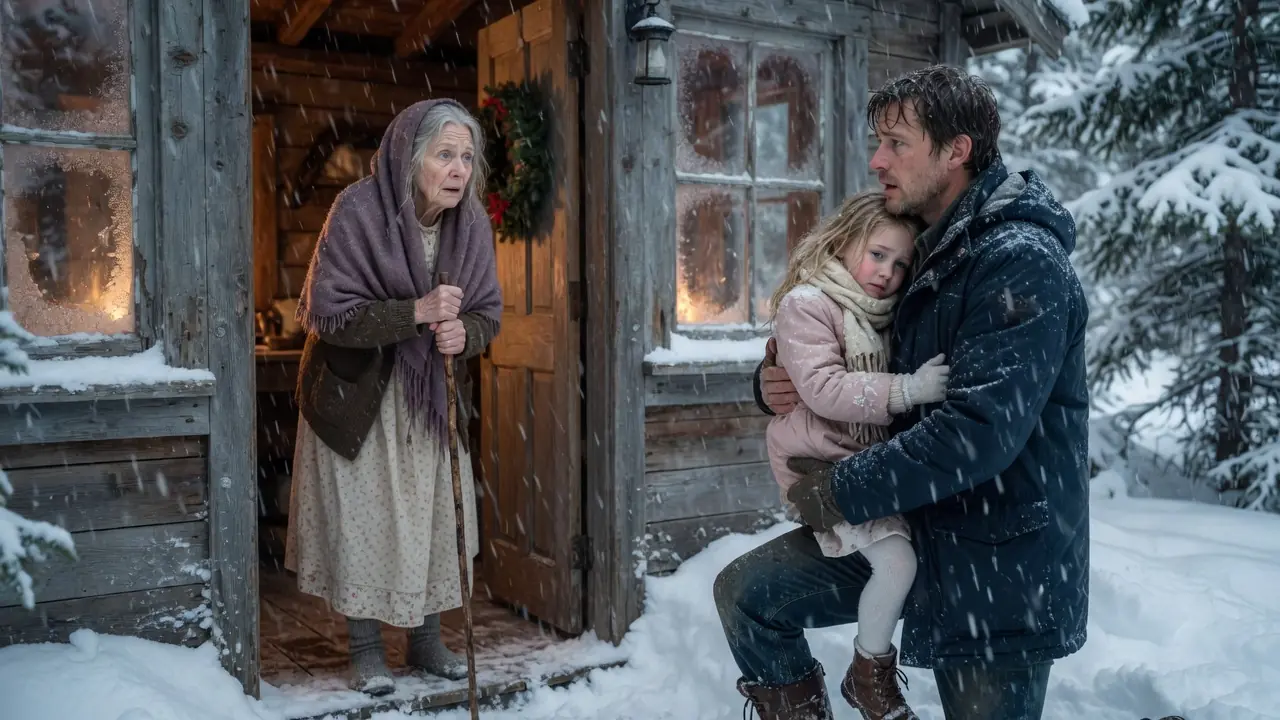
She went to the window and saw a snow-covered man clutching his frail eight-year-old daughter, pleading for help.
Memories of the blizzard three years earlier filled her with fear of strangers.
But despite her trembling hesitation, she decided to open the door.
She let them in, led them to warm themselves by the fireplace, and offered them a cup of hot tea.
What she didn’t know was that the man she had just helped was a billionaire, and this simple act of kindness would change her life forever.
The wind howled like a wounded animal across Silver Pine Ridge, rattling the windows of Eleanor Price’s cabin with such force she thought the glass might shatter.
She pulled her shawl tighter around her shoulders and edged closer to the fireplace, the only source of light now that the power had gone out an hour ago.
The flames cast dancing shadows across the worn wooden walls, and she could see her breath misting in the air despite the fire’s warmth.
Seventy-two years on this earth, and Eleanor had seen plenty of Colorado winters.
But this one felt different.
Meaner.
The kind of storm that buried everything under feet of snow and didn’t apologize for it.
She flexed her fingers slowly, wincing as the arthritis sent sharp pains through her knuckles.
The cold always made it worse.
On nights like this, she could barely hold a coffee cup, let alone do anything useful.
She thought of Harold, how he used to massage her hands on winter evenings, his strong fingers working the stiffness out of hers.
That was before the stroke took him six years ago.
Before she learned what it meant to be truly alone.
The cabin creaked and groaned under the wind’s assault.
Eleanor reached for another log to add to the fire when suddenly, a sound cut through the storm’s roar.
Bang.
Bang.
Someone was pounding on her front door.
Eleanor froze, the log halfway to the flames.
Her heart began to race, each beat painful against her ribs.
Bang.
Bang.
Bang.
The pounding came again, more desperate this time.
Then a man’s voice, muffled but frantic, shouted against the wind.
“Please, help us. My daughter, she’s freezing.”
Eleanor’s hands began to shake, and it wasn’t from the arthritis.
She set the log down carefully and stood, gripping the arm of her chair for support.
Her mind was already racing backward, pulled against her will to that night three years ago.
It had been winter then, too.
Not as cold, but dark.
A young man had stood at her door, maybe thirty, with a friendly smile and apologetic eyes.
His car had broken down, he had said.
Could he just use her phone?
Maybe warm up for a minute?
Eleanor had been lonely then.
Harold had been gone three years at that point, and she had welcomed the company, even from a stranger.
She had opened the door wide, invited him in, and put the kettle on for tea.
He had waited until her back was turned.
Then she felt the cold press of a knife blade against her throat and heard his voice, no longer friendly, telling her not to scream.
He had taken everything.
The cash she kept in the kitchen drawer.
Harold’s watch.
Her grandmother’s silver candlesticks.
Even the wedding ring she had slipped off to wash dishes, sitting by the sink.
The police had been kind but useless.
No fingerprints.
No witnesses.
No leads.
The man had vanished into the night, and Eleanor had been left with empty drawers and a heart full of fear.
She had sworn then, sitting in this very cabin with the locksmith changing all her locks, that she would never open her door to a stranger again.
Never.
Bang.
Bang.
“Please, anyone. She’s not breathing right.”
Eleanor’s legs carried her toward the door before her mind could stop them.
She pressed her face close to the small window, peering through the frost that had built up on the glass.
The candles behind her provided just enough light to see.
A man stood on her porch, covered in snow, his coat soaked through.
In his arms, he held a small child, maybe seven or eight years old.
The girl’s face was flushed red, her head lolling against the man’s chest.
Even from where Eleanor stood, she could see the child shivering violently.
Eleanor’s hand moved to the lock, then stopped.
Her whole body trembled.
The memories crashed over her.
The knife.
The theft.
The weeks of nightmares afterward.
The way she jumped at every sound for months.
But the child.
That little girl in the man’s arms.
“No,” Eleanor whispered to herself. “No, I can’t. What if it’s a trick? What if there’s someone else waiting? What if...”
The girl coughed, a wet, rattling sound that Eleanor could hear even through the door and the storm.
The man pressed his daughter closer to his chest, trying to shield her from the wind.
Eleanor closed her eyes.
She saw Harold’s face, the way he had looked at her on their wedding day.
She heard his voice, gentle but firm.
“Ellie, you’ve got the biggest heart of anyone I know. Don’t ever let the world make you lose that.”
But Harold had never been robbed at knifepoint.
Harold had never known what it felt like to have everything stolen, to feel violated in your own home.
The girl coughed again, weaker this time.
Eleanor’s hand shook as it gripped the deadbolt.
Everything in her screamed to leave the door locked, to call out that she couldn’t help, to wait until morning when surely someone else would find them.
But morning might be too late.
With a sound that was half sob, half prayer, Eleanor threw the deadbolt and yanked the door open.
The wind immediately tried to rip the door from her arthritic grip, and snow blew into the cabin.
The man nearly fell forward, catching himself at the last second.
“Thank God,” he gasped. “Thank God. Thank you.”
“Please, get inside,” Eleanor said, her voice harder than she intended.
She stepped back, clutching a walking stick she had grabbed from beside the door.
Not much of a weapon, but better than nothing.
Quickly, the man stumbled inside, the girl still clutched in his arms.
Eleanor slammed the door shut against the wind and threw the bolt home with shaking fingers.
For a moment, the only sounds were their heavy breathing and the crackling of the fire.
Eleanor backed up several steps, the walking stick held firmly in front of her.
The man stood just inside the door, dripping melted snow onto her floor, his arms wrapped protectively around his daughter.
Now that they were in the light, Eleanor could see them more clearly.
The man was in his mid-thirties, with dark hair plastered to his head and exhaustion written in every line of his face.
His clothes, though soaked, looked well-made.
The girl wore a pink winter coat that was far too thin for this weather, and her blonde hair hung in wet tangles around her fever-flushed face.
“Thank you,” the man said again, his voice cracking. “I’m Michael. Michael Grant. This is my daughter, Lily. We were driving to Glenwood Springs when the storm hit. The car went off the road about two miles back. I tried to wait it out, but Lily, she’s been sick for two days, and it was just getting worse, and...”
“Stop,” Eleanor interrupted, her voice sharp.
She tightened her grip on the stick.
“Don’t move from that spot. Don’t touch anything.”
Michael’s eyes widened, but he nodded.
“Okay. Okay. We won’t. I promise. We just need to get warm. Please.”
Lily stirred in his arms and let out a weak whimper.
“Daddy, I’m cold.”
“I know, sweetheart. I know. We’re inside now. You’re going to be okay.”
Eleanor’s heart twisted at the girl’s voice, but she kept her distance.
“Put her down by the fire, slowly. Then sit in that chair.”
She pointed to the armchair farthest from the door, farthest from her bedroom, farthest from anything valuable.
“Don’t get up unless I say you can.”
“Yes, ma’am,” Michael said quietly.
He knelt by the fireplace and gently set Lily down on the rug.
The girl curled into a ball immediately, shivering so hard her teeth chattered.
Michael moved to the chair Eleanor had indicated and sat, his hands visible on his knees.
“We won’t cause any trouble, I swear. We’ll leave as soon as the storm passes.”
Eleanor didn’t answer.
She kept the walking stick in one hand and backed toward the hallway closet.
Without taking her eyes off Michael, she fumbled behind her for the door handle, opened it, and pulled out two old blankets.
She tossed them toward the fire.
“Wrap her up,” she ordered. “Get those wet clothes off her first.”
Michael moved quickly but carefully, always aware that Eleanor was watching his every move.
He helped Lily out of her soaked coat and wrapped her in both blankets.
The girl’s shivers didn’t stop, but they became less violent.
Eleanor watched as Michael tucked the blankets around his daughter with gentle, practiced hands.
The way he checked her forehead for fever.
The way he whispered reassurances that everything would be all right.
The tenderness in every movement.
It didn’t look like an act.
But then again, the man three years ago hadn’t looked dangerous either.
“I’m going to make tea,” Eleanor announced. “You stay right where you are. If you move from that chair, I’m calling the police.”
She had no phone service, but he didn’t need to know that.
“We won’t move,” Michael promised. “Thank you, really. You saved our lives tonight.”
Eleanor didn’t respond.
She backed into the kitchen, keeping them in sight as long as possible.
Only when she absolutely had to turn her back did she finally look away to fill the kettle and set it on the gas stove.
Her hands shook so badly she nearly dropped the matches.
In the living room, she could hear Michael speaking softly to Lily.
She could hear the girl’s occasional coughs.
She could hear the storm still raging outside, trapping them all together in this small cabin.
Eleanor leaned against the counter and closed her eyes briefly.
What had she done?
What had she just let into her home?
But when she opened her eyes and looked back into the living room, all she saw was a father holding his sick child close to the fire, both of them looking more like refugees than threats.
She turned back to the stove and waited for the water to boil, the walking stick still clutched in her other hand.
It was going to be a very long night.
The kettle whistled, and Eleanor jumped despite expecting it.
She poured the boiling water over tea bags in two chipped mugs, her movements mechanical, her mind replaying the moment she had opened the door, questioning it, regretting it, justifying it in an endless loop.
When she carried the mugs back to the living room, Michael was still in the chair where she had left him.
Lily had stopped shivering quite so violently and now lay curled against her father’s leg, the blankets cocooned around her.
“Here,” Eleanor said, setting one mug on the small table beside Michael’s chair.
She kept the other for herself and retreated to her own chair across the room, the walking stick propped within easy reach.
“It’s just plain tea. Nothing fancy.”
“It’s perfect. Thank you.”
Michael wrapped his hands around the mug but didn’t drink immediately.
He glanced down at Lily.
“Could she have some water? Something to drink?”
Eleanor hesitated, then stood and went back to the kitchen.
She filled a glass with water and brought it out, but instead of handing it to Michael, she knelt by Lily herself, keeping Michael in her peripheral vision.
“Can you sit up a little, dear?” Eleanor asked, her voice gentler than she intended.
Lily’s eyes fluttered open.
They were blue, Eleanor noticed.
Bright blue, even dimmed with fever.
The girl struggled to push herself up on one elbow, and Eleanor helped support her head.
“Small sips,” Eleanor instructed, holding the glass to Lily’s cracked lips. “That’s it. Not too fast.”
Lily drank greedily at first, then slowed at Eleanor’s urging.
When she had had enough, she sank back down with a soft sigh.
“Thank you,” she whispered.
Eleanor’s throat tightened.
She stood quickly and retreated back to her chair, putting distance between herself and the child’s trusting eyes.
Michael took a sip of his tea and closed his eyes briefly.
“This is the best thing I’ve ever tasted.”
“It’s just Lipton,” Eleanor said flatly.
“Feels like liquid life right now.”
He cradled the mug, and Eleanor noticed his hands were red and raw, probably from carrying Lily through the snow.
“I don’t know how to thank you. When I saw your light through the trees, I thought it was a miracle.”
Eleanor didn’t answer.
She sipped her own tea and studied him over the rim of her mug.
In the firelight, she could see him better now.
He had a kind face, she supposed.
Worry lines around his eyes.
A day’s worth of stubble on his jaw.
His clothes were good quality but nothing flashy.
A fleece pullover.
Jeans.
Hiking boots that had seen actual hiking.
“You said you were heading to Glenwood Springs,” Eleanor finally asked.
Michael nodded.
“We were going to visit family there. I should have checked the weather more carefully, but the forecast said the storm wouldn’t hit until tomorrow night. I thought we’d beat it.”
He laughed bitterly.
“Guess the storm had other plans.”
“The weather up here doesn’t care about forecasts,” Eleanor said. “Changes its mind every five minutes.”
“I’m learning that.”
Michael glanced down at Lily, who seemed to have fallen into a restless sleep.
“She’s been fighting a cold all week. I probably shouldn’t have brought her on this trip at all, but she wanted to go, and I thought the drive would be okay. I’m an idiot.”
“You couldn’t have known the storm would come early.”
“No, but I should have been more careful. Should have checked the tires better. Should have had chains.”
He ran a hand through his wet hair.
“Should have done a lot of things differently.”
Eleanor recognized the tone.
She had spent enough nights after Harold died cataloging all her own should-haves.
Should have noticed the signs of his stroke coming.
Should have insisted he see the doctor sooner.
Should have.
Should have.
Should have.
“You got her here,” Eleanor said quietly. “That’s what matters.”
Michael looked up at her, and she saw genuine gratitude in his eyes.
“Because you opened your door in the middle of a blizzard to complete strangers. That took courage.”
Eleanor’s hand tightened on her mug.
Courage or foolishness, she thought.
The jury was still out.
A silence fell between them, broken only by the crackling fire and the wind howling outside.
Eleanor found herself watching Lily sleep, watching the rise and fall of the girl’s chest under the blankets.
So small.
So vulnerable.
“How old is she?” Eleanor heard herself ask.
“Eight. Just turned eight last month.”
Michael’s face softened when he looked at his daughter.
“She wanted a birthday party at the roller-skating rink. Invited her whole class. Fell down about twenty times and got right back up every single time.”
He smiled at the memory, then the smile faded.
“Her mom would have loved seeing that.”
“Is her mother not...”
Eleanor trailed off, unsure how to ask delicately.
“Lily’s mom died two years ago. Cancer.”
Michael’s voice was quiet but steady, like he had said these words many times before.
Eleanor felt something shift in her chest.
“I’m sorry to hear that.”
“Thank you.”
Michael stared into his tea.
“Sam was the strong one. The organized one. I’m still figuring out how to do this alone. Most days, I feel like I’m just barely keeping my head above water.”
“That must be very difficult,” Eleanor said softly, and she meant it.
She thought of Harold, of how lost she had been after he died.
At least she had had all those years with him.
At least she had the memories.
This little girl would barely remember her mother.
Michael looked up.
“You said ‘is her mother not’ in the past tense. So you understand what it’s like to lose someone.”
Eleanor hesitated.
Sharing personal information felt dangerous, like opening another door.
But something in Michael’s expression, the genuine sorrow mixed with understanding, made her answer.
“My husband passed six years ago. A stroke. Very sudden.”
“I’m sorry,” Michael said, and the sincerity in his voice was unmistakable.
“So am I.”
Eleanor pulled her shawl tighter.
“We were married forty-three years.”
“That’s a beautiful thing. Forty-three years together.”
Michael managed a small smile.
“Sam and I only had ten. I thought we’d have so many more.”
Another silence settled between them.
Eleanor watched as Michael carefully took off his wet socks and set them near the fire to dry.
He moved slowly, telegraphing every action, clearly aware that she was still wary.
When he settled back in the chair, he kept his hands visible on the armrests.
“Can I ask your name?” he ventured. “I’d like to know who to thank.”
Eleanor debated not answering, but that seemed unnecessarily rude.
She had already let them in, after all.
“Eleanor Price.”
“Thank you, Mrs. Price. Truly. I know this wasn’t easy for you.”
Eleanor didn’t respond to that.
Instead, she asked, “What do you do for work? I mean, when you’re not driving through blizzards?”
“I work in technology. Software development mostly.”
Michael’s answer was vague but not evasive.
“It keeps me busy. Too busy sometimes, which is why this trip was important. Lily needs more than just a dad who works all the time.”
Eleanor nodded slowly.
She could respect a man who recognized his shortcomings and tried to do better.
As if to emphasize the point, a particularly strong gust of wind slammed against the cabin, making the walls shudder.
Lily stirred and whimpered in her sleep.
Michael immediately knelt beside her, checking her forehead with the back of his hand.
“She’s burning up.”
Eleanor stood and moved closer despite herself.
From this distance, she could see the flush of fever on Lily’s cheeks and hear the congestion in her breathing.
“Do you have any medicine?” Michael asked, looking up at Eleanor with desperate hope. “Children’s Tylenol? Anything?”
Eleanor thought of her medicine cabinet.
Aspirin for her arthritis.
Blood pressure medication.
Nothing for children.
“No. Nothing that would be safe for her age.”
Michael’s face fell.
He looked back down at his daughter, stroking her hair gently.
“Okay. Okay, we’ll manage. We’ve gotten through worse.”
Eleanor watched them for a long, long moment, then made a decision.
“Wait here.”
She disappeared into the kitchen and returned a few minutes later with a bowl of cool water and a clean cloth.
She set them down beside Michael without explanation.
“My mother used to do this when I had fevers as a girl,” Eleanor said, her voice a bit less gruff than before. “Won’t cure anything, but it helps keep the fever from getting too high. Wipe her face, her neck, her wrists. Not too cold, or you’ll make her shiver more.”
Michael’s eyes glistened.
“Thank you.”
Eleanor retreated back to her chair and watched as Michael dampened the cloth and gently pressed it to Lily’s forehead.
The girl sighed softly but didn’t wake.
Michael worked quietly, methodically, wetting the cloth again and again, tending to his daughter with infinite patience.
Despite herself, despite her fear and her caution, Eleanor felt the ice around her heart begin to crack just a little.
This wasn’t the man from three years ago.
This was a father desperately trying to save his sick child.
Whatever else he might be, that truth was written in every careful touch, every worried glance, every gentle word.
“You’re a good father,” Eleanor found herself saying.
Michael looked up, surprised.
“I try. Most days, I feel like I’m failing.”
“You got her through a blizzard. Carried her however many miles to find help. That’s not failing.”
“Maybe.”
Michael managed a small smile.
“Or maybe I’m just stubborn.”
“Stubborn is what keeps us going sometimes.”
Michael studied her face in the firelight.
“You sound like you know something about that.”
Eleanor looked away, uncomfortable with the perceptiveness, but not offended.
“This life up here alone, it requires a certain amount of stubbornness.”
“How long have you been up here by yourself?”
Eleanor was quiet for a moment, then decided there was no harm in answering.
“Since my husband died. Six years now. We used to come up here together on weekends, holidays. After he passed, I just stayed.”
“Family nearby?”
“No family. Never had children.”
Eleanor’s voice was matter-of-fact, hiding the old pain.
“Harold and I, we wanted them, but it just didn’t happen for us.”
“I’m sorry.”
“It’s just how things turned out.”
Eleanor adjusted her shawl.
“We had a good life together anyway. That was enough.”
They sat in companionable silence for a while longer.
Michael continued to tend to Lily, and Eleanor found herself relaxing incrementally.
The walking stick, while still within reach, no longer felt quite so necessary.
“Storm’s getting worse,” Eleanor observed, listening to the wind. “We should try to rest. Morning will be here before we know it.”
“You’re right.”
Michael settled back in his chair, but kept one hand on Lily, maintaining contact with his daughter.
“Mrs. Price, I know you don’t know us, and I know you’re being cautious. That’s smart. But I promise you, we’re not going to cause you any trouble. First light, if the storm’s passed, we’ll be out of your way.”
Eleanor didn’t respond immediately.
She pulled her shawl tighter and stared into the fire.
Finally, she said, “We’ll see what the morning brings.”
It wasn’t acceptance, but it wasn’t rejection either.
It was the best she could offer.
As the hours ticked by and the fire burned low, Eleanor found her eyes growing heavy despite her determination to stay alert.
The last thing she saw before sleep claimed her was Michael, still awake, still watching over Lily with a father’s eternal vigilance.
And for reasons she couldn’t quite explain, that image gave her comfort.
Eleanor woke with a start, her neck stiff from sleeping in the chair.
The fire had burned down to embers, casting the room in a dim red glow.
For a moment, she couldn’t remember why she was in the living room instead of her bed, why her hand was wrapped around a walking stick like a weapon.
Then she heard the cough.
It all came rushing back.
The storm.
The knock at the door.
The strangers now sleeping in her home.
Eleanor’s heart raced as she looked across the room.
Michael was still in the chair where she had last seen him, but his head had finally drooped forward in exhausted sleep.
Lily lay curled at his feet, the blankets rising and falling with her labored breathing.
Outside, the storm continued its assault.
Eleanor could hear the wind shrieking like something alive and angry.
She could hear the weight of snow building on the roof.
Her small clock on the mantel read 3:47 in the morning.
She stood slowly, her joints protesting the movement.
The arthritis was particularly bad tonight, or rather this morning.
Her fingers felt like they had been frozen solid, the joints swollen and painful.
She flexed them carefully, biting back a wince.
The fire needed tending.
Eleanor picked up the poker with her better hand and stirred the embers, then added two more logs from the stack beside the hearth.
The wood caught quickly, and flames began to climb.
Lily coughed again, a deep, wet sound that made Eleanor frown.
The girl rolled over, pushing the blankets off, mumbling something in her fevered sleep.
Eleanor hesitated, then knelt beside the child.
She pressed the back of her hand to Lily’s forehead the way her own mother had done decades ago.
Hot.
Far too hot.
“Come on now,” Eleanor murmured, more to herself than the sleeping girl. “You’re burning up, little one.”
She retrieved the bowl Michael had been using and refilled it with cool water from the kitchen.
As she dampened the cloth and pressed it to Lily’s flushed face, the girl’s eyes fluttered open.
“Mama?” Lily whispered, her voice small and confused.
Eleanor’s throat tightened.
“No, sweetheart. Your daddy’s right here, though. He’s just sleeping.”
Lily’s unfocused eyes found her father’s form in the chair.
“Where are we?”
“You’re safe. That’s all that matters right now.”
“I don’t feel good.”
“I know.”
Eleanor wrung out the cloth and gently wiped Lily’s neck and wrists.
“This will help a little bit.”
Lily’s hand suddenly reached out and grasped Eleanor’s wrist.
Her grip was weak but desperate.
“Don’t leave.”
Something in Eleanor’s chest twisted painfully.
She thought of all the nights she had been the one asking that question into the darkness.
All the times she had wished someone, anyone, was there to sit with her through the long, lonely hours.
“I’m right here,” Eleanor found herself saying. “You rest now.”
Lily’s eyes drifted closed again, but her hand remained wrapped around Eleanor’s wrist.
The old woman stayed kneeling there on the hard floor, her knees aching, her back protesting, but she was unwilling to pull away from that small, trusting grip.
After a while, she heard movement.
Michael stirred in the chair, his eyes opening slowly, taking a moment to remember where he was.
When he saw Eleanor kneeling beside Lily, he sat up quickly.
“I’m sorry,” he said, his voice rough with sleep. “I didn’t mean to fall asleep. I should have been watching her.”
“You were exhausted,” Eleanor said. “No sense apologizing for being human.”
Michael rubbed his face with both hands.
“How is she?”
“Fever’s still high, but she’s resting.”
Eleanor carefully extricated her wrist from Lily’s grasp and stood, her knees popping audibly.
“How long has she been sick?”
“Started with a runny nose about five days ago. By day three, it was in her chest. I took her to the doctor, got antibiotics, thought we were managing it.”
Michael looked down at his daughter with anguish written on his face.
“The doctor said it was okay to travel as long as she kept taking her medicine, but I think the cold, the stress of the drive, the storm, it all made it worse.”
Eleanor lowered herself back into her chair.
“Kids get sick. It happens.”
“Not this sick. Not on my watch.”
Michael’s hands clenched into fists.
“I keep second-guessing everything. Should we have stayed home? Should I have pulled over sooner? Should I have...”
“You should stop torturing yourself,” Eleanor said quietly but firmly. “You’re doing the best you can in a difficult situation. That’s all anyone can do.”
Michael stared at her for a long moment, then nodded slowly.
“You’re right. I’m sorry.”
They sat in silence for a while, listening to the fire crackle and the wind howl.
Eleanor found herself studying Michael’s face in the flickering light.
The exhaustion etched into every line.
The weight of responsibility he carried alone.
“It’s hard, isn’t it?” she finally said. “Doing it all alone.”
Michael looked at her with understanding in his eyes.
“Yes. It is.”
“I thought I knew loneliness when Harold first died,” Eleanor continued, surprising herself with her candor. “But at least I had all those years with him. At least I had the memories. You’re trying to raise a child and keep your wife’s memory alive and deal with your own grief all at the same time.”
“Some days, I don’t know if I’m doing any of it right.”
Michael’s voice was raw with honesty.
“I look at Lily, and I see Sam in her smile, in the way she tilts her head when she’s thinking. And it’s beautiful and it’s torture all at once.”
Eleanor nodded.
She understood that particular pain.
“The first year after Harold died, I couldn’t look at his things. His chair, his coffee mug, his coat still hanging by the door. They were everywhere, reminding me of what I’d lost.”
“What did you do?”
“Eventually, I packed some things away. Not everything. I kept his favorite chair, his books, but I put away the things that hurt too much to see every day.”
Eleanor paused.
“Everyone grieves differently. There’s no right way to do it.”
“Did it get easier?”
“In some ways. In others, no.”
Eleanor met his eyes honestly.
“The pain doesn’t disappear. It just becomes part of you. You learn to carry it.”
Michael absorbed this silently.
Then he said, “Thank you for talking to me about this. Most people don’t know what to say, so they just avoid the topic entirely.”
“People are uncomfortable with grief,” Eleanor said. “They think if they don’t mention it, you won’t think about it. As if you could ever stop thinking about it.”
“Exactly.”
Michael managed a small smile.
“You understand.”
They talked through the long hours of the night, sharing stories of the people they had lost, the lives they had built and had to rebuild.
Eleanor found herself telling Michael about Harold, about their courtship, their marriage, the quiet joy of their years together.
Michael spoke of Sam, of her fierce love for Lily, her strength during the illness, her grace even at the end.
“She made me promise something before she died,” Michael said as dawn began to lighten the sky. “She made me promise I wouldn’t let grief turn me into a ghost. That I’d keep living, keep trying, keep being present for Lily.”
“That’s a hard promise to keep.”
“It is. But I’m trying.”
He looked at Eleanor with sudden intensity.
“Which is why I’m grateful for tonight. Not just because you saved us, but because you reminded me that there are still good people in the world. People who choose kindness, even when it’s risky.”
Eleanor shifted uncomfortably.
“I just opened a door.”
“You opened a door when you were terrified, when every instinct told you not to. That’s courage, Mrs. Price.”
Eleanor didn’t know how to respond to that, so she stood and moved to the window.
The storm had finally begun to weaken.
The snow was falling less heavily now, and the wind had died down to occasional gusts.
“Storm’s breaking,” she observed. “Should be clear by morning.”
Michael joined her at the window, careful to maintain a respectful distance.
“Thank you again for everything.”
“You’ve said that enough times,” Eleanor said, but there was no sharpness in her tone.
“I’ll probably say it a few more times before we leave,” Michael admitted with a slight smile.
They stood together in comfortable silence, watching the world outside transform from chaos to calm.
And Eleanor realized with surprise that she wasn’t counting the hours until they left.
She was simply here, in this moment, with these unexpected guests who had somehow become something more than strangers.
Lily stirred behind them, and Michael immediately went to her side.
Eleanor watched him check her temperature, adjust her blankets, and whisper soft reassurances.
She watched the tenderness and love in every gesture.
Whatever else happened, whatever came next, Eleanor knew one thing for certain.
Opening that door had been the right choice, even if her heart was still learning to believe it.
The storm finally broke around eight in the morning.
The wind died to occasional gusts, and the snow stopped falling, though what had already fallen lay in deep drifts as far as the eye could see.
Eleanor stood at her kitchen window, looking out at the transformed landscape.
Everything was buried under what had to be three feet of snow at least.
The road.
The path to town.
Even her woodshed was nearly covered.
The world had turned into a blank white canvas, beautiful and treacherous.
Behind her, she could hear Michael talking softly to Lily in the living room.
The girl’s fever had broken sometime around dawn, and while she was still weak and congested, she was clearly on the mend.
Eleanor put the kettle on for more tea and began pulling out ingredients for breakfast.
Eggs.
A bit of bacon she had been saving.
Some bread that was getting stale but would do for toast.
Her hands moved automatically through the familiar motions, though the arthritis made every task harder than it should be.
“Can I help?”
She turned to find Michael standing in the kitchen doorway.
His hair was still a mess, and he badly needed a shave, but his eyes were clearer after a few hours of sleep.
“I can manage,” Eleanor said, but her tone was less defensive than it might have been yesterday.
“I’m sure you can, but I’d like to help anyway, if you’ll let me.”
When Eleanor hesitated, he added, “I make a pretty decent breakfast. Used to cook for Lily and Sam on weekends. It was kind of our family tradition.”
Eleanor studied him for a moment, then nodded toward the refrigerator.
“Bacon’s in there. Don’t burn it.”
“Yes, ma’am.”
Michael’s smile was genuine as he rolled up his sleeves.
They worked in companionable silence for a few minutes.
Eleanor cracked eggs into a bowl while Michael set the bacon to sizzling in the pan.
The smell filled the small kitchen, warm and comforting.
“How’s Lily this morning?” Eleanor asked.
“Much better. The fever breaking was a huge relief.”
Michael flipped the bacon carefully.
“She asked if we were having breakfast here. I told her that was up to you.”
Eleanor whisked the eggs more vigorously than necessary.
“You can’t go anywhere in this snow anyway. Road won’t be clear until afternoon at the earliest.”
“Thank you.”
They finished cooking and carried the food into the living room.
Lily was sitting up now, wrapped in the blankets, looking much more like a normal little girl and less like a fever victim.
“That smells good,” she said, her voice still hoarse but stronger.
“How are you feeling, sweetheart?” Eleanor asked, setting a plate in front of her.
“Better. Still tired, though.”
“That’s the sick working its way out,” Eleanor said. “Eat what you can.”
They sat together around the fire eating breakfast.
Lily chatted between bites about the books Eleanor had given her last night, about how much she liked the stories even though the pages were yellow and crinkly.
“These books are older than Daddy,” Lily observed, studying one of the covers.
“They’re older than a lot of things,” Eleanor said with a hint of amusement. “I got those for my tenth birthday. That was a very long time ago.”
“What was it like when you were little?” Lily asked, her natural curiosity overcoming her fatigue.
Eleanor found herself smiling at the memory.
“Well, we didn’t have television, for one thing, or computers. When we wanted to have fun, we had to go outside and make up games.”
“That sounds hard.”
“It was different,” Eleanor allowed. “But we didn’t know any other way, so it seemed perfectly normal to us.”
Michael listened with interest as Eleanor shared a few more memories of her childhood.
When breakfast was done, he insisted on cleaning up.
While he washed dishes, Eleanor noticed him glancing around the kitchen with what seemed like professional interest.
“Mrs. Price,” he said carefully as he dried the last plate, “I hope you don’t mind me mentioning this, but I noticed your kitchen faucet is dripping pretty badly, and that bottom hinge on the front door is loose. Would it be all right if I took a look at them? Just to make sure they’re not going to cause bigger problems.”
Eleanor’s first instinct was to refuse, but she caught herself before the words came out.
Michael wasn’t being intrusive or condescending.
He was simply offering to help in the way he knew how.
“I suppose that would be all right,” she said slowly. “Tools are in the shed, if you can get to it through all that snow.”
Michael grinned.
“I carried Lily through worse last night. I think I can manage.”
He bundled up in his now-dry coat and went outside.
Eleanor watched through the window as he waded through the deep snow, sometimes sinking up to his thighs.
When he finally reached the shed, he had to dig out the door before he could open it.
“Your daddy’s very determined,” Eleanor observed to Lily, who had come to stand beside her at the window.
The girl nodded.
“Mama used to say he was like a dog with a bone when he decided to do something. She meant it in a nice way, though.”
Eleanor smiled.
“I’m sure she did.”
Michael came back carrying a toolbox and immediately set to work.
Eleanor tried not to hover, but she found herself drawn to watch his careful, methodical approach.
The way he tested the hinge, tightened each screw precisely, then tested it again to make sure it was secure.
The way he dismantled the faucet with confident movements, replaced a worn washer, and reassembled everything.
“There,” he said finally, turning the faucet off and on. “No drip. That should hold.”
“Thank you,” Eleanor said, and meant it.
Michael started to pack up the tools, then paused.
“Mrs. Price, I don’t want to overstep, but I noticed while I was in the shed that your woodpile is getting pretty low. Would you mind if I split some more? The exercise would do me good after sitting all night.”
Eleanor opened her mouth to protest, then closed it again.
The truth was, her woodpile was low, and splitting wood with her arthritic hands was becoming nearly impossible.
“If you’d like to,” she said finally, “I won’t stop you.”
Michael spent the next hour outside splitting wood and stacking it neatly under the shed’s overhang where it would stay dry.
Eleanor watched him work from the window, marveling at his steady rhythm, the competent way he handled the axe.
This was a man who wasn’t afraid of physical labor, despite working in technology.
Lily settled by the fire with her books, occasionally looking up to make sure both adults were still nearby.
She seemed content, Eleanor noticed.
Not anxious or fearful, just peacefully present in the moment.
When Michael finally came back inside, his face was red from the cold and exertion, but he was smiling.
“That should last you a good while now.”
“You didn’t have to do all that,” Eleanor said.
“I wanted to.”
Michael hung up his coat.
“Besides, it felt good to do something physical. I spend too much time behind a computer screen.”
The rest of the morning passed quietly.
They drank tea, talked in fits and starts, and simply existed together in the warm cabin while the world outside remained frozen and still.
Around noon, Lily found some paper and crayons in her backpack.
She settled by the fire and began to draw with intense concentration, her tongue poking out slightly as she worked.
Eleanor found herself drifting over to watch.
“What are you making?”
“A picture,” Lily said, not looking up. “For you.”
“For me?”
“Uh-huh. It’s a surprise, though. You can’t see until I’m done.”
Eleanor returned to her chair, secretly touched by the gesture.
Michael dozed in his chair, finally catching up on the sleep he had missed.
The cabin was peaceful, filled with the crackling of the fire and the soft scratch of Lily’s crayons on paper.
When Lily finished about an hour later, she held up the paper proudly.
“Done. You can look now, Grandma Eleanor.”
Eleanor’s breath caught at the casual use of Grandma, but she said nothing about it.
Instead, she leaned forward to study the drawing.
It was simple in the way that children’s art is simple, but the meaning was unmistakably clear.
A small cabin sat in a field of white snow.
Orange and yellow lights spilled from its windows and door.
And in that doorway stood a figure with gray hair, arms outstretched, while two smaller figures approached through the snow.
A man carrying a child.
At the bottom, in careful, shaky letters, Lily had written:
The lady who saved me.
Eleanor’s throat closed up entirely.
She couldn’t speak.
She stared at the drawing, at the way this child had seen her.
Not as a frightened old woman who had reluctantly opened a door, but as a savior.
As someone with arms outstretched in welcome.
“Do you like it?” Lily asked anxiously.
“It’s...”
Eleanor’s voice cracked.
She cleared her throat and tried again.
“It’s beautiful, sweetheart. It’s the most beautiful thing anyone’s ever given me.”
“Really?”
Eleanor carefully took the drawing, holding it as if it were made of glass.
“I’ll treasure this always.”
Lily beamed.
Then, without warning or hesitation, she crossed the room and hugged Eleanor.
Eleanor froze.
She couldn’t remember the last time she had been hugged.
Years.
It had been years.
Lily’s small arms wrapped around her middle, and the girl’s head tucked perfectly under her chin.
Slowly, carefully, Eleanor’s arms came up to return the embrace.
She held the child gently, feeling the warmth of her, the absolute trust in the way Lily relaxed against her.
Something inside Eleanor’s chest cracked open.
Something that had been frozen solid for far too long.
When Lily pulled back, she was still smiling.
“You’re nice. I’m glad the storm brought us here. I’m glad we met you.”
Eleanor couldn’t find words.
She just nodded, blinking back tears.
Michael had woken during the exchange.
He watched them with an expression Eleanor couldn’t quite read.
Something warm and sad and hopeful all at once.
As the afternoon wore on, they heard the distant sound of a snowplow working its way up the mountain road.
Civilization was returning.
Soon Michael would be able to call for help, and they would leave.
The thought filled Eleanor with an unexpected hollow feeling.
Around four o’clock, Michael’s phone finally got a signal.
He made several calls, arranged for his car to be towed, and organized their departure.
A friend from Denver would come get them.
Could be there in a few hours.
“We’ll be out of your way by evening,” Michael told Eleanor. “I’ve got a friend coming with a truck. He’ll take us home.”
Eleanor nodded, telling herself she was relieved.
Telling herself she would be glad to have her space back, to return to her quiet solitude.
She didn’t believe herself at all.
Lily looked up from her books with troubled eyes.
“Do we have to go?”
“Yes, sweetheart. We’ve stayed long enough.”
“But I like it here.”
Lily’s lower lip trembled slightly.
“I like Grandma Eleanor.”
Eleanor felt her heart squeeze.
“I like you too, sweetheart.”
Michael pulled a small notebook from his pocket and wrote something down, then tore out the page.
“Mrs. Price, this is my phone number. If you ever need anything, and I mean anything at all, please call me. Or if you just want to talk. Anytime.”
Eleanor took the paper carefully.
Just a phone number.
Nothing more.
No title.
No address.
Just seven digits and his name.
Michael.
“Thank you,” she said quietly. “For everything you did around here today. You didn’t have to.”
“I wanted to.”
Michael held her gaze.
“You saved our lives last night. Let me have the small satisfaction of knowing your door won’t fall off its hinges and you’ll have enough firewood.”
Eleanor almost smiled.
“When you put it that way.”
When Michael’s friend arrived around 6:30, Eleanor helped them gather their few belongings.
Lily moved slowly, reluctant, holding onto Eleanor’s hand as they walked to the door.
“Can we come visit you?” Lily asked suddenly.
Eleanor looked at Michael, uncertain.
He nodded encouragingly.
“I’d like that,” Eleanor found herself saying. “I’d like that very much.”
Lily threw her arms around Eleanor one more time.
“I’ll draw you more pictures.”
“I’ll hang them right next to this one,” Eleanor promised, holding up the drawing of the cabin.
Michael shook Eleanor’s hand formally, but his eyes were warm.
“Thank you, Mrs. Price, for your courage, your kindness, and your hospitality. We won’t forget it.”
“Neither will I,” Eleanor said softly.
She stood in the doorway as they climbed into the truck, waving as it pulled away, watching until the taillights disappeared around the bend.
Then she closed the door, the one with the newly fixed hinge, and locked it carefully.
The cabin felt enormous and empty.
Too quiet.
Eleanor looked at the chairs by the fire where Michael and Lily had sat, at the bowl and cloth still beside the hearth, at the drawing in her hand.
She walked to her mantelpiece and propped the drawing against a framed photo of Harold.
Two pieces of her life side by side.
The past and something new she couldn’t quite name yet.
Outside, darkness fell over Silver Pine Ridge.
Inside, Eleanor built up the fire with the wood Michael had split and sat in her chair.
She looked at the drawing for a long time, at the figure with outstretched arms.
The lady who saved me.
But Eleanor wondered if maybe, just maybe, they had saved her too.