The first time Eleanor Whitaker saw the boy, he was standing behind the grocery store on Maple Avenue with both hands inside a trash bin.
It was late November in Dayton, Ohio, the kind of cold evening that made the sky turn gray before five and sent people hurrying home with their collars raised. Eleanor was seventy-three years old, small-boned but steady, with silver hair pinned at the back of her head and a faded green coat she had worn through more winters than she could count. In one hand, she carried a paper bag with two cans of soup, a loaf of discounted bread, and a small carton of milk. In the other, she held her old umbrella, though the rain had stopped an hour ago.
She had taken the alley because it was shorter.
At her age, shorter mattered.
Her knees ached when the weather turned, and the walk from the grocery store to her little house on Reed Street felt longer every year. She told herself not to complain. She still had her legs. She still had her home. She still had enough to eat, most days, if she planned carefully.
Then she heard the metal lid scrape.
Eleanor stopped.
Behind the grocery store, under the weak yellow light beside the loading dock, a boy was leaning into the trash bin. He could not have been more than ten. His jacket was too thin for the weather, the sleeves ending above his wrists. His shoes were dirty, one lace missing. A brown paper bag sat on the ground beside him, already holding something wrapped in plastic.
He reached deeper into the bin.
Eleanor’s heart tightened.
“Child,” she called.
The boy jerked back as if someone had struck him. In his hand was a bruised apple with a split down one side. His eyes darted toward the alley, toward the street, then toward Eleanor.
“I wasn’t stealing,” he said quickly.
His voice shook, but he tried to make it hard.
Eleanor took one slow step closer. “I didn’t say you were.”
The boy clutched the apple. “They throw it away. Nobody wants it.”
Eleanor looked at his face. He had dark curls flattened by the cold and large brown eyes that were far too alert for a child. There was dirt on his cheek, but not the playful kind. His lips were chapped. His small fingers were red from the cold.
“What’s your name?” she asked.
He looked suspicious. “Why?”
“Because I don’t like calling a child ‘child’ twice.”
He hesitated.
“Micah,” he said.
Eleanor nodded. “Micah. My name is Eleanor Whitaker.”
He said nothing.
She looked at the apple in his hand. “Put that down.”
His expression changed immediately. Fear flashed across his face, followed by anger.
“It’s mine.”
“No,” Eleanor said gently. “It’s rotten.”
“I can cut that part off.”
“You can also get sick.”
He lifted his chin. “I’ve eaten worse.”
The words were meant to sound brave.
They only made Eleanor sadder.
She stepped closer, not too close, and held out her grocery bag. “Come with me.”
Micah stepped back. “No.”
“I’m not taking you anywhere bad.”
“That’s what people say.”
Eleanor paused.
The alley was quiet except for the hum of the grocery store refrigerator units and the distant sound of cars passing on the main road. She understood then that this was not just hunger. Hunger was only the door. Behind it lived mistrust, fear, and the stubborn pride of a child who had learned too early that help could come with a price.
So she did not reach for him.
She did not touch him.
She only said, “There is a small diner two streets over. Maggie’s Kitchen. They know me there. I will buy you a meal. You can sit by the door if that makes you feel better. You can leave whenever you want. But you are not eating trash while I am standing here.”
Micah looked down at the apple.
His fingers tightened around it.
Eleanor saw the fight inside him. Pride against hunger. Fear against cold.
“I don’t have money,” he said.
“I know.”
“I can’t pay you back.”
“I didn’t ask you to.”
His eyes narrowed. “Why would you do that?”
Eleanor looked at him for a long moment. “Because someone should have done it before now.”
Micah stared at her.
Then, slowly, he dropped the apple back into the bin.
Eleanor did not smile too quickly. She only nodded toward the street.
“Come along, Micah.”
He picked up his paper bag from the ground, but Eleanor stopped walking.
“Leave that too.”
His face hardened.
“There’s bread in there.”
“From the trash?”
He did not answer.
Eleanor took a breath. “Leave it. I promise you will have better bread before ten minutes pass.”
Micah looked at her as if promises were dangerous things.
Then he set the bag down.
They walked side by side through the alley, though Micah kept several feet between them. Eleanor slowed her pace so he could follow without feeling chased. Under the streetlights, she noticed how thin he was. Not just small. Thin. The kind of thin that came from stretching meals, skipping breakfast, pretending not to be hungry until the body stopped pretending.
Maggie’s Kitchen sat at the corner of Oak and Hill, a narrow little restaurant with fogged windows and a red sign that buzzed in the cold. Eleanor had known Maggie for thirty years. She had gone there with her husband, Samuel, every Friday before he passed. After his funeral, Maggie had quietly stopped charging Eleanor for coffee, though Eleanor always left coins under the saucer anyway.
When Eleanor pushed open the door, warmth rushed out.
Maggie looked up from behind the counter. She was a round-faced woman in her fifties with tired eyes and a voice that could sound stern even when she was being kind.
“Evening, Ellie,” Maggie said. “You’re late today.”
“I took the alley,” Eleanor replied.
Maggie’s eyes moved to Micah.
The boy froze near the door.
Eleanor gave Maggie a small look, one that said, not too many questions.
Maggie understood.
“Well,” Maggie said, wiping her hands on her apron. “You picked a good night. Chicken stew is hot, biscuits just came out, and I made too much peach cobbler.”
Micah’s eyes flickered at the word biscuits.
Eleanor led him to a booth near the front window. He sat at the edge, one foot turned toward the door.
Eleanor sat across from him.
Maggie brought water first, then a bowl of chicken stew so full it nearly spilled over, two biscuits with butter melting down the sides, and a small plate of sliced fruit. She set everything in front of Micah.
The boy stared.
Maggie placed a spoon beside the bowl. “Eat before it gets cold.”
Micah looked at Eleanor.
She nodded once.
He picked up the spoon and began carefully at first. Then the hunger took over. He ate like someone trying not to be seen eating. Fast, quiet, almost ashamed. Eleanor looked toward the window to give him privacy.
Maggie came back with tea for Eleanor.
“On the house,” she whispered.
Eleanor shook her head.
Maggie leaned closer. “Don’t start with me tonight.”
Eleanor allowed it.
When Micah finished the stew, he used a piece of biscuit to clean the bowl. When he realized Eleanor had noticed, his face flushed.
“My grandmother used to do that,” Eleanor said softly. “She said leaving gravy behind was a sin.”
Micah looked surprised. A small smile tried to appear, then vanished.
“You have a grandmother?” he asked.
“Had,” Eleanor said. “A long time ago.”
“Is she dead?”
“Yes.”
“My grandma too.”
The words came out flat, but Eleanor heard the grief under them.
“I’m sorry,” she said.
Micah shrugged as though sorry was another thing he could not afford.
Maggie brought cobbler.
Micah stared at it. “I can’t.”
“Too full?” Eleanor asked.
“No. I mean… I can’t take all this.”
Maggie planted one hand on her hip. “The cobbler is already on the plate. If you don’t eat it, my feelings will be injured.”
Micah looked startled.
Eleanor smiled. “You don’t want to injure Maggie’s feelings. They are very dramatic.”
Maggie pointed at Eleanor. “Careful.”
For the first time, Micah laughed.
It was small and quick, but it changed his whole face. For one second, he looked exactly his age.
After he ate the cobbler, Eleanor asked the question she had been holding.
“Where do you live, Micah?”
His smile disappeared.
“Around.”
“That is not an address.”
“I know.”
“Do you have someone waiting for you?”
He looked at the table.
Eleanor waited.
Finally, he said, “My mom works late.”
“Where?”
He shrugged. “Different places.”
“And your father?”
“Gone.”
The word closed the subject.
Eleanor folded her hands around her teacup. “Does your mother know you were behind the grocery store?”
Micah’s jaw tightened. “She doesn’t know everything.”
“That was not my question.”
He looked toward the door again.
Eleanor softened her voice. “I am not trying to get you in trouble.”
“Adults always say that before trouble comes.”
Eleanor had no easy answer.
Before she could speak, the diner door opened, and a gust of cold air blew in. A police officer stepped inside, stamping water from his boots.
Micah went rigid.
Eleanor noticed immediately. His hand moved toward his coat pocket, then stopped. His shoulders pulled inward.
The officer, a young man named Daniel Reed, smiled at Maggie. “Evening. Just grabbing coffee.”
Maggie poured him a cup.
Micah lowered his head.
Eleanor understood enough. She leaned across the table and said quietly, “Look at me.”
Micah did not.
“Micah.”
He lifted his eyes.
“You are safe in this booth.”
His breathing was quick.
Officer Reed glanced over, curious, but Eleanor gave him the kind of look older women give when they are not asking for permission. He took his coffee and left without approaching.
Only after the door closed did Micah breathe normally again.
Eleanor did not ask why he was afraid. Not yet.
Instead, she said, “I have a grandson’s old coat at my house. He left it years ago. It might fit you better than that one.”
“I can’t go to your house.”
“Then I will bring it here tomorrow.”
“I might not be here tomorrow.”
“Then I will bring it anyway.”
Micah looked confused by that.
Eleanor reached into her purse and pulled out a small notepad. She wrote her address and phone number carefully, then tore the page out and slid it across the table.
“If you are hungry again, come to this address. If you need help, call this number. If someone scares you, come to Maggie’s and tell her to call Eleanor.”
Micah stared at the paper.
“I don’t need help,” he said.
Eleanor nodded. “Of course.”
He slowly took the paper and folded it into his pocket.
When it was time to leave, Eleanor paid Maggie quietly with nearly all the cash she had. Maggie noticed and frowned, but Eleanor shook her head before she could protest.
Outside, Micah stood under the diner awning.
“Which way?” Eleanor asked.
He pointed vaguely down the street.
“May I walk with you part of the way?”
“No.”
She expected that.
“Then take these.” She handed him the grocery bag with the soup cans, bread, and milk.
He stared at it.
“That’s yours,” he said.
“I have oatmeal at home.”
“I can’t.”
“You can.”
His eyes shone, but he looked angry about it. “Why do you keep doing this?”
Eleanor looked at his thin jacket, his tired face, and the way his fingers gripped the bag like he wanted to believe it was real.
“Because when my husband died,” she said, “I learned that a person can be surrounded by houses and still be alone. I don’t know your whole story, Micah. But I know no child should be alone with hunger.”
He looked away.
“Go on now,” she said. “And stay out of trash bins.”
Micah nodded once and disappeared into the cold.
That night, Eleanor returned home with no groceries.
Her house was small, painted pale blue, with a porch that leaned slightly to the left and rose bushes sleeping beneath the frost. Inside, everything was neat. Too neat, some people might say. Samuel’s chair still sat by the fireplace. His Bible rested on the side table. His old coat hung in the hall closet, though it had not been worn in eight years.
Eleanor made oatmeal with brown sugar for dinner.
She told herself she had done one small thing.
But she could not stop seeing Micah’s hands in the trash.
The next day, she went through the cedar chest in the spare room. Her grandson Adam had lived with her for one summer when he was twelve, before his mother remarried and moved to Arizona. He was grown now, busy, polite on holidays, distant in the way some family becomes distant without meaning harm. He had left behind a navy winter coat, a pair of gloves, and a red knit hat.
Eleanor washed everything.
Then she went to Maggie’s Kitchen at four.
Micah did not come.
She returned the next day.
And the next.
On the fourth day, Maggie said, “Ellie, you can’t sit here every evening waiting for a child who may not show.”
Eleanor looked out the window. “I know.”
But she came again the next evening.
This time, Micah appeared across the street just as the sky darkened. He stood near the mailbox, watching the diner like it might vanish if he got too close.
Eleanor saw him and lifted one hand.
He did not wave back.
But after a minute, he crossed the street.
When he entered, Maggie said nothing. She simply brought soup.
Eleanor placed the folded coat beside him.
Micah touched it with one hand.
“I told you I had one.”
He swallowed. “You kept it?”
“I said I would.”
He looked down. “People say stuff.”
“I imagine they do.”
He put the coat on. It was slightly big, but not too big. The gloves fit well. The red hat made him look younger.
Maggie leaned over the counter. “Well, look at that. Like a proper winter gentleman.”
Micah pulled the hat lower over his ears, embarrassed.
Over the next month, he came to Maggie’s several times a week. Never at the same hour. Never with warning. Sometimes he ate quickly and left. Sometimes he sat with Eleanor for almost an hour, answering questions in pieces.
His mother’s name was Tasha Bennett.
She cleaned offices at night and sometimes took extra shifts at a laundry service. They lived in a basement apartment on Fenwick Street. The landlord did not fix the heat properly. Sometimes there was food. Sometimes there was not. Tasha loved Micah, but exhaustion had worn her down to almost nothing.
Eleanor learned not to judge too quickly.
Hunger had many causes.
One evening, Micah arrived with a bruise near his cheekbone.
Eleanor’s heart tightened. “What happened?”
“Nothing.”
“Micah.”
“I fell.”
“You fell onto a fist?”
His eyes flashed. “I said I fell.”
Eleanor sat back. “All right.”
But everything in her became alert.
Later, Maggie quietly told Eleanor that Fenwick Street had become worse in recent years. Too many boarded windows. Too many men standing outside at odd hours. Too many families trapped by low rent and no choices.
Eleanor began packing meals.
At first, just sandwiches.
Then soup in jars.
Then extra groceries when she could afford them.
Micah protested every time.
Eleanor ignored him every time.
One Friday evening, after a heavy snow, Micah did not come.
Nor Saturday.
Nor Sunday.
By Monday, Eleanor’s worry had become a physical thing. She called the number Micah had once given her for his mother, but it did not work. She went to Maggie’s. No one had seen him.
So Eleanor did something she had not done in years.
She walked to Fenwick Street.
The neighborhood looked tired in the winter light. Broken fences leaned beneath the snow. A couch sat half-buried near the curb. The apartment building Micah had described was brick, with rusted railings and a front door that did not close all the way.
Eleanor hesitated at the entrance.
She was seventy-three. She was alone. She knew some people would call her foolish.
But then she saw a child’s red knit hat caught on the railing.
Her red knit hat.
She went inside.
The basement hallway smelled of damp concrete and old cigarettes. A baby cried somewhere upstairs. Music thumped faintly through a wall.
Eleanor found the door marked B2 and knocked.
No answer.
She knocked again.
“Micah?” she called.
A long pause.
Then she heard movement.
The door opened only a crack.
Micah stood there, his face pale.
Behind him, the apartment was dim and cold. A blanket hung over one doorway. A small space heater sat unplugged near the wall.
“Mrs. Whitaker?” he whispered.
“What happened?”
He looked behind him. “You shouldn’t be here.”
A woman coughed from inside.
Eleanor’s tone sharpened. “Is that your mother?”
Micah nodded.
“May I come in?”
He hesitated, then opened the door.
Tasha Bennett lay on a mattress in the corner, wrapped in blankets, her skin shining with fever. She was younger than Eleanor expected, maybe thirty-two, but hardship had carved shadows beneath her eyes. On the floor nearby sat two empty medicine bottles and a plastic cup of water.
Eleanor crossed the room. “How long has she been this sick?”
“Three days.”
“Has she seen a doctor?”
Micah shook his head. “She said it costs too much.”
Eleanor touched Tasha’s forehead and felt heat.
“Oh, honey,” she whispered.
Tasha opened her eyes slightly. “Who…”
“My name is Eleanor. I’m a friend of Micah’s.”
Tasha tried to sit up but began coughing.
Eleanor turned to Micah. “Call 911.”
His face filled with panic. “No.”
“Yes.”
“They’ll take me away.”
“Not if we explain.”
“You don’t know that.”
Eleanor looked at him, and her heart hurt for the impossible burden he carried.
“Micah, your mother needs help now.”
Tasha reached weakly toward him. “Baby…”
That broke him.
He grabbed the phone.
At the hospital, Tasha was treated for pneumonia made worse by exhaustion and the cold apartment. The doctors said another day might have changed everything. Micah sat beside her bed, silent and hollow-eyed.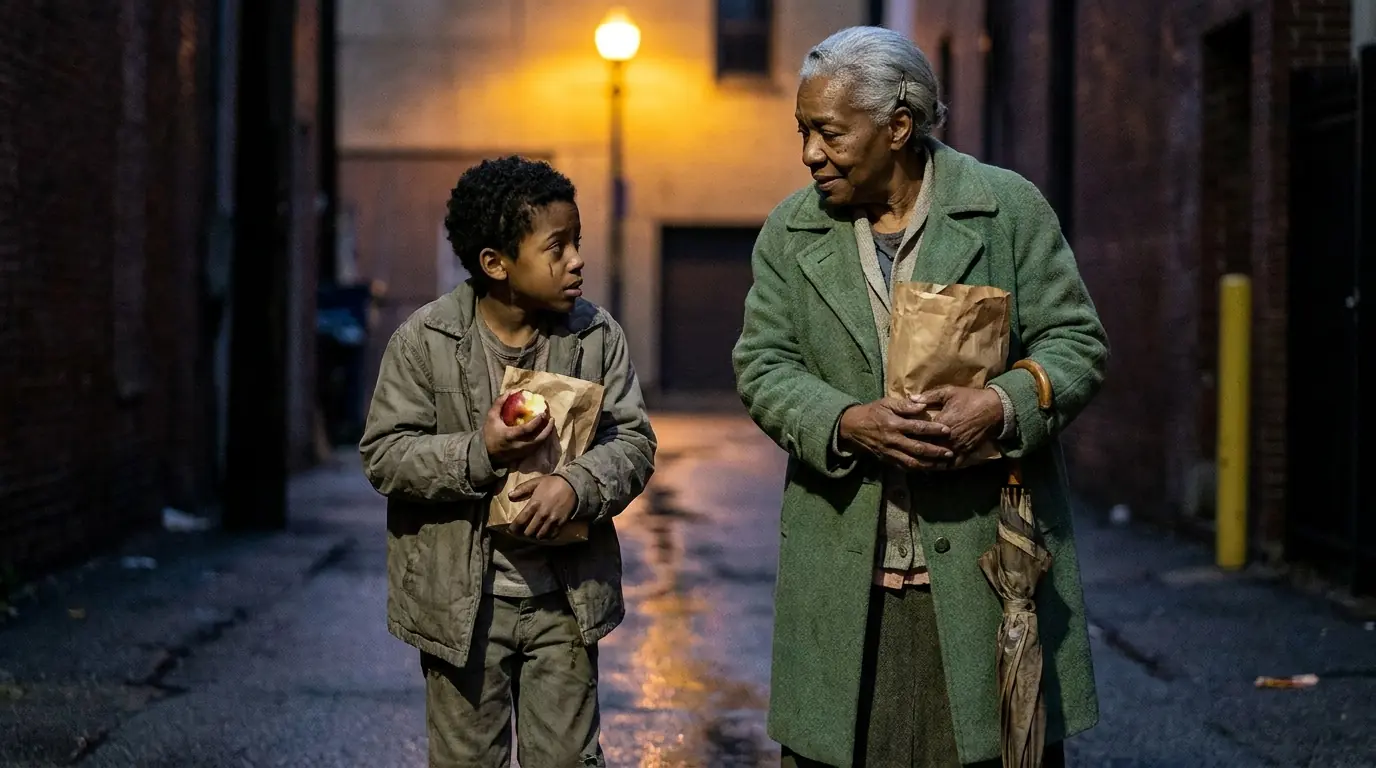
Eleanor stayed.
When a social worker came, Micah grabbed Eleanor’s sleeve without thinking.
She looked down at his hand.
It was the first time he had reached for her.
A Kind Waitress Helped a Poor Old Man — Until He Revealed His True Identity
The social worker, a kind woman named Denise Carter, asked careful questions. Eleanor answered what she knew. Tasha, weak but clear enough, explained the situation. There was no abuse from her, no abandonment, only poverty pressing so hard it had nearly crushed them both.
Temporary housing was arranged through a family assistance program. But there was a waiting period, paperwork, interviews, delays.
Tasha could not return to the freezing apartment.
Micah had nowhere safe to go.
Eleanor heard herself speak before caution could stop her.
“They can stay with me.”
Denise looked at her. “Mrs. Whitaker, that is generous, but there are procedures.”
“Then begin them.”
Micah stared at Eleanor.
Tasha began to cry. “I can’t ask that.”
“You didn’t,” Eleanor said.
The next week changed Eleanor’s house forever.
Tasha slept in the spare room while she recovered. Micah took the small room that had once belonged to Eleanor’s grandson during summer visits. At first, he kept his backpack packed beside the bed. He did not use the dresser. He did not leave his shoes anywhere but pointed toward the door.
Eleanor pretended not to notice.
She made breakfast every morning. Oatmeal, eggs when she had them, toast with jam, apples sliced thin because Micah liked them better that way but would never say so.
Tasha apologized constantly.
Eleanor finally put a hand on her hip and said, “If you apologize one more time for being alive in my house, I’m going to make you eat my experimental meatloaf.”
Tasha blinked.
Micah looked up from his toast. “Is it bad?”
“Terrible,” Eleanor said.
Tasha laughed so hard she coughed.
Little by little, the house warmed.
Not just from the furnace, though Eleanor kept it higher now.
It warmed with voices.
Micah doing homework at the kitchen table. Tasha folding laundry on the couch. Maggie visiting with casseroles. Eleanor humming while she cooked more than one portion for the first time in years.
At night, after Micah went to bed, Tasha sometimes sat with Eleanor in the living room and told her the truth.
She had grown up in foster homes. She had aged out of the system with no money and no family. Micah’s father had left before he was two. Tasha had worked every job she could find, but one missed paycheck became two, one late fee became debt, one broken heater became pneumonia.
“I tried,” Tasha whispered one night. “I swear I tried.”
Eleanor reached over and covered her hand. “I believe you.”
Tasha cried quietly.
Eleanor did not offer speeches. She had learned that some pain needed a witness more than advice.
Months passed.
Tasha got stronger. Denise helped her find a better job at a hospital laundry department with regular hours and benefits. A local church helped with a deposit for a small apartment, but Eleanor insisted they stay until the place was ready.
Micah changed slowly.
He stopped hiding food in his backpack.
He began leaving books on his desk.
He laughed more easily at Maggie’s jokes.
One afternoon, Eleanor found him in Samuel’s old chair, reading a library book about architecture.
“What are you reading?” she asked.
“Houses,” he said.
“Houses?”
He showed her a page with drawings of floor plans. “People decide where rooms go before the house exists. Like they can imagine a whole life before it happens.”
Eleanor smiled. “That’s a beautiful way to put it.”
He looked embarrassed. “It’s just buildings.”
“No,” she said. “It’s more than buildings.”
He stared at the page. “I want to design houses one day.”
“For rich people?”
He shook his head. “For people who don’t have safe ones.”
Eleanor could not speak for a moment.
“That sounds like a worthy life,” she said.
Micah glanced at her. “Do you think I could?”
“I think you must.”
When summer came, Tasha and Micah moved into their apartment.
It was only five blocks away, but the house felt painfully quiet after they left. Eleanor walked through the rooms that evening and found a note on the kitchen table.
Dear Mrs. Whitaker,
Thank you for not letting me eat from the trash. Thank you for the coat. Thank you for helping my mom. I don’t know how to pay you back yet, but I will.
Micah
Eleanor pressed the paper to her chest.
“You already did,” she whispered.
But life moved forward, as it always does.
Micah visited often at first. Then school became busier. Tasha worked more hours. Micah joined a program for gifted students, then a summer design camp, then high school clubs Eleanor barely understood. He still came by for Sunday dinner whenever he could, taller each year, his voice deepening, his dreams becoming more specific.
He won a scholarship.
Then another.
When he graduated high school, Eleanor sat in the audience wearing her best blue dress, clapping so hard her palms hurt. Micah found her afterward and hugged her without hesitation.
“You’re coming to the party,” he said.
“I wouldn’t miss it.”
He went to college in Columbus to study architecture.
Eleanor missed him terribly.
He called every week at first, then every other week when classes became demanding. He sent pictures of models he built, sketches, buildings he admired. Eleanor saved every photograph, every letter, every postcard.
Tasha visited regularly, bringing groceries and refusing to let Eleanor carry heavy things.
“You helped us,” Tasha said. “Let me help you now.”
Eleanor would grumble, but she always let her.
Years gathered quietly.
Eleanor turned eighty.
Then eighty-two.
Maggie retired and sold the diner to her niece, though everyone still called it Maggie’s Kitchen. The grocery store behind which Eleanor first saw Micah became a pharmacy. Fenwick Street was partially renovated after a city housing initiative. Some things improved. Some things did not.
Eleanor’s knees worsened.
Her hands trembled slightly when she buttoned her coat.
The house on Reed Street, once merely old, began to demand repairs she could not afford. The roof leaked near the back bedroom. The porch sagged dangerously. The furnace made a sound like an angry animal every time it started.
One winter morning, a city inspector came after a neighbor reported the porch.
He was polite but firm.
“Mrs. Whitaker, this structure is unsafe.”
“I know it leans,” Eleanor said.
“It’s more than leaning.”
He gave her a notice requiring repairs within sixty days.
The estimate came to more money than Eleanor had seen in years.
Tasha offered to help. Eleanor refused. Tasha had her own bills, her own life, her own aging mother in another state. Maggie’s niece organized a small fundraiser, but it barely covered the furnace inspection.
Eleanor began sleeping in the living room because the roof leak had spread.
She told no one how bad it had become.
Then, one rainy evening, she walked into the kitchen and found water dripping through the ceiling into a pot.
The sound brought her back instantly.
Metal lid scraping.
A boy behind a grocery store.
Hands in a trash bin.
She sat at the table and cried for the first time in months.
Not because of the house.
Because she was tired.
A week later, a black SUV stopped outside.
Eleanor watched from the window as a tall young man stepped out holding a folder.
For one strange second, she did not recognize him.
Then he turned toward the porch light, and she saw the eyes.
Micah.
He was twenty-eight now, broad-shouldered, clean-shaven, dressed in a dark wool coat over a suit. His curls were shorter, his face sharper, but when he smiled, she saw the hungry boy from the alley and the child in the red knit hat.
Eleanor opened the door before he could knock.
“Micah Bennett,” she said, her voice trembling.
He smiled. “Hi, Mrs. Whitaker.”
She reached for him, and he wrapped her carefully in his arms.
“You didn’t tell me the house was falling apart,” he said softly.
She pulled back. “Who told you?”
“Your roof did. I drove by yesterday.”
“You drove by without visiting?”
“I needed to check something first.”
She narrowed her eyes. “Check what?”
He held up the folder.
“May I come in?”
At the kitchen table, where he had once done homework with a borrowed pencil, Micah opened the folder. Inside were drawings, permits, photographs, and documents.
Eleanor put on her glasses.
“What is all this?”
Micah took a breath. “I started a nonprofit last year with two partners. We design and renovate safe housing for families, seniors, and people who are one emergency away from losing everything.”
Eleanor stared at him.
“We’ve done three small projects so far,” he continued. “But I always knew what the fourth would be.”
He slid one drawing toward her.
It was her house.
But not as it was.
As it could be.
The porch repaired and widened. A ramp built gently along the side, hidden by flower boxes. The roof replaced. The kitchen opened slightly for easier movement. The spare room restored. The heating system upgraded. A small reading nook added near the window where Samuel’s chair sat.
Eleanor’s hand covered her mouth.
“Micah…”
He placed a key on the table.
It was silver, shining beneath the kitchen light.
“What is that?”
“A temporary apartment,” he said. “Fully furnished. Ground floor. Five minutes from here. You can stay there while we renovate.”
She shook her head. “No. Absolutely not. I can’t pay for this.”
“I’m not asking you to.”
“That’s too much.”
“No,” Micah said, and his voice changed.
It became the voice of a man, steady and full of feeling.
“What you did was too much. You stopped a hungry child from eating garbage. You fed him when he had nothing. You brought food to his mother. You walked into a basement apartment when most people would’ve looked away. You gave us your house, your time, your safety. You made me believe homes could be designed for people who were scared.”
Eleanor’s eyes filled.
Micah leaned forward. “Every building I design started in this kitchen.”
She looked down at the key.
“I never wanted you to pay me back,” she whispered.
“I know,” he said. “That’s why I want to.”
The renovation began two weeks later.
Eleanor complained about nearly everything.
The apartment was too nice.
The bed was too soft.
The workers were too polite.
The new porch design was too fancy.
Micah listened patiently to all of it and ignored most of it.
Tasha came on weekends, bringing food and laughing whenever Eleanor tried to boss the contractors. Maggie visited with pie. Neighbors stopped by to watch the old house slowly become new again.
Micah did not turn it into something grand or unfamiliar. He understood better than anyone that a home was not only walls and paint. It was memory. He preserved Samuel’s chair. He kept the kitchen window where Eleanor had grown basil in chipped mugs. He repaired the old front door instead of replacing it because Eleanor said Samuel had painted it himself.
But he made the house safe.
Strong.
Warm.
When Eleanor returned three months later, spring had touched the rose bushes. The porch no longer leaned. The steps were even. The roof was new. Light filled the kitchen. Her bedroom ceiling was smooth and dry.
Eleanor walked through slowly, one hand on Micah’s arm.
In the spare room, she stopped.
The room had been painted soft yellow. A bookshelf lined one wall. A framed note hung beside the window.
It was the note Micah had left years ago.
Thank you for not letting me eat from the trash.
Eleanor turned to him.
“I kept it,” he said. “Tasha found it in your drawer when we were packing. She asked if we could frame it.”
Eleanor could barely see through her tears.
Then Micah opened the closet.
Inside were small coats, backpacks, folded blankets, and boxes of school supplies.
Eleanor looked confused.
Micah smiled. “There’s one more thing.”
He led her back to the porch, where a small sign had been mounted near the door.
THE WHITAKER ROOM
Emergency shelter and meal support for children and families, founded in honor of Eleanor Whitaker.
Eleanor read it once.
Then again.
“No,” she whispered.
“Yes,” Micah said gently. “With your permission, this house will help others the way it helped us. Not strangers coming all the time. Carefully, safely, through the family services office. A meal. A warm room. A night or two when someone has nowhere safe.”
Eleanor gripped the railing.
For years, she had thought of her house as a place slowly emptying itself of life.
Now Micah was offering to fill it again.
“Why name it after me?” she asked.
Micah looked at her the way the boy in the diner had once looked at a bowl of hot stew, unsure how something so good could be real.
“Because I went looking for garbage,” he said, “and you showed me I was worth a meal.”
Eleanor covered her face and cried.
Micah stood beside her quietly, letting her have the moment.
That summer, the first family came through the Whitaker Room.
A mother with two little girls whose apartment had burned in an electrical fire. They stayed one night, ate vegetable soup at Eleanor’s kitchen table, and left the next day with clean clothes, grocery cards, and a housing appointment.
Then came a teenage boy who had aged out of foster care and needed somewhere safe until his caseworker arrived.
Then a grandmother with her grandson after a winter power outage.
Eleanor did not run the program alone. Micah made sure of that. Professionals handled paperwork, safety, and transportation. Volunteers brought meals. Tasha coordinated supplies. Maggie’s Kitchen donated soup every Thursday.
But Eleanor did what she had always done best.
She sat at the table.
She learned names.
She noticed who was hungry before they asked.
One cold evening, years after she had first seen Micah behind the grocery store, Eleanor opened her front door to find a small boy standing on the porch with a social worker. He wore a thin jacket and stared at the floor.
His name was Caleb.
He had not eaten since morning.
Eleanor stepped aside and smiled gently.
“Come in, Caleb,” she said. “There’s soup on the stove.”
The boy hesitated. “I don’t have money.”
Eleanor felt the past move through the room like a soft wind.
Behind her, Micah stood in the hallway, older now than she had been when she first met him in some ways, though not in years. His eyes met hers.
Eleanor looked back at Caleb.
“I didn’t ask for money,” she said.
The boy stepped inside.
Micah turned away for a moment, wiping his eyes.
Later that night, after Caleb had eaten two bowls of soup and fallen asleep beneath a quilt, Eleanor sat on the porch with Micah. The repaired boards held firm beneath their feet. The roses moved gently in the evening air.
“I used to think I saved you,” Eleanor said softly.
Micah looked at her. “You did.”
She shook her head. “Not alone. I gave you dinner. You turned it into a life.”
Micah smiled. “You gave me more than dinner.”
Eleanor looked toward the street, where the old grocery store sign had been replaced years ago. “I was scared that night.”
“You were?”
“I was an old woman in an alley talking to a stubborn boy with a rotten apple. Of course I was scared.”
Micah laughed.
Then he grew quiet.
“I was scared too,” he said. “But I was more hungry than scared.”
Eleanor reached over and patted his hand.
“You never paid me back,” she said.
He blinked, startled.
Then he saw the teasing light in her eyes.
“What do you call the house?” he asked.
She looked around at the repaired porch, the glowing windows, the room waiting for children who needed warmth, and the young man who had returned not with debt, but with devotion.
“I call it interest,” she said.
Micah laughed again, and this time Eleanor joined him.
Inside, the house breathed with quiet life. Soup cooled on the stove. A child slept safely under a quilt. The old chair by the window waited for morning light.
And Eleanor Whitaker, who had once walked home with an empty grocery bag after feeding a hungry boy, finally understood the strange and beautiful mathematics of kindness.
A meal could become a dream.
A coat could become a career.
A small house could become shelter.
A child saved from a trash bin could grow into a man who returned with a key.
And an old woman who thought she had very little left to give could discover that the little she gave was enough to build a home for many.
A Waitress Helped A Man Was Rejected by Restaurant — His Son Returned With a Promise