Margaret Ellis was seventy-two years old when she found the two children behind her diner.
It was a cold evening in Cedar Hollow, Kentucky, the kind of November cold that slipped through coat sleeves and settled deep into the bones. Rain had fallen all afternoon, turning the alley behind Ellis’s Kitchen into a narrow strip of wet brick, puddles, and old cardboard boxes. The diner had closed an hour earlier, but Margaret was still inside, wiping down the counter, counting coins from the register, and packing leftover biscuits into a paper bag.
She had run Ellis’s Kitchen for thirty-eight years.
The diner was small, with six red stools at the counter, five booths by the window, and a kitchen barely large enough for two cooks, though Margaret had been doing most of the cooking alone for years. The sign outside had faded. The roof leaked near the back hallway. The floor tiles had cracks that she covered with rubber mats. But every morning, she unlocked the door before sunrise, brewed coffee, made gravy, fried eggs, and served people who had nowhere else to sit for a while.
Her husband, Walter, had built the counter himself before he died. Her daughter lived three states away and called every Sunday, always asking Margaret to sell the diner and move closer.
But Margaret never did.
The diner was not just a business. It was the last place where Walter still felt near. It was the place where neighbors came when they were hungry, lonely, tired, grieving, or too proud to say they needed help.
Margaret understood pride.
She had plenty of it herself.
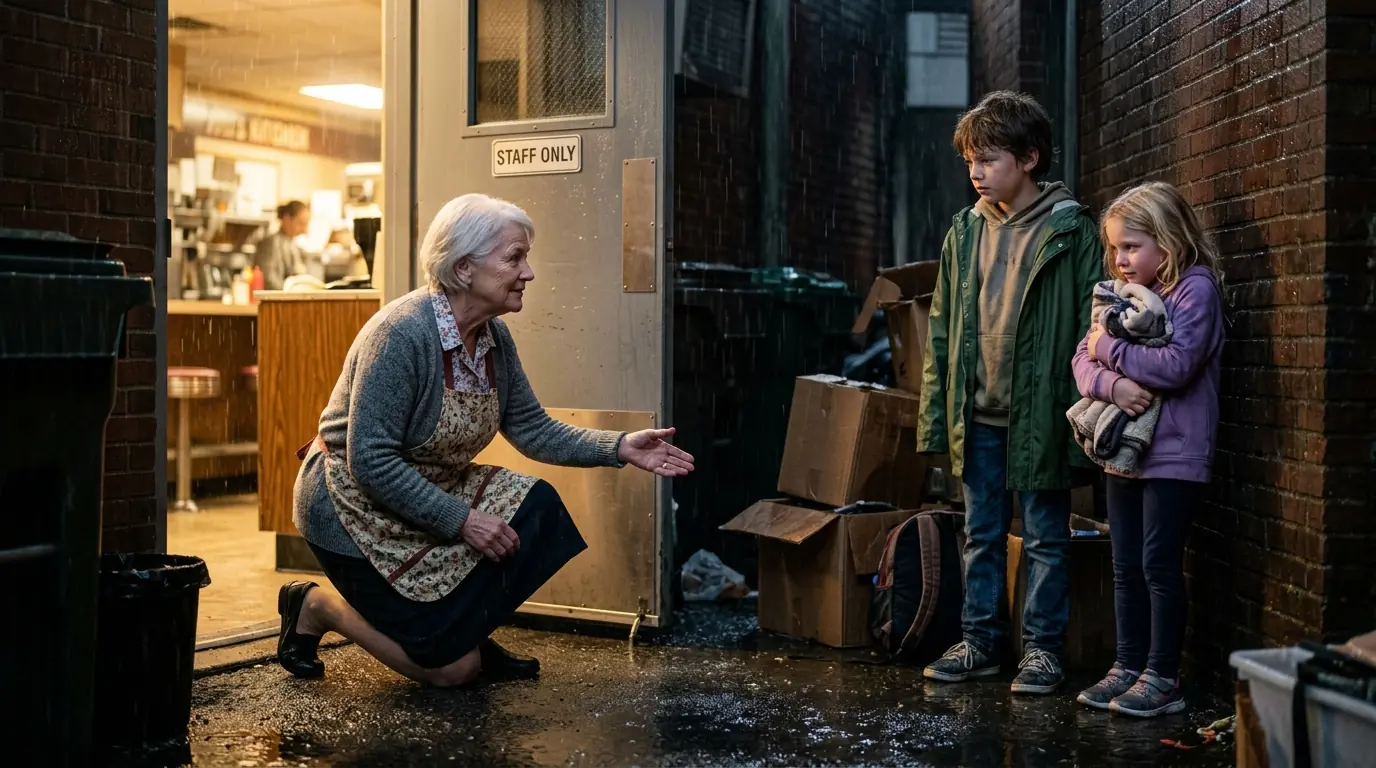
That night, after closing, she took the trash bag out through the back door. The rain had slowed to a mist, and the alley smelled of wet pavement and old leaves. She pulled her cardigan tighter around her shoulders and lifted the trash bag toward the bin.
Then she heard a small sound.
At first, she thought it was a cat.
A thin, muffled whimper came from behind a stack of broken crates near the brick wall.
Margaret froze.
“Hello?” she called.
No answer.
She stepped closer, careful not to slip.
“Who’s there?”
The crates shifted.
A boy’s face appeared in the gap between two boxes. He was maybe ten years old, with tangled brown hair, pale cheeks, and eyes too alert for a child. His jacket was too small, his jeans soaked at the knees, and both hands were wrapped around the shoulders of a smaller girl pressed against him.
The little girl looked about seven. Her blonde hair was dirty and damp, and she wore a thin purple hoodie with one sleeve torn near the wrist. Her lips were blue from cold.
Margaret’s breath caught.
“What in heaven’s name are you two doing back here?”
The boy tightened his arms around the girl.
“We’re leaving,” he said quickly. “We didn’t take anything.”
“I didn’t ask if you took anything.”
“We’ll go.”
“No, you won’t.”
His eyes narrowed with fear.
Margaret lowered her voice.
“What are your names?”
The boy hesitated.
“Eli.”
“And her?”
He looked down at the little girl.
“Annie.”
Annie did not speak. She only shivered against him.
Margaret looked at their wet shoes, their trembling hands, the cardboard pieces they had tried to use as shelter.
“Are you alone?”
Eli looked away.
That was answer enough.
Margaret opened the back door wider.
“Come inside.”
Eli shook his head immediately.
“No.”
“Child, it is freezing.”
“We’re fine.”
“You are absolutely not fine.”
“We can’t go with strangers.”
Margaret looked at him carefully.
Smart boy, she thought. Scared, but smart.
“You don’t have to come far,” she said. “Just inside the back door. You can sit where you can see the exit. I’ll give you food, dry towels, and then we’ll talk.”
Eli still hesitated.
Annie’s teeth chattered.
That decided it.
Margaret stepped back and held the door open.
Eli looked down at Annie.
The little girl whispered, “I’m cold.”
His face changed.
He helped her stand.
They entered the diner through the back door, leaving muddy prints on the kitchen floor. Margaret said nothing about the mud. She sat Annie near the small heater by the pantry and handed both children clean towels from the laundry basket.
Then she moved quickly.
Soup first.
A pot of chicken and vegetable soup still sat on the stove. She heated it, sliced leftover biscuits, poured two glasses of milk, and placed everything on the small prep table.
Eli watched every movement.
“You don’t have to feed us,” he said.
“That is the first foolish thing you’ve said since we met.”
“We can pay later.”
“I didn’t ask.”
“We don’t want trouble.”
Margaret placed a bowl in front of him.
“Then eat before I become trouble.”
Annie reached for the spoon with both hands and began eating so fast Margaret had to gently stop her.
“Slowly, sweetheart. Your stomach needs to remember food is coming.”
Annie looked up, startled by the softness in the woman’s voice.
Eli waited until Annie had eaten several bites before touching his own soup.
Margaret noticed.
She noticed everything.
The way he gave his sister the bigger biscuit. The way he kept glancing at the back door. The way his shoulders stayed raised, ready for danger. The way Annie leaned into him without thinking, as if he had been her whole world for too long.
Margaret sat across from them.
“Where are your parents?”
Eli’s spoon stopped.
Annie looked down.
“Our mom died,” Eli said.
Margaret’s heart tightened.
“And your father?”
“Gone.”
The word was flat. Final.
“Any family?”
Eli shook his head.
“We had an aunt. She said she couldn’t keep us anymore.”
Margaret closed her eyes briefly.
“How long have you been outside?”
“Not long.”
“Eli.”
He looked at her.
“How long?”
His jaw trembled, though he tried to hide it.
“Four days.”
Annie whispered, “Five.”
Eli looked at her sharply.
Margaret stood before he could feel ashamed.
“Finish eating.”
“What are you going to do?” he asked.
“For tonight? I’m going to get you dry clothes from the donation box at church, make up the old sofa in the storage room, and call Reverend Paul in the morning.”
Eli pushed back from the table.
“No. We can’t go to a shelter.”
Margaret paused.
“I didn’t say shelter.”
“They’ll split us up.”
Annie began to cry silently.
Eli put an arm around her.
“They always said they would split us up if nobody wanted both.”
Margaret looked at them for a long moment.
She had no grand plan. No legal papers. No spare bedroom ready with clean quilts. No extra money. Her diner barely survived from week to week. She was an old widow with swollen hands, a leaky roof, and more bills than patience.
But she knew what fear sounded like when it came from a child.
And she knew she could not send them back into the rain.
“No one is splitting anybody tonight,” she said.
Eli stared at her.
“Promise?”
Margaret met his eyes.
“I promise tonight. Tomorrow, we will figure out tomorrow.”
That night, Margaret made a bed for them in the storage room behind the kitchen. It was not much: an old sofa, a padded chair, three quilts, and a small lamp. She found dry clothes in a box of donations waiting to be taken to church. The pants were too big for Eli, and the sweatshirt had a faded baseball logo, but they were warm. Annie wore a pink sweater with one missing button and socks that reached nearly to her knees.
Margaret washed their wet clothes in the diner sink and hung them near the heater.
Before they slept, Annie stood in the doorway of the storage room clutching the quilt.
“Are you going to lock the door?”
Margaret’s chest ached.
“No, sweetheart.”
“Can Eli sleep close?”
“As close as you need.”
Eli looked embarrassed, but Annie grabbed his sleeve.
Margaret turned off the main kitchen light.
“If you need me, I’ll be right out front.”
“You’re staying here?” Eli asked.
“This is my diner. I’ve slept in that booth more times than I care to admit.”
“Why?”
“Because old women are stubborn.”
Annie gave a tiny smile.
It was the first one.
Margaret sat in booth three that night, wrapped in her cardigan, listening to the soft sounds of two children sleeping in the back room.
She did not sleep much.
By morning, she had made a decision.
Not a reckless decision, she told herself.
A temporary one.
She called Reverend Paul, who ran the small church down the street. Then she called Mrs. Dawson, a retired school secretary who knew every family agency contact in the county. Margaret explained the situation carefully, but she made one thing clear before anyone could speak of rules too quickly.
“These children stay together,” she said. “Whatever happens next, they stay together.”
There were phone calls. Forms. Visits. Questions. Temporary approvals. Emergency arrangements. Background checks. People in offices who meant well but moved too slowly.
Through all of it, Eli kept his hand near Annie’s shoulder.
Margaret answered every question honestly.
Could she afford to care for them permanently?
No.
Was she young enough to raise children again?
Probably not.
Did she have proper space?
Not yet.
Was she willing?
Yes.
That answer did not change.
For the first two weeks, Eli and Annie stayed at the diner after closing and slept in the storage room. During the day, Margaret arranged for them to attend school again. Reverend Paul helped with clothes. Mrs. Dawson brought backpacks and notebooks. Customers quietly left envelopes, winter coats, lunch boxes, and once, a pair of nearly new sneakers in Eli’s size.
Eli trusted none of it at first.
He counted everything. Food. Doors. Minutes. Promises.
Annie trusted faster, but only if Eli nodded first.
Margaret learned their habits.
Eli saved half his meals in napkins until she gently told him there would be breakfast tomorrow. Annie hid biscuits in her sweater pocket, not because she was greedy, but because hunger had taught her not to believe in later. Eli woke at every loud noise. Annie cried if she could not see him.
Margaret did not scold them.
She gave them routine.
Breakfast at six-thirty.
School bus at seven-fifteen.
Homework in booth two at four.
Dinner after the rush.
Baths at Reverend Paul’s house until Margaret could fix the tiny bathroom in the apartment above the diner.
Bed by nine.
Slowly, the children began to breathe.
After a month, Margaret moved them upstairs.
The apartment above the diner had been unused for years, except for boxes of old decorations and things she could not bring herself to throw away after Walter died. With help from neighbors, she cleaned it out. They painted the small bedroom pale yellow. Someone donated bunk beds. Someone else brought a dresser. Margaret found curtains at a thrift store with little blue birds on them.
Annie loved the curtains.
Eli pretended not to care about the bunk bed, but Margaret saw him run his hand over the wooden ladder when he thought no one was looking.
The first night upstairs, Annie stood in the doorway of the bedroom.
“This is ours?”
“For now,” Margaret said.
Eli turned sharply.
“For now?”
Margaret realized her mistake.
She knelt slowly, because her knees complained, and looked at both children.
“I mean, as long as I am allowed to keep you safe, this is yours.”
Eli’s face stayed guarded.
“People change their minds.”
Margaret nodded.
“They do.”
Annie’s eyes filled.
Margaret continued, “So I won’t ask you to believe every word tonight. I’ll just keep saying it and living it until you can.”
Eli looked at her for a long time.
Then he asked, “Why are you doing this?”
Margaret looked past them into the small room.
The fresh sheets. The thrift-store lamp. The blue bird curtains. Two children who had learned too much about being unwanted.
“Because when a child knocks on the world’s door, someone ought to open it,” she said.
“We didn’t knock,” Eli whispered.
“No,” Margaret said. “You were too cold to knock. So I opened it anyway.”
The years that followed were not simple.
Love did not erase fear overnight.
Eli got into fights at school when other children teased Annie. Annie had nightmares and woke screaming for a mother whose voice she barely remembered. Margaret struggled with paperwork, school meetings, medical appointments, grocery bills, and the strange exhaustion of raising children in her seventies.
Some mornings, she looked at herself in the bathroom mirror and thought, What have you done, old woman?
Then Annie would shuffle into the kitchen wearing mismatched socks and ask if biscuits could have extra honey. Or Eli would quietly carry heavy flour bags from the storage room without being asked. Or both children would sit at the diner counter doing homework while rain tapped the windows, safe and warm above the place that had found them.
And Margaret would know.
She had done the only thing she could live with.
Eli changed slowly.
At first, he was all edges. He questioned every kindness. He kept emergency coins hidden under his mattress. He did not like anyone touching his things. He watched men carefully, especially loud ones. He never let Annie walk anywhere alone.
Margaret gave him responsibility without making him feel trapped.
He took out trash. Stocked napkins. Wiped menus. Carried soup to older customers when the diner was busy. He learned the register by twelve and could make perfect coffee by thirteen.
Customers grew used to seeing him there.
“Morning, Eli.”
“Morning.”
“How’s school?”
“Fine.”
“Fine good or fine bad?”
“Just fine.”
Margaret would call from the kitchen, “That means he got an A and doesn’t want attention.”
Eli would groan, but his ears turned red.
Annie changed differently.
She bloomed.
She sang while setting tables. She drew pictures on receipt paper. She named every pie Margaret baked. Apple pie became “Sunday pie.” Chocolate cream became “happy pie.” Lemon meringue became “cloud pie.” Customers started using her names without question.
She loved school. She loved reading. She loved sitting beside Margaret in the kitchen, watching her cook.
“Why do you put sugar in the tomato sauce?” Annie asked once.
“Because tomatoes can be sharp.”
“People can be sharp too.”
“Yes.”
“Can you put sugar in people?”
Margaret smiled.
“Sometimes kindness does that.”
At night, when the diner was closed, the three of them ate together in booth three. Margaret could have taken them upstairs, but the booth felt like their first table, the place where soup had become safety.
Eli always sat facing the door.
Annie always sat beside Margaret.
Years passed in small, ordinary miracles.
Birthdays with homemade cake.
School concerts.
Report cards taped to the refrigerator.
Bad colds.
New shoes.
Lost teeth.
Burned toast.
Arguments over chores.
Annie learning to ride a bike in the alley.
Eli getting his first part-time job outside the diner, then secretly giving half his first paycheck to Margaret.
She found the money under the sugar jar.
She marched upstairs with it.
“Eli Thomas Reed.”
He looked up from his homework.
“You used my middle name.”
“That means trouble.”
“I wanted to help.”
“You are fifteen. You do not pay my electric bill.”
“You pay everything.”
“That is my job.”
“You’re tired.”
Margaret softened, but only a little.
“I am often tired. That does not make you the parent.”
His face tightened.
“I was Annie’s parent before you.”
The room went quiet.
Margaret sat on the edge of the bed.
“Yes,” she said gently. “You were. And you did a brave job. But you get to be a boy too.”
Eli looked away.
“I don’t know how.”
“Then we’ll learn.”
When Eli turned seventeen, he told Margaret he wanted to study business.
“Business?” she repeated, surprised.
He shrugged.
“Diners close because people don’t know numbers.”
Margaret raised an eyebrow.
“Is that your professional opinion?”
“I’ve seen your paperwork.”
“You had no business seeing my paperwork.”
“It was in the bread drawer.”
“That was a filing system.”
“That was chaos.”
He pulled out a notebook filled with calculations.
“You spend too much on certain suppliers. The breakfast combo loses money if people order extra bacon. The Thursday stew special makes more than you think. And you should sell frozen biscuits by the dozen before holidays.”
Margaret stared at him.
“When did you do all this?”
“At night.”
“While I thought you were doing homework?”
“It was homework. Just not assigned.”
She wanted to scold him.
Instead, she laughed until she had to sit down.
Eli did study business, first at community college, then at a state university with scholarships, part-time work, and more determination than sleep. He came home on weekends to help at the diner. He fixed Margaret’s bookkeeping, built a simple website, and convinced her to sell holiday biscuit boxes.
“They won’t buy them,” she said.
They sold out in two days.
Annie followed a different path.
She loved people. She loved stories. She loved the way food could make strangers talk to each other. In high school, she volunteered at community programs and helped younger children with reading. She later studied social work, driven by a quiet promise she rarely spoke aloud.
“No kid should think a cardboard box is a bedroom,” she told Eli once.
He nodded.
Neither needed to say more.
As the children grew, Margaret aged.
Her hair turned fully white. Her hands shook when she lifted heavy pots. Her knees ached climbing the stairs. She began forgetting small things: where she placed her glasses, whether she had ordered sugar, why she had walked into the pantry.
Eli noticed first.
Annie noticed next.
Margaret denied everything.
“I am old, not helpless,” she snapped one Christmas when Eli suggested hiring more kitchen help.
“There is a difference between help and helpless,” Eli said.
“I know the difference.”
“Then stop treating them like the same word.”
Margaret glared at him.
“You got too smart.”
“You paid for school.”
“I regret it daily.”
But she let him hire a morning cook.
Then a weekend server.
Then, eventually, she stopped working open to close.
The diner, however, faced problems no amount of love could avoid.
A new highway bypass pulled traffic away from Cedar Hollow. A chain restaurant opened near the exit. The roof needed major repair. The apartment plumbing failed twice. The bank sent letters. Property taxes climbed.
Margaret hid the worst of it.
She had spent years protecting Eli and Annie from worry. It was hard to stop.
But Eli found the final notice one evening while visiting from Lexington, where he worked for a restaurant management company.
He stood in the diner office, holding the letter.
The bank intended to begin foreclosure proceedings if payments were not made within sixty days.
Margaret stood in the doorway.
“You weren’t supposed to see that.”
Eli turned.
“When were you going to tell us?”
“When I had a solution.”
“You don’t.”
“I might have.”
“Margaret.”
He rarely called her by her first name.
When he did, she knew he was frightened.
She sat heavily in the office chair.
“I didn’t want you two carrying this.”
Annie arrived an hour later after Eli called her. She was twenty-four now, working with a family support nonprofit in Louisville. She walked into the diner, saw Margaret’s face, and immediately began crying.
“Oh, Gran.”
Margaret hated tears almost as much as she hated bank letters.
“Don’t start. I’m not dead.”
“No,” Annie said, kneeling beside her chair. “But you’re scared.”
Margaret looked away.
The truth came out slowly.
The debt. The repairs. The slow decline in customers. The missed payments. The offers from a developer who wanted to buy the diner, tear it down, and build a gas station with a fast-food counter.
Eli’s jaw tightened.
“They want to tear it down?”
“Land is worth more than old biscuits, apparently.”
Annie wiped her face.
“This is our home.”
Margaret’s voice softened.
“It was.”
“No,” Eli said. “It is.”
Margaret looked at them both: the boy who had once guarded a shivering little sister in an alley, and the girl who had once asked if kindness could put sugar in people. They were grown now. Strong. Capable. Beautiful in ways that had nothing to do with appearances.
“I can’t ask you to save an old woman’s diner,” she said.
Eli knelt in front of her.
“You didn’t ask.”
Annie took her hand.
“You opened the door before we knocked.”
Eli looked around the office, then toward the diner beyond it.
“Now let us open one for you.”
They did not promise miracles.
They made plans.
Eli took leave from work and dug through every account, bill, loan document, supplier contract, and tax record. Annie contacted local organizations, former customers, school groups, church members, and anyone who remembered what Ellis’s Kitchen had meant to Cedar Hollow.
But they did not simply start a fundraiser and hope.
Eli was too practical for that.
He built a proposal.
Ellis’s Kitchen would become more than a diner. It would remain a working restaurant, but with added community programs: pay-what-you-can breakfasts twice a week, after-school meals for children, job training for teenagers, and a small upstairs support office where local families could connect with services through Annie’s nonprofit network.
The diner had always been doing that kind of work informally.
Now they would make it official.
Annie named the program The Open Door Table.
Margaret said the name sounded too grand.
Annie kissed her cheek.
“So are you.”
“I am five foot three.”
“Still grand.”
Eli negotiated with the bank. He hated every minute, but he was good at it. He showed revised revenue projections, community commitments, and donor pledges. He reached out to former Cedar Hollow residents who had moved away but remembered the diner.
Annie gathered stories.
And the stories came.
People wrote about Margaret feeding them when they had no money. Letting them sit in the booth during storms. Giving leftover soup to families. Hiring people who needed second chances. Remembering every birthday. Sending food after funerals. Packing biscuits for children before school.
One message came from a man who wrote:
When I was fourteen, Mrs. Ellis gave me breakfast for six months and told everyone I was washing dishes for it. I wasn’t. She just knew my father had lost his job. I am a teacher now because somebody fed me before school.
Another came from a woman in Ohio:
My mother worked double shifts, and I waited at Ellis’s Kitchen until she picked me up. Margaret never made me feel unwanted. She gave me crayons, grilled cheese, and a safe table.
Annie printed every story and taped them to the diner wall.
Margaret tried to take them down.
“I look like I’m dead,” she complained.
“You look loved,” Annie said.
“Worse.”
The campaign spread.
Local news came. Then regional news. People drove in from neighboring towns. Former customers returned with their children and grandchildren. Volunteers painted the walls. A retired contractor offered roof work at cost. A plumber fixed the upstairs bathroom for free because Margaret had fed his family after his mother’s surgery twenty years earlier.
Eli’s former employer offered to invest in the diner’s expansion as a community partnership. Annie’s nonprofit helped secure grant support for the Open Door Table program.
The bank agreed to pause foreclosure.
Then, after weeks of pressure, paperwork, donations, and negotiations, they reached the number needed to save the building.
The day the final payment cleared, Eli and Annie brought Margaret into the empty diner before opening.
The chairs were still stacked on tables. Morning light entered through the front windows. The old sign outside had been restored, freshly painted in cream and blue.
Margaret looked tired.
She had been tired for months.
Eli placed an envelope on the counter.
“What is this?”
“Open it,” Annie said.
Margaret gave them both a suspicious look.
“If something jumps out, I’m disowning you.”
“You never officially owned us,” Eli said.
Margaret opened the envelope.
Inside was a copy of the deed transfer documents and a small brass key tied with a blue ribbon.
Her hands trembled.
“What did you do?”
Eli stood beside Annie.
“We paid the debt.”
Margaret looked up, stunned.
“You what?”
“We paid the debt,” Annie repeated, crying already. “The diner is safe.”
“No,” Margaret whispered. “No, you can’t spend your money on this.”
“We didn’t do it alone,” Eli said. “The town helped. Former customers helped. Grants helped. I refinanced part of it through the new business plan.”
“That sounds like debt.”
“It sounds like investment.”
“I don’t want you burdened.”
Eli’s voice softened.
“Gran, you carried us when nobody else could.”
Annie stepped closer.
“You gave us food, a bed, school, birthdays, home, and each other. You fought so we wouldn’t be split apart.”
Margaret’s eyes filled.
Eli placed the key in her palm.
“This is not us paying you back,” he said. “We could never pay you back.”
Annie smiled through tears.
“This is us making sure your door stays open.”
Margaret closed her fingers around the key and began to cry.
Not the quiet kind she could hide.
Real tears.
The kind that came from a place too deep for pride to reach.
Eli wrapped his arms around her carefully. Annie joined them. For a moment, the three of them stood in the diner where everything had begun: the old woman, the boy, and the little girl who had once come in from the cold.
Only now, the children were grown.
And they were holding her up.
The reopening of Ellis’s Kitchen became the largest event Cedar Hollow had seen in years.
The sign outside now read:
Ellis’s Kitchen
Home Of The Open Door Table
Margaret complained about the second line.
“It makes us sound like a church basement.”
Eli said, “We serve better biscuits than a church basement.”
Annie said, “And more people need the door.”
The diner was packed from morning until night.
Old customers came. New families came. Teachers brought students. Church ladies brought flowers. Former residents drove hours. People filled the booths, stood along the walls, and waited outside just to hug Margaret or shake Eli’s hand or tell Annie how proud they were.
At noon, Annie stepped behind the counter and tapped a spoon against a glass.
Margaret narrowed her eyes.
“No speeches.”
“Yes speeches,” Annie said.
“I raised you better.”
“You raised me brave.”
The room quieted.
Annie stood beside Eli, both of them facing the crowd. Margaret sat on a stool near the register, arms crossed, pretending she was annoyed.
Annie began.
“Years ago, my brother and I were found in the alley behind this diner. We were cold, hungry, and terrified. We had learned not to trust promises because too many had already been broken.”
The room fell silent.
Eli continued.
“Margaret Ellis opened the back door. She gave us soup. She gave us dry clothes. She gave us a place to sleep. But more than that, she gave us a life where we were not separated, not forgotten, and not treated like a problem.”
Margaret looked down at her hands.
Annie’s voice trembled.
“She became our grandmother before any paper said she was allowed to. She taught us that family can begin with a bowl of soup and a promise kept one night at a time.”
Eli looked at Margaret.
“This diner saved us because she was here. Now this town has helped us save the diner because all of you know what she has been doing for decades.”
Annie lifted a small framed sign.
It read:
The Open Door Table
For Every Child Who Needs A Safe Meal
For Every Neighbor Who Needs A Place To Sit
For Margaret Ellis, Who Opened The Door First
Margaret covered her mouth.
The applause began softly, then grew until the windows seemed to shake.
Margaret hated being praised.
But that day, she let herself hear it.
Years passed again, but differently now.
Margaret no longer carried the diner alone.
Eli managed the business side, though he still let Margaret approve every menu change. Annie ran The Open Door Table program from the upstairs office, connecting families with food, school supplies, counseling, job resources, and emergency support.
Children came after school for meals.
Teenagers worked part-time and learned cooking, budgeting, and customer service.
Parents came when they needed help but did not know how to ask.
Nobody was made to feel poor for needing food.
Margaret insisted on that.
“Dignity first,” she told every volunteer. “Then biscuits.”
The diner became brighter. Safer. Busier. The roof no longer leaked. The apartment upstairs became a small family support space, but Eli and Annie kept one room exactly as it had been when they were children: the bunk bed, the blue bird curtains, the thrift-store lamp.
Margaret asked why.
Annie said, “Because some children need to see what a beginning can look like.”
Sometimes, when Margaret felt strong enough, she would sit in that room alone.
She would look at the bunk bed and remember Annie’s tiny voice asking if the room was theirs. She would remember Eli’s suspicious eyes, the coins hidden beneath his mattress, the way he had forgotten how to be a boy.
Then she would walk downstairs and see Eli in a button-down shirt arguing with suppliers, and Annie kneeling beside a child with a backpack, speaking softly.
And she would think, They made it.
Not because life had been easy.
Because someone had stayed.
On Margaret’s eighty-fifth birthday, Eli and Annie planned a private dinner after closing.
“No party,” Margaret warned.
“No party,” Eli promised.
He lied.
When Margaret came downstairs that evening, the diner was full of people holding candles. Former teachers. Customers. Volunteers. Families helped by the Open Door Table. Children who had grown taller. Neighbors who had known Walter. Eli’s wife and young son. Annie’s husband and baby daughter.
Margaret stopped on the last stair.
“Oh, you wicked children.”
Annie grinned.
“Happy birthday, Gran.”
Eli walked to her and offered his arm.
“Come on. Your throne is booth three.”
“I do not have a throne.”
“You absolutely do.”
Booth three had been decorated with blue flowers and a framed photograph of the original diner. On the table sat a bowl of chicken and vegetable soup, two biscuits, and three spoons.
Margaret stared at it.
Annie whispered, “The first meal.”
Margaret sat slowly.
Eli sat on one side of her. Annie sat on the other.
For a moment, they were not adults with careers, families, programs, responsibilities, and a saved diner.
They were three people at the table where love had begun.
Eli lifted his spoon.
“To the woman who opened the door.”
Annie lifted hers.
“To the home that found us.”
Margaret looked at them both, her eyes shining.
“And to the two children who gave an old woman more life than she knew what to do with.”
They ate the soup together while the diner glowed around them.
Later that night, after everyone had gone and the candles had been blown out, Margaret stood behind the counter with Eli and Annie.
The building was quiet.
Rain tapped softly against the windows.
Just like the night she found them.
Margaret listened to it for a while.
“You know,” she said, “I was scared that night.”
Eli looked at her.
“You were?”
“Of course I was. I had no idea what I was doing.”
Annie laughed softly.
“You always seemed like you knew.”
“That is one of the great tricks of old age. We look wise because we move too slowly for panic.”
Eli smiled.
Margaret looked toward the back door.
“I almost told myself it wasn’t my business.”
Annie’s smile faded.
“But you didn’t.”
“No,” Margaret said. “Because your little face was blue, and Eli looked like he was ready to fight the whole world with an empty stomach.”
Eli looked down.
“I would have.”
“I know.”
Margaret reached for their hands.
“I am glad I opened the door.”
Annie squeezed her fingers.
“So are we.”
Eli held her other hand.
“You saved us, Gran.”
Margaret shook her head.
“No. I helped you get warm. You two did the hard work of growing.”
“You did more than that,” Annie said.
Margaret looked around the diner: the restored counter Walter had built, the booths filled each day, the Open Door Table sign, the wall of children’s drawings, the old blue bird curtains framed upstairs, the kitchen where soup still simmered for anyone who needed it.
Maybe Annie was right.
Maybe opening a door was never just opening a door.
Maybe it was choosing to believe the person on the other side had a future.
Margaret Ellis had cưu mang two homeless children on a freezing rainy night, not because she had enough money, strength, or certainty, but because she had enough heart to make room.
Years later, Eli and Annie returned that love in the only way they could.
They saved her diner.
They protected her home.
They turned her kindness into a living program that helped other children step out of the cold.
And every November, when rain fell against the alley bricks, Margaret would ask the kitchen to make extra soup, just in case someone outside was too cold, too proud, or too frightened to knock.
Because once, two children had not knocked.
And she had opened the door anyway.