The leather travel bag struck the polished marble floor of Sterling Crown Galleria with enough force to snap its brass clasp. Documents, keys, a silver fountain pen, and a small velvet jewelry case spilled beneath the cold white lights of the luxury corridor. Officer Grant Mercer kicked the empty bag aside, then planted himself inches from Adrian Cole as though daring the tall Black man to react. Around them, elegantly dressed shoppers slowed beside the designer boutiques, pretending to examine window displays while secretly watching the humiliation unfold.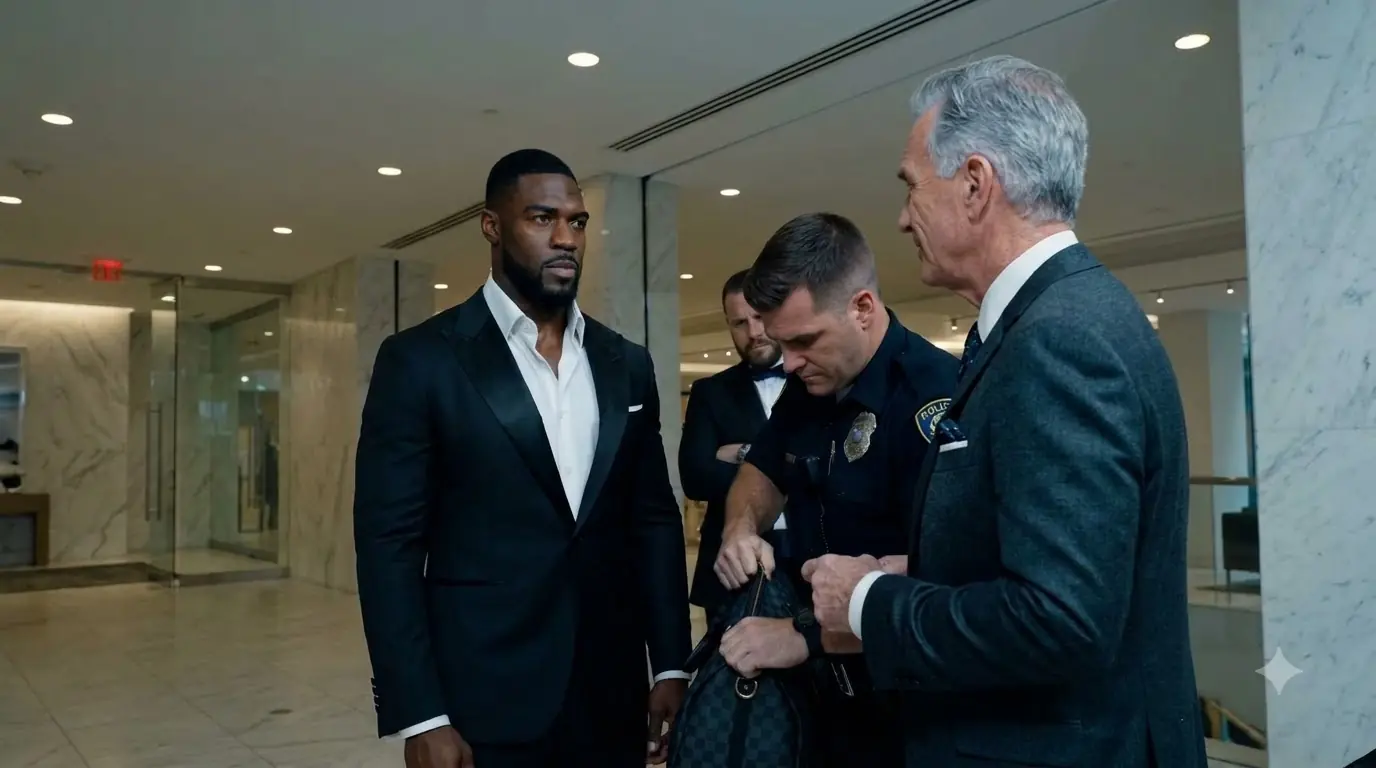
Adrian remained perfectly still. His tailored black jacket sat cleanly over his broad shoulders, and his open-collar white shirt showed no sign of panic despite the officer’s hand hovering beside his holster. At thirty-nine, Adrian had negotiated billion-dollar acquisitions, survived hostile boardrooms, and dismantled companies whose executives underestimated him before he entered the room. An angry police officer and a wealthy man in a blue suit did not frighten him, but the accusation being constructed in front of him demanded patience.
Richard Halston stood beside Mercer with a gold-tipped cane resting against one leg. He was sixty-seven, silver-haired, lean, and dressed in the kind of midnight-blue designer suit that announced old money before he opened his mouth. He had spent twenty-two years as chairman of Sterling Crown’s ownership board and believed that title gave him permanent control over every person who crossed the marble beneath his shoes. Although the sale of the mall had officially closed three days earlier, Richard had not yet informed most tenants that he no longer controlled the property.
The private event that evening was supposed to celebrate the opening of a European jewelry house. Champagne moved between guests on mirrored trays while a string quartet played beneath a glass chandelier imported from Venice. Richard had invited investors, politicians, celebrities, and executives who considered the mall their private social club. Adrian had arrived without an entourage because he wanted to observe the property before management introduced him as its new controlling owner.
He entered through the main doors carrying the same leather bag he used for every acquisition closing. Inside were final ownership documents, a secure tablet, copies of the mall’s financial records, and the black card issued by Cole Meridian Holdings to senior principals. Adrian expected to walk quietly through the building, inspect tenant operations, and meet the night manager in private. He did not expect Richard Halston to turn the evening into a trap.
Richard first noticed him near the entrance of the jewelry boutique. Adrian had paused beside a security camera, studying its position and the dead angle near the east corridor. Richard mistook the inspection for criminal interest and ordered a young sales associate to watch him. When Adrian entered the private lounge without displaying the silver invitation worn by other guests, Richard followed.
“You appear lost,” Richard said.
Adrian looked at him. “I know exactly where I am.”
“This event is invitation only.”
“I’m aware.”
“Then show me yours.”
Adrian glanced toward the old chairman’s cane. “I don’t report to guests.”
Richard’s smile vanished. He had expected embarrassment, perhaps an apology followed by retreat. Adrian’s calm refusal felt like a direct challenge to the hierarchy Richard believed governed the building. He signaled to Officer Mercer, who had been hired for private security duty through the city department’s approved-event program.
Mercer approached with his shoulders already squared. He was forty-two, powerfully built, and known among mall employees for converting minor disputes into public displays of authority. Richard often requested him because Mercer never questioned which guests deserved protection and which people should be removed. The arrangement had benefited both men for years.
“Identification,” Mercer demanded.
Adrian continued watching Richard. “You called an armed officer because I wouldn’t show you an invitation?”
“I called him because you don’t belong here,” Richard replied.
Mercer stepped between them. “I said identification.”
Adrian slowly turned. “Tell me what law I’m suspected of breaking.”
“That attitude is about to become one.”
“An attitude isn’t a crime.”
Mercer grabbed the leather bag from Adrian’s hand before he could pull it away. The officer placed it on a marble bench, forced open the clasp, and began searching without consent. Adrian told him clearly that he did not have permission, but Mercer continued while Richard watched with a satisfied smirk.
The velvet jewelry case appeared beneath a stack of contracts.
Richard pointed immediately. “That came from the boutique.”
Adrian looked at the case, then at Richard. It was not his. He had never seen it before entering the building, and the fact that Richard recognized it so quickly told Adrian everything he needed to know.
Mercer lifted the case and opened it. Inside rested a diamond bracelet valued at more than two hundred thousand dollars. Several guests gasped as Richard accused Adrian of stealing it during the private reception.
The officer pulled Adrian’s belongings from the bag and threw them onto the floor. Mercer demanded identification again, but Adrian did not answer. His attention moved beyond the officer’s shoulder toward the black glass dome mounted above the corridor.
A camera watched the entire scene.
The system had been upgraded two months earlier during acquisition due diligence. Richard believed the cameras still fed only into the local security room, but Cole Meridian had required an independent cloud mirror after auditors discovered irregularities in mall inventory records. Every frame was simultaneously visible to the security director at Adrian’s headquarters.
Adrian tilted his head toward the lens.
Richard’s smirk weakened.
“Looking for someone to rescue you?” Mercer asked.
“No,” Adrian replied. “I’m confirming they can see your face.”
Mercer shoved Adrian’s shoulder.
The businessman moved only half a step, then straightened. A dangerous stillness entered his expression, and several nearby guests instinctively moved backward.
“Do that again,” Adrian said, “and everything attached to your badge becomes evidence.”
Mercer placed one hand beside his weapon. “You threatening me?”
“I’m describing what happens next.”
Richard jabbed a finger toward Adrian’s chest. “Men like you enter through service doors, not ours.”
Adrian looked down at the finger without blinking.
“Take your hand away.”
Richard pressed closer. “You should be grateful security caught you before my guests handled you themselves.”
“Your guests?”
“My building.”
“Not anymore.”
Richard laughed, but the sound came out strained. He understood the mall had been sold, yet he had never seen the buyer’s principal. The acquisition had been conducted through attorneys, holding companies, and encrypted calls because Cole Meridian suspected financial misconduct inside Sterling Crown. Richard assumed the new owner was an overseas investment group that would leave him in operational control.
Adrian’s final words awakened a possibility Richard did not want to consider.
Heavy footsteps suddenly echoed from the west corridor.
Mall manager Daniel Price appeared near the escalators, running so quickly that one side of his jacket hung outside his trousers. Sweat covered his forehead, and he carried a tablet against his chest with both hands. He pushed between guests, nearly colliding with a champagne server before reaching the confrontation.
“Officer,” Daniel gasped. “Stop.”
Mercer did not move. “Step back. Active theft investigation.”
“You need to see this.”
“I said step back.”
Daniel shoved the tablet toward him.
The live security feed showed Adrian entering the mall at 7:14 p.m. with the leather bag zipped and clasped. A second camera followed him into the lounge, where Richard’s personal assistant brushed against Adrian while pretending to stumble. Her hand slipped beneath the bag’s open flap for less than two seconds.
The next angle showed Richard watching from across the room.
Mercer leaned closer to the screen.
Daniel rewound the footage and enlarged the frame. The assistant placed the velvet jewelry case inside Adrian’s bag, then walked directly toward Richard. He whispered something into her ear before signaling Mercer.
The color left the officer’s face.
Richard stepped forward. “That image is manipulated.”
Daniel swiped to another feed. The jewelry boutique’s interior camera showed Richard removing the bracelet from a locked display twenty minutes earlier. He passed it to his assistant behind a decorative column, unaware that the upgraded camera covered the reflection in a mirrored wall.
A third recording contained sound.
“Put it in his bag,” Richard’s voice said clearly. “Mercer will take care of the rest.”
The corridor became silent.
Richard moved away from the tablet as if the image could touch him. Mercer released his grip on Adrian’s shoulder and stared at the scattered belongings across the floor. His breathing changed from aggression to calculation.
“Mr. Halston told me he witnessed the theft,” Mercer said.
Adrian finally looked at him. “So you searched my property without consent, assaulted me, and threatened violence because a wealthy man pointed.”
“I was responding to a report.”
“You were performing for him.”
Richard attempted to leave.
Two mall security officers stepped into his path.
“Move,” Richard demanded.
Neither man obeyed.
Daniel scrolled to a secure ownership profile on the tablet. Adrian’s photograph appeared beside the Cole Meridian Holdings seal, followed by the words CHAIRMAN AND CONTROLLING PRINCIPAL — STERLING CROWN GALLERIA.
Mercer read the screen twice.
Then he looked toward Adrian.
Richard peered over the officer’s shoulder and staggered backward. His cane struck the marble floor with a sharp crack. The man he had called a thief owned the building around him, including the security system that had just dismantled the lie.
Adrian reached slowly inside his jacket.
Mercer flinched and touched his holster.
“Don’t,” he warned.
Adrian removed a heavy black business card and held it between two fingers. Silver lettering identified him as Adrian Cole, chairman of Cole Meridian Holdings and controlling owner of Sterling Crown Galleria.
Mercer accepted the card with a trembling hand.
Richard leaned against the wall.
“You bought the mall?” he whispered.
Adrian’s gaze remained cold. “I bought the debt you buried, the leases you manipulated, and every camera you forgot to check.”
Richard recovered enough composure to straighten his jacket. “This is a misunderstanding.”
“No. A misunderstanding is calling the wrong meeting room. You planted stolen property on me and brought an armed officer to complete the performance.”
“I never touched your bag.”
“The footage shows your assistant did.”
“She acted independently.”
The assistant stood near the boutique entrance, pale and motionless. When Adrian looked toward her, she lowered her head.
Daniel quietly informed them that the camera feed had already been preserved in three independent locations. The security director had also contacted the city’s internal affairs division after hearing Mercer threaten Adrian.
The officer’s knees weakened.
His hand moved away from his holster, and Daniel carefully took the tablet before Mercer dropped it. The weapon remained secured, but his authority had vanished from the corridor.
Mercer looked at Richard. “You told me the cameras near the lounge were offline.”
That single sentence exposed more than he intended.
Adrian’s expression sharpened. “How would he know which cameras you believed were offline?”
Mercer realized the question’s danger.
Richard stared at him in warning.
Neither man answered.
The theft accusation had not been an improvised act of prejudice alone. It belonged to a larger relationship. Adrian had spent three months reviewing suspicious injury claims, missing jewelry, altered incident reports, and insurance settlements connected to Sterling Crown. Each event involved wealthy clients accusing employees, contractors, or visitors who lacked the resources to fight back.
Officer Mercer appeared in seven of those reports.
Richard appeared in five.
The mall’s insurance company paid millions to guests whose losses were confirmed through security summaries written by Richard’s team. Original footage from the incidents had supposedly been corrupted, while edited clips supported the claims. Adrian purchased the property partly because his analysts suspected someone was using the mall as a machine for insurance fraud.
Tonight, Richard had revealed the mechanism.
He selected a target whom the crowd would find easy to suspect. An item was planted, Mercer created an official report, and compromised management supplied convenient footage. The accused person disappeared beneath legal pressure while Richard’s associates collected payments.
Adrian crouched and retrieved one of his documents from the floor.
Mercer instinctively moved to help, but Adrian raised a hand.
“Don’t touch anything else.”
The officer froze.
Daniel ordered the corridor sealed. Boutique doors closed, elevators paused, and security staff redirected guests toward the atrium. Nobody involved in the confrontation could leave until city investigators arrived.
Richard tried to regain control through indignation.
“You cannot detain me inside a commercial property.”
Adrian stood. “You’re free to walk toward any exit.”
Richard glanced at the security officers.
“They’re blocking me.”
“They’re preserving a crime scene. You can wait for police, or you can push through them and create another camera angle.”
Richard remained where he was.
Within seven minutes, two internal affairs investigators entered from the east doors with a police captain and three uniformed officers. Captain Lena Brooks immediately separated Mercer from Richard, secured the officer’s body camera, and instructed him to surrender his weapon.
Mercer stared at her. “Captain, I was responding to a theft.”
“You disabled your camera twelve minutes before entering this corridor.”
“It malfunctioned.”
“The system log says manual deactivation.”
He looked toward Richard again.
Captain Brooks noticed. “Stop looking at him. He is not your supervisor.”
Mercer handed over the weapon.
Internal affairs reviewed the mall footage at the security desk while Adrian’s attorneys joined remotely through Daniel’s tablet. The investigators found that Mercer had entered the building through a service corridor rather than the official police check-in station. He accepted an envelope from Richard’s driver before walking toward the lounge.
The envelope was recovered from Mercer’s locker inside the security office.
It contained ten thousand dollars in cash.
Mercer claimed it was payment for private security work. No invoice, contract, or departmental authorization supported the explanation. His approved overtime rate for the evening was eighty-five dollars per hour.
Richard’s assistant requested an attorney, then asked to speak privately with investigators. She had worked for him for eleven years and knew the scheme had become impossible to protect. Within an hour, she admitted planting the bracelet under Richard’s orders.
She also provided the password to an encrypted drive stored inside his office.
The drive contained spreadsheets tracking staged theft claims, insurance payouts, and payments to officers, security employees, and cooperative witnesses. Several victims had been Black professionals whom Richard believed the mall’s wealthy clientele would instinctively distrust. Others were immigrants, delivery workers, and temporary employees with limited legal protection.
Adrian studied the names.
One belonged to a former maintenance supervisor who had lost his pension after being falsely accused of stealing luxury watches. Another belonged to a young Black woman arrested during her first week as a boutique assistant. Charges against her were dismissed, but her photograph remained online beneath stories repeating the allegation.
Richard watched Adrian read.
“You don’t understand how this property works,” he said. “People expect exclusivity.”
Adrian closed the file.
“Exclusivity isn’t a license to manufacture criminals.”
“I protected the mall’s reputation.”
“You monetized prejudice.”
Richard’s face tightened. “This place was successful before you arrived.”
“It was bleeding money through fraudulent settlements.”
“You’ll destroy everything by exposing it.”
“No. I’ll destroy the people who confused the building with their private hunting ground.”
Captain Brooks placed Mercer under arrest for assault, unlawful search, evidence tampering, bribery, and conspiracy. He did not resist when another officer closed the handcuffs around his wrists. His earlier threat about breaking Adrian’s face had been captured by the mall cameras and dozens of phones.
Richard was taken into custody shortly afterward.
As officers escorted him across the corridor, he stopped near Adrian. The smugness had disappeared, replaced by disbelief that money and reputation had failed to preserve him.
“You set this up,” Richard said.
Adrian looked toward the scattered contents of his bag.
“I walked through my own front door. You built everything else.”
The story spread before midnight.
Guests had recorded the confrontation from multiple angles, but Adrian’s communications team released only a brief statement confirming an active investigation and announcing that Sterling Crown would cooperate fully. He refused to publish the footage of his own humiliation until every victim connected to Richard’s scheme had been contacted privately.
The next morning, Adrian stood inside the mall before hundreds of employees.
He wore a simple navy suit and carried the repaired leather bag. Daniel Price stood nearby, expecting to be dismissed because the fraud had occurred under his management.
Adrian addressed him first.
“You ran toward the truth when staying in your office would have protected your position.”
Daniel lowered his eyes. “I should have discovered it earlier.”
“You discovered it when it mattered.”
Adrian promoted him to interim chief operating officer and ordered him to assemble an independent review team. Every prior theft allegation, use-of-force incident, insurance claim, and employee dismissal from the previous eight years would be reopened.
The mall also ended its private-duty arrangement with Mercer’s precinct pending external review. New rules required body cameras to remain active, all bag searches to receive written consent or proper legal authority, and every security incident to be mirrored automatically to independent storage.
Adrian then spoke to the employees.
“Last night was not wrong because the man they humiliated owned the mall.”
The room became quiet.
“It was wrong because they believed humiliation became acceptable when the victim appeared powerless. Ownership exposed them, but dignity should never depend on a business card.”
Several employees wiped their eyes.
Over the following months, prosecutors charged Richard, Mercer, and four additional participants with conspiracy, insurance fraud, bribery, evidence manipulation, and civil-rights violations. Investigators connected them to seventeen fabricated incidents and more than six million dollars in fraudulent claims.
Mercer lost his badge and pension benefits connected to criminal conduct. Richard’s assets were frozen, including his penthouse, private aircraft share, and accounts used to move settlement money. Several luxury guests who knowingly participated agreed to testify in exchange for reduced charges.
The victims received formal exonerations.
Adrian personally met the former maintenance supervisor whose pension had been taken. He restored the man’s retirement benefits, compensated him for lost wages, and offered him a role advising the mall’s new employee-protection office.
The young boutique assistant returned only once.
She stood in the same corridor where officers had handcuffed her three years earlier. Adrian apologized on behalf of the institution, though he had not owned it then.
“You didn’t do it,” she said.
“No, but I own what happens next.”
She accepted a settlement but declined the job offered to her. Adrian respected the decision. Repair did not require victims to return to places that had harmed them.
Six months after the confrontation, Sterling Crown reopened its main atrium following extensive reforms. The event included employees, community leaders, small-business owners, and former victims once banned from entering.
Adrian arrived carrying the same leather bag.
Its broken clasp had been replaced, but he kept a scratch across the front panel untouched. Daniel once asked why he had not purchased a new one.
“Because repaired things should remember what happened,” Adrian replied.
Near the jewelry boutique, a black glass camera dome reflected the corridor below. Adrian paused beneath it and looked upward.
That camera had not saved him because technology possessed courage. It had saved him because someone on the other side saw the truth and ran toward the confrontation before Richard could erase it.
Daniel joined him.
“Everything ready?”
Adrian nodded. “Open the doors.”
As guests entered, Adrian noticed a young Black man wearing a delivery uniform approaching the main corridor with several boxes. A new security officer stepped forward, offered assistance, and directed him through the closest entrance rather than sending him around the building.
Nobody demanded that he use the service door.
Adrian watched until the man disappeared into the crowd.
Richard Halston had believed the mall belonged to people who dressed like him, paid like him, and treated everyone else as scenery. Officer Mercer believed a badge allowed him to convert that arrogance into force.
They selected Adrian because they thought his presence could be questioned more easily than their power.
They were correct about only one thing.
The real predator had entered Sterling Crown that evening.
It simply was not the Black man standing calmly beside the scattered contents of his bag.