The marble hallway of the Hamilton Federal Courthouse was designed to make people feel the weight of the place.
Every detail carried a message.
The tall white columns.
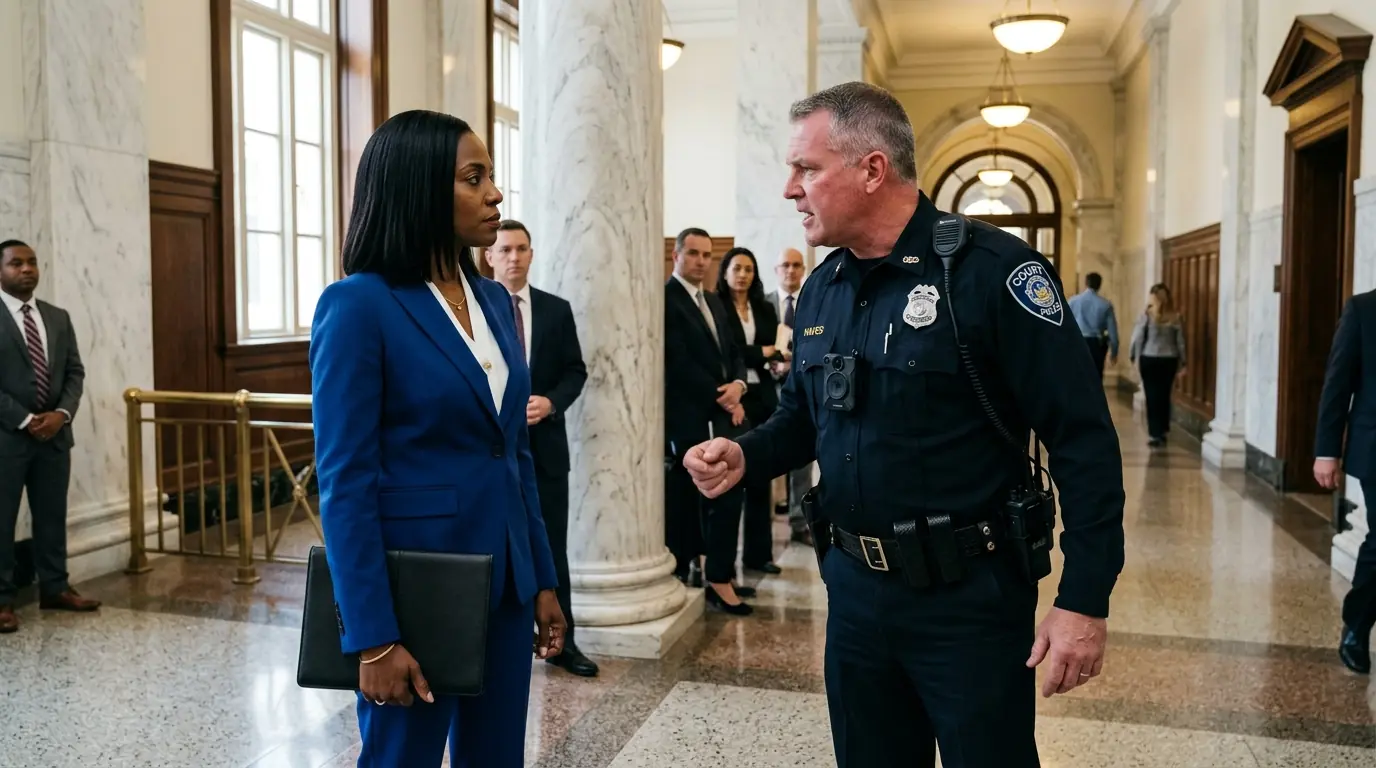
The polished stone floors.
The quiet footsteps echoing beneath the high ceiling.
The framed portraits of former judges lining the walls.
Everything about the building represented one idea.
The law was bigger than any single person.
Every morning, hundreds of people entered those doors.
Attorneys carrying briefcases.
Clerks holding documents.
Witnesses preparing for difficult conversations.
Families waiting for decisions that could change their lives.
And judges walking silently toward courtrooms where their words carried consequences.
For most people, the courthouse was intimidating.
For Judge Victoria Carter, it was familiar.
She had walked those halls for eleven years.
She knew which elevator was always slower.
She knew which courtroom had the strongest air conditioning.
She knew which clerk always arrived early with coffee before sunrise.
The building was not just where she worked.
It was where she had spent a large part of her life serving others.
But on one Tuesday morning, a simple misunderstanding inside those marble walls would reveal something much bigger.
It would reveal how quickly assumptions could replace facts.
Victoria Carter arrived at 8:15 a.m.
She was fifty years old, a Black American woman with deep-brown skin, straight shoulder-length black hair, and a calm expression that rarely changed even under pressure.
People who worked with her often described her the same way.
Focused.
Fair.
Difficult to intimidate.
But those who knew her personally understood something else.
Victoria was not calm because she did not feel pressure.
She was calm because she had spent decades learning how to handle it.
Before becoming a federal judge, she had worked as a prosecutor.
Before that, she had studied law and spent years helping communities understand their rights.
She had seen people lose control in difficult moments.
She had seen anger create bigger problems.
She had seen fear make people forget important details.
So she developed a personal rule.
When the situation becomes emotional, become more precise.
That rule followed her everywhere.
Even outside the courtroom.
That morning, she wore a royal-blue professional suit over a white blouse.
Her jewelry was simple.
Her shoes were practical.
She carried a black folder filled with case notes and documents.
Nothing about her appearance announced her position.
That was intentional.
Victoria had always disliked the way titles changed conversations.
A person who ignored her opinion before knowing her position often became extremely polite after discovering she was a judge.
She never found that meaningful.
To her, respect that appeared only after recognition was not real respect.
It was a reaction to power.
And she believed people deserved better than that.
At 8:20 a.m., Victoria entered the courthouse through the side hallway.
This entrance was commonly used by judges and senior court personnel.
She had access.
She had permission.
She had walked through those doors countless times.
But that morning, the security officer at the hallway entrance was someone she had never met.
Officer Richard Hayes.
Hayes was fifty years old.
A white American police officer with short gray hair, a strong build, and more than two decades of law enforcement experience.
He had spent most of his career believing in strict order.
Follow procedures.
Question unusual situations.
Maintain control.
His coworkers described him as serious.
Some respected that seriousness.
Others believed he sometimes confused confidence with certainty.
Hayes believed experience gave him the ability to recognize problems quickly.
That belief had helped him many times.
But it had also created a weakness.
Sometimes he saw a problem before he had enough information to prove one existed.
That morning, he stood near the restricted hallway entrance checking credentials.
He had been assigned there for only a few weeks.
He knew the regular judges.
The regular attorneys.
The regular employees.
He did not know Victoria.
And that mattered.
Because when she walked toward the hallway, he did not see a judge.
He saw an unfamiliar woman entering a restricted area.
Victoria noticed him watching.
She slowed slightly.
“Good morning.”
Hayes looked at her.
“Morning.”
She continued walking.
Then he spoke.
“Ma’am.”
Victoria stopped.
“Yes?”
“Where are you going?”
Victoria looked toward the hallway.
“Chambers.”
Hayes studied her.
“Whose chambers?”
“Judge Carter’s.”
The officer looked at her.
Then at the hallway.
“Do you have authorization?”
Victoria nodded.
“Yes.”
“Identification?”
“Of course.”
She reached toward her folder.
Hayes immediately raised one hand.
“Slowly.”
Victoria stopped.
She looked at him.
“I am getting my courthouse identification.”
“I understand.”
“Then why tell me slowly?”
Hayes did not answer.
Instead, he said:
“Just show me.”
Victoria opened the folder.
She removed her credential holder.
The card had flipped slightly inside the plastic sleeve.
Hayes saw the credential but not the name.
He looked at the photo.
Then at her.
Then back at the card.
“You need to come with me.”
Victoria frowned.
“For what?”
“I need to verify this.”
“You can verify it here.”
“No.”
His answer was immediate.
Victoria noticed.
Not because the answer was unusual.
Because of the confidence behind it.
“Officer, what exactly are you verifying?”
Hayes looked at her.
“Your access.”
“My access is valid.”
“That is what I’m checking.”
Victoria remained polite.
“Then check it.”
The officer’s expression changed.
“You seem unwilling to cooperate.”
Victoria almost smiled.
“No.”
She shook her head.
“I am asking you questions.”
“That is not cooperation.”
“It can be.”
The hallway became quieter.
A court clerk walking nearby slowed down.
An attorney waiting near the elevator looked over.
Hayes noticed the attention.
He lowered his voice.
“Ma’am, this is a restricted area.”
“I know.”
“Then you understand why I am asking.”
“Yes.”
Victoria looked directly at him.
“But asking is different from assuming.”
Hayes stared.
“What does that mean?”
“It means you are treating me like I have done something wrong before explaining what I did.”
The officer crossed his arms.
“Are you always this argumentative?”
Victoria’s expression stayed unchanged.
“No.”
“Then what is this?”
“Clarification.”
Hayes shook his head.
“You’re making this harder than it needs to be.”
Victoria answered immediately.
“No.”
She looked at him.
“You are.”
That response irritated him.
Not because it was disrespectful.
Because it was accurate.
Hayes stepped closer.
“I need you to follow instructions.”
“I am willing to follow reasonable instructions.”
“Reasonable according to who?”
“The law.”
The word hung between them.
Hayes looked at her differently now.
Not as someone confused.
As someone challenging him.
That was the moment his interpretation changed.
The conversation was no longer about access.
It became about authority.
“Turn around.”
Victoria looked surprised.
“Why?”
“I said turn around.”
“For what purpose?”
Hayes took a breath.
“Further questioning.”
“Am I being detained?”
“Yes.”
“Under what reason?”
Hayes paused.
The hesitation lasted only a second.
But several people noticed.