He had the badge, the credentials, the authority, but still he was treated like a suspect.
This is what happened next.
Have you ever noticed how the wrong look at the wrong time can flip your whole day upside down?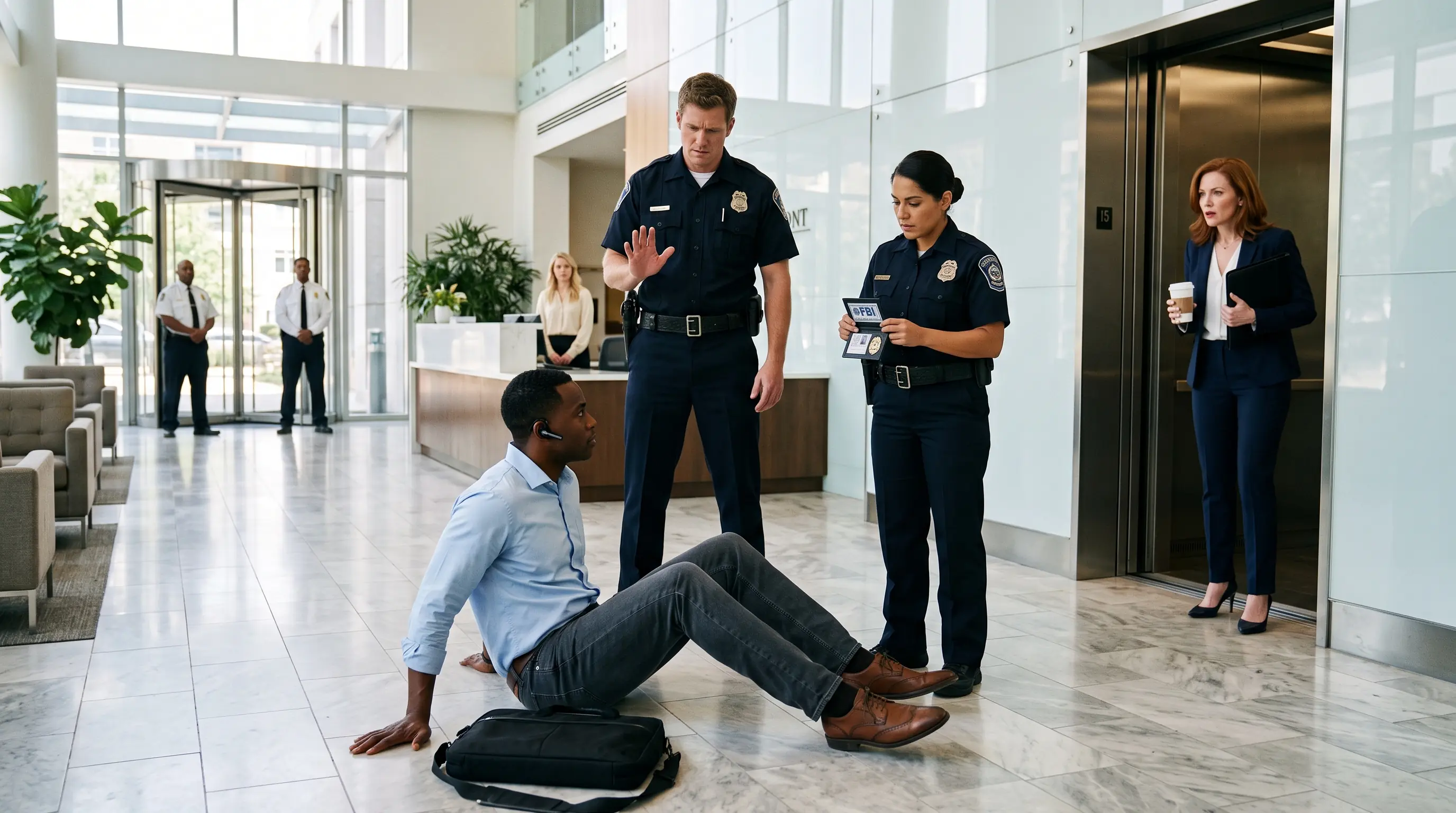
It was a Tuesday morning, just after 10:15. The lobby of the Fairmont Business Center in Arlington, Virginia, was the kind of place where nothing much happened. Rows of gray armchairs. Fake plants in big ceramic pots. A front desk manned by someone who hated their job quietly enough to get through it.
People came and went, mostly in silence. No one looked too long at anyone else.
Except today.
Julian McCall walked in with quiet confidence, like a man who knew exactly where he was going. He wore dark jeans, a clean button-down shirt, and carried a black laptop bag slung over his shoulder. His posture was sharp, alert, but not aggressive. Just focused.
On his way through the glass double doors, he nodded politely at the security guard near the desk.
No response.
Julian made his way to the waiting area and stood near the wall, scrolling through his phone, listening to something in his Bluetooth earpiece. Every now and then, he spoke quietly, too quietly for anyone else to make out what he was saying.
To most people, it would have looked like a man preparing for a business meeting.
But not to everyone.
From behind the curved reception desk, Tara Bledsoe, a new administrative assistant at Greybridge Analytics, squinted at him. She leaned slightly toward her colleague and whispered, “You know that guy?”
The other woman glanced up briefly, shrugged, and went back to typing.
Tara did not let it go.
Her eyes narrowed.
“He’s been pacing. Talking to himself. Looks off.”
She did not know Julian. She did not ask who he was. But the pieces in her head clicked in the wrong order: dark clothes, Bluetooth, standing alone, quiet voice.
Instead of walking over and asking if he needed help, she picked up the desk phone and dialed building security.
“Hey, we’ve got someone out front. Not sure what he’s doing. Might want to check it out.”
She used the words “acting suspicious.”
That was enough.
Upstairs on the fourth floor, Julian’s contact at Greybridge was running late. He had no idea what was about to go down downstairs.
Julian stayed where he was, not knowing that someone had just made a call that would change the next seven minutes of his life.
But downstairs, two officers were already pulling into the lot, responding to a call that had left out some key details.
The call came through to Arlington County PD dispatch as a possible suspicious person inside a commercial property. No weapons. No direct threats. Just vague enough to make it sound low priority, but pointed enough that it could not be ignored.
Officer Travis Denim and his partner, Officer Paulina Reyes, were the closest unit. Both had been on the force for a few years. Not rookies, but not veterans either.
Denim was the type who took every call seriously. Maybe too seriously.
Reyes was quieter, more observant. She tended to ask more questions before making moves.
“Male, late thirties, Black, standing in the lobby, pacing, talking into a Bluetooth,” the dispatcher read off. “Caller said he might be scoping the place out.”
“Scoping?”
“Could be nothing,” Reyes said flatly. “Or something.”
She checked her body camera and got out.
Inside, Tara watched the patrol car from the window, arms folded across her chest like she was waiting for proof that she had not overreacted.
Julian still stood near the wall, now reviewing files on his phone. He shifted his weight to one side, opened a PDF, and quietly said into his mic, “Subject confirmed. Location secured. Waiting for contact.”
The doors opened behind him.
“Sir, can we speak with you for a moment?”
Denim’s voice echoed across the marble floor.
Julian looked up, confused at first.
“Sure. What’s this about?”
“Mind stepping away from the wall? Hands visible.”
Julian blinked. He was not panicked. Just thrown off.
“I’m with the Bureau. Just here for a scheduled meeting.”
“Bureau of what?”
“FBI.”
Denim raised an eyebrow.
“Got ID on you?”
“Yeah,” Julian said calmly, reaching for his bag. “Let me grab it.”
“Sir, don’t reach.”
Julian froze. His hands stopped mid-motion.
The lobby, already too quiet, became still.
“I just said I’m reaching for my credentials,” Julian replied, still calm but firmer.
Reyes stepped a little closer, watching both men.
“Can you set the bag down and open it slowly?”
Julian knelt, unzipped the bag slowly, and placed it on the ground.
“My badge is in the side pocket. You can take it out yourself if you’d rather.”
Denim did not move right away. His jaw tightened.
Julian stayed perfectly still.
“I’m here to meet with someone from Greybridge Analytics. Surveillance inquiry. You can call Agent Jennifer Rhodes from the FBI field office in D.C. if you want to verify.”
They did not call.
Reyes’s eyes flicked toward Tara, still standing behind the reception desk. The assistant did not say a word. She did not explain what she saw or why she called.
“Sir, we need you to sit on the floor, hands where we can see them,” Denim said louder this time.
Julian slowly lowered himself down, never breaking eye contact.
But upstairs, the elevator had just started moving, and the person inside was about to change everything.
Julian sat on the cold tile floor, palms flat, his laptop bag untouched beside him. His breathing stayed steady, but his eyes tracked every movement the officers made. Where their hands hovered. How close they stood. What was not being said out loud.
Across the lobby, Tara fidgeted. She was not sure what she expected would happen, but it was not this. She looked at the floor, then at Julian, then at the officers, then back at the floor again.
Her face tightened.
She did not say a word.
Officer Denim kept his stance wide and his voice firm.
“Are you armed, sir?”
Julian replied evenly.
“Yes. Bureau-issued Glock 19, concealed right hip, fully authorized. Credentials are in the side pocket of my bag.”
Denim did not respond right away.
He did not move forward.
He did not check the ID.
He just watched Julian like he was trying to catch a lie forming in the air.
Officer Reyes took a half step toward the bag.
Julian saw it.
“Left side zip. Silver badge case with photo ID inside. I’m Special Agent Julian McCall. Badge number 79261.”
Reyes crouched, unzipped the side pocket, and carefully removed the badge case.
She opened it.
There it was.
Photo. Badge. Credentials.
Everything real.
Everything valid.
Her eyes flicked back to Julian, then up at Denim.
“Looks legit,” she said quietly.
Denim did not relax.
“Still need to confirm,” he muttered.
Julian did not look surprised.
“You can radio FBI field ops in D.C., or you can call Agent Jennifer Rhodes directly. I’m sure she’ll answer.”
He sounded calm, but it was the kind of calm you wear like armor.
The tension kept thickening even though Reyes now had everything she needed to verify the situation. It was as if Denim did not know how to de-escalate once he had already escalated. Like backing down meant losing control.
The lobby doors opened again.
Two building security guards entered, one older, one new. Neither said much. They just took in the scene: a federal agent on the floor, two cops hovering above him, and a receptionist looking like she wished she had never picked up the phone.
The older guard whispered something to Reyes. She nodded.
Julian shifted slightly.
“Look, I’m not trying to be difficult, but I’m not a threat. I’m just doing my job. I’m not going to reach for anything without you saying so.”
Reyes stood fully now, holding the badge case in her hand. She looked at Denim.
“We should call it in.”
But Denim did not respond. He was staring at Julian, less convinced he was dangerous now, but still unsure what to do with him.
It had only been five minutes.
It felt like thirty.
Then came the sound they did not expect.
The soft ding of the elevator behind them.
Someone was arriving who did not need to guess who Julian was.
The elevator doors slid open, and out stepped Agent Jennifer Rhodes, sharp as ever in a navy pantsuit, shoulder-length red hair tucked behind one ear, FBI badge clipped at her waist. She held a slim portfolio in one hand and a travel coffee in the other.
She looked ready for a briefing.
Not a confrontation.
But the moment her eyes landed on the scene, Julian sitting on the floor, two officers standing over him, the lobby tense as a coiled spring, she stopped cold.
“What the hell is going on?”
Her voice cut clean through the silence.
Everyone turned.
Julian did not even flinch.
“Good morning, Jennifer.”
She walked forward, not hurrying, but not slow either.
“Why is my lead investigator on the floor?”
Officer Denim hesitated.
“Ma’am, we responded to a suspicious person call. This man—”
“This man,” Jennifer interrupted, “is Special Agent Julian McCall. He’s here with my full authority. You’ve got his badge in your hand, so I’ll ask again. Why is he on the floor?”
Officer Reyes stepped in.
“Ma’am, we were told he was behaving strangely. Security asked us to check it out. He said he had a weapon, so we followed protocol.”
Jennifer did not raise her voice, but it was clear she was no longer just asking.
“Did he resist?”
“No.”
“Did he threaten anyone?”
“No.”
“So you saw a Black man standing in a lobby with a Bluetooth in his ear, and the immediate next move was to put him on the ground.”
She looked at Denim.
“That what we’re doing now?”
He did not answer.
Julian stood slowly.
“Seven minutes,” he said, brushing off his jeans. “That’s how long I sat there while they stared at me like I might blow up the building.”
Jennifer’s jaw tightened.
“You’re good to go,” she told him.
Then she turned to Reyes and handed her a business card.
“If either of you wants to confirm who he is, my direct number is on there. But let me save you the trouble. He’s been with the Bureau twelve years. I’ve worked with him for six. If you looked him up, you’d find more letters of commendation than most agents rack up in two decades.”
Reyes took the card.
Denim did not.
Tara from the front desk stepped forward awkwardly.
“I… I just wasn’t sure. I didn’t want to take chances.”
Julian finally looked at her. Not angry. Just tired.
“You know what the funny part is?” he said, voice level. “I was standing right next to the directory. You could have just asked my name.”
Tara did not respond. Her mouth opened, then closed again.
But Jennifer was not done, and the next thing she said hit harder than anything yet.
She stepped closer to the officers, her tone still calm but edged with something sharp enough to cut through the awkward silence.
“Before I walked into this building,” she said, “Agent McCall reviewed a personnel file. A police officer applied for transfer to the Behavioral Analysis Unit. That file crossed his desk this morning.”
She turned her head slightly toward Denim.
“And unless I’m mistaken, that name was Travis Denim.”
You could have heard a paperclip drop.
Denim blinked like he had not heard her correctly.
“Excuse me?”
Jennifer looked him in the eye.
“You applied. You listed your academy record, your field time, even the incident where you de-escalated a domestic call without backup. Solid file, honestly.”
Julian crossed his arms.
“I flagged it for interview. Thought you had good instincts. Thought you might be someone who sees people clearly.”
Denim’s throat moved, but no words came out.
“You were ten minutes away from making your first impression with the Bureau,” Jennifer added. “And now here we are.”
Reyes shifted her stance slightly, shooting a glance at her partner. The reality of the moment was settling in fast, and it was heavier than either officer expected.
Tara, still nearby, turned slowly and began walking back behind the desk, her presence shrinking with every step.
No one stopped her.
Julian kept his voice calm.
“This is why we talk about bias. Because it doesn’t have to look violent to be dangerous. Sometimes it’s just a phone call, or a decision not to ask questions, or a hand near a holster for seven minutes straight while someone waits for permission to exist.”
Denim finally spoke.
“I didn’t know.”
Jennifer did not soften.
“That’s the problem, Officer Denim. You didn’t want to know. You saw what you expected to see.”
There was no yelling. No raised voices. Just two FBI agents and two local cops standing on a clean lobby floor that now felt like a courtroom.
Julian looked at Reyes.
“You read my badge. You knew it checked out.”
Reyes nodded slowly.
“I did.”
She looked down for a second.
“I didn’t press the issue. I should have.”
Julian nodded once. Not angry. Not bitter. Just clear.
“We don’t get to choose the moments that test us,” he said. “Only how we handle them.”
The elevator behind Jennifer dinged again.
Another passenger stepped out. This time, an executive from Greybridge finally arriving for the meeting Julian had scheduled an hour earlier. He paused, confused by the sight.
Jennifer looked at Julian.
“We still doing the briefing?”
Julian grabbed his bag.
“Yeah. Let’s go.”
But just before they left, Julian turned back and said one last thing, something that would stick with Officer Denim long after that day ended.
He turned around slowly, one hand resting on the strap of his bag. He looked right at Denim, who was now standing a little too still, as if part of him wanted to disappear into the floor.
“I want you to remember something,” Julian said, his voice low and steady. “The only difference between you and me in this lobby was that I knew who I was.”
Denim did not answer.
He did not have anything to say.
For the first time all morning, he did not even seem like a cop. Just a man standing in a uniform that suddenly felt too big.
Reyes looked between the two of them, her expression harder to read now. Thoughtful, maybe even ashamed. She opened her mouth like she wanted to say something, but did not.
Julian did not wait.
He turned and walked toward the elevator again, stepping inside beside Jennifer.
Tara stood half hidden behind the front desk, holding her phone like it might protect her from what she had witnessed. She did not speak. She did not apologize.
But her face said everything.
Jennifer pressed the button for the fifth floor. The doors began to close.
Then, at the last second, Julian’s voice slipped out again, soft, almost quiet enough to miss.
“Seven minutes,” he said. “That’s all it took to almost ruin a career and maybe end a life.”
The doors shut.
Upstairs, the tone was different.
Julian did not walk like a man who had just been humiliated. He walked like someone who had seen it before too many times. Every time, it stung a little less. Not because it did not hurt, but because it had started to feel expected.
Jennifer glanced sideways as they walked down the hallway toward the conference room.
“You all right?”
Julian shrugged.
“I’m fine. Just tired.”
Jennifer did not press.
They entered the briefing room, where a digital screen already displayed Greybridge’s logo and a list of names tied to the cybercrime case they were working. Julian connected his laptop and began pulling up files like nothing had happened.
Business as usual.
But downstairs, things were not the same.
Officer Reyes approached Denim quietly.
“You okay?”
He did not answer right away.
“I applied to the Bureau because I wanted to do something more,” he finally said. “Make a real difference.”
Reyes nodded slowly.
“Maybe today was your first chance to do that.”
Denim exhaled, eyes still locked on the empty elevator doors.
“Didn’t feel like it.”
Reyes looked back at the reception desk. Tara had left. Her screen still glowed, but her seat was empty.
“No,” she said. “It didn’t. But maybe it still can.”
What Julian did not know yet was that one of these officers was not just shaken.
They were about to make a choice that would completely shift how the story ended.
The meeting upstairs wrapped an hour later. Julian closed his laptop and shook hands with the cybersecurity team, his face unreadable, professional, composed. But there was still a weight in his shoulders that had not been there earlier that morning.
As he stepped into the hallway with Jennifer, she handed him her car keys.
“You want me to walk down with you?”
Julian shook his head.
“I’ve got it.”
Jennifer hesitated, then nodded.
“I’ll call you later.”
He gave her a small nod and took the elevator down alone.
No music. No noise. Just the soft mechanical hum and the blinking floor numbers overhead.
When the doors opened on the lobby, he did not expect anyone to be waiting.
But Officer Reyes was still there, leaning against a column, arms crossed, expression quiet. Not defensive. Not detached. Just real.
Julian walked past her without stopping, but she stepped forward.
“Agent McCall.”
He paused.
Reyes took a breath.
“I stayed because I wanted to say something. Not because someone told me to.”
Julian looked at her, but did not speak.
“You were right,” she continued. “I read your badge. I saw the credentials. But I still stood there and let it play out like you were lying. I didn’t ask why. I didn’t challenge my partner. I just watched.”
Julian’s voice was low.
“Why are you telling me this now?”
“Because I don’t want to be another person who sees the truth too late and just walks away.”
He studied her face.
She was not trying to save face. She was not performing. There was no badge to flash now. Just a woman trying to own her silence.
“Apologies don’t fix much,” Julian said.
“I know they don’t. They don’t erase fear or undo years of this.”
“I know that, too. But accountability starts with hearing yourself say it out loud. Most people don’t even get that far.”
Reyes nodded.
“I thought I knew what bias looked like. I didn’t realize it could wear a uniform like mine.”
Julian finally gave her a small, tired smile.
“It wears all kinds of things. Suits. Scrubs. Security shirts. It even sits behind reception desks.”
She smiled faintly at that.
“You think Denim still has a shot at the Bureau?”
Julian’s face grew serious again.
“He does. But only if he’s honest with himself first. The Bureau doesn’t need people who carry power without understanding it.”
Reyes stood quietly as Julian walked past her toward the glass doors.
Before stepping out, he paused and looked back.
“Tell him the interview’s still on,” he said. “But I won’t be the one doing all the talking.”
The last scene was unexpected, quiet, and waiting for Julian just outside those glass doors.
The glass doors slid open with a soft hiss. Julian stepped outside into the overcast afternoon. The parking lot was half full. Birds chirped somewhere overhead. Tires hissed on wet pavement in the distance.
It should have been just another walk to the car.
But near the far side of the lot, leaning against a patrol cruiser with his arms folded, stood Officer Denim.
Julian’s pace slowed.
Denim looked up, saw him, and straightened.
For a long second, neither of them said anything.
Then Julian approached. Not out of invitation, exactly. More out of something closer to curiosity.
“You waiting for something?” Julian asked.
Denim shook his head.
“Just didn’t want to leave like that.”
Julian did not answer.
Denim spoke again, this time looking straight ahead.
“This morning, I thought I knew who I was. I thought I was the guy who didn’t let this stuff happen on his watch.”
“And now?” Julian asked.
Denim looked at him.
“Now I think maybe I’ve just been lucky that no one ever challenged that belief.”
Julian let the silence hang a moment.
“You know,” he said, “in the Bureau, we deal with patterns. Behavior. Psychology. Subconscious decisions people don’t even realize they’re making.”
Denim listened.
“But what we don’t talk about enough,” Julian continued, “is how we aren’t immune to the same patterns we’re trained to spot in others.”
Denim lowered his eyes.
“I messed up.”
Julian nodded slowly.
“Yeah. You did. But this isn’t about protecting your ego. It’s about whether you’re willing to learn something uncomfortable and keep showing up.”
Denim looked back at him.
“I still want the Bureau job.”
Julian met his eyes.
“Then earn it.”
He handed Denim a folded sheet of paper from his bag.
“What’s this?” Denim asked.
“A prep sheet for your interview. Extra questions. Scenarios. Real ones. Use it or don’t. Your call.”
Denim unfolded it, eyes scanning the page.
Julian turned to leave, then paused.
“Next time you walk into a room,” he said, “don’t just see what’s there. Ask yourself what you might be missing.”
Then he walked off toward his car, keys already in hand.
Denim stood alone in the lot, holding a piece of paper that weighed more than it should have. Not because it was heavy, but because it carried a mirror he had not been ready to look into before today.
The truth is, stories like this do not always end in shouting matches or handcuffs.
Sometimes they end in quiet realizations, in questions no one wants to ask themselves, in awkward silences that finally give way to understanding.
We cannot fix what we do not face.
And we cannot move forward if we keep pretending there is nothing to fix.
Silence does not make us safe.