Three knocks.
That was all it took to change Henry Owens’s life forever.
The seventeen-year-old opened the door of his cramped apartment while still wearing his pajamas and froze. 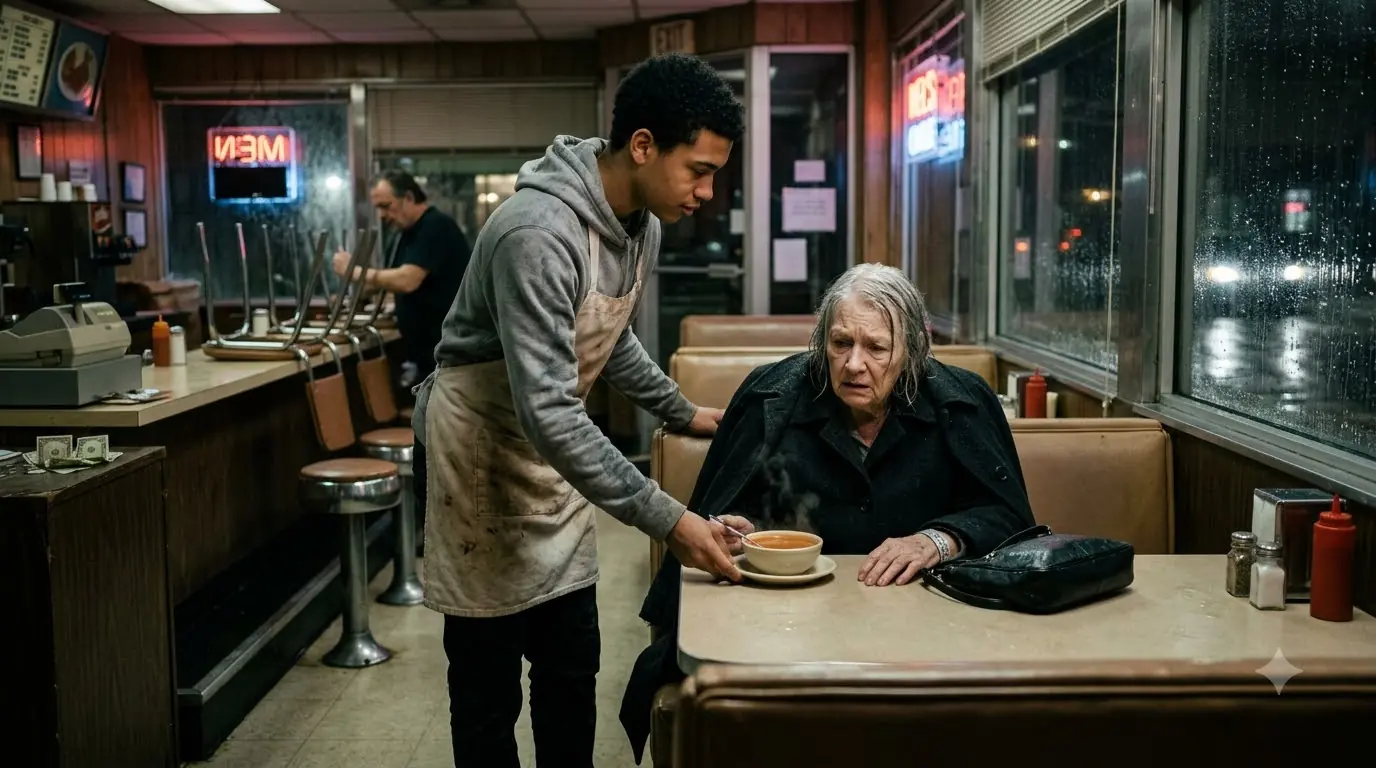
A stranger stood in the hallway dressed in an expensive suit, his gray hair neatly combed, while a black town car waited at the curb behind him—a vehicle that did not belong in this South Philadelphia neighborhood.
“Henry Owens?” the man asked.
Henry’s heart began to pound.
“Yes.”
“I need to speak with you about Friday night,” the stranger said. “About what you did for my mother.”
The freezing rain. The confused elderly woman. The twelve dollars—Henry’s last twelve dollars—that he had given away without thinking twice.
He had not known her full story. He had not known where she came from or what kind of life she had lived. He had only known that she was frightened, cold, and in need of help.
Henry had no idea what was about to happen.
Nothing in his life would ever be the same again.
Two days earlier, Henry’s alarm screamed at 4:47 in the morning. He slapped it silent before the second ring, careful not to wake his mother, who was sleeping on the pullout couch six feet away.
Their studio apartment was so small that Henry sometimes joked he could touch both walls if he stretched his arms wide enough. The old radiator clanked and hissed beside the window, making the kind of noise people stopped hearing after living with it for years.
Henry’s feet touched cold linoleum.
February in Philadelphia had settled into the walls. The thermostat remained at sixty-two degrees because raising it any higher could turn the electric bill from difficult into impossible.
He tiptoed into the bathroom, splashed cold water over his face, and studied himself in the mirror. Dark circles had formed beneath his eyes.
Sleep had become a luxury.
Henry worked three jobs while maintaining a 3.8 grade-point average. Some nights, he slept four hours. On better nights, he managed five.
In the kitchen, which was little more than a corner containing a hot plate and a miniature refrigerator, Henry made instant coffee. It was the cheapest brand in the store, the kind that tasted like burnt rubber but cost barely more than a dollar for an entire container.
His mother stirred on the couch.
“Baby, are you up already?”
Janet Owens’s voice was rough with exhaustion. She had returned less than twenty minutes earlier from an overnight shift cleaning floors at a hospital.
The work paid minimum wage. She regularly accepted double shifts because one income had never been enough to cover rent, food, utilities, and medication.
“Go back to sleep, Mom,” Henry said. “You just got home.”
“Did you eat something?”
“Yeah. I’m good.”
It was a lie.
There were crackers in the cupboard and less than a spoonful of peanut butter left in the jar. That would have to be breakfast.
Henry checked the balance in his bank account.
Thirty-four dollars and fifty cents.
Rent was due in five days.
Eight hundred ninety dollars.
His chest tightened as he stared at the number.
Not now, he told himself. He could not think about it now.
Two letters rested on the table.
One made him smile every time he saw it. The other made him want to scream.
The first was an acceptance letter from Stanford University. Henry had been admitted with a full tuition scholarship.
It was supposed to be his way out. His future. Proof that the hours spent studying after midnight had meant something.
The second letter contained the financial aid breakdown.
Tuition was covered, but housing, books, travel, insurance, and additional fees were not. Henry would need to find approximately eight thousand dollars before the semester began.
Eight thousand dollars.
He had submitted forty-seven scholarship applications.
Every one of them had been rejected.
Henry slipped the letters back into their envelopes, grabbed his backpack, and quietly left the apartment.
The bicycle ride to Jefferson High School took forty minutes. Henry could have taken the bus, but the fare was two dollars and fifty cents each way.
Five dollars a day did not sound like much to most people.
To Henry, five dollars a day was food. It was medicine. It was part of the rent.
So he pedaled.
Rain or shine, snow or heat, Henry rode his bicycle through the city.
That morning, the wind cut through his thin jacket. His legs burned as he pushed uphill, and his breath formed white clouds in the freezing air.
School was the easiest part of his day.
Classes made sense to him. Teachers respected his discipline. Henry was not always the most naturally gifted student in the room, but nobody worked harder.
Mrs. Patterson, his English teacher, stopped him in the hallway before first period.
“Henry, have you made your decision about Stanford?”
He forced a smile.
“I’m still figuring it out.”
Her expression tightened with concern.
“The deposit deadline is in six weeks. You cannot wait too long.”
“I know. I’m working on it.”
What he did not tell her was that he was working on finding eight thousand dollars while earning nine dollars an hour.
He was working on keeping his mother supplied with diabetes medication that cost three hundred forty dollars each month.
He was working on holding together a life built from overdue bills, exhausted promises, and carefully stretched meals.
Mrs. Patterson placed a hand on his shoulder.
“You are going to do great things, Henry. I believe in you.”
He wanted to believe her.
At lunch, Henry sat with his friends while they discussed prom, college, and summer plans.
Jamal had received a full scholarship to Howard University. Tasha had been accepted by Penn State, and her parents were planning a graduation party. Their friend Mack intended to take a gap year because he had decided college was not the right path for him.
“What about you, Henry?” Tasha asked. “Stanford, right? That’s huge.”
“Yeah,” Henry said. “If I can figure out the money.”
“Just ask for more financial aid,” Jamal replied, as if it were that simple.
Henry did not argue.
His friends had families with savings, safety nets, and options. Henry’s family had him, and he was only seventeen, holding everything together with duct tape and prayer.
After school came his first job.
From 3:30 until six, Henry bagged groceries at SaveMore. He earned minimum wage, smiled at every customer, helped elderly shoppers load their cars, and collected shopping carts from the parking lot.
His manager, Mr. Carter, was a decent man. He gave Henry consistent shifts and never asked why the teenager sometimes ate the broken cookies discarded by the bakery department.
At 6:15, Henry biked to Green’s Diner.
It was his favorite job, though it did not pay particularly well. Henry earned nine dollars an hour plus tips, but the diner felt more like a family than a workplace.
Mr. Green, the owner, was sixty-eight years old and had operated the restaurant for three decades. He had a gruff voice, a soft heart, and a habit of pretending not to care about people he quietly helped.
“Henry,” he barked when the teenager entered. “You’re late.”
“I’m five minutes early, Mr. Green.”
“You are usually ten minutes early. That makes you late.”
Henry grinned.
It was their routine.
The diner smelled of coffee, bacon grease, and old vinyl. Worn red booths lined the windows. The floor was covered in black-and-white tiles, and an old jukebox in the corner played nothing but Motown songs.
Mrs. Washington always left him an extra five dollars and told him it was for college. That evening, she arrived at seven, ordered her usual meatloaf with mashed potatoes, and slipped a crumpled bill into his hand before leaving.
“For Stanford, baby,” she whispered.
Henry wanted to cry.
Instead, he smiled.
“Thank you, Mrs. Washington.”
Five dollars.
Every little bit helped.
At the end of the evening shift, Henry counted his tips.
Twenty-three dollars and forty cents.
Combined with what he had already saved, it brought him closer, though still nowhere near the amount he needed.
Tomorrow would be another day, another shift, and another opportunity to move toward an impossible number.
Henry did not know that the final hour of that night would change everything.
At 8:47, the sky opened.
It was not ordinary rain. Freezing rain struck the windows and coated the streets with a thin layer of ice.
Henry stood near the diner window, watching the final customers hurry toward their vehicles with their collars pulled high against the cold.
Mr. Green wiped down the counter.
“We’re closing early. This weather is getting ugly.”
Henry nodded.
If he left soon, he might be able to bicycle home before the roads became too dangerous. He began cleaning tables and stacking chairs.
His phone buzzed.
A message from his mother appeared.
Working overnight. Extra shift. Be safe. Love you.
Henry smiled faintly.
The extra shift meant more money.
They needed it.
Then the bell above the diner door chimed.
An elderly woman stumbled inside.
She was completely drenched. Gray hair clung to her face, and an expensive wool coat hung heavily from her shoulders, saturated with rain.
Her expression stopped Henry cold.
She looked terrified and deeply confused.
The woman gripped the doorframe as though she might fall.
“Ma’am?”
Henry dropped the plates he was carrying onto the nearest table and rushed toward her.
“Are you all right?”
She looked at him without appearing to see him.
“I—I was supposed to…”
Her voice faded.
Mr. Green came around the counter.
“Lady, we’re about to close.”
“She needs help,” Henry said, cutting him off.
He guided the woman toward the corner booth. She moved slowly and unsteadily.
Up close, Henry noticed that her lips had a faint bluish color. Her hands were trembling uncontrollably.
She was dangerously cold.
The woman wore pearl earrings that looked real, a silk scarf embroidered with a monogram, and a medical alert bracelet partially hidden beneath her coat sleeve.
She collapsed onto the booth seat and struggled to catch her breath.
“Please,” she whispered. “I need something warm. Soup.”
Her speech was educated and refined. Whatever had happened to her, she did not appear to live on the streets.
Henry hurried behind the counter, poured a glass of water, and returned.
The woman attempted to lift it, but her hands shook so badly that the water spilled over the rim.
“Let me help.”
Henry held the glass while she drank.
“Thank you,” she managed. “I’m so cold.”
“What’s your name?”
She paused, struggling to recall it.
“Catherine. Catherine Sterling, I think.”
“You think?”
Tears formed in her eyes.
“I can’t remember. I was at the doctor downtown, and then I was walking, and I couldn’t find…”
She opened her purse with trembling fingers and stared inside.
“My wallet. Where is my wallet?”
Henry’s concern deepened.
Something was seriously wrong.
“Do you know where you live, Catherine?”
She closed her eyes and concentrated.
“Chestnut Hill. The house with the iron gates. Edward loved the fountain.”
She suddenly stopped.
“Where is Edward?”
“Is Edward your husband?”
“He’s gone.”
Her voice broke.
“Five years. I forget sometimes.”
Catherine searched her purse again. Several prescription bottles rattled together.
The medical alert bracelet came fully into view.
Henry looked out the window.
The freezing rain was intensifying. The temperature was dropping, and the streets were becoming dangerously slick.
If Catherine walked back into the storm, she might not survive.
“Let me get you some soup,” Henry said. “You need to warm up.”
She looked at him with desperate gratitude.
“I don’t have any money. I can’t find my wallet.”
“Don’t worry about it.”
“But I can’t just—”
“Please. It’s all right.”
Henry walked toward the register.
Mr. Green raised an eyebrow.
“Kid, we’re closing.”
“She needs soup. She’s freezing, she’s lost, and she doesn’t know where she lives.”
“That is unfortunate, but we are not a shelter.”
Henry reached into his wallet.
Twelve dollars.
Six one-dollar bills, one five-dollar bill, and four quarters.
It was everything he had until his next paycheck. It was breakfast money, bus fare, and the thin safety net between him and having nothing.
Henry looked at Catherine shivering in the booth.
He looked at her bluish lips.
Then he looked at the storm outside.
“Tomato soup,” he told Mr. Green. “And crackers.”
Mr. Green stared at him.
“You sure?”
Henry counted the money once.
Then twice.
Then a third time.
Twelve dollars.
“Yeah,” he said. “I’m sure.”
He handed over the bills.
Mr. Green took them slowly, entered the order, and disappeared into the kitchen.
A few minutes later, he placed a bowl of hot tomato soup on the counter.
Henry carried it to Catherine.
Steam rose from the bowl.
She wrapped both trembling hands around it as though it were the most valuable thing in the world.
“Thank you,” she whispered. “I don’t even know your name.”
“Henry. Henry Owens.”
“Henry Owens,” she repeated slowly. “I need to remember that.”
She began eating.
Color gradually returned to her face while Henry remained beside the table, watching a stranger warm herself with the meal he had purchased using his last twelve dollars.
He did not know that a security camera in the corner was recording everything.
He did not know that the confused woman sitting in the booth was one of the wealthiest people in Philadelphia.
Within forty-eight hours, Catherine would remember his name.
Nothing would ever be the same.
Catherine ate slowly, her hands still trembling around the spoon.
Henry sat across from her and watched the blue color fade from her lips. It was a good sign, but the confusion remained.
“Where do you live?” he asked again.
“Chestnut Hill. I told you. The house with the gates.”
“Do you remember the address?”
Her face clouded.
“I…no. I can’t.”
Panic crept into her voice.
“Why can’t I remember?”
“It’s okay,” Henry said quickly. “It’s all right. Do you have a phone?”
Catherine searched through her purse, removing a compact, tissues, and several pill bottles.
“No phone. I must have—I don’t know where it is.”
Henry tried to think.
Catherine needed to get home, but she did not know the address and had no phone, money, or identification.
Then he noticed the medical bracelet again.
“Catherine, may I look at your bracelet?”
She extended her arm without hesitation.
Henry leaned closer and read the engraving.
Catherine Sterling. Alzheimer’s patient. If found, call emergency contact Marcus Sterling.
A telephone number followed.
Henry’s heart sank.
Alzheimer’s disease explained the confusion, memory loss, and terror in her eyes. Catherine was not merely lost. She was vulnerable and had been wandering through freezing rain.
“Catherine,” Henry said carefully, “your bracelet has an emergency number. May I call it so someone can help you get home?”
She looked at the bracelet as if she had never seen it before.
Then she nodded.
“Yes, please. I want to go home.”
Henry pulled out his phone.
The battery had dropped to twelve percent. He had forgotten to charge it the previous night.
He dialed the number.
It rang once.
“Mom?”
A man answered immediately. His voice was desperate and frantic.
“Where are you? We’ve been looking everywhere.”
Henry swallowed.
“Sir, my name is Henry Owens. I’m at Green’s Diner on Tasker Street in South Philadelphia. Your mother is here. She’s safe.”
There was silence.
Then Henry heard what sounded like a sob of relief.
“Oh, thank God. Thank God.”
The man’s voice cracked.
“Is she all right? Is she hurt?”
“She’s cold and confused, but she’s warming up. She had some soup. She doesn’t have her wallet or phone, and she cannot remember her address.”
“We have had a security team looking for her for three hours,” the man said rapidly. “She had an appointment at the Jefferson Hospital memory clinic at six. She was supposed to meet her driver afterward, but she never arrived.”
Henry looked at Catherine.
“She mentioned a driver named Victor.”
“That’s right.”
There was muffled conversation in the background. Someone appeared to be crying.
The man returned to the phone.
“Henry, I cannot thank you enough. We are sending a car now. Can you remain with her? Twenty minutes, please.”
“Of course. I’ll stay as long as she needs me.”
“How is the weather there? Is she warm enough?”
“She’s inside. She has soup, and she’s warming up.”
The man’s voice broke again.
“You have no idea what you have done. Thank you. What is your full name? I need to know who saved my mother.”
“Henry Owens, sir. But I’m only glad she’s safe.”
“Henry Owens,” the man repeated. “I will not forget that name. Victor will be there soon. Please keep her safe.”
“I promise.”
Henry ended the call.
“Your son is sending Victor to pick you up,” he told Catherine. “You will be home soon.”
Relief flooded her expression.
“Marcus called Victor?”
“Yes. They have been looking for you.”
“I got lost.”
Tears spilled over her cheeks.
“I couldn’t remember. I tried so hard.”
Henry reached across the table and gently squeezed her hand.
“You’re safe now. That’s what matters.”
Catherine gripped his hand.
“You’re a good person, Henry Owens.”
Mr. Green had been watching from behind the counter.
He approached and placed a cup of hot tea beside Catherine.
“On the house,” he muttered.
Catherine looked up at him.
“Thank you.”
Mr. Green nodded and returned to the counter, but Henry saw something new in the older man’s expression.
Respect.
The next twenty-three minutes felt much longer.
Henry sat with Catherine and kept her talking so she would remain calm and oriented. He asked about the house, the fountain, and Edward.
Catherine told him the fountain had been installed for their thirtieth wedding anniversary. She could see it from her bedroom window.
Sometimes she lost the thread of the story halfway through a sentence. She would pause, become confused, and begin again.
Henry never rushed her.
Outside, headlights appeared through the rain.
A black Lincoln Town Car stopped at the curb.
“That’s Victor,” Catherine said with sudden clarity.
The driver’s door opened, and an older man with silver hair hurried through the rain.
He burst into the diner, saw Catherine, and visibly sagged with relief.
“Mrs. Sterling. Thank God.”
Catherine stood unsteadily.
“Victor. There you are. I’ve been waiting.”
Victor crossed the room and supported her arm.
Then he turned toward Henry.
“You’re Henry?”
Henry nodded.
Victor gripped his hand firmly. His eyes were red.
“Mr. Sterling told me what happened. Thank you for caring for her.”
“I’m just glad she’s safe.”
Victor helped Catherine into her coat.
Only then did Henry realize that she was still wearing his jacket, which he had draped around her shoulders earlier.
“Wait,” he said. “That’s my jacket.”
Catherine started to remove it.
“No, keep it until you reach the car. It’s cold outside.”
Victor looked closely at Henry.
He saw the thin shirt, worn shoes, and exhaustion around the teenager’s eyes.
“Son, give me your contact information. The family will want to thank you properly.”
“That isn’t necessary.”
“Please.”
Henry wrote his name and telephone number on a napkin.
Victor folded it carefully and placed it inside his coat pocket.
At the door, Catherine looked back.
“Henry Owens,” she said. “Henry Owens. I need to remember. You helped me.”
She repeated the name as though trying to secure it inside her failing memory.
“Just get home safely,” Henry said.
Victor opened an umbrella and guided Catherine toward the waiting vehicle. He helped her into the back seat and gently closed the door.
Before entering the driver’s seat, Victor looked back at the diner and raised a hand in gratitude.
The Lincoln pulled away.
Its taillights disappeared into the storm.
Henry stood beside the window, suddenly aware of how cold he felt without his jacket.
Mr. Green walked up beside him.
“That was a good thing you did, kid.”
“She needed help.”
“You gave her your last twelve dollars.”
Henry shrugged.
“She needed it more than I did.”
Mr. Green removed his wallet and counted out twenty dollars.
“Take this.”
“Mr. Green, I can’t.”
“You can, and you will.”
He pressed the money into Henry’s hand.
“What you did tonight was special. Now get home before the weather finishes you off.”
Henry’s throat tightened.
“Thank you.”
He grabbed his backpack and went outside.
The freezing rain struck him like a wall.
His bicycle remained chained to the rack. Henry unlocked it, climbed on, and began the long ride home.
He was soaked within minutes. His hands became numb, and his legs burned as the wheels slipped over icy pavement.
Henry did not regret the twelve dollars.
Catherine was safe.
That was what mattered.
He could not have known that fifteen miles away, Marcus Sterling was watching footage from the diner.
He saw Henry pull out the bills and count them three times. He saw the hesitation, the sacrifice, and the final decision.
Marcus began making plans.
Plans that would change Henry’s life forever.
The apartment was dark when Henry stumbled through the door at 10:38 that night.
He was soaked and shivering so violently that his teeth chattered.
Janet was still at the hospital working the overnight shift. Without her, the apartment seemed even smaller and emptier than usual.
Henry removed his wet clothing and hung it over the radiator.
The old metal pipes clanked and hissed but produced barely enough warmth to dry anything.
He opened the cupboard.
Crackers.
Henry ate them while standing because he was too tired to sit.
His phone buzzed.
A low-battery warning appeared.
Five percent.
He connected it to the charger and collapsed onto his bed.
The evening replayed inside his mind. Catherine’s confused expression. Her trembling hands. The way she repeated his name in a desperate attempt to hold on to it.
Alzheimer’s disease.
Henry’s heart ached for her.
He had noticed the expensive clothes and jewelry, but none of it had protected her from becoming lost and frightened.
Some things money could not repair.
Henry reached into his pocket and found a business card that had fallen from Catherine’s purse. He had picked it up and intended to return it, but forgotten during the confusion.
The card was thick and heavy, with gold embossed lettering.
Catherine Sterling
Founder and Chairwoman
Sterling Global Enterprises
An address in Center City and a private telephone number appeared below her name.
Curiosity overcame Henry.
He searched for Catherine Sterling online.
The results loaded slowly through the apartment’s weak internet connection.
Then the screen filled with articles.
Sterling Global Enterprises was a Fortune 500 company with major holdings in real estate development, venture capital, infrastructure, and community investment.
A professional photograph appeared.
Catherine looked nothing like the confused woman from the diner.
In the photograph, she wore a navy suit and stood in front of a glass office building. Her silver hair was perfectly styled, and her eyes looked sharp, confident, and commanding.
Henry scrolled.
Estimated net worth: 4.7 billion dollars.
The phone nearly slipped from his hand.
He read the figure again.
Four point seven billion.
Henry had just helped a billionaire.
He sat upright, unable to process it.
The woman who could not find her wallet or remember her address was one of the wealthiest people in Philadelphia.
Yet on that freezing night, her money had meant nothing.
She had still been lost, cold, and frightened.
Henry wondered how many people had seen her wandering and chosen not to help.
Rich or poor, Catherine had been a human being in danger.
Henry was glad he had stopped.
He would make the same choice again.
He placed the business card on the nightstand beside the Stanford letter.
The contrast was impossible to ignore.
Catherine had built a multibillion-dollar company but could no longer trust her memory.
Henry had almost nothing except his intelligence, his mother, and the choices he made.
He fell asleep hoping Catherine had reached home safely.
Saturday passed quietly.
Henry woke around nine to find his mother returning from work. He told her what had happened at the diner, describing the elderly woman, the bracelet, the soup, and the emergency telephone call.
Janet listened with tears forming in her eyes.
“Baby, you did a good thing.”
“I just hope she’s okay.”
“That disease is frightening.”
Janet hugged him.
“Rich or poor, everyone struggles. You treated her like a person. That matters.”
Henry showed her Catherine’s business card.
Janet’s eyes widened.
“A billionaire?”
“I didn’t know, Mom. She only needed help.”
“That’s why I’m proud of you.”
The rest of Saturday was ordinary.
Henry completed homework and used Mr. Green’s twenty dollars to buy rice, beans, and eggs.
The numbers had not changed.
Rent was still due Thursday.
Stanford still required eight thousand dollars.
On Sunday morning, Henry woke to the smell of eggs cooking on the hot plate.
His mother had prepared breakfast.
They sat together at the tiny table.
“What do you want to do today?” Janet asked.
“Rest. Spend time with you.”
She smiled.
“Perfect.”
At 9:03, someone knocked.
Three sharp knocks.
Henry and Janet looked at one another.
They rarely received visitors.
“Are you expecting someone?” she asked.
“No.”
Henry approached the door and looked through the peephole.
A tall man in an expensive suit stood in the hallway. Through the street-facing window behind him, Henry could see a black Lincoln Town Car parked outside.
His stomach dropped.
He recognized the vehicle.
Henry opened the door.
The man extended his hand.
“Henry Owens?”
“Yes.”
“My name is Marcus Sterling. I’m Catherine’s son—the woman you helped Friday night.”
He paused.
“May I come inside? I need to speak with you.”
Henry stepped aside.
Marcus entered the tiny apartment. A woman in a gray suit followed him.
“This is Victoria Hayes,” Marcus explained. “My executive assistant.”
Janet appeared from the kitchen, her protective instincts immediately alert.
“Henry, what’s going on?”
“Mom, this is Marcus Sterling. His mother is the woman I helped Friday.”
Janet’s eyes widened.
Marcus offered his hand.
“Mrs. Owens, you have raised an extraordinary young man.”
She shook his hand cautiously.
“Please sit. Can I make you some coffee?”
“That’s kind, but please don’t trouble yourself.”
Marcus’s eyes swept across the apartment.
He saw the worn couch, the Stanford letter on the table, the medical bills on the kitchen counter, and the radiator struggling to warm the room.
He noticed everything.
Marcus and Victoria sat on the pullout couch. Henry and Janet took the two chairs across from them.
Marcus leaned forward.
“Henry, I need to tell you what happened Friday.”
Henry’s heart pounded.
“My mother was diagnosed with Alzheimer’s disease eight months ago.”
Janet placed a hand over her mouth.
“On Friday, she had an appointment at Jefferson Hospital’s memory clinic. After the appointment, she was supposed to meet our driver in the parking garage on level three, section B.”
Marcus paused, struggling to control his emotions.
“She went to level two, section C.”
When Catherine could not find Victor, she panicked.
She could not remember the correct level, his telephone number, or the plan they had made.
“She left the hospital and began walking,” Marcus continued. “By the time anyone realized what had happened, she had already disappeared into the city.”
Janet reached for Henry’s hand.
“We had a security team searching,” Marcus said. “The police were involved. We were terrified.”
Victoria opened a tablet.
“We reconstructed her route through traffic and security cameras.”
A city map appeared with red dots marking Catherine’s path.
“She wandered for nearly two hours,” Victoria said.
Marcus swiped to a series of images captured at different locations.
“Seventeen people clearly saw her.”
In one image, a woman pulled her child closer and crossed the street.
In another, a man pointed toward a shelter and continued walking.
A shop owner stepped outside and warned Catherine to move away from his entrance.
A bus driver refused to let her board when she could not find money or explain where she needed to go.
Tears filled Marcus’s eyes.
“My mother built a Fortune 500 company. She donated millions to hospitals, schools, and community programs. But when she was frightened and vulnerable, people treated her like she was invisible.”
He looked directly at Henry.
“Then she walked into Green’s Diner and met you.”
Marcus placed the tablet on the coffee table.
“I need you to see something.”
Security footage from the diner began playing.
The image was grainy but clear enough.
Catherine stumbled inside. Henry rushed toward her. He brought water, helped her drink, and guided her to the booth.
Then the footage reached the register.
Henry pulled the money from his wallet.
Marcus paused the video and enlarged the image.
“Watch.”
The footage showed Henry counting the twelve dollars once.
Then twice.
Then a third time.
The struggle appeared plainly on his face before he handed the money to Mr. Green.
Marcus’s voice cracked.
“Twelve dollars. That was all you had?”
Victoria opened a briefcase.
“Our foundation has a standard screening process for scholarship candidates,” she said carefully. “We conducted a legal financial and educational review after receiving your information from the diner.”
She placed several documents on the coffee table.
Bank records. School transcripts. Scholarship applications. Janet’s medical bills.
Janet stiffened.
“You investigated us?”
Marcus met her eyes.
“I needed to understand who this young man was. I needed to understand why someone with so little gave away what he had to save my mother.”
He pointed to Henry’s bank balance.
“Your account contained thirty-four dollars and fifty cents that morning. You gave away twelve dollars—more than one-third of everything you had.”
Henry’s throat tightened.
Marcus picked up another document.
“You submitted forty-seven scholarship applications. Every one was rejected.”
He placed the Stanford acceptance letter beside it.
“Stanford gave you a full tuition scholarship, but you need eight thousand dollars for housing, books, and additional expenses.”
Janet began to cry.
Marcus lifted another page.
“Your mother’s medication costs three hundred forty dollars each month. She has accumulated forty-two hundred dollars in medical debt.”
He looked at Henry.
“You knew what that twelve dollars meant, and you gave it away anyway.”
Marcus restarted the recording.
This time, the tablet played audio from the telephone call.
Henry heard his own voice.
“Sir, my name is Henry Owens. I’m at Green’s Diner on Tasker Street in South Philadelphia. Your mother is here. She’s safe.”
Then Marcus’s voice came through the speaker, breaking with relief.
“Oh, thank God. Thank God.”
The recording continued through Henry’s calm explanation and his promise to remain with Catherine until Victor arrived.
Marcus stopped the audio and wiped his eyes.
“Do you understand what that call meant to me? To my family?”
He displayed a series of text messages from Friday night.
8:13 p.m.: Security team reports no sign of Catherine.
8:47 p.m.: Police expand the search radius.
9:02 p.m.: Marcus writes to the family group, Please, God, let her be safe.
9:11 p.m.: Incoming call from an unknown number.
“That was you,” Marcus said. “You called from a phone with almost no battery to tell me my mother was alive.”
He looked down.
“The medical team said that if she had remained outside another thirty minutes, the exposure could have caused a fatal medical crisis.”
His gaze returned to Henry.
“You did not merely buy her soup. You saved her life.”
Henry could not speak.
Marcus leaned back and took a breath.
“After she came home, my mother could not stop talking about you. She kept repeating your name.”
Henry Owens.
Henry Owens helped me.
Find Henry Owens.
Marcus removed a folded sheet of paper from his jacket.
The handwriting was unsteady.
Henry Owens saved my life. Do something. Make it matter. —C.S.
“My mother’s memory is deteriorating,” Marcus said. “She forgets conversations from an hour earlier. She forgets appointments, names, and sometimes entire days.”
His voice dropped to a whisper.
“But she remembered you.”
Catherine had written Henry’s name in three separate journals. She had saved a photograph captured from the diner’s security footage on her phone.
“She made me promise that no matter what she forgets, I will remind her that Henry Owens saved her life.”
Janet was sobbing quietly.
Henry’s vision blurred.
“She also made me promise something else,” Marcus continued. “She wanted us to do something for you. Something that honors what you did.”
He opened his briefcase and removed a leather folder.
“Three months ago, before my mother’s condition became undeniable, she proposed creating a new scholarship.”
“Not a scholarship for valedictorians or star athletes,” Victoria added. “A program for students whose character is demonstrated through their choices.”
“Then Friday happened,” Marcus said. “You proved exactly what she had been looking for.”
Inside the folder were documents, letters, and a check.
“Henry,” Marcus said quietly, “my mother wants to change your life. I want to help her do it.”
He slid the first document across the table.
It was a check made payable to Henry Owens.
Eight thousand dollars.
The memo line read: Stanford University housing and educational expenses.
Henry stared at the amount.
“I can’t accept this. I didn’t help your mother for money.”
“I know,” Marcus said gently. “That is exactly why we are giving it to you.”
Janet read the check over Henry’s shoulder, her hands trembling.
Marcus placed a second document on the table.
“Your mother has been enrolled in the Sterling Family Foundation Medical Assistance Program. Her diabetes medication, doctor visits, and related treatment will be covered for four years.”
He turned to Janet.
“We also paid the forty-two hundred dollars in outstanding medical debt. It is finished.”
Janet’s knees weakened.
Henry caught her before she fell.
Both of them were crying.
Marcus placed a third document beside the others.
“Twelve months of rent have been paid in full. Ten thousand six hundred eighty dollars was transferred to your landlord this morning.”
The room seemed to spin around Henry.
Marcus allowed them a moment before continuing.
“That is the thank-you. What comes next is the opportunity.”
He removed a leather-bound charter.
Embossed across the cover were the words Sterling Character Scholarship Initiative.
“Fifty million dollars over ten years,” Marcus said. “One hundred students selected annually, not simply for grades, but for character.”
Victoria explained the selection standards.
Acts of kindness. Community service. Personal sacrifice. Integrity under pressure. Leadership demonstrated when no reward was expected.
Marcus looked at Henry.
“You will be the inaugural recipient. The first Sterling Character Scholar.”
Henry’s voice was barely audible.
“Why me?”
“Because seventeen people had the opportunity to help my mother,” Marcus said. “You were the only person who did.”
He displayed the image of Henry counting his money.
“You knew what the twelve dollars represented. Meals, transportation, survival. You gave it away anyway.”
Marcus held Henry’s gaze.
“That was not luck. It was not convenience. It was character. That is what my mother wants to invest in.”
He pushed a final folder across the table.
Henry Owens
Sterling Character Scholar
“This package provides a full scholarship to Stanford, professional mentorship, living support, and a structured career pathway. Its total value over four years is approximately four hundred fifty thousand dollars.”
Henry’s hands shook as he opened it.
“The question is not whether you deserve it,” Marcus said. “The question is whether you will accept it.”
Page after page contained numbers that did not feel real.
Victoria guided Henry through the details.
“Education support begins with full coverage of Stanford tuition, housing, books, insurance, and required fees. The estimated value is eighty-two thousand dollars annually for four years.”
More than three hundred thousand dollars.
“There is also a fifteen-thousand-dollar annual living stipend for food, personal expenses, and emergencies,” Victoria continued. “A three-thousand-dollar technology allowance will cover a laptop, software, and academic supplies.”
Janet’s tears fell onto the pages.
“The travel allowance provides four round-trip flights each year so Henry can return home during breaks.”
Victoria turned the page.
“Professional development includes a paid summer internship at Sterling Global Enterprises. Twenty-five dollars an hour, forty hours a week, for ten weeks each summer.”
Marcus continued.
“You will receive personal mentorship from me and members of our senior leadership team. There will be quarterly meetings with an executive success coach and annual professional-development workshops.”
He pointed to another section.
“After graduation, you will receive a guaranteed interview and conditional job offer in our community development division. The expected starting salary is seventy-five thousand dollars with full benefits.”
Henry could barely process the information.
“But there is more,” Marcus said. “You will not only receive this scholarship. You will help us build it.”
Henry would assist in reviewing future applications. He would speak at fundraising events, school assemblies, and conferences.
He would mentor younger scholarship recipients and eventually serve on the program’s selection committee.
“You will help represent what character-based educational investment looks like,” Victoria said.
“The requirements are straightforward,” Marcus explained. “Maintain at least a 3.0 GPA. Complete forty hours of community service each quarter. Submit progress reports and attend the annual Sterling Scholars Summit.”
He paused.
“And commit yourself to paying the opportunity forward.”
Henry shook his head slowly.
“Why me? I only bought soup and made a telephone call. Anyone would have done it.”
“But they did not,” Marcus said.
He pulled up the map again.
Seventeen red dots appeared.
“We have evidence of seventeen people who saw my mother. Traffic footage, private security cameras, and witness statements allowed us to reconstruct every interaction.”
He showed Henry the images one by one.
A woman pulled her child close and crossed the street.
A man pointed toward a shelter without asking what Catherine needed.
A shop owner threatened to call the authorities if she did not leave.
“My mother wore a four-hundred-dollar coat and real pearl earrings,” Marcus said. “She was not unhoused. She was ill.”
His voice broke.
“People saw a problem instead of a person.”
He looked at Henry.
“You saw a person.”
Janet finally spoke.
“My son does not think he is special.”
Marcus turned to her.
“Mrs. Owens, being special is not about being different from everyone else. It is about making a different choice when the choice matters.”
He unfolded a timeline.
“Friday at 8:47, my mother entered the diner. Henry’s shift was ending. The storm was worsening, and he had twelve dollars until payday.”
Marcus pointed to the security timestamp.
“At 8:51, he made his decision in three seconds.”
For the remainder of the evening, Henry sat with Catherine, kept her calm, listened to her stories, and helped orient her.
“At 9:11, he called me. He asked for nothing. His only concern was getting my mother home safely.”
Marcus pointed to the final time.
“At 9:34, Henry remained until Victor arrived. He could have left once the soup was purchased. His shift was over, and the weather was dangerous, but he stayed.”
Marcus’s eyes filled again.
“That is not ordinary kindness. It is character. It is leadership.”
Henry looked down at the scholarship folder.
“What if I’m not good enough? What if I fail? What if I cannot live up to what you believe I am?”
The room fell silent.
Marcus leaned forward and placed a hand on Henry’s shoulder.
“Listen to me. You have already proven you are good enough.”
He gestured toward the documents.
“You work three jobs. You maintain a 3.8 GPA. You were admitted to Stanford on merit. You help care for your mother. When you had twelve dollars to your name, you gave it to a stranger.”
His voice softened.
“You have lived under impossible standards your entire life. This is not about proving yourself again. This is about finally receiving support that matches your character.”
“We are not looking for perfection,” Victoria added. “We are looking for someone real.”
Janet wiped her eyes.
“What do we need to do?”
Marcus removed a final document.
“Accept the scholarship and sign the agreement. The Stanford check is available today. Medical coverage begins tomorrow. The rent has already been paid.”
He placed a pen beside the papers.
“Everything changes today if Henry says yes.”
Henry looked at his mother.
He saw hope in her eyes, but also the exhaustion created by years of double shifts, medical bills, and fear.
He looked at the Stanford letter.
His dream had seemed close enough to touch yet impossible to reach.
He looked at the eight-thousand-dollar check, the exact amount that had kept him awake so many nights.
Then he looked at Marcus Sterling, a billionaire’s son who had come to South Philadelphia on a Sunday morning to sit inside a cramped apartment and offer him a future.
Henry picked up the pen.
His hand shook so badly that he struggled to hold it.
“Yes,” he whispered. “Yes. Thank you. I don’t know how to thank you enough, but yes.”
Marcus smiled while tears ran down his face.
“You already thanked us. You saved my mother.”
Henry signed his name.
Marcus stood and extended his hand.
“Welcome to the Sterling family, Henry.”
They shook hands.
Then Marcus pulled him into an embrace.
Janet hugged Victoria, and both women cried.
Inside that tiny apartment, something shifted.
A life changed.
A future opened.
A legacy began.
Three months later, the Philadelphia Inquirer published Henry’s story on the front page.
The article included an image from the diner’s security footage showing Henry counting the twelve dollars in his hand.
Within hours, the story spread across the country.
Local television stations requested interviews. National news organizations contacted the Sterling Foundation. People wanted to hear from the teenager in South Philadelphia who had given everything he carried to help a frightened stranger.
Henry gave the same answer in every interview.
“I didn’t do anything extraordinary. I just didn’t look away.”
The world disagreed.
In May, Henry graduated from Jefferson High School as valedictorian with a final GPA of 3.9.
His graduation speech was brief.
“We should help people not because helping is easy or because we expect a reward. We help because we are human. That is what I did. It is what all of us are capable of doing.”
The audience gave him a standing ovation that lasted nearly three minutes.
Catherine Sterling sat beside Janet Owens.
Marcus held his mother’s hand throughout the ceremony.
Catherine leaned toward Janet.
“Your son saved my life.”
Janet whispered back, “Your family saved his.”
After the ceremony, five students approached Henry to ask about the Sterling Character Scholarship.
The ripple effect had already begun.
August brought Stanford’s move-in day.
The Sterling Foundation flew Janet to California with Henry. It was the first time either of them had traveled by airplane.
Catherine and Marcus met them on campus and helped arrange the dormitory room.
The room was modest but beautiful. Henry’s desk stood beside a window overlooking palm trees.
Janet cried through most of the afternoon.
“My baby is really here,” she repeated.
Campus media covered Henry’s arrival. During freshman orientation, nearly six hundred students heard the story of the freezing night in Philadelphia.
Afterward, twenty students asked for more information about scholarships based on service and character.
Henry realized the program had already become larger than his personal story.
He thrived during his first semester.
He studied economics, public policy, and ethics, finishing with a 3.8 GPA.
Every Sunday, Henry called his mother through video chat.
The transformation in Janet’s life was visible.
With consistent medication, she no longer rationed her pills. She reduced her hospital schedule to one job and enrolled in online accounting courses.
“You are not the only person with dreams,” she told him.
Henry volunteered twelve hours each week at a community center in East Palo Alto.
He tutored three students from low-income households.
One of them, Maria, was preparing college applications and would be the first person in her family to attend a university.
“I don’t think I’m smart enough,” she told Henry.
He remembered forty-seven rejection letters and the twelve dollars he had counted three times.
“Being smart enough is not the real question,” he said. “The question is whether you are willing to try.”
Maria was eventually accepted by six colleges.
Henry wrote her recommendation for the Sterling Scholarship.
In November, the Sterling Foundation officially launched the Character Scholarship Initiative at the headquarters of Sterling Global Enterprises.
The announcement took place inside a glass building in downtown Philadelphia before a room filled with reporters, educators, students, and nonprofit leaders.
Marcus stood at the podium first.
He announced a fifty-million-dollar commitment over ten years, designed to support one hundred students annually.
Catherine spoke next.
Her delivery was slower than it had once been, and she occasionally looked at Marcus for reassurance, but that day her thoughts were clear.
“Character matters more than perfection,” she said. “Kindness matters more than credentials.”
She looked toward the cameras.
“When I was lost and frightened, Henry Owens did not see a billionaire or a helpless stranger. He saw a human being.”
The quotation spread online within an hour.
Henry appeared through a live video connection from Stanford.
“This program is not searching for perfect grades,” he said. “It is searching for young people who choose kindness when no one is watching.”
Applications opened on December 1.
The foundation’s website crashed within minutes under the number of visitors.
By the end of the month, more than three thousand four hundred applications had arrived.
During winter break, Henry returned to Philadelphia and joined the selection committee.
The stories inside the applications broke his heart and restored his faith at the same time.
One applicant was a girl who had spent more than two thousand dollars of her babysitting earnings to purchase groceries for elderly neighbors during a public health crisis.
Another was a boy living inside a shelter who organized a winter clothing drive and collected four hundred fifty coats.
One student had created a free tutoring group inside her apartment building and taught twenty younger children.
Another teenager spent his birthday money to pay a classmate’s overdue lunch account after learning the student was being punished for a debt his family could not afford.
The committee selected twelve scholars for the inaugural class.
The combined educational value of the awards was approximately 2.8 million dollars.
Catherine held the announcement photograph with trembling hands.
“This is legacy,” she whispered to Marcus. “Not buildings. This.”
The community surrounding Henry changed as well.
Green’s Diner experienced a dramatic increase in customers after people learned where the story had begun.
Mr. Green framed Henry’s original receipt and created a pay-it-forward board where customers could purchase meals for people who could not afford them.
Within six months, the board had provided one hundred fifty-six free meals.
Mr. Green raised employee wages and hired two additional workers.
Jefferson High School created the Henry Owens Character Award, a one-thousand-dollar annual scholarship for graduating seniors who demonstrated integrity and service.
Alumni donated twelve thousand dollars during the first year, securing the award for more than a decade.
The first recipient was Maya Rodriguez, a student who had spent every lunch period tutoring children with special needs.
Henry returned to the school to present the award.
He stood before eight hundred students.
“I’m not a hero,” he told them. “I simply did not look away. None of you should look away either.”
Twenty-three students approached him afterward to ask about applying for the Sterling Scholarship.
Five other restaurants in Philadelphia created pay-it-forward meal programs.
A community organization launched the Sterling Kindness Challenge, encouraging residents to document acts of service throughout the city.
More than two thousand acts were recorded during the first six months.
Schools began using Henry’s story in lessons about character, civic responsibility, and compassion.
Posters displayed Catherine’s words:
He did not see a billionaire or a helpless stranger. He saw a human being.
That was the world they were trying to build.
One choice at a time.
Exactly one year after the night at the diner, Henry walked down Tasker Street shortly after six in the evening.
Cold air stung his cheeks.
The winter felt much like the year before, but everything else had changed.
Henry was home from Stanford during the break. His freshman year was progressing well, and for the first time in his life, the future no longer felt like something that might disappear if he stopped working for a single moment.
Green’s Diner came into view.
The building had been renovated with new paint and repaired booths, but the heart of the place remained unchanged.
Henry pushed open the door.
The bell chimed.
Mr. Green looked up and grinned.
“The scholar is back.”
They embraced.
Mr. Green’s eyes were wet.
Henry slid into a booth.
Not the corner booth.
That one now carried a small brass plaque.
January 12, 2024
Where Kindness Changed Everything
The original receipt was framed beside it, surrounded by photographs and newspaper clippings.
Mr. Green brought Henry coffee without asking and sat across from him.
They talked about Stanford, Janet’s classes, the twelve scholars, and the diner’s pay-it-forward program.
“One hundred fifty-six meals this year,” Mr. Green said. “Your story made people better.”
Henry looked at the board.
Thirty-one meals had already been prepaid for the coming weeks.
Before leaving, he quietly added two hundred dollars from his internship earnings.
Mr. Green noticed but said nothing.
He only nodded.
At 7:15, Henry stood and buttoned his coat—the good one his mother had purchased using her first holiday bonus.
The door chimed again.
A young Latina girl entered.
She appeared to be about fourteen. Her thin jacket was soaked, and she looked exhausted and frightened.
She approached the counter.
“How much is the tomato soup?”
“Six dollars and fifty cents,” Mr. Green answered gently.
The girl searched her pockets.
She placed a handful of coins and crumpled bills on the counter.
Four dollars and eighty-five cents.
Her face fell.
“I thought I had enough. I’m sorry.”
She turned toward the door.
Henry reached the register before she took three steps.
“I’ve got it.”
She looked at him.
“You don’t have to.”
“I know.”
Henry smiled.
“But someone did something similar for me exactly one year ago tonight.”
He paid for the soup and removed a Sterling Scholarship information card from his wallet.
“If you’re thinking about college someday, contact this program. We help students with strong character and difficult circumstances.”
The girl accepted the card with trembling hands.
“Just promise that someday, when you are able, you will help someone else.”
Her eyes filled with tears.
“Thank you. I won’t forget.”
“Remember the person you help, too.”
The girl sat inside the booth bearing the brass plaque.
Mr. Green raised his coffee mug from across the room.
Henry nodded.
Outside, January rain began to fall.
Henry looked through the window one last time.
The girl was eating the hot soup, warming herself while reading the scholarship card with new hope in her eyes.
Another circle had begun.
Another life might be changing.
Henry finally understood what Catherine had been trying to teach him.
The story had never been only about him.
It was about what happened when one person refused to look away.
A telephone call had saved Catherine’s life. Her gratitude had opened a future for Henry. That future had created opportunities for students, meals for strangers, and acts of service across an entire city.
Character revealed itself when no one was watching.
Its effects continued long after the moment had passed.
Henry had once counted his final twelve dollars three times before deciding to help a frightened stranger.
That choice became a scholarship, a movement, and a tradition.
Catherine had possessed billions, yet on the night she became lost, her wealth could not tell her where she lived or protect her from the cold.
Only another person’s choice could do that.
Seventeen people saw her wandering.
Sixteen continued walking.
Henry stopped.
The cameras recorded his decision, but most acts of character are never recorded. They happen quietly, without witnesses, applause, or the promise of reward.
Somewhere, another person was counting the little they had and deciding whether they could afford to help.
Henry had learned that kindness was not always something people offered after securing their own comfort.
Sometimes kindness meant choosing another person’s humanity while your own life was still uncertain.
The twelve dollars had purchased one bowl of soup.
What followed could not be measured by the price printed on the receipt.