"Please, somebody. I can't get up."
"Sir, I'm coming. Give me your hand."
"I can't. My chest. I can't breathe."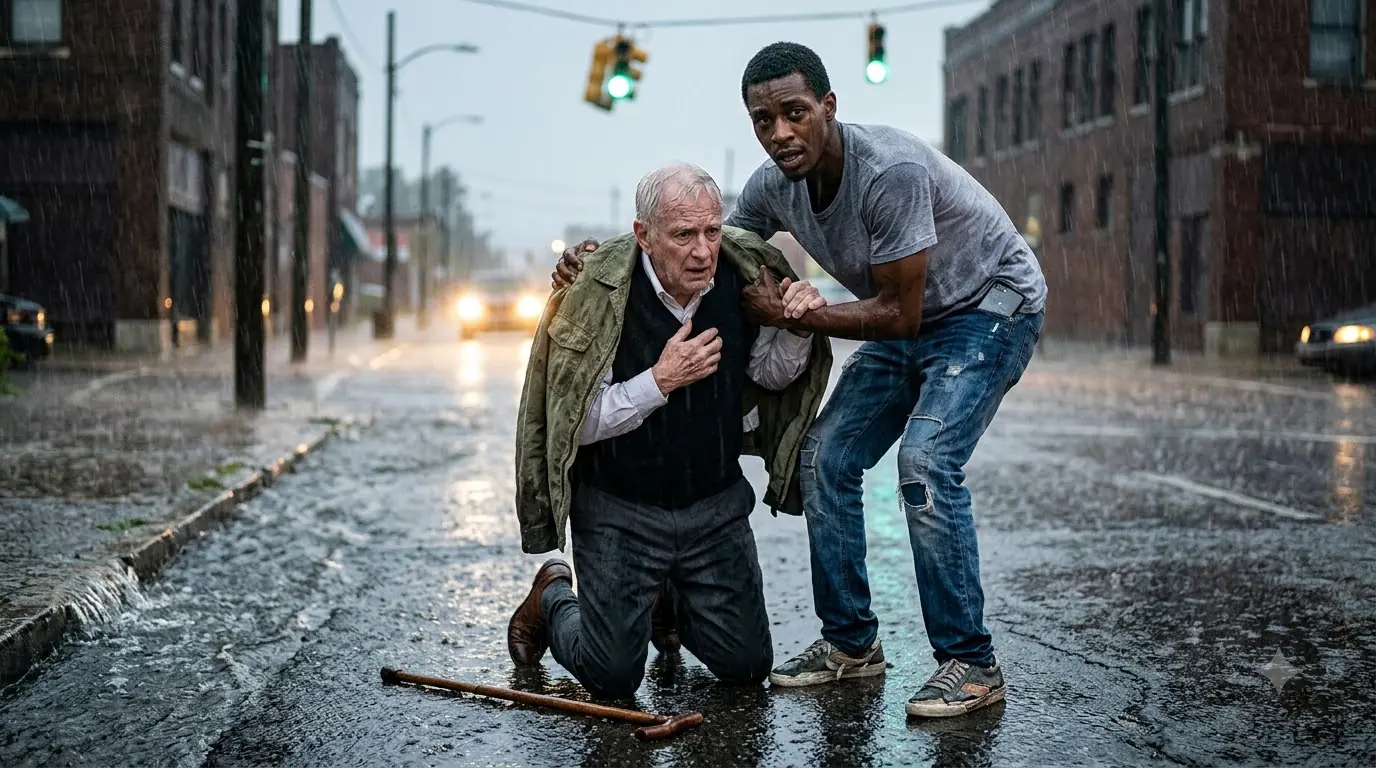
"Look at me. Look at me. I've got you. Hold on."
Owen Harris pulled the old man off the pavement with both arms, ripped off his only jacket, and wrapped it around the stranger's body.
"Son, you'll freeze without that."
"Which way is home, sir?"
Owen was twenty-one years old, had four dollars in his pocket, and had a night shift starting in eleven minutes that he had just thrown away. The old man looked at Owen, looked at his torn shirt and cracked hands, and stared as though he were memorizing every detail of his face. Owen did not think anything of it. He should have, because what arrived at his mother's front door the next morning changed the Harris family forever.
To understand what that morning meant, you have to understand what Owen Harris woke up to every other morning of his life. Shelby Avenue sat on the south side of Memphis, Tennessee, the kind of street where every house leaned a little, porch lights flickered because the wiring was older than the people living inside, and sidewalk cracks ran so deep that weeds grew through them like they owned the place. Owen lived in a duplex at the end of the block. The roof leaked in three places, including one directly above his bed, where he kept a bucket that sometimes caught drips so steadily they sounded like a metronome.
The kitchen floor groaned every time someone stepped near the stove. The walls carried water stains that Owen's mother, Denise Harris, had tried to hide with picture frames from the dollar store. It did not work, but she did it anyway. The house was worn, but it was theirs for as long as they could keep paying for it.
Owen was tall but thin, the kind of thin that did not come from choice. His collarbones pressed against his skin as if they were trying to break through, and his hands were rough and split at the knuckles from years of lifting things heavier than he was. He wore the same faded olive-green jacket every day, its shoulders splitting and its zipper broken since the previous winter. His jeans had been patched so many times the thread no longer matched, and his sneakers, held together with dollar-store glue, made a soft peeling sound every time he took a step.
He worked two jobs. In the mornings, he loaded crates at Mr. Grady's grocery store on Lamar Avenue, moving forty-pound boxes of canned goods, sacks of rice, and pallets of bottled water for six hours at $8.25 an hour. His back ached by noon and his shoulders burned by two, but he never clocked out early. At night, he washed dishes at Rosie's Diner on Third Street for $7.75 an hour, standing with hot water up to his elbows for five straight hours and getting no break longer than ten minutes.
The steam made the skin around his fingernails peel. He wrapped his fingers in tape and kept scrubbing. Between the two jobs, he earned just under $1,400 a month. Rent alone was $950, so the math never worked.
Owen knew that. He kept a small notebook in his back pocket, every page filled with columns showing what was owed, what was due, and what was already late. He sat at the kitchen table after midnight with a pencil in his hand, trying to force the numbers into something that looked like enough. They never did, but Owen never complained, not to his mother, not to his coworkers, and not to anyone else.
Denise Harris was fifty-three. She worked two shifts at a laundromat on Poplar Avenue, folding, pressing, sorting, and hauling bags that weighed almost as much as she did. She had chronic back pain that began as a sharp stab in the morning and settled into a deep, constant ache by noon. With no insurance and no savings, she took ibuprofen and kept moving.
Owen watched her every morning. He saw her grip the edge of the counter while straightening, close her eyes for two seconds, breathe through the pain, and then smile as though nothing were wrong. He never said anything, but he noticed everything. That was why a folded notice sat hidden behind a sunflower magnet on the refrigerator door.
It was the third notice that year. Final warning: pay the back rent or vacate by the thirtieth. Owen had hidden it so his mother would not see it, and he had already called the landlord twice, begged for an extension, and received one more week. One week was all they had.
The electricity bill was two months overdue. Owen unplugged the toaster, microwave, hallway lamp, and anything else that did not need to stay connected overnight, hoping to slow the meter by a few cents. He ate less so Denise could eat more. Whenever she asked whether he had eaten dinner, he said he had eaten at the diner, even though Rosie's did not feed the dishwashers and he had usually survived on tap water until the hunger passed.
Every morning before work, Owen walked past Mrs. Patterson's house three doors down. She was seventy, lived alone, and had front steps so rotten that one of them had caved in. The city did not repair them, and her family did not visit. Owen fixed them himself.
He found scrap wood behind the grocery store, borrowed a hammer from a neighbor, and spent forty minutes before work one Saturday nailing new planks into place. Mrs. Patterson came outside holding a plate of homemade oatmeal cookies that were still warm.
"Owen Harris, you didn't have to do that."
"Couldn't have you falling, Mrs. Patterson."
He thanked her, broke one cookie in half, ate a piece, and slipped the rest into his jacket pocket for his mother. That was Owen. He never talked about being good. He simply was, quietly and consistently, without requiring anyone to watch.
That Tuesday evening, Owen left the duplex around 7:30. The sky was gray but calm, and he pulled his jacket as closed as the broken zipper allowed before beginning the twenty-five-minute walk to Rosie's Diner. He knew every crack in the sidewalk by heart. When he looked up once, dark clouds were stacking fast in the west.
He pulled the jacket tighter and kept walking. He had no idea that in less than two hours he would give it away to a complete stranger.
The storm that struck Memphis that night had not been in the forecast. It arrived hard and sudden. One minute the sky was gray and heavy; the next, the wind shifted from the west and the clouds split apart as if something had torn them open.
Rain did not fall. It attacked. Sheets of water slammed the pavement so hard that gutters overflowed within seconds, hail pinged against car hoods, street signs rattled, and traffic lights along Shelby Avenue swung sideways before going dark one by one.
Owen was eight minutes into his walk when the storm hit. He owned no umbrella, so he ducked under a bus-stop awning and pressed himself against the glass. His jacket soaked through in less than a minute, water ran down his forehead and into his eyes, and the glue on the sole of his left shoe began to give way.
He checked the cracked screen of his phone. It was 8:41, and his shift began at nine. If he ran, he could still make it. He stepped back into the rain and started moving.
Four blocks north of Shelby Avenue, in the opposite direction, Gerald Whitfield was already in trouble. He had spent the afternoon at Elmwood Cemetery, sitting on the same bench beside the same grave and holding the same white carnations he brought every Tuesday. They had been Eleanor's favorite.
Gerald spoke to his wife as if she could still hear him. He told her how quiet the house had become, how the hallway still seemed to carry her perfume some mornings even though he knew that was impossible, and how he continued setting two places at dinner after three years of eating alone. He lost track of time.
When the first crack of thunder sounded, Gerald looked up and realized the sky had turned black. He reached for his phone and called Raymond, his driver.
"Mr. Whitfield, I'm stuck on Union. The whole road is flooded, and the fire department has it blocked. I can't get through."
"Could be an hour. Maybe more."
Gerald ended the call and looked toward the cemetery gate. His house in Chickasaw Gardens was about a mile and a half away. He had walked it years before when his knees still worked and Eleanor walked beside him.
He gripped his wooden cane and pushed himself up from the bench. "I walked this city before you were born, Raymond," he muttered to no one. "I'll manage."
He did not manage. The first quarter mile was slow but steady, with Gerald keeping his head down, one hand on the cane and the other holding his vest closed against the wind. His cashmere vest soaked through, his Oxford shirt clung to his chest, and his polished leather shoes filled with water at every step.
Then the sidewalk dipped where a storm drain had collapsed. Gerald did not see it. His cane struck the edge, slipped, and cracked cleanly in half as he fell hard onto both knees.
His right hand caught the pavement, tearing the skin across his palm. He tried to stand, but his knees would not lock. Then his chest tightened, not sharply, but with the heavy pressure his cardiologist had warned him about.
Do not overexert. Do not get cold. Do not let your heart rate spike. Gerald was doing all three.
He remained on his knees on Shelby Avenue as rain poured around him. Cars passed, one after another, their headlights sweeping over him before continuing through the storm. Nobody stopped. Nobody even slowed down.
His breathing shortened, and his fingers began to go numb. The rain was so loud he could barely hear his own voice when he finally called out.
"Help. Somebody, please."
Nothing answered him. He tried again, louder, and his voice cracked on the final word.
"Help!"
Six blocks south, Owen Harris was running with his head down and his arms pumping. He had fifteen minutes to make his shift, and every dollar from that night meant the lights stayed on another day. Then he heard something faint, almost swallowed by the wind.
A voice, thin and broken, came from somewhere ahead. Owen slowed, wiped rain from his eyes, and squinted through the sheets of water. Thirty feet away, he saw white hair, a dark vest, two halves of a broken cane, and an old man on his knees near the road.
Owen looked at his phone. It was 8:52. He had eight minutes to clock in.
If he stopped, he would not make it. If he did not make it, Rosie might fire him. If Rosie fired him, he could not pay the electric bill.
Owen stopped thinking and ran toward the old man.
"Sir! Sir, don't close your eyes. Stay with me."
What happened over the next forty-five minutes stayed with Gerald Whitfield for the rest of his life. Owen dropped to his knees beside him on the freezing pavement while water rushed past them like a shallow river.
"Sir, can you hear me?"
Gerald's eyes were half open, and his breathing was shallow. Blood from the scrape on his right palm mixed with rainwater. His white hair lay flat against his head.
"My cane," he whispered. "It broke."
"Forget the cane. Can you stand?"
"I don't think so."
Owen looked around. The street was empty now, with no pedestrians and no cars close enough to wave down, only rain, wind, and a distant traffic light flickering as it swung from its wire. He slid his arm beneath Gerald's left shoulder, braced his legs, and pulled.
Gerald was heavier than Owen expected, his body becoming dead weight against Owen's thin frame. Owen's shoes slipped on the pavement, and the glued sole on the left one peeled back completely. He adjusted his grip, planted his feet again, and pulled until Gerald rose, shaking and unsteady, but standing.
"Hold on to me, sir. I've got you."
Gerald gripped Owen's arm. His pale, trembling fingers pressed into the soaked fabric of Owen's shirt, and Owen could feel the old man's racing pulse through the contact.
"Where do you live?"
"Chickasaw Gardens. About a mile north."
A mile through the storm with a man who could barely stand should have been impossible. Owen did not hesitate.
"Then we'd better start walking."
They moved slowly. Owen kept his left arm locked around Gerald's waist and his right hand around the old man's forearm. Every step was deliberate, and every few feet Owen scanned the pavement for cracks, standing water, broken glass, or anything that might bring them down again.
After three blocks, Owen stopped and studied Gerald's face. The old man's lips had gone pale, his vest was saturated, and his body shook from cold rather than effort. Owen pulled off the faded olive-green jacket, the only warm thing he owned, and draped it around Gerald's shoulders.
"Son, what are you doing?"
"You need it more than I do right now."
"You'll freeze."
"I run hot, sir. Don't worry about me."
He did not run hot. He was already shivering, but he resumed walking before Gerald could argue.
The rain grew worse. Wind drove water sideways into their faces, and Owen positioned himself slightly ahead and to the left so his bare arms and thin shirt took the worst of it. The soaked fabric clung to his chest, revealing every rib when he leaned into the wind.
Gerald noticed. He noticed the ruined shoe slapping against the pavement, the cracked hands holding him upright, and the way Owen never once complained. He noticed everything.
Five blocks into the walk, Gerald's chest tightened again. He stopped and pressed his free hand against his sternum, his breathing turning into short, ragged attempts that did not seem to fill his lungs.
"Sir, are you okay?"
"I just need a minute."
"Do you need me to call 911?"
"No hospital. Just let me sit."
Owen spotted a covered porch three houses ahead. He guided Gerald to it and lowered him carefully onto the concrete step beneath the overhang. Gerald leaned against the railing with his eyes closed and his chest rising in uneven intervals.
Owen crouched beside him with one hand on his shoulder. For nearly five minutes, they stayed there while rain hammered the porch roof and poured from its edges like a curtain. Owen counted the seconds between Gerald's breaths and waited for the rhythm to steady.
He did not check the time. He did not think about Rosie's Diner, the electricity bill, the eviction notice, or the four dollars in his pocket. He simply stayed.
When Gerald finally opened his eyes, he looked at Owen for a long time. He took in the soaked shirt, the cracked hands, the ruined shoes, and the patience of a young man crouching beside him as though he had nowhere else in the world to be.
"Why did you stop, Owen?"
"Sir?"
"Out there in the rain. Why did you stop for me? Nobody else did."
Owen was quiet for a moment as rain dripped from his hair and ran down the bridge of his nose.
"My mama always said that if you can help, you help. Doesn't matter who. Doesn't matter when."
Gerald stared at him, then nodded slowly. Something shifted behind his eyes, something Owen could not read.
"Your mother raised a good man."
"She'd say she's still working on it."
Gerald almost smiled.
They started moving again, even more slowly than before. Gerald's breathing had steadied, but his legs remained weak, and Owen carried most of his weight over the final two blocks. Eventually, they turned onto a broad, tree-lined street where the houses sat far back from the road behind long driveways, iron gates, and carefully maintained lawns.
Owen had never been in this part of Memphis. Gerald raised a trembling hand and pointed toward a house with stone columns.
"That one."
It was not quite a mansion, but it was close. Warm light glowed from tall windows, and a wrought-iron gate opened automatically as they approached. A gravel driveway stretched toward the house, its white stones set in neat rows.
Owen's right shoe crunched across the gravel. His left shoe only slapped because the sole was gone.
He helped Gerald up the front steps and settled him into a cushioned chair on the covered porch. Then he checked the old man's breathing, examined his hand, and made sure the bleeding had slowed.
"You're home now, sir. You're okay."
Gerald looked up at him. Rain still streamed down Owen's face, his arms were covered in goosebumps, and his lips had begun turning blue.
"Come inside, son. At least dry off."
"I should probably get going."
"Owen, come inside."
Inside the house, Owen saw things he did not understand yet. The hallway was lined with framed photographs of Gerald shaking hands with men in suits, cutting ribbons in front of buildings, and standing on construction sites in a hard hat while groups of workers gathered around him. Owen glanced at the pictures but asked no questions.
He was more concerned with finding Gerald a dry towel.
Gerald Whitfield had met many people during his seventy-eight years. He had known business partners, politicians, contractors who smiled to his face and stole behind his back, and people who always wanted something from him. He had never met anyone like Owen Harris.
The young man stood in the foyer dripping onto hardwood floors worth more than a year of Denise's rent. He did not seem to notice. He was too busy wringing out a towel and handing it to Gerald.
"Dry your hair first, sir. You don't want to catch pneumonia."
Gerald accepted the towel and watched Owen scan the house, not with envy or awe, but with the quick attention of someone checking whether an elderly man had water, heat, a safe chair, and everything else he needed.
"Sit down, son. I'll get you something warm."
"Sir, you nearly collapsed. You sit. I'll figure out the kitchen."
Something in Owen's tone left no room for argument, so Gerald sat.
The kitchen was larger than Owen's entire living room. It had marble counters, a six-burner stove, and a refrigerator large enough to hold a month's worth of groceries. When Owen opened it, he found eggs, butter, bread, soup, and other things his own refrigerator had not contained in weeks.
He warmed soup, placed two bowls on the table, set napkins beside them, and pulled out Gerald's chair. They ate in silence while rain tapped the tall windows. For the first time in hours, Owen's hands stopped shaking.
Gerald watched him eat. Owen held the spoon carefully, as if the bowl might disappear, and tore the bread into small pieces to make it last. He finished every drop, then picked up both bowls and carried them to the sink without being asked.
"Owen."
"Yes, sir?"
Gerald removed a leather wallet and placed a hundred-dollar bill on the counter.
"For tonight. For your trouble."
Owen stared at the bill. One hundred dollars would cover the electricity. It would buy a week of breathing room and spare his mother seven more days of worry.
He shook his head.
"I didn't do it for money. You needed help. That's it."
Gerald took out another bill and made the offer two hundred dollars.
"Then let me pay for the shift you missed. You lost wages because of me."
Owen went quiet. His jaw tightened, and Gerald could almost see the calculations moving behind his eyes: rent, electricity, food, and the eviction notice he believed nobody else knew about. The silence lasted three seconds.
"I appreciate it, Mr. Whitfield. I really do."
Owen slid the bills back across the counter.
"But I'm good."
He was not good, and both men knew it. Gerald returned the money to his wallet and did not push again. Instead, he remembered the three seconds of silence, the tightening jaw, and the decision to refuse when everything in Owen's life was demanding that he accept.
Owen called Denise and kept the conversation brief.
"Mama, I'm fine. I helped someone get home. I'll be there soon."
He walked to the front door. His jacket had dried near a heating vent, the only item in the house that belonged to him, and he pulled it on.
Gerald removed a small white card from his shirt pocket. It was plain and carried only a name and telephone number: Gerald Whitfield. There was no logo, company, or title.
"Take this, Owen. In case you ever need anything."
Owen slipped it into his jeans pocket without studying it.
"Thank you for the soup, Mr. Whitfield."
"Thank you for a great deal more than that, son."
Owen stepped back into the lighter rain and turned once before leaving.
"Mr. Whitfield, get some rest. And maybe don't walk in any more storms."
Gerald almost laughed.
Owen walked home for forty-five minutes in the drizzle. His left shoe flapped with every step, but his chest felt warm in a way he could not explain. The small white card rested against his thigh, and he had no idea what it was worth.
Owen fell asleep that night believing he had done a small thing. He was wrong.
He reached home a little after eleven. Denise was still awake at the kitchen table in her bathrobe, both hands wrapped around a cup of tea that had gone cold.
"Where were you? I was worried sick."
"I helped an old man get home in the storm. He fell on Shelby and couldn't get up."
Denise looked at Owen's soaked clothing, the ruined shoe, and the tremors running through him.
"You walked him home in that?"
"Yes, ma'am."
She studied him for a long moment, then stood, pulled a dry towel from the closet, and draped it across his shoulders, repeating the same simple gesture he had offered Gerald two hours earlier.
"That's my boy."
She did not ask for more, and Owen did not offer more. That was how they worked.
Owen emptied his pockets onto the kitchen table. Four crumpled dollar bills, a grocery receipt, and the small white card landed beside one another. Denise picked up the card and turned it over.
"Gerald Whitfield. Who's that?"
"The man I helped. Nice guy. Lives up in Chickasaw Gardens."
Denise raised an eyebrow. Chickasaw Gardens was old money, the home of doctors, lawyers, and people who did not often end up on their knees on Shelby Avenue. She set the card down.
"Get some sleep, baby."
Owen showered, changed into dry clothes, and fell asleep in less than three minutes. The card remained on the kitchen table beneath the sunflower magnet, directly beside the eviction notice. He did not think about it again.
Fourteen miles north, Gerald Whitfield was wide awake.
He sat in his study with the room dark except for a brass desk lamp casting a circle of light over a mahogany desk. Floor-to-ceiling bookshelves rose behind him. A telephone sat in front of him.
Gerald dialed a number.
"Thomas, I need you at my house tomorrow morning. Seven sharp. Bring the foundation paperwork. All of it."
Thomas Caldwell, Gerald's attorney of thirty-one years, paused on the other end.
"Gerald, it's eleven at night. Which foundation?"
"Eleanor's. The community initiative. The one she asked me to start before she died."
The next pause lasted longer.
"Gerald, that file has been sitting in your drawer for two years."
"I know. Bring it."
Gerald ended the call and opened the bottom drawer of his desk. He removed a thick cream-colored folder, slightly dusty, with a handwritten tab that read Whitfield and Sons Community Initiative. The handwriting belonged to Eleanor.
He ran his thumb over the ink and looked at the framed photograph on his desk. Eleanor stood in a summer dress with the garden behind her, smiling in the way she always had.
"I found him, Ellie," Gerald whispered. "I think I finally found a reason."
Outside, the rain had stopped and the sky was beginning to clear. At 6:45 the next morning, three black SUVs left Gerald Whitfield's driveway. Owen Harris had no idea.
Owen opened the front door at 6:52 the next morning and, for the first time in his life, had no words. He was already dressed for his shift at Mr. Grady's grocery store in the same jeans, patched jacket, and broken sneakers, and he held a cup of instant coffee in one hand when he heard the engines.
Not one engine. Several.
The sound was deep and steady, the kind of sound that did not belong on Shelby Avenue. Owen looked through the kitchen window and froze with the coffee halfway to his mouth.
Three black SUVs were parked in a row outside the duplex. Their tinted windows were spotless, and the vehicles looked as though they had arrived from another world.
"Mama, come here."
Denise stepped out of the hallway while tying her robe.
"What is it?"
"Look outside."
She looked, and her hands stopped on the sash.
"Owen, who are those people?"
"I don't know."
The door of the middle SUV opened. A man in a gray suit, navy tie, and polished shoes stepped out and opened the rear passenger door.
Gerald Whitfield emerged.
This was not the Gerald from the night before. That Gerald had been a frail old man on his knees in the rain with a broken cane, soaked vest, and trembling hands. This Gerald stood straight in a tailored charcoal suit with a sharply folded blue pocket square, combed silver hair, and polished shoes.
He looked like a man who owned things, because he did.
Two more people followed him. A tall man in a dark suit carried a leather briefcase. He was Thomas Caldwell, Gerald's attorney. Beside him walked a woman in a navy blazer holding a folder against her side, Rebecca Moore, whose exact role Owen did not yet understand but whose presence made it clear that she was important.
Gerald crossed toward the duplex without rushing. He carried a new polished-oak cane with a brass handle but placed little weight on it. As he approached, he studied the cracked siding, sagging porch, and front step that dipped in the middle.
He looked at the house the way a man examined a problem he had already decided to solve.
Owen stepped outside.
"Mr. Whitfield, what are you doing here?"
Gerald smiled, not broadly, but with the quiet warmth of recognition.
"Told you I'd remember, didn't I?"
"Sir, you didn't have to come all this way."
"Invite me in, Owen."
Owen glanced back at Denise. She nodded while smoothing her hair, suddenly embarrassed by the bathrobe, the cluttered kitchen, and the cracked linoleum floor.
They entered the duplex. Gerald did not stare at the peeling wallpaper or water stains. His eyes went to the sunflower magnet on the refrigerator and the two papers tucked behind it: the card he had given Owen, and beside it, a folded notice.
He did not need to read it. He knew what a final warning looked like.
Gerald sat at the kitchen table. Thomas Caldwell opened the briefcase and laid a stack of documents across the worn surface, while Rebecca remained nearby with her folder ready.
"Mrs. Harris, my name is Gerald Whitfield. Your son saved my life last night."
Denise looked at Owen, who lowered his eyes toward the floor.
"He didn't tell you that part, did he?"
"He said he helped someone get home."
"He carried me a mile through the worst storm this city has seen in five years. He gave me his jacket, missed his shift, and refused every dollar I offered him."
Gerald paused, then looked at Denise with complete sincerity.
"Ma'am, I've built things my entire life. Buildings, bridges, roads. But I have never built anything as solid as what you built in that boy."
Denise pressed her lips together, and her eyes filled before she could prevent it.
Thomas Caldwell cleared his throat and turned one of the documents toward them.
"Mr. Harris, Mrs. Harris, Gerald Whitfield is the founder and chairman emeritus of Whitfield and Sons Construction, one of the largest construction and development firms in the Mid-South. His company built Riverside Medical Center, the downtown convention hall, and more than three hundred residential and commercial properties across Shelby County."
Silence filled the room.
Owen stared at Thomas, then at Rebecca, then at Gerald, and finally at the small white card beneath the sunflower magnet. It held only a name and number because a man like Gerald Whitfield did not need to print a title. Everyone who mattered already knew who he was.
"Mr. Whitfield," Owen whispered. "I didn't know. I swear I didn't know who you were."
Gerald leaned forward and met his eyes.
"I know you didn't, son. That's exactly why I'm here."
He reached across the table and placed a hand on Owen's arm, the same arm Owen had used to pull him off the pavement twelve hours earlier.
"You helped me because I was an old man in the rain, not because of what I have or what I might give you. You helped because that is who you are."
Gerald sat back and folded his hands.
"Now I want to explain why I brought Thomas and Rebecca with me. What your mother is about to hear may make her cry, and that is all right. For the first time, they are going to be the right kind of tears."
Gerald had not come carrying random charity. He had come carrying a plan.
He looked at Owen, then Denise, before speaking again.
"Before I say anything else, I want to tell you about my wife."
The room became still.
"Eleanor died three years ago. Pancreatic cancer. Fast and cruel. She was here one month and gone the next."
Gerald's voice did not break, but it slowed, as if he were selecting each word carefully so it would not cut him on the way out.
"Every Tuesday, I visit her grave at Elmwood. I sit on the same bench, bring white carnations, and speak to her as though she can still hear me. Maybe she can. I don't know."
He opened the cream-colored folder with Eleanor's handwriting on the tab.
"During the last ten years of her life, Eleanor tried to convince me to do something with our money. Not make more of it. Use it. She wanted a fund for families who were one bad month away from losing everything: scholarships, home repairs, job training. She planned all of it."
Gerald touched the writing on the folder.
"She asked me to begin it before she died. I told her I would, but I didn't. For two years, this sat inside my desk. I told myself I was too busy, too tired, and too old. The truth is that I stopped believing there was a point."
He looked directly at Owen.
"Last night, you changed that."
Owen shifted uncomfortably in his chair, unsure where to look.
"You pulled me off the ground in the rain. You gave me your only jacket, walked me a mile with a shoe falling apart, and then fed me soup in my own kitchen. When I tried to pay you twice, you pushed the money back and said you were good."
Gerald shook his head.
"You were not good, Owen. You were broke. You were cold. You were about to lose your home, and you still said no."
Denise raised a hand to her mouth and looked at her son. Owen stared down at the table.
"That was when I knew Eleanor had been right and I was finished waiting."
Gerald nodded to Thomas. The attorney slid three documents forward.
"First," Gerald said, touching the top page, "a full academic scholarship to the University of Memphis for the construction management program. Four years. Tuition, books, supplies, and living expenses are covered by Whitfield and Sons. When you graduate, an apprenticeship will be waiting for you at the company, with a real salary and a clear path forward."
Owen read the paper, then read it again. His lips moved slightly, as if he were sounding out words he did not trust.
"Mr. Whitfield, I can't accept this."
"You are not accepting charity, Owen. You are accepting an opportunity you earned. There is a difference. Keep reading."
Gerald turned toward Denise.
"Second, Mrs. Harris, there is an open position in the administrative office at Whitfield and Sons. Office manager, Monday through Friday, eight to five. It includes full health, dental, and retirement benefits, and the health plan covers preexisting conditions, including chronic back pain."
Denise blinked and lowered her hand, but no words came.
"I understand you have been working double shifts at a laundromat. I understand you have lived with pain for years because you could not afford a doctor. That ends now. If you want the position, it is yours, beginning on the first of next month."
Denise looked at Owen. His eyes were red, and he pressed his thumbnail so hard against the table's edge that the skin turned white.
Gerald slid the final document forward.
"Third, this house. I am sending a Whitfield and Sons crew here on Saturday. New roof, new floors, electrical work, plumbing, fresh paint, and everything else the building needs. A full renovation, with no cost to you."
He looked around the kitchen at the cracked ceiling, stained walls, and groaning floor.
"No family should live beneath a leaking roof, especially not a family like yours."
Owen stood suddenly, his chair scraping against the linoleum. He took two steps toward the window and stood with his back to the room. His shoulders rose and fell, and he pressed a fist against his mouth.
Nobody spoke.
Denise broke first. The sound that left her was not quite a word and not quite a cry. It carried three years of hidden pain, three eviction notices, six-dollar dinners, and ibuprofen taken instead of seeing a doctor.
She stood and walked toward Gerald. Denise was a woman who never embraced strangers, never displayed weakness in front of her son, and had held her family together with her bare hands every day of her life. She put both arms around Gerald Whitfield and held on.
Gerald, who had not been held by anyone since Eleanor died, closed his eyes and embraced her in return.
Owen turned, wiped his face with the back of his hand, walked to Gerald, and took the old man's hand in both of his. He held it the same way he had held it in the storm.
"Mr. Whitfield, I don't know what to say."
"You do not have to say anything, son."
"My mama," Owen began, but his voice failed. He tried again. "My mama has never had health insurance. Not once in her life."
Gerald squeezed his hand.
"She does now."
Rebecca Moore opened her folder with professional care, though her own eyes were wet.
"There is one more thing," Gerald said.
He removed a single sheet from the bottom of Eleanor's folder. A new name appeared across its top in dark green ink: The Eleanor Whitfield Community Fund.
"This is for Shelby Avenue, for every family on this block. Home repairs, scholarships for young people, and job-placement assistance. My wife wanted this to exist, and now it will."
Gerald placed the page on the table beside the eviction notice.
"Her name deserves to be on something that matters."
The first Whitfield and Sons truck arrived on Shelby Avenue on Saturday morning. By Sunday, the entire block had come outside to watch.
The work began with the Harris duplex. A crew of twelve arrived with two flatbed trucks loaded with lumber, drywall, copper piping, and rolls of insulation. The foreman, Ray Sullivan, was broad-shouldered, wore steel-toed boots, and carried thirty years of construction experience behind a permanent frown.
He walked through the property with a clipboard.
"The roof is finished, the wiring is dangerous, and the plumbing is held together with tape and prayer."
Ray looked at Owen.
"How long have you lived like this?"
"As long as I can remember."
Ray shook his head.
"Not anymore."
The crew removed the roof on the first day. By the third day, new trusses were in place.
Owen asked whether he could help. Ray said no. Owen arrived at six the next morning wearing gloves and ready to haul materials anyway.
By noon, Ray had stopped telling him to leave.
"The kid learns faster than most of my men," Ray told Gerald by telephone that night. "He has good hands and good instincts. Doesn't talk much. Just works."
Gerald was not surprised.
The renovation took eleven days. New hardwood floors replaced the groaning linoleum, fresh drywall covered the stains Denise had tried to hide behind picture frames, and workers installed a safe electrical panel, new plumbing, and a roof that did not leak. The kitchen received a proper stove, a quiet refrigerator, solid cabinets, and counters that did not chip when someone set down a pot too hard.
When the work was complete, Denise walked through the duplex and touched every wall. She ran her fingertips over the smooth surfaces, opened every cabinet, and turned each faucet on and off simply to hear it run without squealing. She said very little. She did not need to say more.
Owen's scholarship began that fall. At the University of Memphis, he entered the construction management program as the oldest student in most of his classes and the first to arrive every morning. His professors noticed that he asked precise questions and already understood materials, weight, and structural stress in ways that no textbook alone could teach.
One adviser wrote in a midterm evaluation, "This student has been building things his entire life. He simply did not know the work had a name."
Three weeks into the semester, Ray Sullivan called Owen with another proposal: a twenty-hour-per-week apprenticeship at Whitfield and Sons, arranged around his class schedule, with real job sites, real projects, and real pay. Owen accepted before Ray finished the sentence.
Denise began work at Whitfield and Sons on the first Monday of October. She had an office-manager position from eight to five, her own desk and computer, and a small brass nameplate that read Denise Harris. She stared at it for ten minutes on her first morning.
Her first doctor's appointment came that Thursday. A full examination and X-rays confirmed degenerative disc compression caused by years of heavy lifting without support. The damage was real, but it was treatable.
The doctor prescribed medication that worked and physical therapy twice a week. For the first time in fifteen years, Denise could stand straight without gripping a counter. The relief was not immediate or perfect, but for the first time, it had a plan behind it.
The Eleanor Whitfield Community Fund launched quietly. Gerald refused a press conference or ribbon-cutting ceremony. He wanted results, not spectacle.
The first house repaired after the Harris duplex belonged to Mrs. Patterson, three doors down. Workers rebuilt the steps Owen had once patched with scrap wood, installed a safe railing, and replaced the windows with ones that sealed against cold and rain. When the crew finished, Mrs. Patterson stood on the porch and cried.
Owen was there. He handed her a tissue and carried her groceries inside.
By the third month, five houses on Shelby Avenue had been renovated. By the sixth, nine families who had lived for years with mold, leaking pipes, unsafe wiring, and damaged roofs woke each morning inside homes that finally felt like homes.
The fund awarded its first three scholarships to young people from the neighborhood between nineteen and twenty-four years old. Two entered skilled-trade programs, and one began nursing school. Each scholarship carried Eleanor's name.
WREG Channel 3 ran a report in November. The reporter stood on Shelby Avenue beside freshly paved asphalt and new streetlights installed through a city partnership Gerald had quietly arranged. The segment was titled "Local Man's Act of Kindness Catches Construction Mogul's Attention."
Owen did not want to be interviewed. Gerald persuaded him.
"Your story might inspire someone else to stop for a stranger, Owen."
Owen sat in front of the camera wearing a new jacket, a real one with intact seams and a working zipper. When the interviewer asked why he had helped Gerald, Owen gave five words that the station used as its headline.
"I just did what was right."
The segment aired on a Tuesday night. By Wednesday morning, the Eleanor Whitfield Community Fund had received $214,000 in donations from across Tennessee.
Gerald called Owen that evening.
"Eleanor would have loved this."
Owen smiled.
"I think she already knows, sir."
Two years later, another storm rolled into Memphis on a Tuesday evening. Owen was twenty-three and driving home from campus in a used Honda Civic that Gerald had helped him find but had not purchased for him. Owen made every payment himself, and that distinction mattered.
He looked steadier now. He wore clean boots, a new jacket, and a watch Denise had given him for his birthday. It was not expensive, but it was the first gift she had ever purchased without having to choose between rent and groceries.
The rain came fast, just as it had two years before. The sky split open, gutters flooded, and the wind pushed streetlights sideways.
Owen was four blocks from home when he saw an elderly man hunched beside a mailbox, one hand gripping it to remain upright. He pulled over before the thought had finished forming, turned off the engine, and stepped into the rain.
"Sir, are you all right? Can I help you?"
The man looked at him. He was perhaps eighty, confused and soaked through.
"I live on the next street. I just can't see the curb in this rain."
"I've got you. Hold my arm."
Owen walked the man home for three blocks with no umbrella and no hesitation. The man thanked him four times, and Owen answered the same way each time.
"Don't worry about it, sir."
When Owen returned to his car, two more vehicles had stopped behind it with their doors open. Two young men in their early twenties were already in the rain checking on a woman sitting beneath a bus shelter with a toddler on her lap.
Owen recognized both men. They lived on Shelby Avenue and had received scholarships from the Eleanor Fund. One attended a welding program, and the other was six months into an electrical apprenticeship with a downtown firm.
They saw Owen and nodded. Nobody needed to explain. They already understood what you did when a storm came.
Owen called Gerald that night.
"Mr. Whitfield, you won't believe what happened today."
"Try me."
Owen told him about the old man on the sidewalk, the two vehicles that stopped, and the mother with the toddler beneath the bus shelter. Gerald remained quiet for a long time.
"Eleanor would have loved that."
"I think she already knows, sir."
It became a tradition. Whenever a storm struck Memphis, Owen and volunteers from the Eleanor Whitfield Community Fund drove through the neighborhood, checking on elderly residents, helping stranded people reach home, and making sure nobody remained on their knees in the rain.
They called it the Storm Walk.
On a recent Tuesday, Owen sent Gerald a short message: Storm tonight. We're heading out. Six cars this time.
Gerald was eighty now, slower than before but no less stubborn. He typed a one-line response.
Make it seven. I'm coming, too.