The snow had been falling since midnight.
By morning, it had buried the sidewalks to the knee, silenced the usual groan of Boston traffic, and turned the street outside Aurora Coffee into something that looked almost beautiful.
The cars parked along the curb had become soft white shapes. 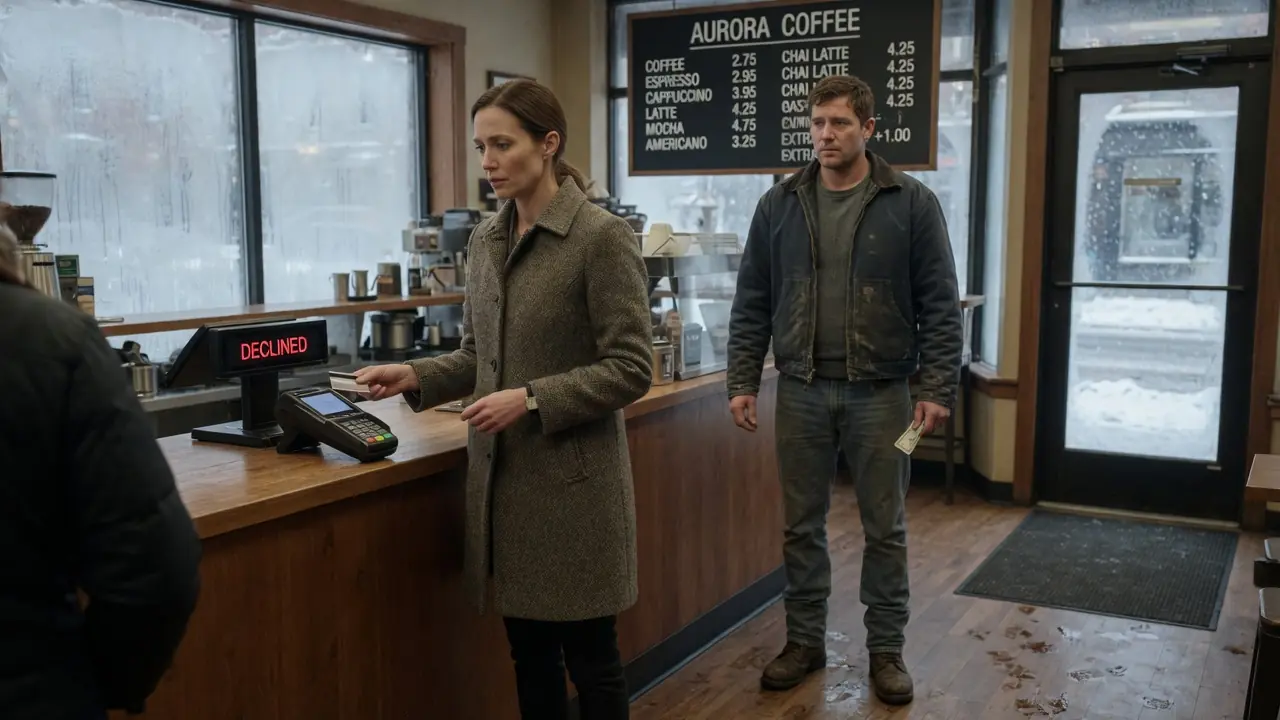
The street signs were edged with frost. The old brick buildings across the street looked gentler under the snow, as if winter had decided to cover every sharp corner in the city.
Almost beautiful.
Because if you looked long enough, you noticed what the postcard version left out. The gutters were already turning gray with slush.
The snowplows had been through twice, leaving hard ridges along the sidewalks. The cold was not the kind that made children want to run outside with mittens and sleds. It was the kind that got into your knuckles and stayed there.
Inside Aurora Coffee, the warmth was aggressive.
The heating system worked hard, the espresso machines worked harder, and the whole room smelled of roasted beans, wet wool coats, and expensive perfume.
Every table was taken. People stood two deep near the counter, holding phones in gloved hands, watching the baristas the way you watch a surgeon: focused, impatient, and ready to be disappointed.
Aurora Coffee was not the sort of place where people came simply because they wanted coffee.
They came because the cups had a small gold sun printed on them. They came because the pastries were described in French, though half the customers pronounced them badly. They came because the place looked good in photographs, with white tile, dark wood, hanging plants, and a chalkboard menu written by someone with elegant handwriting and no fear of overcharging.
The woman at the register did not fit the room.
She was somewhere in her late thirties, wearing a plain gray coat, the kind a person might find on a rack at a mid-tier department store. No logo. No statement. Her hair was pulled back simply, and she wore no jewelry except a small watch on her left wrist. She did not look poor, not exactly. She looked ordinary.
In Aurora Coffee, where ordinary was the one thing the clientele worked hardest to avoid, that was almost worse.
Her name was Victoria Hale, though no one in that room knew it.
She placed her order quietly.
“A medium coffee, black.”
The barista did not look up fully.
“Name?”
“Victoria.”
The total came to four dollars and eighty cents.
Victoria handed her card across the counter and waited. The barista, young and sharp-boned, with the kind of beauty that had taught her early how to be impatient with other people, swiped the card once.
The machine beeped.
She swiped it again.
The machine beeped twice.
“It’s declined.”
Victoria did not flinch.
“Try it again, please.”
“I already tried it twice.”
“Try it once more.”
The barista looked at her the way people look at a malfunction, not with anger exactly, but with annoyance. The kind of look you give a printer that jams on the one morning you cannot afford a delay. She swiped the card a third time.
The little reader beeped twice again.
Declined.
“It’s declined,” the barista said, louder this time.
The room shifted.
Not dramatically. No one turned fully around. No one wanted to look as though they were interested in another person’s embarrassment. But a particular stillness settled over the line, the kind that falls when someone else’s misfortune has just been announced and everyone pretends not to listen while listening harder.
Heads dipped slightly.
Eyes stayed on phones.
A woman at a nearby table paused with her cup halfway to her mouth.
“I don’t understand,” Victoria said.
Her voice remained level.
“That card should work.”
“Well, it doesn’t.”
The barista held the card out between two fingers, as if returning something unclean.
“Do you have another payment method?”
Victoria looked into her bag.
She searched it with calm patience, though she already knew what she would find. A wallet. A folded receipt. A pen. A small packet of tissues. Four one-dollar bills.
No coins.
No second card.
She took out the bills and smoothed them against the counter.
“I have cash, but not enough exact change.”
The barista sighed.
“Ma’am, there’s a line.”
There was.
Eight or nine people deep, depending on whether you counted the man near the pastry case who had not decided if he was staying. Now all of them were watching, still not looking directly, still pretending they were not, but watching.
Someone at a nearby table whispered something.
The person across from them gave a small laugh.
Just small enough to deny if challenged.
Victoria stood at the counter with four dollars in her hand and eighty cents missing. The barista was already looking past her.
No one moved.
Then the man three people back in line stepped forward.
He was not remarkable to look at. Medium height, broad through the shoulders in the way of someone who worked with his body rather than a gym. His jacket was dark blue, worn at the elbows, and his work boots had left wet prints on the entry mat where the snow had melted off them.
He had a strong jaw, calm eyes, and the kind of face that did not announce itself. He looked neither warm nor cold. He simply looked present, like someone who had spent a lot of years paying attention to things other people missed.
He reached the counter and set a five-dollar bill beside Victoria’s four.
“That should cover it,” he said.
The barista looked at the money.
Then at him.
Then at the line, which had adjusted around him like water around a stone.
“You don’t have to,” Victoria began.
“It’s fine.”
He was not looking at her when he said it.
He was looking at the barista, waiting.
There was no performance in it. No glance toward the room. No little smile inviting admiration. No speech about kindness, no joke to make the moment lighter, no attempt to make Victoria feel grateful in front of strangers.
Just a man completing a transaction.
The barista took the nine dollars, made the change, and set Victoria’s coffee on the counter. The man collected his own cup, which had apparently already been waiting. He nodded once, not at Victoria specifically, but at the completion of the moment.
Then he walked to the door.
He pushed it open with his shoulder because his hands were full.
Cold air rushed in.
The bell above the door gave one bright sound.
She stood at the counter with her coffee in her hand.
Around her, the room had already moved on. The line reformed. The barista called the next name. Steam hissed from the espresso machine. Someone complained about oat milk. The little moment closed over itself like water over a stone.
Victoria found the nearest empty table.
She sat down.
She did not drink the coffee immediately.
Instead, she looked at the door where the man had disappeared. His wet footprints remained on the tile for a moment, but other shoes quickly crossed over them, smearing the evidence until it became indistinguishable from everyone else’s tracks.
She pulled out her phone.
Then she made a note.
The man’s name was Ethan Brooks, though she did not know that yet.
He lived on the third floor of a building on Callaway Street, in an apartment that had been built in 1962 and last renovated in 1994. The lobby smelled of old carpet, radiator heat, and something metallic from the mailboxes. The elevator worked three days out of five, and Ethan had learned to check the light above the doors before committing to it.
That morning, he took the stairs.
He always took the stairs when he had time.
His apartment had three rooms that were supposed to function like more than three rooms. A kitchen just wide enough for two people if one of them stood sideways. A small living space that became his bedroom at night when the couch folded out. One real bedroom, which belonged entirely to Lily. A second small room that the landlord called a bedroom, but Ethan used as storage, a workspace, and a place to keep tools that were too expensive to leave in his truck.
The windows were single pane, and he had sealed the edges with foam tape in October. The insulation above the ceiling was questionable. The building’s heating system was central and temperamental, and when it went out, which it did every January without fail, the super took between twelve and thirty-six hours to respond.
Ethan had adapted.
He kept an electric space heater positioned under Lily’s desk. He kept extra blankets in a bin under her bed. He kept the kettle clean because hot tea could convince a child that a cold apartment was an adventure for at least twenty minutes.
He made Lily breakfast every morning at 6:45.
Scrambled eggs, because when she was four, she had told him she liked them fluffy. Ethan had spent two weeks perfecting the technique: low heat, constant movement, pull them before they looked finished. Now he made them the same way every time without thinking.
Toast.
Orange juice from concentrate.
A glass of water she almost never finished, but that he poured anyway because hydration mattered even when compliance did not.
Lily was six years old. She had her mother’s gray-green eyes, the kind that looked different in different light, and Ethan’s stubbornness, which her first-grade teacher had described more diplomatically during the fall conference.
“She has a strong internal compass,” Mrs. Kellerman had said.
Ethan had translated that immediately.
“She argues.”
Mrs. Kellerman had smiled.
“She advocates.”
Lily came out of her room at 6:52 that morning wearing mismatched socks and carrying a book about tide pools.
“Dad,” she said, climbing onto the kitchen stool, “do starfish have brains?”
Ethan set her plate in front of her.
“They have a nervous system, but not a brain the way we think of one.”
“So they’re smart in a different way?”
“Something like that.”
Lily opened the book to a page she had already folded at the corner.
“Mrs. Kellerman said being smart and being wise are different things.”
“Mrs. Kellerman’s right.”
“Which one are you?”
Ethan looked at her.
She was reading while she talked, which had driven Clara crazy when they were still together. Ethan had decided it was simply how Lily processed the world, two streams running at once.
“I’m working on it,” he said.
She accepted that.
He ate standing at the counter because the day was already pressing against him.
He had a 7:30 call with a property manager in Dorchester about a broken heat pump in a twelve-unit building, three apartments of which had already been without heat for two days. After that, he had an afternoon job in Somerville, a commercial ventilation system at a restaurant that two previous technicians had misdiagnosed.
He had done the assessment last week.
He knew what the problem was.
It was a simple fix made complicated by people who did not want to admit they had been wrong.
He understood that feeling.
By 7:12, Lily was in her coat, hat, gloves, and boots. Ethan checked her backpack folder, lunch, and the library book she was returning. Then he walked her four blocks to school through the snow, her hand in his, listening while she completed her developing theory that starfish were probably smarter than people assumed because people always underestimated anything without a face.
At the school door, she let go of his hand without ceremony.
“Bye, Dad.”
Then she disappeared inside.
The heavy door swung shut behind her with the authoritative thud of institutional architecture.
Ethan stood in the snow for a moment.
Then he walked back to his truck and drove to Dorchester.
The heat pump was exactly what he had expected. A refrigerant leak compounded by a clogged filter that had been ignored for at least eighteen months. The compressor was fine. The previous technician had recommended a full replacement because full replacements were expensive and easy to justify to people who did not understand systems.
Ethan fixed the problem in four hours.
The property manager, Gerald Finch, wore a fleece vest indoors and called everyone buddy. He looked surprised when Ethan handed him the invoice.
“That’s it?”
“That’s it.”
“The last guy said it needed a new compressor.”
“The last guy was wrong.”
Gerald looked at the invoice again.
“This is a lot less than I expected.”
“I know.”
Ethan picked up his kit.
“Because it’s what it costs.”
He drove to Somerville.
The restaurant had been without functional ventilation since Thursday. The kitchen staff had been working in what one of the cooks, a heavyset man named Tony, described as “a sauna with food in it.”
Tony kept offering Ethan water.
“You sure you don’t want anything? Coffee? Soup? We got soup.”
“I’m good.”
“You’re in my kitchen. Nobody is good until I feed them.”
The commercial hood system had two issues. A motor was failing, and a grease filter had been installed backward, which was something Ethan had seen exactly once before in eleven years and which still baffled him. He fixed the system, explained the problem to Tony, and refused to charge for the extra ten minutes he spent showing the staff how to check the filter direction.
Tony packed him a container of soup anyway.
Ethan drove home through slow traffic and dirty snow.
He ate the soup standing at the kitchen counter while Lily did homework at the table. Then he helped her with spelling words, listened to her argue that whale should not have an h if the h was not doing anything useful, and read two chapters of her tide pool book before bed.
After she fell asleep, he sat on the edge of the fold-out couch and opened his bank app.
He had checked it three times since noon.
The numbers had not changed.
Rent was due in eleven days.
He had enough.
After paying it, he would have forty-three dollars left.
He set the phone face down on the cushion and lay back, staring at the water stain on the ceiling. The landlord had promised twice to address it. Ethan had stopped asking.
He thought about the woman at the coffee shop.
Not her clothes. Not her face. Not the declined card.
Her stillness.
That was what he remembered.
The practiced quality of it. Like someone who had learned a long time ago to give nothing away when people were watching.
He had seen that in clients before. Wealthy ones, poor ones, proud ones. The stillness of people who refused to let embarrassment become public property.
He understood it.
He fell asleep with the light on.
There are categories of invisibility.
There is the kind that belongs to the very old, who have become furniture to the young.
There is the kind that belongs to the very shy, who choose smallness as shelter.
And there is the kind that belongs to people whose work happens inside walls: plumbers, electricians, HVAC technicians, janitors, maintenance men, cleaners, people who keep buildings running while everyone else treats comfort as the natural state of the universe.
Ethan had been invisible for eleven years.
He did not resent it exactly.
Resentment required expectation, and he had adjusted his expectations with the methodical precision he brought to everything else. People did not thank the system. They thanked warmth. They thanked cold air in summer. They thanked the fact that the office lights worked and the conference room did not smell like burnt wiring.
They did not usually thank the person who made those things true.
That was fine.
He was not in the business of being seen.
But he noticed.
He noticed the way clients angled their bodies slightly away when he entered expensive rooms. The unconscious geometry of class. He noticed when people referred to him in the third person while he stood right there.
“The guy can look at the boiler.”
As if he were a function rather than a person.
He noticed the houses. The art on the walls. The particular silence of expensive rooms. He was not envious in any burning way. He was curious about them, the way a person might be curious about a place they would never visit.
Most of all, he noticed children.
Some watched him work with open, uncomplicated interest.
“What does that do?”
“Why is it that color?”
“Is it hot?”
He always answered clearly, with actual information, the way he answered Lily. Children did not deserve the condensed version.
Other children did not see him at all.
They had already learned the lesson their parents were teaching without meaning to.
He thought about Lily, who saw everything.
Two weeks before the coffee shop, she had handed him a drawing after school without comment. It was a picture of a house, blue sky, green grass, despite the fact that outside it was February. Two stick figures stood beside the house, one tall, one small. The tall one had a tool belt.
At the bottom, in her careful first-grade handwriting, she had written:
Dad fixing things.
Ethan had folded it and placed it in his inside jacket pocket.
It was still there.
Victoria Hale had not been at Aurora Coffee by accident.
She was the founder and CEO of Meridian Financial Technologies, a fintech company headquartered in a glass tower in Boston’s financial district. Meridian developed compliance software for mid-sized regional banks, the kind of work that sounded boring until something failed and millions of dollars disappeared into someone else’s account.
Victoria had built it from a three-person operation in a shared Cambridge workspace into a company with two hundred forty employees over eleven years.
She had done it with the specific intensity of someone who understood that the distance between success and collapse was thinner than most people admitted.
Her employees respected her.
Some feared her.
Most misunderstood her.
The test at Aurora Coffee was one she conducted four times a year. She called it a service audit. Her COO, Bradley Winfield, a careful man who had worked with her for six years and had long ago decided that fully understanding Victoria Hale was not a realistic professional goal, called it “the card thing.”
Victoria would take a card she had temporarily blocked. Always a different card. Always a small purchase. Always a public place.
She would let the card decline.
Then she would observe.
What she was observing was not only the employee behind the counter.
She was watching the room.
Victoria had a theory that the fundamental character of any organization, community, or system could be read in how it treated the person who was momentarily unable to perform.
Who intervened?
Who looked away?
Who laughed?
Who pretended not to notice, which was its own answer?
She had done it seventeen times over four years. Restaurants. Pharmacies. Hotel front desks. Parking garages. Coffee shops.
Only twice had anyone helped.
The first time, two years earlier, it had been a woman in her fifties who paid without comment and went back to her crossword puzzle. Something about the lack of performance had stayed with Victoria. The economy of it. The absence of anything that demanded gratitude.
This time, it was the man with the worn jacket.
Victoria had watched him from three people back in line, exactly where she had placed herself. Not at the front. Not at the back. In the middle, where attention diffused and she became simply another waiting body.
She watched him step forward with the five-dollar bill.
She watched his face.
No announcement.
No smile toward the room.
No attempt to make himself the hero of the moment.
He paid and left.
That was all.
That was everything.
Victoria sat at the table afterward and made her note.
Then she did what she did with every such note. She used the plate number of the truck she had seen through the window as the man crossed the street. From that, through a legal compliance service Meridian used for vendor verification, she had a name by late morning.
Ethan Brooks.
Thirty-four.
Licensed HVAC technician.
Sole proprietor of Brooks Heating and Air.
Business address matching his residential address on Callaway Street.
No corporation.
No employees.
Clean record.
Eleven years in operation.
Customer reviews averaging 4.8 stars.
Honest.
Fair.
Fixed what others could not.
Did not oversell.
Explained everything clearly.
Victoria read the reviews twice.
Then she made a different kind of note.
Two days later, she called Bradley into her office.
Bradley arrived with a tablet in one hand and the expression of a man prepared for ten different possible crises.
“Tell me we’re not acquiring another company,” he said.
“We’re not acquiring another company.”
“Good. Then I can breathe.”
“I found a candidate.”
Bradley’s eyebrows lifted.
“For the facilities operations role?”
“Yes.”
“Please tell me this one has management experience.”
“No.”
“Corporate operations?”
“No.”
“Budget oversight?”
“Not formally.”
Bradley closed his eyes for a moment.
“Victoria.”
“He is an HVAC technician.”
Bradley opened his eyes.
“Of course he is.”
She slid Ethan’s printed reviews across the desk.
Bradley read silently.
“He looks honest,” he said.
“He is honest.”
“You do not know that.”
“I know enough to investigate further.”
“Victoria, we need someone who can manage vendors across two offices, coordinate contractor schedules, oversee budget compliance, deal with facilities risk, and speak to department heads who think the thermostat is a personal attack.”
“Yes.”
“And your answer is one man who paid for coffee?”
“My answer is a man who notices systems and responds correctly when others look away.”
Bradley rubbed his forehead.
“This is the card thing again.”
“It is a useful test.”
“It is an eccentric test.”
“Both can be true.”
Bradley sighed.
“Interview him. But do not offer him a job because he was kind once.”
Victoria looked toward the window, where snow moved between the glass towers.
“I won’t.”
That was not entirely true.
She did not intend to offer him the job because he was kind once.
She intended to offer him the job because kindness without performance, competence without arrogance, and attention without prompting were rare enough that only fools ignored them when they appeared.
Ethan was replacing a section of gutter drainpipe when the black SUV arrived.
It was Thursday morning, three days after the coffee shop. The snow had returned overnight, softer this time, smaller flakes that looked decorative until they quietly accumulated into something real.
The pipe on the north side of Ethan’s building had cracked during the winter. The building manager trusted Ethan with small structural fixes that were technically outside his scope, so he had asked him to handle it before the melt caused trouble.
It was not complicated work.
A ladder.
A replacement pipe.
Two brackets.
Maybe an hour and a half.
He was twelve feet up when the SUV turned onto Callaway Street.
He noticed it because vehicles like that did not usually turn onto Callaway Street. Long, black, polished, moving slowly in a way that was not uncertain. It knew exactly where it was going.
It stopped in front of his building.
Mrs. Petrova from 2B appeared on the front step, pretending to check her mail. Two children from the second floor pressed their faces to the window above.
The driver got out first and opened the rear door.
A woman stepped out.
She wore a different coat from the one she had worn at Aurora Coffee, but it was still simple, dark navy, precise. Her hair was down now. She looked different with power than she had looked without it, which did not surprise Ethan. Power was mostly posture, and posture was mostly practice.
She looked up at the building.
Then at the ladder.
Ethan climbed down carefully.
He had learned never to rush down a ladder, no matter what was happening at the bottom.
When he reached the ground, he turned and faced her across six feet of snow-covered sidewalk.
“Mr. Brooks,” she said.
“That’s right.”
“I’m Victoria Hale.”
She did not extend her hand immediately. She let the name stand for a moment, which told him she was used to it meaning something.
Then she offered her hand.
He shook it.
His hands were cold and rough from the ladder. Hers were neither cold nor rough.
“I was at Aurora Coffee on Monday morning,” she said.
“I know.”
“I’d like to talk to you.”
Mrs. Petrova had abandoned all pretense of checking mail and was simply watching from the stoop. The SUV idled quietly, steady as a kept promise.
Ethan looked at the gutter pipe.
Then at Victoria.
“I’m going to finish what I’m doing first.”
She paused for one beat.
“Of course.”
He went back up the ladder.
Victoria waited on the sidewalk.
She did not look at her phone. She did not look impatient. She watched the street, then the building, then the work itself. Ethan could not tell which mattered to her more.
He finished the repair in twenty minutes, came down, stowed the ladder in his truck, and pulled off his gloves.
“There’s a diner on Waverly,” he said. “If you want to talk.”
The SUV followed his truck six blocks to Paulette’s.
The diner had been there since 1971 and had changed its menu exactly once, in 2003, when they added a vegetable omelet for a regular who had become vegetarian after a health scare. The booths were red vinyl. The coffee came in heavy ceramic mugs. The windows fogged from the warmth inside. Outside, snow continued in its quiet, indifferent way.
They sat across from each other.
Victoria drank her coffee black.
Ethan added cream.
“I run a company called Meridian Financial Technologies,” she said. “We build compliance software for regional banks. We have two hundred forty employees, and we’re expanding. Three months ago, we acquired a smaller firm in Providence, and we’re integrating operations.”
Ethan waited.
“We created a position: operations manager, facilities and physical infrastructure oversight. The role exists because we’ve outgrown our current structure. We need someone who understands physical systems, the kind buildings run on. Someone who can manage vendors, coordinate contractors, track budgets, identify problems before they become failures.”
She turned the mug a quarter turn on the table.
“We’ve been looking for three months. The candidates are technically qualified and functionally useless because they see what things are, not what they are about to become.”
She looked at him directly.
“I watched you for three minutes on Monday. You assessed a situation. You identified the correct response. You executed it without caring about the impression it created. No hesitation. No performance.”
Ethan looked at her.
“I paid for coffee.”
“You did the right thing when every other person in that room decided it wasn’t their problem,” she said. “That is not as common as it should be.”
“I’m an HVAC technician.”
“I know exactly what you are.”
“The role pays ninety-four thousand dollars a year, health and dental, three weeks of paid time off. You would manage a team of six initially, with likely expansion to nine after the Providence integration.”
The number sat between them.
Ethan knew what his hands were worth. He had known for eleven years. He had made peace with it the way people make peace with hard facts, because peace is more efficient than grievance.
But ninety-four thousand dollars was not a number he had ever attached to himself.
He had thought about numbers like that the way people think about mountains.
Real.
Existing.
Simply not where he was.
He drank his coffee.
A bus pushed through the snow outside, headlights smearing light across the fogged window.
“Why are you here personally?” he asked. “You could have sent someone.”
Victoria looked at him for a moment.
“Because I wanted to see if you would react the same way to me across a table as you did to a stranger at a counter.”
She picked up her coffee.
“You have. You’re not impressed by the car. You finished your work before you spoke to me. You picked this diner. You are not trying to figure out what I want to hear.”
“I don’t have an office background.”
“I know. That is not what I need most.”
“I don’t know the vocabulary. The protocols.”
“Those can be learned. Character cannot.”
She reached into her coat pocket and produced a card. Heavy stock. Simple print. Her name and a phone number.
“I’m not asking you to be someone you’re not, Mr. Brooks. I’m asking you to be exactly who you are in a different context.”
She set the card beside his mug.
“Think about it. I’d like an answer by the end of the week.”
She stood, placed two bills on the table for the coffee, and walked to the door.
The driver was already waiting.
Ethan sat in the booth after the SUV left.
June, the owner, called from behind the counter without looking up from the register.
“She pay?”
“She paid.”
“Good. You want more coffee?”
“Yeah,” Ethan said. “Thanks.”
He did not tell Lily that night.
He made dinner, pasta with tomato sauce he kept frozen in labeled containers, a system he had developed after deciding improvisation led to waste. He listened while Lily described the science project she was developing about the water cycle and the specific injustice of being assigned evaporation instead of precipitation.
“Evaporation is where it starts,” Ethan said.
“But precipitation is where things arrive.”
“Nothing arrives without leaving first.”
Lily considered that with appropriate seriousness.
Then she ate three more bites.
After she was in bed, Ethan sat in the kitchen with Victoria’s business card on the table in front of him.
The overhead light made the apartment feel both familiar and strange, the way a room looks different when you are considering leaving it.
He had lived on Callaway Street for four years. Before that, he had lived in a smaller place in East Boston after Clara left. He always used the word left, not abandoned. Abandoned had blame in it, and Ethan had chosen not to build Lily’s childhood on blame.
Clara called on Lily’s birthday and Christmas. She sent money when she could, which was not often enough to plan around. She lived in Oregon now, working seasonal jobs, still trying to figure out a life that had become too heavy for her at twenty-seven.
Ethan had stopped being angry.
Anger required extra energy.
He picked up the card.
Ninety-four thousand dollars.
He set it down.
The fear was not one thing.
It was several things braided together.
There was the fear of being wrong. The fear that he would walk into that glass building and discover within a week that Victoria Hale had imagined a version of him that did not exist. Competent, steady, capable beyond ducts and coils and compressors. And the real version of him would disappoint her thoroughly enough to confirm what he had long suspected: that he was exactly the size of his current life and no bigger.
There was the fear of what he would lose.
Not hardship.
He would not miss the forty-three dollars after rent, the space heater, the elevator that worked three days out of five, or the water stain on the ceiling.
But he knew this life.
He knew its rhythms.
He knew how to succeed in it, barely, continuously, just enough.
He did not know how to succeed in the other thing.
And there was another fear, quieter and harder to name.
That wanting more was a kind of abandonment.
Of what, exactly?
Himself maybe.
The version of him that had built something from almost nothing and called survival enough because calling it enough made it bearable.
He went to bed at eleven.
At two in the morning, he was still awake.
He stood at the kitchen window, drinking water, looking at the street below. The snow had stopped, and the streetlights made orange pools on the white ground. Nothing moved.
He thought about the heat pump in Dorchester.
The previous technician had recommended a full compressor replacement because he had looked at the category of problem instead of the problem itself.
Ethan thought about what it meant to look carefully.
He finally slept around three.
At breakfast, Lily set her juice glass down with the precision of a child making an announcement.
“You look weird.”
“I have something I’m thinking about.”
“What kind of thing?”
“A job. A different kind of job.”
She absorbed this, ate some egg.
“Is it a good job?”
“It might be.”
“But you’re scared?”
He looked at her.
She said it without softness but without cruelty.
Just accurate.
“A little.”
She picked up her toast.
“If you think it’s the right thing, then you have to do it.”
“That’s what I always tell you.”
“I know,” she said. “That’s why I’m telling you back.”
Then she returned to the tide pool book.
Ethan sat across from her in the small kitchen, steam rising from his coffee, radiator ticking beside the wall. His six-year-old daughter had given him his own advice and made it impossible to ignore.
After he walked her to school, he called the number on the card.
On Monday morning, Ethan Brooks stepped into the lobby of Meridian Financial Technologies wearing his cleanest clothes.
Dark pants.
Gray button-down.
A jacket without worn elbows.
Shoes polished with a tin he had found at the back of the closet.
The building on Congress Street was made almost entirely of glass. The lobby had a security desk, two sets of elevator doors, and a large abstract installation on the east wall that might have suggested water, light, or money. Ethan genuinely could not tell.
The receptionist smiled with professional warmth.
He gave his name.
A woman named Annette came to collect him. She brought him up to the fifteenth floor, where the office opened in bright, clean lines of glass, white desks, plants, screens, conference rooms, and people moving quickly with laptops and paper cups.
The employees wore clothes that looked considered.
Not necessarily expensive, though some of them were. Intentional. Everything in the room seemed chosen.
Ethan caught the glances.
Not hostile exactly.
Curious.
Assessing.
The kind of look people gave someone who appeared in a familiar environment in an unfamiliar way.
He wore his plainness without apology.
Victoria stood when Annette brought him into her office.
He had not expected that.
“Mr. Brooks. Sit down.”
Her office was organized but not sparse. Two monitors. Paper files. A whiteboard covered in notes he did not try to read. A framed photograph on one shelf showed an older woman standing beside a much younger Victoria, both of them smiling in front of what looked like a small brick house.
Victoria noticed him notice.
“My mother,” she said.
“She looks kind.”
“She was.”
The past tense was quiet but complete.
Victoria sat.
“I’d like you to meet the team today. Then, if you’re willing, I’d like you to walk the facility, including Providence through video. Tell me what you see.”
“What I see?”
“What’s wrong. What’s about to be wrong. What has been ignored.”
“You want an audit.”
“I want your audit.”
He nodded.
“All right.”
The team was six people.
Dana Patel managed vendor contracts. She had intelligent eyes and the posture of someone deciding whether to be threatened or curious. Marcus Lee handled facility scheduling and seemed genuinely indifferent, which Ethan found more comfortable than forced welcome. Elise Morton oversaw budgets. Paul Nguyen coordinated internal moves. Keisha Ford handled safety compliance. Trevor Mills managed office supply logistics and looked at Ethan like he expected him to ask where the mop closet was.
They were polite.
Uniformly polite.
The kind of polite that meant Victoria had told them to be.
Ethan did not try to impress them.
He asked about systems, maintenance schedules, vendor response times, emergency protocols.
“When was the last time the HVAC on fourteen was serviced?”
Marcus checked his tablet.
“February.”
“This February or last February?”
A pause.
“Last.”
Ethan made a note.
He walked the building for three hours.
Not the official tour. Annette offered one, and he thanked her, then declined. He walked the building the way he walked every building: looking at things that were load-bearing, things that connected to other things, things people passed every day without noticing because they had become invisible.
The server room on the fourteenth floor had an air circulation problem. Not critical yet, but the intake on the secondary cooling unit was partially blocked by a storage rack someone had pushed against the wall for convenience and never moved back.
The temperature reading was elevated.
Within normal range technically, but elevated in the way that preceded problems.
A supply closet had cleaning chemicals stored too close to electrical panels. A conference room had uneven heating because someone had redirected airflow with a decorative bookshelf. One emergency exit pathway in the Providence office, seen over video, was partially obstructed by unused furniture from the acquired firm.
He wrote everything down.
At the end of the day, Victoria asked him into her office.
“Well?”
“The buildings are running because people have been lucky.”
Bradley Winfield, who had joined the meeting, blinked.
Victoria leaned back slightly.
“Explain.”
Ethan did.
For forty minutes, he walked them through what he had seen. Not dramatically. Not defensively. Just fact by fact, system by system, small failure by small failure.
When he finished, Bradley looked annoyed.
Not at Ethan.
At the list.
“How expensive is this?”
“Cheaper now than later,” Ethan said.
Victoria’s mouth almost smiled.
Bradley sighed.
“I hate answers that are correct and inconvenient.”
Victoria looked at Ethan.
“Can you start Monday?”
He thought of Lily.
The rent due in eleven days.
The water stain.
The drawing in his pocket.
“Yes.”
The first month was harder than he expected.
Not because of the work itself.
Systems were systems. Air moved through ducts. Water moved through pipes. Electricity followed rules. Buildings spoke constantly if you knew how to listen.
People were less predictable.
Dana tested him with questions.
Marcus ignored his first three scheduling suggestions until the second one prevented a vendor delay.
Elise asked for budget forecasts in a format Ethan had never seen before and looked briefly alarmed when he admitted it.
Trevor treated him like a contractor who had accidentally been given an office badge.
Bradley watched him with the caution of a man who trusted Victoria’s instincts but had been forced to survive enough of them to remain nervous.
Ethan learned.
He took notes.
He asked questions when he needed to.
He did not pretend to know things he did not know.
That, strangely, unsettled people more than ignorance would have.
In corporate rooms, Ethan quickly realized, many people worked hard to sound certain before they were useful.
He did the opposite.
One afternoon, during a meeting about the Providence integration, a vendor representative named Carl Redding presented a proposal for replacing the entire access control system in the newly acquired office.
“Full replacement is the only sensible path,” Carl said. “The current infrastructure is outdated, unstable, and incompatible with Meridian’s standards.”
The quote was $280,000.
Bradley looked irritated but resigned.
Dana looked suspicious.
Victoria said nothing.
Ethan asked, “What specifically is incompatible?”
Carl smiled at him.
A thin smile.
“The system architecture.”
“Which part?”
“The legacy interface.”
“Which interface?”
Carl’s smile tightened.
“I’m not sure this is useful at this level of detail.”
Ethan looked at the printed proposal.
“You listed four panel replacements, but the panel models in the Providence office are compatible with Meridian’s current system if firmware is updated. You also quoted new door readers for twelve doors, but the photos show HID readers that do not need replacement.”
The room went still.
Dana leaned forward.
Carl’s face changed.
“Those units are nearing end of life.”
“Maybe. But that’s not what your proposal says. It says incompatible. They’re not.”
Victoria looked at Carl.
“Is Mr. Brooks incorrect?”
Carl adjusted his cuff.
“I would need to confirm with technical.”
Ethan turned one page.
“You signed the technical assessment.”
No one spoke.
Bradley smiled for the first time in a way Ethan trusted.
It was not warm.
It was delighted by someone else’s discomfort.
The final approved repair cost $38,000.
Afterward, Dana stopped testing Ethan and started bringing him problems.
“You want to look at this before I reject it?” she asked two days later, placing another vendor proposal on his desk.
“Yes.”
She nodded.
“Good.”
That was the first sign.
Trust at Meridian did not arrive as praise.
It arrived as work.
The fraud started in Providence.
Ethan did not find it by looking for fraud. He found it by looking for patterns, which was what he did with every system. Not what was wrong yet, but what had changed in a way no one accounted for.
It was his second week with full access to operational dashboards: power consumption, HVAC loads, vendor entries, physical access logs. He was not supposed to analyze financial data streams, but the dashboards were integrated enough that patterns overlapped.
He noticed after-hours entries for one key card.
Three or four nights a week.
Always between 11:30 p.m. and 1:00 a.m.
Always at the Providence office.
Always near the same workstation cluster.
The entries did not match any maintenance schedule, cleaning contract, or security protocol Ethan had received.
He printed the logs and brought them to Dana.
“Is this vendor access?”
Dana took the paper.
Her expression changed.
“Which workstation cluster?”
He told her.
She picked up her phone.
What followed was a sequence Ethan watched mostly from the edge, which was where he felt comfortable. Victoria’s team determined over the next forty-eight hours that the pattern corresponded to an employee in Providence accounting integration who had been exploiting a gap in merged compliance systems to run duplicate vendor payment requests.
Each amount was small enough to avoid automatic review.
Total over three months: $140,000.
The employee was confronted.
The gap was closed.
Most of the money was recoverable.
On Friday afternoon, Victoria called Ethan into her office. She stood at the window, looking down at Congress Street.
“You weren’t looking for it,” she said.
“No.”
“You were looking at access logs because of the HVAC maintenance question.”
“I wanted to know if the after-hours pattern was maintenance-related.”
She turned.
“One hundred forty thousand dollars.”
“The air conditioning mattered,” Ethan said.
Victoria almost smiled.
“Yes,” she said. “It did.”
He turned to leave.
“Mr. Brooks.”
He stopped.
“The team is coming around, in case you hadn’t noticed.”
He had noticed.
Dana had begun asking before deciding. Marcus had started running maintenance windows past him before finalizing them. Elise had taught him the budget format without making him feel stupid. Even Trevor had stopped calling him “the facilities guy” and started using his name.
“I noticed,” Ethan said.
Victoria studied him.
“You still don’t look comfortable here.”
“I’m not.”
“Are you unhappy?”
“No.”
“Then what?”
Ethan looked through the glass wall at the bright office outside.
“I’m learning the difference.”
Victoria nodded, as if that answer made sense to her.
“Good.”
Lily visited Meridian for the first time in early March.
Not because Ethan planned it.
Because school closed unexpectedly for a heating issue that Ethan was not responsible for and had opinions about. Mrs. Petrova could not watch Lily that day. The after-school program was closed too. Ethan called Victoria to explain he might need to work remotely.
“Bring her,” Victoria said.
“I can work from home.”
“Bring her.”
So Lily arrived at Meridian wearing a purple coat, snow boots, and the expression of someone prepared to evaluate an entire company for moral quality.
Annette gave her a visitor badge.
Lily studied it.
“It doesn’t have my last name.”
Annette blinked.
“It just says Lily.”
“What if there are two Lilys?”
Annette looked at Ethan.
Ethan shrugged.
“She’s not wrong.”
Annette printed a new badge.
Lily Brooks.
At Ethan’s desk, Lily unpacked colored pencils, a whale book, and a folder of worksheets. For the first hour, she behaved with such intense seriousness that people kept stopping by to introduce themselves.
Dana asked what she was drawing.
“A whale.”
“What kind?”
“A blue whale. But this blue pencil is wrong.”
Dana looked genuinely concerned.
“I’ll see what we have in marketing.”
Ten minutes later, she returned with a full set of artist pencils from the design department.
Lily nodded.
“These are better.”
By noon, she had drawn a whale, a server room, Ethan’s desk, and Victoria standing beside a window.
Victoria paused when she saw the drawing.
“Is that me?”
“Yes.”
“What am I doing?”
“Thinking.”
Victoria looked at Ethan.
He looked away, amused.
Lily studied Victoria.
“You’re the coffee lady.”
Victoria stilled.
“Yes.”
“My dad said your card didn’t work.”
“That’s true.”
“He helped you.”
“Yes.”
Lily looked at her with complete seriousness.
“Do you help him back?”
The office seemed to quiet despite no one openly listening.
Victoria lowered herself into the chair across from Lily.
“I am trying to.”
Lily considered that.
“Good. He fixes everything.”
Victoria’s face changed slightly.
“No one fixes everything.”
“My dad tries.”
Victoria looked at Ethan then, and something in the look made him uncomfortable in a way that was not unpleasant. It was the discomfort of being seen more clearly than he intended.
Later that day, Victoria asked him to walk with her to the server room.
“You have a remarkable daughter.”
“Yes.”
“She sees through people.”
“She gets that from her mother.”
“Not from you?”
“I see systems. She sees people.”
Victoria glanced at him.
“I’m not sure those are different.”
The snow returned on a Tuesday, six weeks after Ethan started at Meridian.
Light snow.
Straight down.
Each flake distinct and unhurried.
By seven in the morning, it had covered sidewalks in a thin, even layer that muffled footsteps and made the city feel as though it were considering something.
Ethan woke at six.
He made Lily’s eggs the same way he always made them. She had a substitute teacher that day and considered this a major disruption, but she was willing to attend school, which was its own small victory.
He walked her there in the snow, her hand in his.
This time she did not talk about tide pools, whales, starfish, or the injustice of substitute teachers. She simply walked beside him in the quiet, and he let her.
At the school door, she said, “Bye, Dad.”
Same as always.
Total.
Then the door swung shut behind her.
Ethan stood in the snow.
Then he walked three blocks north to Aurora Coffee.
The morning crowd was the same, more or less. Same queue. Same noise. Same warmth hitting him in the face when he pushed through the door. He got in line behind a woman in a camel coat and a man reading emails on two phones.
The barista at the counter was different.
Younger.
Unfamiliar with the architecture of that morning six weeks earlier.
That was fine.
He ordered a medium coffee, black.
Simple.
He paid with his new card, the one tied to his Meridian direct deposit account. It still felt slightly unreal in his hand, the way the number on his pay stub felt unreal, though it became more real each week.
He took his coffee to a small table by the window and sat.
Outside, people moved through the snow with collars up and heads down, the universal Boston winter posture. A cab left a wake of gray slush along the curb. A dog on a leash stopped to investigate a fire hydrant with the solemn gravity of a scientist conducting fieldwork.
He had forty minutes before work.
He heard the chair across from him move.
Victoria Hale sat down with her own coffee.
Medium.
Black.
He had not heard her come in.
“Coincidence?” he asked.
“The building is three blocks from here,” she said. “I’ve come here for years.”
“And six weeks ago?”
“Six weeks ago, I was conducting a service audit.”
“You know that sounds strange.”
“I know many accurate things sound strange.”
He almost smiled.
They drank in silence for a moment.
“How is Lily?” Victoria asked.
He looked at her.
She had asked about Lily before, but this time it did not sound like polite memory. It sounded like genuine curiosity.
“She’s good. Substitute teacher today. She’s handling it.”
“The whales?”
“Still whales. Though she has complaints about available blue pencils.”
“I’ll have Dana source better ones.”
“That may be beyond facilities.”
“Nothing is beyond facilities if the facility contains Lily.”
He looked out the window to hide a small smile.
The coffee was good.
It had always been good coffee.
That was never the problem.
The problem had been the room around the coffee. The atmosphere of careful indifference. The way people watched someone stand eighty cents short and decided it had nothing to do with them.
This morning, the room felt slightly less cold.
He could not tell if the room had changed or if he had.
“Would you do it again?” Victoria asked.
“Do what?”
“What you did. If it were someone else at that counter. Someone you didn’t know. Someone who could not offer anything afterward.”
He thought about it.
Genuinely.
Not because the answer was complicated, but because he respected the question enough not to make it sound automatic.
“Yes,” he said.
“Even knowing what came after?”
“The after part isn’t why.”
Victoria looked at him steadily.
“No,” she said. “I know.”
A woman near the register fumbled with a stroller and dropped a mitten. A man behind her picked it up and handed it back before she noticed. Small. Ordinary. No applause.
Victoria saw it too.
Her expression softened.
“My mother once had her card declined at a pharmacy,” she said.
Ethan looked at her.
Victoria turned her cup slowly.
“I was sixteen. She was buying antibiotics. I remember the cashier announcing it loudly. I remember the people behind us sighing as though her embarrassment had inconvenienced them personally. She had cash in the car, but for those thirty seconds, everyone in that line treated her like she had failed a test she did not know she was taking.”
She paused.
“One older man paid the difference. He never gave his name. My mother cried in the car. Not because of the money. Because someone had stepped forward when everyone else stepped back.”
Ethan said nothing.
Victoria looked toward the counter.
“That is why I do the audits. Not because of coffee. Because systems reveal themselves in small humiliations.”
“And what did Aurora reveal?”
“That the coffee is good,” she said. “The room needs work.”
He nodded.
That was a fair assessment.
She stood and picked up her cup.
“I’ll see you upstairs.”
He watched her walk toward the door.
For the first time since he had known her, she looked neither like the woman in the gray coat nor the CEO stepping out of the SUV. She looked like both at once. A person in a good coat, holding coffee, stepping into snow.
Ethan sat for a few minutes longer.
He thought about the fold-out couch he still slept on, even though his salary could now cover a two-bedroom apartment. He had not moved yet. He was taking it slowly. He was not ready to make that declaration to himself or to Lily, though he had started looking at listings in neighborhoods with better heating and elevators that worked more than three days out of five.
He thought about the drawing in his jacket pocket.
Dad fixing things.
Worn now at the folds.
He thought about the server room on fourteen, the intake now clear, the temperature readings normal. He thought about the access logs, the fraud he had found by looking not for crime, but for a pattern that did not belong.
He thought about Lily telling him, If you think it’s the right thing, then you have to do it.
He had time before work.
He went back to the counter and bought a muffin.
“For the staff,” he told the barista.
The barista looked confused, then surprised.
“Thanks.”
Just that.
Thanks.
He put on his coat and walked out into the snow.
Three blocks north, the glass building waited.
Fourteen floors up, the team was assembling. Dana would have questions about the Providence integration timeline. Marcus had a vendor meeting he wanted Ethan to sit in on. There was a heating zone on fifteen running two degrees colder than the others, not critical yet, but the kind of thing you addressed before it became one.
Ethan walked through the snow with his hands in his pockets and his collar up.
The city moved around him as it always did, fast, indifferent, vast, not particularly interested in any one person’s story.
That was fine.
He knew what he was walking toward.
He was the same man who had walked away from that counter six weeks ago with no announcement, no backward glance, just someone who had seen something that needed doing and done it before stepping back into the snow.
But he was also becoming something larger.
Not different.
Larger.
That was the part he had not understood before.
Growth did not mean abandoning the person who had survived. It meant giving that person more room to live.
The building’s glass doors reflected the white sky and his own small figure approaching. He pushed through them without breaking stride. Lobby warmth hit his face. He took off his coat as he walked to the elevator.
The elevator worked.
He went up.