The afternoon heat pressed down on the crowded parking lot outside the Cook County State’s Attorney’s Office in downtown Chicago. Cars moved slowly between rows of government vehicles, attorneys hurried toward the courthouse carrying files, and uniformed officers stood near the entrance directing traffic around a construction zone.
Danielle Lawson barely noticed any of it.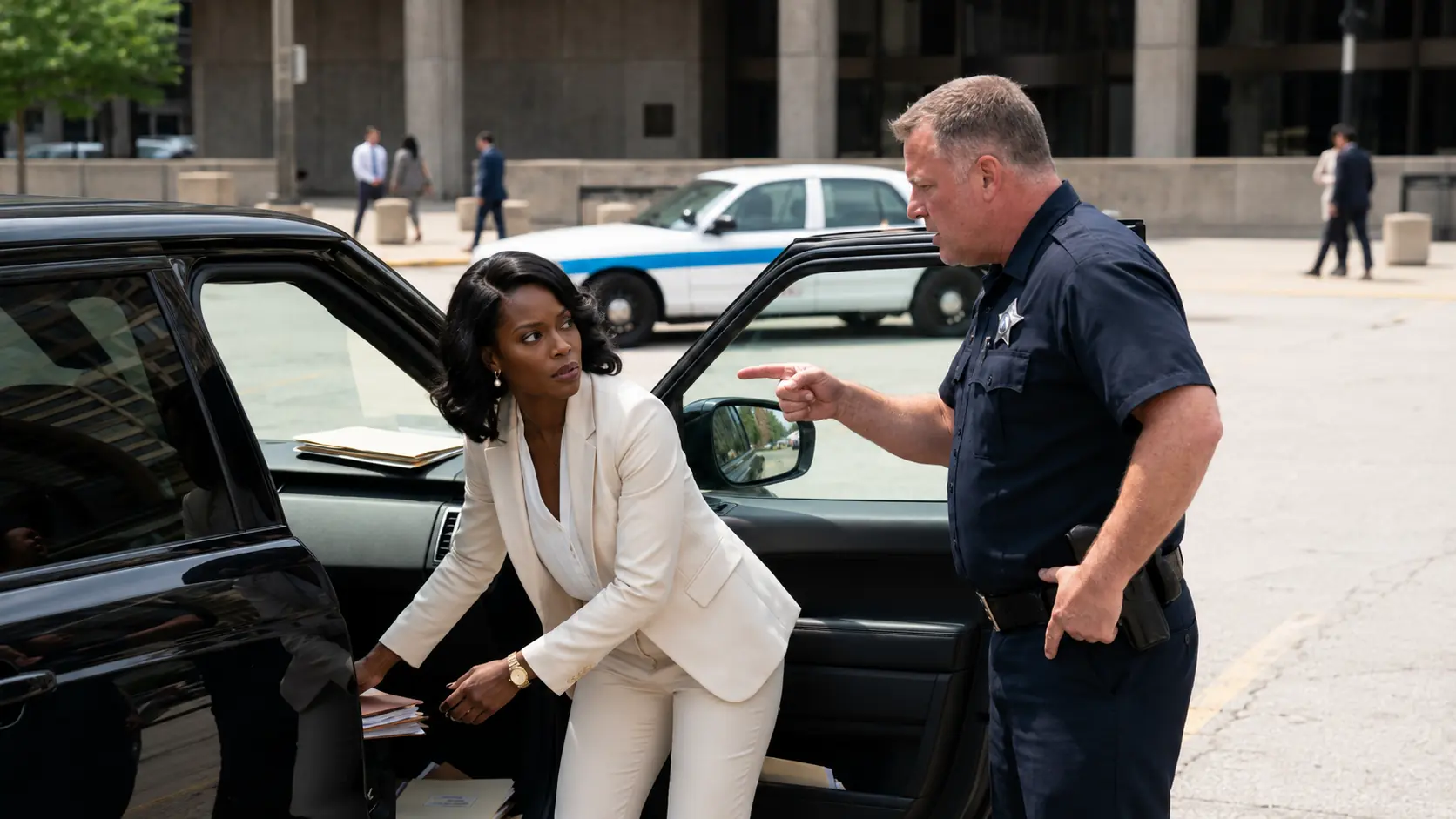
She was bent through the open driver’s door of her black luxury SUV, pushing aside legal folders, unopened mail, and a pair of heels she had thrown onto the passenger floor that morning. Her cream blazer was folded neatly across the back seat, leaving her in a white blouse and matching tailored trousers. Sweat gathered along her hairline as she searched beneath the seats for the black leather purse containing her wallet, state identification, and security credentials.
Her phone vibrated on the center console.
Three missed calls from her assistant.
The first meeting of the afternoon had already started, and Danielle was supposed to appear before the county oversight committee in twelve minutes. The subject was police accountability, specifically the department’s failure to discipline officers involved in unlawful stops.
She pushed another stack of documents aside.
“Come on,” she whispered. “Where did I put you?”
The purse was not beneath the passenger seat. It was not in the center compartment or inside the leather trial bag she had brought from court. Danielle straightened and tried to remember the morning. She had stopped for coffee, answered a call from the attorney general’s office, then placed several files inside the SUV before driving downtown.
The faint rumble of an engine approached behind her.
A patrol cruiser entered the parking lot and slowed.
Danielle glanced over her shoulder.
The officer behind the wheel was a broad white man in his late forties with short graying hair and a hard face. He stared directly at her as the cruiser passed. Danielle returned to the SUV, hoping he would continue toward the government entrance.
The cruiser stopped.
Its driver’s door opened.
Heavy boots struck the asphalt.
“Hey!”
Danielle froze with one hand resting on the driver’s seat.
She closed her eyes briefly, already understanding what was about to happen.
When she turned, the officer stood several yards away with one hand resting near his duty belt. His nameplate read MULLIGAN. His expression was not curious or cautious. It was accusatory.
“What do you think you’re doing?” he demanded.
Danielle stepped away from the SUV.
“I’m looking for my purse.”
“In that vehicle?”
“Yes.”
He looked from her face to the expensive SUV.
“You got identification?”
“It’s in the purse. That’s why I’m searching for it.”
Officer Patrick Mulligan approached slowly, studying her as if he had already discovered evidence of a crime. His eyes moved over her tailored clothing but seemed to find no contradiction between her appearance and the conclusion he had formed.
“Step away from the car.”
“This is my car.”
“I didn’t ask whose car you claim it is. I told you to step away.”
Danielle raised both hands slightly and moved back several feet.
“There’s no need for this to become difficult. Run the license plate. It’s registered in my name.”
Mulligan looked toward the open driver’s door.
“You expect me to believe you misplaced your purse inside a vehicle like this?”
“A vehicle like what?”
His jaw tightened.
“You know exactly what I mean.”
Danielle felt anger rise but forced herself to remain calm. She had prosecuted officers who escalated ordinary encounters because they interpreted questions as defiance. She understood how quickly a bad assumption could become a dangerous command.
“My name is Danielle Lawson,” she said. “I’m the state attorney. I work inside that building.”
Mulligan stared at her for a moment.
Then he laughed.
“State attorney?”
“That is correct.”
“You got any proof?”
“My identification is inside the purse I’m trying to find.”
“Convenient.”
“It would take you less than a minute to run the plate.”
He stepped closer.
“People like you don’t get jobs like that. Quit lying.”
Danielle’s expression hardened.
“Run the plates. Then tell me I’m lying.”
Mulligan unsnapped the handcuff pouch on his belt.
“Keep talking, and I’ll make you regret it.”
Danielle looked at the people beginning to slow near the sidewalk. Two courthouse employees had stopped by the entrance, and a young attorney was holding up a phone.
She faced Mulligan again and extended her wrists.
“Cuff me. Your chief will hear every word.”
For one brief moment, uncertainty appeared in his eyes.
Then pride erased it.
He seized Danielle’s arm, pulled it behind her back, and closed a steel cuff around her wrist.
“You’re under arrest for suspected vehicle theft.”
“You haven’t checked the registration.”
“You can explain yourself at the station.”
“You have no evidence a crime occurred.”
“I saw you searching a car without identification.”
“You saw a Black woman standing beside her own SUV.”
Mulligan tightened the second cuff.
“Keep playing that card. It won’t help you.”
The cold metal dug into Danielle’s wrists as he led her toward the patrol car. Several people were now recording openly. A woman in a courthouse badge stepped forward.
“Officer, I think you should verify the vehicle.”
Mulligan glared at her.
“Stay out of police business.”
Danielle stopped before entering the cruiser.
“You are arresting the elected state attorney outside her own office. Think carefully about your next decision.”
“You’re not the state attorney.”
“What makes you so certain?”
He pushed her into the back seat.
“Because I know your type.”
The door slammed.
Danielle sat against the hard plastic seat while Mulligan returned to the SUV. He shone a flashlight inside despite the bright afternoon sun, opening compartments and moving the documents she had been searching through. Several folders were marked CONFIDENTIAL, but he handled them carelessly.
Her phone remained on the console.
It rang again.
Mulligan looked at the screen, saw the name of Danielle’s chief deputy, and turned the device facedown.
He still did not run the plate.
A younger officer arrived several minutes later. His name was Aaron Brooks, and the uncertainty on his face deepened when he saw Danielle in the back seat.
“What happened?” Brooks asked.
“Caught her breaking into that SUV.”
“Did someone report it stolen?”
“I observed suspicious activity.”
Brooks looked at the license plate.
“You run it?”
“I’ll do that at the station.”
Danielle leaned toward the open window.
“Officer Brooks, the SUV is registered to Danielle Lawson. I am Danielle Lawson, the Cook County state attorney.”
Brooks stared at her.
Mulligan waved dismissively.
“She’s been saying that since I stopped her.”
“We should probably check.”
“I’ve been doing this job for twenty years,” Mulligan snapped. “I know a car thief when I see one.”
Brooks lowered his voice.
“She doesn’t exactly look like she’s stealing a car.”
Mulligan stepped closer to him.
“And what does a criminal look like?”
Brooks looked toward Danielle and immediately understood the trap inside the question.
“I’m saying verification would settle it.”
“Then verify it after transport.”
Mulligan returned to the driver’s seat.
As the cruiser pulled from the lot, Danielle watched her office disappear through the rear window. Employees stood near the entrance with their phones raised. By the time the car reached the street, the video was already spreading through government offices.
Inside the State’s Attorney’s Office, Danielle’s assistant, Rachel Ellis, watched a thirty-second clip sent by a courthouse clerk.
The image shook, but the voices were clear.
“People like you don’t get jobs like that.”
Rachel stood so quickly her chair struck the wall.
She called Chief Deputy State Attorney Mark Edwards.
“You need to see this.”
Mark watched the recording once, then again.
“Where is she?”
“Central Precinct.”
“Notify the attorney general’s office. Preserve every camera surrounding that parking lot and contact Internal Affairs.”
Rachel hesitated.
“Should we tell the police chief?”
Mark picked up his suit jacket.
“I’m going to let him discover what his officer just did.”
At Central Precinct, Mulligan removed Danielle from the cruiser and led her through the booking entrance. Officers glanced at her but asked no questions. He placed her inside a small processing room and began completing an arrest report.
“Name?”
“I gave it to you.”
“State it again.”
“Danielle Michelle Lawson.”
“Occupation?”
“You already know what I told you.”
Mulligan smiled.
“Unemployed?”
Danielle looked directly at him.
“State attorney.”
He typed something.
“What did you enter?”
“Suspect claims government employment.”
“You are falsifying an official report.”
His fingers paused above the keyboard.
“You want me to add threatening an officer?”
“I’m warning you that every action you take is being documented.”
“This isn’t one of your imaginary courtrooms.”
“No,” Danielle said. “Courtrooms have rules.”
Mulligan grabbed the chain between her cuffs and guided her toward a holding room.
“You’ll sit there until you decide to tell the truth.”
“I told you the truth in the parking lot.”
“You told me a story.”
He locked her inside.
Danielle sat on a metal bench and looked at the red marks around her wrists. She had worked in buildings like this for fifteen years, but always from the other side of the door. She knew the procedures, the rights of detainees, and every shortcut officers used when they believed no one important was watching.
What disturbed her most was not Mulligan’s arrogance.
It was how ordinary the rest of the station appeared.
Officers walked past the holding room carrying coffee. Phones rang. Reports were filed. No one asked why a well-dressed woman accused of vehicle theft had arrived without a complainant, a broken window, or evidence that the car belonged to someone else.
She thought of the defendants she had prosecuted based on reports written by officers like Mulligan. How many had insisted an encounter began differently? How many had no government title, respected attorney, or public audience to force someone to listen?
Mulligan returned forty minutes later.
“You ready to admit the SUV wasn’t yours?”
Danielle looked up.
“Have you run the plate?”
“That isn’t how this works.”
“It is precisely how this works.”
“You don’t tell me how to do my job.”
“I oversee criminal prosecutions in this county. I know exactly how your job is supposed to be done.”
Mulligan leaned closer to the bars.
“You really committed to this state-attorney thing, aren’t you?”
Danielle stood.
“You don’t know who you’re dealing with.”
“I’ve dealt with criminals smarter than you.”
“You have dealt with people you assumed had no power.”
His expression hardened.
“Watch your mouth.”
“Or what? You’ll arrest me again?”
The younger officer, Brooks, appeared at the end of the hallway with a clipboard.
“Mulligan.”
“What?”
“I ran the plate.”
Mulligan turned slowly.
Brooks’s face had lost its color.
“It belongs to Danielle Lawson.”
Danielle remained silent.
Mulligan glanced back at her.
“She could have stolen the owner’s keys.”
Brooks lowered his voice.
“The registered owner is the Cook County state attorney.”
Mulligan stared at him.
“That proves nothing.”
“There’s a photograph in the state database.”
Brooks turned the clipboard around.
Danielle’s official portrait appeared beside her name and title.
For the first time since the parking lot, Mulligan had nothing to say.
Danielle stepped closer to the bars.
“Still think I’m lying?”
His face reddened.
“Why didn’t you show identification?”
“My purse was inside the SUV.”
“You should have identified yourself more clearly.”
“I told you six times.”
Mulligan looked toward Brooks.
“Don’t release her yet.”
Brooks blinked.
“On what charge?”
“Obstruction.”
Danielle laughed once, though there was no humor in it.
“You are now inventing a second charge to protect the first.”
Mulligan pointed at her.
“You refused lawful commands.”
“I stepped away, raised my hands, and allowed you to handcuff me.”
“You argued.”
“That is not obstruction.”
Footsteps sounded in the main corridor.
Mark Edwards entered with two attorneys from Danielle’s office, the head of Internal Affairs, and Police Chief David Hernandez. Behind them came a visibly nervous precinct sergeant.
The room changed immediately.
Mulligan straightened.
Chief Hernandez looked through the bars at Danielle, then at the handcuff marks on her wrists.
“Open the door.”
Mulligan stepped forward.
“Chief, I can explain.”
“Open it.”
Brooks unlocked the holding room.
Danielle walked out without looking at Mulligan. Mark removed his coat and placed it around her shoulders despite the summer heat.
“Are you hurt?”
“My wrists. Nothing more.”
Chief Hernandez’s face tightened.
“State Attorney Lawson, I sincerely apologize.”
“Save the apology until you understand what happened.”
He turned toward Mulligan.
“Did you run the vehicle registration before making the arrest?”
Mulligan remained silent.
The precinct sergeant answered.
“No, Chief.”
“Was there a theft complaint?”
“No.”
“Signs of forced entry?”
“No.”
“Witness claiming she did not own the SUV?”
“No.”
Hernandez looked at Mulligan.
“Then explain the probable cause.”
“She was searching through an expensive vehicle without identification.”
Danielle stepped forward.
“He told me people like me do not become state attorneys.”
The hallway went silent.
Mulligan shook his head.
“She’s twisting my words.”
Mark held up his phone.
“Twenty-three people recorded you.”
He played the video.
Mulligan’s voice filled the corridor.
“People like you don’t get jobs like that. Quit lying.”
Chief Hernandez watched the entire clip without moving.
When it ended, he faced Mulligan.
“Give the sergeant your badge and duty weapon.”
Mulligan’s eyes widened.
“You’re suspending me because she has political power?”
Hernandez’s voice hardened.
“I am suspending you because you made an arrest without evidence, refused to perform the most basic verification, used racist language, and continued detaining her after the registration proved she told the truth.”
“I made a judgment call.”
“You made a judgment about her before you investigated anything.”
Mulligan removed his badge but held it tightly.
“You’re all reacting because she’s important.”
Danielle stepped between him and the chief.
“That is the problem.”
Mulligan looked at her.
“You are sorry because I turned out to be the state attorney. You should have followed the law even if I cleaned offices inside that building.”
“I didn’t know who you were.”
“You did not need to know.”
He lowered his eyes.
Danielle continued.
“You saw a Black woman beside an expensive vehicle and constructed a crime around her. Every fact that contradicted you became another lie in your mind.”
“I was protecting property.”
“You never found out whose property you were protecting.”
Mulligan’s jaw tightened.
Mark handed Chief Hernandez a formal notice preserving all evidence connected to the arrest. The state attorney’s office requested body-camera footage, dispatch logs, cruiser video, station recordings, personnel complaints, and every arrest Mulligan had made involving suspected vehicle theft during the previous five years.
The chief read the list.
“That is extensive.”
“It needs to be,” Danielle said. “This did not begin today.”
Mulligan laughed bitterly.
“You’re going after my whole career.”
“I’m examining it.”
“You think you’re better than every cop here?”
“No. I think no badge should protect an officer from the rules he enforces.”
Danielle was released without charge.
Outside the station, reporters had already gathered. The parking-lot video had spread across Chicago, and news stations were broadcasting the confrontation on a loop. Microphones rose as Danielle emerged beside Mark and Chief Hernandez.
“State Attorney Lawson, will you file a lawsuit?”
“Do you believe the arrest was racially motivated?”
“Should Officer Mulligan be fired?”
Danielle stopped at the top of the steps.
“This is not only about what happened to me,” she said. “I had attorneys, witnesses, and institutional power capable of correcting the mistake quickly. Many residents do not.”
She looked toward the cameras.
“The question is not why an officer arrested the state attorney. The question is how often the same officer treated ordinary citizens this way when no cameras were present.”
The Internal Affairs investigation began that evening.
By the end of the first week, investigators found nineteen complaints against Mulligan. Eleven came from Black motorists, five from Latino residents, and three from young white drivers he described as poor or suspicious. Several claimed he refused to check registration documents before making arrests. Two people had spent nights in custody before charges were dismissed.
Supervisors had classified nearly every complaint as unsubstantiated.
One report stood out.
Three years earlier, a Black nurse named Patricia Coleman had been arrested beside her husband’s Mercedes after retrieving a jacket from the back seat. Mulligan claimed she could not explain why she possessed the keys. Patricia insisted he never allowed her to finish speaking. The charge was dismissed when her husband arrived at the station.
She filed a complaint.
The department closed it within two days.
Danielle met Patricia inside her office.
“Did anyone interview you?” Danielle asked.
“No.”
“Did they contact your husband?”
“No.”
“Were you informed of the outcome?”
“I received a letter saying there wasn’t enough evidence.”
Patricia looked toward the window.
“When I saw your video, I recognized his voice before I saw his face.”
More people came forward.
A college professor.
A restaurant owner.
A delivery driver.
A retired firefighter.
The details varied, but the pattern remained the same. Mulligan made an assumption, treated disagreement as resistance, and delayed verification until after the arrest. His reports used phrases such as evasive behavior, suspicious demeanor, and inconsistent explanation without identifying any actual crime.
Chief Hernandez convened a disciplinary hearing two weeks later.
Danielle attended with Mark, Patricia, and representatives from a civilian oversight organization. Mulligan entered in a suit rather than his uniform, accompanied by a union attorney.
He denied racial bias.
“I would have arrested anyone behaving suspiciously.”
Danielle placed the parking-lot photograph on the table.
“What specific behavior indicated theft?”
“She was searching through a vehicle.”
“With the correct keys.”
“I didn’t know that.”
“Because you refused to check.”
“She had no identification.”
“Does lack of identification establish vehicle theft?”
“No.”
“Was the window broken?”
“No.”
“Was the alarm sounding?”
“No.”
“Had anyone reported the SUV stolen?”
“No.”
“Did she attempt to leave?”
“No.”
“Did she threaten you?”
“No.”
“What remained after those facts?”
Mulligan looked toward his attorney.
Danielle answered for him.
“Your assumption.”
The union attorney objected, but the hearing officer allowed her to continue.
Danielle played the recording again.
“People like you don’t get jobs like that.”
“What did you mean?”
Mulligan shifted in his chair.
“I was frustrated.”
“That does not answer the question.”
“I thought she was lying.”
“Because of what evidence?”
He remained silent.
Danielle closed the folder.
“You believed I could not be the state attorney because I did not match the person you imagined holding that office.”
Mulligan finally looked at her.
“I said something I shouldn’t have.”
“You placed me in handcuffs before you said it. The words merely revealed what had already guided your decision.”
The department terminated him the following morning.
But Danielle refused to let the investigation end with one firing.
She accepted a position on a new police-accountability committee under three conditions. Community members with prior complaints would hold half the seats. Disciplinary records would be reviewed independently rather than by an officer’s direct supervisors. Every vehicle-theft detention would require documented plate verification unless an immediate danger made it impossible.
Chief Hernandez accepted.
Several police officials resisted.
They argued that the changes would slow officers and create hesitation during investigations. Danielle invited them to the same parking lot where she had been arrested.
She stood beside her SUV while academy instructors recreated the encounter.
The exercise took forty-two seconds.
An officer entered the plate into a mobile terminal. The registration returned Danielle’s name. A photograph confirmed her identity. The supposed crime disappeared before anyone reached for handcuffs.
Danielle faced the gathered supervisors.
“Forty-two seconds,” she said. “That is the delay you called dangerous.”
No one answered.
Six months later, unlawful vehicle-theft detentions fell sharply. Complaints regarding unnecessary handcuffing decreased, and officers received updated training emphasizing observation before assumption. Body-camera audits focused not only on physical force but on language used during early encounters, where bias often revealed itself first.
Brooks, the young officer who finally checked the plate, testified during the department review. He admitted that he knew something was wrong in the parking lot but lacked the courage to challenge a senior officer directly.
Danielle asked him why.
“I did not want to become his next target.”
“And what changed?”
“I realized staying quiet made you the target instead.”
He later became one of the instructors teaching recruits how to intervene when a colleague ignored procedure.
A year after the arrest, Danielle returned to the parking lot on another hot afternoon. She parked in the same space and stood beside the driver’s door.
The memory remained vivid.
Mulligan’s hand near his holster.
The cuffs closing around her wrists.
The certainty in his voice when he declared that people like her did not hold positions of power.
Her assistant approached carrying two coffees.
“You all right?”
Danielle accepted one.
“Yes.”
“You’ve been staring at that space for five minutes.”
“I was thinking about how close he came to making this ordinary.”
Rachel understood.
Most injustice did not survive because everyone approved of it. It survived because people became accustomed to watching it happen.
Danielle looked toward the office entrance. A group of young attorneys crossed the lot, laughing together before returning to work. Among them was a Black woman beginning her first year as an assistant state attorney.
She waved when she recognized Danielle.
Danielle waved back.
Officer Mulligan had believed someone like her could not become state attorney.
He had been wrong about her title.
More importantly, he had been wrong to believe anyone needed an important title before deserving the truth.
He arrested Danielle because he thought she was powerless.
The consequences began only when he discovered she was not.
Danielle’s work afterward was designed to ensure the next person would not need power, witnesses, or a government office to be believed.
Justice could not depend on who sat inside the handcuffs.
It had to begin before they ever closed.