He thought the badge on his chest gave him the right to be judge, jury, and executioner.
Officer Bryce Callahan was the kind of cop who believed he owned the asphalt of Pine Creek, and he had a special hatred for outsiders who drove cars nicer than his.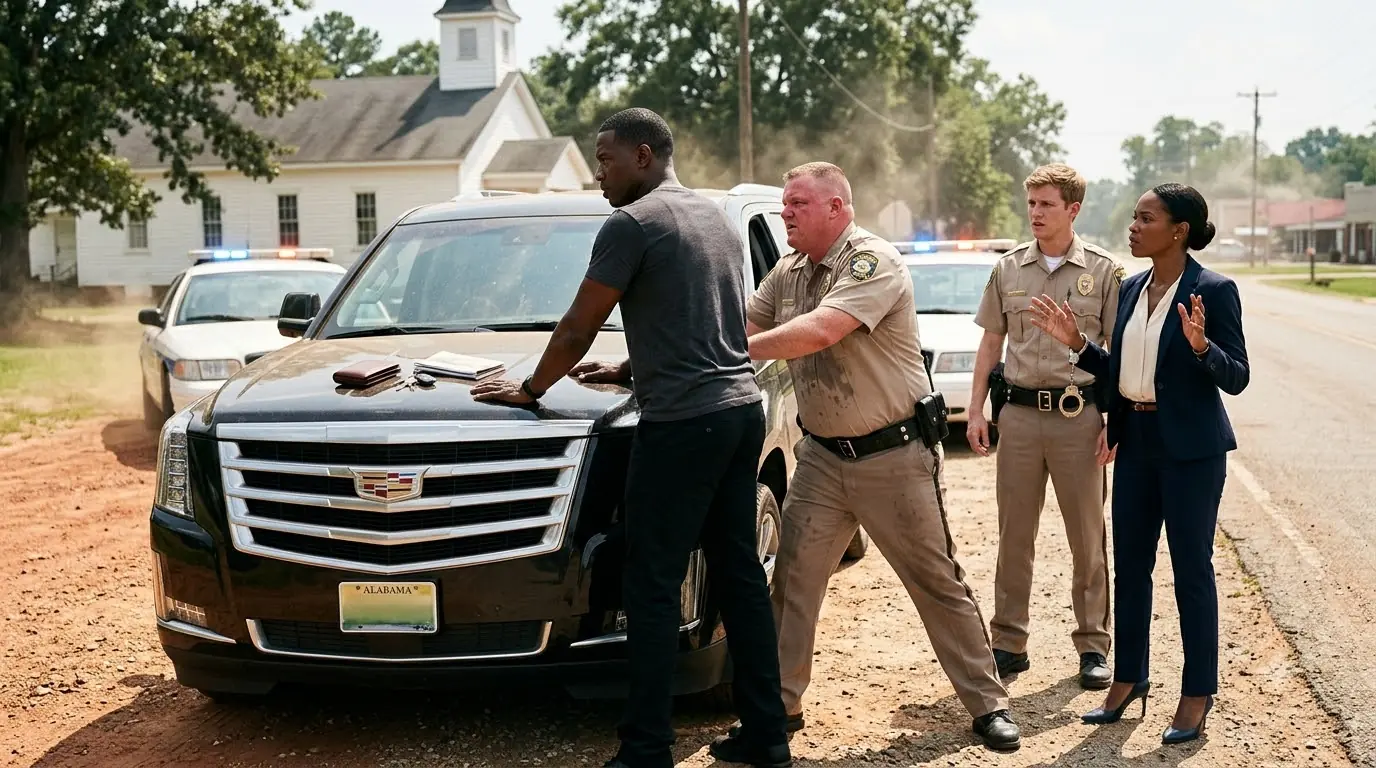
On a humid afternoon in the heat of summer, Callahan made the biggest mistake of his life.
He did not just profile a couple in a luxury SUV. He unknowingly declared war on two of the highest-ranking federal officials in the country.
This was not simply a story about bad policing. It was the beginning of the most complete career-ending reckoning Bryce Callahan could ever have imagined.
The heat in Pine Creek pressed down like a wet wool blanket. It was the kind of town where everybody knew everybody else's business, mostly because there was not much business to know.
At the center of that spider web sat Officer Bryce Callahan. Bryce was forty-five, heavy in the gut, with a buzz cut that had retreated halfway up his scalp.
He wore his uniform tight, the fabric straining against a chest that had not seen a gym in a decade, but he compensated with attitude. In Pine Creek, Bryce was not just a patrolman. He was the gatekeeper. He had been on the force for twenty years, long enough to know which drunk drivers to drive home and which ones to throw in the drunk tank.
He had a reputation, one he cultivated carefully. They called him the Hammer down at the local dive bar, the Rusty Nail. He liked that. Hammers crushed things.
Bryce was parked in his usual speed trap, a gravel turnout hidden behind a massive billboard advertising Langley's Personal Injury Law. He was sipping lukewarm sweet tea, sweat beading on his upper lip, while he watched interstate traffic trickle onto Main Street.
He was bored, and boredom was dangerous for a man like Bryce Callahan. Boredom led him to look for trouble.
That was when he saw it, an obsidian- Range Rover, the newest model, gleaming so hard that the sun bounced off it like a mirror. It was moving slowly and respectfully, doing exactly the speed limit. To Bryce, that was the first red flag. In his mind, nobody drove the speed limit unless they were hiding something.
He squinted and leaned forward over the steering wheel. The windows were tinted dark, barely legal by Alabama standards, but he could make out two silhouettes.
As the SUV passed his hiding place, a shaft of sunlight cut through the windshield. Bryce saw the driver, a man with broad shoulders and sunglasses, one hand resting casually on the wheel. Beside him sat a woman looking down at a phone or a map.
The knot in Bryce's stomach tightened with a familiar mix of jealousy and territorial aggression. "Drug money," he thought instantly. It was a reflex, a path worn deep by years of unchecked bias. Who else drove a hundred-thousand-dollar vehicle through Pine Creek on a weekday? Nobody working a normal job bought something like that, he decided.
He did not check the plates. He did not wait for a traffic violation. He threw the gearshift into drive.
Gravel crunched as his cruiser lurched onto the pavement. "Dispatch, this is Unit Four Alpha," Bryce mumbled into his radio, not bothering to swallow the ice in his mouth. "I am pursuing a suspicious vehicle, Range Rover heading north on Main. Possible drug trafficking."
The dispatcher, Mrs. Higgins, crackled back without asking for probable cause. In Pine Creek, Bryce's instincts had been treated as probable cause for years. Bryce flipped on his lights, no siren, just the silent strobe of authority. He sped up and rode the bumper of the Range Rover, trying to frighten the occupants into making a mistake.
"Run," he thought. "Give me a reason."
The Range Rover did not run or swerve. The driver signaled right, calmly and methodically, and pulled onto the dusty shoulder near the old Baptist church. Bryce smirked. "Gotcha."
He checked his dash camera. It was on, but Bryce knew the tricks. He angled the cruiser so the camera would catch the suspect's door, while leaving room to later claim that the audio had malfunctioned if necessary. He unbuckled, adjusted his belt, and rested one hand on the grip of his Glock 17 without drawing it.
He approached the passenger side because he liked forcing drivers to turn away from him. Then he struck the glass hard with his knuckles. Bang. Bang. Bang.
The window slid down silently. Cold air poured from the vehicle, and the interior smelled like new leather. The woman in the passenger seat turned toward him. She had sharp features, her hair pulled into a tight professional bun, and she wore a navy blazer. She looked over the rim of her sunglasses with annoyance rather than fear.
"Is there a problem, Officer?" she asked. Her voice was crisp and controlled.
Bryce hated the tone because it sounded educated, as if she believed she was better than him. "License and registration," he barked, ignoring her question. He leaned in, letting his sweaty face invade the cool interior, and looked past her toward the driver.
The driver was a mountain of a man wearing a fitted gray T-shirt that showed arms the size of tree trunks. He, too, was calm, and that calm unsettled Bryce.
"Do you know why I pulled you over?" Bryce demanded.
"We were doing thirty-five," the driver replied in a deep voice. "The signal was on. The plates are valid."
"I pulled you over because you have an obstructed view," Bryce lied. "That air freshener hanging from the mirror."
There was no air freshener. The driver glanced at the empty mirror and then back at Bryce. "There is nothing on the mirror, Officer."
"Do not get smart with me," Bryce snapped, using a racially charged form of address meant to diminish him. "I said license and registration. Now."
Kendrick reached slowly toward the center console. Bryce jumped back and gripped his weapon. "Hands! I want to see hands on the dash now."
"I am getting my wallet," Kendrick said, freezing in place. "You asked for identification."
"I do not know what you are reaching for," Bryce shouted, performing for the dash camera and building a false claim of danger. "Get out of the car. Both of you. Out."
"Officer," the woman said, her voice turning icy, "this is unnecessary. We are complying."
"Get out or I will drag you out," Bryce roared.
He wanted a reaction. He wanted them to shout back or resist, because that would give him the excuse he wanted to force them onto the ground. Kendrick looked at the woman, and they exchanged a silent glance Bryce could not interpret. It was not fear. It was communication and protocol.
"Okay," Kendrick said. "We are stepping out."
Bryce backed away with his hand twitching over the holster. He imagined tearing the expensive vehicle apart, finding drugs hidden in the panels, and seizing it. By nightfall, he believed, he would be the hero of the precinct. He had no idea that he had just ordered the Special Agent in Charge of the FBI's Atlanta Field Office and a senior prosecutor from the Department of Justice Civil Rights Division out of their vehicle.
The heat struck Kendrick and Serena Voss as soon as they stepped onto the gravel. Neither flinched. They stood beside the SUV with their hands clearly visible.
"Spread them. Hands on the hood," Bryce ordered.
"Am I under arrest?" Kendrick asked without moving.
"You are being detained for investigation," Bryce spat. "Now do what I told you."
Kendrick placed his hands on the hot hood, and Serena did the same. Bryce moved behind Kendrick and kicked his ankles apart. "Wider."
He patted Kendrick down aggressively, searching his waistband, pockets, and legs for a weapon or anything he could call contraband. Then he felt a hard rectangle in Kendrick's back pocket. Triumph rose in his throat.
"What is this?" Bryce demanded.
"My wallet," Kendrick replied, "which contains the identification you requested."
Bryce ripped the wallet free without opening it and tossed it onto the hood. Then he moved toward Serena.
"Officer," Serena said sharply, "I do not consent to a search. You have no probable cause."
"I have probable cause because you are acting nervous and your partner is combative," Bryce improvised.
He reached for her. "Do not touch me," Serena said. It was not a scream. It was a command, and for one second it stopped him cold.
Bryce leaned close to her ear. "You listen to me. You are in Pine Creek now. The Constitution ends at the county line. I can do whatever I want."
He grabbed her arm, turned her around, and searched her roughly. Finding nothing, he stepped back in frustration. "Stay right there. If you move, I will use my Taser."
He walked to the driver's door of the Range Rover. "You cannot enter the vehicle without a warrant," Serena called.
"Probable cause," Bryce shouted back. "I smelled marijuana."
"You are lying," Kendrick said. "Neither of us smokes. This search is illegal."
"Tell it to the judge," Bryce muttered.
He tore through the center console, finding mints, a charging cable, and sunglasses. The glove box held insurance papers and a Hertz rental agreement from Atlanta. "Drug runners always use rentals," he told himself.
Then he reached beneath the driver's seat and felt cold metal. His heart hammered. He pulled out a SIG Sauer P320.
Bryce scrambled from the SUV holding the weapon in the air like a trophy. "Gun! On the ground. Get on the ground now!"
He leveled his service weapon at Kendrick's chest. Kendrick did not drop. He rose slowly from the hood and turned to face Bryce, his expression controlled but dangerous.
"Officer," Kendrick said with deadly calm, "put that weapon down. That firearm is legal."
"Get on the ground or I will shoot," Bryce shouted, his hands shaking as adrenaline flooded him. "You are under arrest for illegal possession of a concealed weapon."
"It is not illegal," Serena said, her hands still raised and her eyes tracking Bryce's trigger finger. "Check the wallet. Open the wallet you threw on the hood."
"I do not care about your fake identification," Bryce yelled.
He keyed the radio on his shoulder. "Dispatch, 10-18. I need backup. I have two suspects at gunpoint. Weapon recovered. Send everyone."
"You are making a mistake that will cost you everything," Kendrick said. "Look at the badge next to the gun."
Bryce glanced at the weapon in his hand. A small leather credential holder was clipped near the holster he had missed under the seat. He had pulled out only the firearm.
"Shut up," Bryce shouted as sirens began to wail in the distance.
Two cruisers arrived in clouds of dust. Officer Riley and rookie Deputy Ellis jumped out.
"Cuff them," Bryce yelled. "Resisting arrest and illegal firearm possession."
Riley rushed Kendrick and twisted his arm behind his back. Kendrick did not resist, but Riley struggled against the dense muscle in his shoulders.
"I am a federal agent," Kendrick said loudly and clearly so every dash camera would record it. "My badge is in the wallet on the hood. If you put those cuffs on me, you are unlawfully detaining a federal officer."
Riley hesitated. "Bryce, what is he saying?"
"He is lying. They all say that. Cuff him."
Riley snapped the cuffs shut. Ellis took Serena's arms and cuffed her as well. She did not resist. Her eyes remained fixed on Bryce as she memorized every detail, from his badge number to the stains darkening his uniform.
"You should check that wallet," Riley said nervously.
"Fine."
Bryce snatched the wallet from the hood and flipped it open. He expected a Georgia driver's license or cheap counterfeit credentials. Instead, a heavy gold shield glinted in the sunlight. An eagle spread its wings above the words Department of Justice, Federal Bureau of Investigation, Special Agent.
Bryce blinked and rubbed his thumb across the badge. Then he looked at the identification card beside it. Kendrick Voss, Special Agent in Charge. The heat seemed to disappear, replaced by a chill that began at the base of his spine.
He ran to the Range Rover, grabbed Serena's purse, and dumped its contents onto the seat. A second credential case fell out. United States Department of Justice, Civil Rights Division, Senior Prosecutor.
Bryce looked up. Kendrick stood cuffed beside the cruiser, not staring at the ground but directly at him. For the first time, Bryce understood that the expression on Kendrick's face was not anger. It was pity.
"Riley," Bryce croaked.
"Yeah?"
"Take them in."
His voice trembled, but he could not admit he was wrong in front of the others. He doubled down. "They are good fakes. Take them in."
Riley looked doubtful, but he followed the order and shoved Kendrick into the cruiser. When the door slammed, Bryce stared down at the gold badge in his hand. His fingers shook so hard that he nearly dropped it.
He had arrested the FBI, but he did not yet know why Kendrick and Serena were in Pine Creek.
The ride to the Pine Creek Police Department was short, but inside the cramped rear seat it felt endless. A scratched, yellowed Plexiglas divider separated the dirty back seat from the air-conditioned front. Kendrick sat hunched because he was too large for the space, his knees pressed against the cage. He did not complain. He breathed in a slow rhythm learned during hostage-negotiation training at Quantico.
Beside him, Serena watched the town pass through the window: the dilapidated gas station, the high school football field, and the endless row of churches. Officer Riley kept glancing into the rearview mirror. The confidence given to him by his uniform faded with every mile.
"Bryce says the badges are fake," Riley muttered, mostly to himself. "They have to be fake. Who carries credentials like that in a glove box?"
"Someone who does not want to display them unless necessary," Kendrick said from the back. His voice carried through the divider. "Officer Riley, think carefully about what you do next. You are participating in the unlawful detention of federal officials. If you process us or fingerprint us, you deepen your role in what follows."
"Be quiet," Riley shouted, but his voice cracked. "You do not talk back there."
They entered the station's sally port, and the heavy gate rattled shut behind them. Bryce was already inside, having driven ahead to control the narrative before Kendrick and Serena arrived. He stood near the booking desk, speaking quickly to the desk sergeant, a tired man known as Sergeant Frank.
"Drug runners," Bryce announced loudly. "High-level operation. Expensive vehicle, concealed weapon, fake federal credentials, professional counterfeits. Process them separately under maximum-security procedures. No calls until we verify their identities."
Sergeant Frank peered over his reading glasses while chewing a toothpick. "Federal agents, Bryce? You arrested federal agents?"
"Fake federal agents," Bryce snapped, slamming a hand on the counter. "The badges are a cover. They thought they could scare me off, but I saw through it."
Riley brought Kendrick and Serena through the sally-port door. Kendrick walked with his head high despite the cuffs. Serena carried herself as if entering a boardroom rather than a jail.
"Empty your pockets," Bryce ordered. He grabbed Kendrick's arm and tried to shove him toward the counter, but Kendrick did not move until he chose to.
"You already have our wallets, phones, and badges," Serena said. "You are legally required to verify those credentials through the Department of Justice switchboard. Do you need the number, or do you know how to use a search engine?"
"I do not need your numbers," Bryce sneered. He leaned close to her face. "I will book you as Jane Doe until you give me your real name. You will sit in a holding cell until you break."
"My name is Serena Voss. I am a senior prosecutor with the Civil Rights Division," she repeated, carefully enunciating each word. "You are violating Title 18, Section 242 of the United States Code, deprivation of rights under color of law."
Bryce laughed harshly. "You memorized a statute. Cute. Strip-search them."
The booking room fell silent. Even Riley froze.
"Excuse me?" Sergeant Frank asked.
"You heard me," Bryce said, his eyes bright with panic and anger. "I suspect they are carrying narcotics internally. Standard procedure for trafficking suspects. Search both of them."
"I am not doing that," Officer Tara said from the corner. She stood and crossed her arms. "I am not searching a woman in a business suit who sounds like a federal prosecutor because you have a hunch."
"This is insubordination," Bryce screamed, his face turning red. "I am the arresting officer. I give the orders."
"Actually, I give the orders," a voice boomed from the hallway.
Chief Wade Garrick entered the booking area. Garrick was a relic of the old South, with leathery skin and a belly hanging over his belt. He was not a good man, but he was pragmatic. He disliked public disorder, and Bryce was creating a great deal of it.
"What is this circus, Callahan?" Garrick asked, studying the well-dressed pair in handcuffs.
"I caught major traffickers," Bryce said, hurrying toward him. "Range Rover, concealed firearm, and fake federal identification."
He tossed the credential cases onto the counter. Garrick lifted Kendrick's badge and felt its weight. He had seen fake badges before, usually cheap metal with glued-on seals. This one was solid, precisely engraved, and fitted with a secure access chip on the back.
Garrick looked at Kendrick and then at the cuffs. "Who are you?"
"Special Agent in Charge Kendrick Voss, FBI Atlanta Field Office," Kendrick replied. "If those cuffs are not removed very soon, Chief Garrick, I will personally ensure this department never operates the same way again."
Garrick turned to Bryce. "Did you run the badge number?"
"It is fake. Why would I run a fake number?"
"Run it now," Garrick ordered Sergeant Frank.
"The system is slow," Frank said as he began typing.
Garrick looked at Serena's credentials. "Voss. The same surname. You arrested a husband and wife?"
"Siblings," Serena corrected, "and partners on a federal task force."
"What task force?" Bryce scoffed. "There is no task force in Pine Creek."
Kendrick smiled, and the expression frightened Bryce more than anger would have. "That is because you are the target, Callahan."
The room seemed to lose its air.
"What did you say?" Bryce whispered.
"We were not passing through," Kendrick said. "We have been investigating a money-laundering operation involving Langley's Personal Injury Law, law-enforcement kickbacks, false arrests, and fraudulent settlements. We were on our way to meet a local informant when you stopped us."
Bryce's face turned pale. He remembered the billboard under which he parked every day and the cash envelopes Arthur Langley handed him each week in exchange for ignoring certain drivers and targeting others.
"He is lying," Bryce shrieked. "He is trying to scare you. Chief, put them in a cell."
Chief Garrick studied the badges, then Bryce, the liability he had tolerated for too long, and finally the wall phone.
"Uncuff them," Garrick said quietly.
"No." Bryce drew his Taser. "Nobody touches them. They are my arrests."
"Bryce, put it down," Riley shouted, drawing his own firearm.
The station entered a standoff, police facing police.
"This is the moment you decide how the rest of your life unfolds," Kendrick said calmly. "Use that Taser and you add another assault. Fire a weapon and the federal team surrounding this building will respond. Put it down, and you may still have a chance to cooperate."
Bryce's hand shook. He looked toward Garrick, but the chief had already turned away from him. Bryce lowered the Taser.
"Uncuff them," Garrick repeated.
Riley rushed forward and released the cuffs. Kendrick rubbed his wrists but did not strike Bryce or raise his voice. He reached across the counter, recovered his phone from the property bin, and switched it on.
"I need to make a call," Kendrick said.
"Use the office line," Garrick offered, wiping his forehead with a handkerchief.
"I do not need your line."
Kendrick dialed from his cell phone and placed the call on speaker. The room remained silent.
"Director's office," a woman answered.
"Patricia, this is Kendrick Voss. Code Red, Pine Creek, Alabama."
The voice sharpened immediately. "Status of Agent Voss and Prosecutor Voss?"
"Secure for the moment, but compromised. Local law enforcement intercepted us. I was held at gunpoint, and both of us were subjected to an illegal search and false imprisonment."
"Are you safe now?"
"For the moment. I need the team. Bring everyone."
"Estimated arrival is minutes. They are holding at the perimeter."
The call ended. Kendrick looked toward Bryce, who leaned against a filing cabinet as if he might be sick.
"They will be here soon," Kendrick said. "You should begin thinking about cooperation, because resignation will be the least of your problems."
Minutes can feel very long inside a silent police station. Bryce sat in a chair in the corner while everyone else moved subtly away from him. Riley, Tara, and Sergeant Frank gathered on the opposite side of the room, distancing themselves from the approaching consequences.
Kendrick and Serena sat on a metal bench. Serena retrieved a notebook from her purse and wrote rapidly. Every few seconds she looked up at Bryce and added another line.
"What are you writing?" Bryce asked hoarsely.
"Your indictment," Serena replied without looking up. "I am adding the threatened strip search. Abuse under color of law and retaliatory conduct will be addressed."
"You cannot prove that. It is my word against yours."
"I will testify," Officer Tara said. Her voice shook, but it remained firm.
Bryce's head snapped toward her. "You would betray another officer?"
"You are not asking for loyalty," Tara replied. "You are asking us to help cover abuse. You nearly pulled this entire department into a federal crime. I am not going to prison for you."
"Traitors," Bryce spat.
Then the coffee in Sergeant Frank's mug began to ripple. A low vibration moved through the floor, soft at first, then louder.
Riley went to the window. "What is that?"
"A helicopter," Garrick said, staring at the floor.
Sirens followed, not one cruiser but many. Tires screeched outside, and doors slammed in rapid succession.
"Open the gate," an amplified voice ordered from beyond the sally port. "This is the FBI. Open the gate immediately or we will breach."
Sergeant Frank fumbled for the control and pressed it. The metal door rolled upward. Sunlight poured into the station, revealing six federal agents in tactical gear with bold yellow FBI lettering across their chests. Behind them came a woman in a gray suit, flanked by two Alabama state investigators.
"Secure the room," the lead tactical agent ordered.
The team swept inside. Every local officer raised both hands. The federal agents moved directly to Kendrick and Serena.
"Sir, ma'am, are you injured?" the lead agent asked while scanning the room.
"We are fine, Agent Rostova," Kendrick said. "The immediate threat is contained."
Assistant Director Margaret Hale entered and surveyed the station with open disgust. She fixed her eyes on Chief Garrick.
"Who is in charge here?"
"I am," Garrick stammered. "Chief Wade Garrick."
Hale stepped into his space. "Chief Garrick, you are relieved of command effective immediately. The Alabama State Bureau of Investigation is assuming control of this department. This building is now a federal crime scene."
"On what grounds?" Garrick asked, trying to recover some authority.
"On the grounds that your department is part of a protection and extortion scheme connected to Langley's Personal Injury Law," Kendrick said. "We have wiretaps, bank records, fabricated reports, planted evidence, and kickback ledgers."
He turned toward Bryce. "We also have extensive evidence of Officer Callahan's enforcement practices."
Hale followed his gaze. "Is that him?"
"That is Officer Bryce Callahan," Serena said. "He initiated a stop without cause, searched the vehicle unlawfully, assaulted and detained federal officials, falsified the reason for the stop, threatened an invasive search, and brandished a Taser after his error was exposed."
Hale nodded toward the tactical team. "Take him into custody."
Two agents seized Bryce and placed him against the wall. They spread his feet and secured his wrists, making him feel the same loss of control he had imposed on Kendrick.
"Watch my shoulder," Bryce protested.
Agent Rostova began reading him his rights. "You have the right to remain silent. Anything you say can and will be used against you in federal court."
"This is a mistake," Bryce shouted as they moved him toward the exit. "I was doing my job. They looked suspicious. It was a lawful stop."
Kendrick stepped close as Bryce passed. "You wanted to find contraband in my car and become a hero. Instead, you are going to become the public face of police corruption in Alabama."
Bryce spat toward him. Kendrick wiped the moisture from his cheek without reacting.
"Remove him," Kendrick said.
As Bryce was placed inside a federal SUV, he saw news vans arriving. National networks and local stations lined the road. The FBI had brought not only agents but scrutiny, and the story of a corrupt small-town officer arresting senior federal officials was already spreading.
Inside the station, agents seized computers and boxed files. Chief Garrick sat with his head in his hands while a state investigator read him his rights. Serena recovered her badge and clipped it to her belt.
"Are you all right?" she asked Kendrick.
"I am fine, but this is not finished. Callahan is muscle. We still need Langley and the judge signing fraudulent warrants."
"Langley is at his office," Serena said, checking her phone. "The second team is executing the warrant now."
Kendrick looked toward Tara and Deputy Ellis, who stood frightened in the corner. He walked toward them, and both flinched.
"Relax," he said. "I know who built this network. Standing by while it operated is serious, but cooperation still matters."
He handed Tara a business card. "If you want any chance of keeping your career, tell us everything. Every payment, every planted charge, and every time Garrick ignored what Callahan was doing. Speak truthfully and your cooperation will be considered. Stay silent and you will be treated as part of the network."
Tara accepted the card with shaking hands. "I will talk. I will tell you everything."
"Good choice."
Kendrick turned toward the door. "Come on, Serena. We need to recover our vehicle. Callahan appears to have left it unlocked."
They stepped into the humid Alabama afternoon as cameras flashed. Kendrick did not smile. This was not a victory lap. It was the beginning of a cleanup.
For Bryce Callahan, watching through the tinted glass of a federal transport vehicle, his old life was already over. He simply did not yet understand how complete the destruction would be.
Months later, the federal courthouse in Birmingham stood in stark contrast to Pine Creek's humid, dusty streets. It was a fortress of marble and glass, cooled to a crisp chill. For Bryce Callahan, sitting at the defense table in an orange jumpsuit that strained across his body, the room felt like an oven.
He had spent those months in federal detention after being denied bail as both a flight risk and a danger to the community. The irony was clear to everyone except Bryce, who still saw himself as the victim. The courtroom was packed, every gallery seat occupied.
Kendrick and Serena Voss sat in the front row wearing tailored suits. They were not the prosecutors assigned to the case, but they were the central witnesses and the people whose investigation had opened the network. Behind them sat reporters from across the country.
The case had become national news. Bryce's dash-camera footage, the same footage he had hoped would support his false version of events, had been released. Millions had watched him invent an obstructed-view violation, conduct an unlawful search, use racially degrading language, and continue the arrest after seeing federal credentials. The recording had become the grave marker of his reputation.
"All rise," the bailiff announced.
The Honorable Judge Evelyn Vance entered. She was known among attorneys as the Scalpel because she cut through evasions and legal theater with precision. Bryce's court-appointed attorney, Mr. Finch, stood beside him with a stack of motions that seemed increasingly useless.
"Mr. Finch," Judge Vance said, adjusting her glasses, "we are here on the defense motion to suppress the dash-camera recording. You contend that the evidence is unreliable."
"Yes, Your Honor," Finch said, sweating. "My client argues that portions of the audio were altered, that he did not use discriminatory language, and that Agent Voss provoked the encounter in an effort to entrap a local officer."
Judge Vance looked toward the prosecution table. United States Attorney David Ross stood. Serena was present only as a witness and adviser because prosecuting her own case would have created a conflict.
"Your Honor," Ross said, "the government has the original storage card, its metadata, an independent analysis from the FBI Digital Forensics Laboratory, and multiple synchronized dash-camera recordings. We also have a cooperating witness who can explain that Mr. Callahan's conduct was not an isolated error."
Bryce frowned. "What witness?"
"The United States calls Arthur Langley."
Bryce's heart seemed to stop. The rear doors opened, and Arthur Langley entered under escort. He no longer resembled the confident lawyer whose face appeared on billboards across Pine Creek. He looked smaller, older, and terrified.
Langley took the witness stand and was sworn in. He avoided Bryce's eyes.
"Mr. Langley," Ross began, "do you know the defendant?"
"Yes," Langley said quietly. "That is Bryce Callahan. He was on my payroll for seven years."
A murmur rolled through the gallery. Bryce gripped the edge of the table.
"You liar," he shouted. "You traitor."
Judge Vance struck the gavel. "Mr. Callahan, another outburst will result in your removal from this courtroom."
Ross continued. "What did you pay Officer Callahan to do?"
Langley swallowed. "He targeted people from outside Pine Creek, especially drivers in expensive vehicles who appeared to have substantial insurance coverage. He would stop them, intimidate them, sometimes use force, and create charges or vehicle seizures. Then one of my runners would approach them at the jail and offer legal representation against the city."
"What happened after that?"
"The cases were settled quietly. I received fees, Callahan received a share, and other officials received payments to make the paperwork disappear. We called it churn and burn."
"Did Officer Callahan have a preference regarding whom he targeted?"
Langley hesitated and finally looked toward Kendrick. "He targeted drivers. He said they were easier to frighten and that Pine Creek juries would believe a white officer before they believed an outsider."
The gallery erupted. Judge Vance brought down the gavel repeatedly until the room settled.
Bryce stared at Langley as if the man had struck him. The case was no longer about one illegal stop. It was a civil-rights conspiracy and a long-running criminal enterprise.
Mr. Finch looked at Bryce with open disgust and declined to cross-examine Langley. There was no useful question he could ask without making the testimony worse.
Ross then directed attention to the courtroom monitors. "The government will replay the portion of the recording showing the firearm recovery and the defendant's response to Agent Voss's credentials."
The video filled the screens. Bryce's voice rang through the courtroom as he shouted about a gun. Kendrick's calm warning followed. Then the image showed Bryce opening the credential case and realizing whom he had arrested.
The close view captured the fear in Bryce's eyes. It was not the fear of a man facing danger. It was the fear of a bully discovering that his chosen victim possessed greater authority than he did.
Judge Vance looked directly at him. "I have seen enough. The motion to suppress is denied. The evidence is authentic, relevant, and admissible. Mr. Callahan, your counsel would be wise to discuss the strength of the government's case with you, because a jury will see exactly what this court has seen."
Bryce looked toward Kendrick. Kendrick gave him a small, formal nod. There was no anger in it, only certainty.
The trial that followed was devastating. Federal analysts traced payments from Langley's accounts to Bryce, Chief Garrick, Judge Abernathy, and several shell companies. Former detainees described stops that began without cause and ended with fabricated charges, seized property, or coerced settlements. Officer Tara testified about the threatened strip search, the refusal to verify credentials, and Bryce's attempt to continue the detention after learning the truth.
Deputy Ellis admitted that he had followed orders because he was afraid of Bryce and Chief Garrick. Officer Riley testified under a cooperation agreement, acknowledging that he had applied handcuffs after Kendrick identified himself as an FBI official. The jury saw every recording and every document.
Deliberations lasted less than three hours. Bryce was found guilty of deprivation of rights under color of law, conspiracy to commit extortion, filing false police reports, obstruction, unlawful search and detention, and assault on a federal officer.
At sentencing, Judge Vance did not soften her words. "Bryce Callahan, you disgraced the uniform you wore. You used state authority as a weapon of fear against innocent citizens. You did not merely violate statutes. You damaged the public trust and taught an entire community to fear the people sworn to protect it."
She sentenced him to twenty-five years in federal custody. Bryce would be an old man before he had any chance to live outside prison again.
He was transported from the detention center in shackles, secured by a chain at his waist and ankles. The other prisoners watched him closely. They recognized him from the news, and a tattooed man two rows behind whispered something to another inmate while staring at him.
Bryce arrived at the Federal Correctional Institution in Talladega. Because his convictions involved violence and abuse of official authority, he was assigned to general population rather than a minimum-security camp. Intake stripped away the last visible pieces of his former identity.
He was searched, processed, issued prison clothing, and given a thin mattress roll. The intake officer, a young man, studied the paperwork and then Bryce.
"Name?"
"Bryce Callahan," he muttered. "I was a police officer. I need protective custody."
Recognition crossed the officer's face. "Protective custody is limited. Keep your head down, follow the rules, and move to Cell Block D."
Cell Block D roared with televisions, shouting, and metal striking metal. As Bryce walked the tier, the noise softened. Faces turned toward him. News traveled quickly inside prison, and everybody knew why he was there.
His cell was a six-by-eight-foot concrete box. His assigned cellmate, a large man with a shaved head and extremist tattoos, was doing push-ups when Bryce entered. The man stood and looked him over.
"You are the cop from television?"
"Former cop," Bryce said quickly. "I was framed."
The cellmate laughed without humor. "People here do not like police. They like famous police even less because attention brings searches and lockdowns."
"I can pay for protection," Bryce said. "I have money outside."
"Your money is gone," another inmate called from the walkway.
Bryce turned. Three men stood beyond the bars. One of them explained that federal forfeiture actions had seized Bryce's house, vehicle, hidden cash, and pension proceeds connected to the conspiracy. Kendrick and Serena had also filed civil claims on behalf of the victims.
Bryce sat on the bunk as the truth settled over him. The asset-forfeiture laws he had once used to take property from others had now been applied to him.
"So you are broke, famous, and former law enforcement," his cellmate said. "That is a difficult combination."
That night, the block lights went out. Bryce lay awake listening to the breathing below him and the taunts from other cells.
"Pull me over now, Officer Callahan," someone shouted through the darkness.
Laughter echoed along the tier. Bryce closed his eyes and saw the Range Rover, the sunlight on the paint, and Kendrick's calm face.
Why had he not simply let them drive away? Why had he needed to be the biggest man in the room? Regret came late, when it could no longer protect him from anything.
The next morning, Bryce sat alone in the cafeteria with watery oatmeal and a hard biscuit. A shadow fell across the table. He looked up and saw the warden.
"Callahan, you have a legal visitor."
His heart jumped. He imagined an appeal or new counsel. The warden led him to a private visitation room.
Bryce entered expecting Mr. Finch. Kendrick Voss sat at the metal table, rested and composed. The guard closed the door behind Bryce.
"What are you doing here?" Bryce asked.
"I told you I would see the investigation through," Kendrick replied. "I wanted to know whether the system worked."
"You ruined my life."
"No, Bryce. You ruined your life. I turned on the lights. You were already standing in the darkness doing what you had done for years."
Kendrick slid a document across the table. Bryce stared at it.
"What is this?"
"A cooperation agreement from the Department of Justice. Langley was a middleman. We want the judge, the mayor, the towing companies, the doctors, and everyone else who supported the network. You know where the records are and how the payments moved. You were the bagman."
Bryce looked at the proposed reduction. If he cooperated, he might shorten his sentence and move to a safer unit. If he cooperated, everyone in prison would know he had become an informant.
"If I talk, they will come after me in here."
Kendrick stood and buttoned his jacket. "If you do not talk, you will serve the full sentence among people who already know exactly who you are. You have twenty-four hours. The offer expires when I return to Atlanta."
Kendrick knocked for the guard and left. Bryce remained alone with the paper and the choice between loyalty to people who had abandoned him and survival.
The pen felt heavier than his service weapon ever had. Bryce stared at the signature line while fluorescent lights buzzed above him.
In Pine Creek police culture, being an informant had always been treated as worse than being a criminal. Sitting in prison, Bryce finally understood that the loyalty he had worshiped was a one-way transaction. Chief Garrick hoped to protect his pension. Mayor Harlan Donovan publicly denied knowing him. Arthur Langley had already cooperated to save himself.
Bryce had spent his career as the Hammer, crushing anyone who threatened the local power structure. Now he owned nothing but a prison number and a bunk in Cell Block D.
He uncapped the pen. "If I am going down," he whispered, "I am taking the whole town with me."
He signed Bryce A. Callahan and knocked on the door. "Guard, I am finished. Tell Agent Voss I will cooperate."
Days later, the storm Kendrick had promised finally reached Pine Creek. It arrived not as weather but as a wave of federal indictments.
Before sunrise on a weekday, a convoy of SUVs, unmarked vans, and armored vehicles rolled down Main Street. Coffee was brewing in the diner, and school buses were warming their engines as federal teams moved toward their targets.
The first target was the courthouse. Agents entered the chambers and home office of Judge Roy Abernathy, who had spent years signing incomplete warrants and allowing Bryce to fill in details later. Abernathy was found attempting to destroy documents.
News helicopters captured the respected judge being escorted from his home in a robe and handcuffs. The image spread nationally within the hour.
The second target was City Hall. Mayor Harlan Donovan stood at a televised press conference denying any knowledge of the corruption when Kendrick walked onto the stage.
"Mayor Donovan," Kendrick announced, "we have a federal warrant for your arrest."
Donovan froze. "You cannot do this here. I am the mayor."
"You are charged as a participant in a racketeering scheme," Kendrick replied. "We have the ledger, the construction kickbacks, the impound-lot payments, and your percentage of the settlements Langley arranged. It is over."
Serena stepped forward and secured the mayor's wrists while cameras flashed. The public image was impossible to manage: a local official who had protected corruption was being taken into custody by the same justice system he had tried to manipulate.
Across Pine Creek, the remaining pieces fell. The towing-company owner who imposed inflated fees and shared the proceeds with police was arrested. A doctor who falsified sobriety and injury records was taken into custody. Officials who had hidden money through shell businesses received warrants before they could move the funds.
Officer Riley surrendered voluntarily, crying as he asked investigators to consider his cooperation. Chief Garrick's financial records exposed years of payments and deliberate failures to supervise. By midday, the old power structure of Pine Creek had collapsed.
Months later, Bryce sat in a sterile recreation room at a federal correctional institution in West Virginia. His cooperation had earned him a reduced sentence and transfer to a protected unit for inmates who had testified against criminal organizations. It was a lonely place filled with former gang members, organized-crime associates, and corrupt officials who had traded information for safety.
There was no status for Bryce there. No one called him the Hammer. He was simply an inmate assigned to sweep floors for a few cents an hour.
A television on the wall carried a live ceremony from Washington, D.C. Bryce stopped moving and leaned on the broom.
The Attorney General stood at a podium. Behind him were Kendrick and Serena Voss.
"For extraordinary courage, restraint, and dedication to the rule of law," the Attorney General said, "Special Agent in Charge Kendrick Voss and Senior Prosecutor Serena Voss receive the Attorney General's Award for Distinguished Service. Their work dismantling systemic corruption in Alabama has become a national model for civil-rights enforcement."
The camera moved toward Kendrick. He looked strong and controlled, not like a victim but like a man who had completed difficult work.
Bryce felt something he had not expected. It was no longer anger or jealousy. It was resignation.
He remembered the roadside heat, the polished Range Rover, and the certainty that he ruled his small territory. He remembered seeing a man in an expensive vehicle and deciding, before any evidence existed, that he must be a criminal.
"I chose the wrong fight," Bryce thought. More truthfully, he had chosen the wrong way to live long before Kendrick and Serena ever entered Pine Creek.
"Callahan, keep moving," a guard called. "The floor will not sweep itself."
"Yes, sir," Bryce muttered.
He lowered his eyes and pushed the dust back and forth across the linoleum. The piles moved without ever going anywhere, much like the life he had built.
In Atlanta, Kendrick and Serena left the Department of Justice building after the ceremony. Their medals rested in velvet boxes rather than on their clothes. They walked toward a dark blue government SUV with protective glass.
"Do you think Bryce watched?" Serena asked as she placed her bag in the rear seat.
Kendrick paused with one hand on the door. "I think he did. He has plenty of time to watch television."
"Do you feel sorry for him?"
Kendrick thought about the people Bryce had terrorized before stopping them. He remembered families separated by false charges, careers damaged by fabricated reports, property taken under false pretenses, and a community trained to fear its own police department.
"No," he said. "He received the consequences he ordered for everyone else. We only delivered them through the law."
They entered the vehicle, and the engine came to life.
"Where next?" Serena asked as she fastened her seat belt.
"There is another civil-rights investigation waiting," Kendrick said. "A county official in Mississippi believes local authority places him beyond federal law."
Serena looked toward him. "Then we should introduce ourselves."
The SUV rolled from the garage into the bright afternoon sun. Kendrick and Serena were not hunting for revenge or spectacle. They were pursuing officials who had mistaken power for permission and prejudice for public service.
Bryce Callahan had believed his badge made him untouchable. He had treated bias as instinct and authority as ownership. He forgot that no person is above the law, especially those who have sworn to enforce it.
Bryce continued serving his reduced federal sentence after surrendering evidence against the wider Pine Creek network. He lost his position, pension, property, reputation, and freedom. Kendrick and Serena Voss continued their work at senior levels of federal law enforcement, carrying the lesson from Pine Creek into every investigation that followed.
Karma was not an abstract idea in Bryce Callahan's story. It arrived in the form of evidence, witnesses, warrants, and two federal officials who remained calm long enough to expose everything he believed would stay hidden.