“Move that tractor now, old man, or I’ll have the sheriff drag you off and charge you with blocking federal property.”
Steven Cross stood beside the railroad tracks with one polished shoe pressed against the gravel bed. Behind him, six survey workers waited beside two white trucks filled with measuring equipment, steel stakes, and bright orange marking flags. Across both rails sat Gordon Wells on his red 1952 Farmall M tractor, his arms folded beneath the faded straps of his denim overalls.
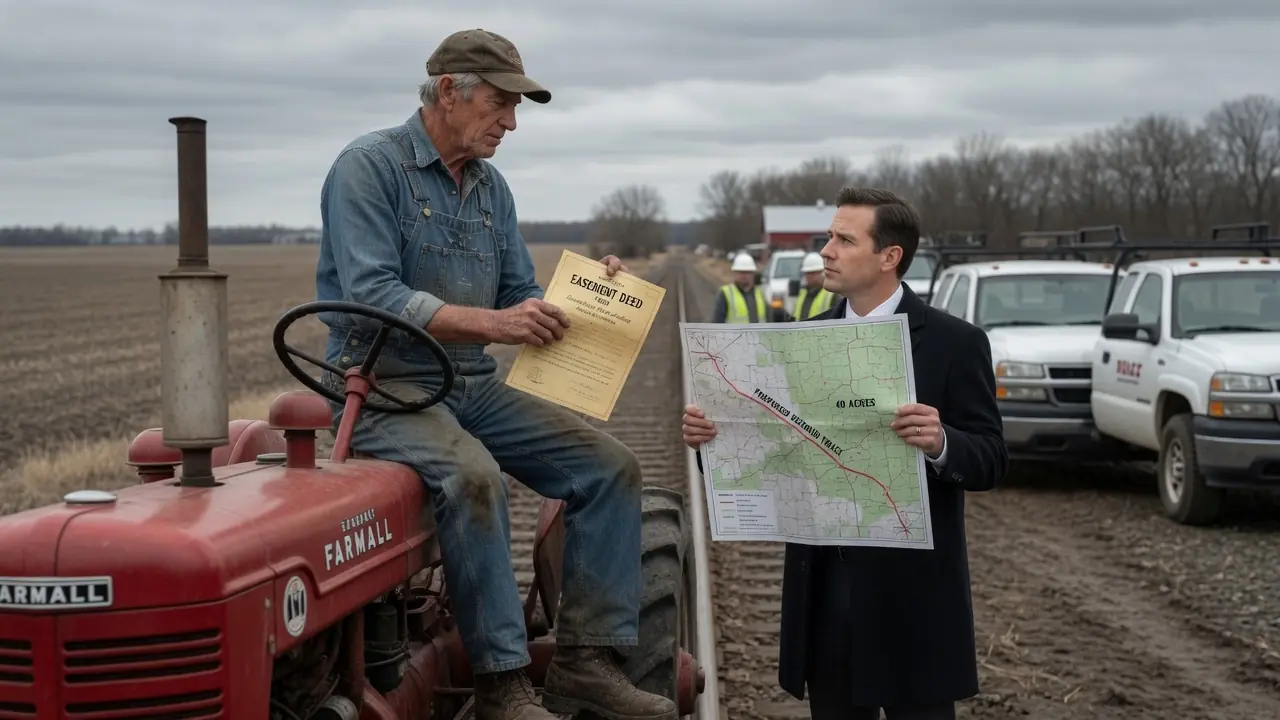
“Federal property ends at this easement line,” Gordon replied, raising an old county deed. “And your survey is nineteen feet inside my farm.”
Steven’s face tightened. “Take the twelve thousand dollars, or the railroad will split this land whether you agree or not.”
Gordon reached down, turned off the tractor’s engine, and settled deeper into the cracked leather seat. “Then bring the sheriff, the judge, and every lawyer you own. I’m sitting here until one of you learns to read.”
The confrontation had begun three weeks earlier with a certified letter delivered to Gordon’s mailbox in Callaway County, Missouri. The envelope bore the name of the Midland Continental Railroad and contained a formal notice regarding the expansion of its freight corridor. Gordon read the first page while standing beside the road, then carried it into the kitchen and read it again beneath the brighter light above the table.
The railroad planned to construct a second track across his property.
Not beside the existing rail line that had crossed the northern boundary since 1887. The new track would curve southward through Gordon’s most productive forty-acre field, separating the barn, cattle pens, fuel tanks, and machine shed from nearly half the cropland they served. The letter offered twelve thousand dollars for what it described as temporary inconvenience, access rights, and cooperation.
Gordon’s wife, Patricia, found him staring at the attached survey map. At sixty-five, she had spent most of her life interpreting the silence of a man who rarely wasted words. She poured coffee into two mugs and sat across from him without asking whether something was wrong.
“They’re putting another track through the south field,” Gordon said.
Patricia studied the map. “Through it or beside it?”
“Through it.”
She traced the proposed line with one finger. “That cuts the farm in half.”
“Exactly.”
Gordon had farmed the same 220 acres for forty-two years. His grandfather purchased the land after returning from the First World War, and his father expanded it slowly through years of cautious borrowing and relentless work. Gordon had inherited no fortune, only soil, machinery, debt, and the expectation that he would leave the land better than he found it.
The original railroad line ran along the northern edge of the property. For generations, the Wells family had planted around it, crossed it carefully, and accepted the distant rumble of one freight train each afternoon. The recorded right-of-way covered a sixty-foot corridor, clearly marked in the deed and county plat.
The proposed track did not remain inside that corridor.
Gordon measured the distance himself the following morning. He carried an old survey chain, a wooden stake, and a copy of the 1887 map to the northern field. According to his measurements, the new line entered his property more than ten feet beyond the easement at its narrowest point and nearly twenty feet beyond it closer to the south field.
He called the number printed on the railroad’s letter.
Steven Cross arrived four days later in a black sedan that looked painfully clean against Gordon’s gravel driveway. He was forty-six, sharply dressed, and carried himself with the confident impatience of a man accustomed to explaining decisions rather than negotiating them. He placed a leather briefcase on the hood of Gordon’s pickup and unfolded several survey drawings.
“The second track is part of a federally approved freight expansion,” Steven said. “It will reduce delays and support regional commerce.”
“That doesn’t explain why it runs through my field.”
“The existing curve is inefficient. The new alignment allows higher speeds and better clearance.”
“It also separates my barn from my crops.”
Steven removed a check from the briefcase. “Midland Continental is offering twelve thousand dollars as a courtesy payment.”
Gordon looked at the check without touching it. “Courtesy?”
“For inconvenience during construction.”
“You’re taking productive land.”
“The railroad already possesses expansion rights under the recorded easement.”
Gordon placed his copy of the old deed beside Steven’s survey. “Show me where.”
Steven barely glanced at it. “Railroad rights-of-way are broad by nature.”
“That is not what I asked.”
The attorney’s expression cooled. “Mr. Wells, refusing cooperation will not stop the project. It will only delay payment and increase legal expenses.”
Gordon folded the check and returned it. “Then you should keep this for your legal expenses.”
Steven left with the survey maps but without Gordon’s signature.
Patricia waited until the sedan disappeared before speaking. “He thinks you’re an old farmer who’ll become frightened when lawyers start calling.”
“He’s half right.”
“Which half?”
“I’m an old farmer.”
Their son, Michael, arrived that evening after Patricia called him. Michael was thirty-eight and managed a farm equipment dealership in Columbia, though he still returned every weekend to help with planting and repairs. He studied the proposed route and immediately calculated the operational damage.
Every tractor would need to cross an active double-track rail line to reach the southern fields. Cattle trailers would have to travel more than a mile around the property. Drainage patterns would change, fencing would need replacement, and at least fourteen acres would become difficult to farm efficiently.
“Twelve thousand won’t even cover one year of lost production,” Michael said.
“It was never meant to,” Gordon replied. “It was meant to make me sign before I understood what I was losing.”
Michael suggested contacting an agricultural property attorney named Carol Marsh. She had represented farmers in utility easement disputes and had developed a reputation for reading old deeds more carefully than the corporations relying upon them.
Carol visited the farm two days later.
She wore practical boots beneath her business trousers and spent more time walking the property than sitting in Gordon’s kitchen. She measured the original right-of-way, photographed old boundary markers, and requested certified copies of every railroad filing in the county archive.
Four days later, she called Gordon.
“The railroad does not have authority to build where they surveyed.”
Gordon leaned against the barn wall. “How certain are you?”
“Certain enough to take the case.”
Carol explained that the 1887 easement permitted railroad operations inside a specifically defined corridor. It did not grant unlimited authority to expand across additional farmland. If Midland Continental wanted land beyond the recorded boundary, it needed either Gordon’s voluntary agreement or a formal condemnation proceeding with full compensation.
“Their new track is eleven-point-three feet outside the easement at the closest location,” Carol said. “At the widest point, it extends nineteen feet into your property.”
“They told me it was federal property.”
“It becomes federal authority only where they possess lawful rights. Your cornfield does not become railroad property because their attorney draws a line through it.”
“What should I do?”
“Do not sign anything. Do not accept their check. And call me the moment equipment enters your property.”
The railroad did not wait long.
On a cloudy Tuesday morning, Gordon saw two survey trucks turn from Caldwell County Road and enter the northern field. Men unloaded stakes and equipment beside the existing rail line. Steven Cross emerged from the second vehicle carrying the same black briefcase.
Gordon walked to the barn.
Patricia followed him. “What are you doing?”
He opened the tractor shed and climbed onto the Farmall M his father had purchased used in 1957.
“Gordon.”
He turned the ignition.
The old tractor coughed, shuddered, and settled into a rough mechanical rhythm. Patricia stepped onto the running board and gripped the fender.
“Carol said to call her.”
“I called Michael. He’s calling Carol.”
“She did not tell you to drive a tractor onto active tracks.”
“No.”
“What exactly are you planning?”
“To give them time to find the right paperwork.”
Patricia climbed down but followed alongside as Gordon drove toward the northern field. His son’s pickup appeared on the road behind them, moving fast enough to throw gravel against the ditch.
“Dad!” Michael shouted after stopping near the fence. “Wait until Carol gets here!”
Gordon continued.
The survey crew watched the tractor approach. One worker raised his arm, assuming Gordon intended to pass behind them. Instead, Gordon turned toward the crossing, drove onto the gravel rail bed, and positioned the Farmall directly across both steel rails.
He switched off the engine.
Steven Cross marched toward him.
The survey crew fell silent.
“Move that tractor now,” Steven ordered. “You are interfering with railroad operations.”
Gordon unfolded the deed across the steering wheel. “Your men are surveying outside the easement.”
“We possess all necessary authority.”
“Show me.”
“I am not required to debate property law with you beside the tracks.”
“Then don’t debate. Show me the paper.”
Steven looked toward the survey foreman. “Call railroad security.”
Michael reached the tractor and stood beside his father. “There’s a freight train scheduled in three hours.”
“I know.”
“You could be arrested.”
“I know that too.”
Patricia arrived moments later carrying Gordon’s coat and a thermos of coffee. She handed him both without criticizing him again.
“Your back will start hurting before noon,” she said.
“It already hurts.”
“Good. Perhaps discomfort will improve your judgment.”
Despite her words, she stood beside the tractor.
The county sheriff arrived twenty-five minutes later. Sheriff Raymond Cole had known Gordon for three decades and looked deeply unhappy to see him sitting across an active rail line.
“Gordon, you need to move.”
“Do you have a court order?”
“No.”
“Then ask Mr. Cross to show you where the railroad’s property ends.”
Steven stepped forward. “Sheriff, this man is obstructing interstate commerce and trespassing on federally regulated infrastructure.”
Gordon pointed toward the ground beneath his tractor’s rear wheel. “That tire is on my farm.”
The sheriff removed his hat and rubbed his forehead. “I’m calling the county commissioner.”
Diane Fuller arrived in a white county vehicle forty minutes later. She had served as commissioner for eleven years and had watched Midland Continental expand across fourteen local farms. Several landowners had complained about low payments, damaged drainage, and survey crews crossing disputed boundaries, but most signed agreements before challenging the railroad’s authority.
Diane walked directly to Gordon.
“You understand this could become dangerous if dispatch sends a train through here?”
“I understand.”
“Will you move if I order an immediate boundary review?”
“When the survey crew leaves my field.”
She turned toward Steven. “Show me the recorded easement.”
Steven opened his briefcase and removed several documents. Diane compared them with Gordon’s certified deed and the proposed survey map.
“Where is the document granting expansion outside this sixty-foot corridor?” she asked.
“The railroad possesses implied authority to modernize its operations.”
“Implied authority is not a property description.”
“This project has federal approval.”
“Federal approval does not transfer Mr. Wells’s land to your company.”
Steven’s confidence began to weaken.
Diane called the county surveyor, who arrived with electronic measuring equipment and two assistants. They located the original markers, compared modern coordinates with the 1887 plat, and measured the proposed route.
The process took two hours.
Gordon remained on the tractor.
Patricia brought sandwiches. Michael paced near the crossing while Carol Marsh arrived and began asking the railroad attorney questions he did not want to answer.
At 1:45 in the afternoon, the county surveyor approached Commissioner Fuller.
“The proposed track is outside the recorded easement,” he confirmed. “Eleven-point-three feet at the western boundary, widening to nineteen feet near the south field.”
Diane turned toward Steven. “Do you have a separate agreement, condemnation order, or deed authorizing entry onto this land?”
Steven said nothing.
At 2:17 p.m., Diane issued a stop-work order.
The survey foreman instructed his men to remove their stakes. Equipment returned to the trucks. Steven made several angry calls before walking toward Gordon one final time.
“You have delayed the inevitable.”
Gordon remained seated. “I delayed theft long enough for someone to measure it.”
“The railroad will condemn the land.”
“Then do it legally.”
“You may regret forcing this into court.”
“I already regret trusting you to respect a boundary.”
Steven left with the survey crew.
Only after the final truck disappeared did Gordon restart the Farmall. He drove it carefully off the tracks and returned to the barn as though completing an ordinary morning’s work.
Patricia followed him inside.
“You sat there for almost five hours.”
“Six.”
“Your doctor told you not to remain in one position that long.”
“My doctor has never had a railroad trying to divide his farm.”
She touched his shoulder. “Do not make me a widow over forty acres.”
Gordon looked at her. “I was not fighting for only forty acres.”
“I know.”
Three weeks later, Midland Continental filed a formal condemnation petition.
Carol welcomed the move.
Condemnation required an independent appraisal, public filings, judicial review, and legally calculated compensation. The railroad could no longer hide behind a twelve-thousand-dollar courtesy payment.
The appraiser spent two days studying Gordon’s farm.
He tested soil productivity, reviewed crop yields, examined drainage patterns, and calculated how the proposed track would affect access between the barn and southern acreage. He also considered severance damages—the loss created when a project divided a working property into less useful sections.
The land alone was worth far more than the railroad claimed.
Operational disruption increased the figure. Additional fencing, crossing delays, drainage modifications, crop losses, and reduced efficiency raised it further.
The final appraisal valued total damages at one hundred fourteen thousand dollars.
Steven Cross called the number absurd.
Carol submitted it to the court.
During the preliminary hearing, the railroad argued that the project served public transportation needs and that Gordon’s resistance was emotional. Carol did not dispute the project’s purpose. She disputed the company’s attempt to obtain private land for less than its real value.
“Public necessity does not erase the requirement for just compensation,” she told the judge. “Nor does it allow a corporation to treat a family farm as empty space between two points on a map.”
The judge ordered both sides into negotiation.
Midland Continental increased its offer to forty thousand dollars.
Gordon refused.
They offered sixty-five thousand.
He refused again.
Steven eventually visited the farm without his survey crew. He found Gordon repairing a gate while Patricia collected eggs nearby.
“Ninety-eight thousand,” Steven said. “Final settlement.”
Gordon continued tightening the hinge.
“That is substantially above the value of the acreage physically occupied.”
“It is below the appraised loss to the farm.”
“The railroad can take the land through condemnation.”
“Then let the judge decide.”
“You risk receiving less.”
“So do you.”
Steven looked toward the south field. Autumn corn stood in straight rows across the acreage his company wanted to divide.
“What number ends this?”
“One hundred fourteen thousand.”
“You expect every dollar of your attorney’s appraisal?”
“I expect you to pay what you tried to take.”
Steven left without agreement.
The following morning, Carol called.
“They accepted the valuation.”
Patricia heard Gordon’s answer from across the kitchen.
“Good.”
“That is all you have to say?” she asked after the call ended.
“What should I say?”
“You forced a railroad to pay almost ten times its original offer.”
“I forced them to use the legal process.”
Patricia smiled. “And you happened to park a tractor across their tracks.”
“That helped them find the process faster.”
The case did not end with Gordon’s settlement.
Commissioner Fuller requested a review of every recent railroad expansion in Callaway County. Investigators examined fourteen projects and found three where survey activity extended beyond recorded easements without proper negotiation.
Those landowners had accepted small payments because they believed resistance was impossible.
The county reopened their claims.
Each farmer received a new appraisal and full compensation. One project was rerouted entirely after severance damages made the original design too expensive.
News of Gordon’s protest traveled through farming communities. Some people praised him as courageous. Others called him reckless for blocking active tracks.
Gordon rejected both descriptions.
“I had a deed,” he told a local reporter. “I sat there until someone read it.”
The railroad eventually changed the second-track design. Engineers discovered they could follow the original northern corridor by adjusting the curve and reducing speed through one section.
Construction remained within the legal easement.
The south field stayed intact.
The barn remained connected to the crops. Gordon worked the same acreage that autumn, driving the Farmall past the place where survey stakes had once marked a line through his farm.
Michael joined him during harvest.
“You know they’ll tell this story after you’re gone,” his son said.
“What story?”
“The day you parked Grandpa’s tractor on railroad tracks.”
“It was not Grandpa’s tractor.”
“He bought it.”
“I rebuilt the engine twice.”
Michael laughed. “That sounds like something Grandpa would say.”
Gordon stopped the combine at the field’s edge and looked toward the railway. Two freight trains now passed each day, their sound rolling across the northern boundary without cutting through the heart of the farm.
“My father almost lost this place once,” Gordon said.
“When?”
“During the farm crisis. Interest rates climbed, crop prices fell, and the bank wanted payment he didn’t have. He sold cattle, equipment, and eighty acres before he saved the rest.”
“You never told me.”
“He did not like discussing it.”
“What stopped the bank?”
“Nothing. He paid them.”
Michael waited.
Gordon looked across the field. “He did not have a document proving they were wrong. I did.”
That winter, Gordon placed the original easement deed inside a fireproof safe. He added the independent appraisal, court settlement, county survey, and Carol’s legal notes.
Then he called Michael into the kitchen.
“These stay with the farm.”
His son nodded.
“If anyone comes with a map, check it against the deed.”
“I will.”
“If they offer money before showing legal authority, assume the money is cheaper than what they want.”
“I understand.”
“And never park machinery on active tracks unless every other option has failed.”
Patricia looked up from the stove. “That last lesson arrives rather late.”
Gordon almost smiled.
Years later, the red Farmall M stopped working permanently. Michael wanted to restore it, but Gordon insisted they leave the faded paint, dented fenders, and cracked seat untouched.
They cleaned the engine, replaced damaged parts, and parked the tractor inside the main equipment shed.
Above it, Michael hung a framed copy of the 1887 easement.
Visitors sometimes asked why an old tractor deserved such careful preservation.
Gordon’s grandchildren knew the answer.
It had not saved the farm through power, speed, or machinery. It had simply carried one stubborn farmer to the exact line where corporate authority ended and his family’s rights began.
The railroad had arrived with attorneys, surveyors, federal language, and a twelve-thousand-dollar check. It expected Gordon to believe resistance was too expensive and the outcome already decided.
Instead, he unfolded an old deed and refused to move.
One tractor blocked one track for six hours.
But the legal review it forced protected four farms, preserved Gordon’s most productive field, and reminded an entire county that powerful companies still had to respect property lines.
Gordon never called himself victorious.
Whenever Patricia mentioned the story, he corrected her.
“I didn’t defeat the railroad,” he would say. “I made them stay on their side of the fence.”