The crowd inside Cedar Ridge Livestock Arena fell silent when Dale Harper shoved a transfer document across the steel rail and reached for the lead attached to the enormous black Angus bull. Ledger stood nearly a ton of muscle and controlled power beneath the overhead lights, his polished coat reflecting the flashes of cameras surrounding the championship pen. Margaret Hale remained beside his shoulder, one steady hand resting against the animal she had raised since he was small enough to fit beneath her arm. She wore a blue denim shirt, faded jeans, a tan ranch hat, and the calm expression of a woman who had spent six years preparing for the moment another person tried to steal what patience had built.
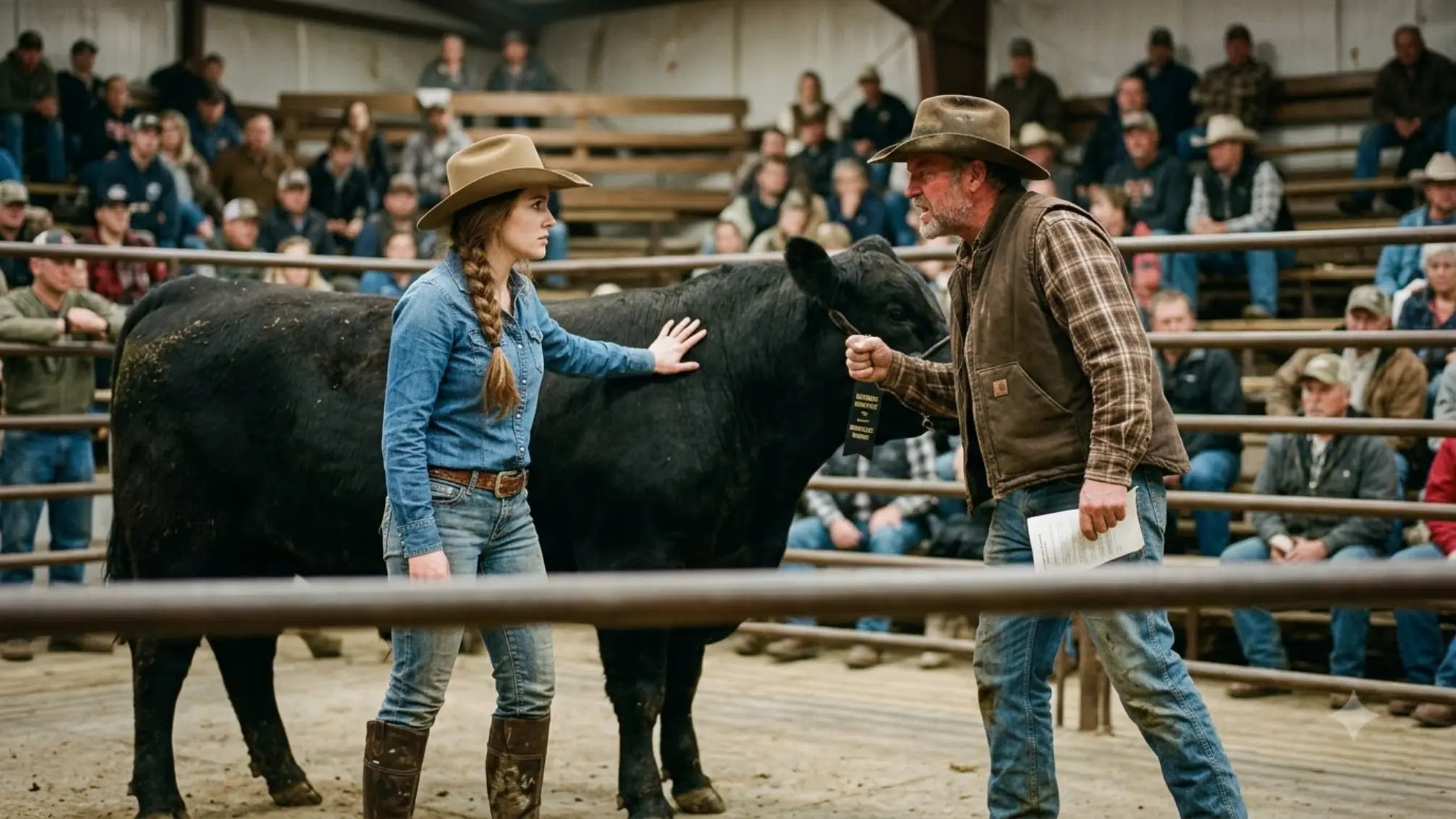
Dale’s hand stopped several inches from the lead rope. Behind him stood two men wearing Harper Cattle Company jackets, both suddenly less eager to move after hearing the word DNA. Judges, breeders, reporters, and families filled the stands, while three television cameras remained trained on the confrontation. Dale had chosen the most public possible place to intimidate Margaret, never imagining that she had wanted witnesses too.
He lifted the transfer document and waved it toward the judges. “This proves my family retained breeding ownership when the calf was sold.” His weathered face had turned dark red beneath his battered hat, and his gray beard trembled with anger. “She was allowed to raise him, but she never had the right to sell semen, register offspring, or profit from Harper blood.” Margaret looked at the document without touching it because she already knew exactly which signature had been forged.
The championship announcer lowered his microphone. Senior judge Warren Pike stepped down from the center platform and approached the rail with two association officials. He had spent the afternoon praising Ledger’s daughters for their feet, balance, and calm disposition, but now his expression had become guarded. “Mrs. Hale, Mr. Harper has filed an emergency ownership challenge,” he said. “Until this is resolved, the association may be required to freeze Ledger’s registrations.”
Margaret lifted the sealed laboratory packet. “Then freeze every registration connected to Harper Cattle Company too.” Dale laughed loudly, trying to make the demand sound ridiculous before anyone could consider it. Warren did not laugh. He had seen enough frightened breeders clutching paperwork to recognize when a quiet person arrived carrying something more dangerous than anger.
Six years earlier, Ledger had not looked dangerous to anyone.
The auctioneer nearly skipped Lot 73 because the little black calf stood alone in the corner of the sale pen with mud dried along his ribs. He was thin, undersized, and quiet enough to disappear beside the stronger calves sold before him. Buyers walked past without slowing, studying catalog photographs and discussing famous bloodlines while the animal lowered his head near the gate. The auctioneer tapped the microphone, announced thirty-five dollars, and received nothing but silence.
Margaret Hale had been twenty-three then, recently returned to the 140-acre family farm after completing an agricultural-science program she could barely afford. Her grandfather Samuel had died the previous winter, leaving the property divided between Margaret and her younger brother, Nathan. The farm carried no grand buildings or fashionable name, only good grass, old fences, and notebooks filled with breeding observations written in Samuel’s careful hand. Margaret attended the auction hoping to purchase two affordable heifers, not an unwanted bull calf.
Dale Harper sat in the front row wearing a new leather vest and drinking coffee from a silver travel cup. Harper Cattle Company controlled nearly six thousand acres and sold registered Angus cattle across several states. Dale’s animals appeared in magazines, his trucks carried polished logos, and buyers treated every calf connected to his name as valuable before seeing it walk. When the auctioneer asked one final time whether anyone would offer thirty-five dollars, Margaret raised her hand.
The gavel struck the rail before she could reconsider. Dale turned in his seat, saw her bidder number, and laughed so loudly that several nearby cattlemen joined him. “You bought yourself a pet,” he called. Margaret looked toward the small calf, who followed the handler without pulling against the rope. “Maybe,” she replied. “Or maybe everyone else stopped looking too soon.”
Nathan met her at the barn after sunset. He lowered the trailer gate, saw the calf standing in the fresh straw, and stared at Margaret as though she had returned with an injured dog. “That is the thirty-five-dollar bull?” he asked. She nodded while opening the inside gate. “He is smaller than the dog,” Nathan said.
The calf stepped carefully from the trailer. He did not bolt, kick, or fight the rope, even after the long and frightening day. Margaret watched the straight placement of his feet, the width between his eyes, and the natural balance beneath the thin body. “He deserves enough time to show us what he is,” she said.
Doctor Elena Price examined him the following morning. She was a practical veterinarian who had treated the Hale cattle since Margaret was a child and did not soften bad news for sentimental owners. After checking the calf’s lungs, heart, joints, mouth, and reflexes, she stood and brushed straw from her knees. “He is underdeveloped and was probably weaned too early, but I do not see weakness.”
Margaret folded her arms. “What do you see?”
“Good feet, clean joints, and a calmer mind than most calves his age.”
Nathan leaned against the gate. “So he might live?”
Doctor Price looked offended. “He is not dying. He is behind.”
Margaret smiled. “Good.”
The calf settled into the farm with almost no trouble. While other young cattle paced fences or wasted energy challenging one another, he ate, slept, and observed everything around him. Margaret named him Ledger because she joked that he would either drain the farm account or someday balance it. Nathan said the name sounded ridiculous until the calf began turning his head whenever Margaret called it.
Word spread through Cedar Ridge within days. At the diner, Dale Harper told everyone that Margaret had spent thirty-five dollars on the worst calf in the sale. Some ranchers laughed because agreeing with Dale felt safer than questioning the richest cattleman in the county. Margaret entered while he was still telling the story and ordered coffee without acknowledging him. He asked whether her bargain bull was worth the purchase price yet.
“Not today,” she said. “Ask me when he finishes growing.”
Dale grinned. “You might be waiting forever.”
“I have grass and patience.”
“Patience does not improve bad blood.”
Margaret looked at him over the rim of her cup. “Neither does money.”
Ledger grew slowly during the first year, but every month brought a small change. His shoulders widened, his back remained level, and his feet stayed correctly placed even as his weight increased. Doctor Price began watching him walk before checking any other animal during visits. One spring afternoon, she stood beside the pasture fence and pointed toward the young bull moving across the hill.
“Watch his rear feet,” she told Margaret. “They land almost exactly where the front feet leave.”
“Is that unusual?”
“It is efficient. A badly built animal fights its own body with every step.”
Nathan joined them. “And Ledger?”
Doctor Price smiled. “Ledger wastes nothing.”
Margaret entered him in the county’s young-bull evaluation that autumn. She had no expectation of winning because the barns were filled with larger animals from nationally advertised breeding programs. Dale arrived with three heavy bulls groomed by professional crews, each wearing embroidered Harper halters. When he saw Ledger in a plain pen beside Margaret, he shook his head.
“You brought him here?”
“I brought him to be evaluated.”
“Against real cattle?”
Margaret closed the pen gate. “That depends on what the judges see.”
Ledger remained smaller than several competitors, but his calmness attracted attention the moment he entered the ring. He walked without resistance, stopped squarely, and ignored the noise from children pressing against the rail. The judges examined his feet twice and circled him longer than any other animal. Dale stopped smiling.
Two weeks later, the official results arrived by mail. Ledger had not placed first overall, but he earned the highest structural score in the entire evaluation. His feet were rated exceptional, his movement nearly perfect, and his disposition ideal for long-term breeding. Doctor Price read the final recommendation aloud: “Suitable as a foundation sire where longevity and maternal consistency are priorities.”
Nathan read the paper again. “They saw it.”
Margaret folded the report carefully. “They saw what he is today.”
“Is that not enough?”
“One report proves he can walk. Calves will prove whether he can build a herd.”
Samuel Hale’s notebooks warned against mistaking one promising animal for a bloodline. Margaret selected only eighteen cows for Ledger’s first breeding season, each known for fertility, sound udders, strong hips, and calm behavior. She rejected several impressive-looking females because their records showed difficult births or weak feet. Dale heard about the plan at the feed mill and asked whether she was gambling her entire future on a bargain calf.
“I am testing him,” Margaret answered.
“With eighteen cows?”
“Enough to find a pattern.”
“And when the calves disappoint you?”
“Then I will accept the evidence.”
He leaned closer. “You should accept it now.”
Margaret smiled. “You are remarkably worried about an animal you called worthless.”
The first calves arrived the following spring. Nathan noticed that nearly every newborn stood quickly and found its mother without assistance. Doctor Price examined the group and found consistent shoulder width, strong joints, and unusually calm temperaments. There were no difficult births and no calves born with crooked legs or poor mouths.
The second crop looked even better. Ledger’s daughters developed wide, functional hips and balanced frames, while his sons grew steadily without requiring expensive feed. Commercial ranchers driving past the Hale property began slowing near the fence. Several returned later with notebooks and questions.
Margaret refused the first offers for breeding rights. A respected breeder offered ten thousand dollars for partial access, then doubled it after examining Ledger’s offspring. She still declined. Nathan worried she was turning away the money they needed to repair the barn and replace an aging tractor.
“One crop can be luck,” she said. “Two can be coincidence.”
“What will three be?”
“A bloodline.”
The third calf crop confirmed everything. Ledger did not create flashy giants that impressed buyers for ten minutes and failed after two seasons. He produced durable cattle with correct feet, efficient movement, fertile daughters, and quiet dispositions. Ranchers who earned their living from calves rather than magazine photographs understood the value immediately.
The first Ledger daughters entered the county breeding-stock showcase when they were nearly two years old. They won their class as a group because the judges could see a consistent pattern across animals raised from different mothers. His sons won the next division. By late afternoon, the announcer had repeated Ledger’s name so many times that even casual spectators remembered it.
The local newspaper printed a photograph of Margaret beside the champion heifer. The headline read: Thirty-Five-Dollar Bull Sires County’s Best Young Herd. Agricultural magazines repeated the story, and breeding inquiries arrived from across the Midwest. Nathan covered one wall of the farm office with a map and began placing pins wherever letters originated.
Dale stopped laughing publicly.
Privately, he became obsessed.
Harper Cattle Company had once dominated the county showcase, but its recent calves had begun developing problems. Several bulls grew rapidly before their feet broke down. Daughters from Dale’s most advertised sire experienced difficult births, and three commercial clients demanded refunds. Rather than admit the bloodline had become too narrow, Dale blamed nutrition, handling, and inexperienced buyers.
Ledger’s rise threatened more than his pride. Ranchers who once paid high prices for Harper genetics began purchasing Hale bulls instead. Margaret’s animals cost less, lived longer, and required fewer veterinary interventions. Within two years, the Hale waiting list contained more names than Harper’s annual catalog.
A national artificial-insemination company contacted Margaret after reviewing Ledger’s performance records. Its representative spent three days checking calves, veterinary reports, feed records, and maternal histories. He offered a contract large enough to pay every Hale Farm debt, replace the barn, and establish a new testing program. Margaret accepted only after adding limits that prevented overuse of the bloodline.
That decision made Ledger’s genetics available across the country.
His daughters became foundation cows in respected herds. His sons improved commercial cattle from Montana to Georgia. One granddaughter won a regional championship, followed by another at the state livestock exposition. Breed journals began calling Ledger one of the most consistent Angus sires developed in the region during the decade.
Margaret never called him a miracle.
She called him evidence.
Six years after the thirty-five-dollar purchase, Ledger entered the Cedar Ridge arena as part of a foundation-sire exhibition. He was older, heavier, and silver had begun appearing near his muzzle, but he moved with the balance that first attracted Doctor Price’s attention. The crowd rose when the announcer described his offspring, championship records, and estimated contribution to regional cattle production.
Margaret stood beside him wearing the blue denim shirt Samuel had given her before he died. Nathan watched from the rail with Doctor Price, both smiling as Ledger stopped exactly where Margaret asked. Dale Harper entered the arena before the applause ended. He carried a folder marked with the seal of the National Angus Registry.
Warren Pike halted the exhibition. Dale announced that Ledger had been sold under a restricted transfer and that Harper Cattle Company retained all breeding rights. He claimed Margaret had violated the original agreement, registered hundreds of calves unlawfully, and profited from genetics she did not own. The document bore the signature of the auction barn’s former manager and what appeared to be Margaret’s own name.
The accusation threatened everything Hale Farm had built. If the registry accepted it, Ledger’s offspring could be suspended, contracts frozen, and millions of dollars in cattle placed under ownership review. Buyers who trusted Margaret’s records might face lawsuits or financial loss. Dale knew the damage could begin before anyone proved the document false.
Margaret did not appear surprised.
Three months earlier, someone had attempted to access Ledger’s registry file using credentials connected to Harper Cattle Company. Nia Collins, a young records technician at the breed association, noticed the request and contacted Margaret because it sought to replace the original sale record. The new document claimed Harper had retained genetic ownership despite selling physical possession of the calf.
Margaret immediately requested certified copies from the auction archive. The original bill of sale contained no restriction, no retained interest, and no second contract. She then ordered a complete DNA review of Ledger, his descendants, and the cattle Harper had registered during the year Ledger was born. What the laboratory found reached far beyond a forged ownership claim.
Dale stepped closer to Ledger in the arena. “Hand over the lead, Margaret. The association will take custody until the challenge is resolved.” Ledger shifted once, sensing the aggression in the man’s posture. Margaret rubbed the bull’s shoulder, and he settled immediately.
“Your document was created eleven weeks ago,” she said.
Dale lifted it higher. “It carries your signature.”
“It carries a copy of my signature from a breeding invoice dated four years after the auction.”
“That is a lie.”
“The ink analysis says otherwise.”
A murmur moved through the stands. Warren Pike extended his hand for Margaret’s laboratory packet. Dale attempted to stop him, insisting that only ownership should be discussed. Margaret gave the report to Warren, then opened a second folder containing the original auction receipt.
The receipt listed Lot 73, one black Angus bull calf, sold without restriction for thirty-five dollars. It carried the auctioneer’s signature, Margaret’s bidder number, and the time of sale. Nathan also produced the canceled check used to pay for the animal. The bank record had remained in Samuel Hale’s old filing cabinet because Margaret never threw away farm documents.
Dale’s lawyer stepped from the crowd and demanded that the DNA report remain confidential. That request interested Warren more than the ownership dispute. “Why would parentage testing be confidential if Mr. Harper is claiming the animal came from his herd?” he asked. Dale’s attorney whispered something, but the microphones near the judging rail captured only the word exposure.
Warren opened the report.
Ledger’s DNA confirmed that his sire was Harper Black Crown, the most famous bull Dale had ever owned. Black Crown had produced animals sold for record prices and was featured across Harper advertising. Ledger’s mother, however, was listed in registry records as dead before his birth.
That impossibility triggered further testing.
The laboratory compared stored DNA from Harper animals with samples submitted under different registration names. Fourteen supposedly unrelated champion bulls were full or half siblings produced by cows whose identities had been altered. Dale had substituted parentage records to hide excessive inbreeding and to sell ordinary calves as descendants of more valuable females.
Ledger had been born during an unplanned breeding between Black Crown and a young cow named Harper Willow 18. Willow possessed excellent structure but came from a maternal line Dale considered unfashionable. When her undersized calf failed to match the size expected at weaning, Dale removed his identity tags and consigned him anonymously to the county auction.
He had thrown away the evidence of Willow’s value.
Years later, Ledger’s success revealed that the maternal line Dale dismissed was healthier than the bloodlines he aggressively marketed. If breeders learned the truth, they would question the parentage and performance claims attached to hundreds of Harper cattle. Dale therefore needed control of Ledger before the DNA results became public.
Warren lowered the report.
“Mr. Harper, did you submit altered parentage records to the registry?”
Dale pointed toward Margaret. “This is her attempt to destroy me.”
“That was not my question.”
“She stole my genetics.”
“You sold the animal.”
“For thirty-five dollars because his identity was incomplete.”
Margaret looked at him. “His identity was incomplete because you removed it.”
Dale’s face changed.
The arena cameras captured the exact moment he realized he had answered too quickly.
Margaret continued before his lawyer could stop her. “You knew who his sire was. You erased the records because Ledger embarrassed your breeding program, then forged a contract after his offspring proved you wrong.” Dale lunged toward the lead rope. Nathan started over the rail, but Margaret did not move.
Ledger turned his enormous head toward Dale.
The bull did not charge or toss his horns. He simply stepped between Margaret and the man reaching for her. Nearly a ton of calm black muscle filled the space, forcing Dale backward without violence.
Farm Woman (coldly, gripping the lead): “He remembers the hand that fed him.”
Rival Rancher (furious, backing away from the bull): “You trained him to threaten me.”
Farm Woman (fiercely, standing beside Ledger): “No. I taught him not to fear men who confuse force with ownership.”
Rival Rancher (shouting, pointing at the report): “Those papers will never survive my lawyers.”
Farm Woman (calmly, turning toward the cameras): “They do not have to survive your lawyers. They only have to survive the truth.”
Two agricultural investigators entered the arena with a county deputy. They had been waiting outside because Margaret submitted the laboratory findings to state authorities before the exhibition. Dale’s attempt to use the forged transfer in a public registry proceeding created fresh evidence of fraud. The deputy asked him to step away from the animal and surrender the document.
Dale refused until the investigator mentioned the search warrant already being executed at Harper Cattle Company. His shoulders lowered. The men in Harper jackets moved away from him, suddenly interested in protecting themselves.
The association suspended every Harper registration connected to the disputed bloodlines. Buyers were notified that ownership of their physical cattle remained secure while parentage records underwent review. Margaret asked Warren not to punish ranchers who had purchased animals in good faith. “They trusted paperwork the association approved,” she said. “Make the people who falsified it answer, not the families already carrying the cost.”
The investigation lasted nearly nine months.
Auditors found that Dale had manipulated registrations for more than a decade. Valuable parentage was assigned to selected calves, while weak or disappointing animals were removed from records and sold through local auctions without ranch identification. When successful animals later emerged, Harper representatives attempted to purchase or control them before their origins became public.
Ledger was not the first.
He was simply the one too successful to hide.
Former Harper employee Eli Mercer testified that Dale ordered workers to change ear tags and destroy breeding notes. Eli had remained silent because Harper Cattle Company owned the house where his family lived and controlled his health insurance. After investigators guaranteed protection, he produced photographs of the original calving board showing Ledger’s birth number beside Willow 18’s name.
The auction barn’s retired clerk, Marjorie Benton, also testified. She remembered the undersized calf because Dale personally instructed her not to list the consignor in the public catalog. When Margaret purchased Ledger, Dale joked that Hale Farm could keep every future problem connected to him. Marjorie had written the remark in her private sale notebook because it seemed unusually cruel.
Dale’s forged transfer document failed every examination. Margaret’s signature had been digitally copied, the auction manager’s signature was traced from an old tax form, and the paper stock had been manufactured only four months earlier. Security footage showed Dale’s attorney delivering the document to the registry office under the claim that it had recently been discovered in storage.
The ownership challenge collapsed.
The fraud case did not.
Harper Cattle Company faced lawsuits from breeders who had paid premium prices based on false pedigrees. The national registry permanently revoked Dale’s membership and removed his authority to register cattle. Banks froze company accounts after learning that livestock used as loan collateral carried unreliable valuations.
Dale eventually accepted a plea agreement involving fraud, forgery, falsification of agricultural records, and attempted theft through deception. He avoided the longest possible sentence by helping identify every affected animal and surrendering company records. The court ordered the sale of Harper’s luxury properties, equipment collection, and show cattle to fund restitution.
Margaret did not purchase Harper Ranch when it entered receivership.
Several investors encouraged her to take it, claiming she deserved the land after what Dale had done. She refused because turning another family’s collapse into her personal expansion felt too much like the behavior she had spent years opposing. Instead, she helped a cooperative of former Harper employees buy part of the property.
Willow 18 was found on a smaller pasture included in the receivership sale. She was old, thin, and no longer producing calves, but her DNA confirmed beyond doubt that she was Ledger’s mother. Margaret brought her to Hale Farm.
Ledger recognized her scent before the trailer gate fully opened. The old cow stepped into the pasture, and the massive bull approached without aggression. They touched noses briefly before Willow began grazing as though she had always belonged there.
Nathan stood beside Margaret at the fence.
“You paid more than thirty-five dollars for her.”
“Much more.”
“Is she going to balance the books too?”
Margaret smiled. “Not every good decision needs to.”
Hale Farm created the Samuel Hale Foundation Breeding Trust the following year. A portion of every Ledger breeding contract funded DNA testing, record education, and legal support for small cattle producers facing registration disputes. Margaret also established grants for young farmers unable to purchase fashionable genetics.
She taught them the lesson Samuel had written repeatedly in his notebooks.
A sale ring measured current opinion.
It did not measure tomorrow’s potential.
Ledger retired from active breeding at ten years old. His descendants continued winning structural evaluations and commercial-production awards, but Margaret reduced public appearances as he aged. She wanted the final years of his life to belong to the pasture rather than cameras.
One evening, Dale Harper appeared at the outer gate.
He had completed his sentence and looked smaller without the expensive vest, employees, or cattle bearing his name. Margaret walked down from the barn but did not invite him onto the property. Ledger grazed beneath the oak tree behind her, silver spreading across his muzzle.
Dale held a folded paper.
“I came to apologize.”
Margaret waited.
“I was wrong about him.”
“You were wrong about more than a bull.”
He lowered his eyes. “I know.”
“Do you?”
Dale looked toward Ledger. “I spent my life believing value came from making people want what I owned. When I saw what he became, I thought taking him back would restore what I had lost.”
“You never lost Ledger.”
Dale frowned.
“You discarded him,” Margaret said. “What you lost was the lie that your judgment created value.”
He offered her the folded paper. It was the original calving note containing Ledger’s birth date and Willow’s number. Dale had hidden it from investigators until the final property inventory, then decided to bring it himself.
Margaret accepted the paper.
“I am not asking forgiveness,” he said.
“That is good.”
“Will you ever give it?”
“I do not know.”
He nodded and turned toward the road.
Margaret watched him leave without satisfaction. Accountability had protected ranchers, restored records, and ended a corrupt operation. It could not return the years of fear experienced by employees or remove the financial damage carried by innocent breeders.
Ledger remained beneath the oak tree.
Margaret crossed the pasture and rested one hand against his shoulder, exactly as she had in the championship arena. His breathing was slower now, but the enormous body still carried the balance Doctor Price noticed when he was a thin calf no one wanted. Nearby, Willow grazed among daughters and granddaughters built from the potential others failed to see.
Nathan joined her at the fence.
“Do you remember what Dale said at the auction?”
“That I bought a pet.”
“He was almost right.”
Margaret looked at Ledger.
“He became more than livestock a long time ago.”
The evening sun stretched across the 140 acres Samuel Hale had protected through drought, debt, and stubborn patience. Ledger’s descendants moved quietly through the grass, strong-footed and calm, each one carrying proof that ordinary appearance could conceal extraordinary value.
The crowd had once placed Ledger’s worth at thirty-five dollars.
Dale later tried to claim him when the bloodline became valuable enough to save one ranch and destroy another.
But Ledger’s greatest victory was never the championships, contracts, or millions attached to his name.
It was the fact that one farm woman looked into a forgotten sale pen, ignored the laughter around her, and gave tomorrow enough time to prove everyone wrong.