The bus had stopped sinking quickly, which somehow made the situation worse. It leaned at a sickening angle in the muddy floodwater beside Highway 9 in Polk County, East Texas, its right rear wheels buried so deeply that the lower windows were already only a few feet above the brown current. Thirty-four passengers remained inside while branches, fence boards, plastic buckets, and pieces of somebody’s porch rushed past in water moving faster every minute. On the embankment above them stood two modern heavy-recovery trucks, six trained technicians, and Captain Derek Holt, a man who had spent twenty-three years believing there was always another procedure to try.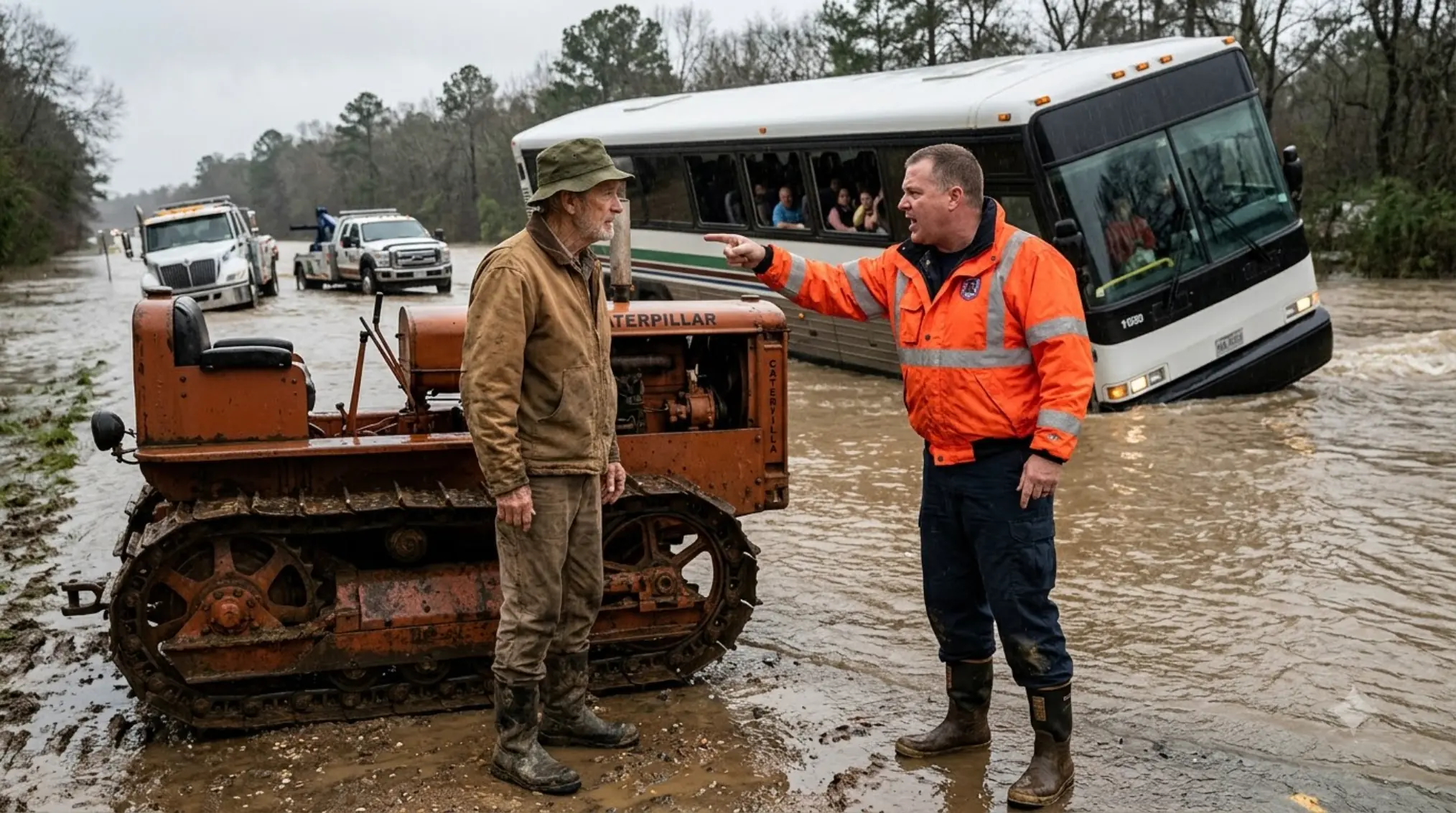
At 3:19 that Tuesday afternoon, Holt finally discovered what it felt like to have procedures without options. His primary forty-ton recovery truck had driven eleven feet into the flood before its electronic control system detected moisture and automatically locked the hydraulics. The engine still ran, lights still flashed, and every dashboard screen remained bright, but the boom and winch refused to move. The second recovery unit had failed even sooner, its computerized boom frozen in place after another sensor triggered a protection mode designed to prevent mechanical damage. Two machines worth nearly half a million dollars sat uselessly in water while the bus continued tilting.
Holt threw his radio onto the hood of the command vehicle. “Boards are fried. Both hydraulic systems are locked. Helicopter’s grounded because of the wind.” Nobody answered because everyone already knew the next sentence. Holt stared toward the bus and finally said, “We pull the passengers. We leave the bus.”
Inside, driver Diane Cho heard none of it. She was too busy keeping thirty-four frightened people from turning a dangerous situation into a catastrophe. Diane had driven the Lone Star Regional route more than four hundred times and knew every hill, bend, cattle crossing, and drainage ditch between Lufkin and Livingston, but six hours of violent rain had hollowed out the shoulder beneath perfectly normal-looking asphalt. When the right rear wheels reached the weakened section, the entire edge collapsed beneath sixteen tons of steel, luggage, fuel, and human beings.
Diane had reacted instantly. She steered into the slide instead of away from it, kept the front wheels aligned with the pavement, shut down the engine once the exhaust neared the water, and ordered everyone toward the high side of the bus. The passengers obeyed because her voice sounded like she knew exactly what she was doing. What Diane did not tell them was that the water had risen nearly seven inches since she made the emergency call.
In the back row sat sixty-seven-year-old Ray Sutton, a retired diesel mechanic who had spent thirty-one years repairing farm equipment and heavy trucks. He watched the waterline against the glass instead of the panicked people around him. Every six minutes, it climbed roughly two inches. Ray glanced toward a mother holding a sleeping toddler and decided not to share his calculations.
Then he felt something beneath his boots.
A vibration.
Slow.
Heavy.
Mechanical.
Ray pressed his palm against the seat frame.
The rhythm was old enough that he recognized it immediately.
A diesel engine without computers deciding how it should sound.
“Well,” Ray whispered.
The businessman beside him looked over.
“What?”
Ray turned toward the window.
“Somebody finally brought a tractor.”
Across the flooded field, a rust-orange machine crawled through the rain.
It was not large by modern standards.
It certainly was not impressive.
Its paint had faded through seventy years of sun and work. Rust marked the edges of the blade. The steel tracks moved with an uneven metallic rhythm, and the open operator station looked primitive beside the climate-controlled rescue trucks lined across the road.
But it was moving.
And that was more than anything else on the embankment could claim.
Seventy-six-year-old Walter Briggs sat behind the controls of the 1952 Caterpillar that his father had purchased when Walter was a boy. Walter had used that machine to push storm debris, dig ponds, clear fence lines, pull tractors from spring mud, repair creek crossings, and shape the same East Texas land where his family had farmed for generations. He knew every vibration through the seat and every change in engine tone.
He had been watching the rescue operation from his fence for almost twenty minutes.
Then he had watched the expensive trucks stop moving.
Walter had turned around without saying anything.
He walked to his equipment barn.
Pulled the tarp from the Caterpillar.
Checked the oil.
Fuel.
Track tension.
Cable.
Then he started the engine.
The old diesel caught on the second attempt.
Now the Caterpillar climbed onto the muddy shoulder and stopped twenty feet from Holt.
The captain walked straight toward it.
“Shut that thing down!”
Walter reduced the throttle.
Holt pointed toward the road.
“This is an active emergency scene.”
Walter looked past him.
The bus had settled another inch.
“I noticed.”
“You can’t be here.”
Walter’s expression barely changed.
“I live there.”
He pointed toward a distant farmhouse.
“I don’t care where you live. Back that machine out.”
Walter looked toward the recovery trucks.
One sat axle-deep in floodwater.
The second had its boom raised uselessly toward the gray sky.
He looked back at Holt.
“Your equipment working?”
Holt’s face hardened.
“We have certified crews handling this.”
Walter glanced again at the bus.
“Looks like your certified crews are handling a lot of standing around.”
Several technicians heard him.
One looked away to hide a smile.
Holt stepped closer.
“Back that antique out. My crews are handling this.”
Walter finally turned fully toward him.
“Your half-million-dollar trucks are handling nothing.”
The words landed hard.
Holt pointed toward Walter’s chest.
“You touch that bus and whatever happens is on you.”
Walter looked at the rising water.
Then at the thirty-four faces watching through the windows.
“Then get your equipment out of my way and watch somebody finish the job.”
For several seconds, neither man moved.
Holt was angry because Walter had embarrassed him.
Walter was irritated because Holt was wasting time.
They were not the same thing.
A younger technician named Marcus Webb stepped forward.
“Captain.”
Holt did not look at him.
“What?”
Marcus was twenty-eight, an engineering graduate with certifications covering almost every modern recovery platform the county operated. He understood exactly why the two trucks had failed. He also understood something increasingly uncomfortable.
The Caterpillar might work.
“Let him look.”
Holt turned.
“You serious?”
“The ground pressure on those tracks is lower than our front axles. No ECU. Mechanical transmission. Intake’s high.”
“You want some farmer improvising around a passenger bus?”
Marcus looked toward the water.
“I want something that moves.”
That silenced the group.
Holt looked back at Walter.
“If you make this worse—”
Walter interrupted.
“I won’t.”
“You don’t know that.”
Walter pointed at the bus.
“Rear axle is buried in clay. Bus isn’t stuck because it weighs fifteen tons. It’s stuck because your boys kept pulling straight uphill.”
Marcus stared.
Walter continued.
“That mud’s holding the axle like a suction cup. You yank harder, you tear something. You pull slow, release, pull again, you break the mud loose before you move the bus.”
Marcus glanced toward the tow lines.
The old farmer had diagnosed in seconds what their equipment analysis had not.
Holt remained unconvinced.
“You’ve done this before?”
Walter looked at him.
“For about fifty years.”
Another gust of wind pushed rain across the roadway.
The bus shifted.
Passengers screamed.
That ended the debate.
Holt looked at Marcus.
“Get our lines clear.”
Walter climbed back onto the Caterpillar.
He did not celebrate.
He did not even smile.
He drove.
The steel tracks entered the floodwater.
Eighteen inches.
Twenty-four.
Thirty.
The Caterpillar continued.
Unlike the wheeled recovery trucks, the tracks spread the machine’s weight across the mud instead of concentrating it into four sinking points. Water reached the lower body. The engine kept breathing through an intake positioned well above the current.
Marcus walked along the bank watching.
Every lesson he had received about sophisticated machine protection systems suddenly looked different.
His trucks had done exactly what engineers designed them to do.
They protected themselves.
Walter’s tractor had only one purpose.
Work until something physically prevented it.
The Caterpillar reached the rear of the bus.
Walter stopped.
Then, to everyone’s surprise, he climbed down directly into the brown water.
Holt shouted.
“What the hell are you doing?”
Walter ignored him.
The flood reached his chest.
Visibility was zero.
He worked entirely by touch, running both hands beneath the rear frame until he located a structural crossmember strong enough to accept the pull.
Ray Sutton watched from the bus.
He knew exactly what Walter was doing.
“Smart.”
The businessman looked at him.
“What?”
“He’s not hooking the axle.”
“Why not?”
“Because the axle’s what’s trapped.”
Ray pointed.
“He’s pulling the frame. Lets the wheels follow instead of making them carry everything.”
Walter threaded the heavy choker around the crossmember.
Secured it.
Checked it twice.
Then climbed back onto the Caterpillar.
The cable tightened.
Passengers fell silent.
Walter increased the throttle.
The engine note deepened.
The tracks dug into the mud.
Nothing happened.
Holt shook his head.
Walter released tension.
Waited.
Then pulled again.
The bus moved three inches.
Marcus’s eyes widened.
Walter released again.
Waited.
Pulled.
Six inches.
The clay was beginning to break.
He was not attempting to overpower the mud.
He was teaching it to let go.
Fourth pull.
The bus shifted.
Fifth.
Its rear wheels climbed slightly.
The passengers began shouting.
Diane immediately grabbed the intercom.
“Everyone stay seated! High side only!”
Walter kept his eyes on the cable.
Sixth pull.
The front wheels reached firmer ground.
He reduced power.
Adjusted angle.
Then applied tension one final time.
The Caterpillar dug in.
The cable became perfectly straight.
The bus rose from the flooded shoulder.
Not violently.
Not dramatically.
Slowly.
The rear tires emerged from brown water.
Mud poured from the wheel wells.
The bus climbed the slope until all four corners rested on solid pavement.
Walter stopped.
For three seconds, nothing moved.
Then the entire roadside erupted.
Rescue workers shouted.
Passengers applauded through the windows.
One technician raised both fists.
Marcus simply stared at the Caterpillar.
Walter lowered the throttle.
Diane opened the front door.
She stepped onto the pavement.
Tested the surface.
Then turned toward the passengers.
“All right. One row at a time.”
Thirty-four people exited.
An elderly woman kissed Diane’s cheek.
A businessman stepped off still holding his phone, looked at the rusted Caterpillar, then quietly put the phone away.
The mother carrying the toddler began crying as soon as her boots touched dry ground.
Ray Sutton was last.
He walked toward Walter.
The two older men stood beside the Caterpillar.
Ray nodded toward it.
“D4?”
Walter nodded.
“Fifty-two.”
“Original engine?”
“Rebuilt twice.”
Ray smiled.
“Still sounds right.”
Walter looked toward him.
“You a mechanic?”
“Thirty-one years.”
They shook hands.
Nothing else was necessary.
Holt approached.
His orange jacket remained clean compared with Walter’s soaked brown coat.
The captain extended one hand.
“Mr. Briggs.”
Walter looked at it.
Holt swallowed some pride.
“I was wrong.”
Walter accepted the handshake.
Holt continued.
“I thought you were putting people at risk.”
“Fair concern.”
“I also thought I knew more because we had better equipment.”
Walter looked toward the dead recovery truck.
“That equipment is better.”
Holt seemed surprised.
Walter continued.
“Just not today.”
That answer bothered Marcus more than arrogance would have.
Walter was not proving old machines were superior.
He was proving that tools were situational.
The most advanced machine on paper could become useless if conditions removed the assumptions built into its design.
Marcus approached.
“Mr. Briggs?”
Walter looked at him.
“How did you know seven pulls would do it?”
“I didn’t.”
Marcus frowned.
“You stopped after every pull like you had a plan.”
“I had a plan.”
“But you didn’t know seven?”
“No.”
Walter pointed toward the tracks.
“First pull tells you what the ground wants to do.”
Then toward the bus.
“Second tells you whether you listened.”
Marcus laughed.
Walter did not.
He was serious.
“Machines talk.”
Marcus looked toward the computerized wrecker.
“Mine mostly throws error codes.”
Walter finally smiled.
“That’s talking too. Just in a worse language.”
By late afternoon, television crews arrived.
One reporter named Linda Park had already been covering road closures farther south when somebody called about the stranded bus. Her cameraman captured Walter driving through floodwater, the cable tightening, and the bus finally climbing free.
She found Walter while he was preparing to leave.
“Mr. Briggs!”
He turned reluctantly.
“Can we ask you one question?”
“One.”
“Everyone here had specialized rescue equipment. You arrived with a tractor built seventy years ago. Why did yours succeed?”
Walter looked toward the Caterpillar.
Rainwater dripped from the faded hood.
“My father bought that machine.”
Linda waited.
Walter continued.
“He taught me something when I was young.”
“What?”
“Don’t sell what still runs. Don’t replace what still works. And don’t mistake new for better.”
He glanced toward the flooded highway.
“The creek doesn’t care when your machine was built.”
Linda raised the microphone.
“What does it care about?”
Walter climbed onto the track.
“Whether it can do the job.”
The Caterpillar engine started again.
This time Holt did not order it away.
Every rescue worker watched Walter drive toward his farm.
The rust-orange machine crossed the muddy shoulder, climbed the embankment, and disappeared beyond the trees.
Marcus remained standing beside the disabled recovery truck.
Holt approached.
“You all right?”
Marcus nodded.
“Yeah.”
“You look like somebody ruined engineering for you.”
Marcus laughed.
“Maybe improved it.”
Holt followed his gaze.
Marcus said, “We train people to understand systems. Sensors, load calculations, software protections.”
“That’s the job.”
“Part of it.”
Holt looked at him.
Marcus continued.
“That old man knew what the mud was doing because he’d felt it through a machine for fifty years.”
“You suggesting we buy tractors from 1952?”
“No.”
Marcus shook his head.
“I’m suggesting we stop assuming technology replaces experience.”
Holt said nothing.
The statement remained with him.
Two weeks later, the county conducted its after-action review.
The meeting lasted nearly four hours.
Engineers from the recovery-truck manufacturers participated remotely. Rescue supervisors reviewed body-camera footage. Highway officials discussed the shoulder collapse. Weather specialists explained how six hours of rain had saturated the clay beneath the asphalt.
Nobody blamed the technicians.
The trucks had functioned according to specification.
That became the uncomfortable part.
The primary wrecker’s moisture sensor had protected electrical systems by disabling hydraulics.
The rotator’s safety controls had prevented operation once water threatened critical components.
Both protections were logical.
Both had also made the trucks useless precisely when they were needed most.
Captain Holt requested changes.
Not the removal of safety systems.
Redundancy.
Manual override procedures.
Mechanical fallback equipment.
And training with local farmers, equipment operators, construction crews, and experienced heavy-machine mechanics.
A county administrator looked surprised.
“You want rescue teams training with farmers?”
Holt nodded.
“I watched a farmer recover a fifteen-ton bus after two certified units failed.”
That ended the argument.
Marcus volunteered to coordinate the first workshop.
His first call was to Walter Briggs.
Walter refused.
“I’m not an instructor.”
Marcus persisted.
“You don’t have to teach a class.”
“Good.”
“Just show us how you read ground conditions.”
Silence.
“And rigging.”
More silence.
“And maybe the incremental pull technique.”
Walter sighed.
“You boys got coffee?”
“Unlimited.”
“Decent coffee?”
Marcus hesitated.
“No.”
Walter grunted.
“I’ll bring my own.”
The workshop happened six weeks later on Walter’s property.
Twelve rescue technicians arrived.
Walter put away their laptops during the first hour.
He made them walk muddy ground.
Feel soil.
Watch tracks.
Listen to engine load.
Understand why pulling harder was not always pulling better.
Marcus absorbed everything.
Holt attended too.
Nobody mentioned the argument beside the bus.
They did not need to.
Months later, another storm crossed Polk County.
A delivery truck slid from a rural bridge approach.
This time the county response included a modern recovery truck and a small mechanically controlled tracked loader positioned as backup.
The expensive wrecker completed the recovery perfectly.
The older machine never moved.
That was exactly what Walter wanted.
The point had never been to worship old equipment.
The point was to be ready when the first choice became useless.
Walter continued farming.
The 1952 Caterpillar returned to the barn.
The tarp went back over it.
Nothing about the machine looked heroic.
Rust continued spreading.
The seat remained cracked.
The blade cable needed adjustment.
But every few weeks Walter started it, let the diesel warm properly, moved the tracks, checked the fluids, and shut it down again.
One afternoon Marcus visited.
He brought good coffee.
Walter accepted it.
They sat outside the barn.
Marcus looked toward the covered Caterpillar.
“You know that video has millions of views?”
Walter frowned.
“What video?”
“The rescue.”
“Oh.”
“People are calling you a hero.”
Walter took a drink.
“Bus driver was the hero.”
Marcus smiled.
“Why?”
“She kept thirty-four frightened people from doing thirty-four stupid things.”
Marcus laughed.
Walter remained serious.
“And your crews got there. You tried. People forget that because one machine failed.”
Marcus looked toward the ground.
Walter continued.
“Most failures aren’t one fool doing something wrong.”
He nodded toward the barn.
“Usually it’s good people with the wrong tool at the wrong moment.”
Marcus remembered that.
Years later, it became something he repeated to younger technicians.
Not as nostalgia.
As engineering.
The bus was eventually repaired.
Diane Cho returned to driving.
Ray Sutton sometimes told the story at the diesel shop where his grandson worked, though he always corrected people who exaggerated it.
“The tractor didn’t drag the bus through a raging river.”
He would shake his head.
“It broke the suction and pulled it onto solid ground.”
Someone inevitably asked whether that was less impressive.
Ray always smiled.
“No.”
Because the real story was not about an antique defeating modern technology.
It was about thirty-four people trapped between rising water and a system that had reached the edge of its design.
Then a seventy-six-year-old farmer looked at the same problem and saw something familiar.
Mud.
Weight.
Cable.
Traction.
Patience.
He did not need seventeen sensors to tell him the ground was bad.
He had spent fifty years learning how bad ground behaved.
He did not need a computer calculating the perfect pull.
He knew enough not to demand everything from the machine at once.
And he did not drive into the flood because he wanted to prove anybody wrong.
He drove in because people were still inside the bus.
That was the part Walter Briggs never understood why everyone found extraordinary.
To him, the decision had been simple.
A machine still worked.
People needed help.
So he used it.