“I’m not sitting next to him—move him before I make this plane a scandal.”
Celeste Whitmore did not whisper the demand. She wanted every passenger in the first-class cabin to hear it, and judging by the silence that immediately spread through the cream leather seats, she succeeded. The glamorous forty-two-year-old blonde sat rigidly beside the window in a red designer dress and black blazer, one jeweled hand pointing toward the aisle as though the tall Black man standing beside her were an object placed in the wrong section of the aircraft. Marcus Bennett simply stared at her, his expression controlled enough that the anger behind it was visible only in his eyes.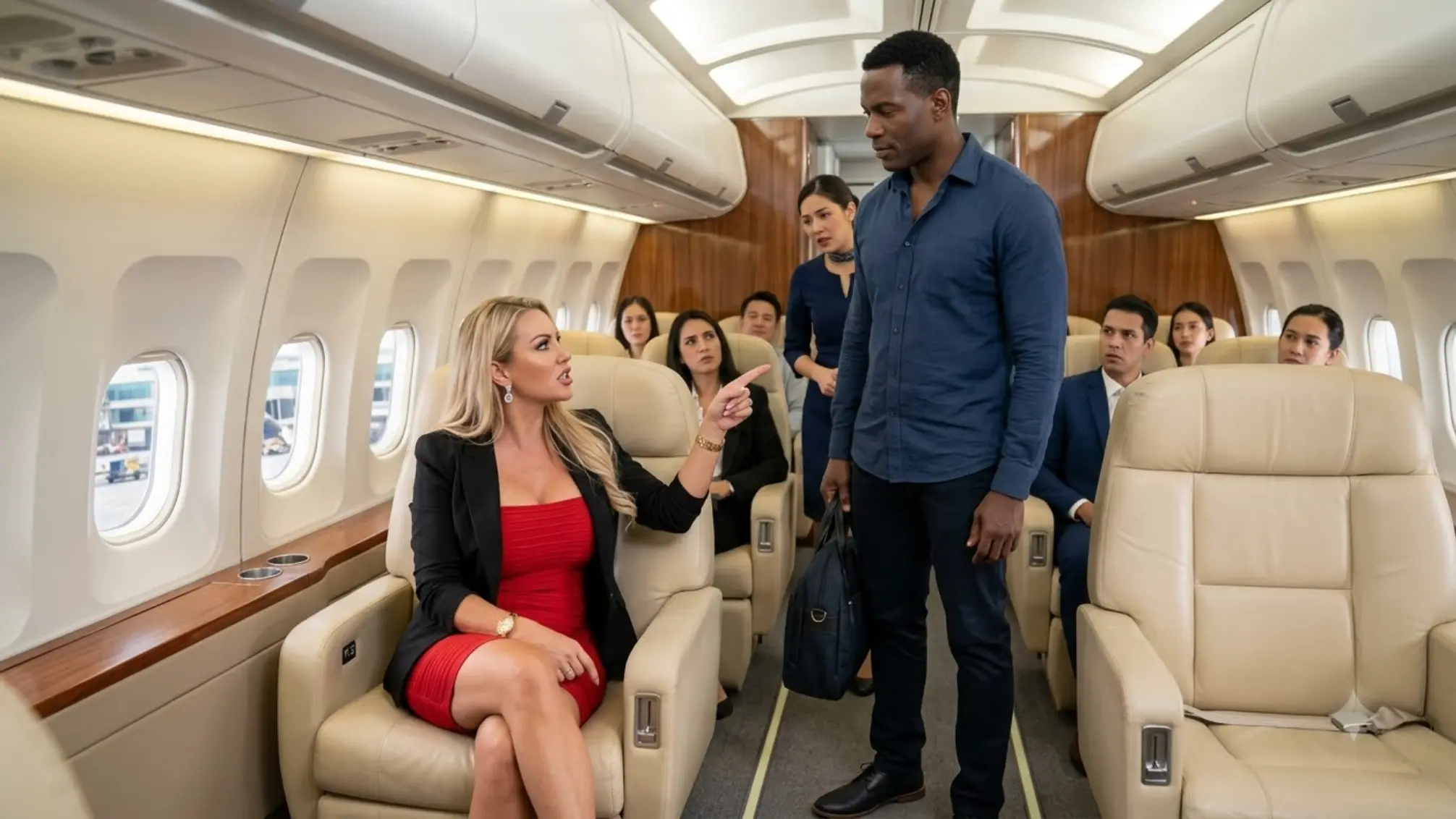
“Your ticket gives you a seat,” Marcus said. “It doesn’t give you the right to decide who deserves one.” His dark blue button-up shirt carried no logo, his trousers were plain, and the inexpensive black shoes on his feet were deliberately different from the custom footwear usually waiting inside his Manhattan apartment. There was no executive assistant beside him, no security detail, no driver waiting on the ramp, and no visible sign that twelve days earlier his investment group had completed the controlling acquisition of Meridian Atlantic Airlines. Tonight, Marcus wanted to see the company the way ordinary passengers saw it.
Celeste laughed and looked toward a flight attendant standing several rows away. “I paid for luxury, not to be trapped beside a man who looks like he belongs in coach.” Several passengers visibly reacted, and one elderly man lowered his newspaper entirely. Marcus leaned slightly closer, not threatening her, but refusing to give up an inch of the aisle. “Keep talking,” he said quietly, “because when this cabin learns who I am, you’ll be the one begging for another seat.”
The flight attendant hurried toward them. Her name tag identified her as Rachel Kim, and although she was smiling professionally, tension showed around her eyes. “Ma’am, Mr. Bennett is assigned to 2B, directly beside you.” Celeste immediately held up one hand. “Then reassign him.”
Rachel glanced toward Marcus. “His boarding pass is confirmed.”
“I don’t care.”
Celeste turned toward the cabin with the confidence of someone accustomed to rooms rearranging themselves around her. “There must be another seat. Move him to business, premium economy, coach, anywhere.” She looked Marcus up and down again before adding, “Surely someone made a mistake.”
Marcus said nothing.
He wanted to hear what happened next.
Rachel remained polite. “There is no mistake, ma’am.”
Celeste’s expression sharpened. “Do you know who I am?”
Rachel hesitated.
That question interested Marcus immediately.
Celeste noticed the hesitation and smiled.
“I’m Celeste Whitmore.”
Recognition crossed Rachel’s face.
Marcus saw it.
He knew the name too.
Whitmore Premier Travel operated luxury airport lounges, corporate concierge programs, executive ground transportation, and premium passenger services across eleven major American airports. Meridian Atlantic had signed a multi-year partnership with the company under the previous chief executive, and the contract was currently worth just under seventy million dollars. Marcus had seen Celeste’s photograph in briefing materials, but the studio portrait showed controlled elegance rather than the contempt now sitting three feet from him.
Celeste crossed her arms. “Now perhaps you understand why I’m not spending six hours like this.” Rachel looked toward the galley, clearly calculating the consequences of angering one of the airline’s most commercially valuable partners. Marcus watched her carefully because this was exactly why he had refused executive treatment on the flight. Policies looked excellent in board presentations; pressure revealed whether employees were actually allowed to follow them.
Rachel finally answered. “I understand who you are, Ms. Whitmore.”
“Good.”
“But Mr. Bennett still has a confirmed seat.”
Celeste stared at her.
Marcus almost smiled.
Rachel had chosen correctly.
Celeste’s voice dropped. “Perhaps you should call your purser.”
“I already have.”
As if summoned by the sentence, a senior flight attendant named Peter Lawson emerged from the front galley. He was in his early fifties, silver-haired and polished, and he greeted Celeste by name before anyone introduced her. That detail told Marcus the woman was not merely known to the airline; she was accustomed to special treatment.
Peter listened to Rachel’s explanation. Celeste repeatedly interrupted, claiming she felt uncomfortable and insisting that first class was supposed to provide a certain “standard.” Marcus asked what standard she meant. Celeste looked directly at his simple clothing.
“Presentation.”
Marcus tilted his head. “So this is about my shirt?”
“It’s about the entire experience.”
“You mean me.”
Celeste smiled thinly. “If you want to reduce it to that.”
Peter cleared his throat. “Perhaps we can resolve this without delaying departure.” Marcus immediately recognized the phrase as the beginning of a compromise that would probably burden the quieter party. He had heard executives use similar language whenever somebody wanted discrimination to become a logistical inconvenience rather than a moral problem. He remained silent.
Peter turned toward Marcus. “Sir, we have a very comfortable business-class seat available across the aisle near the bulkhead.” Rachel looked at him sharply. Marcus noticed. “And why would I move?”
Peter lowered his voice. “We’re simply trying to keep everyone comfortable.”
“I’m comfortable in the seat I purchased.”
Celeste scoffed. “You haven’t even sat down.”
Marcus looked at her. “Because you’re blocking it.”
Several passengers laughed quietly.
Celeste’s face reddened.
Peter tried again. “Mr. Bennett, we would compensate you generously for the inconvenience.”
Marcus reached into his pocket and removed his boarding pass. “How much did I pay for 2B?” Peter checked the handheld device. “Your fare was $6,840.”
“And you’re asking the person with the confirmed $6,840 seat to move because the passenger beside him dislikes the way he looks.”
Peter stopped.
Rachel looked toward Marcus with growing curiosity.
“That is not how I would characterize it.”
“Then characterize it.”
Peter did not.
Celeste snapped, “This is absurd.”
She pressed the call button repeatedly even though two crew members were already standing beside her.
Marcus looked down at her. “Does pressing it harder summon someone more important?”
A man in row three laughed.
Celeste spun toward him. “Stay out of this.”
The man lifted both hands.
Marcus finally stepped into the row and placed his small black carry-on beneath the ottoman. Celeste immediately stood and moved into the aisle as if his presence physically contaminated the space around her. She demanded another seat again.
Peter offered her the business-class seat instead.
Her expression became almost comical.
“You want me to move?”
“You’re the passenger requesting separation.”
“I am one of this airline’s largest commercial partners.”
Marcus looked toward Peter.
That sentence would matter later.
Celeste continued. “My company sends thousands of high-value travelers through Meridian every month.” She jabbed one finger toward Marcus. “He probably bought that seat with miles.”
Marcus sat down.
“Cash.”
She looked at him.
“Full fare.”
Celeste laughed dismissively. “Congratulations.”
Marcus fastened his seat belt.
Rachel returned to the galley while Peter continued attempting to negotiate. The cabin door was scheduled to close in seven minutes, and passengers had begun openly recording. Celeste finally demanded that the captain intervene.
Peter refused.
“The captain has operational responsibilities.”
“Then get airport security.”
Marcus looked up. “For what?”
“I feel threatened.”
The cabin became quiet again.
Marcus’s expression hardened.
“I haven’t touched you.”
“You’re intimidating me.”
“I’m sitting in my assigned seat.”
“You challenged me.”
“You insulted me.”
Celeste pointed toward his chest. “See? Aggressive.”
Rachel returned carrying a tablet.
Marcus noticed that her posture had changed.
“Mr. Bennett,” she said carefully, “may I confirm your full name?”
“Marcus Elijah Bennett.”
Celeste rolled her eyes. “Wonderful. We have his biography now.”
Rachel typed.
The tablet froze.
She frowned and entered the information again.
Then her face changed.
Peter noticed immediately.
“What is it?”
Rachel angled the screen away from Celeste.
“Sir, I think you should see this.”
Peter took the tablet.
He stared at it.
Then he looked at Marcus.
Marcus knew exactly what had appeared.
The acquisition was confidential only until market opening the following morning, but airline executive databases had already been updated because certain corporate security permissions could not legally remain attached to the previous ownership team. Marcus’s passenger profile carried an internal designation visible only after full identity verification.
BENNETT, MARCUS E.
EXECUTIVE CLEARANCE: A1
ROLE: CHIEF EXECUTIVE OFFICER / CONTROLLING OWNERSHIP REPRESENTATIVE
Peter swallowed.
Celeste noticed.
“What?”
Nobody answered.
She stood.
“What does it say?”
Marcus unfastened his seat belt and slowly rose.
Peter handed the tablet to him.
Marcus glanced at the screen.
Everything was correct.
He returned it.
Celeste stared between them.
“Who are you?”
Marcus looked directly at her.
“The man you said belonged in coach.”
Her confidence faltered.
“That isn’t what I asked.”
Marcus slipped one hand into his pocket.
“I’m Marcus Bennett.”
“I heard your name.”
“And Bennett Capital closed its acquisition of Meridian Atlantic twelve days ago.”
Peter lowered his head slightly.
Celeste stopped moving.
Marcus continued.
“Tomorrow morning the company announces me as the new chief executive officer.”
No one in first class made a sound.
Celeste’s lips parted.
Then she laughed.
It was short and nervous.
“That’s ridiculous.”
Marcus looked toward Peter. “Is it?”
Peter answered quietly.
“No, ma’am.”
The silence became absolute.
Celeste looked around the cabin and realized several passengers were recording every second.
Her entire demeanor changed.
“Mr. Bennett, obviously there has been a misunderstanding.”
Marcus raised an eyebrow.
“Thirty seconds ago I belonged in coach.”
“I was frustrated.”
“You called me unfit for this cabin.”
“I never said unfit.”
Rachel spoke unexpectedly.
“You said he didn’t meet the standard.”
Celeste looked at her furiously.
Rachel did not retreat.
Marcus noticed that too.
Celeste lowered her voice. “Marcus, perhaps we should discuss this privately.”
“We’re already having the conversation you chose to make public.”
“I didn’t know who you were.”
Marcus stared at her.
“Exactly.”
The word seemed to hit harder than anything else he had said.
He did not raise his voice.
“You thought I was an ordinary passenger.”
Celeste looked away.
“That means you believed there would be no consequences.”
She immediately denied it.
Marcus sat again.
“I didn’t board this aircraft looking for you, Ms. Whitmore.”
That part was true.
“But now that we’ve met, I’m going to read your company’s contract very carefully.”
Her face changed again.
The aircraft door closed.
Celeste requested to leave the plane.
Peter told her they could still reopen the door before pushback if she genuinely wanted to deplane. She looked toward Marcus, perhaps expecting him to offer reassurance.
He did not.
She remained onboard.
For the first hour of the flight, almost nobody in first class spoke.
Celeste stared through the window.
Marcus opened his laptop.
He had intended to review maintenance statistics and employee retention reports.
Instead, he opened the Meridian Atlantic commercial partnership folder.
He searched WHITMORE PREMIER TRAVEL.
The first documents appeared ordinary.
Airport lounge concessions.
Premium passenger transfer agreements.
Executive concierge services.
Revenue-sharing arrangements.
Then Marcus noticed a series of unusually high service credits.
Whitmore Premier had received millions in discretionary payments connected to what the contract called priority experience recovery.
Marcus opened the details.
The language was vague.
He sent a secure message to his incoming chief compliance officer.
Pull every passenger complaint connected to Whitmore Premier. Do not alert regional management yet.
The response came four minutes later.
Understood.
Celeste noticed him typing.
“Are you seriously investigating me because we argued?”
Marcus did not look away from the screen.
“No.”
“What are you doing?”
“My job.”
She folded her arms.
“This is retaliation.”
Marcus closed one document.
“If your company is clean, you have nothing to worry about.”
Celeste became silent.
That silence told him more than outrage would have.
Three hours into the flight, the first compliance report arrived.
There were forty-three passenger complaints mentioning Whitmore Premier employees during the previous eighteen months.
Twelve alleged discriminatory treatment.
Eight involved premium lounge access being denied despite valid credentials.
Six involved passengers being pressured to surrender confirmed first-class seats to clients connected to Whitmore Premier’s executive service program.
Marcus stopped reading.
He opened the passenger names.
One caught his attention.
Dr. Alana Brooks.
He remembered the case.
A Black pediatric surgeon traveling from Atlanta to Seattle had publicly complained six months earlier after being removed from first class despite holding a confirmed ticket. Meridian Atlantic had blamed an aircraft change.
The internal record said something else.
A Whitmore Premier client wanted the seat.
Marcus continued.
Another case involved an elderly Latino restaurant owner.
Another involved a Black software engineer.
Another involved a white construction-company founder traveling in worn jeans.
The pattern was not exclusively racial.
It was based on perceived status.
People who looked unlikely to cause expensive trouble were easier to remove.
Marcus looked toward Celeste.
She was asleep.
He wondered how much she knew.
By the time the aircraft landed in New York, his compliance team had found something worse.
Whitmore Premier employees had access to limited passenger-status information through the airline partnership.
That access was intended to coordinate premium services.
Someone had used it to identify travelers without elite corporate profiles.
Those passengers were disproportionately targeted when valuable seats or lounge space needed to be reassigned.
Marcus read the preliminary analysis twice.
The discrimination he experienced onboard was not separate from Celeste’s business.
It looked disturbingly similar to the company’s operating logic.
The aircraft arrived at the gate shortly after 9:00 p.m.
Celeste stood immediately.
Marcus remained seated.
She looked down at him.
“I assume lawyers will be involved.”
“Yes.”
Her face tightened.
“My company employs eight hundred people.”
“I know.”
“If you destroy our partnership over one conversation, you hurt them too.”
Marcus closed his laptop.
“If I end your contract, it won’t be because you insulted me.”
Celeste hesitated.
“What did you find?”
Marcus stood.
“Tomorrow.”
She stared at him.
“What happens tomorrow?”
“You’ll find out.”
By 6:30 the following morning, twenty-two people were inside Meridian Atlantic’s Manhattan headquarters.
Marcus arrived wearing a charcoal suit.
No disguise.
No plain shoes.
No attempt to look ordinary.
The board had assembled for what they believed would be a routine transition meeting before the public acquisition announcement.
Instead, Marcus placed the Whitmore file on the table.
Celeste attended remotely with two attorneys.
She looked completely different from the woman on the plane.
Controlled.
Prepared.
Expensive.
Marcus began with the flight incident only because it explained why the contract received immediate review.
Then he moved to the data.
Forty-three complaints.
Repeated access denials.
Seat reassignment patterns.
Internal messages.
Service credits.
Executive concierge clients being favored over confirmed passengers.
One board member interrupted.
“Were passengers compensated?”
Marcus looked at him.
“Some.”
“Then commercially, that may be considered recovery.”
Marcus opened another document.
“They were compensated after they complained.”
The room became quiet.
“The people who stayed silent received nothing.”
Celeste’s attorney intervened.
“None of this proves Ms. Whitmore personally directed discriminatory behavior.”
Marcus nodded.
“You’re correct.”
Celeste relaxed slightly.
Then Marcus continued.
“That is why we reviewed executive communications.”
Her expression froze.
An email appeared on the conference-room screen.
It had been sent from Celeste to Whitmore Premier regional managers eleven months earlier.
Protect top-tier clients first. If capacity is tight, relocate passengers least likely to impact revenue.
Another message followed.
Use judgment. Appearance usually tells you who has leverage.
Nobody spoke.
Celeste immediately argued that the sentence referred to business travelers versus leisure travelers.
Marcus displayed another message.
Don’t waste premium inventory on bargain-looking travelers when a real client needs it.
A director near the end of the table closed his eyes.
Celeste’s attorney asked for the meeting to pause.
Marcus refused.
The next evidence involved money.
Whitmore Premier received contractual bonuses tied to premium-client satisfaction.
Those bonuses increased when its customers received last-minute first-class upgrades.
Creating those upgrades sometimes required somebody else to lose a seat.
The system had quietly rewarded displacement.
Regional airline managers benefited too.
The more high-value Whitmore clients reported excellent service, the better certain internal performance metrics looked.
Everyone had an incentive not to ask who was being moved.
Marcus turned toward the board.
“This company built a process where disrespect could become profitable.”
Nobody challenged the sentence.
The contract contained a compliance clause permitting immediate suspension when partner conduct exposed Meridian Atlantic to regulatory or civil-rights risk.
Marcus invoked it.
Whitmore Premier’s airline agreement was frozen pending full review.
Celeste stared through the screen.
“You cannot do this overnight.”
Marcus looked at the clock.
“It has been twenty-four hours since you told me I belonged in coach.”
She flinched.
“This is personal.”
“No.”
He leaned forward.
“What happened to me was personal.”
Then he touched the folder.
“This is evidence.”
The distinction mattered.
Federal transportation regulators were notified.
Independent auditors were brought in.
The airline announced that it was reviewing premium-service practices and passenger reassignments.
Marcus refused to release Celeste’s name publicly until legal review confirmed what could responsibly be disclosed.
He had no interest in spectacle.
The videos made secrecy impossible anyway.
By lunchtime, the first-class confrontation had millions of views.
Celeste’s finger pointed toward Marcus in frozen screenshots across social media.
One clip captured her saying she paid for luxury rather than sitting beside someone who looked like he belonged in coach.
Another captured Marcus’s identity being revealed.
But the most damaging footage came later.
Passengers had recorded her saying, I didn’t know who you were.
That sentence became the story.
Commentators asked why identity should matter.
Whitmore Premier released a statement blaming an emotional disagreement.
It made things worse.
Employees began contacting reporters.
Former staff described pressure to prioritize wealthy clients regardless of ordinary reservations.
One former concierge provided internal training slides dividing passengers into categories based partly on perceived complaint risk.
The categories had unofficial nicknames.
Red Carpet.
Manageable.
Disposable.
Marcus stared at the final word for a long time.
His compliance officer asked whether he wanted coffee.
“No.”
He wanted every reservation associated with those classifications.
Three days later, auditors discovered that more than nine hundred passengers had potentially been disadvantaged through premium-service interventions during the previous three years.
Not all had been illegally removed.
Many changes were legitimate.
But enough questionable cases remained to trigger a major investigation.
Whitmore Premier’s other partners noticed.
Two hotel groups suspended contracts.
A luxury credit-card issuer opened its own compliance review.
The company’s lenders requested information regarding potential liabilities.
Celeste called Marcus directly.
He declined twice.
On the third call, his general counsel suggested he answer with a witness present.
Marcus agreed.
Celeste’s voice sounded tired.
“You’re destroying everything I built.”
Marcus stared through his office windows at Manhattan.
“No.”
“You froze the contract that keeps half my company alive.”
“I froze it because evidence suggests your company abused passenger data.”
“You could have handled this quietly.”
Marcus almost laughed.
“Like you handled me quietly?”
Silence.
“That’s not fair.”
“Neither was seat 2B.”
Celeste exhaled.
“I made a terrible comment.”
“This stopped being about your comment three days ago.”
“My employees need those jobs.”
“And our passengers needed the seats they paid for.”
She became angry.
“You think because you bought an airline you understand the travel business?”
Marcus remained calm.
“I understand something simpler.”
“What?”
“A customer shouldn’t need to look rich before a contract matters.”
Celeste hung up.
The external investigation continued.
Regulators eventually found substantial failures in access controls and passenger-reassignment oversight.
Meridian Atlantic accepted responsibility for its part rather than placing everything on the contractor.
Marcus insisted on that.
His own company had allowed the system to exist.
Several airline managers had looked away because Whitmore Premier delivered profitable customers.
They faced discipline too.
One vice president resigned.
Two regional managers were terminated.
Passenger records were corrected.
Compensation programs were established.
Marcus ordered premium reassignments to require digitally recorded reasons and secondary authorization.
A confirmed passenger could no longer be moved simply because someone more profitable appeared.
Whitmore Premier did not survive intact.
The suspended airline contract triggered loan problems because the company had borrowed heavily against expected partnership revenue.
Investigators discovered inflated forecasts and questionable accounting unrelated to the discrimination case.
Lenders withdrew support.
The board removed Celeste as chief executive.
She sold major personal assets to cover obligations she had guaranteed.
Within months, the company entered restructuring.
Headlines said the woman who insulted the Black CEO had “lost everything.”
Marcus disliked the phrase.
It made the story sound like revenge.
The reality was more complicated.
Celeste did not lose her company because she refused to sit beside him.
She lost control because the confrontation exposed a business culture she had helped create.
The distinction mattered.
Six months later, Marcus boarded another Meridian Atlantic flight.
He wore the same dark blue shirt.
The same plain trousers.
The same simple shoes.
His security team hated the experiment.
Marcus insisted.
At the boarding door, a young flight attendant scanned his pass.
“Welcome aboard, Mr. Bennett.”
She did not recognize him.
Marcus smiled.
“Thank you.”
His seat was 4A.
Beside him sat a construction worker in dusty boots and a reflective jacket.
The man looked embarrassed.
“Sorry about the clothes. Came straight from the job.”
Marcus put his bag away.
“You paid for the seat?”
“Yeah.”
“Then the clothes are perfect.”
The man laughed.
They spent the first hour talking about bridges.
Marcus never mentioned who he was.
Near the end of the flight, the construction worker finally asked what Marcus did for work.
Marcus looked around the cabin.
“Airlines.”
“Pilot?”
“No.”
“Mechanic?”
Marcus smiled.
“Management.”
The man nodded sympathetically.
“Sounds stressful.”
“You have no idea.”
After landing, Marcus remained seated while other passengers exited.
Rachel Kim appeared from the galley.
She had transferred to the airline’s training department after the investigation.
“Still traveling undercover?”
Marcus stood.
“Not very successfully if you recognize me.”
Rachel laughed.
She had helped redesign crew training after the incident.
The new program used anonymized scenarios based on real passenger complaints.
Employees were taught one principle before anything involving status, clothing, revenue, or executive preference.
The seat belongs to the confirmed passenger.
Marcus liked the simplicity.
Rachel asked whether he ever regretted taking that flight.
“No.”
“Even after everything?”
“Especially after everything.”
He looked toward the empty seat where the construction worker had been sitting.
“I spent years reading customer surveys.”
Rachel waited.
“One rude woman taught me more in six hours.”
Rachel smiled sadly.
“Expensive lesson.”
Marcus looked around the cabin.
“Worth it.”
Before leaving, he touched the cream leather seat beside him.
Months earlier another passenger had looked at the exact same kind of seat and decided dignity came included only with money.
Marcus had learned something different.
Luxury could buy space.
It could buy better food.
It could buy larger seats, private lounges, and faster boarding.
But it could not purchase superiority.
No first-class ticket gave one passenger ownership over another person’s humanity.
And no CEO title should be required before anyone understood that.
Celeste had believed the twist was discovering Marcus owned the airline.
Marcus knew better.
His ownership changed the consequences.
It did not change what had been right before she knew his name.
That was why he never used the confrontation video in company advertising.
He never turned the event into a heroic story about a billionaire teaching an arrogant woman a lesson.
He refused interview requests asking him to reenact the moment.
The story belonged to something larger.
Every passenger who had once been dismissed because their clothes looked inexpensive.
Every traveler whose accent encouraged an employee to assume they would not complain.
Every customer moved because somebody richer wanted what they already paid for.
Every employee afraid to challenge a commercially valuable passenger.
The system had taught people to calculate dignity.
Marcus wanted that calculation removed.
A year after the confrontation, Meridian Atlantic published its annual passenger-rights report.
Involuntary premium-seat reassignments had fallen sharply.
Complaints involving appearance-based treatment dropped.
More importantly, complaint reviews were now grouped for patterns instead of handled individually.
Rachel sent Marcus the report with one short message.
2B changed a lot.
Marcus smiled.
He still had the original boarding pass.
Not framed.
Not displayed.
Just folded inside his desk drawer.
Occasionally he looked at it.
Seat 2B.
One ordinary seat.
One extraordinary argument.
And one reminder that the most dangerous problems inside powerful organizations often survive because nobody important experiences them personally.
Marcus Bennett happened to be important.
That was luck.
The next passenger might not be.
So he built the system for that person instead.