Commander Derek Kelner’s hand locked around Astra Lennox’s forearm so hard that the fabric of her gray polo stretched across her shoulder.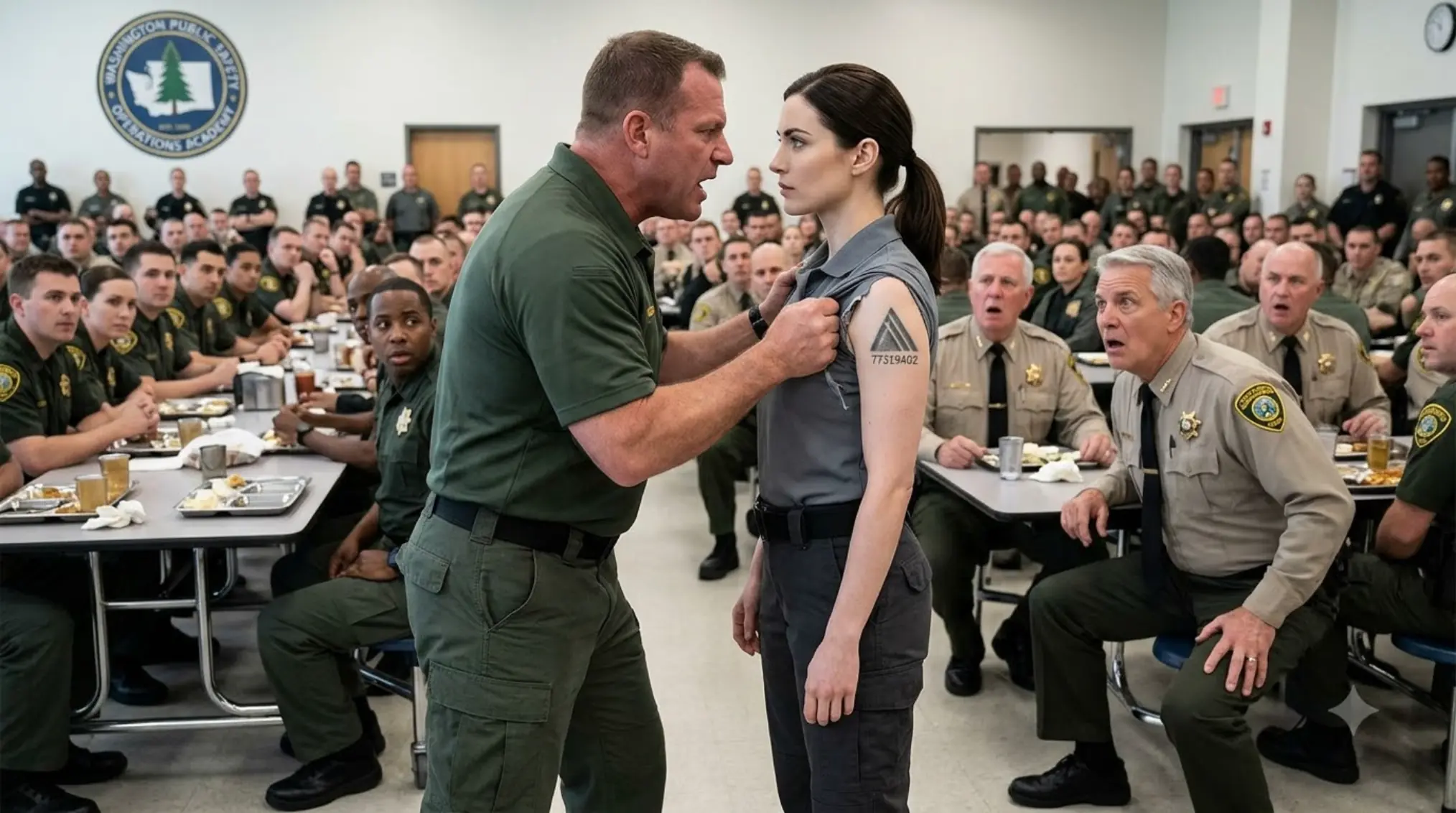
“You’re coming with us.”
Astra did not move.
Around them, the brightly lit dining hall of the Washington State Public Safety Operations Academy had fallen almost completely silent. Stainless-steel tables filled the enormous room, and more than two hundred trainees, instructors, technicians, investigators, and senior officials had stopped eating to watch the confrontation unfold.
Kelner was forty-seven, broad through the shoulders, close-cropped brown hair already darkened with sweat around his temples. He had spent most of lunch speaking loudly enough for nearby tables to hear him. People around the academy knew that voice. It meant someone was about to become an example.
Today, he had chosen Astra.
She was thirty, striking without trying to be, with fair skin, sharp features, dark-brown hair tied into a low ponytail, and piercing blue eyes that remained unnervingly calm while Kelner pulled harder.
Her gray contractor polo carried no rank.
No visible government credential.
Nothing that explained why she had spent eleven days moving freely through one of the state’s most sensitive communications facilities.
To almost everyone in the room, Astra was an outside technician.
She repaired terminals.
Replaced encrypted drives.
Updated network hardware.
Drank black coffee.
Spoke very little.
Kelner believed that made her harmless.
He was wrong.
The fabric tore.
A sharp ripping sound cut through the room.
The left sleeve split open from the seam and exposed part of Astra’s upper arm.
A faded black symbol appeared against her pale skin.
A triangle.
Three parallel lines.
Beneath it was an eight-digit identification number.
Kelner stared at it for half a second.
Then laughed.
“What’s this supposed to be?”
Astra looked directly into his eyes.
“Let go.”
His expression hardened.
“Filing a complaint?”
“Let go.”
“That tattoo doesn't scare me.”
“It isn't supposed to.”
Kelner slammed her forearm against the edge of the stainless-steel table.
Several people jumped.
Astra did not.
Then, from two tables away, a chair scraped violently backward.
Everyone turned.
Senior Investigator Thomas Donovan was standing.
He was sixty-three, silver-haired, heavy through the shoulders, and had spent more than thirty years inside state protective operations before moving into academy oversight.
His face had lost all color.
He was staring at Astra’s arm.
“Commander.”
Kelner glanced over.
“Stay out of this, Donovan.”
Donovan ignored him.
He stepped closer.
His eyes never left the black triangle.
“That insignia is restricted.”
Kelner scoffed.
“It’s a tattoo.”
“No.”
Donovan’s voice dropped.
“That number.”
Astra slowly reached into the pocket of her dark utility trousers with her free hand.
Kelner tightened his grip.
“Hands where I can see them.”
Astra removed a heavy bronze coin.
No agency name.
No seal.
Only a pattern around the edge and another eight-digit number.
She slid it across the table.
The coin stopped in front of Donovan.
He picked it up.
His hands trembled.
He looked from the coin to Astra’s exposed arm.
Then again.
“No.”
Astra said nothing.
Donovan whispered:
“You’re supposed to be dead.”
The entire dining hall froze.
Kelner’s grip loosened.
Only slightly.
That was enough.
Astra twisted her arm once and pulled free.
She stepped backward.
Kelner stared at Donovan.
“What the hell are you talking about?”
Donovan looked at him.
Then at the hundreds of people surrounding them.
“That identification belongs to a classified state operative declared dead four years ago.”
A murmur spread through the room.
Kelner’s expression changed.
Astra calmly pulled the torn section of her polo back over her shoulder.
Donovan looked at her.
“Astra Lennox?”
She met his eyes.
“Yes.”
Kelner stepped backward.
The first trace of panic appeared.
And Astra knew the operation was over.
Eleven days of silence had just ended because Derek Kelner could not tolerate one woman refusing to serve him bottled water.
Astra had entered the academy under the name already printed on her contractor credentials.
That part was real.
Her occupation was not.
Four years earlier, she had belonged to a six-person covert investigative team tasked with tracing corruption involving secure communications contracts, organized crime, and compromised public officials.
Internally, the team was known by a code name that appeared almost nowhere in permanent records.
The six operatives worked compartmentally.
Different cover identities.
Different locations.
Minimal digital footprints.
Their final operation began after someone inside government repeatedly leaked transport routes and protected-witness locations.
People were dying.
The leak was too precise to be accidental.
Astra’s team followed financial transfers through shell corporations until the trail pointed toward a source with access to multiple protected systems.
Before they could identify the individual conclusively, their own location was compromised.
The safe facility was attacked.
Official records listed six dead.
Five actually were.
Astra survived because she had been sent outside the primary structure minutes before the attack to inspect a malfunctioning relay.
The explosion threw her into a drainage channel.
By the time emergency teams arrived, the building was gone.
Astra’s supervisors faced a decision.
Declare her alive and risk warning whoever had exposed the team.
Or let the traitor believe all six investigators were dead.
Astra chose the second.
For four years, she lived under controlled identities.
No public photographs.
No visits home.
No contact with old colleagues except through secure channels.
And one objective:
Find who sold them.
The breakthrough came eighteen months earlier.
A financial analyst uncovered recurring offshore transfers linked indirectly to procurement accounts managed by academy logistics operations.
The transfers were small enough to avoid obvious alarms.
But they occurred shortly before several historical security compromises.
The person authorizing those accounts was Derek Kelner.
At first, investigators believed Kelner might simply have been careless.
Then they found encrypted communications.
Payments.
Foreign intermediaries.
And one archived access record from four years earlier.
Kelner’s credentials had opened the communications system that contained Astra’s team location hours before the attack.
It was not enough for arrest.
They needed current evidence.
So Astra walked back into the world.
As a contractor.
For eleven days, Kelner barely noticed her.
That was exactly what Astra wanted.
She replaced network cards in the communications room.
Updated workstation firmware.
Checked secure terminals.
And every evening, she copied fragments of Kelner’s financial activity onto an encrypted storage device concealed inside an ordinary diagnostic tool.
The evidence became stronger.
Wire transfers.
False vendor accounts.
A hidden property purchase.
Messages discussing “old cleanup work.”
Then Astra found the phrase that changed the investigation:
All six were confirmed removed.
A date appeared beside it.
Four years earlier.
The same night her team died.
Astra stared at those words for almost a minute.
Then closed the file.
She felt no dramatic rush of revenge.
Only cold certainty.
Kelner had done it.
Now she had to prove enough of it for everyone else.
Her extraction was scheduled for Friday.
The confrontation happened Thursday.
Kelner noticed Astra in the dining hall because every table near his preferred section was occupied.
He carried a tray toward her.
Behind him walked Petty Officer Sutter, one of his closest subordinates.
Kelner stopped.
“Move.”
Astra looked up.
“There are open seats behind you.”
“I didn't ask where the open seats were.”
She returned to her lunch.
Kelner stood there.
“Get up.”
Astra’s blue eyes lifted.
“I’m on break.”
Several people glanced over.
Kelner smiled thinly.
“Contractors don't tell senior command where they sit.”
“I wasn't telling you where to sit.”
That got a few suppressed reactions from nearby trainees.
Kelner heard them.
His face hardened.
He slammed his tray onto Astra’s table.
A cup tipped.
Food scattered.
“Pick that up.”
Astra looked at the mess.
Then at him.
Without a word, she crouched and began collecting the spilled food.
Kelner smiled.
He thought he had won.
Then Sutter walked past.
His shoulder struck Astra’s.
“Watch yourself.”
Astra caught something else.
A slight tug against her jacket pocket.
She did not react.
But she had spent years recognizing covert hand movement.
Sutter had placed something inside her pocket.
Astra finished cleaning the floor.
Then stood.
Kelner was already waving toward two security officers.
“We have a theft issue.”
Astra almost admired how quickly the setup moved.
One security officer approached.
“Ma’am, Commander Kelner says restricted equipment may be missing.”
Astra looked toward Kelner.
He folded his arms.
“Search her.”
The security officer hesitated.
“Sir, we need consent or established—”
Kelner snapped:
“She was inside Communications Section Three this morning. Search her.”
Astra could have stopped everything.
One credential.
One secure call.
One name.
Instead she raised her hands.
“Go ahead.”
The officer searched the jacket pocket.
He removed a small black communications module.
Restricted.
Serialized.
Kelner immediately smiled.
“Well.”
Astra looked at Sutter.
He would not meet her eyes.
Kelner stepped closer.
“You've got anything clever to say now?”
“Yes.”
He waited.
Astra said:
“Preserve the dining hall cameras.”
His smile disappeared for a second.
Then returned.
“You think anyone’s worried about your complaint?”
“No.”
That was when he grabbed her.
And tore the sleeve.
And exposed the mark.
Donovan still held the bronze coin.
Kelner looked from him to Astra.
“This is some kind of performance.”
Astra calmly answered:
“No.”
“You expect me to believe she’s some dead secret operative?”
Donovan turned the coin over.
“Commander, I processed casualty authentication after the incident.”
Kelner went completely still.
That was the first moment Astra knew he understood precisely what Donovan was referencing.
She saw it in his eyes.
Recognition.
Not confusion.
Recognition.
Donovan noticed too.
“You know what I'm talking about.”
Kelner recovered quickly.
“Of course I do. Everyone at senior level heard about that case.”
“No.”
Donovan shook his head.
“Not this identification system.”
Astra watched Kelner’s breathing accelerate.
Then she looked toward Sutter.
He was edging backward.
“Don't.”
Everyone turned toward her.
Sutter stopped.
Astra pointed toward his right hand.
“You've been touching your pocket since the module was found.”
Sutter looked down instinctively.
Mistake.
Astra continued.
“If security searches it, they’ll find the access sleeve you used to remove the module from storage.”
Sutter’s face went white.
Kelner shouted:
“Enough!”
Astra ignored him.
“Camera twelve covers the serving line. Camera fourteen covers this table. Camera seventeen covers the corridor outside Communications Three.”
She looked toward the security officers.
“Preserve all three.”
Kelner stepped toward her.
Donovan blocked him.
“Don't.”
Kelner’s face twisted.
“You don't command me.”
“No.”
Donovan nodded toward the doors.
“But they do.”
Three people had entered.
The State Public Safety Commissioner.
A representative from the Attorney General’s investigative division.
And Special Agent Lauren Hale from the federal financial crimes task force.
Kelner stopped breathing for a second.
Hale walked directly toward Astra.
“You were supposed to wait for extraction.”
Astra looked at her torn sleeve.
“I had scheduling complications.”
Hale almost smiled.
Then her eyes moved toward Kelner.
“Commander Derek Kelner?”
He said nothing.
She displayed credentials.
“You are not under arrest at this moment. You are, however, ordered not to leave this facility while a search warrant is executed.”
Kelner’s face collapsed.
“Search warrant?”
Astra looked at him.
“The one your banking records paid for.”
The dining hall emptied under controlled supervision.
Nobody wanted to leave.
Everyone wanted to know what was happening.
But investigators needed witnesses separated.
Astra sat in a small conference room wearing a borrowed jacket over her torn polo.
Donovan entered twenty minutes later.
For several seconds he simply looked at her.
Then he closed the door.
“I attended your memorial.”
Astra’s expression softened.
“I know.”
“You know?”
“I saw the attendance report.”
He laughed bitterly.
“Of course you did.”
He sat.
“Five names.”
“Yes.”
“I shook families’ hands.”
Astra looked toward the window.
“I couldn't contact anyone.”
“I understand.”
He paused.
“I don't like it.”
“Neither did I.”
“Four years?”
“Yes.”
Donovan looked older suddenly.
“Why come back personally?”
Astra knew he deserved the truth.
“Because Kelner accessed the file that exposed us.”
Donovan froze.
“You’re sure?”
“I copied the authorization logs eleven days ago.”
“And the payments?”
“Connected.”
Donovan closed his eyes.
For years, everyone had believed the team’s loss resulted from extraordinary hostile intelligence.
Instead, someone on their own side had sold them.
“How much?”
Astra understood the question.
“How much money?”
“Yes.”
She told him.
Donovan stared.
“That’s it?”
Astra nodded.
Five people dead.
Families destroyed.
Four years of secrecy.
For an amount of money that looked painfully ordinary when spoken aloud.
Donovan stood.
“I need air.”
Before leaving, he turned.
“Did you know Sutter would plant the module?”
“No.”
“Then why let the search happen?”
“Because if I stopped him immediately, he could claim misunderstanding.”
She looked toward the dining hall.
“Now we have video.”
Donovan stared at her.
“You've become frighteningly patient.”
Astra answered quietly:
“I had four years to practice.”
The search of Kelner’s office lasted nine hours.
Investigators found encrypted drives concealed behind a false cabinet panel.
Offshore banking information.
Communications with intermediaries.
Archived access credentials.
And a series of messages that matched exactly with security failures tied to Astra’s former team.
Sutter broke first.
He admitted Kelner had ordered him to plant the communications module.
Why?
Because Kelner had begun suspecting Astra was not an ordinary contractor.
She asked too few casual questions.
Remembered too much.
Moved through secure areas without the confusion most outside technicians displayed.
Kelner wanted her removed before Friday.
The theft accusation was supposed to end her access quietly.
Instead, his impatience exposed everything twelve hours before Astra planned to disappear.
The dining hall footage became crucial.
It showed Sutter approaching Astra.
His hand moving toward her jacket.
It showed him leaving.
Minutes later the “stolen” module appeared in that exact pocket.
The evidence chain was devastating.
Then another witness came forward.
A young systems technician named Jamie Cole.
“I saw him.”
Investigators looked up.
“Sutter?”
Jamie nodded.
“He took the module.”
“When?”
“About twenty minutes before lunch.”
“Why didn't you report it?”
Jamie looked ashamed.
“Commander Kelner was with him.”
That answer revealed another layer of the institution.
People had seen things.
They had stayed silent because Kelner had taught them silence was safer.
Charges followed.
Conspiracy.
Fraud.
Obstruction.
Evidence tampering.
Financial crimes.
And offenses connected to the historic security breach that killed Astra’s team.
The final case lasted months.
The public never received every detail.
Much remained sealed.
But enough emerged.
Kelner had used privileged access to sell protected information through intermediaries.
The attack four years earlier was linked directly to one of those transactions.
He had assumed everyone connected to the investigation died.
Astra’s survival destroyed that assumption.
Sutter cooperated and received a reduced sentence after admitting his role in the planted-evidence setup and providing access to communications Kelner thought had been deleted.
Kelner received decades in federal custody.
The academy conducted its own internal review.
That revealed something less criminal but equally important.
Kelner had intimidated people for years.
Public reprimands.
Retaliation.
Humiliation.
Threats.
People avoided challenging him because his authority appeared untouchable.
His corruption survived partly because everyone had learned not to ask what he was doing.
The Commissioner changed that.
Anonymous reporting channels were moved outside the local command structure.
Restricted-property access became automatically logged and audited.
No senior officer could personally direct evidence searches involving subordinates without independent authorization.
And complaints against supervisory personnel went directly to an outside review unit.
Astra approved of those changes more than any public praise directed toward her.
Because corruption rarely survives on secrecy alone.
It survives on fear.
Three months after Kelner’s conviction, Astra returned to the dining facility.
Not undercover.
Not exactly.
She still wore simple clothes.
Gray polo.
Dark trousers.
Her sleeve intact.
Donovan sat at the same table.
He placed an orange in front of her.
Astra looked at it.
“Very funny.”
“I thought you liked oranges.”
“I did before everyone started associating them with investigations.”
He laughed.
She sat.
The room was quieter than she remembered.
Not from fear.
Just ordinary lunch noise.
A young technician walked past and noticed Astra.
Then noticed the tattoo barely visible beneath her sleeve.
He looked away politely.
That mattered.
No staring.
No whispers.
No mythology.
Donovan peeled his orange.
“You staying?”
“At the academy?”
“In public.”
Astra considered.
Her official death status had been corrected inside protected systems.
Publicly, the explanation remained vague.
“I don't know.”
“You deserve a life.”
She looked at him.
“You sound like my therapist.”
“You finally have one?”
“No.”
“Then apparently I'm doing free work.”
Astra smiled.
He became serious.
“I meant it.”
She looked across the room.
For four years, she had existed as evidence.
A survivor kept hidden because her existence might expose someone else.
She had forgotten what normal decisions felt like.
Where to live.
Who to call.
Whether to attend someone’s birthday.
Whether to let people remember her face.
“What does a life look like after this?” she asked.
Donovan shrugged.
“Probably irritating.”
“That doesn't help.”
“Laundry. Bad coffee. Property taxes.”
“Compelling.”
“People who know you're alive.”
That stopped her.
Astra looked down.
“Yes.”
“That part.”
Months later, Astra visited five families.
One for each teammate she had lost.
Those conversations were harder than confronting Kelner.
No tactical training prepared her for mothers.
Fathers.
Children who had grown four years older while she remained officially dead.
She explained what she could.
Apologized for what she could not.
Some hugged her.
One father could barely look at her.
Not because he blamed her.
Because seeing the survivor gave shape to everything he had lost.
Astra understood.
She did not ask forgiveness.
She simply stayed.
That was something she had learned during four years as a ghost.
Sometimes justice was not a dramatic arrest.
Sometimes it was refusing to disappear when someone needed the truth to remain in the room.
The torn gray polo eventually ended up in an evidence box.
Astra never asked for it back.
The bronze coin did return.
Donovan personally delivered it.
He placed it on her desk.
“You should keep this.”
“I thought evidence had it.”
“Released.”
Astra turned it over.
The rim number caught the light.
The same eight digits remained on her arm.
“You know,” Donovan said, “Kelner destroyed himself over lunch.”
“No.”
Astra looked at the coin.
“He destroyed himself years earlier.”
“You know what I mean.”
“He simply got impatient at lunch.”
Donovan smiled.
“That sounds more accurate.”
Astra slipped the coin into a drawer.
The black tattoo remained.
She had once considered removing it.
Not anymore.
It represented people.
Five names.
Five lives.
A mission that went wrong.
A betrayal that took years to uncover.
And a warning that titles, uniforms, confident voices, and decorated careers meant nothing without integrity beneath them.
Kelner spent years surrounded by people who obeyed him.
Eventually, he mistook obedience for innocence.
He believed nobody would question the money.
Nobody would challenge the access logs.
Nobody would study the missing records.
Then a quiet contractor walked into his academy wearing a gray polo.
For eleven days, he barely noticed her.
On the twelfth, he tried to frame her.
When that was not enough, he grabbed her in front of two hundred fifty witnesses and tore her sleeve.
He thought he was exposing a powerless technician.
Instead, the fabric opened around the one mark he had spent four years believing no living person could still carry.
Astra never needed to shout.
She never needed revenge.
She needed Kelner to keep believing he was untouchable for just a little longer.
And he did.
Right until the moment the hidden number on her arm appeared beneath the torn gray fabric and an old investigator whispered the words Derek Kelner had spent four years assuming nobody would ever say:
“You’re supposed to be dead.”