She stood in the middle of that barn while seven men looked her over like livestock and walked away.
Seven.
One by one, they chose someone else. Anyone else.
And Eleanor Voss counted every single rejection like a blade going between her ribs.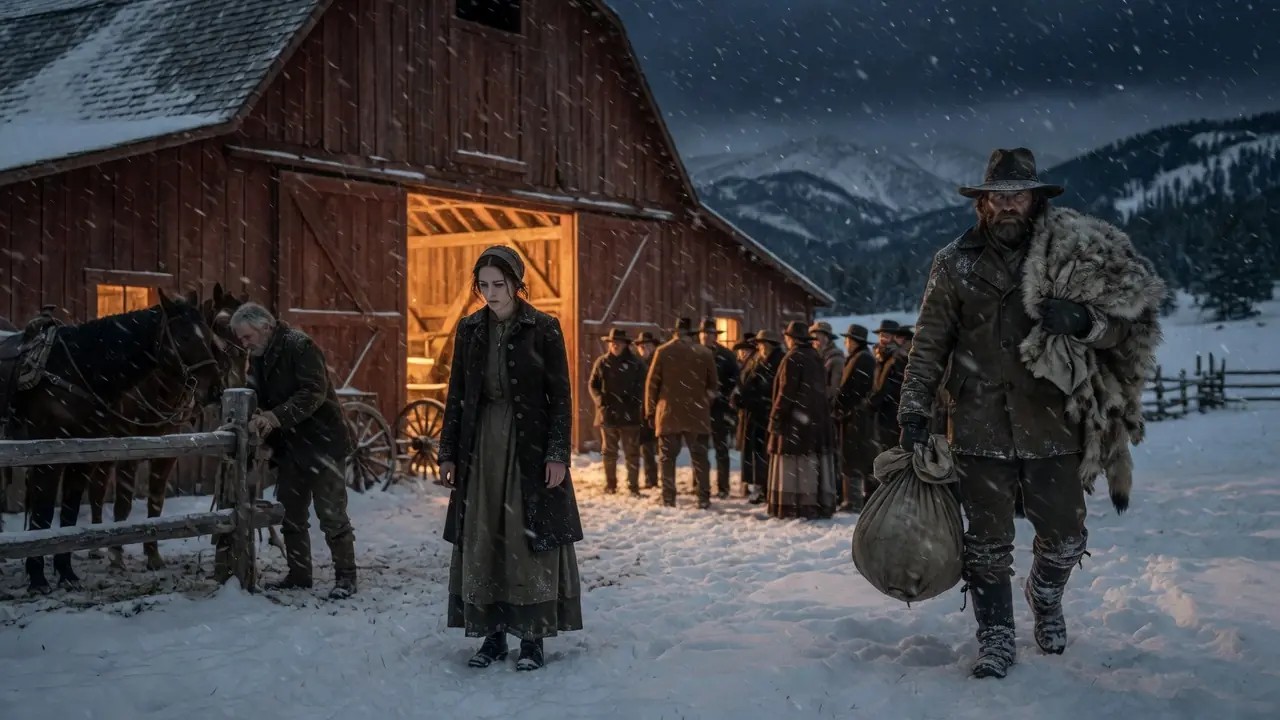
The crowd did not laugh out loud. They were too polite for that. But she could hear it in the silence, in the careful way people avoided her eyes, in the way her own father could not lift his head from his whiskey cup.
Nobody wanted the drunk’s daughter.
Nobody, until the barn doors exploded off their hinges and a man covered in blood and snow walked straight toward her like the mountain itself had sent him.
The cold that settled over Black Hollow in late November was not the kind that merely made you uncomfortable. It was the kind that had opinions about you.
It pressed through the gaps in your walls and found the hollow places in your chest. It reminded you quietly but insistently that it had been here long before you arrived and would be here long after you were gone.
Eleanor Voss had learned to hate that cold the way some women hated unfaithful husbands, personally, specifically, and with a long memory.
She stood at the cracked mirror above the wash basin in the back room of their cabin and tried to make herself presentable for the gathering.
Her dress was clean. She had boiled it twice and pressed it with a flat iron heated on the cook stove, but it was three years old. The fabric had thinned at the elbows, and the hem had been let out so many times it was starting to fray.
Her dark hair, when she pinned it up, looked almost elegant if you did not look too closely. Her eyes were the same dark brown they had always been. Her cheekbones were pronounced in the way that came from not quite eating enough, rather than from fine bone structure.
She looked, she decided, like exactly what she was: a 25-year-old woman who had worked too hard for too long and had very little to show for it.
Behind her, through the thin wall, she could hear her father moving around the main room. The clink of a glass. The scrape of a chair. The particular silence that followed a long swallow.
“Eleanor,” he called, his voice rough. “You about ready?”
“Almost.”
“Don’t take all night. Gathering starts at seven.”
She pressed her lips together and did not answer.
There was nothing useful to say. She could tell him she had been ready for 40 minutes and had been waiting for him to finish the bottle he thought she did not know about. She could tell him she had already heard three women at the dry goods store whispering about whether anyone would offer for her this year, and that the whispers had not been hopeful.
She could tell him a lot of things.
Instead, she picked up her coat, mended at the collar and missing one button, and put it on.
The gathering happened every year in the big barn at the edge of town, the one that belonged to Horus Bellamy, who owned the general store, the feed depot, and roughly half the mortgages in Black Hollow.
On paper, it was a social occasion, a harvest celebration, a chance for the isolated frontier community to come together before the deep winter locked everyone inside for months.
Music, food, cider, neighbors catching up.
In practice, everyone knew what it really was.
It was a marriage market.
The territory was still young enough and wild enough that eligible women were scarce, and winters were brutal enough that men without wives did not survive them well. So every November, before the worst of the cold came down from the mountains, unmarried men and unmarried women were presented to each other in Bellamy’s barn while the community watched and quietly judged.
Matches were made. Arrangements were discussed. Families were formed.
It was practical.
The frontier had no room for romance.
Eleanor understood all of this. She had understood it since she was 17 and watched her older sister Clara get chosen by a wheat farmer from the valley and ride away to a house with solid walls and a husband who did not drink.
She had understood it every year since, standing in this barn or one like it, watching other women get chosen while she stood against the wall with a smile that did not quite reach her eyes.
This was her eighth gathering.
She had never been chosen.
The barn was already full when she and her father arrived. Someone had strung lanterns from the rafters, and they swayed in the drafts, throwing warm yellow light across the faces below.
A fiddle player was working through something fast and cheerful in the corner. The smell of wood smoke, mulled cider, and too many bodies in a closed space pressed against Eleanor’s face when she walked through the door.
Her father peeled away immediately, heading toward the cluster of older men near the cider barrel.
Eleanor watched him go without expression.
“Eleanor Voss.”
She turned.
Margaret Haynes, who ran the seamstress shop, was standing with two other women, all of them wearing their best dresses. All of them watching Eleanor with expressions that were almost kind.
Almost.
“Margaret,” Eleanor said.
“You look well,” Margaret said in the careful tone people used when they meant the opposite. “Cold night for it.”
“It’s always a cold night for it.”
The other women exchanged a small glance.
Eleanor caught it and felt the familiar stone settle into her stomach. Not quite humiliation, not quite anger, something in between that had no clean name.
She excused herself and moved toward the edge of the room.
The gathering had its own choreography, and everyone knew their steps. The eligible women gathered near the center, visible and accessible, doing their best to look appealing without looking desperate. The men circulated, talked, and assessed.
If a man was interested, he approached. If the woman was willing, they talked. If the talking went well, a formal arrangement was discussed with the woman’s father or guardian.
The whole process was supposed to be dignified.
It frequently was not.
Eleanor took up her position near the far wall, not quite in the center of the room, but not hiding either, and waited.
The first hour passed without incident.
Around her, she watched matches begin to form. Young Jenny Marsh was talking animatedly with the new blacksmith, red-cheeked and laughing. The Delqua sisters were surrounded by a small crowd of admirers. Even Martha Potts, who was 42 and had three children and a difficult reputation, was deep in serious conversation with a widowed cattle rancher.
Nobody came to talk to Eleanor.
She drank her cider slowly and watched the fiddle player and told herself she did not care.
His name was Walter Briggs, and he was the first one.
He was a farmer from the South Valley, heavyset and square-jawed, not unpleasant looking. He approached her around eight with his hat in his hands and a prepared sort of expression, the look of a man doing something he had already thought through and decided to do regardless of his personal enthusiasm.
“Miss Voss,” he said.
“Mr. Briggs.”
“You’re Harlan Voss’s girl.”
“I am.”
He nodded slowly, like he was confirming something he had already suspected.
“Your father’s place. The cabin up on Settler’s Road.”
“That’s right.”
“I heard he’s had some trouble with the card games.”
Eleanor held her smile in place with some effort.
“Everyone’s had trouble this winter.”
Briggs nodded again, looking at some point past her left shoulder.
“The thing is,” he said, and his voice had shifted to something apologetic that she already hated, “I’ve got a good operation going. Two hundred acres of wheat, solid cabin, new well dug last spring. I’m looking for someone who can, well, who can bring something to the partnership. You understand?”
Eleanor understood perfectly.
He was telling her that her father’s debts made her a liability. That the cost of marrying her was too high when she came with nothing but a failing cabin and a father who owed money to half the county.
“I understand completely,” she said, keeping her voice even.
“I’m sorry,” Briggs said, and had the grace to look like he meant it slightly.
Then he put his hat back on and walked away.
The second was James Alcott, who ran a small mining claim north of town. He did not even make it through a full conversation. He asked her name, heard it, and his expression shifted into something closed and polite and final. He wished her a good evening and moved on.
The third was a man she did not know, a stranger who had come down from the Northern Territories looking for a wife to help him work a homestead claim. He was perfectly civil. He talked to her for nearly 20 minutes about soil quality and crop yields before he said quietly that he had heard some things about her family situation, and he needed someone who could bring land or resources to the arrangement.
Then he tipped his hat and left.
By the time the fourth man, Thomas Reed, who owned the sawmill, approached and spent approximately three minutes talking to her father across the room before turning away without ever coming over at all, Eleanor had stopped counting.
She stood against the wall and looked at the lantern swinging overhead and breathed carefully.
Do not cry, she told herself. Not here. Not in front of all of them.
She was 25 years old.
In Black Hollow, that was close to old. The other women her age were already married, already mothers, already settled into the life that the frontier demanded you build, or else be left behind by.
She had spent eight years coming to these gatherings and eight years watching other women get chosen. And every year, the leftover feeling got a little heavier and a little harder to set down at the end of the night.
The fifth man was Horus Bellamy’s oldest son, Daniel. He was 20 and spotty-faced, and even he took one look at Eleanor and found somewhere else to be.
She heard someone laugh, low and quickly smothered, from somewhere to her left.
That was what broke something in her.
Not the rejections themselves. She had built up calluses against those. But that small, barely contained sound. Someone finding entertainment in her humiliation. Someone watching her stand here and be passed over again and again, and thinking it was funny.
Eleanor straightened her back, lifted her chin, and walked deliberately across the room toward the punch table.
She was not going to stand against that wall and provide anyone with a show. She would get through the rest of this evening with her dignity intact, or she would die trying.
She had almost reached the table when she heard voices behind her.
Two women speaking in the caring whisper of people who wanted to be heard without technically being overheard.
“Can’t imagine why she keeps coming. Everyone knows no one will.”
“Her father owes money to practically everyone in town. Who’d want to take that on?”
“And she’s not exactly, I mean, she’s not unpleasant looking, but she’s so severe. Never smiles properly. Always staring at things like she’s angry at them.”
“Clara got out at the right time, didn’t she? Before the family…”
Eleanor poured herself more cider with a steady hand.
Her face felt like it was carved from the same cold stone as the mountains outside. She took a long drink and stared at the wall in front of her and told herself that every minute that passed was one minute closer to being able to leave.
That was when the barn doors blew open.
Not opened. Blew open.
The doors slammed back against the barn walls with a sound like a rifle shot, and the cold came through them like a living thing. A wave of winter air made every candle in the room shudder and set the lanterns swinging wildly.
Several women cried out. Men reached for weapons they were not carrying.
In the doorway stood something that Eleanor’s mind took a moment to properly categorize.
He was enormous.
That was the first impression.
The sheer physical scale of him, the way he had to turn slightly sideways to come through the door, even with both panels thrown wide. He was covered in snow from hat brim to boot heel, coated in it like he had walked through the heart of the storm without bothering to seek shelter, which was probably exactly what he had done.
Over his left shoulder he carried a bundle of wolf pelts, gray and silver and dark, three of them at least, each one large enough to cover a man from shoulder to knee.
In his right hand, he held a cloth sack that clinked with a dense metallic sound when he set it on the floor just inside the door.
His face was half hidden under the brim of a battered hat and the shadow of a beard that had grown past the point of intention into the territory of just how it was. His coat was canvas and leather and had been repaired so many times in so many places that the original material was almost incidental.
His boots left large wet prints on Horus Bellamy’s clean barn floor.
He stood in the doorway for a moment, letting his eyes adjust to the lamplight, and the entire room was silent.
Eleanor recognized him before most people did. Not because she knew him personally, but because she had heard the stories. Everyone in Black Hollow had heard the stories.
The mountain man who lived past the timberline, north of where the trails ended. The trapper who came down twice a year to trade and never stayed longer than he had to. The man whose name people said in the same tone they used for bad weather and bear encounters.
Gideon Ror.
He was 30, maybe 32. It was difficult to tell. The mountains did something to a person’s face that had nothing to do with age. They carved it differently, made it harder and more specific.
He had pale eyes, gray or green. It was hard to say in the lamplight. They moved around the room with the calm, deliberate attention of a man who cataloged everything and trusted nothing.
“Ror,” Horus Bellamy said, finding his voice.
He moved forward, his smile the particular shape of a man who had accounts in a ledger he wanted settled.
“We weren’t expecting you until spring.”
“Got down before the worst of it closed the pass,” Ror said.
His voice was lower than Eleanor had expected. Not loud, not performing itself, just a voice that said what it needed to say.
“Brought three grays and 40 pounds of standard pelts, plus this.”
He nudged the cloth sack with his boot. The clinking sound repeated.
Bellamy’s eyes went to the sack.
“What’s in it?”
“Raw silver off the north ridge. About 12 pounds.”
He paused.
“Don’t need to assay. I know what it is.”
The murmur that went through the crowd at the word silver was involuntary and immediate. The sound of people recalculating.
Eleanor watched it move across the room like a wave.
Ror had already stopped looking at Bellamy. His eyes were moving across the crowd in that same systematic way, taking inventory.
Eleanor watched him look at the clusters of eligible women near the center of the room. The Delqua sisters, Jenny Marsh, half a dozen others. She watched something in his expression remain perfectly unmoved, like a man reading a list in a language he did not particularly care about.
Then his gaze reached her and stopped.
Eleanor felt it as a physical thing, the weight of it.
She did not look away. She was not going to do that. Not tonight. Not after everything that had already happened in this barn.
She looked back at him with the same level attention she would have given a strange dog on the road, assessing, not afraid, waiting to see what it would do.
Something shifted in his face. Not a smile, more like the recognition that happened when you saw something unexpected in a familiar place.
He picked up his sack of silver and walked toward her.
He stopped in front of Eleanor with perhaps three feet between them.
This close, she could see that there was something dark on the shoulder of his coat that was not dirt or snow. It took her a moment to identify it as blood. Old blood dried to rust, not fresh.
She filed that away without reacting to it.
“You’re Harlan Voss’s daughter,” he said.
“Eleanor,” she said. “Voss.”
“Ror.”
He did not extend a hand.
He was looking at her the same way he had been looking at her from across the room. Not the way the other men had looked at her tonight. Not evaluating her the way you would evaluate livestock or useful equipment, but something different that she could not quite name.
More like the way you would look at a trail you were thinking about taking, interested in what it could do.
“I know who you are,” she said. “You live past the timberline.”
“North of it,” he said. “Past where the trails end.”
“I’ve heard.”
“What have you heard?”
She considered lying, being diplomatic, giving him something soft.
The night had beaten the politeness out of her.
“That you’re half wild and entirely unfriendly. That you come down twice a year, trade fast, and leave faster. That you haven’t spoken to most people in Black Hollow in years.”
He did not react to any of that, except for something small at the corner of his mouth that might, in different lighting, have been the very beginning of something that wanted to be a smile.
“Mostly accurate.”
“What do you want, Mr. Ror?”
Around them, Eleanor was dimly aware that the barn had gone very quiet. The fiddle had stopped. The conversations had stopped.
Horus Bellamy was standing 15 feet away with his hands clasped in front of him and an expression of intense mercantile attention.
Ror reached into his coat and produced something he set on the table beside her without ceremony, a small leather pouch that made the same dense metallic sound as the larger bag he had carried in.
“I’m looking for a partner,” he said.
Eleanor stared at the pouch, then at him.
“A what?”
“For the winter. The cabin.”
He spoke like a man who had rehearsed this in his head and was delivering it straight, without ornamentation.
“I run the territory alone. I’ve run it alone for six years. That works in summer. Winter…”
He stopped, and she had the sense that this was a sentence he found difficult to finish. Not because he was emotional, but because the admission cost him something.
“Winter is harder. I need someone who can hold the cabin while I work the trap lines. Someone who can do what needs doing without having to be told twice.”
“You need a hired hand,” Eleanor said. “There are men in this town who…”
“I’m not talking about a hired hand.”
There was a flatness to his voice, a lack of patience with being misunderstood.
“I’m talking about a partner. Someone with a stake in it. Someone who stays.”
The word wife hung in the air between them, unspoken, and Eleanor felt the entire barn leaning forward to hear what she would say.
She looked at this man, this enormous, bloodstained, snow-covered, reportedly half-savage man who had just walked into a room full of prettier, younger, better-connected women and come directly to her.
A man who had not looked at her the way the other men had looked at her tonight. A man who had not asked about her father’s debts or her dowry or her prospects. A man who had looked at her like she was something worth looking at.
“Why me?” she said.
It was not quite a question.
He glanced down briefly at her hands. She was holding her cider cup with both of them, and she had never been self-conscious about her hands. They were rough and scarred from years of cutting wood, patching walls, and doing everything around the cabin that her father did not, which was most things.
But she felt suddenly exposed by the gesture, like he had seen something she had not intended to show.
“Your hands,” he said. “You work.”
“Everyone works.”
“Not like that.”
He met her eyes again.
“You’re not afraid of it. The work. You don’t look at it like something that happened to you. You look at it like something you decided.”
Eleanor was quiet for a moment.
It was possibly the most accurate thing anyone had said about her in years. And it came from a stranger in a barn at the worst moment of her year.
She did not quite know what to do with it.
“The mountain is dangerous,” she said.
“Yes.”
“People die up there.”
“Experienced people, yes.”
“I don’t know the first thing about trap lines or surviving above the timberline.”
“I’ll teach you.”
“And if I can’t learn fast enough?”
Something moved in his eyes. Not dismissal, not reassurance, just straightforward honesty.
“Then you’ll have a very hard winter,” he said. “But you’ll have a very hard winter either way.”
Eleanor looked around the barn, at the politely averted eyes, at the small, careful smiles that held pity behind them like a hand behind a back. At her father, who was on his third cider and pretending not to watch. At Daniel Bellamy, who was 20 and spotty-faced and had looked at her like she was not worth the trouble of a conversation.
She looked back at Ror.
“Half,” she said.
He blinked.
For the first time, she saw him do that.
“What?”
“Half of whatever the territory produces. Pelts, silver, whatever else. I’m not going up there as labor. If I’m a partner, I want a partner’s share.”
The barn made a sound. Not a laugh exactly, more like a collective inhale.
Ror looked at her for a long moment. She could see him processing it, testing it against something, making a calculation she could not read.
“Forty percent,” he said.
“Half.”
Another pause. Longer this time.
Then something settled in his expression, a kind of resignation that had an odd quality to it. It looked almost like respect.
“Half,” he agreed.
Eleanor set down her cider cup and picked up the small leather pouch. It was heavier than she had expected, significantly heavier. She put it in her coat pocket.
“When do we leave?”
“Tomorrow morning before light.”
She nodded.
She did not look at the people around her. She did not look for her father. She did not allow herself to feel anything except the cold weight of the silver in her pocket and the knowledge that she was making a decision she could not take back.
“I’ll be ready,” she said.
She spent that night in the cabin doing three things: packing the few items that were worth taking, lying awake in the dark, and trying to talk herself out of what she had agreed to.
She failed.
The truth was, there was not much to pack. A change of clothes. Her mother’s small bone-handled knife that she had kept in the bottom of a tin box for 10 years. A photograph of Clara taken the summer before she married, both of them young and laughing at something off camera. Her sewing kit. A wool blanket that was still good.
Her father found her in the middle of packing around midnight. He stood in the doorway of her room, holding a lamp, and in the light he looked older than his years. His hair had gone silver gray. His face was drawn and pouched from too much drink.
The hands that had once been a carpenter’s hands were now shaky and unreliable.
He had been handsome once. Eleanor remembered it dimly, the way you remember something you learned as a child, in the abstract, without the full texture of the actual thing.
“You’re going then,” he said.
“Yes.”
“With Ror.”
“Yes.”
He was quiet for a moment.
“Eleanor…”
“Don’t.”
She did not say it unkindly. She said it the way you would stop someone from stepping into something bad. Quick and firm and without malice.
“Don’t tell me it’s not safe, because you know what’s not safe is spending another winter in this cabin while the roof gets worse and the wood runs low and your tab at the saloon gets longer. Don’t tell me you need me here, because we both know what that means. And don’t…”
Her voice held. She made sure of it.
“Don’t tell me you’re worried about me, because if you’d been worried about me, you would have done something about it before tonight.”
Her father’s face changed, crumpled slightly, the way a damaged structure settles under its own weight.
He did not argue.
He had no defense for it.
“He’s not a safe man,” her father said finally.
Not arguing. Just saying it.
“I know.”
She closed the lid of her pack.
“I’ve never actually been safe, Papa. I just pretended to be here.”
He did not come in. He stood in the doorway a while longer, and then he went back to his room. The lamp went with him, and Eleanor packed in the dark because she knew every inch of that cabin the way you know a place you have been stuck in for too long.
She was waiting outside at 4:30 in the morning when Ror came down the road with two horses and a loaded pack mule, moving through the dark and the blowing snow like a shadow that had learned to navigate.
He looked at her standing there, pack over her shoulder, coat buttoned to the throat, breath clouding in the cold. He gave a single nod that might have meant good, or might have meant on time, or might have meant this is your last chance to change your mind.
She did not ask which.
She took the reins of the horse he indicated, a broad-chested gray with a calm disposition and cold eyes, and put her foot in the stirrup and hauled herself up.
“How long is the ride?” she asked.
“Three days, if the weather holds.”
She looked north.
The sky above the mountains was the gray black of pre-dawn, heavy with cloud, the peaks invisible. From somewhere up there, barely audible, came the sound of wind moving through rock and ice at speeds that had nothing to do with the still air down here in the valley.
“It won’t hold,” she said.
Ror glanced at the sky, then looked back at her.
“No,” he agreed. “It won’t.”
He turned his horse north, and Eleanor Voss turned hers to follow. Black Hollow fell away behind them in the dark.
She did not look back.
Not because she was not afraid. She was very much afraid, in the specific concrete way of someone who knows what she is walking toward rather than running from.
But because looking back felt like the kind of thing that would cost her something she could not afford to spend.
The cold pressed in immediately. The mountain cold was different in character from the valley cold. More intentional. More specific. It found the gap at her collar and the place on her left wrist where her cuff did not quite reach her glove.
Up ahead, Ror rode like a man who did not feel the cold at all. Back straight, shoulders square, moving with the horse rather than against it.
He had not spoken since they left town.
Eleanor pulled her collar up and followed him into the dark.
Behind her, Black Hollow slept.
Somewhere ahead, beyond the black wall of the mountains, past the timberline where the trails ended and the real world began, a cabin sat in the snow and waited.
The first day broke gray and got grayer.
They rode mostly in silence. Not uncomfortable silence, Eleanor found. Not the silence of two people who had nothing to say to each other, but the silence of people engaged in the same physical task, finding that words would only add weight to it.
The trail climbed steadily through stands of pine that grew taller and more imposing the higher they went, their lower branches buried in snow, their tops swaying in a wind that Eleanor could see but not yet fully feel.
Around midmorning, Ror pulled up beside a frozen stream and let the horses drink from the small area of open water at the edge. Eleanor climbed down, stretched her legs, and looked back down the valley.
Black Hollow was invisible already, buried under the fold of the land. She could see smoke from some of the outlying farms, thin gray lines dissolving into gray sky and nothing else.
“You ever been this far north?” Ror asked.
He was crouched at the stream’s edge, watching the horses.
“No.”
“Anything you want to know before we get above the tree line?”
She thought about it.
There were approximately a thousand things she wanted to know. Most of them about survival. Several of them about him.
She picked the most practical one.
“The wolf attack,” she said. “I saw blood on your coat last night. Old blood.”
He glanced at her sideways and waited.
“Is that going to be a regular thing?” she asked.
Something moved in his face. Not quite amusement.
“Can happen, especially in winter. They come down lower when prey gets scarce.”
He paused.
“I set traps wide. Sometimes they follow the trap line. I’ve only had real trouble twice.”
“And the second time was recently.”
He looked at his coat, at the dark stain on the shoulder, then looked back at the water.
“Three weeks ago,” he said. “Pack of five. I was checking the east line alone.”
“What happened?”
“I killed three, and the other two ran.”
He said it the way he said most things, flat and informational, stripped of drama.
“Took a bite through the coat. Not deep. It’s healed.”
Eleanor looked at the stain and thought about five wolves and one man in the snow and what that moment would have felt like.
She pushed the image away. That was a useful kind of thinking to do when you had time for it. Right now, she did not.
“You’ll need to teach me to shoot,” she said.
He turned to look at her fully.
“Can’t you already?”
“I can use a rifle. I’m not a good shot.”
“How not good?”
“I can hit a stationary target at close range on a good day.”
He absorbed this.
“I’ll teach you,” he said.
Same words as last night in the barn. Same tone. Like a fact he was stating about the future rather than a promise.
They rode until the light started going, then made camp in a hollow between two ridges where a stand of dense spruce broke the worst of the wind.
Ror built a fire with an efficiency that was almost unnerving to watch. Not quick and showy, but deliberate. No wasted movements, every step in its right place.
He had a fire going, a small one, ringed with stone and angled against a rock face to reflect heat, in the time it took Eleanor to unsaddle the horses.
She was surprised to discover she was hungry. The fear and adrenaline of the last 12 hours had burned through her dinner of the night before. When Ror produced a cast iron pot and salt pork and dried beans without commentary and started making food, Eleanor moved to help without being asked.
He let her, which she noted.
The other alternative was to wave her off and do it himself, and that would have told her something specific and uncomfortable about what he actually thought of the partnership he had proposed. He did not wave her off.
He simply made room and handed her the salt without her asking.
They ate without talking much. The fire popped. One of the horses shifted its weight somewhere in the dark behind them. Overhead, the wind moved through the tops of the spruce with a sound like distant water.
“There are rules,” Ror said eventually.
He was looking at the fire.
“Tell me.”
“Never go past the east ridge alone. Not until you know the land. The drop is hidden under snow. Looks like flat ground until it isn’t.”
He paused.
“Never open the cabin door during a whiteout without tying off first. If you lose sight of the cabin in a whiteout, you stay where you are. Don’t walk blind.”
“Okay.”
“Watch the horses. They know the weather better than we do. If they both stop eating, something’s coming.”
“What else?”
He looked at her.
“Don’t try to manage the mountain,” he said. “People die up there trying to beat it. You work with it, not against it, even when it costs you time or feels wrong.”
Eleanor nodded.
She was filing all of it away in the ordered part of her brain, the part that had kept track of leaking roof sections, which stores would extend credit, and which neighbors could be trusted and which could not.
She had spent 25 years managing a difficult situation by paying attention. This was a different situation with higher stakes and colder temperatures.
The principle was the same.
“What about you?” she asked.
He looked back at the fire.
“What about me?”
“Rules about you. Things I should know.”
A pause.
“I don’t make small talk.”
“I noticed.”
“I’ll tell you what you need to know when you need to know it. If I think you’re doing something wrong, I’ll say so. I expect the same.”
“That’s fair.”
“I don’t…”
He stopped. Started again.
“I’ve been alone up there for a long time. I may not…”
Another stop.
Like a man trying to describe a country he had forgotten the language for.
“I’m not easy to be around,” he said finally.
Eleanor looked at the fire.
“Neither am I,” she said. “I’ve been told I’m severe.”
The not-quite smile appeared again at the corner of his mouth.
“Severe?”
“That was the word used tonight at the gathering, yes.”
“By who?”
“Two women who thought they were whispering.”
He was quiet for a moment.
Then he said, “Severe means you don’t pretend. That’s useful up there.”
Eleanor considered that and filed it alongside everything else.
“Good night, Mr. Ror,” she said, pulling her blanket around her and lying down facing the fire.
“Ror,” he said.
“What?”
“Just Ror. Nobody calls me Mr. Anything.”
“Good night, Ror.”
A pause.
“Good night.”
She lay in the dark and listened to the wind and the fire and the distant sound of the mountains adjusting to the cold. The deep, subterranean groaning of rock and ice had no human analog. It reminded you exactly how old and indifferent the world was beneath your tiny human story.
She was terrified.
She was more awake and present and specific than she had felt in years.
She was not sure those were different things.
The second and third days were harder.
The trail climbed into country that had shed any pretense of being hospitable, where the trees thinned and then stopped entirely, and the world became rock and snow and wind from every direction at once.
Eleanor’s horse moved carefully, testing each step, and she let the animal do its work. She focused on staying in the saddle and breathing through the cold that by the second morning had become a presence she had to actively manage.
Keeping her fingers moving. Her toes shifting inside her boots. Her face turned away from the worst of the wind.
Ror watched her without seeming to watch her. She caught him checking her position on the trail, checking her hands on the reins the way you would check the tension of a knot you had tied and were not completely sure of.
She did not find it insulting.
She understood it for what it was.
On the afternoon of the third day, coming over a ridge she had thought was the last one and finding another one behind it, she heard Ror say, “There.”
She looked up.
The cabin sat in a natural hollow about halfway up a north-facing slope, tucked against a rock face that sheltered it from the worst of the west wind. It was larger than she expected, two rooms at least, maybe three.
The logs were heavy and dark with age and weatherproofing. The roof was piled with snow, but clearly solid beneath it. A woodshed ran along the eastern wall, full, she noted with relief, full to the ceiling with split logs.
A small outbuilding, a barn or storehouse, stood 20 feet away, connected to the main cabin by a rope line she recognized immediately as a navigation guide for whiteout conditions.
It was not beautiful. It was not warm-looking or welcoming or any of the things that the word home was supposed to carry.
But it was solid and it was real.
Eleanor Voss, who had spent the last several years in a collapsing cabin watching the walls lean inward, recognized solid and real as the most valuable commodities available.
“It’s good,” she said.
Ror glanced at her.
“Most people say it looks like a prison.”
“Most people don’t know what they’re looking at.”
He turned back to the cabin and did not say anything, but she thought his shoulders shifted slightly. Settled maybe. Like a man who had been holding something a little too tight and had just briefly allowed himself to let go.
They unsettled the horses in the outbuilding, and Ror showed her the water barrel and the feed. Then they carried their packs to the cabin door.
He undid the heavy bar across it and pushed it open. The smell of cold wood and pine rolled over them, along with something else, smoke and leather and the specific animal smell of a place where a solitary person had been living.
Eleanor walked in.
There was a cook stove, a table, two chairs, shelving along every wall loaded with supplies, a narrow bed against the north wall, and another door that probably led to a second room. Skins covered the floor. A lamp stood ready, and Ror lit it immediately.
The glow spread through the space and showed her the proportions of it, how much of his life was here, and how carefully ordered it was. Not neat in the way of someone who cared about appearances, but efficient in the way of someone who knew where everything was in the dark and needed to keep it that way.
She set her pack down on the floor and looked around.
“The second room,” Ror said from behind her, a little gruffly. “That’s yours. I’ll…”
He paused.
“I added a bunk before I came down. Should hold.”
Eleanor turned to look at him.
He was standing in the doorway still, as if he had not quite decided whether to come all the way in, big enough that his head cleared the top frame by only a few inches. He was looking at a point somewhere past her left shoulder with the expression of a man who had made a decision and was now waiting to see the full consequences of it.
“Thank you,” she said.
He nodded, came inside, and closed the door behind him.
The wind pressed against the walls with serious intent, and the logs held, and the lamp burned. Eleanor Voss stood in the middle of her new life and let herself feel for just a moment the full weight of everything she had left behind.
Then she took off her coat, hung it on the peg by the door, and turned to Ror.
“Show me where you keep the firewood for the cook stove,” she said. “Then show me how this thing works, because I have a feeling if I do it wrong, I’ll burn the whole place down.”
He looked at her.
The not-smile was back, and this time it got slightly further along than before.
“The flue,” he said. “It sticks in cold weather. I’ll show you.”
And that was how it started.
Not with speeches or declarations or the kinds of dramatic gestures that stories are usually supposed to have, but with a stuck flue and a cook stove and two people in a mountain cabin at the edge of winter, learning what they had each agreed to.
It would take everything they had.
Both of them knew it.
Neither of them said so.
The flue stuck for three mornings in a row. Each time, Eleanor had to use the iron poker at an angle Ror showed her the first night, not straight up, but canted to the left, catching the lip of the damper that had warped from years of hard freezes.
Each time, it took her two or three tries before it gave.
By the fourth morning, she got it on the first try, and something in her chest settled a fraction, like a debt she had been carrying had been reduced by a small payment.
That was how the mountain worked, she was learning.
It did not give you anything. It made you buy it in small increments with attention and repetition and the willingness to be wrong several times before you were right.
Ror was gone before she woke most mornings. She would hear him sometimes in that half-conscious space before full dark lifted, the particular sound of his boots on the cabin floor, the low scrape of the door bar, the cold that briefly invaded and then got shut out again.
By the time she was dressed and had the fire going, he had been out for two hours already, working the near trap lines while the light was still blue and thin and the animals were still moving.
He came back midmorning usually, sometimes with something, sometimes without. He would drop whatever he had caught on the table outside and come in and pour coffee.
The coffee was the one thing he made without being asked. A strong black brew that Eleanor privately found close to undrinkable, but drank anyway, because in that cold it was heat first and taste second.
He would stand at the window for a few minutes, looking north at the ridge before he said anything at all.
She learned not to talk at him during those minutes.
It was not unfriendliness. It was decompression. The re-entry of a man who had been fully alone with the mountain for hours, coming back to the fact of another person in his space.
She gave him the time, and he used it.
Then he would turn around, and he would be present again, ready to teach her what the morning had produced.
The teaching was relentless.
Not cruel. He did not mock her mistakes or lose patience visibly, but relentless in the way the mountain itself was relentless, in the way the cold did not take days off, and so neither could they.
He showed her how to skin and prepare a rabbit in 15 minutes. She took 40 the first time, and he said nothing. She tried again the next day and took 30, and the day after that, 20.
He showed her the difference between tracks that were hours old and tracks that were minutes old, crouching in the snow and pointing at the compression, the crystal formation at the edge, the way the wind had or had not yet touched the inside of the print.
“You’re not bad at reading sign,” he said one morning after she had correctly identified a fox track crossing a deer trail and estimated it was from the previous evening.
“You say that like you expected me to be worse.”
“I expected you to need more time.”
He stood and brushed snow from his knee.
“You learn fast.”
Coming from him, she was discovering, this was extravagant praise. She accepted it without making a thing of it, which she could tell he appreciated.
The rifle was harder.
Her instinct was wrong. She kept anticipating the shot, flinching before the trigger broke, pulling the barrel down at the critical moment.
Ror stood behind her in the snow while she shot at a plank he had propped against a dead pine 60 yards out. He watched her miss four times without comment.
Then he said, “Stop trying to make it happen.”
She lowered the rifle.
“What does that mean?”
“You’re pushing at the moment. Forcing it.”
He moved around to stand beside her, not touching her, but close enough that she could hear him clearly.
“The shot has to surprise you. Even when you know it’s coming. You set everything right, position, breath, sight, and then you let it happen instead of making it happen.”
Eleanor looked at the plank.
“That’s not very practical advice.”
“It’s the only advice there is.”
She raised the rifle again. He was quiet behind her.
She breathed the way he had shown her. In, let half out, hold.
She looked at the plank, and she stopped trying to do anything, just held steady and waited.
The rifle went off, and the plank jumped.
She had clipped the edge of it, maybe a third of the way from the left side.
“Better,” Ror said.
She shot it again the next day and hit the center. He nodded and turned and walked back toward the cabin.
She stood in the snow with the rifle and felt something that was too tired and complicated to be called satisfaction, but was in the same family.
The cold deepened as November pushed into December.
Eleanor had believed, arriving, that she understood cold. She had lived through Montana winters her whole life, had spent nights in the valley when the temperature dropped to something that made the air hurt.
But the cold above the timberline was categorically different. It was not just temperature. It was weight and intention and persistence.
It came through the cabin walls at night in a way that made the logs breathe and creak. In the mornings, the ice on the inside of the water barrel was sometimes two inches thick and had to be broken with the axe handle before they could use it.
She started getting up earlier, before Ror, to have the fire built up and the water broken before he came through the main room.
She was not sure why she started doing it. It was not that he needed her to. He had managed for six years without anyone doing it.
But doing it felt like the difference between being a passenger and being part of the engine, and she needed to be part of the engine or she would go out of her mind.
He noticed on the third morning she had done it.
He came through the door from outside, already red-faced from the wind, and stopped at the sight of the fire already going and the pot already on.
He looked at it, then at her.
“You don’t have to do that.”
His tone was caught between genuine consideration and the discomfort of someone unaccustomed to being looked after.
“I know I don’t,” she said.
He poured his coffee and stood at the window, and that was the end of that conversation.
But the next morning, she found that he had brought in a full week’s worth of firewood from the shed and stacked it by the door so she did not have to go out in the dark for it.
Neither of them said anything about that either.
That was, Eleanor was realizing, how they communicated the things that were hard to say. Not with words, but with adjustments, small changes in behavior that said, I noticed and I am accounting for you, without the awkward architecture of actually talking about it.
She did not know what to call that.
She filed it away and kept going.
One evening in early December, with the wind loading up outside and both of them sitting at the table after dinner, Ror was working on a piece of harness leather that had torn. Eleanor was sharpening the good knife.
Without looking up from the stitching, he said, “My brother built half this cabin.”
Eleanor held the whetstone still.
She had learned not to respond too quickly to the things he said, because sometimes the important part was coming and she would cut it off by reacting to the first piece.
He pushed the needle through the leather, pulled it through, and set his jaw in the particular way she had come to recognize as a man working against his own habit of silence.
“His name was Thomas. He was two years younger.”
Another stitch.
“He would have been 28 now.”
The past tense. Would have been.
“What happened?” she asked, keeping her voice even.
Ror set the harness down and looked at the window, at the dark and the snow pressing against the glass.
“Land dispute with a man named Crow. Silas Crow, from down in the valley.”
His voice had gone very flat, the way water goes flat before a storm. Still on the surface, everything gathered underneath.
“Crow wanted the North Ridge. Had been trying to buy it for three years. Thomas wouldn’t sell.”
A pause.
“So Crow found another way.”
Eleanor waited.
“He had friends in the territory office. Papers got filed. A claim backdated. Our family had homesteaded here for 15 years, and it didn’t matter. Thomas went to fight it legally. He was down in the valley for three weeks dealing with lawyers and clerks.”
He picked up the harness again, but did not work on it. He just held it.
“He never came back.”
The silence that followed was the specific weight-bearing kind.
“They said it was an accident,” Ror said. “Ice on the road. Horse went down. That’s what the report said.”
He turned the piece of leather over in his hands.
“I’ve never believed it.”
“Crow,” Eleanor said.
“I can’t prove it.”
His voice had a ragged edge that he was controlling tightly.
“I’ve never been able to prove it, and going down there with a rifle instead of evidence would just get me hanged and give him the ridge on top of it.”
He set the harness on the table and looked at his hands.
“So I stay up here and I hold it, and I keep waiting for him to make a move I can answer.”
Eleanor looked at this man across from her.
This man who had seemed, when she first saw him, like someone who had simply chosen solitude, who had walked away from the world because he preferred it that way.
She understood now that it was far more specific than that.
He was not a man who had chosen isolation. He was a man who had been driven to the only ground he could still defend and had been holding it ever since.
“Six years,” she said quietly.
“Six years.”
She thought about that, about what six years of solitary grieving looked like when there was nowhere to put it, no one to put it toward, nothing to do with it except keep working and keep holding and keep waiting.
She thought about how a person gets shaped by that, the way wood gets shaped by the thing it leans against for long enough.
“I’m sorry about your brother,” she said.
She did not dress it up. It did not need dressing.
He nodded once, picked up the harness, and went back to stitching.
Eleanor went back to the knife, and the wind pushed at the walls, and the fire held against it.
That was the night something shifted between them.
Not dramatically. Not in any way that announced itself. But the air in the cabin was different after that, the way air is different after a pressure front has passed through. The same components rearranged.
She started noticing things she had filed away as practical without understanding their full meaning. The fact that he always positioned himself between her and the door when they were outside together. The way he checked the harness on her horse every morning before she mounted, not making a production of it, just running his hand along the straps and checking the buckles with an efficiency that suggested he had been doing it since the first morning, and she had simply not registered it until now.
The extra food. She had thought it was miscounting the first few times she noticed her plate had more on it than seemed right, but it was consistent and calibrated and deliberate.
She thought about saying something about it.
She decided against it.
The mountain had its own language, and she was learning it. One of its central vocabulary items seemed to be, Let people show you things without making them explain it.
The days built on each other.
She got better at the work, and the work got harder in equal measure as the winter deepened. She developed a rhythm for the cabin, what needed doing in what order, which tasks could not wait, and which ones could. The rhythm became hers as much as it was his.
She stopped being afraid of the dark at four in the morning and started being interested in it, in the specific quality of the dark above the timberline, where there was no valley light to dilute it and the stars on clear nights were almost aggressive in their brightness.
She got her first rabbit on a morning in mid-December. She had set the snare herself in a location Ror had approved but not chosen, in the draw behind the woodshed where she had been watching the tracks.
She checked it alone at first light, came back with the rabbit, stood at the table, and skinned it in 17 minutes. She felt a specific pride about it that she was not going to apologize for.
Ror looked at it, then at her.
“Where’d you set the snare?”
“East end of the draw near the deadfall.”
“I thought about setting one there last week. Figured it was too exposed.”
“The run goes under the deadfall. They feel covered even in the open part.”
He considered this.
Then he nodded.
“Put two there next time.”
She did.
Both were full the following morning.
There were hard days. Days when the cold was so complete and so heavy that moving from the cabin to the woodshed felt like swimming against a current. Days when her hands stopped working properly despite the gloves, and she had to press them against the stovetop and wait for the feeling to come back in painful increments.
Days when the isolation was less a quality of the landscape and more an object in the room with her, pressing down.
She missed things she had not expected to miss. Not the life she had left exactly, not the failing cabin and the gatherings and the careful management of her father’s disasters, but the specific texture of other people. The ambient noise of a community. Knowing that somewhere nearby, someone was doing ordinary things.
She did not say this to Ror, but she thought he understood it.
One evening, he came back from the east trap line with a book under his arm, a battered copy of something she did not recognize, and set it on the table beside her plate with no explanation.
She read it over the next week, and they talked about it haltingly at first, like two people discovering their vocabularies overlapped in unexpected places.
That helped.
On a day in the third week of December, checking the west line alone while Ror worked the east, she came over a ridge and startled a pack of three wolves that had found one of the traps.
They were young and lean and hungry, and they did not run when she appeared.
They spread out in the low instinctive formation that meant they were considering their options.
Eleanor’s heart slammed into the top of her chest and stayed there.
She had the rifle. She had it up and cocked before she had consciously decided to do it, some instruction having bypassed the thinking part of her brain and gone directly to her hands.
She stood very still.
The wolves were 40 feet away, maybe less.
The largest one, the gray in the center, the one doing the calculating, held eye contact with her in a way that felt extraordinarily specific and personal.
Stop trying to make it happen, she heard in a voice she had been carrying around in her head for three weeks.
She breathed, let half out, held.
She fired at the snow between her feet and the wolves, not at them. A deliberate miss she had been thinking about for half a second and had decided was the right call. She could hit one maybe, but the other two would be on her before she reloaded.
The sound cracked off the ridge like a physical blow.
All three wolves bolted, clearing the space between her and them in seconds, gone between the trees before the echo finished.
Eleanor lowered the rifle.
Her hands were shaking.
She stood in the snow and let them shake and breathed until they stopped, which took longer than she would have liked.
When she got back to the cabin, Ror was already there.
He looked at her face and said, “What happened?”
She told him specifically, every detail in the right order. He listened without interrupting.
When she finished, he was quiet for a moment.
Then he said, “The warning shot was the right call.”
“I know,” she said.
He looked at her for a moment.
“You’re not going to shake about it forever.”
“I’m not shaking now.”
“You were.”
“I’m not now.”
He turned away, and she thought she heard something that might have been a short exhale that wanted to be a laugh.
It was the closest he had come to one.
Two days before Christmas, though they did not observe it, there was nothing to observe it with, a storm came down from the north that was different in character from everything they had had before.
It was not louder or colder exactly, but it had a quality of duration to it, a sense that it had come a very long way and intended to finish what it had started.
It pressed against the cabin walls with a consistency that made the logs murmur under the strain, and it lasted two full days without a pause.
They were locked inside together for those two days, which was the first extended time they had spent without either of them being able to go outside.
Eleanor learned things about Ror in those 48 hours that six weeks of daily life had only hinted at.
He had nightmares. She heard him once through the wall, a short, sharp sound cut off immediately, the sound of someone who had taught himself to keep it from going further.
He drank coffee constantly.
He had read everything on the shelves at least twice, and some of it many more times than that.
He could be in a room with another person in absolute silence for hours without it seeming to bother him, which was a quality she had never encountered in a man and found unexpectedly like cool water on something that had been chafed for years.
On the second afternoon of the storm, she asked him something she had been holding for a long time.
“At the gathering,” she said. “You walked past all of them. The Delqua sisters were right there. Every man in the room was looking at them.”
He was whittling something at the table, a replacement peg for a harness. He did not look up.
“I know.”
“They’re younger than me. Better connected. Their father owns cattle.”
“I know.”
“So why?”
“I told you why.”
He set down the knife and looked at her with a patience that had the particular quality of a man who had already given an answer he thought was clear enough and was now being asked to repeat it.
“Your hands. The way you were standing. You weren’t performing anything. Everyone else in that room was performing something. Prettiness, or docility, or availability. You were just…”
He paused, seeming to search for it.
“You were just there, like you were done pretending.”
Eleanor looked at her hands. The new calluses layered over the old ones. The split on the side of her right index finger that kept cracking open in the cold. The discoloration on her left palm where she had grabbed a piece of metal too quickly in the frost two weeks ago.
“I was having a terrible night,” she said.
“I know. I could see that too.”
He picked the knife back up.
“You weren’t hiding it well, but you weren’t falling apart either. You were just staying in it.”
He worked the knife along the wood.
“That’s rarer than pretty.”
She did not say anything to that for a long time.
Outside, the storm pressed and groaned, and the cabin held. The lamp on the table threw its circle of light over the two of them, and Eleanor sat with what he had said and turned it over like a stone she had found that might be valuable or might just be a stone.
She was not yet sure which.
She thought about the gathering, about the seven men in the barn full of careful smiles and the sound of someone laughing that she had heard from across the room.
She thought about her father in the doorway with the lamp, saying he was not a safe man, which was true.
He was not a safe man.
He was complicated and damaged and difficult to reach, and the things he was carrying would take a very long time to name, let alone put down.
But she thought about what safety had actually looked like in that collapsing cabin, in those years of careful management and invisible labor and annual humiliation.
She thought it was possible that she had confused safety with familiarity for a very long time.
And that the mountain, brutal and specific and utterly indifferent to her comfort, was giving her something the valley never had.
It was making her real. Particular. Someone whose existence had visible weight.
She was not sure she had been that before.
She did not say any of this to Ror.
She did not need to.
The storm pushed at the walls, and the fire burned. They sat in the same room being the same complicated, imperfect things they were, and that, for tonight, was enough.
The storm that had locked them inside for two days broke on Christmas morning, though neither of them marked it as such.
Eleanor woke to a silence that was different in quality from the howling compression of the previous 48 hours. An open silence, the kind that meant the sky had cleared and the wind had gone somewhere else for a while.
She lay in the narrow bunk in her room and listened to it and felt the particular relief of a pressure that had been applied for a long time suddenly lifting.
Ror was already gone when she came through to the main room. The coffee pot was on the stove, which meant he had not left more than an hour before.
She poured a cup and stood at the window and looked at what the storm had done to the world outside.
Everything had been remade.
The drifts were enormous, six feet in places against the north face of the woodshed, sculpted by the wind into shapes that would have been beautiful if you did not have to move through them.
The sky above was the hard clear blue that only came after a major storm had spent itself, and the light off the snow was so bright it was almost aggressive. The trees at the edge of the hollow bent under their new weight.
The rope line between the cabin and the outbuilding was visible only because it had collected a ridge of snow along its length, a thin white line that marked where safety ended and the open terrain began.
She finished her coffee and got dressed and went to work.
There was always work after a storm. The wood stacked by the door needed replenishing because they had burned heavily for two days. The outbuilding needed to be checked. She had heard something shift in the night that might have been the roof settling under new load.
The horses would need extra feed, and their water bucket would be frozen solid again.
Eleanor moved through all of it methodically, and by the time she finished and came back inside to start on food, the light had shifted from morning blue to the harder white of midday.
Ror had still not come back.
She did not think about it immediately. He worked the trap lines alone most days, and he was often gone until early afternoon.
She made food, ate, cleaned up, and worked on the harness repair she had taken over from him when she discovered she was better at the fine stitching than he was.
His fingers were too large for the smallest needle, something he had admitted once with a flat practicality that had no embarrassment in it, just a man accurately assessing a tool that was not the right size for a particular job.
By two in the afternoon, the light had started its early retreat toward the mountains, and Ror was not back.
Eleanor set down the harness and looked at the window.
He had told her weeks ago that he was never out past midday in winter unless he told her in advance. The short days and the dropping temperatures after afternoon made extended time on the lines dangerous and unproductive.
She had filed that away with all the other things she had filed away, and she was reaching for it now and finding that it mattered more than she had realized.
She went to the window.
The snow outside was undisturbed between the cabin and the tree line. No tracks coming back, which meant he had not returned and gone out again.
She pressed her hand against the glass and looked north toward the ridge where the east trap line ran. She could not see anything because there was nothing to see from here, just the slope and the tree line and the empty white afternoon.
By three, she had made the decision before she consciously knew she had made it.
She was moving before she finished thinking, which was a new thing. She had always been a deliberate person, a person who thought a thing through before acting, and this bypassing of that process was its own kind of information.
She dressed for the worst of the cold.
Every layer. Gloves over liner gloves. The heavy wool scarf. The bear grease on her exposed skin that Ror had taught her was not optional beyond a certain temperature.
She checked the rifle. Full.
She took the extra cartridges and put them in her coat pocket where they would not freeze against her body.
She took the lantern from the hook by the door, checked the oil level, and lit it.
She knew the east trap line. She had walked it with him four times and alone twice. She knew the landmarks in the order they came. The split pine at the trailhead, then the frozen creek crossing, then the long traverse across the upper slope, then the draw where the line turned north toward the ravine.
She did not allow herself to think about what she might find.
She tied off to the rope line and made it to the outbuilding, then let go and oriented herself north by the ridgeline and walked.
The cold hit her immediately with the specific meanness it reserved for the open terrain above the hollow. It came from multiple directions at once, finding every gap with the efficiency of something that had been doing this for a very long time.
She kept moving.
The lantern threw a small sphere of yellow light around her feet that was less useful than she had hoped in the remaining daylight, but would matter more when that light finished going.
The split pine was where it was supposed to be. She crossed the frozen creek, solid, deep enough that it did not flex under her, and climbed to the upper slope and followed the line of the terrain north.
The snow up here was pristine and undisturbed except for the track of small animals. After another 10 minutes of walking, she saw the large, deliberate prints of a man, prints she recognized by their stride length and depth as Ror’s.
She followed the prints.
They went north along the upper slope, steady and even, and then they changed.
The change was abrupt enough that she stopped when she reached it.
The stride shortened. The prints became less regular, one deeper on the right side than the left.
Then she saw the other prints. Not human, overlapping with his.
The wide pad mark of a large wolf.
Then another.
And another.
“No,” she said out loud to nobody.
Then she moved faster.
The trail dropped into the draw, and she followed it, the lantern swinging, the shadows jumping, her breath loud in her own ears.
She was not running. She could not run in this snow. But she was moving as fast as the terrain would allow, and her mind was doing the calculation it kept trying to avoid, measuring the time he had been out against the temperature and what a serious wound meant in those conditions.
She found him two-thirds of the way down the draw, in the shadow of the east ravine wall.
He was on his side in the snow.
Not buried. He had managed to pull himself partially under the overhang of a rock shelf, some survival instinct working even through whatever had happened to him.
His coat was torn across the left shoulder and upper arm. Torn not in a cut, but in the jagged way of teeth. Dark stains marked the snow around him, and more covered the coat. Some of it was old and some of it was not.
Eleanor was on her knees beside him before she had finished registering all of this.
“Ror.”
She put her hand on his face.
His skin was cold. Deeply cold. But not the cold of a man already gone. More like the cold of a man who had been lying in the snow for too long and was still in there somewhere fighting it.
“Ror, open your eyes.”
His eyes opened slowly, and not all the way, but they opened. They were glassy and not fully tracking, but they found her face after a moment.
“Go back,” he said.
His voice was wrong. Low and rough and imprecise in a way she had never heard from him.
“Storm’s coming back.”
“You need to stop talking,” she said.
“Eleanor…”
“I said stop.”
She was already moving, assessing the damage with her hands and eyes.
The shoulder was the worst of it, deep through the coat and the layers beneath. She could not see how deep, and she was not going to be able to evaluate it here.
His right leg had a separate wound lower down above the knee. Less severe, she thought, but she was not sure.
He was conscious, but only approximately, the kind of consciousness that came and went on its own schedule.
She looked at the terrain, the draw, the slope, the distance back to the cabin. She looked at him.
Two hundred pounds of man, minimum, probably more.
She looked at the sky, which was beginning to do the things she had learned to read as a warning. The specific purple gray quality of air getting ready to do something serious.
She looked around the draw.
The remains of a sled were 20 feet away. One of the small freight sleds he used to haul heavy catches back from the far lines. One runner was broken, but one was intact, and the platform was still solid.
She went to it and dragged it back.
It was heavier than she expected. Her arms screamed about it, and she kept moving.
“This is going to hurt,” she told him.
“I know,” he said, which meant he was tracking well enough to understand what she was doing, which was the best information she had received in the last 20 minutes.
Getting him onto the sled took everything she had, and then some things she did not know she had.
He tried to help, and his attempts to help were more hindrance than assistance because he could not control his left arm properly. Twice, she had to stop and breathe and reset before trying again.
But she got him on it, on his back, and she looped the rope across his chest and under his arm so he would not slide off when the terrain tilted.
She took the rope and pulled.
The sled did not want to move.
The broken runner caught and skipped on the uneven snow, and his weight was wrong for the balance of it. The draw ran slightly uphill toward the cabin direction, which was the kind of detail that seemed minor until you were the one doing the pulling.
She put the rope over her shoulder and leaned into it the way she had seen workhorses lean into heavy loads, putting her whole body weight against the resistance rather than trying to muscle it with her arms.
The sled moved.
It moved six inches.
Then another six.
Then it found a groove in the snow where a previous passage had compressed the surface, and it moved a full foot.
Then she was walking slowly, one step and then the next, with the rope over her shoulder and the lantern in her other hand and the dark coming down.
She did not think about the distance.
She had learned that from the mountain.
You do not think about how far the end is. You think about the next step and then the one after that. You break the impossible thing into the smallest possible unit, and you do that unit, then you do the next one.
Ror said her name once about 20 minutes in.
“I’m here,” she said without stopping.
He did not say anything else for a while, and she was grateful for that because she needed all of her attention for the ground under her feet, the rope over her shoulder, and the reading of the terrain by lantern light, which was its own particular skill set she had not had occasion to develop until right now.
The wolves found them on the upper slope.
She heard them before she saw them. Not howling, which was the theatrical version, but the soft, purposeful sound of animals moving through snow, which was worse.
She stopped and turned and raised the lantern.
They were there, two of them, at the edge of the light. She had the very specific thought that these might be two of the three she had warned off three weeks ago, come back with a different calculation now that there was blood in the air.
She set the lantern down in the snow. She unslung the rope from her shoulder.
Her hands were not steady. She acknowledged that without shame, cataloged it, accounted for it.
She brought the rifle up, put the sight on the larger of the two wolves, and breathed.
Let half out.
Hold.
She did not try to make it happen.
The rifle went off, and the wolf dropped.
The second one ran.
Eleanor stood in the dark and listened for more of them, and heard nothing except the wind starting again from the north, which meant she needed to move.
She slung the rope back over her shoulder and pulled.
She could not tell you afterward how long it took or how many times she stopped.
Her memory of it was nonsequential, a series of images with the connective tissue removed.
The lantern light on the snow. The rope burning through the shoulders of her coat. The sound of Ror’s breathing, which she listened for at every stop to confirm it was still happening. The wind coming up and the cold coming with it, finding the sweat on her back and doing what cold did with sweat.
The moment when she could not feel her hands anymore and had to check by looking at them to confirm they were still holding the rope.
The rope line.
She almost walked past it in the dark. It was only the faint white ridge of accumulated snow on the rope itself, caught by the edge of the lantern light, that stopped her.
She grabbed it with both hands and followed it to the outbuilding, then to the cabin door. She got the bar up somehow. She did not quite know how. Then she got the door open and got him inside.
She could not lift him off the sled. Her arms had nothing left in them for lifting.
She got blankets from the bed and piled them on the floor, then cut the rope she had tied across his chest. She cut it because she could not feel her fingers well enough to untie it.
Then she rolled him off the sled and onto the blankets, which was not gentle, and she could not help that.
She got the fire going.
The cold in her hands as they came back was one of the worst physical experiences of her life. The returning circulation felt like being taken apart and put back together with the pieces in slightly wrong positions.
She clenched and unclenched her fists and breathed through her nose and kept working.
She got his coat off him.
The wound was worse than she had been able to assess in the dark outside. Deep across the shoulder and down the upper arm, the kind of damage a large animal does when it means to bring something down.
It was still bleeding slowly but consistently, the blood dark and thick.
She had watched Ror clean and treat two wounds since they had been on the ridge, once on a deep cut from a trap mechanism and once on frostbite damage on his left heel. She had watched carefully because she understood that this knowledge was not academic up here.
She went to the shelf where the medical supplies were. Carbolic. Needle and thread. Clean cloth.
She brought them back and knelt beside him on the floor.
“This is going to be worse than getting on the sled,” she said.
“I know.”
He was more present now, the warmth of the cabin working on him, or the adrenaline of being moved, or both. He was looking at the ceiling with the focused expression of a man applying everything he had to staying still and conscious.
“You can tell me if I’m doing something wrong,” she said.
“I will.”
A pause.
“You’re going to have to pull the edges together before you stitch. It’ll bleed more for a minute. I know you’ve never done this.”
“I’ve sewn up worse on coat leather.”
She poured the carbolic, and he made a sound he immediately contained. Jaw tight. Hands flat on the floor.
She worked fast, but not carelessly.
The stitching was not elegant. She did not have the angle or the training for elegant, but it was tight and it was even, and when she tied it off, she knew it would hold.
She worked for over an hour.
When she finished, her back ached from kneeling, and her hands were shaking again, not from cold this time, but from sustained effort and the particular depletion that comes from concentrating hard on something that matters very much for a long time without stopping.
She sat back on the floor beside him and looked at what she had done.
Not clean. Not the work of someone who knew what they were doing in any trained sense.
But closed.
Held.
The bleeding had stopped.
Ror turned his head and looked at her.
His face had the gray quality of a man who had lost blood and was running low on everything, but his eyes were clear and fully tracking.
“You came out in that,” he said.
Not a question.
“You didn’t come back,” she said.
He was quiet for a moment, looking at her with an expression she had not seen on him before.
Not gratitude exactly, which would have been too clean for what it was. Something more complicated than that. Something that had confusion in it and something else beneath the confusion. A thing that did not quite have a name.
“I told you to leave me,” he said.
“I know you did.”
“I meant it.”
“I know you did.”
She pushed herself to her feet slowly because her legs had their own objections to make.
“I ignored it.”
He watched her move to the stove to check the fire. She could feel him watching, and she let him because there was nothing to hide from at this point, and she was too tired to try anyway.
“The wolves,” he said.
“Two of them. I got one. The other ran.”
A pause.
“With the sled?”
“There wasn’t another option.”
“How far?”
“The full draw. Most of the upper slope.”
She turned to face him.
“It took a while.”
He looked at her for a long moment. At her hands, which she could see herself were bruised at the rope line across the palms, red-dark marks that would be worse tomorrow. At her face, which she imagined looked something like what the inside of her felt like, worn down to the structural components, nothing decorative left.
“Eleanor,” he said.
She waited, but he stopped there on her name, like a man who had started a sentence and found that the sentence he planned was not adequate for what he meant.
Rather than use the wrong words, he chose silence, which was, she had learned, the most honest thing he did.
She pulled a chair close to where he lay and sat in it because her legs were done and the floor was cold.
Outside, the wind was back in force, pushing at the cabin with the renewed determination of something that had rested briefly and was ready to try again.
The fire held against it.
The walls held.
He slept eventually in the fitful way of someone in pain who was too exhausted to fight sleep any longer. Eleanor sat in the chair beside him and watched the fire and let herself be still for the first time in hours.
She thought about the draw in the dark, about the rope over her shoulder and the broken sled and the wolf at the edge of the lantern light.
She tried to find somewhere in the catalog of tonight the moment when she could have made a different choice. Gone back to the cabin. Waited him out. Told herself he was a man who knew the mountain and could handle whatever the mountain gave him.
She could not find it.
Not because the alternative had not been available, but because something in her had already decided before she consciously knew it that this was not acceptable.
That this man, infuriating and difficult and damaged and specific and genuinely interesting in a way she had not expected, was not someone she was willing to leave in the snow.
That was the thing that sat with her as the fire burned low and the wind pushed at the walls and Ror’s breathing steadied toward something more like sleep.
Not that she had done something extraordinary tonight. She had done what needed doing with the tools she had, which was the only definition of extraordinary that had ever meant anything to her.
But that she had wanted to.
That the decision had come from somewhere below calculation, below strategy, below even the partnership and the half share and all the practical scaffolding of the arrangement they had made in Bellamy’s barn.
She had wanted to because somewhere in the last seven weeks of mornings and fires and rifle shots and wrong stitches and wolves and snowstorms and stories told in the dark, she had stopped being a woman who was simply surviving here.
She had become someone who belonged here.
Ror shifted in his sleep, and she leaned forward and straightened the blanket without thinking about it.
He stilled, and she settled back into the chair.
Outside, the mountain turned in its cold and indifferent night.
Inside the cabin on the ridge, the lamp kept burning.
He healed slowly, which frustrated him in a way he could not fully conceal and did not try very hard to.
The first three days after the wolf attack, Ror slept more than Eleanor had ever seen a person sleep. Deep, heavy unconsciousness that she recognized as the body doing the accounting after a significant withdrawal from its reserves.
She checked his stitches twice a day and kept the wound clean. She managed the fever that came on the second night with cold compresses and the particular focused attention of someone who understood that this was the thing that would kill him if anything did.
Not the wound itself, but the infection that could follow it.
The fever broke on the third morning.
She knew it before she checked on him because the quality of the silence from his room changed from the tight, effortful quiet of a man fighting something to the looser quiet of a man simply sleeping.
She stood in his doorway and looked at him and felt something in her chest unclench that had been clenched for three days.
He was sitting up by the fourth day, which was too soon, and she told him so.
“The near trap line needs checking,” he said.
He was at the edge of the bunk with his feet on the floor, testing whether the room would cooperate. His face was the color of old ash.
“I checked it yesterday,” she said. “Two rabbits and a fox. They’re in the shed.”
He looked at her.
“You went to the east draw?”
“The near line, not the draw. I know the difference. The snow was bad yesterday morning.”
“I know. I was in it.”
She set a cup of coffee on the shelf beside him, within reach, but did not hand it to him because she had learned he did not like things handed to him during the brief windows when he could not fully refuse them.
“Drink that, and don’t try to stand up yet. The shoulder’s closed, but the leg isn’t finished. If you tear it open, I’ll be annoyed.”
He looked at her with the expression he got sometimes when she said something that landed differently than he expected. A recalibration, visible for just a second before he settled it back into neutral.
He picked up the coffee.
“You set two snares in the deadfall?” he asked.
“Three. The middle run had fresh sign.”
“Were they full?”
“Two of three.”
She turned back to the main room.
“Drink your coffee, Ror.”
She heard something behind her that she was fairly certain was the quietest possible version of a laugh.
He was on his feet the day after that, which was still too soon, but was at least negotiable.
She got him to agree to the main room only, no outside, by the straightforward argument that if he reopened the leg wound in the cold, she would be stitching it again, and they both knew how she felt about the stitching.
He sat at the table and worked on equipment repair for hours at a stretch, the kind of close work she had originally thought his hands were too large for. Watching him, she realized that the clumsiness with the small needle had been a function of hurry, not an actual limitation.
When he took his time, his hands were precise.
On the sixth day, he went outside.
She watched him from the window. He walked to the woodshed and back, steady but careful on the leg, and she could see him taking inventory of the state of things, the wood levels, the horse situation, the condition of the rope line after the last storm.
He came back inside without her having to call him in, stood at the stove, poured coffee, and said, “You moved the snares on the west run.”
“The creek shifted under the ice. The old locations were wrong.”
“Where’d you put them?”
She told him.
He thought about it and nodded.
“That’s better than where I had them.”
She did not make anything of that, but she kept it.
The recovery period had a quality she had not anticipated. Forced proximity, both of them in the cabin for most of the day. The usual escape valve of the trap lines temporarily unavailable.
They talked more than they had before. Not constantly, not in the effortful way of people trying to fill silence, but in the way that happens when two people have stopped performing normalcy for each other and have arrived somewhere more honest.
He told her about Thomas, more than he had said the first time. Not the facts, which she already had, but the texture of it.
What his brother had been like. How Thomas had been the one who could talk to people, who could negotiate and charm and navigate the social machinery of the territory that Ror had never had the patience for.
How the family operation had functioned as a unit, where each of them did the part they were suited for. How losing Thomas had collapsed not just the personal grief, but the functional structure of the entire enterprise.
“He would have liked you,” Ror said once, not looking at her, working a piece of leather. “He liked people who said what they thought.”
“Most people don’t actually like that,” Eleanor said.
“He wasn’t most people.”
She thought about that, about the brother she had never met who had built half this cabin and had not come back from the valley.
And about the man sitting across from her who had reorganized his entire existence around the hole that left.
“Tell me about Crow,” she said.
The leather work slowed slightly.
“What about him?”
“Everything. If he’s connected to Thomas’s death and he wants the ridge, I need to know what I’m dealing with.”
Ror set down the leather. He looked at the fire for a moment, the long assessing look of someone deciding how much to say.
Then he said, “Silas Crow is 60 years old, and he’s been building his operation in the South Valley for 30 years. He owns the freight company, two ranches, and the contract for timber supply to the new rail line that’s coming through in three years.”
“The rail line,” Eleanor said.
“The silver deposits under the North Ridge would be extremely valuable to a man who already owns the freight operation to move it.”
Eleanor sat with that for a moment.
“So it was never just land.”
“It was never just land.”
“What kind of man is he personally?”
Ror’s jaw tightened slightly.
“The kind who buys what he can and eliminates what he can’t buy, and keeps his hands clean while other people do the eliminating.”
He paused.
“He has four men who work for him permanently. Not ranch hands, not laborers. Hired guns. That’s the polite version.”
Eleanor thought about this carefully. About the geography of the situation, the ridge, the silver, the man in the valley with the freight contract and 30 years of patient accumulation, and the man sitting across from her who had been holding this ground alone for six years, and whose brother had died for it.
“He’ll hear about the wolves,” she said.
Ror looked at her.
“Word travels. Someone in town will know you were hurt. That kind of information gets around.”
She met his eyes.
“When it reaches Crow, he’ll see it as a window.”
The silence that followed had a different quality from his usual silences. More active. The quality of a man processing something he had already known and was now hearing said plainly by someone else.
“How long since he’s made a move?” she asked.
“Two years. Small things. Someone checking the approaches. A rider I didn’t recognize on the south trail. Nothing I could answer.”
He paused.
“He’s been waiting for me to be weak.”
“Well,” Eleanor said quietly, “now he thinks you are.”
That conversation happened on the ninth day of Ror’s recovery.
On the 14th day, she found the tracks.
She had gone south along the tree line, checking a series of snares she had set in the hollow below the ridge, and she found them.
Horse tracks. Three sets. Recent enough that the edges were still crisp, moving along the tree line from south to north in a line that was not a hunting line and not a trapping line.
It was a reconnaissance line, the kind of path a man makes when he is learning the terrain.
She did not touch the tracks. She studied them carefully, fixing the details in her memory. The size of the hooves. The spacing. The way one horse had a slight asymmetry in its right front gait. The depth of the impression suggesting the riders were carrying weight.
Three men, armed, probably moving slowly, checking the ground.
She went back to the cabin and told Ror exactly what she had found in the exact order she had found it.
He listened without interrupting.
When she finished, he was very still for a moment. The particular stillness of a man receiving information he had been expecting for a long time and finding that the arrival of it did not make it easier.
“South approach,” he said. “Along the tree line, moving north.”
“They’re checking the trail to the cabin.”
“Yes.”
She paused.
“How many ways up?”
He looked at her.
“What?”
“How many approach routes to the cabin? The main trail from the south. What else?”
He thought for a moment, and she could see him shifting from personal reaction to tactical assessment, which was the shift she needed from him right now.
“The south trail is the obvious one. There’s the west ridge route, but it’s exposed and difficult in this snow. Experienced mountain men only. The east draw, the one where the wolves…”
“I know the east draw. That’s three.”
“The north face is impassable in winter.”
He looked at the window, thinking.
“If they’re coming in force, it’ll be the south trail. Wide enough for horses in line, narrow enough that you can’t ride four abreast in the tighter sections.”
Eleanor got up and went to the window and looked south toward the tree line.
The tracks were invisible from here, but she knew where they were. She thought about the terrain she had been walking for two months. The deadfalls, the ravines, the narrow sections of trail where the ridge walls came close on both sides.
She thought about all the things the mountain had been teaching her, and about what that knowledge was actually worth, not abstractly, but specifically in the context of men with rifles coming up from the south.
“Show me the map,” she said.
He kept a map, hand-drawn, remarkably detailed for something made without instruments. Distances estimated by step count, elevations marked by comparative notation, every significant terrain feature labeled in his cramped handwriting.
She had looked at it before, but now she spread it on the table and looked at it differently.
Ror sat across from her, and they went through it together, point by point, for two hours.
She started setting traps the next day.
Not snares. Deadfalls.
The mountain variety, the kind Ror had shown her in the first weeks as a way of managing the larger predator problems. Heavy log arrangements triggered by a pressure plate that would drop significant weight on anything that activated them.
She spent three days on it, working alone while Ror was still limited in his mobility, moving through the south approach corridor and making adjustments to the terrain that would not be obvious until they mattered.
“The narrow section at the first switchback,” she told him each evening, going through what she had done.
He listened and sometimes said, “Move it six feet north,” or, “The trigger needs to be higher or a horse will set it off early.”
She filed the corrections and went back the next morning and adjusted.
She collapsed the east approach separately. There was a section of the east draw where the trail ran between two unstable snow shelves that Ror had always walked carefully under.
She did not destroy it. Destroying it would be obvious and would signal that they knew someone was coming. She undermined it, clearing the anchoring brush from the lower shelf so that significant weight on the trail below would bring it down.
She left it looking untouched.
“The west ridge route,” she said on the fourth evening.
“I told you it’s nearly impassable in winter.”
“Nearly.”
He looked at her.
“What are you thinking?”
“If they send someone experienced up the west route to flank while the main group comes south, they’ll expect it to be clear. They won’t expect anyone to have been up there.”
She paused.
“I set three deadfalls on the critical section and knocked snow off the upper ledge face onto the trail, then packed it back. It looks solid. It isn’t.”
He was quiet for a moment.
“When did you do that?”
“Yesterday morning.”
“That section is…”
He stopped.
“That takes four hours to reach in good conditions.”
“Five and a half in current snow.”
She held his gaze.
“I left at four. I was back by noon.”
He looked at her for a long time without saying anything. She could see him doing the same thing he had done since the first morning in the cabin, revising something. Some assessment he had made and kept having to update because the original version kept turning out to be insufficient.
“You should have told me before you went,” he said.
“You’d have tried to come with me.”
“Yes.”
“You’re not ready for five hours in deep snow on that terrain.”
“Eleanor.”
“I know the section. I know the deadfall placements. I was careful.”
She kept her voice even.
“I wasn’t reckless.”
A long pause.
“No,” he said. “You’re not reckless.”
He said it like it was something he had confirmed rather than something he was deciding. A quality he had already cataloged and was now citing from his records.
The men came on a Tuesday.
She knew it was Tuesday because she had been keeping track, marking the days on the inside of the woodshed door in the simple notation Ror used. When she looked at her marks that morning before dawn, she thought about it and found it briefly, absurdly funny that violence was apparently scheduled for Tuesday.
She heard the horses on the south trail at midmorning.
Not the horses themselves. The distance was too great for that. But the disturbance their passage made, the way the birds at the tree line went quiet, and then the silence spread uphill like a wave.
She had been watching for it.
She went inside.
“South approach,” she said.
Ror was already at the window.
He had been at the window off and on for three days. His shoulder was still not right. The range of motion on his left arm was limited, and she had watched him quietly testing it each morning with a grimness that said he knew it and was calculating what it meant for what was coming.
He could shoot. The shoulder did not affect his trigger hand, but he was slower than he should have been, less able to manage fast repositioning. They both knew it, and neither of them said it directly.
“How many?” he said.
“I can’t see yet.”
Soon, they came into view at the south tree line 20 minutes later.
Five horses. Four men. One horse was the pack animal, loaded heavy, which told her they had planned to stay, which told her what kind of visit this was.
The man in front was not anyone she recognized. Behind him, she could make out three others. One of them, even at this distance, had a quality of stillness and deliberateness that suggested he was accustomed to being the most important person in any given situation.
“That’s Crow,” Ror said very quietly from beside her.
She looked.
Sixty years old, Ror had said.
From here, she could see a man of medium height, compact, wearing a good coat and a hat that had not been through what frontier hats usually went through, which meant it was new or he had brought it for the occasion.
There was something almost administrative about him, she thought. The way he sat his horse and looked at the cabin like a man reviewing a property he had already decided to acquire.
“He brought four men,” she said.
“Yes. With the pack horse, they planned to move things out today.”
She felt something cold settle into her stomach that had nothing to do with the temperature.
“He thinks this is already done.”
Ror said nothing.
His face had gone very still, a specific kind of stillness she had only seen from him twice before, and both times it had preceded something she did not want to be near.
But she was beside him, and she was staying there.
“Wait,” she said.
“Eleanor…”
“Wait.”
She kept her voice low and level.
“They don’t know what I’ve done to the approaches. If they come straight up the south trail, the first deadfall triggers at the switchback before they can see the cabin clearing. Let them come to us.”
He looked at her, at her face, at her hands on the rifle, at whatever he read in the rest of it.
“How confident are you in the trigger mechanism?” he said.
Not, Are you sure? Which would have been the wrong question.
The right question.
“Very,” she said. “I tested weight on it twice.”
He nodded.
“Once we split. The south window and the door. It gives you the better angle on the clearing approach. Window’s mine.”
“Your shoulder.”
“Window’s mine,” he said again, and the flatness of it told her the conversation was finished.
They moved into position.
She was behind the door, which she had left open three inches on the latch. Enough to see through and more than enough to shoot through.
He was at the south window, crouched, his rifle across the sill.
The four men came up the south trail in single file, horses moving carefully in the snow. Eleanor watched them come and breathed slowly and waited.
The lead man reached the first switchback, and she heard clearly, even from this distance, the crack of the trigger mechanism.
Then the heavy percussive crash of the deadfall releasing, 300 pounds of log dropping onto the trail from the shelf above.
The lead horse screamed and reared. The man on it went into the snow. The next two horses scattered backward down the trail in the instinctive panic of prey animals encountering falling things.
Crow’s horse held. The man had a good horse and good control, but it danced sideways, and Crow himself had both hands on the reins and was not, for the moment, doing anything else.
“Now,” Ror said.
He put his rifle through the window, and Eleanor opened the door.
She did not shoot at the men. She shot at the snow shelf above the switchback, the one she had identified a week ago as the secondary mechanism, the shelf that had been loaded for weeks with accumulated weight and needed only a significant impact nearby to begin moving.
The rifle shot hit two feet below its crest, and the shelf let go in a slow, massive exhalation. Not an avalanche, but a slide, heavy and deliberate, pushing down across the trail below the switchback and stopping it as completely as a closed gate.
They were cut off from the cabin.
Between the deadfall and the slide, the south trail was impassable for horses.
One of the men on foot, the one who had been dumped by the horse, pulled his rifle and fired toward the cabin. A panicked shot went high and left and hit nothing.
Eleanor heard Ror’s rifle answer from the window, and the man’s hat came off, and he threw himself behind a tree.
“Crow!” Ror called from the window.
His voice had changed. Not louder, but stripped of everything except the essential thing underneath it.
“Silas Crow.”
A silence from below.
Then Crow’s voice came up through the cold air with the forced evenness of a man managing his situation.
“Ror, I heard you’d had some trouble. Came to discuss the property question.”
“The property question is settled,” Ror said. “Has been for 15 years.”
“The territory office has some concerns about the documentation. I’m just here to…”
“You’re here because you thought I was hurt enough to take.”
A pause.
“I’m not.”
Eleanor watched the three men below who were still functional. The fourth was behind his tree and staying there. The others regrouped slowly, reading their situation.
The trail was blocked. They could not bring the horses up. The two rifle positions from the cabin had the clearing covered.
She watched them look at each other and watched the calculation moving across their faces, the arithmetic of what they had walked into versus what they had expected to walk into.
The man on Crow’s left, one of the permanent men, she thought, the ones who were not ranch hands, started moving to the east, toward the draw.
She had been watching for this.
“The east draw is not a better option,” she called down, clearly enough to be heard.
The man stopped, looked toward the cabin, locating her voice, then looked at the draw and back at Crow.
“Who is that?” Crow said.
For the first time, his voice had something in it that was not controlled. Not quite surprise, not quite unease, but a crack in the administrative certainty that had been in his voice a minute ago.
“That’s my partner,” Ror said.
The word landed in the cold air and sat there.
Eleanor watched Crow absorb it. Watched him recalculate whatever he had been told about the situation on the ridge. The injured trapper. The vulnerable cabin. The straightforward acquisition of a position he had been patient about for years.
She watched the calculation fail to produce the result he had brought it here to produce.
“We can discuss this like…”
Crow started.
“There’s nothing to discuss,” Eleanor said.
Her voice was steady. She was surprised to find how steady it was, but she had stopped being surprised by herself at some point in the last few weeks and had simply started taking it as information.
“You have one passable trail out, and it goes south, and it’s still open because I left it open. That changes if you’re not moving in five minutes.”
A long silence from below.
“There are four of us,” Crow said.
“I know,” Eleanor said. “I set the deadfall for five.”
Another silence, this one longer.
She watched the man on Crow’s left look at the east draw again. She watched him decide, based on whatever he saw in her voice, or in the blocked trail, or in the specific texture of how badly this had already gone, that the draw was not worth testing.
She watched him say something quietly to Crow that she could not hear.
Crow sat on his horse and looked at the cabin for a long moment. She could not see his face clearly at this distance, but she could see the posture of a man recalculating a plan he had been building for a long time and arriving at the conclusion that today was not the day it resolved.
He turned his horse.
They went back down the south trail around the slide the way they had come, single file. Eleanor watched them until they disappeared into the trees, and the sound of the horses faded, and the south trail was empty.
She held her position for another 10 minutes, watching.
Then she came out from behind the door and stood in the center of the cabin and let out a breath that seemed to have been stored in her chest for approximately the last two hours.
Ror came away from the window.
He was moving carefully. The activity had cost his shoulder something. She could see it in the tightness around his jaw, but he was upright and functional and looking at her with an expression she did not have a name for.
“The east draw line,” he said. “You told him it was blocked?”
“Yes.”
“Is it the undercut shelf?”
“Yes.”
“I said it three days ago.”
“He didn’t test it.”
“No,” she said. “He didn’t.”
Ror was quiet for a moment. He put his rifle on the table and stood with his hands flat on the surface and looked at the grain of the wood and said nothing.
“He’ll come back,” Eleanor said. “With more men and a better plan.”
“I know.”
He looked up.
“But not today.”
“Not today.”
The fire in the stove had burned low while they had been at the window and the door, and the cabin was colder than it should have been.
Eleanor went to it, added wood, and got it going again. The warmth spread back through the room, and the light shifted.
She stood at the stove with her hands out and felt the heat come back into them.
Behind her, she heard Ror sit down heavily in the chair at the table. The sound of a man who had been holding something at great cost for a long time and had found, just briefly, a surface to set it on.
“Thomas would have been good at that,” he said.
“What you did. The planning.”
She did not turn around. She kept her hands over the stove.
“Tell me about the silver deposits,” she said. “The North Ridge. I need to know exactly what we’re holding and exactly what Crow knows about it. If he’s coming back, we need to know what this is worth to him down to the last ounce.”
A pause.
Then, with the particular quality of a man who had decided to stop carrying something alone, he said, “Sit down. I’ll tell you everything.”
She turned from the stove and sat across the table from him.
Outside, the mountain held its cold and indifferent silence.
Inside the cabin on the ridge, the two of them began to plan.
Crow came back 18 days later.
Eleanor had known he would. She had said so, and Ror had agreed, and they had spent those 18 days the way you spend time when you know something is coming but do not know exactly when.
Working. Planning. Sleeping badly.
The planning sessions at the table after dinner had become their most honest conversations, the place where neither of them had the energy to be careful about what they revealed.
You learn a person quickly when you are building a defense together. You learn what they are afraid of and what they are not, what they will sacrifice and what they will not, where their thinking is sharp and where it has blind spots.
Ror’s blind spot was Crow himself.
The six years of carrying Thomas’s death had done something specific to his judgment about the man. It made it too personal, too hot in the places where it needed to be cold.
When they talked about Crow’s likely next move, Ror kept framing it in terms of what Crow deserved rather than what Crow would actually do.
Eleanor had to pull him back each time, gently but consistently, because they could not afford the difference between those two things.
“He won’t come with four men again,” she said on the third night of planning. “He came with four because he thought it was already over. He’ll come with more.”
“How many more can he bring without it looking like what it is?”
“In winter up here, he could bring 10 and call it a survey team.”
She traced the south trail on the map with her finger.
“The trail won’t support 10 horses in a line without time. They’ll have to come in sections or on foot from the tree line up.”
“On foot changes everything.”
“Yes.”
She looked at the North Ridge marked on the map, the deposits marked in Ror’s cramped notation.
“He needs to get to the ridge itself. The cabin is secondary. He needs to plant a man on that ridge and take samples, file updated paperwork with the territory office. If he can establish physical presence with documentation, he doesn’t need us gone immediately. He just needs us contested.”
Ror looked at her.
“You’ve been thinking about this differently than I have.”
“You’ve been thinking about stopping him. I’ve been thinking about what he actually needs and how to make every path to it impossible.”
She paused.
“Those aren’t the same problem.”
He was quiet for a moment.
“What does he actually need?”
“Access to the ridge. Alive witnesses who saw him there. Documentation he can file before we can contest it.”
She met his eyes.
“We don’t have to beat him in a fight. We have to make the ridge inaccessible long enough that spring comes and we can get to the territory office ourselves with proper documentation first.”
“The territory office,” Ror said.
His voice had the flatness that came when something hit too close to what had happened to Thomas.
“I know,” she said. “But the legal route is what he used on your family, and it’s what he’ll use again. If we don’t play it, we’re just two people on a mountain with rifles and no standing.”
She held his gaze.
“Thomas went down there alone. We go together with everything documented. That’s different.”
He looked at the fire for a long time.
Then he said, “I know someone in the territory office. Someone Thomas trusted before everything went wrong. Name’s Aldrich. Deputy registrar.”
“He wasn’t part of what Crow did?”
“I don’t think so.”
“You think?”
“I’ve had six years to go over it. Aldrich had nothing to gain from it, and he was the one who wrote Thomas about the irregularities in the filing, which is how we knew something was wrong in the first place.”
He paused.
“If he’s still in his position.”
“First we survive winter,” Eleanor said. “Then we find out.”
So they planned and they worked.
Eleanor extended the defensive perimeter of the approaches, adding two more deadfall positions on the south trail and cutting escape routes through the east draw that would be invisible under snow to anyone who did not know to look for them.
Ror’s shoulder came back slowly, not to full strength, not in those weeks, but to functional. To the point where he could carry weight, work the lines, and move through rough terrain without the careful management of the recovery period.
His leg healed cleaner than the shoulder. She had been more worried about the leg because of the infection risk from the depth of it, but it closed properly, and the mobility returned steadily.
By the 10th day after Crow’s first visit, she watched him walk the full perimeter of their defensive positions and assess her work with the eyes of a man who knew this terrain better than anyone alive.
She waited for his verdict.
“The west ridge position,” he said when he came back. “The second deadfall. Twenty feet south.”
“The sightline?”
“I know what you were thinking with the sightline, but 20 feet south puts it at the compression point where the ridge narrows. Anything coming up triggers it with no room to back off. Where you have it now, there’s six feet of clear trail behind the trigger that a fast horse might make.”
She went back up the next morning and moved it.
He was right.
She did not mind that he was right, which was its own kind of information about how far they had come from the first weeks, when she had been filing everything away in careful, neutral terms and keeping her reactions behind glass.
Crow came on a gray morning with the sky the color of dirty wool and the barometric pressure dropping in the specific way that meant serious weather was building from the northwest.
Eleanor registered the pressure drop when she woke and mentioned it to Ror, who had already registered it and was at the window with coffee, looking at the cloud formation above the North Ridge.
“Today,” he said.
She did not ask how he knew.
She went and got dressed in everything she had.
They came up the south trail at nine in the morning, and this time there were nine of them.
She counted from the west window, staying back from the glass, and got nine. Seven riders and two on foot already, the footmen carrying equipment she recognized at a distance as survey tools.
Crow had brought his documentation team. He was planning to reach the ridge today regardless of what happened to the cabin.
“He split his priorities,” she said. “The survey men are the real objective. The riders are cover and distraction.”
Ror looked where she was looking. Absorbed it.
“If the survey men reach the ridge…”
“They won’t.”
She said it with a flatness that she recognized as having come from somewhere she had not had before November. Not bravado. Bravado was noise. This was something quieter and more specific.
The voice of someone who had already done the geometry and was satisfied with the result.
The riders hit the first deadfall at the switchback at 9:20.
She had reset and reinforced it after the first visit. Heavier log, tighter trigger. It released with a crack she could hear clearly from the cabin, followed by the immediate chaos of horses reacting to falling weight and noise.
Two horses went down in the snow. Men shouted. The tight trail threw everything into disorder in exactly the way a tight trail was designed to do.
The two survey men had stopped below the switchback at the sound. She watched them look at each other and then look uphill toward the ridge, making a calculation she already knew the answer to.
The south trail was blocked, but the ridge was only 800 feet above them, and they had equipment and maps, and Crow was paying them enough to try the direct slope.
She was already moving before they started climbing.
“East exit,” she told Ror, pulling on her coat. “I’ll get above them on the slope. Give me 20 minutes before you do anything at the south trail.”
“Eleanor.”
“Twenty minutes.”
She was at the door.
“The slope route cuts two miles off the time to get above them. I walked it four days ago.”
She looked at him.
“Twenty minutes, then you deal with the trail.”
He looked at her with that expression that had stopped having a name somewhere around the third week. Not approval exactly. Not fear exactly. The expression of a man watching someone do something that he understands fully and cannot argue with and finds in equal measures impressive and terrible.
“Fifteen,” he said. “The weather’s moving faster than you think.”
She went out the east exit at a run, or what passed for running in two feet of packed snow. She took the cut she had made through the east draw and climbed.
The slope above the south trail was steep and open, the kind of terrain that was difficult to move through quickly and impossible to move through quietly. But she was not trying to be quiet. She was trying to be fast and to be above the survey men before they got enough elevation to reach the ridge approach.
She climbed with her rifle across her back and her hands in the snow in front of her on the steep sections, using her whole body against the angle the way she had learned to use it against everything else up here.
The cold air burned in her lungs, and she kept moving.
She heard the men below her before she saw them. They were working hard, breathing hard, not accustomed to this terrain the way she was, their survey equipment making the climb awkward and slow.
She got above them into the rock outcrop that jutted from the slope 40 feet below the ridge proper, and she looked down and found them.
Two men, maybe 60 feet below her, moving steadily upward.
One was carrying a transit instrument over his shoulder. The other had a sample case and a roll of documentation paper, and he was moving with the particular focused determination of a man who had been paid in advance and intended to earn it.
Eleanor braced against the rock, brought the rifle around, and shot into the snow slope four feet to the left of the lead man.
The sound was enormous in the open terrain.
The snow in front of the man erupted, and he lurched sideways into his partner. They both went down in the snow, and the transit instrument went down with them and slid 10 feet before catching on a rock.
“Leave it,” she called down, her voice carrying clearly in the cold air. “The equipment and the samples. Leave them and go back down.”
The lead man scrambled upright. He was looking up the slope, trying to find her, his face red and furious.
“Who the…”
She shot again, closer this time, and he went back down into the snow.
“I will not miss a third time,” she said. “Leave the equipment.”
A silence.
The second man said something she could not hear to the first man. The first man looked up the slope again, looked at the ridge above her. He could see the ridge from there, probably, the rock face and the approach to the silver deposits, everything Crow had sent him here for.
She watched him calculate the distance and the angle and the fact of the rifle above him and find that the math did not favor him.
He left the transit.
The second man left the sample case and the documentation paper.
They went back down the slope, sliding more than walking, considerably faster than they had come up.
Eleanor stayed in the rocks and watched them go.
Below, on the south trail, she could hear the continuing chaos. Ror dealing with the remaining riders. The crack of a rifle once, and then the sound of horses moving away downhill.
The wind was coming in hard from the northwest now. The pressure drop was materializing into something real and heavy, and the first snow began while she was still on the slope. Small, hard pellets driven sideways by the wind.
That meant the real storm was 20 minutes behind them.
She descended carefully.
The slope was changing under her feet as the new snow came in, the surface going from difficult to treacherous. She took it slowly because a broken ankle on this slope in this weather was a death sentence, and she had not survived everything she had survived to end that way.
She reached the cut through the east draw and followed the rope line and came through the cabin door into the heat and the smell of wood smoke.
Ror was at the table. He had a cut on his left forearm, not deep, from something she would ask about later.
He was sitting very still with both hands flat on the table and his eyes on the door, waiting for her.
When she came in, something moved across his face that he made no effort at all to control.
She stood in the doorway and let the relief in his face matter to her. She did not deflect it or minimize it or file it away for later.
She let it land.
“Survey men are off the slope,” she said. “They left their equipment.”
“The trail’s clear. Crow’s men went south.”
He paused.
“Crow too.”
“How many of his people did you…”
“Nobody’s dead,” he said. “I made sure of it. Nobody’s dead on either side, and that matters when we go to the territory office.”
He looked at her steadily.
“You said that two weeks ago. You said it matters that we can say nobody was killed.”
She had said that.
She had said it in the context of legal standing, of how the story would read to a deputy registrar when two people came down from the mountain in spring. She had been right, and he had heard it, and he had held it even in the middle of something that must have cost him everything he had to hold.
She came inside and closed the door.
The storm arrived against the walls with a sound like a freight wagon going off a cliff, all at once, committed. The cabin held against it the way it always held.
Eleanor stood in the middle of the room and felt the full complicated weight of what had just happened and what was still ahead of them.
“It’s not over,” she said.
Not to be bleak. To be accurate.
“No,” he agreed. “But today is over.”
She sat down across from him, and they looked at each other across the table for a moment. Two people who were tired in a way that went past the body into something more structural.
She thought about the night in Bellamy’s barn. How many lives ago that felt. How completely other that person seemed to the person sitting in this cabin right now.
“Spring,” she said.
“Spring,” he agreed.
That was a promise between them, though neither of them said it in those terms.
Spring came the way spring always came to that country, not gently, not in a single arrival, but in arguments, retreating and advancing. Warm days that convinced you, and cold nights that corrected you.
The snowpack softened and refroze in daily cycles until the balance finally tipped and the melt became permanent. The south-facing slopes went from white to brown to the first tentative green.
Eleanor stood outside the cabin on the first morning that felt genuinely warm and looked at the mountain and tried to find the person she had been in November somewhere in what she felt right now.
She could not locate her.
Not because she was gone exactly, but because she had been built into something larger, the way a stone gets built into a wall. It is still there, still itself, but the wall is what it has become.
She had scars on both hands that had not been there before. Her face in the small mirror was different. Not harder, or not just harder, but more specific, more inhabited, like a place that had been lived in long enough to show the living.
She was 26 years old, and she had survived a winter above the timberline, two separate confrontations with men who had intended her real harm, a wolf in the dark, and a fever that had wanted to take the only person on the ridge she had come to trust.
She had come through all of it with something that was not triumph. Triumph was too clean, too simple. This was more like the specific knowledge of what she was made of.
That knowledge, she was finding, changed everything.
Not the circumstances of her life, not yet, but the angle at which she met them.
They left for Black Hollow on a Tuesday in late March, which Eleanor noted without saying anything. She had always marked Tuesdays differently now.
Ror rode in front the way he had in November, but the quality of the silence between them on the trail was different from that November silence in ways she could feel but would have struggled to describe.
November had been two people in proximity who did not know each other.
This was two people who knew each other well enough that silence did not require management.
He had said something to her the night before they left that she had not expected.
He had been at the table going through the documentation they had assembled, the records of the silver deposits, the survey maps, the records of Crow’s incursion, everything organized in the order a legal argument required.
He had looked up without preamble and said, “The half share. I want to formalize it properly before we go down.”
She had looked at him.
“We discussed this.”
“I want it in writing with a witness.”
He paused.
“And I want the cabin on the document too. Not just the territory production. The property.”
Eleanor had been quiet for a moment.
“Ror…”
“You dragged me through a blizzard on a broken sled,” he said. Flat, factual, the tone he used for things he had decided and was done negotiating. “You built defenses that held twice. You’ve worked this territory for four months, and you know it as well as I do.”
He looked back at the documents.
“The half was always the right number.”
She did not argue.
She had learned when he had decided something, and she had learned that arguing with a decided thing he was right about was a waste of both their time.
They reached Black Hollow in the early afternoon of the second day, and the town received them the way towns receive things they do not quite know how to categorize.
Word had come down through the winter. The frontier had its own telegraph made of travelers and traders and the particular human need to report interesting things to the next person you met.
So Black Hollow had heard fragments.
The mountain man was hurt.
Someone was up there with him.
Crow’s survey team had come back without equipment and with a particular silence about what had happened on the ridge.
The pieces existed.
Nobody had assembled them into a complete picture.
The complete picture was Eleanor Voss riding into town beside Gideon Ror with silver samples in their saddlebags and documentation in Ror’s coat and an expression on her face that several people would describe afterward as something they found difficult to name.
Not arrogance. Not triumph. Something quieter than either.
She saw her father from a distance. He was standing in front of the dry goods store with the slightly unfocused look of a man who had had a difficult winter and was facing something he had been told to expect and still did not know how to receive.
She rode to him and dismounted, and he looked at her. At her hands. At her face. At the coat that had been mended twice more since November.
Something in his own face shifted and crumpled in the way she had seen it crumple once before, in the doorway of their cabin with the lamp.
“Eleanor,” he said.
“Papa.”
She stood in front of him on the main street of Black Hollow.
“Are you all right? I…”
He stopped and looked at Ror, who had dismounted and was holding both horses and looking at nothing in particular with the deliberate tact of a man giving two people space to have a conversation.
“I heard some things about the winter.”
“I imagine you did.”
“I was… I thought…”
He could not find the shape of what he meant.
His hands were steadier than they had been in November, she noticed. Not steady, but steadier.
“I kept expecting someone to come down from the mountain with bad news,” he said.
“I know.”
She paused.
“I’m here, Papa. That’s the news.”
He looked at her for a long moment.
Then he put his arms around her, awkward, unpracticed, the embrace of a man who had stopped being a father in any functional sense years ago and was attempting to remember how.
She stood in it for a moment and let him, because he was her father, and he was flawed past the point of many kinds of repair, and none of that changed the fact that he was her father.
Then she stepped back.
“I have things to take care of today,” she said. “I’ll come by tonight.”
They went to the territory registrar’s office first.
The registrar, a flat-faced man named Hollis, wore his authority in the rigid set of his shoulders. He received them with the weariness of someone who had been hearing Silas Crow’s name in conversations about this situation for long enough to have formed opinions he was not planning to share.
Ror laid the documentation on the desk.
Eleanor laid the survey maps beside it.
The silver samples went on top.
“We’d like to speak with Deputy Registrar Aldrich,” Eleanor said.
Hollis looked at them.
“Aldrich retired.”
Her stomach tightened.
“His position was taken by his son,” Hollis finished. “William Aldrich. I can send for him.”
William Aldrich was approximately 30, with his father’s reputation for precision and an additional quality of being visibly angry about certain things that had happened in this territory during his father’s tenure. Angry in the specific way of a man who had watched something done wrong and had spent years waiting for the chance to address it.
He looked at the documentation Eleanor and Ror had assembled with the focused attention of someone who knew exactly what he was looking for and was finding it.
“The backdated claim,” he said on his third time through the documents. “The one Crow filed on your family’s homestead six years ago.”
Ror said nothing.
“The original has irregularities that were noted at the time and not acted on,” Aldrich said.
He said it the way you say something that has been sitting in your chest for years, waiting for the right moment to be said out loud.
“My father noted them. He was persuaded to set them aside.”
He looked up.
“I was not persuaded. I was 16, and I read my father’s private notes. I have been waiting for someone with standing to bring this to a proper hearing.”
The hearing took three days.
Crow arrived on the second day with his own documentation and his own lawyers. Eleanor sat through the procedural machinery of it with the patience of someone who had survived four months of things considerably more demanding than paperwork.
She testified once, precisely and factually, in the voice she had been using since November, the voice that said, I know what I saw and I know what I did, and I am not asking you to like it.
Crow sat across the hearing room and looked at her during her testimony with the expression of a man trying to reconcile what he had been told about the situation on the ridge with the person currently sitting in the room with him.
The two did not match.
She could see him recalculating, and she met his gaze without hostility and without performance, just the flat acknowledgement of a person who had already won and was being generous enough not to say so.
The ruling came on the third afternoon.
The original Ror homestead claim, including the North Ridge and its deposits, was confirmed. Crow’s backdated filing was declared fraudulent.
The matter of Thomas Ror’s death was referred to a federal marshal for separate investigation.
William Aldrich had added that to the proceeding himself. Neither Eleanor nor Ror had expected it, and when Ror heard it, he went very still in the way she had come to understand was him feeling something he did not have a name for yet.
Crow left Black Hollow the following morning.
She heard from the freight operator’s wife that he had gone south to his other properties and did not intend to return.
She accepted that information and felt not satisfaction exactly, but the quiet, specific sense of something that had been unresolved for a very long time finally resolving, the way a joint pops back into place, briefly intense, and then just the memory of the long ache that preceded it.
They stayed in Black Hollow for two weeks.
Long enough to file the formal partnership documentation that Ror had wanted in writing. Long enough to arrange the first formal assay of the North Ridge deposits with a surveyor who was not employed by anyone named Crow. Long enough to begin the conversation with the failing lumber mill about a purchase arrangement that would give the mill new capital and give the two of them a base of operation in the valley for the seasons when the high ridge was impassable.
Horus Bellamy came to speak to Eleanor on the third day.
He found her outside the registrar’s office and stood in front of her with his hat in his hands. In the tone of a man doing something his dignity found expensive, he said he understood she and Ror had some interest in capital investment in the valley, and that the mill he had been trying to sell for two years might be something worth discussing.
She looked at him. At the hat in his hands. At the lowered eyes. At the carefully arranged expression of a man who remembered what had happened in November and was now standing across from someone who had significantly more resources and significantly more standing than she had had then, trying to navigate that without having to acknowledge it directly.
She could have said nothing.
She could have been cold.
She could have let him stand in his own discomfort for a while, which he had earned.
“Come by Thursday,” she said. “Bring the mill accounts.”
He looked up.
Something in his face shifted. Relief, yes, but also something else. Something more complicated that she recognized as the particular surprise of a person expecting punishment and finding pragmatism instead.
“Thank you, Miss Voss.”
“Mrs. Ror,” she said.
Not correcting him. Just stating the current fact.
He lowered his eyes again and went away.
Eleanor stood on the main street of Black Hollow in the spring sunlight and looked at the mountains to the north. She felt the distance between the woman she had been in this town in November and the woman standing here now, and found she could not measure it in any unit she knew.
She heard Ror’s boots on the boardwalk behind her and did not turn.
“Bellamy,” she said.
“I saw.”
He came to stand beside her. Not behind her. Beside her, which was exactly where he had been standing since December.
“Thursday. He’ll negotiate hard. He doesn’t have another buyer, and he knows we know that. But he’ll negotiate hard anyway because he can’t help himself.”
“Let him.”
A pause.
“You’ll take him apart.”
She smiled briefly at the mountains.
“I might let you do some of it.”
“You’re frightening when you’re quiet.”
“I’m always quiet.”
“Exactly.”
He made a sound beside her that she recognized by now as the thing that wanted to be a laugh and occasionally, briefly, became one.
They stood together on the main street and let the sun come down on them. The town moved around them with the particular awareness of people in the presence of something they did not fully understand, but had decided to respect.
The stories about them started that spring and kept changing as they traveled.
By the time they reached the far settlements, the facts had accumulated details that neither of them would have recognized. The wolves had become a dozen. The storm had become the worst in 40 years. Crow’s men had numbered 20.
She heard some of the versions herself and found she did not mind the distortion, because distortion was how significance got communicated in a place that had no other mechanism for it.
What remained consistent across all the versions, the one detail that did not change regardless of who was telling it or how far from the source it traveled, was this:
The woman had gone out in the blizzard alone to find him.
Everything else was decoration.
That was the core of it. The part that people kept. The part that traveled.
Years later, because there were years, because they built them the way you build anything worth having, imperfectly and with interruptions and with the specific difficulty of two people who were each fundamentally accustomed to doing things alone learning to do things together, a traveler coming through the territory would ask a local about the name on the map.
The North Ridge had been formally surveyed and registered, and the name on the survey was the name that William Aldrich had written on the documentation because it was the name on the partnership filing and because it was, by that point, what everyone already called it.
Voss Ridge.
The traveler would ask, and the local would tell the story, or some version of it.
The story would always start the same way.
A woman stood in a barn in November, and seven men looked her over and walked away. Then the mountain sent someone who looked at her differently.
Eleanor heard this version once from a trader who did not know who she was, and she listened to the whole thing and did not correct it.
Not because she agreed with the framing. The mountain had not sent Ror. Ror had walked in on his own with silver and wolf pelts and the specific loneliness of a man who had been holding something alone for too long.
But because the part that mattered was in there somewhere. The part about being looked at differently. The part about what happens when one person sees what others missed.
She thought about that sometimes. About what it meant to be seen.
Not flattered. Not wanted in the surface way. But actually seen. The specific and inconvenient reality of you. The scarred hands and the severe expression and the stubbornness and the things you had survived that had not made you soft.
She thought about the women in that barn and their careful smiles. She thought about her father saying he was not a safe man. She thought about the walk up the mountain in the dark with a stranger, and the fear that had been real, and the decision she had made anyway.
The decision had never really been about Ror.
That was what she understood now in the way that you understand things only after you have lived through them.
It had been about herself. About what she was willing to carry and what she was willing to build and what she finally, finally refused to keep pretending was good enough.
The mountain had not rescued her.
She had walked into it with both eyes open, carrying her own weight. It had demanded everything she had, and she had found that everything she had was sufficient.
That was not the same thing as rescue.
That was something harder and more permanent and more hers.
Ror found her one evening, years into it, standing at the south window of the cabin. They had expanded it by then, added a room, replaced the broken stove pipe. She was looking down at the valley where the lights of the settlements made small gold points in the dark.
“Thinking about something,” he said.
She was quiet for a moment.
“About the barn,” she said.
He came and stood beside her.
Below them, the lights.
Above them, the stars.
In between, the mountain in its old, cold silence.
“Do you regret it?” he said.
Not worried. He had stopped being worried about the answer to that question somewhere in the second winter. Just asking because they were people who asked each other things.
“No,” she said.
And because honesty had always been the language between them, she added, “I regret some of what came before it. The years of pretending the cabin was enough. The years of going back to those gatherings.”
She paused.
“I don’t regret a single day up here.”
He was quiet beside her.
Outside, the mountain held its silence, the old indifferent silence that had stopped feeling hostile a long time ago and had become instead something like company. The constant presence of something so much larger than either of them that their smallness stopped being frightening and became, in a strange way, a relief.
“The stitching on my shoulder,” he said.
She looked at him.
“It held,” he said. “It held better than the professional work I had done in ’79.”
A pause.
“I thought you should know that.”
She looked at him for a moment, at this man who had walked into Bellamy’s barn like a storm and had been, in the years since, significantly more complicated and more difficult and more worth knowing than any version of him she could have invented that night.
“Go make coffee,” she said.
“I did.”
She stayed at the window a moment longer, looking at the valley and the lights and the stars.
Then she turned and came into the warmth and the smell of coffee and the particular, specific life she had built in the hardest place she had ever been.
Below in the valley, the town that had once watched her stand against a barn wall and kept its small, careful smiles would tell its stories.
Above, on the ridge that bore her name, not because she had been rescued there, not because the mountain had been kind to her there, but because she had held it and held it and refused to let go, Eleanor Voss had become exactly what she had always been.
If only the world had bothered to look.
The only difference was that now, the world had no choice.