I should have known something was wrong the moment Mark came home without making a sound.
Usually, when my husband returned from a work trip, the whole house knew it.
The garage door would rattle, the old motor dragging itself upward with that familiar groan we kept meaning to have fixed. His suitcase wheels would bump over the little step near the laundry room. 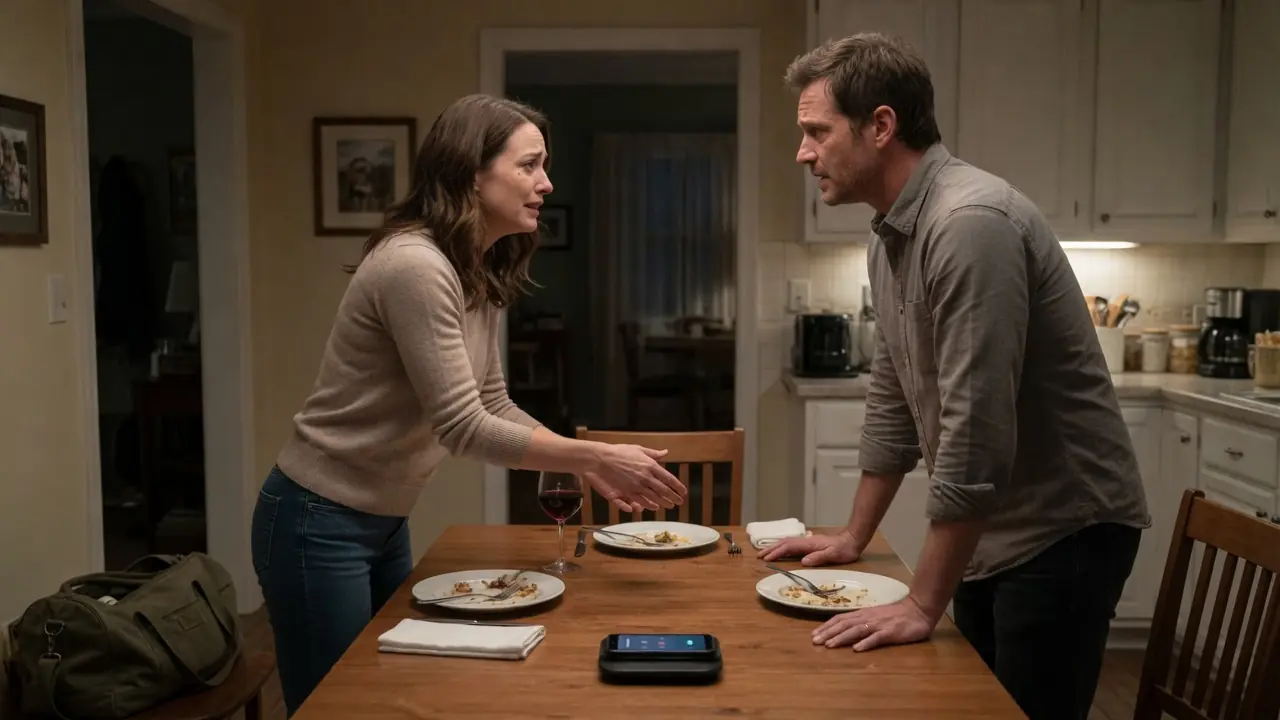
Then he would call out, “Babe, I’m home,” loud enough to reach every room, like we were still newlyweds and not two tired people nine years into a marriage full of bills, work schedules, laundry, grocery lists, and quiet disappointments.
Even after everything ordinary had settled on us, Mark had always entered the house like he was glad to come back to me.
That night, he came in like a man entering a room where something had already died.
Our house sat in a quiet suburb outside Columbus, Ohio, on a street lined with maple trees and neat driveways. It was the kind of neighborhood where people flew American flags on porches, waved from driveways, and pretended not to notice when a marriage next door began cracking behind closed blinds.
The kitchen lights were low.
Dinner was on the table.
A glass of red wine sat untouched beside my plate.
I had made roasted chicken, potatoes, and green beans because that was what I made when I wanted life to look normal. It was the dinner I made after hard weeks, after arguments we had not fully resolved, after his mother’s surgery, after our fourth anniversary when we were too broke to go out but too proud to admit it.
Roasted chicken meant home.
Roasted chicken meant we were fine.
That evening, it meant nothing.
Normal had become a costume, and I was wearing it badly.
I had spent all afternoon rehearsing.
I rehearsed while folding towels. I rehearsed while deleting messages from my phone. I rehearsed while standing in the bathroom mirror, forcing my mouth into a soft smile and practicing the words, “How was the trip?” like an actress auditioning for the role of faithful wife.
Every time I said it, my stomach twisted.
But I told myself guilt always felt worse before it passed.
I told myself one mistake did not have to destroy a life.
The trouble was, it had not felt like one mistake while I was making it.
It had felt like hunger.
That was the part I hated most.
If it had felt disgusting from the beginning, maybe I could have stopped. If it had felt wrong in the clean, simple way people imagine betrayal feels wrong, maybe I would have pushed Derek out the door before midnight.
But it did not.
It felt like being seen.
That was the dangerous part.
Derek Walsh had been Mark’s best friend since college. He was the kind of man who entered a room loudly, laughed before anyone else understood the joke, and made people feel chosen by aiming his attention at them. He knew how to lean in when someone talked. He remembered tiny details and repeated them later as if they mattered. He could make eye contact feel like a secret.
Mark trusted him completely.
That trust had once made Derek safe to me, almost like family.
He had stood at our wedding in a charcoal suit and given a toast about how Mark was “the last decent man in Ohio.” Everyone laughed. Mark had thrown an arm around Derek’s shoulders afterward, grinning like a man who believed the people he loved stood in a circle around him.
Derek spent holidays with us when he was single.
He helped Mark build the deck.
He once drove through a snowstorm to bring us jumper cables when our car battery died outside a grocery store.
He knew where we kept the spare key.
He knew which cabinet held the wine glasses.
He knew Mark’s laugh, Mark’s weaknesses, Mark’s loyalty.
And somehow, I let myself forget that knowing someone’s home does not mean you belong in every room of it.
The affair did not begin with a kiss.
It began with complaints.
Small ones.
Careless ones.
Mark had been traveling more that year for work, helping launch regional logistics contracts for his company. He was good at his job, which meant his bosses trusted him with more and more. Two days in Chicago. Three days in Denver. A week in Dallas. Another in St. Louis.
He always called.
He always texted.
But he was tired when he got home.
I was tired too.
I worked part time managing intake at a physical therapy clinic, and even though my hours were lighter than his, the days had begun to feel strangely empty. We had tried for children for three years, quietly at first, then with doctors, then with tests, then with calendar apps and disappointment arranged in monthly cycles.
No one tells you that infertility can make a house feel haunted by people who never existed.
Mark dealt with it by becoming busier.
I dealt with it by becoming resentful.
Neither of us called it that at the time.
We called it stress.
We called it timing.
We called it needing a break.
Derek heard the things I should have been saying to my husband.
He heard them because I let him.
At first, it was over group dinners, when Mark was away and our old friends invited me out so I would not be home alone. Derek would sit beside me and ask, “How are you really doing?” I told myself it was harmless because other people were around.
Then he started texting.
Not at night at first.
Just normal things.
Checking in.
Sending jokes.
Commenting on photos I posted.
Then the messages grew warmer, more pointed.
You looked tired yesterday. You taking care of yourself?
Mark’s lucky. I don’t think he notices half of what he has.
If you ever need someone to actually listen, you know where I am.
I should have shut it down.
Instead, I let myself feel comforted.
The week Mark flew to Denver for a conference, Derek texted me on Wednesday afternoon.
Mark mentioned the furnace was making that rattling sound again. I can swing by and take a look.
I stared at the message for a long time.
The furnace had been making noise.
Derek did know a little about repairs.
And I was lonely.
That was the excuse I chose.
He arrived at seven with a toolbox and a bottle of wine.
The toolbox made it look practical.
The wine made it true.
He checked the furnace, tightened something, said it was probably fine but Mark should still call a professional if it got worse. Then he stood in the kitchen with his hands in his jacket pockets, not leaving.
I should have said thank you and walked him to the door.
Instead, I opened the wine.
We talked too long.
At first, about normal things.
The conference.
The furnace.
Friends.
Work.
Then Derek looked at me over his glass and said, “You seem different lately.”
I laughed it off.
He did not.
“No,” he said. “I mean it. You seem lonely.”
That word should have frightened me.
Instead, it made something in my chest loosen.
I said, “I’m fine.”
He gave me a look.
“You don’t have to do that with me.”
And I was foolish enough to believe that was tenderness instead of an opening.
By ten, we were sitting on opposite ends of the couch.
By eleven, he was beside me.
He told me Mark had grown complacent.
He told me I looked like a woman who had forgotten she was beautiful.
He told me he had always wondered what would have happened if he had met me first.
I should have laughed.
I should have told him to leave.
I should have called my husband.
Instead, I listened.
By midnight, everything had changed.
By morning, I hated myself.
Derek left before sunrise, buttoning his shirt in my hallway, smiling like the world had handed him something he had always expected to take.
I stood in the kitchen with my robe pulled tight around me, watching him leave through the back door. He kissed my cheek before stepping out, like we were lovers in some tragic movie instead of two selfish people destroying a man who trusted us both.
I told myself I would never see him alone again.
Then he texted me an hour later.
I can still smell you on me.
I stared at the message until my hands shook.
I deleted it.
Then deleted the whole thread.
Then went into recently deleted and erased that too.
I washed the wine glasses twice. I changed the sheets. I opened windows even though the October air was cold. I lit candles in the bedroom, the hallway, and the kitchen. I scrubbed the kitchen counter, wiped the doorknobs, vacuumed the living room, and tried to erase evidence from the air itself.
But no matter what I cleaned, I could still feel the betrayal sitting inside the walls.
When Mark came home that evening, I was ready to pretend.
At least, I thought I was.
The front door opened quietly.
No garage door.
No suitcase wheels over the laundry room step.
No cheerful “Babe, I’m home.”
Just the soft click of the lock and the low sound of his overnight bag being set down near the entryway.
I stood in the kitchen, gripping the back of a chair.
“Hey,” I said.
My voice sounded too light.
Mark appeared in the doorway wearing dark jeans, a gray shirt, and the exhaustion of a man who had driven two hours after landing because he hated sleeping in hotels. His hair was slightly messy, and his conference badge still hung from his bag strap.
He looked at me for one second longer than usual.
Then he smiled.
But it did not reach his eyes.
“Hey,” he said.
That was all.
No hug.
No kiss.
No “I missed you.”
He walked to the sink, washed his hands, dried them slowly, and sat across from me.
I told myself not to panic.
Maybe he was tired.
Maybe the flight had been bad.
Maybe my guilt was turning every ordinary silence into a threat.
For ten minutes, we ate like strangers pretending to be married.
He asked about the neighbors.
I mentioned the HOA email about trash pickup.
He nodded.
I laughed at the wrong time.
The food tasted like paper in my mouth, but I kept cutting it into smaller pieces, hoping the motion looked casual.
Mark barely ate.
He kept his eyes on his plate, then on the window, then back to me.
His calm was unbearable because I could not tell whether it came from ignorance or knowledge.
Then his phone buzzed.
Once.
Then again.
The sound cut through the kitchen like a knife sliding out of a drawer.
Mark did not look down immediately.
That was what scared me.
If it had been a work email, a weather alert, a message from his mother, he would have glanced at it automatically. Instead, he placed his fork beside his plate, wiped his mouth with his napkin, and only then reached for the phone.
He set it faceup between us.
The screen lit.
Derek.
My stomach dropped so hard I thought I might be sick.
Mark looked at the message.
Then he looked at me.
Still calm.
Still quiet.
And then he said the words that made my whole body go cold.
“You can answer him, or you can answer me.”
I stared at the phone, praying the message preview would disappear before I had to read it.
But the screen stayed bright.
Derek’s name hovered above the one line that had just arrived, cruelly clear under the kitchen light.
It was only seven words.
Tell her I still taste last night.
The room seemed to tilt.
My fingers tightened around the stem of my wine glass until I thought it might snap. I could not breathe. The worst part was not that Derek had texted my husband. The worst part was what the message revealed.
He was not panicking.
He was not ashamed.
He was not trying to protect me or Mark or even himself.
He was enjoying it.
Mark watched my face.
“Rachel,” he said, using my name in a way that felt formal, almost final. “Answer him.”
I shook my head.
“Mark...”
“Answer him,” he repeated. “Or answer me.”
Tears gathered in my eyes, but they did not fall yet.
“I can explain.”
He leaned back slightly.
“No. You can confess. Explaining is what people do when they still think the truth can be decorated.”
The sentence landed harder than shouting would have.
I opened my mouth, but nothing came out.
Every lie I had prepared seemed childish now. Every excuse dissolved under the phone’s glow. I had spent the day deleting messages, washing sheets, lighting candles, and rehearsing a smile, but I had not prepared for the possibility that Derek would betray the betrayal itself.
Mark picked up the phone and unlocked it.
My eyes widened.
“How do you have his messages?”
He looked at me for a long second.
“Because Derek got drunk at the airport bar this afternoon and sent me the first one by mistake.”
My hand flew to my mouth.
Mark’s face did not change.
“He wrote, ‘She was better than you deserve.’ Then he deleted it immediately.”
His jaw tightened once, then loosened with painful control.
“But message previews are patient.”
I could not speak.
Mark placed the phone back on the table.
“I called him.”
My body went cold.
“What did he say?”
Mark gave a small laugh, empty of humor.
“At first? Nothing. Then he said I was imagining things. Then he said you were lonely. Then he said if I had been a better husband, maybe my wife wouldn’t have needed someone else.”
I closed my eyes.
Derek had said that.
Of course he had.
A man who sleeps with his best friend’s wife rarely stops at one betrayal.
Mark continued, voice low.
“Then he hung up on me. And I drove home wondering whether you would tell me before I asked.”
That hurt in a way I was not ready for.
He had come home already knowing enough to destroy me. But he had sat at the table, eaten dinner, asked about the neighbors, and waited.
He had given me a doorway back into honesty.
And I had stood on the wrong side of it, smiling over roasted chicken.
“I was going to tell you,” I whispered.
Mark’s eyes sharpened.
“When?”
I looked down.
Silence answered.
He nodded once, as if confirming something he already knew.
“That’s what I thought.”
The phone buzzed again.
Neither of us moved.
Another message from Derek.
I told you she’d never confess.
Mark closed his eyes for the first time.
That was the moment I understood Derek had not texted out of guilt, panic, or mistake. He wanted Mark to know. He wanted the marriage broken openly.
Maybe because he wanted me.
Maybe because he wanted to win.
Maybe because humiliating Mark mattered more to him than anything he had whispered to me in the dark.
Mark opened his eyes.
“Pick it up.”
I shook my head.
“No.”
“Pick it up, Rachel.”
My hand trembled as I reached for the phone.
The screen felt hot against my skin.
Mark’s voice stayed calm.
“Call him.”
“What?”
“Call him. Put it on speaker.”
“Mark, please.”
“Call him.”
I looked at my husband across the table.
His face was pale now, but controlled. His hands rested flat beside his plate, fingers spread slightly, as if he was physically holding himself in place.
I realized he was not doing this just to punish me.
He was doing it because Derek had entered our house, our marriage, and our table without ever facing the sound of his own betrayal.
I pressed Derek’s name.
The phone rang once.
Twice.
Then Derek answered.
“Mark?” His voice was loose, smug, and faintly drunk. “Finally ready to talk like a grown man?”
Mark did not speak.
I did.
“Derek.”
Silence.
Then Derek laughed softly.
“Rachel.”
My name in his mouth made me feel dirty.
Mark’s eyes stayed on mine.
I forced myself to keep speaking.
“Why are you texting him?”
Derek exhaled.
“Because he deserves to know what he lost.”
Mark’s jaw tightened.
I felt sick.
“You said you cared about me.”
“I do.”
“No,” I said, and my voice broke. “You cared about proving you could take something from him.”
Derek’s tone changed.
“Don’t start acting innocent now.”
“I’m not innocent.”
That was the first honest thing I had said all night.
Mark’s eyes flickered, but he said nothing.
Derek scoffed.
“You came to me, Rachel. You were crying about how lonely you were, how Mark never saw you, how your marriage felt dead. Don’t rewrite this because he’s sitting there looking wounded.”
I flinched.
Mark looked at me.
I could see the question in his eyes.
Was that true?
It was.
Not in the clean way Derek meant it.
But it was true enough to hurt.
I had complained about loneliness. I had spoken carelessly about my marriage to the one person I should never have trusted with my pain. I had given Derek my resentment, and he had fed it back to me as permission.
“I said things I should never have said,” I whispered.
Mark looked away.
Derek laughed.
“There. At least she admits it.”
Mark leaned forward, finally speaking.
“You came to my house.”
The line went quiet.
Derek said nothing.
Mark continued.
“You drank my wine. Sat at my kitchen table. Walked past the photo from my wedding. Then you slept with my wife in my bed.”
His voice did not rise, but every word hit like a hammer.
Derek’s answer came colder.
“You weren’t here.”
My heart stopped.
Mark’s face changed.
The calm cracked for half a second, and beneath it was pain so raw I almost reached for him.
But I had no right to touch him.
Not now.
Maybe not ever again.
Mark took the phone from my hand.
“You were my brother,” he said.
Derek was quiet.
For the first time, he did not have a line ready.
Mark continued.
“You stood next to me when my father died. You were at my wedding. You held a toast and called me the luckiest man alive.” His voice lowered. “Did you hate me then, or did you just wait until betrayal became convenient?”
Derek breathed into the phone.
“Mark, you and I both know you stopped being enough for her.”
I covered my mouth as tears spilled over.
That sentence was not love for me.
It was contempt for him.
And I had let that contempt into my home.
Mark looked at the phone.
Then he ended the call.
For several seconds, the kitchen was silent except for my breathing.
The chicken had gone cold.
The wine glass still stood near my hand.
The message remained on the screen like a stain.
Finally, Mark stood.
“Where are you going?” I asked.
“To the guest room.”
“Mark, please. Can we talk?”
He looked at me then.
Really looked.
And I saw the terrible exhaustion of a man who had spent hours traveling home with his heart breaking in silence.
“We are talking,” he said. “For the first time in months.”
I began to cry harder.
“I made a horrible mistake.”
“No,” he said quietly. “A mistake is sending an email to the wrong person. This was a series of choices.”
I nodded because I could not deny it.
“You let him in.”
“Yes.”
“You drank with him.”
“Yes.”
“You spoke about me to him.”
My voice failed.
“Yes.”
“You slept with him.”
I pressed my hand against my mouth.
“Yes.”
“And then you sat across from me tonight pretending the house was clean.”
That destroyed me.
Because it was exactly what I had done.
I had cleaned the house but not the truth.
“I’m sorry,” I whispered.
Mark looked down at the floor.
“I believe you.”
Hope rose in me automatically.
Cruelly.
Then he finished.
“I just don’t know if your apology belongs to me, or to the version of your life that disappeared when Derek texted.”
The hope died.
He walked upstairs.
The guest room door closed.
Not slammed.
Closed.
That was worse.
I remained at the table for a long time.
The phone buzzed again, but I did not look at it. I was afraid of Derek’s name. Afraid of Mark’s silence. Afraid of myself most of all.
The woman I thought I was would not have done this.
But that woman, I realized, had been partly imaginary for a long time.
At 2:13 a.m., I stood and carried my plate to the sink.
My hands shook so badly the fork clattered against the counter. I looked toward the hallway where Mark’s overnight bag still sat near the door. He had not even unpacked before the truth came out.
He had come home to a house that had already been changed by another man’s presence.
I walked to the laundry room.
The sheets were in the dryer.
Clean.
Warm.
Meaningless.
I pulled them out and held them to my chest, then sank to the floor.
I cried there, surrounded by the smell of detergent, because I finally understood that washing something does not make it untouched.
Some stains are not on fabric.
By morning, Mark had already left for work.
There was a note on the kitchen table.
I am staying at a hotel tonight. Do not contact Derek. Do not delete anything else. We will speak tomorrow.
No love.
No signature.
Just instructions from a man trying to keep what remained of his dignity intact.
I did not call Derek.
I blocked him.
Then I unblocked him long enough to screenshot every message that still remained in hidden folders, backups, and archived notifications. I sent them to my email. Then I blocked him again.
For the first time since the affair began, I chose truth even though truth did not help me look better.
Derek called from another number at noon.
I did not answer.
He texted.
Don’t let him make you feel guilty. We both know you wanted this.
I stared at the words for a long time.
Then I forwarded them to Mark.
No explanation.
Just the screenshot.
Mark did not reply.
That silence was earned.
Over the next week, our marriage became a series of conversations that hurt more than the discovery itself.
Mark came home on Sunday afternoon with dark circles under his eyes and a folder in his hand. He sat at the kitchen table across from me, in the same chair he had occupied during the dinner, and placed the folder beside him like evidence.
“I need a timeline,” he said.
My throat tightened.
“What?”
“A timeline. When the texting changed. When he came over. What happened. What you deleted. What you told him about me.”
I started crying before he finished.
Mark closed his eyes briefly.
“Rachel, if every truth is going to make me manage your emotions, I can’t do this.”
That sentence stopped me.
I wiped my face with both hands.
“You’re right.”
It was one of the hardest things I had ever said.
Not because the words were complicated, but because I had grown used to making my distress the center of the room. If I cried, Mark softened. If I broke down, the conversation shifted from what I had done to how bad I felt.
That had been part of the old pattern.
I could not use it anymore.
So I told him.
Not perfectly.
Not cleanly.
But fully.
I told him about the messages. The compliments. The loneliness. The furnace excuse. The wine. The couch. The bedroom.
He asked if it happened more than once.
“No,” I said.
He stared at me.
“Do not answer quickly. Think.”
I did.
I went back through every message, every moment, every emotional crossing of a line I had pretended was harmless.
“Physically, once,” I said. “Emotionally, longer.”
Mark nodded, jaw tight.
“That answer sounds more honest.”
He asked what I had said about him.
That was worse.
Because betrayal is not only bodies.
Sometimes it is handing your spouse’s private weaknesses to someone who wants to use them.
I told Mark I had said I felt lonely. That he worked too much. That he stopped seeing me. That sometimes I felt like a roommate. That I hated how far fertility treatments had pushed us apart. That I resented him for being able to travel, work, sleep, come home, and believe we were surviving when I felt like I was disappearing.
Mark listened.
His face did not change much.
That made it harder.
“Did you tell him about the miscarriage?” he asked.
I froze.
It had happened early. So early the doctor had used careful language, but I had known. Mark had held me on the bathroom floor while I cried into his shirt. We had never told our families. It was ours. Private. Sacred in the way grief becomes sacred when no one else knows the shape of it.
I looked at the table.
“Yes.”
Mark stood so abruptly the chair scraped the floor.
He walked to the sink and gripped the edge with both hands.
For a moment, I thought he might throw something.
He did not.
He just stood there breathing.
When he turned back, his face looked older.
“That was not yours to give him.”
“I know.”
“No,” he said, voice shaking now. “I don’t think you do. That was ours. You gave him our dead child as foreplay for your self-pity.”
The words hit me so hard I could not breathe.
I wanted to say that was cruel.
I wanted to tell him he was making it sound uglier than it was.
But it was ugly.
And perhaps he had a right to name it accurately.
I folded forward and sobbed into my hands.
Mark picked up his folder.
“I can’t look at you right now.”
He left again.
That night, I called a therapist.
Not a marriage counselor.
A therapist for me.
Her name was Dr. Elena Sato, and her first available emergency slot was Monday afternoon. I sat in her office on a gray couch and said the words out loud.
“I cheated on my husband with his best friend.”
She did not gasp.
She did not comfort me.
She asked, “Are you here because you want to understand why, or because you want someone to help you feel less guilty?”
I hated her for the question.
Then I answered.
“I don’t know.”
She nodded.
“That is probably the first honest place to start.”
Derek became ugly quickly.
When he realized I was not leaving Mark for him, his messages turned cruel. He emailed me from a burner account, saying I was weak, saying Mark would never touch me again, saying I would come back when loneliness returned.
He sent Mark a long message pretending to apologize.
It began with remorse.
I am sorry this happened.
Then it became strategy.
But Rachel and I connected because she felt unseen.
Then insult.
You should ask yourself why your wife was so desperate for someone else’s attention.
Then humiliation.
You can hate me, but you know I gave her something you stopped giving her.
Mark forwarded the message to me with one sentence.
This is the man you gave my place to.
I read it until I hated every excuse I had ever made.
Derek’s wife found out two weeks later.
I had not known he was still living with her.
He had told me they were separated, sleeping in different rooms, waiting for lawyers, existing together only because selling the house would be complicated.
Another lie.
Her name was Natalie.
She called me one afternoon from a number I did not recognize. Her voice was shaking with rage and humiliation.
“Did you know?” she asked.
I stood in the laundry room, one hand gripping the dryer door.
“No,” I whispered.
“Would it have stopped you?”
I wanted to say yes.
I wanted one clean answer.
One thing that could make me appear less selfish.
But after everything, I could not spend one more breath lying.
“I don’t know,” I said.
She went quiet.
Then she said, “At least you finally told the truth.”
She hung up.
That conversation stayed with me.
Because it proved betrayal does not only move in one direction. It spreads outward, touching people who never sat at the kitchen table, never read the messages, never made the choices.
I had not just betrayed Mark.
I had helped Derek betray another woman too.
A month later, Mark and I sat with a marriage counselor.
Her name was Dr. Patel. Her office had soft chairs, a box of tissues, and framed prints of trees on the walls. I expected Mark to talk about anger. I expected him to say he could not sleep, could not eat, could not look at me.
He did say those things eventually.
But first, he talked about humiliation.
“The hardest part,” he said, staring at the carpet, “is picturing him in my house. Not just with her. In my kitchen. Touching the glasses. Walking past our wedding photo. Knowing where the bathroom is. Knowing my dog’s name.”
I stared at my hands.
“He knew my life,” Mark continued. “That’s why it hurts differently. A stranger would have been pain. Derek is contamination.”
I broke down.
Mark did not comfort me.
Dr. Patel let the silence sit.
That was when I began to understand that remorse can be selfish too. Sometimes crying is only another way to ask the wounded person to stop showing you the wound.
I had to learn to cry without asking Mark to rescue me from the consequences of my own actions.
Some days he hated me.
He never said it that plainly, but I could feel it. Other days, he looked at me like he missed me, which hurt even more.
We slept in separate rooms.
We divided bills temporarily.
We stopped sharing a bathroom.
We told our families we were “working through some things,” which was a small phrase for a large fire.
My sister, Leah, knew more because I broke down and told her.
She was quiet for a long time.
Then she said, “I love you, but I’m not going to help you make excuses.”
“I’m not asking you to.”
“You might without realizing it.”
She was right.
People who betray often want two impossible things. We want to be honest and still be seen as the person we were before honesty arrived. We want consequences, but only the kind that prove our remorse rather than truly cost us something.
I lost friends.
Not because Mark demanded it.
He did not.
But some people simply could not look at me the same way when the truth came out. Some had known Derek for years. Some had known Mark longer. Some were couples who saw in me the thing they feared might be hidden in their own homes.
I used to think losing social comfort would be the worst part.
It was not.
The worst part was watching Mark move through our house like a guest.
He used to leave his keys on the counter and his shoes by the door. Now everything he brought home stayed contained. Bag zipped. Phone in pocket. Wallet upstairs. His presence had become temporary, even when he was standing ten feet from me.
Derek vanished from our lives after his own marriage collapsed.
Or at least, he stopped trying to contact us when Mark threatened legal action for harassment. His absence did not fix anything. In fact, it made his role seem smaller and mine larger. Without Derek actively causing damage, all that remained was what I had chosen.
Three months after the dinner, Mark came home early on a Friday.
I was washing dishes.
He stood in the doorway and said, “I need to ask you something.”
I turned off the water.
“Okay.”
He looked tired.
“Why didn’t you tell me you were lonely?”
I gripped the edge of the sink.
“I tried, in small ways.”
“No,” he said, not cruelly. “You hinted. You sighed. You punished me for not reading your mind. But you never sat across from me and said, ‘I am lonely, and I am in danger of looking for comfort somewhere else.’”
He was right.
That was the unbearable thing.
I had wanted him to notice without me having to risk rejection. I had wanted him to fix pain I had not fully named. Then when Derek named it for me, I mistook manipulation for understanding.
“I was ashamed,” I said.
“Of being lonely?”
“Of needing more.”
Mark nodded slowly.
“And now?”
I wiped my hands on a towel.
“Now I’m ashamed that I chose betrayal instead of honesty.”
He looked down.
“That answer sounds real.”
It was the closest thing to hope he had given me in months.
But hope did not mean forgiveness.
Another three months passed before Mark moved back into our bedroom.
Not fully.
Not easily.
The first night, he slept on the edge of the bed, turned away from me, stiff as a man lying beside a memory that could bite.
I did not touch him.
I stared at the ceiling and silently promised not to demand closeness before trust had even learned to stand again.
Rebuilding did not look romantic.
It looked like shared calendars.
Phone transparency.
Counseling bills.
Hard conversations.
Separate bank passwords becoming shared again slowly.
Location updates that were not demanded but offered.
It looked like Mark asking where I was going and me answering without irritation. It looked like me telling him when I felt lonely before loneliness turned into resentment. It looked like him admitting he had hidden inside work because providing felt safer than being emotionally present.
We both had failures.
But only one of us had betrayed the marriage.
I never let myself forget that distinction.
At one session, Dr. Patel asked Mark what he needed from me that I was not giving.
He thought for a long time.
Then said, “I need her to stop asking when I’ll be over it.”
I turned toward him.
“I don’t ask that.”
“Not with words,” he said. “But every time I have a bad day, you look disappointed. Like my pain is ruining your progress report.”
That sentence exposed something ugly in me.
Because he was right.
I had been treating his healing like a measure of my redemption. If he had a good day, I felt hopeful. If he pulled away, I felt punished. Somewhere in my shame, I had made his pain about my future.
So I stopped asking, directly or indirectly.
When he was quiet, I let him be quiet.
When he needed to walk alone, I did not follow.
When he slept in the guest room again after a hard trigger, I did not cry outside the door.
Love, I learned, was not always proving you were sorry.
Sometimes love was giving the person you hurt enough room to decide whether they still wanted you there.
On the anniversary of that dinner, I made roasted chicken again.
Not because I wanted to recreate the night.
Because I refused to let one meal own our kitchen forever.
I spent the afternoon cooking slowly. I did not drink wine. I did not rehearse a fake smile. I did not light candles to cover anything. The house smelled of garlic, rosemary, potatoes, and a fear I had learned to carry honestly.
Mark came home through the garage this time.
The door rattled.
His shoes sounded on the laundry room step.
Then, after a pause, he called out, “I’m home.”
My chest tightened.
I stood in the kitchen, hands trembling.
When he walked in, I said, “I’m glad you are.”
He looked at the table.
Then at me.
For a moment, the past moved through the room between us.
“I almost didn’t come back,” he said.
“I know.”
“I still think about leaving.”
“I know.”
He pulled out his chair.
“But I’m here.”
That was not forgiveness wrapped in poetry.
It was better.
It was honest.
We ate quietly.
No phones faceup between us.
No messages glowing like evidence.
No acting.
Just two people sitting in the place where a marriage had nearly ended, trying to decide every day whether truth could build what lies had almost buried.
A year after discovery, Mark asked if we could drive to Lake Erie for a weekend.
It was the first trip that was not work, therapy, family obligation, or escape. We rented a small cabin with bad water pressure and a view of the gray lake. The November wind beat against the windows at night, and we sat under an old quilt watching waves fold into themselves.
On Saturday morning, we walked along the shore.
Mark stopped near the water and said, “I need to say something without you trying to fix it.”
I nodded.
“I still see it sometimes,” he said. “You and him. In the house. In our bed. It comes out of nowhere.”
I swallowed hard.
“I’m sorry.”
“I know.” He looked at the water. “I believe you’re different now. I do. But I don’t know if I will ever be a person who doesn’t remember.”
I forced myself not to argue with pain.
“That may be true.”
He turned to me.
“Can you live with that?”
The old me would have cried. The old me would have said, “How long do I have to pay for this?” The old me would have needed reassurance that my remorse had an expiration date.
Instead, I said, “I can live with the truth. I don’t want to live with lies anymore, even the ones that make me feel better.”
Mark’s eyes filled, but he did not cry.
He reached for my hand.
It was the first time in more than a year that he reached first.
We did not become perfect after that.
No marriage does, even without betrayal.
There were still hard days. There were still triggers. There were still moments when a certain phrase, a bottle of wine, or the sound of a phone buzz could pull the past into the room like smoke.
But we learned to name it.
“I’m remembering,” Mark would say.
And I would answer, “I’m here. Ask me anything.”
Sometimes he asked.
Sometimes he did not.
Sometimes he simply needed to know the door was open.
Years later, I still remember the sound of Derek’s message arriving.
One buzz.
Then another.
I remember Mark placing the phone between us. I remember the way he looked at me, calm enough to make lying impossible. I remember his sentence more clearly than any scream.
“You can answer him, or you can answer me.”
For a long time, I thought that was the moment my marriage collapsed.
Now I know it was the moment my hiding ended.
Derek had wanted to expose us because betrayal made him feel powerful. He thought his message would make Mark look weak. Instead, it revealed the truth about all three of us.
Derek was cruel.
I was cowardly.
And Mark was stronger than either of us had deserved.
The phone did not destroy my marriage.
I did.
The message only turned on the light.
And in that light, I finally had to choose whether I wanted to keep lying in the dark or become the kind of woman who could sit across from the man she hurt and answer him honestly.
I am still learning how to be that woman.
Mark is still learning whether he can trust her.
Some people hear that and want a cleaner ending.
They want me punished forever or forgiven instantly. They want betrayal to lead to divorce or redemption with no middle ground. They want the wrongdoer ruined or the marriage magically healed.
Real life is not that neat.
Sometimes the person who cheats is not a cartoon villain.
Sometimes she is a frightened, selfish woman who lets loneliness become entitlement.
Sometimes the betrayed husband does not leave, not because he is weak, but because he is strong enough to make a choice more complicated than pride.
Sometimes staying is not the same as forgetting.
Sometimes forgiveness is not a door opening all at once, but a window cracked slowly over years.
I do not know what our marriage will look like ten years from now.
I only know what I choose today.
No deleted messages.
No hidden loneliness.
No private resentment handed to someone eager to weaponize it.
No cleaning the house while leaving the truth dirty.
Every night now, when Mark’s phone buzzes on the table, I do not flinch because of secrets.
I look at him.
And I answer.