Nell Archer arrived in Copper Creek, Colorado, with a worn valise, a wrinkled letter, and a heart that had already survived more disappointment than most people saw in a lifetime. The stagecoach left her standing on the dusty platform beneath a pale afternoon sky, while strangers moved around her with bundles, crates, and tired horses. She had traveled from Missouri to marry Samuel Bell, a shopkeeper who had written her twelve letters filled with promises of kindness, shelter, and a new beginning. But before Nell could even ask where to find him, the station clerk quietly told her Samuel had married the banker’s niece three days earlier.
For a moment, Nell did not understand the words. She stared at the clerk’s face as if the meaning might change if she waited long enough. The wind pushed dust across her brown traveling dress and lifted loose strands of hair from beneath her faded bonnet. In her gloved hand, Samuel’s final letter trembled like a cruel joke written in another person’s life.
She found him an hour later outside his shop, standing beside his new wife with a ribbon still tied around the door handle. Samuel’s face went pale when he saw Nell, but not with regret strong enough to matter. He said there had been pressure from business partners, that his situation had changed, that surely Nell understood how difficult life could be. His wife looked Nell up and down once, then turned away as if the abandoned woman with a valise were an inconvenience left in the street.
Nell did not cry in front of them. She only folded Samuel’s letters, placed them back in her bag, and walked away with her chin lifted so sharply it hurt her throat. By sunset, she had less than four dollars, no room paid for, no relatives nearby, and no clear idea how a woman alone could survive in a town that had already watched her be humiliated. She sat on a bench near the livery stable, holding her valise with both hands, trying not to look as frightened as she felt.
Judson Cray saw her from across the road. He had come into town for flour, coffee, lamp oil, and nails, but he stopped outside the mercantile when he noticed the woman sitting too still on the bench. People in grief often moved in certain ways, he had learned, either too much or not at all. This woman had the stillness of someone holding herself together by sheer will because if she loosened even one breath, she might come apart.
Judson was thirty-seven, broad-shouldered, sun-browned, and known throughout Copper Creek as a man who spoke only when speech served a purpose. Three years earlier, his wife Clara had died after a hard winter illness, and since then the Cray ranch had become a place people mentioned with lowered voices. His father, Elias, had taken Clara’s death worse than anyone expected. Six months before Nell arrived, the old man had shut himself inside his bedroom and nearly stopped living altogether.
Judson stood there for several long moments, watching Nell stare at the dust near her boots. He knew better than to approach a strange woman without cause, and he knew pity could shame a person as deeply as cruelty. But he also knew the look of someone who had nowhere to go. After one more moment of hesitation, he crossed the street, removed his hat, and stopped several feet away from her bench.
“Ma’am,” he said quietly, “I don’t mean to intrude.” Nell lifted her eyes, guarded and tired. Judson kept his hands visible and his voice low. “I heard what happened with Bell. If you need honest work, my ranch needs a housekeeper and cook. Room, meals, and ten dollars a month.”
Nell studied him carefully. “Why would you offer that to a woman you don’t know?” Judson looked toward the mountains in the distance, then back at her. “Because my house is falling apart from grief, and you look like grief has just handed you an empty road.” The answer was too honest to sound rehearsed. Nell looked down at her valise, then at the street where Samuel Bell’s shop stood in the distance, and realized pride would not feed her.
“I can cook,” she said. “I can clean, sew, keep accounts, and manage a pantry.” Judson nodded once. “Then you can earn the room.” Nell stood, smoothing her dress with trembling fingers. She had crossed hundreds of miles for a husband and instead found a job from a stranger whose eyes looked almost as tired as her own.
The Cray ranch sat three miles outside Copper Creek, tucked against a stretch of dry pasture and low hills. The house was large but neglected, with a sagging porch, dusty windows, and a silence that seemed to have weight. Nell stepped through the front door and felt immediately that the place had not been lived in properly for years. It had been occupied, endured, and survived, but not lived in.
Judson showed her the kitchen first. It was cold, wide, and dim, with a black iron stove, copper pans hanging unused, and shelves that smelled faintly of flour gone stale. A faded blue apron hung on a peg beside the pantry door, untouched and stiff with old dust. Judson saw Nell looking at it and said, “That belonged to Clara. Best not to use it.”
Nell nodded. She understood grief had rules, even when those rules made no sense to the living. He showed her the small room beside the back stairs where she could sleep, then pointed toward the hallway upstairs. “My father’s room is at the end. Leave his tray outside the door. Don’t expect him to answer.”
“Does he eat?” Nell asked. Judson’s jaw tightened. “Sometimes broth. Sometimes nothing.” He looked away before she could see the worry fully. “Doctor says he has to want to live. I don’t know how to make a man want what he’s already set down.”
The next morning, Nell rose before dawn and began working. She swept dust from corners, scrubbed the kitchen table, washed the windows, emptied spoiled flour, and started a small fire in the stove. She did not touch Clara’s apron. Instead, she rolled up her sleeves, tied on her own plain cloth apron, and opened her mother’s old herb journal.
The journal had been Nell’s only inheritance of tenderness. Her mother had filled it with recipes, remedies, and notes about which herbs brought strength, which soothed a cough, which warmed a chilled body, and which reminded lonely people of home. Nell had carried it through boardinghouse kitchens, sewing rooms, church suppers, and now into a ranch house that felt as if it had forgotten the sound of morning. She ran her fingers across the page for simple bread and whispered, “Help me begin.”
Judson came in from the barn two hours later and stopped at the kitchen doorway. Fresh bread sat cooling near the stove, coffee simmered on the back burner, and oatmeal with cream, cinnamon, and dried apples waited on the table. He stared at it as if Nell had performed some impossible act. She glanced up from kneading another batch of dough and grew nervous under his silence.
“If I’ve done something wrong, tell me,” she said. Judson removed his hat slowly. “No one’s cooked breakfast in this kitchen for a long while.” Nell wiped flour from her wrist. “Then maybe the house was hungry before anyone else was.” He looked at her then, not sharply, but with the startled expression of a man hearing a door open somewhere inside him.
The first tray Nell placed outside Elias’s room came back untouched. So did the second, and the third. Judson said nothing, but Nell noticed the way his eyes moved toward the hallway each morning. He expected disappointment and still suffered it each time. So Nell began changing the meals, not grandly, but carefully.
She made chicken broth with thyme and onion, corn cakes with honey, soft potatoes mashed with butter, and tea steeped with mint from a dry bundle in her valise. Every evening, she carried the tray upstairs herself and set it beside Elias’s door. “Mr. Cray,” she would say gently, “supper is here if you want it.” Most nights, no answer came.
A week passed, then another. The ranch hands began eating better, Judson’s shoulders lost a little of their iron stiffness, and the house slowly gathered ordinary sounds again. A broom against the floor. A kettle singing. A knife chopping onions. Bread crust cracking as it cooled.
Still, Elias did not come out.
One afternoon, Nell found Judson standing in the kitchen after everyone else had gone. He was looking at Clara’s apron on the peg. Nell dried her hands on her own apron and waited, sensing he had not come in for coffee. Judson finally said, “She used to sing in here.”
“Your wife?” Nell asked softly. He nodded. “Badly, most times. But she sang anyway.” His mouth pulled into something that was almost a smile and almost pain. “My father used to complain about it, then sit closer so he could hear better.”
Nell looked toward the hallway. “Then this kitchen remembers more than sorrow.” Judson turned to her, and his eyes were red-rimmed from wind or memory. “You talk like rooms are alive.” Nell returned to the bread dough on the table. “Some are. Some are only waiting for people to come back.”
The stew happened on a Thursday, though later Judson would remember the day by the smell rather than the calendar. Nell had found a cut of beef too tough for quick frying, so she browned it slowly with onions, carrots, potatoes, garlic, bay leaf, and a careful measure of herbs from her mother’s journal. She added a little vinegar, a little molasses, and let the pot simmer until the whole kitchen filled with deep, rich warmth. Outside, cold wind moved across the yard, rattling the porch boards.
Judson sat at the table repairing a leather strap while Nell stirred the pot. He had eaten less that morning because a calf had been lost in the north pasture, and worry sat on him like another coat. Nell did not press him. She had learned he accepted care better when it did not announce itself.
Then they heard it. A slow dragging sound came from the hallway, followed by the faint tap of a cane against the floorboards. Judson’s hands froze over the leather strap. Nell lowered the wooden spoon without realizing it.
Elias Cray appeared in the doorway like a ghost who had forgotten how to haunt. He was thin, pale, and stooped, with white hair falling over his forehead and one hand gripping the doorframe. His eyes were fixed not on Judson, not on Nell, but on the black iron pot. For the first time in six months, the old man had left his room.
Judson rose from the table so suddenly his chair scraped hard against the floor. Elias barely seemed to notice. He stared at the stew with trembling eyes, then lifted his gaze toward Nell. His voice came out rough, brittle, and barely more than breath.
“Who made this stew?” he asked.
Nell’s heart pounded so hard she could hear it. “I did, sir.” Elias took one slow step into the kitchen, then another. Judson looked as if he were afraid to move, afraid one wrong sound might send his father retreating back into the dark room forever. Nell reached for a bowl with hands that trembled only slightly.
Elias sat at the table. No one told him to. No one dared speak. Nell ladled stew into a bowl, set it before him, and placed a piece of bread beside it. Elias looked at the steam rising from the bowl as tears gathered in his sunken eyes.
“My Martha made stew like this,” he whispered. Judson blinked. “Ma?” Elias nodded, still staring down. “Before your mother died, before Clara, before this house got so quiet. Bay leaf, molasses, vinegar, thyme. She said beef needed patience same as men.”
Nell’s throat tightened. “My mother wrote the recipe in her journal. She said she learned it from a woman heading west years ago.” Elias lifted the spoon slowly and took one bite. The silence that followed seemed to fill every corner of the kitchen. Then his face broke, and he began to cry.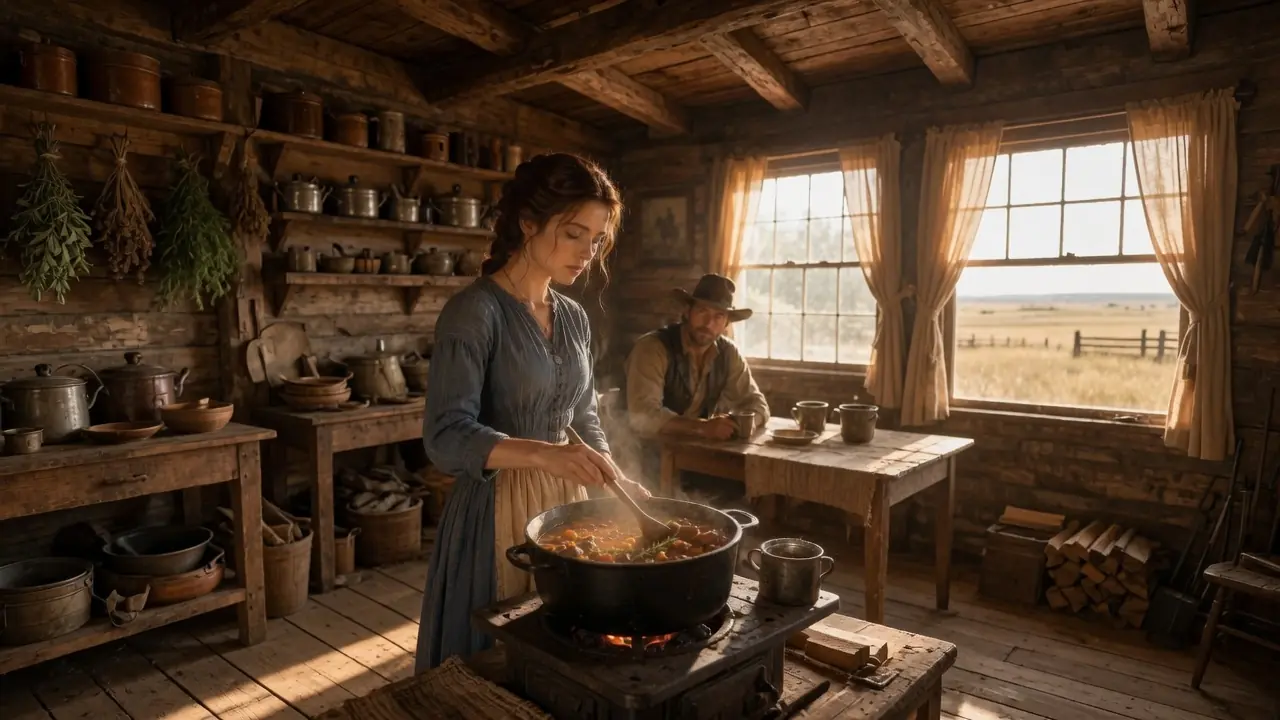
Judson looked away, his own jaw clenched so hard it shook. Nell stood near the stove, holding the empty ladle, unsure whether to comfort or disappear. Elias took another bite, then another, tears slipping down his cheeks. “I forgot,” he said. “God forgive me, I forgot what living smelled like.”
After that day, Elias did not return fully to life all at once. Grief does not obey one bowl of stew, no matter how much love is stirred into it. But the next morning, his tray came back half-eaten. The morning after that, he asked for coffee. Three days later, he came downstairs again and sat in the kitchen while Nell made biscuits.
Judson changed too. Not quickly, and not in ways he seemed aware of at first. He began bringing in split wood before Nell asked, then repairing loose shelves, then opening curtains that had stayed drawn for years. He still spoke little, but silence around him no longer felt like a locked gate. It felt like a field beginning to thaw.
The town noticed, because small towns always notice when grief loosens its grip. Mrs. Bell, the shopkeeper’s new wife, came by once with a basket of preserves and a mouth full of false sweetness. She looked at Nell in the kitchen and said, “How fortunate you found servant work after such an awkward arrival.” Nell’s cheeks warmed, but before she could answer, Judson stepped in from the porch.
“Miss Archer saved my father’s life,” he said evenly. Mrs. Bell’s smile faltered. Judson hung his hat on the peg and looked directly at her. “Around here, we call that honorable work.” Mrs. Bell left soon after, and Nell did not thank Judson because if she did, she feared she might cry.
Spring came slowly to Copper Creek. Snow melted from the high slopes, mud thickened the yard, and green shoots appeared near the garden fence. Nell planted herbs by the kitchen window, using seeds from her valise and a few Elias remembered Martha growing years before. The old man began sitting on the porch in the afternoons, wrapped in a blanket, watching the ranch hands move cattle across the low fields.
One evening, Elias called Nell to the porch. He held a small wooden box in his lap, carved with faded flowers. “This was Martha’s,” he said. “Clara kept it after my wife passed, but it belongs in hands that know what herbs can do.” Nell stepped back instinctively. “I can’t take that.”
“You can,” Elias said. “And you will, unless you want to insult an old man who finally came out of his room.” Nell laughed through sudden tears, and Judson, standing near the porch rail, looked at her as if the sound had struck him somewhere tender. Inside the box were packets of seeds, handwritten recipes, and a silver measuring spoon worn thin from use. Nell held it as carefully as if it were a blessing.
But healing often invites old trouble to test it. In May, a cattle buyer named Abram Voss came to the ranch with a contract Judson had apparently signed months earlier, when Elias was still shut away and the ranch accounts were sinking. The contract gave Voss the right to buy half the Cray herd at a price far below value if payment on an old supply debt was not made by summer. Judson had signed because he thought the ranch was already dying.
Nell found the duplicate contract while cleaning the desk in the study. She had kept accounts for a widow’s boardinghouse in Missouri and knew enough numbers to recognize a trap. When she brought the paper to Judson, his face darkened. “I meant to fix it before spring,” he said. “Then my father worsened, and I let too many things slip.”
Elias, seated by the stove, held out a shaking hand for the contract. He read it slowly, his eyes clearing with anger. “Voss cheated your grief,” he said. Judson’s mouth tightened. “I let him.” Nell looked from father to son and felt the old darkness pressing at the house again.
“We have six weeks,” she said. Judson looked at her. “To do what?” Nell set the account ledger on the table. “To sell something else, cut expenses, collect what others owe, and stop acting like the ranch is already lost.” Elias made a rough sound that might have been a laugh. “Martha would have liked her.”
For the next month, Nell became more than a cook. She balanced accounts, found unpaid invoices, negotiated with the feed merchant, and organized a Saturday supper in Copper Creek to sell Cray beef pies, bread, preserves, and stew. The whole town came because everyone had heard about the stew that pulled Elias Cray from his room. Samuel Bell attended with his wife and tried very hard not to meet Nell’s eyes.
Judson watched Nell move through the crowd that night, serving bowls, taking coins, smiling with tired grace, and standing taller than she had the day she arrived. She no longer looked like a woman abandoned on a platform. She looked like someone who had claimed a place. Judson realized then that the ranch had not merely given Nell shelter; Nell had given the ranch a future.
They raised enough money to pay Voss before the deadline. When Voss arrived expecting surrender, Judson handed him the full amount in cash while Elias sat beside him on the porch. Nell stood near the door, flour on her sleeve and steel in her eyes. Voss counted the money twice, then looked annoyed that grief had not made the Crays as weak as he expected.
After Voss left, Elias lifted his cane and pointed it at Nell. “That woman stays,” he said. Judson looked at her, and for the first time, his voice carried open emotion. “If she wants to.” Nell’s hands tightened around her apron. No one had asked what she wanted in a long time.
That evening, after Elias had gone to bed, Nell found Judson in the kitchen. The stew pot was clean, the fire low, and the room smelled faintly of bread and lavender. Judson stood by Clara’s old apron, holding it carefully in both hands. Nell stopped in the doorway, unsure whether she had stepped into something private.
“I kept this like touching it would erase her,” Judson said. Nell stayed quiet. He folded the apron slowly and placed it in a cedar chest near the pantry. “But grief isn’t love if it keeps the living from breathing.” He turned toward her. “You taught me that.”
Nell’s eyes filled. “I only cooked supper.” Judson shook his head. “No. You came into a house where no one wanted to hope, and you hoped anyway.” He stepped closer, not too close, but close enough for honesty. “Nell Archer, I don’t know what was stolen from you before you came here, but I know what you gave back to us.”
She looked down at her hands, roughened from work but steadier than they had been in Copper Creek that first day. “I thought I came here because I had nowhere else to go.” Judson’s voice softened. “Maybe. Or maybe this house was waiting for someone brave enough to light the stove.” Nell laughed softly through tears, and this time she did not look away.
Months later, people in Copper Creek still told the story of the stew. Some said Elias had smelled his dead wife’s recipe and followed the memory back to life. Some said Nell Archer had bewitched the house with herbs and bread. Others said Judson Cray had finally let the past rest because a stranded woman showed him how to feed the future.
The truth was simpler and deeper than the stories. Nell kept cooking. Elias kept coming downstairs. Judson kept opening windows. The ranch hands laughed in the kitchen again, and the garden by the window grew thyme, sage, mint, and rosemary in neat green rows.
One year after Nell arrived, Judson built a new shelf in the kitchen for both herb journals, Martha’s and Nell’s mother’s, side by side. Elias carved a small sign for the pantry door that read, “Hope Stews Here,” though he pretended it was a joke. Nell hung it anyway. Judson watched her smooth her fingers over the letters and thought he had never seen anything belong more completely.
On a cool autumn evening, with a pot of beef stew simmering on the stove, Judson stood in the doorway and asked again, softer this time, “Who made this stew?” Nell turned from the pot, smiling now because the question no longer carried shock. It carried memory, healing, and the strange mercy of second beginnings. “Someone who finally found her kitchen,” she said.
Elias laughed from the table. Judson smiled, and the house seemed to draw a deep, living breath around them. Nell had come to Copper Creek believing her future had been stolen by one man’s betrayal. Instead, she found a grieving ranch, a silent father, a wounded son, and a black iron pot waiting for the meal that would bring them all back to life.