Daniel Reyes had carried medications worth more than his car, blood products that could not be replaced, laboratory specimens labeled with names he was never allowed to remember, and once a pediatric heart valve that had required three different signatures before anyone would let him cross a hospital loading dock.
But he had never carried anything that made his hands feel as heavy as the red-and-white cooler pressed against his chest that Thursday afternoon.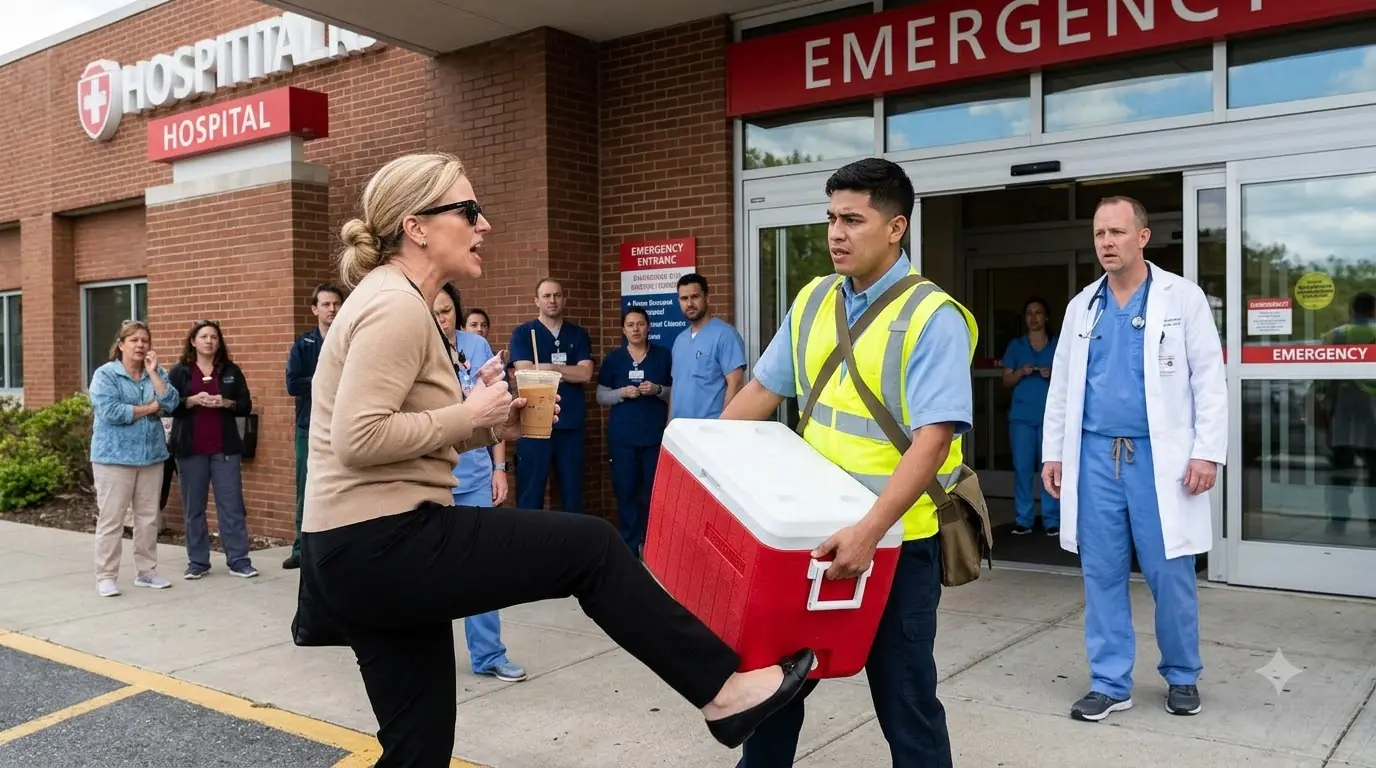
It was not physically heavy.
The reinforced medical transport container weighed less than twenty pounds.
What made it heavy was the label.
HUMAN ORGAN FOR TRANSPLANT.
Daniel had read those words hundreds of times during training. He had watched instructors explain seals, temperature logs, chain-of-custody forms, emergency contacts, delivery windows, alternate entrances, and exactly what to do if a vehicle failed between hospitals.
None of that prepared him for the strange feeling that came when the label was attached to something real.
Something donated.
Something somebody had died before another person could receive.
“Daniel?”
He looked toward Samantha Lee, the transplant coordinator standing beside the ambulance bay.
She was thirty-six, compact, fast-moving, and carried two phones because apparently one was not enough when your job involved keeping operating rooms, surgeons, couriers, laboratories, donor networks, and frightened families synchronized to the minute.
“You have the receiving signature sheet?”
Daniel tapped the pocket of his yellow reflective vest.
“Right here.”
“Temperature logger visible?”
He glanced at the small external indicator.
“Yes.”
“Tamper seal?”
“Intact.”
“Hospital security knows you’re coming through the east emergency entrance.”
“Got it.”
Samantha looked at him for one extra second.
“Don’t stop anywhere.”
Daniel smiled.
“I wasn’t planning to get coffee.”
“I’m serious.”
“I know.”
She softened.
“So am I.”
The kidney had arrived by air from another state and was being transferred across the city to St. Catherine Medical Center, where a patient named Noah Bennett had already been admitted.
Daniel did not know Noah.
He did not know his age.
He did not know how long he had been sick.
Couriers were intentionally told only what they needed.
Names sometimes appeared on paperwork, but Daniel had learned early not to build stories around them.
Too much emotion made people careless.
And carelessness did not belong in transplant transport.
He secured the cooler inside the rear compartment of his medical transport van, verified the locking bracket twice, closed the door, and climbed into the driver’s seat.
Samantha tapped the passenger window before he pulled away.
Daniel lowered it.
“Daniel.”
“Yes?”
“Call if anything feels wrong.”
He gave her a thumbs-up.
Then drove.
Across the city, forty-eight-year-old Caroline Whitmore was having what she believed to be an intolerable day.
The trouble had started at eight that morning when the landscaping company arrived forty minutes early and blocked half her driveway.
At nine-fifteen, a bank representative told her a wire transfer would not clear until the following business day.
At ten, her hairstylist canceled.
At eleven-thirty, Caroline discovered a scratch near the rear passenger door of her pearl-white luxury SUV.
It was not large.
Approximately three inches.
Barely visible unless sunlight struck the metallic paint at exactly the right angle.
Caroline stared at it for nearly five minutes.
Her first thought was not that she might have brushed a shopping cart.
Or that the scratch could have happened days earlier.
Her first thought was that somebody else had done it.
Somebody careless.
Somebody who would deny it.
That possibility bothered her more than the scratch itself.
Caroline had spent much of her adult life believing problems became permanent only when people failed to confront them immediately.
Her father had taught her that.
“Never let people think they can inconvenience you for free.”
He had said it when contractors arrived late.
When waiters forgot an order.
When neighbors parked too close to the driveway.
When somebody bumped a shopping cart against their family sedan.
Caroline had interpreted that philosophy as strength.
Her husband Thomas Whitmore had called it exhausting.
They had been divorced for four years.
Caroline blamed his unwillingness to “stand up for himself.”
Thomas blamed the fact that every restaurant reservation eventually became an argument.
Both were probably partly correct.
That afternoon Caroline drove to St. Catherine Medical Center to visit her older sister Margaret, who had been admitted for observation after a minor cardiac episode.
Margaret was stable.
The visit should have been simple.
Caroline arrived already irritated because visitor parking near the main entrance was full.
She circled twice.
Then a hospital shuttle blocked the lane.
Then a maintenance cart stopped beside a service door.
By the time Caroline found a temporary space near the east entrance, she was gripping the steering wheel hard enough to hurt her fingers.
She stepped out holding an iced coffee.
Then noticed Daniel’s medical transport van pulling into the restricted loading zone twenty yards away.
He parked quickly.
Opened the rear door.
Removed the red-and-white cooler.
Closed the van.
Started moving toward the hospital.
Caroline looked at her SUV.
Then the van.
Something in her mind connected them.
The scratch.
The close parking.
The narrow lane.
She did not remember seeing Daniel’s vehicle anywhere near her earlier.
That detail should have ended the thought.
Instead, irritation completed the story for her.
“Hey!”
Daniel kept walking.
Hospital entrances were noisy.
Ambulances.
Automatic doors.
Rolling carts.
People speaking through phones.
He did not realize the shout was directed at him.
Caroline shouted again.
“Hey! You!”
Daniel turned.
Caroline was already walking toward him.
He looked quickly toward the entrance.
Thirty yards.
Maybe less.
Then at the cooler.
Then back to her.
“Yes, ma’am?”
“You hit my car.”
Daniel blinked.
“What?”
“My SUV.”
She pointed.
“You hit it.”
Daniel looked toward the white vehicle.
Then his van.
There was at least twenty feet between them.
“I just arrived.”
“Don’t lie to me.”
“I’m not.”
Caroline stopped directly in front of him.
“You scratched my door.”
Daniel tightened both arms around the cooler.
“Ma’am, I haven’t been near your car.”
“You were parked right beside it.”
“No.”
“Yes, you were.”
“I just pulled into that medical zone.”
Caroline looked toward the van.
Then back at him.
“Move your vehicle.”
Daniel glanced at the entrance again.
“I can’t deal with this right now.”
That sentence was the mistake.
Not morally.
Practically.
Caroline heard dismissal.
“What did you say?”
“I’m making an urgent delivery.”
“I don’t care.”
Daniel’s expression changed.
He stepped slightly around her.
“Then call hospital security. They can check cameras.”
Caroline moved sideways and blocked him again.
“You’re not walking away from me.”
“Ma’am.”
“No.”
She raised one hand.
“You hit my car and now you think putting on a little vest makes you important?”
Daniel looked down at his reflective vest.
Then at the cooler.
“Please move.”
“What’s in the box?”
“That’s not your concern.”
Caroline laughed.
“Of course.”
Daniel took another step.
She stepped with him.
He stopped.
His pulse increased.
Not because he feared her.
Because time mattered.
He did not know exactly how much time remained within the transplant team’s operating plan.
He only knew every unnecessary minute was unacceptable.
Daniel spoke more firmly.
“Ma’am, this is medical transport.”
“I need to enter that building now.”
“Move.”
Several people near the doors noticed.
A Black hospital security officer standing near a wheelchair station looked over.
A nurse stepped outside carrying paperwork.
Two visitors slowed.
Caroline saw the attention.
Her voice rose.
“Don’t order me around.”
Daniel closed his eyes for half a second.
Then:
“Please step aside.”
“No.”
“Security!”
The officer began moving toward them.
Caroline heard Daniel call.
That transformed embarrassment into rage.
“You’re calling security on me?”
“I’m asking them to help because you’re blocking an urgent delivery.”
“You caused this.”
“I didn’t touch your vehicle.”
“You think you can just walk away?”
Daniel moved again.
This time Caroline reached toward his arm.
He immediately twisted his shoulder away without dropping the cooler.
“Do not touch me.”
That sentence was louder.
The security officer accelerated.
“Ma’am!”
Caroline stepped backward.
For one second it looked like the confrontation would end.
Then Caroline looked down.
At the cooler.
It was sitting against Daniel’s torso, large enough that the lower edge extended slightly forward.
Something inside her made the worst possible decision.
Maybe she wanted to knock it aside.
Maybe she wanted to stop him physically without grabbing him again.
Maybe she simply wanted him to feel the inconvenience she believed he had caused her.
Whatever the thought, it lasted less than a second.
Caroline swung her right foot.
And kicked the cooler.
Hard.
The impact struck near the lower corner.
Daniel’s eyes widened.
The container lurched violently from his grip.
He threw both arms downward.
One knee hit the concrete.
The cooler struck his thigh.
Then his forearm.
For one horrifying fraction of a second, it hovered inches above the pavement.
Daniel caught it.
He pulled it against his chest.
The iced coffee fell from Caroline’s hand.
The plastic cup exploded across the sidewalk.
Nobody spoke.
Daniel remained on one knee.
His hands trembled.
The security officer reached them.
“What happened?”
Daniel did not answer.
He was staring at the cooler.
Seal.
Still intact.
External indicator.
Still green.
No visible crack.
No obvious fluid.
But Daniel knew enough to understand that visible appearance did not determine whether the transport remained acceptable.
The container had experienced impact.
That had to be documented.
The receiving team had to decide what happened next.
Daniel whispered:
“No.”
Caroline looked around.
The anger on her face began dissolving.
Not because she understood yet.
Because everybody else looked terrified.
A woman near the entrance covered her mouth.
One visitor had already raised a phone.
The nurse said:
“Oh my God.”
Then the automatic doors opened.
Dr. Michael Grant came running outside.
Michael was forty-five, a transplant surgeon with fourteen years of operating-room experience and the kind of controlled intensity that made people move before he ever raised his voice.
He wore blue scrubs beneath an open white coat.
A surgical cap remained stuffed halfway into one pocket.
Behind him ran another coordinator.
Michael saw Daniel on the ground.
Saw the cooler.
Saw Caroline.
Saw security.
“What happened?”
Daniel stood carefully.
“She kicked it.”
Michael stopped.
“What?”
“The cooler.”
Daniel’s voice cracked.
“She kicked the cooler.”
Michael looked toward Caroline.
For the first time, she appeared uncertain.
“I didn’t know—”
Michael did not respond to her.
He moved directly to Daniel.