In March of 1935, Vera Aldren had fourteen dollars to her name and enough stubbornness to make those fourteen dollars feel slightly less frightening than they actually were.
The money sat folded inside a small envelope hidden beneath the flour tin in her kitchen. Seven dollars belonged to spring planting, four dollars were supposed to cover feed, and the remaining three represented what Vera generously called an emergency fund even though almost every day on the Aldren farm now qualified as an emergency. One broken axle, one sick cow, one failed well pump, or one more week of dry wind could have erased the distinction completely.
That morning, Vera left the farm before eight with no intention of spending six dollars on chickens.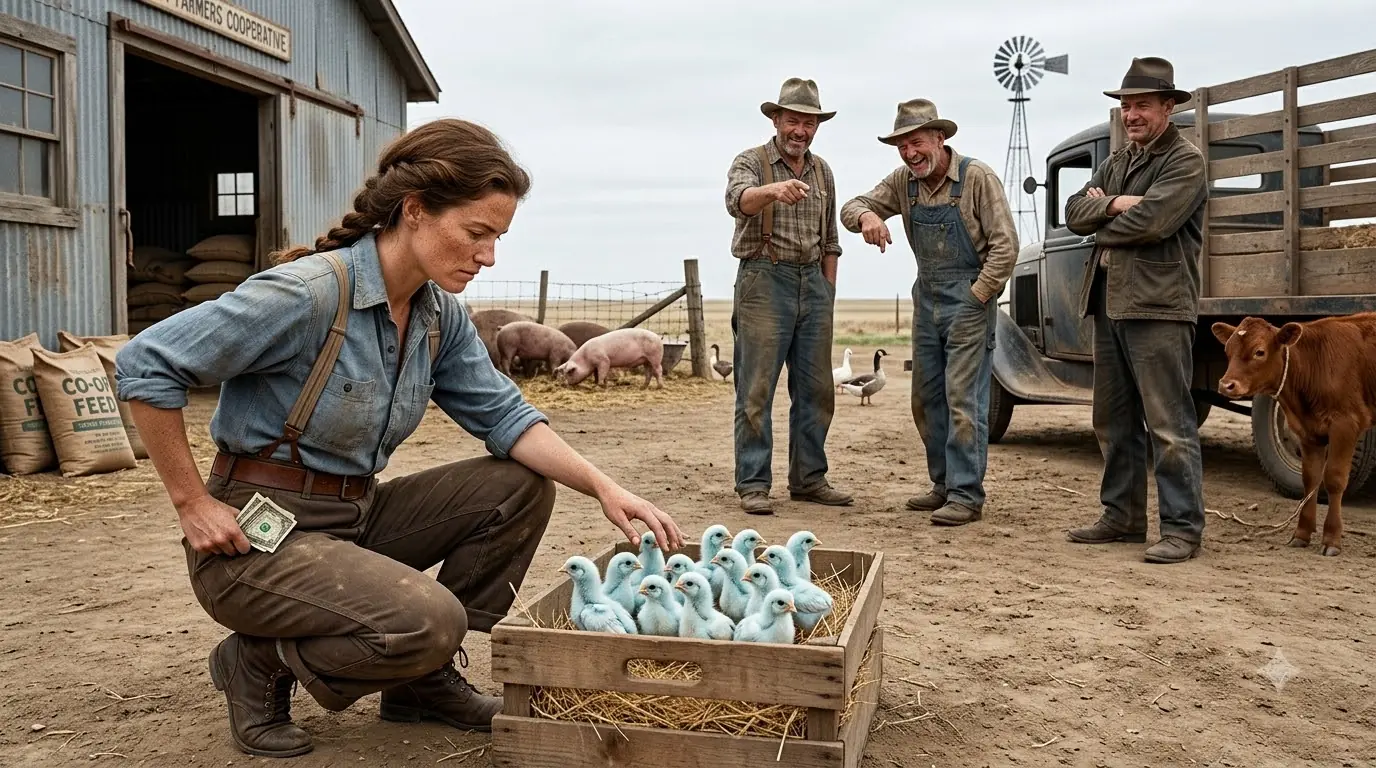
She intended to price feed.
There was an important difference.
Buying feed meant surrendering money she might need later. Pricing feed meant asking questions, doing arithmetic, memorizing figures, and then walking home empty-handed if the numbers did not work. For nearly two years, Vera had become exceptionally good at walking away from things she needed because needing something did not magically create money to pay for it.
The road into Meade County was hard-packed and pale beneath the spring sun. Vera drove her father's old Ford pickup slowly because the left rear tire had developed a habit of losing air whenever she pushed the truck above thirty miles an hour, and she refused to spend fifty cents having somebody inspect a tire that still technically held air most of the day.
Kansas stretched around her in tired shades of brown.
The wheat fields should have been greener by then.
Instead, thin shoots struggled through powder-dry soil while dust gathered along fence lines and under the dead grass beside the road.
Two years of Depression had already taught Vera what debt could do to a family.
Now drought was teaching her what weather could do to pride.
The Aldren farm had belonged to her grandfather before her father. It covered one hundred and sixteen acres outside Meade, though only about seventy-five could reliably grow wheat when the rains cooperated. The rest was pasture, windbreak, a kitchen garden, a small orchard that had nearly stopped producing, and land too uneven or shallow to justify planting.
Her father, Jacob Aldren, had died in January 1933 after pneumonia turned serious faster than anyone expected.
He was fifty-eight.
Vera was twenty-seven.
She had spent almost her entire life beside him.
Her mother had died when Vera was sixteen, leaving father and daughter with a farm neither had ever imagined running without her. Jacob cooked badly, worked constantly, forgot birthdays, repaired machinery with improbable combinations of wire and profanity, and believed almost every difficult problem could be improved by getting up earlier.
When he died, the farm came to Vera.
So did the debt.
And the advice.
There had been more advice than grain.
Lease the property.
Sell half.
Sell all.
Move to Wichita.
Take work in a hotel.
Let a neighbor plant on shares.
Marry somebody with equipment.
That last suggestion appeared so often that Vera eventually began asking men whether they were volunteering.
Most stopped suggesting it.
Vera kept the farm.
At first, because she could not imagine surrendering it.
Later, because surrender had become expensive too.
Nobody was buying land generously in 1933.
By 1935, people were selling farms because banks wanted cash, taxes needed paying, and crops no longer obeyed the optimistic calculations farmers had made years earlier.
Vera survived through small economies.
She canned anything that could be canned.
She patched shirts until the patches required patches.
She collected fallen corn from neighbors after harvest with permission.
She traded eggs for kerosene.
She repaired fence wire instead of replacing it.
She sold two dairy cows, kept one.
She planted garden beans between rows where her mother had once grown flowers.
She learned exactly how long a sack of flour lasted when biscuits became thinner near the end of the month.
And she wrote everything down.
That habit came from Jacob.
He believed memory turned hopeful whenever money was involved.
Numbers were less forgiving.
Vera carried a small notebook in the breast pocket of her faded blue chambray work shirt.
Inside were pages of feed prices, rainfall totals, debts, seed costs, egg sales, fuel purchases, milk trades, and occasionally small observations that had nothing to do with arithmetic.
South fence leaning again.
Old red hen hides eggs behind smokehouse.
Mr. Pike exaggerates everything.
That morning, she added:
Co-op feed. Ask price only.
Then underlined only.
The Meade County Farmers Cooperative stood near the edge of town in a wide dusty yard filled with grain sacks, wagons, trucks, barrels, livestock pens, and men who seemed to believe standing around talking about weather was agricultural labor.
Vera parked beside the windmill.
She climbed out wearing no coat, only her dusty-blue work shirt with sleeves rolled to the elbows, brown canvas trousers held by worn suspenders, dark lace-up boots, and a leather belt that had belonged to Jacob. Her chestnut hair was tied into a thick practical braid, though loose strands already clung around her face from the wind.
Two farmers near the entrance noticed her.
Walter Briggs and Clyde Harrow.
Walter raised one hand.
“Morning, Vera.”
“Morning.”
Clyde nodded toward the empty truck bed.
“Buying big today?”
“Planning to purchase the entire cooperative.”
Walter laughed.
Clyde did not immediately realize she was joking.
That made Vera smile.
Inside, feed prices were worse than she hoped.
Twenty-five-pound sack of mash.
Higher.
Cracked corn.
Higher.
Oats.
Not much better.
The cooperative manager, Mr. Lowell, stood behind the counter with his pencil tucked above one ear.
Vera asked the same questions twice because she wanted no misunderstanding.
“How much if I take two sacks?”
“Dollar seventy-five each.”
“Cash?”
“Dollar seventy.”
“One?”
“Dollar eighty.”
She wrote.
He watched.
“You need feed?”
“Yes.”
“You buying?”
“No.”
Lowell smiled.
“You ask prices like a banker.”
“Bankers have money.”
“Some.”
“Not the ones I know.”
He laughed.
Vera closed the notebook.
“Any screenings?”
“Maybe Friday.”
“How much?”
“Depends.”
“On?”
“How desperate everybody is.”
“Then they'll be expensive.”
“Probably.”
She put the notebook back into her shirt pocket.
Lowell leaned forward.
“You still got those laying hens?”
“Nine.”
“Thought you had fourteen.”
“Three stopped laying.”
“Two got eaten.”
“Fox?”
“One.”
“Other?”
“Neighbor's dog.”
He winced.
“Sorry.”
“I wasn't.”
“The dog cost him five dollars.”
Lowell smiled.
Vera turned toward the door.
Then she heard geese.
Not ordinary goose noise.
Offended goose noise.
A full argument seemed to be happening outside.
She stepped back into the yard.
A livestock dealer had arrived.
His truck was old enough that each board along the sides vibrated independently.
Dust settled around the tires.
The dealer, Lester Baines, was lowering the tailgate while farmers gathered.
Vera knew Lester.
Everybody did.
He traveled between small towns buying animals people wanted gone and selling them somewhere else to somebody who hopefully wanted them slightly more.
His truck contained two young pigs.
Good animals.
Expensive.
A thin red calf.
Not terrible.
Several geese that appeared ready to overthrow civilization.
And three wooden crates.
Vera should have left.
Instead, she walked closer.
Walter Briggs was already negotiating over one pig.
“How much?”
“Nine.”
“Seven.”
“Nine.”
“Seven fifty.”
“Eight seventy-five.”
“You're a thief.”
“Eight fifty.”
“Eight.”
“Sold.”
Vera watched without interest.
Eight dollars for one pig might as well have been eighty.
She walked around the truck.
Then stopped at the last wooden crate.
Twelve chicks huddled inside.
They were not yellow.
Not brown.
Not black.
Their down carried a strange pale blue-white shade, almost silver under sunlight, with darker gray feathering developing along the wings.
Vera crouched.
They were larger than ordinary chicks of similar age.
Not dramatically.
Enough that she noticed.
Behind her, Walter said:
“There are those ugly things.”
Lester looked over.
“Ugly birds still eat.”
Clyde Harrow approached.
“What are they?”
“Chickens.”
“I can see that.”
“Then you're learning.”
Several men laughed.
Lester leaned against his truck.
“Bought them from a fellow west of Liberal.”
“What breed?”
“Mixed.”
“With what?”
“Chicken.”
More laughter.
Vera ignored them.
She looked closely.
The birds did not peck randomly at the straw.
They watched.
One stepped toward the side of the crate as Vera shifted her body.
Another followed.
Then a third.
Vera moved her right hand slowly.
Twelve tiny heads turned.
She stopped.
They stopped.
She moved left.
Again, nearly every bird followed.
Vera frowned.
Clyde said:
“Look at her.”
Walter leaned closer.
“They're hypnotizing her.”
Vera put one finger against the slat.
A chick pecked once.
Not hard.
Then stepped backward.
Another replaced it.
Their movement was coordinated in a way she had never seen among ordinary farmyard chicks.
Not magical.
Nothing like that.
Just alert.
Exceptionally alert.
Vera had raised chickens since she was eight.
She knew what frightened chicks looked like.
She knew what hungry ones did.
She knew the stupid vacant curiosity of birds investigating buttons, shoelaces, and their own reflections.
These were different.
She moved her hand again.
Twelve heads followed.
Lester noticed.
His expression changed slightly.
“You interested?”
Vera did not answer.
“How old?”
“Six weeks, maybe seven.”
“Maybe?”
“Didn't hatch them.”
“Hens?”
“Most.”
“How many?”
“Twelve.”
“I can count.”
“Then we're both talented.”
She looked at their legs.
Healthy.
No obvious swelling.
Eyes clear.
Vent feathers clean.
No coughing.
No dull posture.
“What have they been eating?”
“Whatever the last fool gave them.”
“Helpful.”