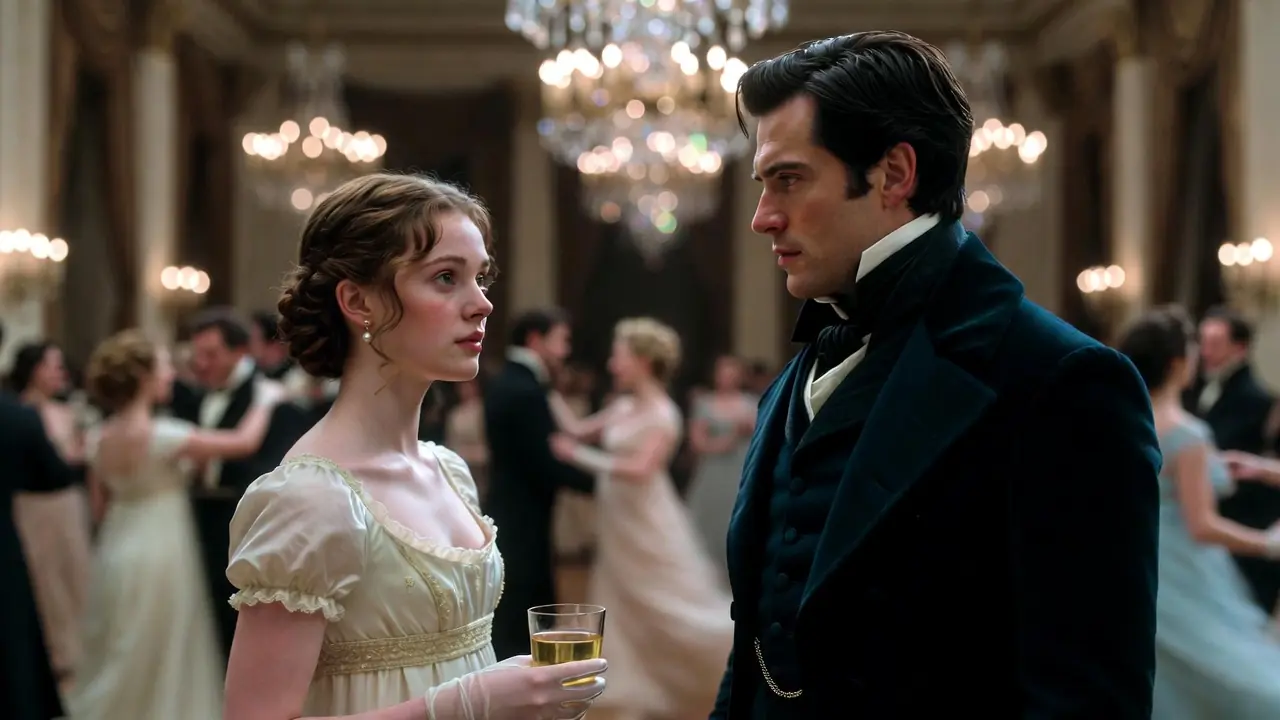
The night Sophia Holloway became the most celebrated woman in London, her sister Mara was standing in the corner of the Ashford Ballroom, holding a glass of lemonade that had gone warm.
She had been standing there for forty minutes.
Nobody had spoken to her, not because she was ugly, not because she was strange, but because she was Mara Holloway, and everyone in that room already knew that the interesting Holloway was Sophia.
Sophia, with her golden hair and her laugh that sounded like music, and her way of tilting her head just so when a gentleman spoke, as if every single word he said was the most fascinating thing she had ever heard in her entire life.
Mara watched her sister from across the room and felt something she was not proud of.
It was not quite jealousy.
It was something older and quieter than that, and something that had been sitting in her chest for so long that she had almost forgotten it was not supposed to be there.
Mara Holloway was twenty-two years old.
She had brown hair and gray eyes, and she read too many books, and she talked too fast when she was nervous.
And she had spent three years being quietly, hopelessly, completely in love with Lord Edmund Calder.
Had been.
Past tense.
That was what she kept telling herself.
But Edmund was standing beside Sophia near the center of the room, and he was smiling at her the way he used to smile at Mara.
Except it was brighter now, more certain, like a man who had finally found what he was actually looking for after spending a long time searching in the wrong direction.
Two weeks ago, he had come to the Holloway House on Barisford Street.
He had sat across from Mara in the drawing room and looked at her with those kind brown eyes she had spent three years memorizing.
And he had said something she still heard when the house went quiet at night.
He had said, "Mara, I think you know what I am going to say."
And she did know.
She had known for weeks, maybe months, in the way a person sometimes knows a thing long before they are ready to admit it to themselves.
"I care for you," he said. "I care for you very much. But what I feel for Sophia is different. It is the kind of feeling a man builds a life on. I hope you can understand that."
She had nodded and said something gracious and calm.
She had waited until he left, and then she had gone upstairs and sat on the edge of her bed and looked at the wall for a very long time.
He had not said she was nothing, not in those exact words.
But he had chosen Sophia.
And in the careful language of drawing rooms and ballrooms and the world they all lived in, that amounted to the same thing.
And Sophia had come to her room that evening with red eyes and a guilty expression and said, "Mara, I never meant for this to happen. You must believe me."
And Mara did believe her.
That was the worst part of it all.
Sophia was not cruel.
She never had been.
She was simply Sophia.
And people fell in love with her the way people sometimes fell into rivers without meaning to, without any warning at all.
And before they even realized what was happening, they were already drowning.
Mara had told her sister it was fine.
She had said it so many times in the two weeks since that she had almost started to believe it herself.
Now she was standing in the corner of the Ashford ballroom, watching Edmund lead Sophia onto the dance floor, and she was holding a warm glass of lemonade, and she was absolutely, completely, entirely fine.
"You look like someone who is pretending very hard," said a voice beside her.
Mara turned.
There was a man standing next to her.
He had not been there a moment ago, or if he had been, she had not noticed him, which seemed nearly impossible now that she was looking at him properly.
He was tall, not in the soft, unremarkable way that some men were tall, but in a way that made the space around him seem smaller and more deliberate.
He had dark hair and sharp features, and eyes that were an unusual shade, the kind that shifted between gray and something deeper, like the sky just before a storm decides what it wants to do.
He was looking at her with an expression she could not quite read.
Not pity.
Not amusement.
Something between the two, but more respectful than either.
"I beg your pardon," Mara said.
"Pretending," he said simply. "You are doing it quite well, for what it is worth. But the lemonade gave you away."
She looked down at the glass in her hand.
"The lemonade?"
"You have been holding it for the better part of an hour. It has been warm for at least forty minutes. A person who was actually enjoying herself would have set it down by now."
He paused.
"Or drunk it."
Mara stared at him for a moment.
Then, because she was tired and her heart hurt and she had been performing composure for two weeks straight without a single break, she said, "Who are you?"
Something moved in his expression.
Not offense.
Something more like surprised interest.
"Someone who noticed you," he said, "across a rather crowded room."
She opened her mouth to say something cutting and sensible, something that would end this strange conversation and allow her to return to the business of being invisible.
But at that exact moment, the music swelled and the crowd shifted.
And through the gap in the dancing bodies, she could see Edmund laughing at something Sophia had said, his whole face lit up with it, and the sight of it hit her somewhere soft and unprotected.
She looked away quickly, but the man beside her saw it.
She knew he did because she felt the quality of his attention change, become slightly more careful.
"I do not know you," she said.
"No," he agreed. "But you know everyone else in this room, and none of them have asked you, and you have been standing in this corner long enough."
He held out his hand.
It was a steady hand, not trembling, not eager, just offered quietly, like something she could take or leave entirely as she pleased.
Mara Holloway looked at that hand for a moment.
Then she set down the warm glass of lemonade on the nearest available surface, and she took it.
She did not know, as they stepped onto the floor, that the man whose hand she had just taken was James Ashford, the Duke of Windmere.
She did not know that he had been standing against the far wall of his own ballroom earlier that evening, watching the dancing with the detached expression of a man fulfilling a social obligation, and that something had made him look toward the corner.
And that when he had looked, he had seen a girl with gray eyes and brown hair, standing very still in the middle of all that noise and light, holding a warm glass of lemonade and watching the world with an expression that was so carefully composed it was almost like a painting of a feeling rather than the feeling itself.
She did not know any of that yet.
All she knew was that someone had finally spoken to her and his hand was warm.
But then the music was playing, and for the first time in two weeks, she was not pretending to be fine.
She simply was, briefly, just for one dance.
But it was enough to begin something.
Across the ballroom, Lord Edmund Calder glanced toward the edge of the floor and noticed his former love dancing with a tall, dark-haired man, and something flickered behind his eyes that he did not examine too closely.
Sophia noticed too.
She watched her sister move through the steps with this unknown man, and she tilted her head the way she always did when something surprised her.
She said quietly to Edmund, "Who is that with Mara?"
Edmund followed her gaze.
"I have no idea," he said, but his eyes stayed there longer than necessary.
The Duke of Windmere knew exactly who Mara was by the time the dance was half finished.
He had asked in his quiet way before he had crossed the room, but he knew her name and her family and the general shape of her situation.
What he had not expected was the way she spoke, direct and a little dry, with none of the careful performance most young women offered him at these events.
What he had not expected was the intelligence in her gray eyes, or the way she held herself, like someone who had been knocked sideways by something but was absolutely determined not to fall.
He found that he wanted very much to know the rest of her.
That was how it began, in a corner of a ballroom with a glass of warm lemonade and a man who noticed what everyone else had looked past.
It began quietly.
But the things that begin quietly are often the ones that change everything.
The morning after the Ashford ball, Mara sat at the writing desk in her room with a cup of tea gone cold beside her and tried to remember exactly how the conversation with the tall, dark-haired man had ended.
She remembered dancing.
She remembered that he was a good dancer, not showy, not the kind of man who used a dance floor to perform, but steady and present and aware of her in a way that made her feel like the only person in the room rather than the least important one.
And she remembered that they had talked through the whole dance, which was slightly improper, and which neither of them had appeared to care about.
She remembered that he had asked her questions and actually waited for the answers, which was rarer than it should have been.
What she could not quite remember was his name.
She had asked, and he had told her, and then the music had ended, and someone had appeared at his elbow, some older gentleman with an urgent expression.
There had been a brief exchange, and then he had looked back at her and said something she also could not quite remember, something low and certain.
And then he was gone.
She had stood on the edge of the dance floor for a moment, feeling oddly unmoored, but then Sophia had appeared beside her with shining eyes and a dozen questions.
Mara had answered them all with half her mind and spent the carriage ride home trying to hold on to the exact shade of those storm-gray eyes before they faded entirely.
She was still thinking about them when her mother swept into the room without knocking, which was how her mother did most things.
Lady Holloway was a handsome woman in her fifties, who had once been the belle of her own season and had never quite stopped treating every social occasion as a battlefield on which territory must be won or lost.
She sat down on the edge of Mara's bed without being invited and looked at her eldest daughter with an expression that was trying very hard to be casual and failing entirely.
"You danced last night," she said.
"I did," Mara agreed.
"But with a very significant person."
Mara turned in her chair.
"What do you mean, significant?"
Her mother's expression shifted into something that Mara recognized with a sinking feeling as barely containing excitement.
"Mara, that was the Duke of Windmere."
The teacup paused halfway to Mara's lips.
"The Duke of Windmere," she repeated.
"James Ashford. It was his family's ball. For goodness' sake, he is one of the wealthiest men in England. He has not danced publicly at any event in over two years, not since..."
Her mother paused delicately.
"Not since his engagement was broken."
Mara set the cup down.
"His engagement was broken?"
"To Lady Charlotte Fenwick. A dreadful business. She broke it off three months before the wedding. Ran off with some gentleman she had met on a tour of the continent. Everyone said the Duke was devastated, though of course he showed nothing. You know how these Ashford men are, all stone and silence."
Her mother paused to draw breath.
"The point is, Mara, that he danced with you in front of everyone, and people noticed. People notice everything at these events."
"It does not mean anything," Mara said.
"It means something when the Duke of Windmere does it," her mother said with absolute certainty. "Mrs. Hartwell has already sent a note this morning. Lady Prescott apparently commented on it to three separate people before she left the ball. And your father had two gentlemen inquire about you at his club this very morning, which has never happened before, not in three seasons."
Mara felt something strange move through her.
Not quite pleasure.
Not quite discomfort.
Something uncertain, like standing on ice that might hold and might not.
"One dance," she said carefully. "It was one dance, Mother."
"With the Duke of Windmere," her mother said again, as if the title itself was an argument that could not be countered.
She stood up, smoothed her skirts, and moved toward the door with the decisive energy of a woman who had already begun making plans.
"Wear the ivory gown to the Pemberton reception on Thursday. The one with the cream trim. It does something very good for your eyes."
She was gone before Mara could respond.
Mara sat for a moment in the quiet of her room.
"The Duke of Windmere."
She said it to herself in the silence and tried to match it to the man who had stood beside her and noticed the warm lemonade and offered his hand without any sort of performance attached to it.
Somehow the title did not quite fit what she remembered, which was simply someone who had looked at her like she was worth looking at.
She was still sitting with that thought when the door opened again, and Sophia came in.
This time more carefully, with an expression that was a careful mixture of happiness and guilt, which was the expression Sophia wore most of the time these days when she was around Mara.
"You know who he is," Sophia said.
It was not a question.
"Mother just informed me," Mara said.
Sophia sat down in the chair by the window and pulled her knees up in the way she always had since they were children, folding herself small.
"Edmund saw you dancing with him. He was watching for quite a long time."
Mara said nothing.
"I think it surprised him," Sophia said carefully.
"Edmund is allowed to be surprised," Mara said. "Edmund may feel whatever he likes. He made his choice."
She said it without anger.
That was the thing about being two weeks out from a heartbreak.
The anger had not really arrived yet.
What she mostly felt was tired.
And behind the tired, there was something that might eventually become anger.
But for now, it was just a dull and persistent ache that showed up most reliably in quiet rooms and dark carriages and the long stretch of time between putting out the candle and actually falling asleep.
Sophia looked at her with those wide eyes that Edmund had apparently fallen irretrievably in love with.
"Are you all right? Truly?"
"I am fine," Mara said for the hundred and seventh time in two weeks. "Sophia, I am fine."
Her sister looked at her for a moment longer, then nodded.
But on her way out, she paused at the door and said without turning around, "He was still watching when you left the floor."
"Edmund?"
"He had an expression I have never seen on him before."
Then she left.
Mara sat in the quiet room and looked at the cold tea and thought about storm-gray eyes and a steady hand offered without conditions and a man who had noticed her in a corner before anyone told him she was worth noticing.
On Thursday, she wore the ivory gown.
The Pemberton reception was smaller than the Ashford ball, held in a narrow townhouse off Grosvenor Square with too many candles and not enough windows, so that the whole room felt warm and slightly gold-tinted, like the inside of a locket.
Mara arrived with her mother and Sophia and stood near the refreshment table while her mother worked the room with practiced efficiency.
Sophia was immediately surrounded by the usual crowd of admirers, Edmund among them, his hand finding the small of Sophia's back with the ease of someone who had already decided that was where it belonged.
Mara watched the candles and tried not to feel anything in particular.
"The ivory suits you," said a voice.
She turned.
He was there, standing a careful distance away, close enough to speak, far enough that it could not be called improper.
He was dressed in dark gray, and he looked, if anything, even more precisely himself than he had at his own ballroom, which was saying something.
"Your grace," she said, because now she knew the title, and it seemed important to use it to put the correct shape around what she was dealing with.
"Miss Holloway," he said.
Something in the way he said her name suggested he had known it for longer than one night.
"How are you finding the evening?"
"Warm," she said honestly, "and rather crowded for the size of the room."
The corner of his mouth moved.
It was not quite a smile.
It was the beginning of one or the memory of one.
"The Pembertons have always believed that a gathering is only a success if the guests are slightly uncomfortable."
"A philosophy that ensures repeat attendance," she said. "Everyone leaves grateful to go home."
This time it was a real smile, small but real.
It changed his face considerably, made him look less like a portrait of someone important and more like an actual person who had feelings and opinions and perhaps even a sense of humor that he kept carefully hidden from most of the world.
"I owe you an explanation," he said.
She tilted her head.
"For what?"
"For leaving abruptly the other night. I was called away before I could say anything useful."
"You did not owe me anything that night," she said. "You were kind enough to dance with me. That was more than sufficient."
He looked at her for a moment with that unreadable expression she was beginning to recognize as his version of careful attention.
"Is that what you thought it was? Kindness?"
"Was it not?"
He was quiet for a moment.
Around them, the reception hummed and chattered, and the candles threw gold across the walls, and somewhere across the room, Sophia laughed at something Edmund said.
The sound of it was familiar enough that Mara did not even flinch.
"I noticed you," the Duke said finally. "Before I knew anything about you, before anyone told me your name, I noticed you standing in that corner, and I thought, there is a woman who is feeling something very large and being extraordinarily careful not to let anyone see it."
He paused.
"I found that I wanted to know what the something was."
Mara looked at him steadily.
"And now that you know?"
"Now that I know," he said, "I find that I want to know considerably more."
It was not a declaration.
It was not a promise.
It was simply an honest thing said by a man who appeared to have very little patience for anything that was not honest.
And Mara, who had spent the better part of three years surrounded by things that were beautifully dishonest, found it startling in a way she had not expected.
"You should know," she said carefully, "that I am not in a very good position at the moment, in terms of..."
She gestured vaguely.
"Feelings. General emotional availability."
"I know," he said. "I am not asking for feelings. I am asking if you will walk with me in the Pemberton garden, which I am told has a rather good rose arrangement and is also slightly cooler than this room, which feels as though it may reach the temperature of a bread oven before the evening is out."
Despite everything, despite the ache and the tiredness, and the way the sound of Sophia's laughter kept threading through the room like a needle, Mara almost smiled.
"A walk in the garden?"
"Simply that," he said.
She went.
The garden was indeed cooler, and the roses were indeed impressive, and they walked along the narrow path between them for a while without saying anything, which was the most comfortable silence Mara had experienced in recent memory.
Most silences lately felt loaded with things that were not being said.
This one felt like simply two people breathing the same night air without needing to fill it up with words.
Eventually, he said, "How long have you been in love with Calder?"
She stopped walking.
He stopped too and looked at her without apology.
"Forgive me. That was direct."
"Three years," she said, because there was something about the directness that made her want to match it, or something close to that. "It was not a sudden thing. It crept up very gradually, and then one day I looked around, and there it was, quite thoroughly established."
"And he chose your sister."
"Two weeks ago."
He nodded slowly, not with pity and with something more like acknowledgment.
The way a person nods when you tell them about weather that has been bad and is expected to continue for a while longer.
"I had an engagement broken," he said, "three years ago."
"I heard," she said, and then immediately felt the impropriety of admitting she had heard, which meant she had been asking or listening when people talked about him.
But he did not seem bothered.
"Then you know how it is," he said. "The way people look at you afterward."
"Oh, like you are a slightly damaged piece of furniture that has been repaired well enough, but whose history everyone already knows."
"Yes."
She said quietly, "I know exactly how that is."
They looked at each other in the garden with the rose smell around them and the faint sounds of the reception floating through the windows above, and something passed between them that was not romantic and was not friendship exactly, but was something true.
A recognition.
Two people who had both been set aside, standing in a garden, breathing cooler air.
"Walk with me again," he said. "Not tonight. In the park on Saturday, in full view of everyone, so it is all perfectly proper."
"You are very concerned with propriety for someone who talks to strangers in ballroom corners," she said.
"I am concerned with your reputation," he said, "which is a different thing entirely."
She looked at him for a long moment.
"Saturday," she said.
He nodded, and they went back inside to the warm gold room and the candles and the noise.
And across the room, Edmund Calder watched the Duke of Windmere hold a door open for Mara Holloway as they came in from the garden, and the expression on his face was the one Sophia had mentioned, the one nobody had seen on him before.
It looked, if one were being honest, very much like a man who was beginning to understand what he had let go of.
Saturday came with pale sunshine and a breeze that carried the last of winter on its edges.
The kind of morning that could not quite decide if it was cold or merely cool.
Mara arrived at the park on Barisford Walk, wearing her best morning coat and the expression of a woman who was absolutely not nervous, which she had been practicing since approximately five in the morning.
The Duke was already there when she arrived.
He was standing near the iron gate with his hands clasped behind his back, looking at the park with the steady gaze of someone who was accustomed to waiting and did not find it uncomfortable.
He saw her before she reached him, and something in his posture shifted.
Not much, just slightly, like a man who had been holding himself carefully and could now hold himself a little less.
"Miss Holloway," he said.
"Your grace," she said.
They began to walk.
Within fifteen minutes, Mara understood what he had meant about full view of everyone, because the park on a Saturday morning in the season was essentially a social occasion with trees.
There were at least a dozen people she recognized within the first turn of the path, and she could feel the weight of their attention, like a second coat.
The Duke seemed entirely unbothered by this.
He walked beside her at a comfortable pace and asked her about the book she was reading, and she told him.
And then he asked her something specific about it that suggested he had actually read it himself, which meant they spent the next twenty minutes in a discussion that was more genuinely interesting than any conversation Mara had had at a social event in the better part of a year.
She caught herself enjoying it.
The enjoyment surprised her a little, not because enjoyment was foreign to her, but because it had been in short supply lately, and she had almost forgotten what it felt like to have it arrive naturally, without any effort, without any pretending required.
"You are surprised," he said in the middle of a pause.
"By what?"
"By enjoying yourself," he said simply. "You keep looking slightly startled, as if you were expecting something unpleasant and keep receiving something that is not."
She considered denying it.
Then she said, "Is it that obvious?"
"Only to someone paying attention," he said.
She looked at him sideways.
"You pay a great deal of attention."
"It is a habit," he said. "I find it more useful than talking."
"Most people find talking considerably easier."
"Most people," he agreed, "are not particularly interested in what they might see if they stopped."
They walked in silence for a moment.
A pair of ladies passed in the other direction and nodded with the bright, slightly too interested expressions of people who were going to have something to say at their next social call.
The Duke nodded back with perfect composure, and Mara kept her face pleasant and unhurried.
"They will talk," she said when the ladies had passed.
"They are already talking," he said. "They have been talking since the Ashford Ball. I imagine half of London has formed an opinion on the subject by now."
"And that does not concern you?"
He was quiet for a moment.
Then he said, "I spent a great deal of time after Charlotte concerned with what people were saying. I found it an extremely unrewarding occupation."
He paused.
"What concerns me now is whether I am behaving well, whether I am being honest, whether the people directly in front of me are being treated with the respect they deserve. The rest of it is noise."
Mara thought about that for a while as they walked.
"That is easier to say," she said eventually, "when you are a duke."
He glanced at her then, to his credit, he did not argue the point.
"Yes," he said. "I imagine it is. I will not pretend otherwise."
That honesty, the simple willingness to agree rather than defend, was doing something to the careful wall she had built over the past two weeks.
Not knocking it down, just finding the places where the mortar was not quite set and applying gentle, consistent pressure.
She did not know whether to be grateful or alarmed.
They completed two full circuits of the park.
At the end of the second one, as they approached the gate again, the Duke stopped and turned to face her with the directness that she was beginning to understand was simply how he operated.
Not rudeness.
Just efficiency.
"I want to be clear about something," he said.
"Please do," she said.
"I am not doing this to be kind to you," he said. "I told you that already. But I am not collecting you as a charitable project, or trying to make Calder feel something by association, or playing any sort of game that has rules I have not told you."
He looked at her steadily.
"I find you interesting. I find your company genuinely pleasant. I would like to continue both of those things, if you are willing, at whatever pace makes sense to you. And that is the entire truth of it."
Mara looked at him standing there in the pale sunshine with the park behind him and the breeze lifting the edges of his coat, being honest with her in the uncomplicated way of someone who had stopped seeing the point of being otherwise.
"All right," she said.
"All right," he said.
He left her at the gate, and she walked home on her own because the Holloway House was only three streets away and she had come alone and it was perfectly proper in daylight.
Mara walked slowly, turning the morning over in her mind, examining it from different angles the way she sometimes did with chapters of books that she wanted to understand better before she continued.
Her mother was waiting in the hall when she arrived.
"Mrs. Beaumont saw you," Lady Holloway said without preamble. "She sent a note. She says you were walking with the Duke for the better part of an hour in full view of everyone on the Saturday Promenade path."
"About forty minutes," Mara said, taking off her coat.
Her mother made a sound that was halfway between a sob and a triumphant laugh.
"Mara, do you understand what this means?"
"It means I took a pleasant walk with an interesting man."
"It means the Duke of Windmere is courting you," her mother said in the voice people used for things they had been waiting a very long time to say in public, "which he has not done for anyone in three years. Mara, this is extraordinary."
Mara hung up her coat and thought about what the Duke had said, the clean plainness of it.
I find you interesting.
At whatever pace makes sense to you.
"Let us not get ahead of ourselves," she said.
But she was smiling a little when she said it, which her mother saw, and which made Lady Holloway press both hands to her heart and look upward with the expression of a woman whose prayers were being answered at a speed she had not anticipated.
But what nobody saw was that across town in the Calder Townhouse on Millbank Street, Lord Edmund Calder had received three separate mentions of the Saturday Park Promenade before noon, and had responded to all three with a composed and pleasant expression that fooled everyone in the room except possibly himself.
He sat in his study that evening and looked at the fire and thought about Mara Holloway, the woman he had always liked and respected and cared for in the genuine way of a person who means well, but is pointing their heart in the wrong direction.
He thought about her gray eyes and the way she talked when she was interested in something, and the three years she had waited quietly.
And he thought about the Duke of Windmere, who was reportedly a man of considerable character, and who had apparently looked across a ballroom and decided that Mara Holloway was worth crossing a room for.
Edmund sat with that for a long time.
Then he did something he was not proud of, which was to wonder for the first time if he had made an error.
The weeks that followed had a particular quality to them that Mara found difficult to name.
Something was shifting slowly and then all at once.
The way seasons shifted so gradually you could not catch the exact moment when one became the other, and yet one morning you stepped outside and realized everything was different.
She and the Duke, James, she had begun to call him James in her own thoughts, though not aloud, not yet, continued to see each other at the usual social events of the season, which was to say nearly every other day.
They danced when there was dancing.
They talked in gardens and at the sides of rooms, and once, in a particularly memorable afternoon in the Holloway family's front drawing room, with her mother positioned in the corner, pretending to do needlework while listening with every fiber of her being to every word spoken.
Mara had found it more amusing than embarrassing.
James had been perfectly composed throughout, and afterward, in the hall as he was leaving, said very quietly, "Your mother embroiders extremely loudly for someone attempting to appear uninterested."
Mara had had to press her hand over her mouth to keep from laughing outright.
She was laughing more.
She noticed it in the way one notices the return of an appetite after an illness.
It crept back in gradually, first in small things.
A dry remark here.
A genuine smile there.
Then in longer stretches, where she would be in the middle of a conversation with James and realize she had not thought about Edmund in hours.
The realization would be followed not by guilt, but by something lighter and more hopeful.
But the world, as it always does, had opinions about this.
The trouble began at the Rothmore dinner.
The Rothmores were a family of considerable social standing and very little warmth, the kind of family that hosted gatherings not because they enjoyed company, but because social influence required maintenance.
The dinner was twelve courses and three hours, and the seating was arranged, as it always was at Rothmore events, with the precision of someone who understood that where you placed people said everything about how you valued them.
Mara was seated near the middle of the table.
Not an insult, but not a compliment either.
The sort of placement that said, you are here, we have acknowledged your existence, let us proceed.
Lady Rothmore, who was seated at the head and who had the particular talent of the very wellborn for delivering devastating observations in perfectly pleasant tones, waited until the fourth course to say it.
"Miss Holloway," she said, addressing the table at large in the way of someone who wanted an audience. "How delightful that the season has turned up so much of interest for you. One hears such things."
She smiled, but it was a very accomplished smile.
"Though, of course, one does wonder sometimes about the wisdom of a young woman in an uncertain position attaching herself, as it were, to a connection of such elevation. It can raise expectations in ways that are not always kind."
The table went quiet in that particular way dinner tables go quiet when something has been said that everyone heard and nobody will acknowledge.
Mara set down her fork very carefully.
She was aware of eyes on her from every direction.
She was aware that how she responded in the next ten seconds would be discussed and dissected and repeated in drawing rooms for the next week.
She was also aware, somewhere in the middle of all that awareness, of a feeling that was clean and clear and had no complexity to it at all.
She was angry.
Not the dull, unformed ache of the past weeks.
This was proper anger, bright and specific, and entirely justified.
"How thoughtful of you to consider my welfare, Lady Rothmore," she said, in a tone that matched her hostess's pleasantness perfectly. "I find, however, that wisdom in these matters looks different depending on one's vantage point. From where I am sitting, which is to say from the vantage point of a woman who has been spoken to honestly and treated with genuine respect, the connection seems very sensible indeed."
She picked up her fork again.
"But I appreciate the concern. It speaks well of you."
There was a beat of silence.
Then the conversation resumed around the table all at once in the way of people releasing a collective held breath, and Lady Rothmore's smile had become somewhat fixed at the edges.
Several people who had been watching Mara were now watching her with expressions that were more interested than before.
James was seated four chairs away across the table.
She did not look at him during any of this, but she felt his attention on her the way you feel sunlight on your face with your eyes closed, warm and present and steady.
After dinner, in the drawing room where the women gathered while the men had port and whatever it was men talked about over port, the atmosphere around Mara had changed.
Several women who had previously treated her with the polite indifference reserved for unremarkable people now sought her out.
Mrs. Dalton, who was formidable and well-connected, and had never in three seasons addressed more than three consecutive words to Mara, sat beside her on the settee and said, "Well handled, my dear. Rothmore has needed that for years. She has the manners of a very well-dressed cat."
Mara managed not to laugh, but it was a near thing.
When the men rejoined them, James found her within moments, which was itself the kind of thing people noticed.
And his eyes, when he reached her, were doing something she was learning to read, that particular quality of attention that meant he had seen something and was deciding what to do with it.
"Four chairs away," he said quietly. "And still well within hearing range."
"I know," she said.
"You did not hesitate," he said.
"I was angry," she said simply. "Anger is clarifying."
He looked at her for a moment with something she was not ready to name quite yet.
Something warm and certain that lived behind his usual composure.
"Yes," he said. "It is."
What Mara did not see, because she was not looking in that direction, was Edmund standing across the drawing room watching this exchange with Sophia at his side, and the expression on his face had gone somewhere private and difficult.
Sophia saw it.
She had been seeing it for weeks, the way his gaze found Mara whenever they were in the same room, the half second of something in his eyes before he remembered to look away.
She had not said anything.
She was not sure she was allowed to say anything.
Mara had chosen Edmund, and Edmund had chosen her.
And she was genuinely happy, or something very close to genuinely happy.
But there was a question she could not stop turning over in her mind.
The question of whether the person Edmund had chosen was Sophia, or whether it was the absence of Mara.
And those were two very different things.
She did not know the answer.
She hoped she was wrong about the question.
Three days after the Rothmore dinner, Edmund came to the Holloway House, not to see Sophia.
That was the thing that cracked something open in the careful structure of the following weeks.
He came on a Tuesday morning when he knew Sophia was out, because he had her schedule by heart by now.
He sat across from Mara in the same drawing room where he had ended things a month ago, and he looked at her with an expression that was not composed at all.
"I need to say something to you," he said.
Mara sat very still.
"Then say it."
"I think I made an error," he said.
The room was very quiet, and outside, a carriage went past on the street.
A clock ticked somewhere in the hall.
"Edmund," she said.
"I think I confused myself," he said. "I think I had been looking at Sophia for so long because she was bright and easy and she made everything feel uncomplicated, and I convinced myself that what I felt for her was greater than what I felt for you because it was louder. But loud is not the same as deep."
He stopped, then started again.
"I miss you. Not in the way of missing something you are accustomed to, but in the way of understanding too late that something was important."
Mara looked at him for a long moment.
She had loved this man.
She was honest enough with herself to know that part of her still held an echo of it, the way a room holds the shape of warmth after the fire goes out.
She could feel that echo clearly, and she could also feel with equal clarity that it was an echo, and that the fire itself had moved on to burn somewhere else.
"Edmund," she said carefully. "What you felt for Sophia was real. I believe that. I believed it then, and I believe it now."
"But what I felt for you was also real," he said.
"Yes," she said. "But you made a choice, and I would like you to think very carefully about why you are unmaking that choice now, and whether it has anything to do with the Duke of Windmere's interest in me."
He flinched, just slightly, which told her everything.
"That is not the only reason," he said.
"I believe you," she said. "But it is a reason, and I think you know that."
She looked at him with the gray eyes he had once told her were uncommonly steady.
"You chose Sophia. Sophia loves you. I think whatever complications exist in that, they are between the two of you. I am not a solution to them."
He was quiet for a long time.
"Are you happy?" he said finally. "With him?"
"Are you happy?"
She thought about it honestly.
"I am becoming happy," she said. "That is not the same thing. But it might be better. It is something I have chosen and am choosing, rather than something that happened to me. I find I prefer it that way."
Edmund stood up.
He looked, in that moment, younger than she had seen him in a long time and a little lost.
She felt a brief, uncomplicated compassion for him that had nothing desperate or longing in it.
"He is a good man," Edmund said.
Not quite a question.
"I believe so," she said.
He nodded.
He left.
Mara sat in the drawing room for a while after and took stock of herself.
She had expected that conversation, if it ever came, to feel like a victory, or at least like a vindication.
What it actually felt like was simpler than that.
It felt like a door closing gently on a room she had already left.
She was ready to go further into the house.
The thing about a story that everyone in a social season is watching is that it develops its own momentum.
People talked about Mara Holloway and the Duke of Windmere the way they talked about the weather, constantly, with great investment and with a strong preference for interesting developments over quiet ones.
What they got for a while was quiet ones.
James was not a man who moved quickly, not publicly, not with anything that mattered.
He was careful in the way of someone who had been hurt by moving too fast before and had learned the lesson thoroughly.
He called on Mara twice a week at the Holloway House, where her mother received him with barely concealed delight.
Her father, a quiet man who preferred books to people and had not been paying attention to the season in general, had roused himself enough to have two very thorough conversations with the Duke about Roman history and come away from both with the firm opinion that the man was worth keeping.
Mara and James walked.
They talked.
They danced when dancing was available.
He sent her books sometimes.
Not with notes, just the books themselves, which she found she liked better than notes, because it meant he had thought about what she would enjoy rather than what would impress her.
She sent him back the ones she had already read with her own thoughts written in the margins, which she realized was perhaps an extremely irregular thing to do, and which he appeared to find delightful.
Between these encounters, Mara thought about him.
This was the honest truth of it, and she was done with dishonesty about herself.
She thought about the way he said her name and the particular quality of his attention, and the small real smile that was different from the composed social expression he wore for most of the world.
She thought about the conversation in the rose garden about being set aside and how it had felt like being genuinely seen by someone for the first time in a very long while.
She was falling in love.
She could recognize the shape of it by now, having done it once before.
But this version was different.
The first time had been soft and unexamined, a gradual slide she had not noticed until she was already at the bottom.
This time she was watching it happen with her eyes open.
She knew what she was walking toward, and she was choosing every step.
That terrified her.
Not because of James, but because of herself.
Because she had been wrong before, badly wrong, and the heart that had survived being set aside was not a careless thing anymore.
It asked questions now.
It required answers before it committed.
She was in the middle of one of these private negotiations with herself on a Wednesday afternoon when her friend Clara Whitmore arrived unexpectedly and sat down in the drawing room with the expression of someone who had news and had been holding it since morning.
Clara was Mara's oldest friend, a sharp and practical woman who had married sensibly two years ago and spent most of her time either managing her household with quiet efficiency or visiting Mara to dissect the social season with cheerful ruthlessness.
She was one of the only people Mara trusted to tell her the truth, even when the truth was inconvenient.
"Something has happened," Clara said before she had fully sat down. "I am going to tell you, and I need you to be calm."
"That introduction does not inspire calm," Mara said.
"Lady Charlotte Fenwick has returned to London," Clara said.
The drawing room was very quiet for a moment.
"James's Charlotte," Mara said.
"The very same. She is back from the continent, apparently unattached, apparently contrite, and apparently telling everyone who will listen that her greatest mistake was leaving James Ashford."
Clara paused.
"She was at the Merryweathers' this morning. She asked after him directly. She was not subtle about it."
Mara looked at her hands in her lap.
She felt something move through her that was not quite fear and not quite anger.
It was more complicated than either of those.
It was the particular sensation of a person who had been carefully building something good, looking up and seeing a wind coming.
"He broke the engagement," she said carefully.
"No, she broke it. Mother said she broke it."
"She did," Clara said. "And she has apparently spent three years regretting it. And she is very beautiful. And she was his intended. London has a long memory for those things."
She paused.
"I am not trying to frighten you. I am trying to make sure you are not the last person to know about this, because you are my friend, and I will not have you blindsided."
"I appreciate that," Mara said.
"What will you do?"
Mara thought about it honestly.
"Nothing," she said. "There is nothing to do. Whatever James decides to do with this information is his business. I have not claimed anything from him. He has not promised anything to me."
Clara looked at her steadily.
"And if he goes back to her?"
Mara sat with that for a moment, the genuine possibility of it.
James choosing someone he had once chosen before, someone who was beautiful and who had once been certain enough to promise to marry him, even if she had lost that certainty and then found it again too late.
"Then he goes back to her," Mara said. Her voice was level. "I will survive it. I survived the last one."
"You should not have to merely survive things," Clara said. "You deserve more than that."
"I know," Mara said. "But I also know that a man cannot be held to feelings he has not declared. And I will not be the woman who panics and makes demands and ruins something that is still being built just because a storm is coming."
She looked at Clara.
"I trust him to be honest with me. That is all I can do."
Clara looked at her for a long moment.
"You love him?"
Clara said it was not a question.
Mara did not deny it.
"Yes," she said quietly. "I believe I do."
She saw James two days later at a musical at the Fenwick House, which was the cruelest possible piece of timing the social calendar had ever produced, because Lady Charlotte Fenwick was there in the house her family owned, wearing an expression of careful hope and looking, as Clara had said, very beautiful.
Mara arrived with her mother and took her seat and watched from across the room as Lady Charlotte made her way toward James with the deliberate grace of a woman who had planned this encounter and intended to execute it well.
James saw Mara before Charlotte reached him.
Across the room, through the assembled guests settling into their chairs, and the musicians tuning at the front, and all the usual organized noise of a musical beginning.
He saw her, and the expression on his face did not shift dramatically or make any sort of performance of itself.
It simply settled, the way a compass settles when it finds north, quietly, with certainty.
He excused himself from Lady Charlotte's approaching path with a brief courteous word, and he crossed the room to where Mara was sitting.
He sat down in the empty chair beside her without asking if it was taken.
"Good evening," he said.
"Good evening," she said.
"You have heard," he said.
"Clara told me two days ago," she said.
He nodded.
Around them, the musical was beginning, which meant that conversation was technically inappropriate, which meant that whatever was said next would be said quietly and close, leaning slightly toward each other in the way of people sharing something that belongs only to them.
"She came to Windmere House yesterday morning," he said.
Mara kept her eyes on the musicians at the front of the room.
"She is sorry," he said. "She was quite sincere about it. Three years is a long time to regret something, and she has regretted it thoroughly."
He paused.
"She asked if there was any possibility of beginning again."
The violinist drew the first long note out into the room, and it hung there, beautiful and aching.
"What did you say?" Mara asked.
"I said no," he said simply. "I said it kindly because she deserved kindness. But I said it clearly because she deserved clarity, too."
He was quiet for a moment.
"What I had with Charlotte was real. I will not diminish it. But it is finished. It has been finished for a long time. What finished it was not her leaving. What finished it was coming to understand, in the time after that, what I had felt was not wrong exactly, but was incomplete, like a room with very good furniture and no light."
Mara turned to look at him.
He was looking at the musicians.
His profile in the warm light of the room was precise and serious and entirely familiar to her now.
The way a person's face becomes familiar, with all the small geography of it, the particular line of his jaw, and the slight furrow that appeared between his brows when he was thinking carefully about something.
"And what is there light in?" she said softly.
He turned then and looked at her, and there was nothing composed or careful in his expression now.
It was simply his face doing what faces do when a person has stopped managing them and let the truth come through.
"You," he said. "You, Mara."
It was the first time he had used her name without the miss in front of it.
In the middle of a musical with forty people around them and the violin singing above their heads.
It landed somewhere deep and permanent.
She did not say anything.
She did not have to.
She reached across the small space between their chairs and put her hand over his where it rested on his knee, quietly, for just a moment.
And then she took it back and looked at the musicians again.
Beside her, she felt him exhale.
Across the room, Lady Charlotte Fenwick watched this from her seat with an expression that was sad but not surprised.
She had come back too late.
She had known walking into this room that she had probably come back too late.
The knowing did not make it easier, but it made it true.
And truth, however uncomfortable, was something you could eventually find your footing on.
And in another part of the room, Edmund Calder sat beside Sophia and watched Mara Holloway lean very slightly toward the Duke of Windmere in the warm light of the musical.
He understood, in the clear and final way of a person who had been avoiding understanding something for too long, that what he had let go of was already someone else's to hold.
Sophia took his hand in the dark of the room.
He held it back and tried to remember why he had chosen it, and slowly, as the music continued, remembered that the reason was real, fast, and good, and worth holding on to.
There is a particular quality to the end of a London season.
Something bittersweet and slightly breathless, like the last pages of a book you have been reading slowly because you did not want it to end.
The weather shifts.
The social calendar thins.
People begin to speak about the country, about estates and autumn, and the particular relief of removing themselves from the constant performance of being seen.
Mara was in the Holloway garden on a Tuesday afternoon in late September, sitting in the old stone chair that had been there since before she was born, reading with the last of the warm light on her pages, when she heard the side gate open.
She did not look up immediately.
The gate was always being opened by one member or another of the household.
But there was a particular quality to the footsteps on the garden path.
She looked up.
James was there, which was unusual because he had not been announced, and because he had come through the garden gate rather than the front door, and because he was not wearing his usual composed expression.
He was wearing something more unguarded than that.
Something she had only seen in pieces before, in ballroom corners and garden paths and the warm dark of a music hall, but never all at once.
"I spoke with your father this morning," he said.
Mara closed her book.
"I would have told you first," he said. "But protocol requires the father, and I thought perhaps that you would prefer to know what he said before I said anything else."
He paused.
"He said yes. He said it very quickly, actually, and then spent twenty minutes talking about Roman aqueducts. So I believe he approves."
Mara looked at him standing in her garden in the September light.
The leaves on the old elm in the corner were just beginning to turn, the first hint of gold at the edges.
Everything was on the edge of something.
"You asked my father," she said.
"I asked your father for the right to ask you," he said. "Those are different things. What I ask your father is his business. What I ask you is yours."
He came a little closer, not rushing, the way he never rushed anything.
He looked at her with those eyes that were gray-blue and storm-edged and entirely certain.
"Mara, I am not asking you because of the season or because of what people will say or because it is the sensible next step in the progression of a well-managed courtship."
He stopped.
"I am asking you because I have spent six months discovering that you are the most genuinely interesting person I have encountered in a very long time. And because your company is the thing I look forward to most in any given week. And because when I imagine the future now, you are in it, in all the quiet ordinary ways as well as the bright ones, and I cannot imagine it being better without you in it."
The garden was very still.
The elm rustled once.
Somewhere inside the house, a door closed.
"I am also asking you," he said with the ghost of that small real smile, "because I suspect you have been making up your mind for several weeks already, and I am simply now giving you the formal occasion to tell me what you have decided."
Mara looked at him.
She thought about a corner of a ballroom and a glass of warm lemonade.
She thought about a rose garden and an honest man saying honest things in the dark.
She thought about a music hall and a hand placed briefly over another and the sound of a long exhale.
She thought about books with notes in the margins, sent back and forth like letters.
She thought about laughing again after weeks of not being able to.
She thought about the feeling of someone paying attention to you so completely that you remembered what it felt like to be worth attending to.
She thought about the girl who had stood in that corner two months ago pretending to be fine while holding warm lemonade.
And she thought about who she was now, standing in her own garden with the September light on her face, not pretending anything at all.
"I have made up my mind," she said.
"I thought you might have," he said.
"Or you are an extremely presumptuous person," she said.
"I am very much aware of that," he said.
"And you talk a great deal for someone who claims to prefer listening."
"Only when the subject warrants it," he said. "You warrant it."
She stood up from the old stone chair and set her book down on it and took two steps toward him on the garden path.
And he did not move to close the remaining distance, which was very like him, always giving her the room to choose, but always making the offer and leaving the acceptance entirely to her.
She crossed it herself.
"Yes," she said when she was standing in front of him, looking up at him in the September light. "That is what I have decided. Yes."
Something happened to his face.
Not drama.
Not performance.
Just the quiet arrival of something that had been on its way for a long time, settling into place with the gentle certainty of something that belongs exactly where it has landed.
He raised one hand and touched her face very carefully, the way a person touches something they are still half afraid of losing.
And she leaned into it without hesitation, because she was done being careful in that particular way, the way that held everything at arm's length under the name of caution.
"Yes," he said very quietly, as if confirming something to himself as much as to her.
Inside the Holloway House, Lady Holloway was watching from the drawing room window with both hands pressed to her mouth.
Her husband was beside her with a book he had technically been reading, but had not turned a page in twenty minutes.
And when he saw his eldest daughter cross the garden and say something to the Duke, and then the Duke's hand rise to her face, he closed the book quietly and said with great satisfaction, "Good."
Lady Holloway made a sound that suggested she found this response insufficient.
"That is good?"
"It is what I hoped for," he said. "Good is the right word for it."
She was still formulating a response to this when Sophia appeared in the doorway behind them, having come from upstairs, where she had apparently also been observing from a window.
She looked at her sister in the garden, and her face did the thing it always did when Sophia felt something deeply, became very open and uncomplicated and entirely honest.
"She looks happy," Sophia said.
"She does," her mother agreed.
"Not fine," Sophia said more quietly. "Actually happy. You can see the difference."
And you could.
Even from a drawing room window, even at this distance, even through glass, you could see it.
Mara Holloway standing in her own garden in September sunshine, looking up at the man who had walked across a ballroom because he had noticed her in a corner and decided she was worth noticing.
And there was nothing performed about it or careful or contained or managed.
She was simply, genuinely, thoroughly happy.
This, it turned out, was the thing that love looked like when it arrived the right way.
Not like being swept up and set down somewhere you had not chosen.
Not like waiting for someone to see you and hoping it would happen.
Not like standing in a corner pretending to be fine.
It looked like being seen first.
Like being chosen clearly and without confusion.
Like knowing all the way down to your bones that you were not the second choice or the consolation or the unremarkable Holloway whom people looked past on their way to the interesting one.
You were the one someone had crossed a room for.
You were the one someone had come back to again and again, at a pace that was thoughtful and honest and never once made you feel like you needed to pretend.
You were, it turned out, someone's entire point.
And that was everything.
In the weeks and months that followed, the story became one of those stories that London seasons remembered, not because it was the most dramatic or the most scandalous, but because it had that quality that the best stories have, where in retrospect every step of it felt inevitable.
Of course he had crossed the room.
Of course she had taken his hand.
Of course two people who had both learned how it felt to be set aside had recognized something in each other and decided, with great care and great honesty, to try building something that would hold.
Edmund Calder married Sophia Holloway the following spring in a very lovely ceremony, to which Mara came as the joyful older sister.
She genuinely was by then, arm in arm with James, and the whole thing was warm and uncomplicated and exactly what it should have been.
Lady Charlotte Fenwick traveled back to the continent and was reported to be doing quite well, which Mara was glad to hear because she was not a woman who required other people to be unhappy in order to feel secure in her own happiness.
She had, she thought, enough of the real thing not to need that.
James gave her a house in the country that had more books than rooms, which she told him was irrational, and which she loved completely.
She wrote in the margins of every one.
He read them all.
This was not the end of things.
It was, as all real beginnings are, disguised as one.
But this is where we leave them.
In a garden in September, in the moment when everything that had been broken had finished being broken, and something new had taken up the space left behind.
The girl who had stood in the corner holding a glass of warm lemonade.
The man who had looked across a room and seen her.
The long, quiet, wonderful everything that came after.