The woman in the white gown had barely crossed the marble floor when the blonde manager stepped in front of her.
“You have the wrong appointment,” the manager said.
Her voice was pleasant enough for a stranger listening from the sidewalk, but the tightness around her mouth told a different story. Behind her, two sales associates stood motionless beside a curved glass counter displaying diamonds beneath warm lights. A security guard near the far wall looked at the door and then quickly away.
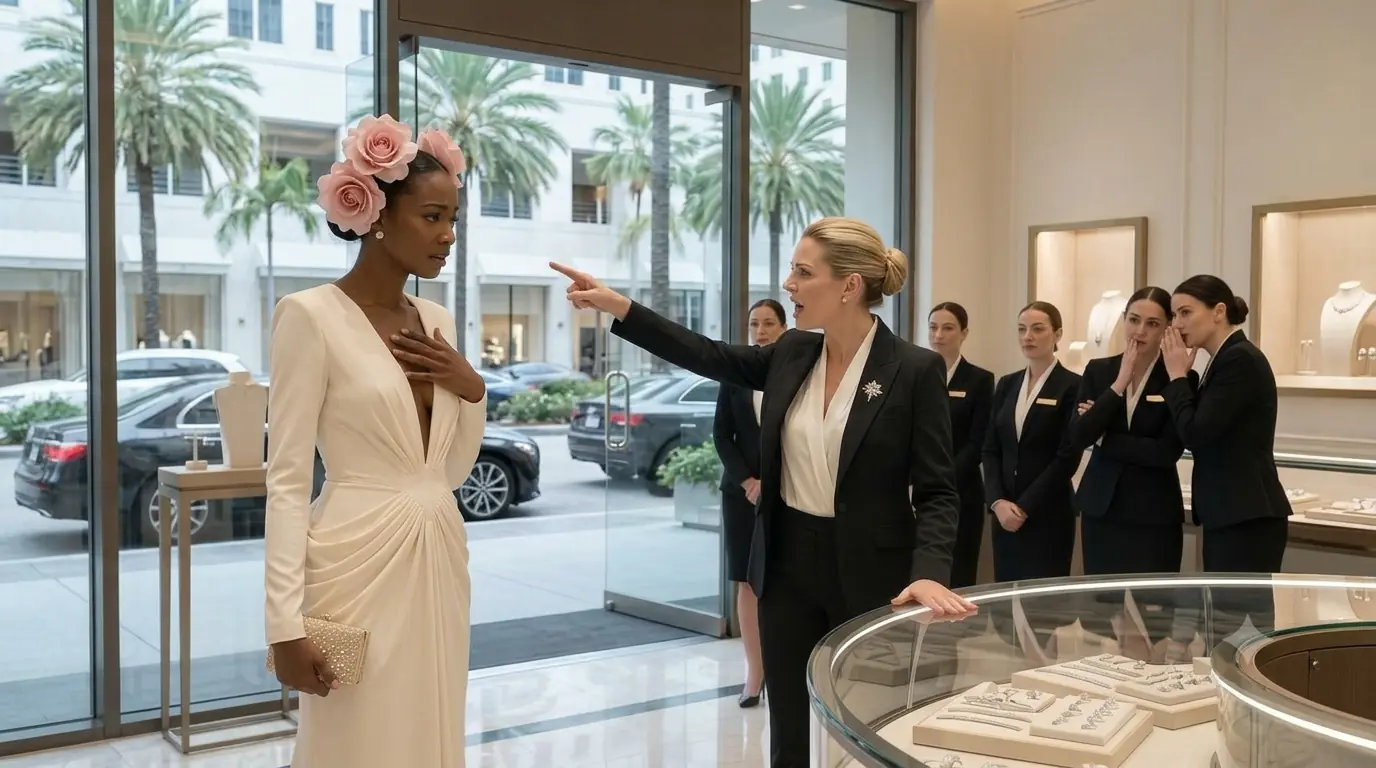
The customer stopped. Her ivory gown fell in long, graceful folds to the polished floor, the tailored wrap neckline framing a delicate pendant. A pale peach flower rested against her dark, neatly styled hair. Her expression remained calm, though the hand holding her small evening bag tightened once.
“I was told someone would meet me here,” she replied.
“Someone made a mistake.” The manager glanced toward the open glass entrance, where afternoon light caught the gold metal framing. “We handle private clients by appointment. You can’t simply arrive dressed for an event and expect us to reorganize the day.”
The customer looked past her at the display counters.
“Then perhaps you should check the appointment book.”
“I am the person who manages that book.”
“That is why I asked you.”
A brief silence settled between them. One associate lowered her eyes. The manager’s face reddened, just a little, as if the quiet answer had somehow been louder than an insult.
From a nearby counter, a man in a tailored navy suit stepped toward them and stopped when he saw the manager’s rigid posture. He had been expecting a routine client introduction. He was beginning to understand that something else was happening.
The woman in white slowly turned her head toward the manager.
“Before you decide I don’t belong here,” she said, “you should know why I came.”
The manager gave a thin smile.
“Oh, I think I know exactly why.”
The customer did not answer. She simply reached into her evening bag and touched the edge of a folded letter that had taken her eleven years to earn the courage to open.
At that moment, nobody in the boutique knew the letter existed. Nobody knew why its envelope carried the faded impression of a flower, or why the woman had chosen to wear white, or what she would eventually ask them to bring out of a vault that had been closed since the previous winter.
Most of all, the manager did not know that the woman she was trying to dismiss had already paid for something no other customer in the room could buy.
Three weeks earlier, Amelia Vaughn had almost thrown the letter away.
It sat on her dining table beside a stack of design sketches, a laptop full of unanswered emails, and a shallow porcelain bowl containing hairpins and loose earrings. Her apartment overlooked a narrow street lined with flowering trees. It was beautiful in the way places could be beautiful after one had lived through enough disorder to appreciate quiet, and Amelia had built the quiet deliberately.
She was thirty-two, a jewelry designer known for restrained pieces that looked simple from a distance and intricate when examined closely. Her work appeared in fashion editorials, on the red carpet, and in the private collections of women who did not want to wear something everyone else recognized. She preferred small studios to grand launches. She preferred a customer describing a memory to an influencer listing the price of a stone.