The dust hadn’t settled on Willa Kennedy’s dreams in three years, not since the day she’d buried her husband and watched everything she’d worked for crumble into the unforgiving Nevada desert soil.
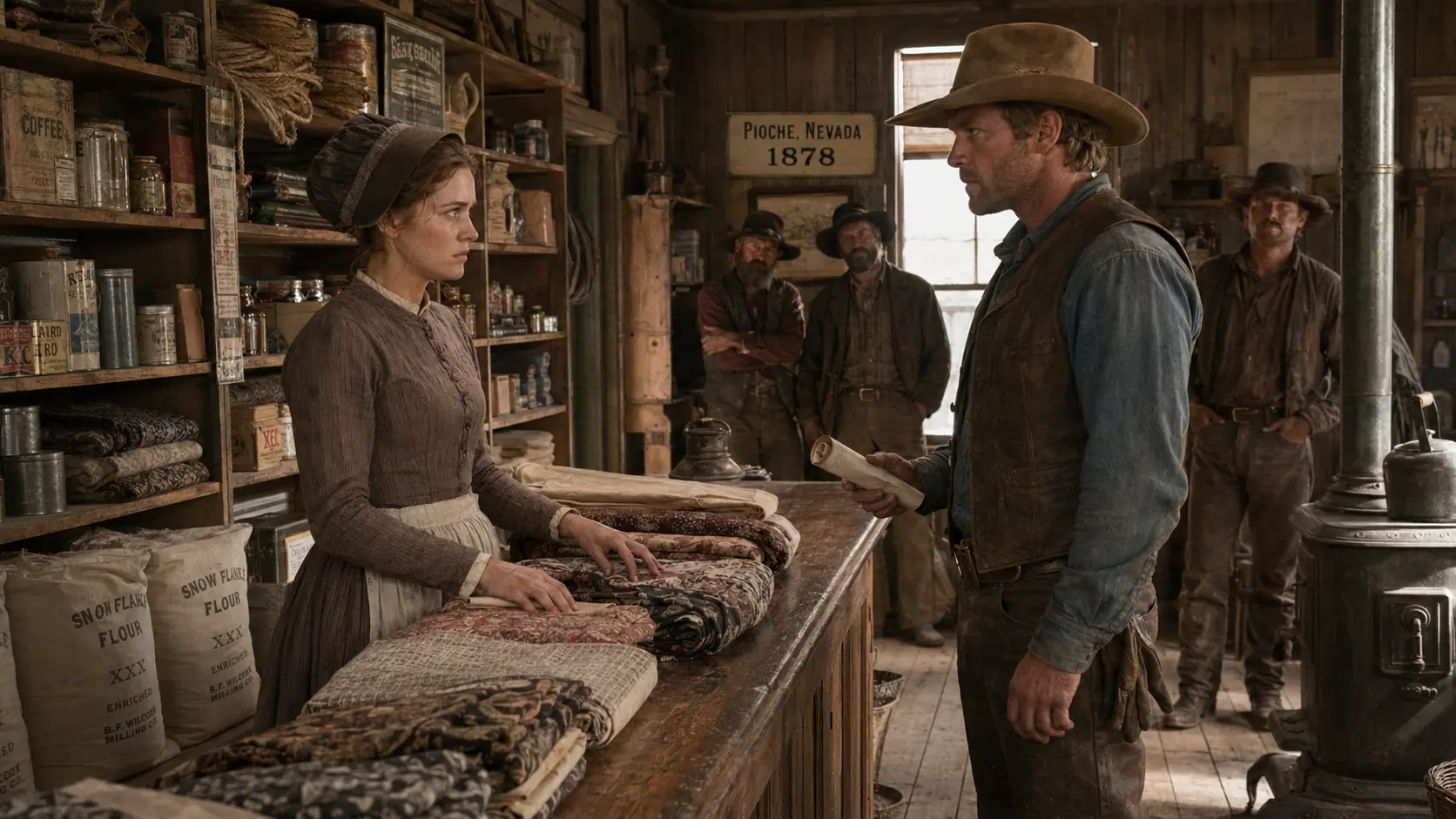
She stood behind the counter of the general store in Pioche, Nevada, her hands mechanically sorting through bolts of fabric while her mind wandered nowhere in particular.
It was safer that way.
The year was 1878, and the silver mining town had seen better days, though it still drew men with grand ambitions and empty pockets.
Willa had learned to keep her head down, do her work, and expect nothing more from life than the next day’s survival.
At 24 years old, she felt decades older, her heart wrapped in layers of protective stone.
The bell above the door chimed, and she glanced up reflexively.
A tall man stepped inside, his boots leaving traces of red dust on the wooden floor.
His hat was weathered but well maintained, and his eyes held a brightness that seemed almost foreign to her now, eyes that still believed in something.
“Afternoon, madam,” he said, his voice carrying a warmth that made her instinctively take a small step back. “I’m looking for some supplies. New in town, starting up a ranch about ten miles west of here.”
Willa nodded curtly.
“What do you need?”
“Name’s Frank Irving,” he said, extending his hand across the counter.
When she hesitated, he didn’t seem offended, just lowered his hand naturally.
“I’ll need flour, salt, coffee, some nails, and rope if you’ve got good quality.”
She moved through the store with practiced efficiency, gathering items and placing them on the counter.
Frank watched her with an openness that made her uncomfortable.
Most men in Pioche either ignored women entirely or looked at them with intentions that had nothing to do with respect.
This man seemed different, though she’d learned not to trust first impressions.
“You’re the widow Kennedy, aren’t you?” he asked as she tallied his purchases.
Her hand stilled for just a moment.
“That’ll be $4.30.”
“I apologize if I spoke out of turn,” Frank said gently. “Old Tom at the boarding house mentioned you ran the best store in town. Said you were fair and honest, which seems rare enough these days.”
“$4.30,” Willa repeated, her voice flat.
Frank counted out the money and began gathering his supplies.
At the door, he paused.
“I meant no disrespect, Mrs. Kennedy. I hope you’ll forgive a newcomer’s clumsy attempt at being neighborly.”
After he left, Willa found herself staring at the coins on the counter longer than necessary.
Something about Frank Irving unsettled her, not because he seemed dangerous, but because he seemed hopeful.
Hope was a luxury she could no longer afford.
Over the following weeks, Frank became a regular customer.
He was building his ranch from almost nothing, he explained during one visit, buying a piece of land that others had deemed too difficult to work.
He’d come from Montana, where he’d worked as a ranch hand for years, saving every penny until he could afford his own place.
“Why here?” Willa asked one afternoon, surprising herself with the question.
She normally didn’t engage in conversation beyond what was necessary.
Frank’s face lit up at her interest.
“The land spoke to me. I know that sounds foolish, but when I rode out there and saw those red rocks against the sky, the way the valley stretched out with mountains on every side, I just knew. This is where I’m meant to build something lasting.”
“Land doesn’t speak,” Willa said, wrapping his purchases. “It takes and takes until there’s nothing left to give.”
“Maybe,” Frank acknowledged. “Or maybe it gives back what you put into it. I’m willing to find out.”
Willa handed him his supplies.
“You’re a dreamer, Mr. Irving. Dreams don’t last long in Nevada.”
“Then I’ll dream hard while I can,” he replied with a smile that reached his eyes.
After he left, Willa found herself troubled by the conversation.
She’d been a dreamer once.
She and her husband, Michael, had come to Pioche five years ago with plans to start a freight business.
They’d been young and in love, certain that hard work and dedication would see them through any difficulty.
Then Michael had been killed when his wagon overturned on a mountain pass, taking their savings and her trust in the future with him.
She’d sold everything to pay his debts and took the job at the general store, owned by an elderly man named Mr. Peterson, who had shown her unexpected kindness.
The dreams she’d once held felt like memories from someone else’s life.
She’d learned to live day by day, never looking too far ahead, never allowing herself to want anything more than basic survival.
It was safer that way.
Wanting things, hoping for things, only led to pain when they were inevitably torn away.
But Frank Irving’s regular visits began to chip away at her carefully constructed walls, though she fought against it.
He always had a story about the ranch, about the progress he was making.
He spoke of the cabin he was building with timber he’d hauled down from the mountains, the well he was digging, the small herd of cattle he planned to buy come spring.
“You should see it, Mrs. Kennedy,” he said one crisp October morning. “The aspens are turning gold on the mountainside. Makes the whole valley glow like it’s on fire with beauty instead of heat.”
“I’m sure it’s very nice,” Willa said, focusing on her ledger.
“Would you like to come see it sometime?”
The question was casual, but she heard the hope underneath it.
“I could use a woman’s practical eye on the cabin. I think I’m building it all wrong, if I’m being honest.”
“I don’t think that would be appropriate, Mr. Irving.”
“It’s Frank. And why not? I’d bring you back before dark. Perfectly respectable.”
Willa set down her pencil and looked at him directly.
“Mr. Irving, I appreciate your business, but I’m not interested in anything beyond selling you supplies. I think it’s best we keep our relationship strictly professional.”
Something flickered in Frank’s eyes, disappointment perhaps, but he nodded.
“I understand. I apologize if I’ve made you uncomfortable.”
She expected him to stop coming by so frequently after that, or perhaps to find another store for his supplies.
But Frank continued his regular visits.
And while he stopped extending invitations, he didn’t stop sharing his dreams.
He talked about wanting to build not just a ranch, but a legacy.
He wanted to raise fine cattle, to hire good workers for fair wages, to prove that success didn’t have to come at someone else’s expense.
“You talk like the world is full of possibilities,” Willa said one day, unable to keep the bitterness from her voice. “Like if you just work hard enough and want something badly enough, it’ll happen. Life doesn’t work that way.”
Frank studied her thoughtfully.
“Then you’re a fool.”
“Maybe,” he agreed. “But I’d rather be a fool with hope than a wise man with none.”
His words haunted her for days.
She found herself thinking about them while she stocked shelves, while she walked to her small room at Mrs. Crawford’s boarding house, while she lay awake at night staring at the ceiling.
When had she become so hardened?
When had she decided that simply surviving was enough?
She knew the answer.
It had been gradual, a slow accumulation of disappointments and losses.
Michael’s death had been the largest blow, but there had been others.
Friends who’d promised to help her and then disappeared when she truly needed them.
Family back east who’d written at first, but whose letters had dwindled to nothing.
The slow realization that in Pioche, like in most frontier towns, a woman alone was vulnerable in ways she’d never imagined.
Mr. Peterson had been kind to give her the job, but she knew the store barely turned enough profit to support one person, let alone two.
She made enough to pay for her room and meals with little left over.
She’d sold her few pieces of good jewelry to make it through the first year.
Her dresses were mended and remended.
She owned one pair of boots that she oiled carefully to extend their life.
This was her reality, and she’d made peace with it.
Or so she’d thought, until Frank Irving walked into her store with his impossible optimism and his dreams that refused to die.
Winter came to Pioche with bitter cold winds that howled down from the mountains.
Snow dusted the red rocks, creating a stark beauty that Willa observed from the store windows.
Frank’s visits became less frequent, which she told herself was a relief.
He was likely snowed in at his ranch, working to keep his animals alive through the harsh season.
But when he did come to town, usually every two weeks for supplies, he looked thinner, more tired.
His hands were cracked and raw from the cold, and she noticed he favored his left leg slightly.
“Are you hurt?” she asked before she could stop herself.
Frank glanced down.
“Just a twisted ankle from a few weeks back. Nearly healed now. Horse got spooked by a mountain lion, threw me into a ravine. Could have been worse.”
“You could have been killed,” Willa said, feeling an unexpected tightness in her chest.
“But I wasn’t,” Frank said cheerfully. “And I got the horse back safe, which is what matters. Can’t run a ranch without a good horse.”
She packaged his supplies in silence, adding an extra tin of salve for his hands without charging him.
He noticed but didn’t comment, just tipped his hat in thanks.
Christmas approached, and the town took on a festive air despite the cold.
The saloon strung up pine garlands, and the church organized a community dinner.
Willa had no intention of attending until Mrs. Crawford, the widow who ran the boarding house, insisted.
“You can’t spend Christmas alone in your room, dear,” Mrs. Crawford said firmly. “It’s not healthy. Come to the church dinner. There’ll be good food and decent company.”
Willa went primarily to stop Mrs. Crawford’s pestering.
The church was crowded and warm, filled with the smells of roasted meat and pine.
She found a seat in the corner, planning to eat quickly and leave.
“Mrs. Kennedy,” a familiar voice said. “Merry Christmas.”
Frank Irving stood beside her, holding two cups of cider.
He offered her one.
“They’re serving hot cider. Thought you might like some.”
She accepted it, the warmth seeping into her cold fingers.
“Merry Christmas, Mr. Irving. I’m surprised you came to town in this weather.”
“Couldn’t miss Christmas,” Frank said, settling into the seat beside her. “Even a fool with hope needs some celebration now and then.”
Despite herself, Willa felt her lips quirk upward slightly.
“I shouldn’t have called you that.”
“Why not? It’s probably true.”
Frank took a sip of his cider.
“But I prefer to think of it as being stubbornly optimistic rather than foolish.”
The dinner proceeded with carols and prayers, and Willa found herself relaxing slightly.
Frank didn’t push conversation, but his presence beside her felt oddly comforting.
When the meal was served, he made sure she got a good portion, casually blocking other people from taking the last piece of turkey so she could have it.
“You didn’t have to do that,” she said quietly.
“Do what?”
“Make sure I got enough food. I can take care of myself.”
“I know you can,” Frank said seriously. “But there’s no law against being kind to someone, is there?”
After the dinner, Frank offered to walk her back to the boarding house.
The streets were icy, and she accepted, knowing it was practical rather than any concession to his attention.
They walked in comfortable silence until they reached Mrs. Crawford’s front porch.
“Thank you for the company tonight,” Frank said. “Made Christmas feel less lonely.”
“You’re lonely out there?” Willa asked, surprised at her own curiosity.
“Sometimes,” Frank admitted. “It’s beautiful land, and I love the work, but it would be nice to share it with someone, to have someone to talk to at the end of a long day.”
He smiled slightly.
“But I’m building something worth sharing first. When I do find someone to share it with, I want to have something to offer besides just dreams.”
Willa felt something twist in her chest.
“Good night, Mr. Irving.”
“Frank,” he corrected gently. “Please, just Frank.”
“Good night, Frank.”
As winter slowly gave way to early spring, Willa noticed changes in herself that she couldn’t quite explain.
She found herself looking forward to Frank’s visits, though she’d never admit it aloud.
She started to listen more carefully when he talked about his ranch, asking occasional questions that seemed to delight him.
“The cabin’s finished,” he told her one March morning. “Not fancy, but it’s solid. Got a good fireplace, real glass windows I hauled from Salt Lake City, and a porch that faces the sunset. You can see for miles from that porch.”
“It sounds nice,” Willa said, and meant it.
“The offer still stands if you’d like to see it,” Frank said carefully. “No pressure, just a neighborly invitation. I’m planning to start my herd next month, and I could use some advice on setting up a proper kitchen. I can cook over a campfire fine, but I’m lost when it comes to organizing a real kitchen.”
Willa considered.
Something in her wanted to say yes, wanted to see this place that Frank spoke of with such love and dedication.
But fear held her back.
Fear of opening herself up to hope again.
Fear of caring about something or someone and losing it all.
“I’ll think about it,” she finally said.
Frank’s smile was genuine.
“That’s more than I expected. Thank you.”
A week later, Mr. Peterson approached Willa with unexpected news.
“I’m selling the store,” he said, his aged face apologetic. “My daughter back in California wants me to come live with her and her family. She’s got grandchildren I’ve never met, and I’m getting too old to run this place properly.”
Willa felt the floor shift beneath her feet.
“When?”
“End of May. The new owner is coming from Carson City. He’ll want to bring his own people, I expect.”
Mr. Peterson patted her shoulder awkwardly.
“I’m sorry, Willa. You’ve been a good worker. I’ll give you a strong reference.”
After he left, Willa stood in the store, feeling the walls close in.
A reference meant nothing in a town like Pioche, where jobs for respectable women were scarce.
She could try to find work in one of the saloons, but she knew what that often led to.
She could leave Pioche, but go where?
She had barely enough savings to survive a month, let alone travel and establish herself somewhere new.
The fear she’d been holding at bay for three years rushed over her like a flash flood.
She’d been so careful, so controlled, and still the world was pulling the ground from beneath her feet.
That evening, she walked without thinking toward the edge of town, her steps carrying her to a small rise where she could see the desert stretching out endlessly.
The sun was setting, painting the sky in shades of orange and purple that hurt to look at because they were so beautiful.
Michael had loved sunsets.
They used to watch them together, making plans for their future that would never come.
“Mrs. Kennedy.”
She turned to find Frank approaching on horseback.
He dismounted quickly, concern evident on his face.
“Are you all right? You’re pretty far from town.”
“I needed to walk,” Willa said, hearing the tremor in her own voice.
“What happened?”
She didn’t know why she told him.
Maybe because she was too tired to keep everything locked inside.
Or maybe because Frank’s presence had become something she’d relied on without realizing it.
The words spilled out about losing her job, about her fear of what would come next, about feeling like no matter what she did, the world was determined to break her.
Frank listened without interrupting, and when she finished, he was quiet for a long moment.
“Come work for me,” he finally said.
“What?”
“Come work at the ranch. I need help. Honest help I can trust. You’re smart and capable and organized. You could manage the household, keep the books, help me build this thing into something real. I’ll pay you fair wages, give you your own room in the cabin, and you’d have security.”
Willa stared at him.
“You can’t be serious.”
“I’m completely serious. Mrs. Kennedy, Willa, I know you don’t think much of dreams, but I’m building something real out there. It’s hard work, and yes, there are risks, but I truly believe it’s going to succeed. And I could use a partner, someone who sees the practical side of things while I’m busy dreaming.”
“I’m not a ranch worker,” Willa protested.
“You’re a survivor and you’re smart. That’s what I need. Someone who won’t let me make foolish mistakes because I’m too caught up in possibilities to see the pitfalls.”
Frank stepped closer, his expression earnest.
“I’m not asking for anything improper. You’d have your own space, your own wages. You could leave anytime if it doesn’t work out. But at least give it a chance. Give yourself a chance.”
“Why would you do this for me?”
Frank met her eyes steadily.
“Because I see someone who’s given up on dreaming, and that breaks my heart. Because I think you’re extraordinary, and you deserve better than to just barely survive. And because, if I’m being completely honest, I think we could build something amazing together, even if just as friends and business partners.”
Willa wanted to say no, to retreat to the safety of her controlled, limited existence.
But standing there with the sunset blazing behind Frank and the whole world spreading out before her, she felt something crack open inside her chest.
A tiny seed of possibility.
“I need to think about it,” she said.
“Take all the time you need,” Frank replied. “But the offer stands regardless of what you decide about the job. If you ever need help, Willa, I’m here.”
For the next two weeks, Willa wrestled with the decision.
Mrs. Crawford encouraged her to take Frank’s offer, saying he was a good man and opportunities like this didn’t come often.
Other townspeople had mixed opinions.
Some thought it was improper for an unmarried woman to work at a man’s ranch, even with separate quarters.
Others thought she’d be a fool to turn down steady work.
In the end, it wasn’t logic that decided her.
It was the morning she woke up and realized that the fear of trying and possibly failing had become less powerful than the fear of never trying at all.
Frank’s persistent hope had worked on her like water on stone, slowly wearing down her resistance until something new could emerge.
She found Frank at the store during his next supply run.
“I’ll take the job,” she said without preamble. “Trial period of three months. If it’s not working out for either of us, I leave with no hard feelings.”
Frank’s face broke into a brilliant smile.
“Three months? That’s fair. When can you start?”
“End of May, when the store closes.”
“Perfect. I’ll come get you with the wagon. Bring whatever you want. There’s plenty of space.”
Willa nodded, feeling simultaneously terrified and exhilarated.
She was doing something reckless, something that went against every protective instinct she’d developed.
But she was doing something, taking action instead of just letting life happen to her.
The last weeks of May passed quickly.
Mr. Peterson’s replacement arrived, a stern-faced man who barely acknowledged Willa.
She packed her few belongings and said goodbye to Mrs. Crawford and the handful of people she’d come to know in Pioche.
On the last day of May, Frank arrived with a sturdy wagon pulled by two strong horses.
He helped her load her trunk and bags with the ease of someone accustomed to physical labor.
Willa took one last look at Pioche, the town that had been her refuge and her prison, and climbed onto the wagon seat beside Frank.
The ride to the ranch took several hours, following a rough trail that wound through red rock formations and scrub brush.
As they climbed higher into the foothills, the landscape opened up into a wide valley surrounded by mountains.
Aspens clustered along a creek that cut through the property, their leaves shimmering silver green in the afternoon light.
“There,” Frank said, pointing ahead. “That’s home.”
The cabin sat on a slight rise overlooking the valley.
It was larger than Willa expected, built from solid logs with a stone chimney rising from one end.
The promised porch stretched across the front, and she could see Frank had built a separate, smaller structure nearby, probably a barn or storage building.
“What do you think?” Frank asked, and she heard the nervousness in his voice.
“It’s beautiful,” Willa said honestly. “You built all this yourself?”
“Mostly. Had some help with the heavy timber, but yes, most of it was me.”
Frank guided the wagon up to the cabin.
“Come on, I’ll show you around.”
The inside of the cabin was rough but clean.
The main room served as kitchen and living area with a large fireplace and sturdy furniture that Frank had clearly made himself.
Two doors led to separate bedrooms on either side of the main room.
“That one’s yours,” Frank said, pointing to the left. “It’s got a real bed frame and a chest for your things. Window faces east, so you’ll get morning light. The other room is mine. There’s a washroom out back with a pump, and I’ve got plans to build a proper bathing room come summer.”
Willa’s room was simple but comfortable, with a handmade quilt on the bed and hooks on the wall for hanging clothes.
Someone, probably Frank, had placed wildflowers in a tin cup on the windowsill.
“I know it’s not fancy,” Frank said from the doorway, “but it’s solid and safe.”
“It’s more than enough,” Willa said, running her hand over the smooth bed frame. “Thank you, Frank.”
Over the following days, Willa began to settle into ranch life.
Frank was an early riser, up before dawn to tend the small herd of cattle he’d purchased.
Willa took over cooking and managing supplies, creating order from the chaos of Frank’s bachelor existence.
She set up a proper ledger for expenses and income, something Frank had neglected in favor of keeping rough notes.
“You’re already worth every penny I’m paying you,” Frank said one evening as they reviewed the books together. “I had no idea I was spending so much in town when I could be buying in bulk.”
“You’re a rancher, not a bookkeeper,” Willa said. “Everyone has different skills.”
They fell into a comfortable routine.
Frank worked the land and animals while Willa managed the household and finances.
In the evenings, they’d sit on the porch, and Frank would share his plans for expanding the herd, for building proper fencing, for eventually hiring a few ranch hands.
Willa found herself offering practical suggestions, pointing out potential problems he hadn’t considered.
“See, this is why I needed you,” Frank said one night. “I get so excited about the possibilities that I forget about practical matters like water rights and winter feed storage.”
“Someone has to keep your feet on the ground,” Willa replied, surprised to find herself almost smiling.
As spring turned to summer, Willa noticed changes in herself.
She woke up each morning with purpose rather than dread.
The work was hard, but it was satisfying in a way the store had never been.
She could see the direct results of her efforts in the smooth running of the household, in the organized supplies, in the healthy accounting books.
More than that, she found herself looking forward to the evenings on the porch with Frank.
He was easy company, never pushing her to share more than she wanted, but always listening when she did talk.
He told her about his childhood in Missouri, about losing his parents young and working his way west, saving for years to afford his own place.
“I was starting to think it would never happen,” Frank admitted one night. “That I’d always be working someone else’s land, building someone else’s dream. That’s why this place means so much to me. It’s proof that dreams can become real if you’re willing to work for them.”
“What if it fails?” Willa asked. “What if drought comes or the cattle get sick or any of a hundred other disasters?”
“Then I’ll figure something out,” Frank said calmly. “I’ll adapt and try again. Failure is only permanent if you let it be.”
Willa shook her head.
“You make it sound so simple.”
“It’s not simple. It’s hard and scary and uncertain. But Willa, living in fear isn’t really living. I’d rather try and fail than never try at all.”
His words echoed in her mind long after they’d both gone to bed.
She lay awake, listening to the night sounds of the ranch, thinking about how different her life had become in just a few months.
She’d been so certain that protecting herself from hope was the only way to survive.
But being here, watching Frank work tirelessly toward his goals, seeing the ranch slowly take shape, she was beginning to wonder if maybe hope wasn’t the enemy she’d thought it was.
July brought intense heat and the hard work of making hay for winter.
Frank hired two temporary workers from town, and Willa cooked large meals to keep everyone fed.
She found herself taking pride in the work, in being part of something larger than herself.
One afternoon, she was hanging laundry when she heard shouting.
She ran toward the sound and found Frank and the workers chasing several cattle that had broken through a fence.
One of the workers was on the ground, clutching his leg.
“What happened?” Willa called.
“Bull got aggressive,” Frank shouted back. “Tom’s hurt. Can you help him?”
Willa ran to Tom, helping him limp back to the cabin.
His leg was badly bruised but not broken.
She cleaned and bandaged the wound while Frank and the other worker secured the cattle and repaired the fence.
Hours later, when the crisis was resolved and the workers had left for town, Frank collapsed onto the porch step beside where Willa was sitting.
“Thank you for helping Tom and for keeping everything running while we dealt with that disaster.”
“That’s what you pay me for,” Willa said.
“It’s more than that.”
Frank turned to look at her, his face serious.
“You’re not just an employee, Willa. You’re a partner in this. Everything we’re building here, it’s as much yours as mine.”
Willa felt something flutter in her chest.
“Frank, I’m just doing my job.”
“No, you’re not. You care about this place. I can see it in how you tend the garden, how you organize everything to run smoothly, how you watch the sunset from this porch like it matters to you.”
He paused.
“I’m glad you’re here. Not just because you’re helpful, but because I like having you here. I like talking with you, working alongside you, sharing this dream.”
“I told you I don’t dream anymore,” Willa said quietly.
“Maybe not yet. But I dream enough for both of us until you’re ready to join me.”
The words hit her like a physical blow.
Until you’re ready to join me.
As if he believed, truly believed, that someday she would hope again, that someday she might want something beyond mere survival.
“What if I’m never ready?” she asked.
“Then I’ll keep dreaming for both of us,” Frank said simply. “For as long as it takes.”
They sat in silence as the sun set over the valley, painting the sky in those colors that still hurt because they were so beautiful.
But this time, the hurt felt different.
It felt like something opening rather than closing, like a wound finally starting to heal.
August arrived with thunderstorms that rolled across the valley, bringing much-needed rain.
Willa stood on the porch one evening, watching lightning illuminate the mountains.
Frank came to stand beside her, and they watched the storm together in comfortable silence.
“I used to be afraid of storms,” Willa said suddenly. “Michael died in a storm. The rain made the mountain pass slippery, and his wagon went over the edge. For a long time, every storm felt like a reminder of what I’d lost.”
“And now?” Frank asked gently.
“Now they just feel like storms.”
Willa wrapped her arms around herself.
“I think maybe I’m starting to let go of some of the fear. Not all of it, but some.”
Frank didn’t say anything, just stood beside her as the storm rolled past.
Later, Willa would realize that was one of the things she appreciated most about him.
He knew when to speak and when silence was better.
As summer progressed, Willa found herself gradually opening up more.
She told Frank about her marriage to Michael, about how young and naive they’d been, full of plans and dreams.
She talked about the loneliness after his death, about the slow realization that no one was coming to save her, that she had to save herself.
“You did save yourself,” Frank pointed out. “You survived. You’re stronger than you give yourself credit for.”
“Surviving isn’t the same as living,” Willa said, echoing his earlier words back to him.
“No, it’s not. But it’s a start. And look at you now. You’re not just surviving anymore, Willa. You’re building something here with me. That takes courage.”
Willa wanted to argue, but she couldn’t.
He was right.
Somewhere between arriving at the ranch and now, she’d stopped simply going through the motions and started actually engaging with life again.
She cared about the garden she’d planted.
She took pride in the organized household.
She looked forward to evenings on the porch and conversations that ranged from practical ranch matters to philosophy and dreams.
September brought cooler temperatures and the beginning of preparations for winter.
The ranch was in good shape, better than Frank had hoped for his first year.
The cattle were healthy, the hay was stored, and they’d made enough profit to expand the herd next spring.
“We did it,” Frank said one evening, reviewing the books with satisfaction. “Actually turned a profit in the first year. That almost never happens.”
“That’s because you have good instincts and work hard,” Willa said. “And because you listened when I told you not to buy that overpriced hay from the supplier in town.”
Frank laughed.
“Yes, that too. Willa, I want to make this partnership official. I want to give you a percentage of the ranch profits, not just wages. You’ve earned it.”
“Frank, I can’t accept that. This is your dream, your ranch.”
“It’s our ranch,” Frank corrected. “At least I’d like it to be. You’ve put as much work into this place as I have. Your three-month trial period is long past. I want you to stay permanently as a full partner, if you’ll have me.”
There was something in the way he said, “if you’ll have me,” that made Willa’s breath catch.
She looked at Frank, really looked at him, and saw not just the dreamer who’d walked into the general store six months ago, but a man who’d proven his dreams could become reality through dedication and hard work.
A man who’d been patient with her fear, who dreamed enough for both of them, who’d given her space to heal without pushing for more than she could give.
“Yes,” she said. “I’ll stay as a partner.”
Frank’s smile could have lit the entire valley.
“You won’t regret this. We’re going to build something amazing here, Willa. I know it.”
And for the first time in three years, Willa felt a small flicker of belief that maybe he was right.
As autumn deepened, Willa and Frank continued working side by side, but something had shifted between them.
The partnership was official now, legally drawn up by a lawyer in Pioche, giving Willa an equal share in the ranch’s success.
But beyond the legal documents, there was an emotional shift that neither of them directly acknowledged.
Willa caught herself watching Frank as he worked, noticing the strength in his shoulders as he repaired the barn roof, the gentleness in his hands when he treated a sick calf.
She found herself laughing at his jokes, something she couldn’t remember doing with anyone in years.
When they sat on the porch in the evenings, she was aware of his proximity in a way she hadn’t been before.
Frank, for his part, seemed to be giving her space to come to terms with whatever she was feeling.
He didn’t push.
Didn’t make declarations.
Just continued to be the steady, hopeful presence he’d always been.
But sometimes she’d catch him looking at her with an expression that made her heart race, a mix of affection and longing that he’d quickly hide when he noticed her noticing.
October brought the first snow to the higher elevations, and they spent long days making final preparations for winter.
One afternoon, while working together to stock the winter supplies in the storage building, Frank suddenly spoke.
“Can I ask you something personal?”
Willa looked up from the sack of flour she was organizing.
“All right.”
“Do you ever think about being married again?”
The question caught her off guard.
“I don’t know. I thought I’d never want to after Michael. The pain of losing him was too much. I couldn’t imagine opening myself up to that kind of loss again.”
“And now?”
Willa was silent for a long moment.
“Now I think maybe I was wrong. Maybe closing yourself off to love because you’re afraid of loss means you lose anyway. You just lose the good parts along with avoiding the potential pain.”
Frank set down the supplies he was carrying and turned to face her fully.
“Willa, I need to be honest with you. I asked you to come work here because I genuinely needed help and because I wanted to give you a chance at something better, but I also asked because I was drawn to you from the first moment I saw you in that store.”
Willa’s heart began to pound.
“Frank.”
“Let me finish, please. I know you’ve been hurt, and I know you needed time. I’ve tried to be patient, to be your friend and partner without asking for more, but I can’t keep pretending I don’t feel the way I feel. I love you, Willa. I’ve loved you for months now. And I think, I hope, that maybe you feel something for me, too.”
Willa stared at him, emotions warring inside her.
Fear rose up immediately, the old protective instinct to shut down and run.
But beneath the fear was something else.
Something warm and terrifying and wonderful.
“I’m scared,” she whispered.
“I know. I’m scared, too. Loving someone is always a risk, but Willa, some risks are worth taking. I’d rather have one day of truly loving you than a lifetime of playing it safe.”
Frank stepped closer.
“I’m not asking you to be sure right now. I’m not even asking you to say it back. I just needed you to know the truth because I dream of a future with you, and I want you to have the choice to dream it with me.”
Tears pricked Willa’s eyes.
“What if something happens to you? What if I lose you like I lost Michael?”
“Then you’ll grieve, and it will hurt, and eventually you’ll heal because that’s what you do, Willa. You survive, and you heal, and you keep going. But at least you’ll have had something real and beautiful instead of nothing at all.”
The tears spilled over, running down Willa’s cheeks.
“You make it sound so simple.”
“It is simple. Not easy, but simple. I love you. Do you love me?”
And there it was.
The question that mattered.
Did she love Frank Irving?
Willa searched her heart, past the fear and the protective walls, down to the truth she’d been avoiding.
“Yes,” she said, her voice breaking. “Yes, I love you. I think I’ve loved you for a while now. I was just too afraid to admit it.”
Frank closed the distance between them, taking her hands in his.
“Then be afraid. Be terrified. But be with me anyway. Let’s be afraid together and brave together and build this life together.”
Willa looked up at him, at this man who’d dreamed enough for both of them, who’d been patient while she found her way back to hope.
“Yes,” she said again, stronger this time. “Yes, Frank. I want that. I want all of it.”
He pulled her into his arms, and Willa let herself be held, feeling safe and terrified and alive all at once.
Frank kissed her forehead, her cheeks, and finally her lips, gentle and reverent, like she was something precious.
And maybe she was.
Maybe they both were.
When they finally pulled apart, Frank was grinning.
“So, does this mean you’re dreaming again?”
Willa laughed, the sound surprising her with its genuine joy.
“Maybe small dreams for now. But yes, I’m starting to dream again.”
“That’s all I need. Small dreams grow into big ones, given time.”
They finished stocking the storage building in comfortable silence, but everything felt different now.
The air seemed brighter.
The work lighter.
The future full of possibility instead of dread.
That evening, they sat on the porch as usual, but this time Frank’s arm was around Willa’s shoulders, and she was leaning into him, marveling at how natural it felt.
They watched the sunset paint the valley in shades of gold and purple, and Willa realized she was no longer afraid of beauty.
She could appreciate it without waiting for pain to follow.
“What are you thinking about?” Frank asked.
“About how different everything is from six months ago. About how I almost said no to coming here.”
Willa tipped her head back to look at him.
“Thank you for not giving up on me. For dreaming enough for both of us until I could join you.”
“Always,” Frank said, pressing a kiss to her temple. “That’s what love is, isn’t it? Holding hope for someone when they can’t hold it themselves until they’re strong enough to share the burden.”
Winter arrived in full force in November, bringing heavy snows that isolated them at the ranch for days at a time, but Willa found she didn’t mind.
The cabin was warm and cozy, and she had everything she needed within its walls.
She and Frank fell into new rhythms, cooking together, reading aloud by the fireplace, planning for the spring.
They were careful with their physical relationship, both aware of propriety and the importance of doing things right.
Frank never pushed for more than Willa was ready to give, content with stolen kisses and the simple joy of holding hands.
One snowy December evening, Frank cleared his throat nervously.
“Willa, I have something to ask you.”
She looked up from the sock she was darning.
“What is it?”
Frank got down on one knee beside her chair, pulling a small box from his pocket.
“I know we’ve only been courting officially for a couple of months, but I’ve known how I feel for much longer. Willa Kennedy, you’re the strongest, most remarkable woman I’ve ever met. You brought practicality to my dreams and taught me that hope tempered with realism is stronger than blind optimism. You’ve made this house a home and this ranch a success, but more than any of that, you’ve made me happier than I ever thought possible. Will you marry me? Will you let me spend the rest of my life dreaming with you?”
Willa looked at the ring in the box, a simple gold band with a small sapphire that caught the firelight.
She thought about how far she’d come from the broken, fearful woman in the general store.
She thought about how Frank had been patient and kind, how he’d given her space to heal while never giving up on the possibility of more.
“Yes,” she said, tears streaming down her face. “Yes, Frank, I’ll marry you.”
He slipped the ring onto her finger and pulled her into his arms, both of them laughing and crying at once.
Outside, the snow continued to fall, blanketing the valley in white.
Inside, two people who’d found each other against the odds held tight to the dream they’d built together.
They were married on a crisp January morning in Pioche’s small church.
Mrs. Crawford cried happy tears, and even stern Mr. Peterson’s replacement attended, looking vaguely approving.
The ceremony was simple but heartfelt.
And when the pastor pronounced them husband and wife, Willa felt something settle deep in her soul.
This was right.
This was where she was meant to be.
The ranch kept them busy through the rest of winter and into spring.
As equal partners now in both business and marriage, they worked side by side to expand the operation.
Frank’s instincts for ranching combined with Willa’s practical management created a formidable team.
In April, a neighboring rancher approached them about buying some of their cattle to improve his herd’s bloodline.
It was their first major sale, and the profit allowed them to make improvements they’d been planning.
They built a proper bunkhouse for the ranch hands they planned to hire, expanded the barn, and even added that bathing room Frank had promised.
“Look at what we’ve built,” Frank said one evening as they surveyed their property from horseback. “This is everything I dreamed of and more. And it’s real, Willa. We made it real together.”
Willa smiled, feeling the truth of his words.
“We did. And it’s just the beginning, isn’t it?”
“Just the beginning,” Frank agreed. “We’ll keep building, keep growing. Maybe someday we’ll have the biggest ranch in this part of Nevada. Or maybe we’ll stay this size and just keep improving what we have. Either way, as long as we’re doing it together, I’ll be happy.”
“Me, too,” Willa said, and meant it with her whole heart.
Summer brought new challenges and new triumphs.
They hired two full-time ranch hands, good men who Frank had worked with before and trusted.
The cattle herd grew, and Willa’s garden flourished, providing fresh vegetables throughout the warm months.
In late August, Willa realized she’d missed her monthly courses.
A trip to the doctor in Pioche confirmed what she suspected.
She was expecting a child.
She told Frank that evening on their beloved porch, watching his face transform from surprise to absolute joy.
“A baby,” he said wonderingly. “We’re going to have a baby. Are you happy?”
Willa asked, though she could see the answer written all over his face.
“Happy doesn’t begin to cover it. Willa, this is beyond anything I dared to dream. A wife I love, a ranch that’s succeeding, and now a child. I’m the most fortunate man alive.”
Willa leaned into his embrace, resting her hand on her still-flat stomach.
A year ago, she would have been terrified by this news, seeing only the ways it could go wrong, the risks and dangers.
But Frank’s persistent hope had changed her.
She could see the joy now, the possibility, the beautiful future they were creating together.
“Our child is going to grow up here,” she said softly, “running through these valleys, learning to ride horses, watching the sunsets from this porch. They’ll grow up knowing they’re loved and safe, and that dreams can come true with hard work and dedication.”
“And they’ll have the best mother in the world,” Frank added, kissing the top of her head. “Someone strong enough to survive anything, brave enough to hope again, practical enough to balance out their dreamer father.”
The pregnancy progressed smoothly.
Willa continued to work, though Frank and the ranch hands insisted on taking over the heavier tasks.
She focused on the household management and the books, her organizational skills keeping the ranch running efficiently even as her body changed.
Winter arrived again, and on a cold February morning in 1880, Willa gave birth to a healthy baby boy.
They named him Matthew, and he had his father’s bright eyes and his mother’s determined expression, even as a newborn.
Frank held his son with wonder and gentleness, looking down at the tiny face with complete adoration.
“Hello, Matthew. I’m your father, and I have so many dreams for you. But the biggest dream is that you’ll grow up happy and loved and brave enough to chase your own dreams, whatever they might be.”
Willa watched her husband with their son, feeling so full of love she thought she might burst.
“Thank you,” she said softly.
Frank looked up.
“For what?”
“For not giving up on me. For dreaming enough for both of us until I could dream again. For showing me that hope isn’t the enemy, that love is worth the risk.”
Willa reached out to touch Matthew’s tiny hand.
“For giving me this beautiful life I never thought I’d have.”
“You gave yourself this life,” Frank said. “You were brave enough to take the risk, to come to the ranch, to open your heart again. I just provided the opportunity. You did the hard work of healing.”
“We did it together,” Willa corrected, “like we do everything.”
As Matthew grew, the ranch continued to prosper.
By the time he was two years old, they’d expanded to become one of the most successful operations in the region.
They were known for fair dealing, quality livestock, and ethical treatment of workers and animals alike.
Other ranchers sought Frank’s advice, and Willa’s reputation as a shrewd businesswoman spread throughout Nevada.
In the spring of 1882, Willa gave birth to twin girls, whom they named Clara and Rose.
The cabin, which had seemed so spacious, suddenly felt small with three children, and they began plans to build an addition.
“A proper ranch house,” Frank said, sketching ideas on paper. “Big enough for our growing family, with space for the children to play and a real dining room for when we host dinner guests.”
“Listen to us,” Willa said with amusement. “Hosting dinner guests, building additions. We’ve come a long way from a dreamer and a woman too afraid to hope.”
“We have,” Frank agreed. “And we’ll keep going. There’s no limit to what we can build together, Willa. Not when we combine your practical wisdom with my stubborn optimism.”
The ranch house was completed in the fall of 1883.
A beautiful two-story structure that maintained the rustic charm of the original cabin while providing modern comforts.
They kept the original cabin as a guest house and storage building, unwilling to tear down the structure that had sheltered them through their first years together.
Matthew grew into an energetic, curious boy who followed his father everywhere, learning ranch work from the moment he could walk.
The twins were equally spirited, and Willa often joked that keeping up with three active children was harder than managing the entire ranch operation.
But the challenges were met with joy rather than resentment.
Every day, Willa marveled at the life she was living, so different from what she’d imagined during those dark years after Michael’s death.
She’d thought her story was over, that she’d spend the rest of her life simply surviving.
Instead, she’d found love, partnership, family, and success beyond anything she could have dreamed.
On a warm evening in June of 1884, the whole family gathered on the porch of the new ranch house.
Matthew, now four years old, was telling an elaborate story about a horse he planned to have when he was bigger.
The twins were playing with wooden dolls Frank had carved for them.
Willa sat with Frank’s arm around her, watching their children with contentment.
“What are you thinking about?” Frank asked, his familiar question.
“About how wrong I was,” Willa said. “Six years ago, I told you dreams don’t last long in Nevada. I was so certain that hope was foolish, that the only way to survive was to expect nothing and protect yourself from disappointment.”
“And now?”
“Now I know that dreams do last if you’re willing to work for them. Not just your dreams, but the dreams we built together. This ranch, our family, the life we’ve created. It’s all real because we both believed in it and put in the effort to make it happen.”
Frank kissed her temple.
“You know what the best part is? We’re not done dreaming. There are still so many possibilities ahead of us. Watching our children grow, expanding the ranch, growing old together. Every day is a new chance to build something beautiful.”
Willa turned to look at him, this man who’d walked into a general store with impossible optimism and somehow made her believe again.
“I love you, Frank Irving. Thank you for having enough hope for both of us until I was ready to join you in dreaming.”
“I love you too, Willa Irving. And I always will.”
He gestured to their children, to the ranch spread out before them in the fading light.
“This is what happens when you dare to dream. This is what’s possible when you’re brave enough to hope.”
As the sun set over the Nevada valley, painting the sky in those colors that no longer hurt to look at, Willa felt complete peace.
She’d been afraid to dream again, terrified that opening her heart would only lead to more pain.
But Frank had dreamed enough for both of them, holding that hope steady until she was strong enough to share it.
And now they dreamed together, partners in every sense of the word, building a legacy that would outlast them both.
The ranch would be here for their children and grandchildren, a testament to what two people could create when they combined hope with hard work, dreams with determination, and above all, love with courage.
The years continued to pass, each one bringing new challenges and new joys.
In 1885, Willa gave birth to another son, whom they named James.
The ranch continued to grow and prosper, becoming one of the most respected operations in Nevada.
Frank’s reputation for fair dealing and quality stock spread far beyond Pioche, and they began shipping cattle as far as California.
But despite their success, Frank and Willa never lost sight of what mattered most.
They prioritized their family, making sure their children grew up with love, security, and the knowledge that hard work and integrity mattered more than wealth.
They treated their ranch hands fairly, paying good wages and providing decent living conditions, earning fierce loyalty in return.
Matthew grew into a responsible young man who loved the ranch as much as his father did.
The twins, Clara and Rose, were different in temperament, but equally beloved.
Clara was thoughtful and gentle, with a gift for handling animals.
Rose was fierce and bold, always ready for adventure.
Young James was the family charmer, able to make anyone smile.
In 1890, when Matthew was ten years old, he asked his parents how they’d met.
The family was gathered around the dinner table, a nightly ritual they maintained no matter how busy the ranch kept them.
“Your mother was working in a general store in Pioche,” Frank began, smiling at Willa across the table. “And I walked in looking for supplies. I took one look at her and knew my life would never be the same.”
“That’s not quite how it happened,” Willa interjected with amusement. “Your father walked in full of dreams and optimism, and I thought he was foolish. I’d given up on hoping for anything good.”
“Why?” Clara asked, her young face serious.
Willa chose her words carefully, aware that her children were old enough for some truth, but young enough to need protection from harsh realities.
“I’d been hurt badly before I met your father. I lost someone I loved, and it made me afraid to love anyone again. I thought if I just kept my head down and expected nothing, I could protect myself from being hurt.”
“But Father changed your mind?” Matthew asked.
“Not exactly,” Frank said. “I couldn’t change your mother’s mind. What I could do was dream enough for both of us. I shared my hopes and plans with her, showed her through my actions that dreams could become real with hard work, and eventually she became brave enough to start hoping again.”
“She was always brave,” Willa corrected gently. “She just needed time to remember it.”
Rose, typically the boldest of the children, asked the question the others were thinking.
“Were you scared to marry Father?”
“Terrified,” Willa admitted. “But your father taught me that being scared is all right as long as you don’t let fear stop you from living. Some things are worth the risk. And love is the most worth it of all.”
“That’s why we named this ranch Dream Valley,” Frank added, referring to the name they’d officially registered the year before. “Because it started with dreams that seemed impossible and became real through hard work, patience, and love. That’s what we want you children to understand. Dreams are important, but so is the work required to achieve them. And the people you love are more important than any dream.”
The children absorbed this wisdom, storing it away for the years ahead.
They were growing up in a stable, loving home on a successful ranch.
But Frank and Willa made sure they understood that such success didn’t come easily or automatically.
They involved the children in ranch work appropriate to their ages, teaching them the value of contributing to something larger than themselves.
In 1893, tragedy struck when a flash flood destroyed part of their best grazing land and killed several head of cattle.
It was a significant setback, the kind of disaster that could break a struggling operation.
Willa felt old fears rising up, the voice that said, “See, this is why you shouldn’t hope, why you shouldn’t build anything, because it will only be taken away.”
But Frank’s steady optimism, tempered now by years of experience, helped her through.
“We’ll rebuild,” he said simply. “We’ve got resources and knowledge we didn’t have 15 years ago. This is hard, but we’ll get through it together.”
And they did.
They used the disaster as an opportunity to improve their land management, implementing new techniques for preventing erosion.
They diversified their operation slightly, adding sheep to complement the cattle.
The setback became a learning experience, and within two years, they’d recovered fully.
“You see,” Frank said one evening as they reviewed the recovered finances. “Dreams don’t mean everything will be perfect. They just mean you believe things can get better, even after setbacks. You taught me that, Willa.”
“Me?” Willa asked in surprise. “You’re the eternal optimist.”
“Yes. But you taught me to combine optimism with practical planning. You showed me that hope is strongest when it’s paired with realistic assessment and hard work. We’re better together than either of us could ever be apart.”
As the children grew older, the family dynamics evolved but remained strong.
Matthew, at 15, was taking on significant responsibilities around the ranch.
Clara discovered a talent for breeding horses, focusing on that aspect of the operation with impressive skill.
Rose, to everyone’s surprise, showed an interest in the business side of things, working with Willa to manage the books and contracts.
James, at eight years old, was still finding his place, but showed promise as a natural leader, able to mediate disputes between his older siblings with wisdom beyond his years.
In 1895, Frank and Willa celebrated their 15th wedding anniversary.
The ranch hands threw them a surprise party, and neighbors came from miles around to celebrate.
As Willa looked around at the gathering of friends, employees, and family, she felt overwhelmed with gratitude.
“What’s wrong?” Frank asked, noticing tears in her eyes.
“Nothing’s wrong. Everything is so right, it almost hurts.”
Willa took his hand.
“Fifteen years ago, I married you with hope and fear in equal measure. Now, the hope has grown so much larger than the fear. You were right, Frank. Dreams do come true if you’re willing to work for them.”
“We were both right,” Frank said. “I was right about the power of dreams, and you were right about the importance of practical planning and hard work. Together, we created something neither of us could have built alone.”
They danced under the stars that night, surrounded by the people and life they’d built together.
Their children laughed and played.
The ranch hands sang old songs, and the Nevada night was warm and welcoming.
As the years rolled on, the Irving family became a fixture in the community.
They were known for their generosity, often helping struggling neighbors with advice or resources.
Willa, once so closed off and fearful, became someone other women came to for counsel.
She had a reputation for practical wisdom and genuine empathy, understanding what it meant to struggle and overcome.
Frank continued to dream big, always seeing possibilities for improvement and growth.
But his dreams were now grounded in the reality Willa had taught him to appreciate.
Together, they formed a balanced partnership that many in the community admired and sought to emulate.
In 1898, Matthew, now 18 years old, fell in love with a neighbor’s daughter.
Watching her son court his sweetheart, Willa saw echoes of her own journey.
The girl, Sarah, was shy and cautious, much as Willa had been.
Matthew, like his father, was patient and persistent, showing Sarah through his actions that love was worth the risk.
“He reminds me of you,” Willa told Frank one evening as they watched Matthew drive off to visit Sarah.
“And she reminds me of you,” Frank replied. “Wounded and careful, but with so much strength underneath. Matthew will do what I did. Dream enough for both of them until she’s ready to dream with him.”
“You think they’ll make it?”
“I know they will. Our son learned from the best how to love someone through their fear. And Sarah will learn, as you did, that hope isn’t the enemy.”
Matthew and Sarah were married the following spring in a beautiful ceremony at the ranch.
Willa helped Sarah prepare, sharing wisdom about marriage and partnership that she’d learned through nearly two decades with Frank.
“Love isn’t always easy,” Willa told the young bride. “There will be hard times and challenges, but if you face them together, if you’re honest with each other and willing to work through difficulties, love grows stronger rather than weaker. Your husband will dream big, just like his father. Your job isn’t to crush those dreams, but to help make them practical and achievable. And his job is to give you space to heal from whatever hurts you carry, to be patient while you learn to hope again.”
Sarah looked at Willa with understanding.
“Matthew told me your story, about how you were afraid to dream and his father dreamed for both of you. That’s how I feel now. Scared, but wanting to be brave.”
“Then be scared and brave at the same time,” Willa said gently. “That’s what I did, and it led me to the most beautiful life I could imagine.”
As 1900 arrived, bringing a new century, the Irving family looked toward the future with optimism.
The ranch was now a substantial operation, employing a dozen full-time workers and seasonal help during busy times.
Matthew and Sarah lived in the original cabin, which had been renovated and expanded.
Clara was engaged to a rancher’s son from the next county.
Rose had announced her intention to attend business school in Carson City.
James, at 13, was developing into a fine young man with his father’s optimism and his mother’s practical sense.
One evening, Frank and Willa climbed to a high point on their property, a place they’d discovered years ago and returned to whenever they needed perspective.
The entire valley spread below them, the ranch buildings visible in the distance, the cattle grazing peacefully.
“Twenty-two years,” Frank said, taking Willa’s hand. “Twenty-two years since I walked into that general store and saw you. Sometimes I still can’t believe how fortunate I am.”
“We’ve built something remarkable,” Willa said, surveying their domain. “Not just the ranch, but our family, our place in the community, the legacy we’re leaving for our children. This is what’s possible when you dare to hope.”
“And when someone practical keeps the dreamer grounded,” Frank added with a grin. “I would have made a dozen foolish mistakes without you, Willa. You saved me from my own optimism more times than I can count.”
“And you saved me from my fear,” Willa replied. “You showed me that life is meant to be lived fully, not just endured. That love is worth the risk of loss. That dreams are worth the effort to achieve. That hope isn’t foolish but necessary.”
They stood together as the sun set, painting the valley in those familiar colors that now meant home and happiness rather than hurt.
After so many years, Willa no longer feared the beauty or the joy.
She’d learned that pain and loss were part of life, but so were love and triumph and the small daily miracles of a life well lived.
“What are you dreaming about now?” Willa asked, echoing Frank’s old question.
Frank was quiet for a moment, thoughtful.
“I’m dreaming about grandchildren running through this valley. About our children taking over the ranch and making it even better than we did. About growing old with you, sitting on that porch we love, watching sunsets for the next 30 or 40 years.”
“That sounds like a good dream,” Willa said softly. “Simple but beautiful.”
“The best dreams are,” Frank replied. “What about you? What do you dream about?”
Willa smiled, amazed that she had an answer to that question, she who had once been so afraid to dream.
“I dream about the same things. About watching our family grow. About continuing to build this life we’ve created together. About teaching our grandchildren that hope and hard work can create miracles. About spending every remaining day of my life loving you.”
Frank pulled her close, and they stood together, overlooking their dream made real.
Dream Valley Ranch stretched out before them.
A testament to what two people could create when one dreamed enough for both until the other was ready to join in.
A testament to patience and love, to hope and hard work, to the power of believing in something better, even when the world seemed determined to break you.
The following years brought the joys and challenges that Willa had dreamed about.
Matthew and Sarah’s first child, a son they named Frank after his grandfather, was born in 1901.
Clara married her rancher and moved to his family’s land, though she remained close with regular visits.
Rose attended business school and surprised everyone by falling in love with her economics professor, a widower with a young daughter.
James took over much of the day-to-day ranch management, showing natural leadership abilities.
Through it all, Frank and Willa remained the heart of the family.
They were the ones everyone turned to for advice, for comfort, for celebration.
Their love story became family legend, told and retold to children and grandchildren.
The tale of how a dreamer walked into a store and fell in love with a woman too afraid to hope.
How he dreamed enough for both of them until she was ready to join him.
How together they built an empire of love and prosperity.
In 1910, on their 30th wedding anniversary, the entire extended Irving family gathered at Dream Valley Ranch.
There were more than 30 people present now, including children, grandchildren, and the chosen family of loyal ranch hands who’d worked for them for decades.
Frank stood to make a toast, his hair now silver, but his eyes still bright with that familiar optimism.
“Thirty years ago, I married the love of my life. I was a dreamer with a half-built cabin and a head full of plans. She was a woman who’d been hurt by life and had learned not to hope for anything good. People said we wouldn’t make it, that I was too foolish and she was too damaged. But here we are, three decades later, surrounded by the fruits of our partnership.”
He turned to Willa, taking her hand.
“My darling wife, you taught me that dreams without practical action are just fantasies. You showed me that true strength isn’t blind optimism, but the courage to hope even after you’ve been broken. You made me a better man, a better rancher, a better father. Every good thing in my life flows from the day you agreed to take a chance on a foolish cowboy with more dreams than sense.”
Willa stood beside him, tears streaming down her face.
“Frank Irving, you saved my life. I don’t mean that metaphorically. You literally saved my life because I wasn’t living before I met you, just surviving. You showed me that hope isn’t the enemy, that love is worth every risk, that dreams can become real with dedication and partnership. You dreamed enough for both of us until I was strong enough to dream again. Everything beautiful in my life comes from your persistent belief that good things were possible.”
They kissed while their family cheered and Matthew called out, “Tell us the story again. Tell us how you met.”
So they did, as they had countless times before and would countless times more.
The story of the cowboy and the widow, the dreamer and the wounded woman, and how love and hope and hard work had transformed both their lives into something neither could have imagined alone.
As the celebration continued into the evening, Willa found a quiet moment to step out onto the porch of the main house, the porch that had hosted so many significant moments in her life.
She looked out over Dream Valley Ranch, seeing the lights from various buildings, hearing the laughter of her family inside, feeling the solid boards beneath her feet that represented everything she and Frank had built together.
Frank joined her, slipping his arm around her waist in the familiar gesture that still made her heart flutter after 30 years.
“What are you thinking about?”
“About how wrong I was to be afraid of dreaming,” Willa said. “About how close I came to saying no when you offered me the job, to pushing you away when you declared your love. I almost missed all of this because I was too afraid to hope.”
“But you didn’t miss it,” Frank pointed out. “You were brave enough to take the chance even though you were terrified. That’s real courage, Willa. Not the absence of fear, but moving forward despite it.”
“We did it together,” Willa said. “You dreamed and I planned. You hoped and I calculated. Together we created something neither of us could have built alone. That’s the real miracle, isn’t it? Not that dreams come true, but that two imperfect people can make each other better and create something lasting.”
“The real miracle is love,” Frank said simply. “Everything else flows from that.”
They stood together in comfortable silence, listening to their family celebrating inside, watching the stars emerge in the darkening sky.
After 30 years, they’d learned to communicate as much through silence as through words, to find peace in shared presence.
The years continued their inevitable march.
Grandchildren grew, and more were born.
The ranch adapted to changing times, incorporating new techniques and technologies while maintaining the core values Frank and Willa had established.
Matthew proved to be an excellent manager, taking over more responsibilities as Frank aged.
Clara’s horse breeding program became renowned throughout Nevada.
Rose’s business acumen helped the ranch navigate economic difficulties.
James, ever the peacemaker and leader, eventually entered local politics, serving his community with the integrity his parents had modeled.
In 1920, Frank and Willa celebrated their 40th anniversary.
Frank’s health had declined somewhat, but his spirit remained as bright as ever.
They spent the day quietly, just the two of them, riding out to their favorite overlook one last time.
“Forty years,” Frank said wonderingly. “Sometimes it feels like yesterday that I walked into that store. Other times it feels like I’ve loved you my entire life.”
“We’ve had a good run,” Willa said, though her voice caught.
She knew Frank’s time was growing shorter, could see it in the way he moved, the way he tired more easily.
But she didn’t fear his death the way she’d once feared Michael’s.
This time she knew she would grieve deeply but survive.
This time she had a lifetime of beautiful memories to sustain her, a family to support her, and the knowledge that their love had been real and lasting.
“The best run,” Frank agreed. “No regrets, Willa. Not a single one. Every moment with you has been a gift.”
“Even when I argued against your more foolish plans?” Willa asked with a watery smile.
“Especially then. You kept me grounded, kept me real. I needed you in ways I don’t think I even understood at first. You weren’t just my wife or my business partner. You were the other half of my soul.”
They sat together until sunset, watching their valley glow with light and life.
When they finally rode back to the ranch house, surrounded by the family and enterprise they’d built together, Willa felt at peace.
Whatever came next, they’d face it as they’d faced everything.
Together.
Frank lived another two years, long enough to see his first great-grandchild born.
Long enough to celebrate Christmas one final time with the entire extended Irving family gathered around him.
He died peacefully in his sleep in January of 1922, with Willa beside him holding his hand.
The grief was profound, but so was the celebration of his life.
People came from all over Nevada to pay their respects to a man who’d been known for his integrity, his optimism, and his unwavering belief in the power of dreams paired with hard work.
Story after story emerged of Frank’s kindness, his willingness to help struggling neighbors, his fair treatment of workers, his devotion to his family.
At the funeral, Willa stood to speak, her voice steady despite her tears.
“My husband used to say that he dreamed enough for both of us until I was ready to dream with him. That’s true, but it’s not the whole story. The whole story is about partnership, about two very different people complementing each other’s strengths and balancing each other’s weaknesses. Frank taught me to hope again, but I taught him that dreams need foundations. Together, we built something lasting.”
She looked out at the gathered crowd, seeing her children and grandchildren, seeing longtime employees and neighbors, seeing the community that Frank had helped build through his generosity and vision.
“This is Frank’s legacy. Not just the ranch, though that’s impressive. Not just our family, though we were his greatest pride. His legacy is the belief that good things are possible, that hard work and hope can create miracles, that love is always worth the risk. He lived that belief every single day, and in doing so, he changed countless lives, starting with mine.”
After Frank’s death, many people expected Willa to fade, to retreat into grief and isolation.
But Frank had taught her too well the importance of continuing to live, continuing to hope, continuing to build.
She remained active in the ranch management, working alongside Matthew and the other children.
She became the family matriarch, the wise woman that others sought out for counsel and comfort.
She lived another 15 years, long enough to see the ranch successfully navigate the economic challenges of the late 1920s and early 1930s.
Long enough to see all her grandchildren grown and starting families of their own.
Long enough to know that the legacy she and Frank had built together would continue for generations.
On a warm spring evening in 1937, Willa sat on the porch of the main house, surrounded by family.
At 83 years old, she was tired but content.
Her great-grandchildren played in the yard while her children and grandchildren visited around her.
“Tell us the story, Grandma,” one of the great-grandchildren asked. “Tell us how you and Grandpa fell in love.”
So Willa told the story one final time, her voice soft but clear.
She told them about being afraid to dream, about the cowboy who walked into a general store with impossible optimism.
She told them about learning to hope again, about building Dream Valley Ranch from nothing, about love that had lasted through four decades and beyond death.
“The most important thing to remember,” Willa said, looking at the faces of her descendants, “is that dreams are powerful, but love is more powerful still. Your grandfather dreamed big dreams, and I helped make them practical and real. Together, we created all of this. Never be afraid to dream, but also never forget that dreams require work, patience, and most of all, people to share them with. Love is the foundation of everything good.”
That night, Willa Irving passed away peacefully in her sleep, joining Frank in whatever came next.
She died as she had lived her last 40 years, surrounded by love, secure in the knowledge that she’d lived fully and well.
The Irving family mourned, but also celebrated.
They gathered at Dream Valley Ranch for the funeral.
More than a hundred people now connected by blood or loyalty to the family that Frank and Willa had started.
They told stories late into the night, keeping alive the memories and lessons of the couple who’d built an empire on hope and hard work.
Dream Valley Ranch continued to thrive for generations.
Each new leader added their own innovations while maintaining the core values Frank and Willa had established.
The original cabin where Frank had first brought Willa in 1878 was preserved as a family museum, containing artifacts and mementos from the early days.
The porch where so many significant conversations had taken place became a sacred family spot where important decisions were still discussed and where couples went to share dreams.
The story of Frank and Willa became legend, told and retold to each new generation.
The tale of how a dreamer loved a wounded woman enough to hope for both of them until she was ready to join him.
How they built something lasting together through patience, hard work, and unwavering commitment to each other and their shared vision.
And on quiet evenings, when the Nevada sunset painted Dream Valley in shades of gold and purple, some family members swore they could still feel the presence of Frank and Willa, still watching over the land and legacy they’d built together, still dreaming for all the generations that would come after them.