Rain lashed against the window of the cramped attic room as Miss Arabella Hartwell pressed her trembling fingers to the cold glass.
Below, carriages departed from Hartwell Manor, her childhood home now lost to her forever.
Her cousin Lavinia, draped in emerald silk that should have been Arabella’s inheritance, laughed shrilly as she climbed into the finest barouche, the one Arabella’s own mother had commissioned before her untimely death.
Three months.
That was all it had taken for her uncle to strip away everything.
The will had been contested, manipulated, twisted by greedy hands and silver-tongued solicitors.
Arabella, once an heiress of considerable fortune, now possessed nothing but the threadbare mourning dress on her back and the ache of betrayal that sat like shattered glass in her chest.
Society had turned its back with remarkable swiftness.
Invitations ceased.
Former friends passed her in the street as though she were invisible, a ghost haunting the edges of a world that no longer claimed her.
Even her dearest companion, Miss Weatherby, had sent a brief note expressing regret that their friendship must end, citing her mother’s concerns about association with the unfortunate.
Arabella was utterly alone.
The position at Mrs. Grimshaw’s school for young ladies was Arabella’s last resort.
The headmistress, a woman with steel-gray eyes and a mouth like a blade, had examined her with cold assessment before pronouncing her barely adequate for the role of junior governess.
The salary was insultingly meager.
The accommodations consisted of a servant’s room beneath the eaves, where wind whistled through gaps in the plaster and mice scratched behind the walls at night.
The students, daughters of wealthy merchants desperate for polish, treated her with casual cruelty, their youth making them keenly aware of hierarchy and her fall from grace.
But Arabella endured.
She taught French irregular verbs and watercolor techniques with quiet dignity, swallowing the humiliation that rose like bile whenever a particularly vicious girl whispered about poor relations and charity cases.
What she did not expect on that frost-gilded November morning was for the entire school to erupt into chaos at the arrival of a black lacquered carriage bearing a ducal crest.
She did not expect Mrs. Grimshaw’s terrified summons.
And she certainly did not expect to find herself standing before Adrian Blackwood, the Duke of Thornfield, the most powerful, most feared, most unattainable man in all of England, asking specifically for her.
The drawing room where Mrs. Grimshaw received her most distinguished visitors smelled of beeswax and desperation.
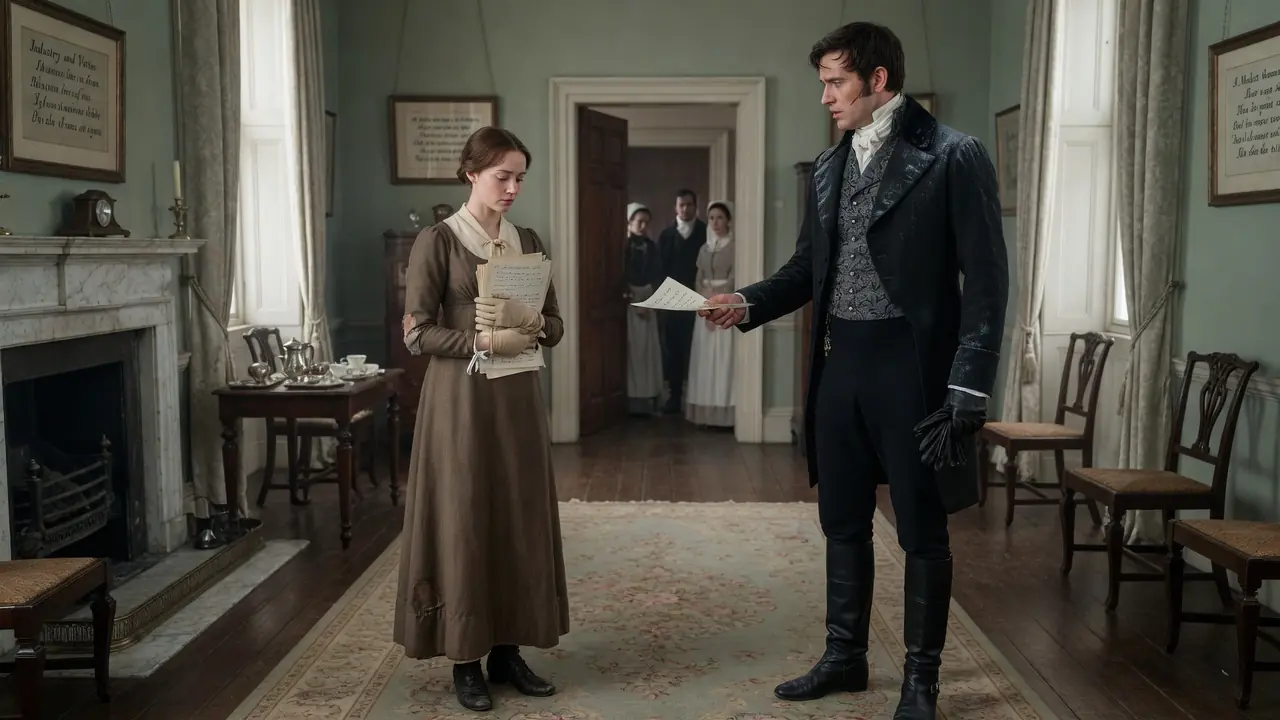
Arabella stood with her hands clasped before her, acutely conscious of the darned patch at her sleeve and the scuff marks on her half boots that no amount of polish could disguise.
The Duke of Thornfield did not sit.
He stood before the fireplace like a monument carved from midnight and marble, his greatcoat still dusted with the morning’s frost.
Those stark illustrations never quite captured the sheer force of his presence.
He was tall, broad-shouldered, with dark hair that fell across his forehead in a manner that suggested he cared nothing for fashion.
A thin scar traced the line of his jaw, pale against his tanned skin.
But it was his eyes that arrested her.
Gray as a winter storm, they fixed upon her with an intensity that made her breath catch.
“Miss Hartwell.”
His voice was low, resonant, carrying the weight of command that came from generations of unchallenged authority.
“I require your services.”
Behind her, Mrs. Grimshaw made a small choked sound.
Arabella felt heat flood her cheeks at the unintentional impropriety of his words.
“Your Grace,” she managed, her voice steadier than she felt. “I am uncertain what services a junior governess might provide to a duke.”
Something flickered in those storm-cloud eyes, surprise perhaps, that she dared speak to him with anything approaching directness.
“My ward,” he said, each word clipped with precision. “Lady Georgiana Blackwood. She is ten years old, possessed of considerable spirit, and has driven away seven governesses in eighteen months. You come highly recommended.”
Arabella blinked.
“By whom, Your Grace? I have been at this establishment mere weeks.”
“By someone whose judgment I trust implicitly.”
He withdrew a folded letter from his coat.
“You will accept the position. The salary will be generous.”
The presumption stole Arabella’s breath.
She was accustomed to orders.
Mrs. Grimshaw issued them with regularity, but never delivered with such absolute certainty of compliance.
“I have not yet been offered a position to accept, Your Grace,” she said quietly, “merely informed that I will take one.”
Mrs. Grimshaw gasped audibly.
The Duke’s expression did not change, but Arabella detected the slightest narrowing of his eyes, the minute tightening of his jaw.
He was not accustomed to being corrected, particularly not by impoverished governesses with nothing to their names.
“You are quite right, Miss Hartwell.”
Each word fell like a chip of ice.
“Allow me to rephrase. I am offering you the position of governess to my ward at a salary of two hundred pounds per annum, with full room and board at Thornfield House. You will have Sundays at liberty and access to my library. Do you accept?”
Two hundred.
Arabella’s heart hammered against her ribs.
It was four times what Mrs. Grimshaw paid her, a fortune by any governess’s standard.
With such a sum carefully saved, she might eventually secure a small cottage, perhaps regain some measure of independence.
But there was something in the Duke’s manner that unsettled her, a darkness that clung to him like fog, a barely leashed tension in the set of his shoulders, and the letter he had not shown her, this mysterious recommendation from someone whose judgment he trusted.
“Might I inquire,” she ventured, “as to the identity of my recommender?”
“You may not.”
His tone brooked no argument.
“Your answer, Miss Hartwell. I have not the luxury of time.”
Arabella lifted her chin, meeting those tempestuous eyes directly.
“Then yes, Your Grace. I accept.”
Thornfield House rose from the Kent countryside like a fortress built of gray stone and shadow.
Arabella pressed her face to the carriage window as they approached, watching turrets and chimneys pierce the heavy clouds that gathered overhead.
The Duke had ridden ahead on horseback, leaving her alone with her meager trunk and mounting trepidation.
The house was beautiful in a severe, uncompromising fashion.
Ivy climbed the eastern wall in twisted ropes of dark green.
Windows gleamed like watchful eyes.
Gardens stretched in geometric precision, their winter bareness only emphasizing the austere elegance of the estate.
A stern-faced housekeeper met her at the servants’ entrance.
Mrs. Blackwell, no relation to the Duke, she explained with crisp efficiency, was a woman of perhaps fifty years, her iron-gray hair pulled back beneath a spotless cap.
“You’ll be in the east wing, Miss Hartwell, near the schoolroom and Lady Georgiana’s chambers.”
She led Arabella up narrow stairs along corridors hung with portraits of disapproving ancestors.
“His Grace has specific instructions regarding Lady Georgiana’s education. You’ll receive them at dinner.”
“I am to dine with His Grace?”
Arabella’s surprise was evident.
Mrs. Blackwell’s expression softened almost imperceptibly.
“His Grace insists all governesses dine with the family. Lady Georgiana requires civilized company at meals, he says.”
A pause, then quieter.
“The previous governesses found it uncomfortable.”
They reached a door of polished oak.
The room beyond was larger than Arabella had dared hope, with a four-poster bed hung with blue damask, a writing desk before a window overlooking the gardens, and bookshelves already lined with volumes.
“His Grace had these brought from the library,” Mrs. Blackwell said, noting Arabella’s gaze. “He thought you might appreciate them.”
Lady Georgiana Blackwood was a tempest contained in a ten-year-old form.
She sat in the schoolroom with her arms crossed, dark curls escaping from their ribbons, mud liberally smeared across her white pinafore.
Her eyes, the same stormy gray as her guardian’s, assessed Arabella with cool calculation.
“You won’t last a week,” she announced without preamble. “Miss Pritchard lasted four days. Miss Weatherby made it to six, but only because she was too stupid to realize I’d put ink in her tea.”
Arabella set down her books and regarded the child thoughtfully.
She saw beneath the bravado, to the loneliness that lurked in those young eyes, the desperate need for attention, even if it came through rebellion.
“Miss Weatherby,” she said softly. “Carolyn Weatherby.”
Georgiana nodded, looking faintly surprised that Arabella knew the name.
“She was my dearest friend once,” Arabella continued, moving to the window.
Rain had begun to fall, streaking the glass with silver tears.
“Until my circumstances changed. Then she decided our friendship was inconvenient.”
She turned back to find Georgiana watching her with new interest.
“I imagine,” Arabella said, “that you drive away governesses because you are testing them, seeing if they will stay when things become difficult, seeing if they actually care, or if they are merely here for the salary and the prestige of teaching a duke’s ward.”
Georgiana’s chin trembled slightly.
“That’s stupid.”
“Perhaps. But I understand it nonetheless.”
Arabella crossed to the desk and opened the top book, a volume of mythology.
“I lost everything, Georgiana. My home, my fortune, my place in society. People I thought loved me disappeared like morning mist, so I understand what it means to wonder if anyone will stay.”
The days at Thornfield fell into an unexpected rhythm.
Arabella discovered that beneath Georgiana’s thorny exterior lived a brilliant, starving mind.
The child devoured books, asked questions that would challenge a university scholar, and possessed an artist’s eye for beauty in the natural world.
They took walks through the winter gardens, Georgiana chattering about the Latin names of dormant plants, while Arabella listened and occasionally corrected her pronunciation.
They read mythology and history, debated the merits of various poets, and worked through mathematics problems that left them both frustrated and laughing.
The Duke remained a distant presence, a shadow glimpsed in corridors, the sound of boots in the library late at night, a figure on horseback disappearing into the morning mist.
He attended dinner each evening, listening to Georgiana’s accounts of their lessons with an attention that seemed almost hungry, but he rarely spoke beyond polite inquiries.
Arabella found herself watching him when she thought he would not notice.
The way candlelight caught in his dark hair.
The strength in his hands as he cut his meat.
The profound loneliness that emanated from him like cold from winter stone.
One evening, as Georgiana excused herself early, claiming tiredness, Arabella found herself alone with him.
Rain drummed against the windows.
The servants had withdrawn.
The silence stretched taut as a violin string.
“She adores you,” the Duke said finally, his voice rough as though from disuse. “I have not seen her so content since before her parents died.”
Arabella’s breath caught.
“I was not aware.”
“My brother and his wife. Carriage accident. Two years past.”
He stared into his wine glass as though it held answers to questions he dared not ask.
“Georgiana witnessed it. She has not spoken of it since, but she carries the weight of that day in everything she does.”
Understanding bloomed in Arabella’s chest like a winter rose, painful and beautiful at once.
The child’s rebellion, her testing of governesses, her desperate need to push people away before they could leave.
It was grief wearing the mask of mischief.
“And you, Your Grace?”
The words escaped before wisdom could cage them.
“Do you also carry that weight?”
The Duke’s head lifted sharply, those gray eyes pinning her with an intensity that stole her breath.
For a long moment, he simply stared at her, and Arabella wondered if she had finally overstepped the invisible boundary between governess and master.
“My brother was everything I am not,” he said at last. “Charming, easy with affection, beloved by all who knew him. When he died, I inherited not only his title and his daughter, but the burden of being an insufficient replacement for the man she lost.”
The raw pain in his voice made Arabella’s throat tighten.
She understood suddenly why he held himself so distant.
He believed himself unworthy of the child’s love, incapable of providing what Georgiana needed.
“You are wrong,” she said softly but firmly. “Children do not need perfect guardians, Your Grace. They need present ones, ones who stay, even when staying is difficult.”
He rose abruptly, crossing to the fireplace.
The flames cast his profile in sharp relief, the strong nose, the scarred jaw, the tension that held his body rigid as iron.
“And what would you know of it, Miss Hartwell?”
Not cruel, but genuinely questioning.
“You who have no family left.”
“I know,” Arabella replied, standing as well, “that chosen family can matter more than blood. I know that Georgiana does not need you to be your brother. She needs you to be yourself, honestly, completely, without apology.”
Winter deepened its grip on Thornfield.
Snow fell in silent curtains, transforming the estate into something from a fairy story.
Arabella and Georgiana built a snowman in the gardens, laughing as their frozen fingers fumbled with the coal for his eyes.
From his study window, the Duke watched them.
Arabella did not know he was there, could not see how his expression softened as she lifted Georgiana to place a battered top hat on their creation’s head, could not hear the breath that shuddered from his chest as he pressed his hand to the cold glass.
That evening, he joined them in the schoolroom.
Georgiana looked up from her watercolors in shock as he settled into the chair beside Arabella, his long legs stretched toward the fire.
“I thought,” he said gruffly, “that I might read to you both, if that would be acceptable.”
Georgiana’s face transformed with joy so pure it was almost painful to witness.
She scrambled into his lap with the unself-conscious affection of a child who had been waiting, hoping for this very thing.
The Duke’s arms came around her automatically, and Arabella saw his eyes close briefly, as though embracing a blessing he thought he had lost forever.
He read from King Arthur’s tales, his deep voice bringing the stories to vivid life.
Arabella listened, her hands still over her needlework, watching the two dark heads bent together, so similar in coloring and in the stubborn set of their jaws.
When Georgiana fell asleep against his chest, the Duke looked up and met Arabella’s gaze.
Something passed between them in that moment, a recognition, an acknowledgement of something neither dared name.
“Thank you,” he whispered.
Arabella’s heart beat against her ribs like a caged bird.
“For what, Your Grace?”
“For giving me back something I thought I had lost. For showing me how to stay.”
The Christmas season approached with aching beauty.
Thornfield transformed under Mrs. Blackwell’s expert direction.
Holly and ivy adorned every mantel.
The scent of cinnamon and cloves perfumed the halls, and a magnificent fir tree appeared in the great hall, waiting to be dressed.
Arabella helped Georgiana string cranberries and fashion paper stars, their fingers sticky with paste and dusted with glitter.
The Duke joined them more frequently now, his presence no longer distant but warm, engaged.
He taught Georgiana to play chess, praised her improving watercolors, and even smiled, a rare, transformative expression that made Arabella’s stomach flutter with sensations she dared not examine too closely.
But late at night, alone in her chamber, she could not deceive herself.
She was falling in love with Adrian Blackwood, impossibly, irrevocably in love with a man so far above her station that even contemplating such feelings bordered on madness.
He was a duke.
She was a governess with a tarnished name and empty pockets.
The gulf between them was unbridgeable.
On Christmas Eve, a letter arrived.
Arabella recognized her uncle’s handwriting with cold dread.
The contents were brief, brutal.
Lavinia was engaged to Lord Peyton.
The wedding would be at Hartwell Manor in spring.
Arabella’s presence was neither required nor desired.
She stood in her room, the letter trembling in her hands, tears sliding unbidden down her cheeks.
The final severance of family ties.
The confirmation that she was truly and utterly alone in the world.
A knock startled her.
She hurriedly wiped her face, but when she opened the door to find the Duke standing there, his expression darkened immediately.
“What has happened?”
Not a question, but a demand.
“Nothing of consequence, Your Grace.”
Her voice wavered traitorously.
“Do not lie to me, Arabella.”
The use of her Christian name shattered her composure completely.
Adrian Blackwood had never considered himself an impulsive man.
Duty, honor, responsibility, these had governed his life since childhood.
But seeing Arabella’s tear-stained face, the grief and betrayal written in every line of her body, something inside him broke free of its careful constraints.
He stepped into her room, propriety be damned, and closed the door behind him.
She backed away, shock replacing sorrow.
“Your Grace, you should not.”
“My name is Adrian.”
He crossed to her in three strides.
“And I am weary unto death of pretending I do not feel what I feel.”
Her lips parted in surprise.
He took the letter from her nerveless fingers, read it quickly, and felt rage kindle hot in his chest.
“They are fools,” he said flatly. “Blind, grasping fools who threw away something precious because they lacked the wit to recognize its worth.”
“I am merely a governess.”
“You are extraordinary.”
The words came rough, fervent.
“You are brilliant and kind and brave. You took a broken child and loved her whole again. You took a man who had forgotten how to feel anything but duty and reminded him what it means to live.”
Arabella stared at him, her chest rising and falling rapidly.
“Adrian, I cannot. We cannot.”
“Why not?”
He reached for her hand, his thumb tracing the delicate bones of her wrist.
“Give me one reason that is not about titles or society’s expectations.”
“Because you could have anyone.”
Her voice broke.
“Any lady of quality, any heiress. Why would you choose someone like me?”
He cupped her face in his hands, his touch achingly gentle despite the intensity burning in his gray eyes.
“Because you see me, Arabella. Not the Duke, not the title, not the fortune. You see the man beneath with all his flaws and fears, and you do not turn away.”
The kiss, when it came, was inevitable as sunrise.
Adrian’s lips met hers with a gentleness that made her knees weak, his hands cradling her face as though she were something infinitely precious.
Arabella melted into him, her fingers clutching the lapels of his coat, tasting wonder and want and the promise of belonging.
When they finally parted, both breathless, he rested his forehead against hers.
“Marry me,” he whispered. “Not because I am a duke and require a duchess. Not because Georgiana needs a mother, though God knows she does. Marry me because I love you, Arabella Hartwell. Because you are the light that led me out of darkness.”
Tears spilled down her cheeks, but these were born of joy so profound it bordered on pain.
“Yes,” she breathed. “Yes, Adrian. Yes.”
He kissed her again, deeper this time, and she felt the last walls around her heart crumble to dust.
The wedding took place in spring in the small chapel on the Thornfield estate.
Georgiana served as flower girl, scattering rose petals with solemn concentration.
Mrs. Blackwell wept openly, and when the vicar pronounced them man and wife, Adrian lifted Arabella’s veil and kissed her with a tenderness that made the handful of guests sigh collectively.
Society would talk, of course.
They always did.
A duke marrying a disgraced governess would provide fodder for gossip for months.
But Adrian had long since ceased caring what society thought, and Arabella had discovered that the opinions of those who had abandoned her held no power over her happiness.
They had found each other in the ruins of their separate griefs.
They had built something new and beautiful from the broken pieces of their pasts.
Five years later, Arabella stood in the gardens of Thornfield, watching her husband chase their three-year-old son through the rose bushes while Georgiana, now fifteen and impossibly elegant, read poetry to their infant daughter beneath the oak tree.
The morning sun gilded everything in gold.
Laughter rang like bells across the manicured lawns, and Arabella felt such contentment settle in her bones that she had to close her eyes against the beauty of it.
She had been ignored by society, betrayed by family, stripped of everything she thought defined her worth.
But in losing everything, she had found what truly mattered.
Love.
Family.
Home.
Adrian caught her watching and smiled, that rare, brilliant smile reserved only for her and their children.
He crossed to her, son perched on his shoulders, and pulled her close.
“Happy, my love?” he murmured against her hair.
Arabella pressed her hand to his chest, feeling the steady beat of his heart beneath her palm.
“Happier than I ever imagined possible.”
And it was true.
The girl who had stood alone in that rain-lashed attic could never have dreamed of this future.
But the woman she had become, forged in loss, tempered by love, knew that sometimes the greatest blessings arrived disguised as disasters.
Sometimes the Duke came knocking precisely when you needed him most, even if you never expected it.