The rumble started in Sadie Miller’s molars before she ever heard the engines.
It came through the floor first, a deep vibration rising from the gravel lot outside Rusty’s Diner, crawling through the cracked linoleum, moving up her knees and into her chest.
The old glass windows began to tremble in their metal frames. The spoon in a coffee mug near the counter clicked once, then again.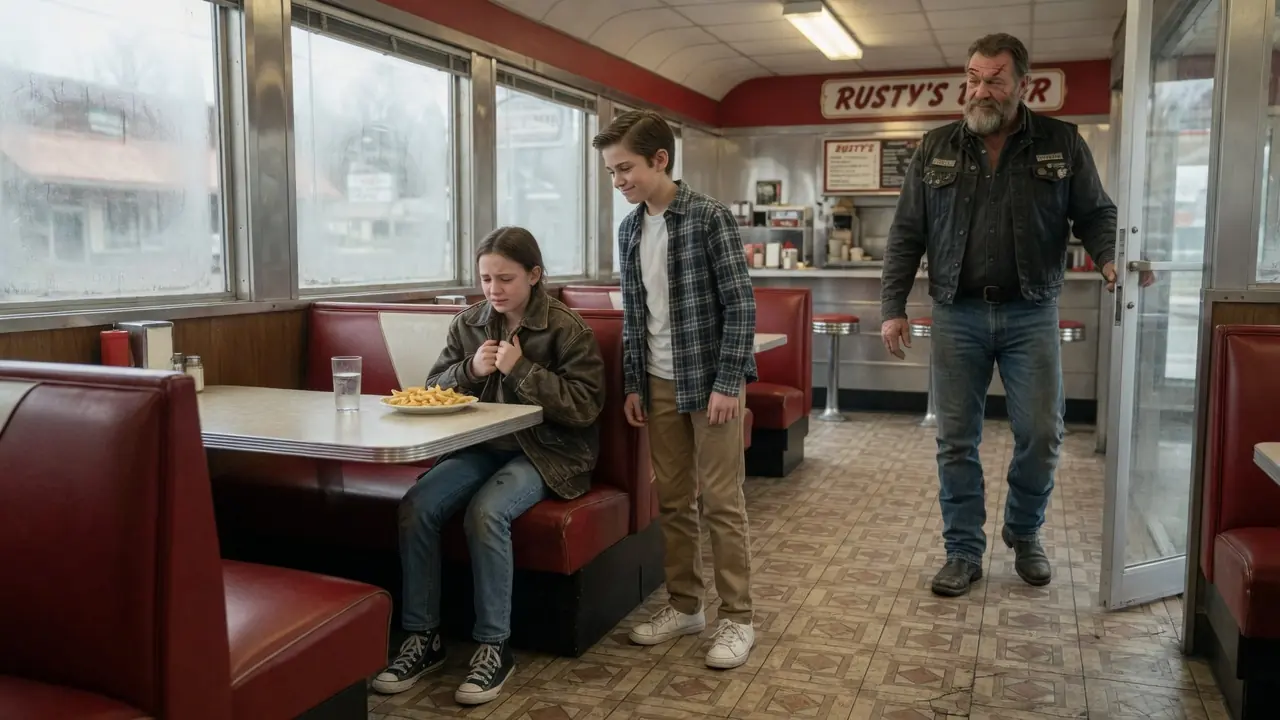
Sadie was on the diner floor when it happened.
Her palms were pressed against the sticky linoleum. Her hip throbbed where it had slammed against the edge of a table. Her father’s oversized leather jacket lay beside her, pulled halfway off her shoulders and flipped inside out, its mustard-yellow lining exposed to the whole room.
Carter Bell stood over her, frozen in the middle of his own ugly laugh.
Ashlyn Kline sat behind him in the booth, one hand over her mouth, her eyes bright with the cruel excitement of someone who had not yet realized the world could turn against her.
Then the engines grew louder.
Not one bike.
Not two.
A whole pack.
By the time a dozen massive men in leather boots stepped onto the diner’s cracked floor, every conversation in the room had already died. The jukebox kept playing softly from the corner, but even the music seemed embarrassed to be heard.
The giant at the front took one look at Sadie.
Then at the jacket.
Then at the patch hidden inside it.
The casual violence in his posture vanished.
He took a knee.
The jacket weighed nine and a half pounds.
Sadie knew this because she had weighed it on the bathroom scale the week after her father died, standing barefoot on the cold tile floor, holding the jacket against her chest while the red needle twitched and settled.
Nine and a half pounds.
It was an absurd garment for a twelve-year-old girl.
The jacket was late 1980s cowhide, thick and stiff as a wooden board, black once but now worn into a deep brownish charcoal at the seams. It was stained with permanent dark shadows of motor oil, road dust, cheap beer, and years of rain. The shoulders slumped down past Sadie’s biceps, and she had to roll the sleeves three tight times just to free her hands.
The collar was too tall.
The zipper was too heavy.
The buckles clinked when she walked.
It smelled like stale tobacco, Old Spice, gasoline, and the damp metallic tang of an unheated garage in winter.
To Sadie, it smelled like an anchor.
It was the only piece of Dean Miller that had not been boxed up, sold off, donated, or buried.
Dean Miller had not died a hero.
There had been no tragic, beautiful sacrifice. No last words delivered under a dramatic sky. No brave final act people could point to and say, “That was the measure of the man.”
He was rebuilding a carburetor on a Tuesday afternoon in the detached garage behind their house. Sadie had been at school, sitting through a math quiz she could not remember now. Her father had stood to grab a rag from the shelf.
An aneurysm snapped in his brain.
He hit the concrete floor before the rag fluttered down beside him.
No goodbye.
No warning.
Just a phone call to the school office, a neighbor crying in the hallway, and an empty house that suddenly seemed too large for one mother and one daughter to survive inside.
After the funeral, people came by with casseroles, envelopes, and sentences that did not help.
“He is in a better place.”
“He would want you to be strong.”
“Time heals.”
Sadie had learned very quickly that grown-ups said things when silence frightened them.
Her mother, Elise, had tried to keep the house from collapsing under grief and bills. She worked double shifts at the county records office, then took weekend work helping a church accountant sort donation receipts. She spoke softly now, as though loud noises might break something invisible.
Dean’s tools were sold first.
The big compressor.
The welding unit.
The expensive socket sets.
The old motorcycle lift.
His motorcycle itself had already been gone for years, sold when Sadie was born because Dean said a baby seat and a Harley did not belong to the same season of life.
Boxes went to relatives.
Some went to storage.
Some went to the church rummage sale because grief did not stop utility bills from arriving.
But the jacket stayed.
It hung on a nail by the back door for three weeks after the funeral.
Every morning, Sadie passed it on her way to the kitchen. Every evening, she passed it again on her way to bed. It hung there like Dean might walk in any second, reach for it, and say, “Road’s calling, kiddo,” in that rough, teasing voice of his.
One morning in October, she took it off the nail and put it on.
Elise found her standing in the hallway, swallowed by leather, her face small and pale above the giant collar.
For a moment, her mother looked like she might tell her to take it off.
Instead, Elise pressed one hand to her mouth and turned away.
Sadie wore it to school that day.
Then the next day.
Then every day after that.
She wore it even though she secretly hated how much it swallowed her. She hated how the stiff collar rubbed the sensitive skin beneath her chin raw. She hated how the sleeves stayed bulky no matter how carefully she rolled them. She hated how the jacket made her shoulders ache by lunchtime.
Most of all, she hated that it made her a walking target at Westbridge Middle School.
Westbridge Middle always smelled like industrial bleach, wet sneakers, pencil shavings, and burned tater tots. It was the kind of place adults called “safe” because no one had to walk through metal detectors, but Sadie knew safety came in layers, and the halls between classes had none.
Middle school was an ecosystem built for conformity.
Anything different was hunted.
Not with teeth.
With laughter.
Whispers.
Shoulder bumps.
Phone cameras.
Nicknames that stuck like burrs.
Carter Bell did not need to work hard to find a victim.
Sadie broadcast her grief in nine and a half pounds of oversized scuffed leather.
Carter smelled like green apple body wash and fresh laundry. His hair always looked damp in a deliberate way, combed forward just enough to make him look careless while proving he had spent time on it. His sneakers were pristine white, squeaking against the floor tiles with aggressive confidence.
He did not beat Sadie up.
Physical violence was too direct, too risky, and Carter was not stupid.
He specialized in the subtle, devastating cruelty of proximity.
The bump that could be called an accident.
The insult murmured just loudly enough.
The way he would lean toward his friends and repeat something under his breath, so Sadie could hear them laugh but not easily prove what had been said.
“You smell like a junkyard, Miller,” he muttered one afternoon as students crowded toward the exit doors.
His shoulder hit hers hard.
Sadie stumbled, the heavy leather throwing her off balance.
She never had the sharp, movie-script comeback ready on her tongue. Instead, she stared at the scuffed rubber toes of her Converse, her face burning with a hot, prickly flush of humiliation.
She bit the inside of her cheek until she tasted copper.
She was furious with herself.
She wanted to be stoic. She wanted to be tough. She wanted to be the kind of girl who could turn around, look Carter dead in the eye, and make him regret speaking.
But mostly, she wanted to disappear.
In that moment, she hated the jacket.
She hated its smell. Its weight. Its stiff collar. Its ugly old buckles. Its proof that she was not like other girls.
She wished, with a desperate and shameful intensity, for a clean pastel fleece jacket from the mall. Something soft. Something ordinary. Something that smelled like detergent and not dead engines.
The guilt of that wish twisted her stomach into painful knots.
Wishing for a new jacket felt like killing her father all over again.
The final bell screamed, a harsh electronic rattle that made everyone move at once. Students flooded out into the biting November air. The sky was the color of old lead, hanging low over Westbridge like a lid pressed down over the town.
A bitter wind swept off the interstate, carrying the scent of frozen exhaust and wet asphalt.
Sadie retreated into the jacket, hunching her shoulders.
The cowhide blocked the wind completely.
It felt like a heavy hand resting on her back.
She walked six blocks to Rusty’s Diner, a dilapidated silver bullet of a building sitting on a gravel lot near the edge of the county line. Rusty’s had once been chrome and red neon, according to an old postcard taped near the cash register. Now the chrome was dull, the neon flickered, and the gravel lot had potholes big enough to hide a lunchbox.
But Rusty’s was warm.
That mattered.
The windows were permanently fogged with grease. The bell above the door clanged violently whenever anyone entered. The coffee was bitter. The fries were cheap. The waitresses did not ask questions if a kid sat alone in the back booth until sunset.
Sadie took her usual booth in the far back.
The red vinyl seat was slashed open, yellow foam showing through like stuffing from a wound. She ordered a basket of fries and a water. It was all she could afford with the crumpled dollar bill she had scavenged from the laundry room jar that morning.
The diner hissed and clattered around her.
Coffee poured.
Oil snapped in the fryer.
A trucker coughed near the counter.
A waitress named Marlene argued with the cook through the pass window.
The smell of scorched coffee and fryer grease was not exactly pleasant, but it was familiar. It cut through the lingering chill in Sadie’s bones.
She slid her arms out of the heavy sleeves but kept the jacket draped over her shoulders like a cape.
Then she ran her thumb over a deep gouge in the lapel.
Dean had made that scar five years earlier when he dropped a wrench against his own chest while laughing too hard at something Sadie had said. She remembered him looking down, tapping the gouge, and saying, “That’s character, kiddo. Leather’s like people. If it never gets marked, it never lived.”
Sadie had repeated that sentence in her mind so many times it had begun to feel less like wisdom and more like a bruise.
She was halfway through her fries when the front door chimed again.
A burst of cold air hit the back of her neck.
She did not have to look up to know who it was.
Ashlyn Kline’s sharp laugh carried over the room first. High and bright and mean around the edges.
Then Carter’s voice.
Loud.
Dominant.
Comfortable in every space he entered because no one had taught him the world could deny him.
They slid into the booth directly across the narrow aisle from Sadie.
Her stomach dropped.
The fries suddenly tasted like salted cardboard.
She kept her head down, staring intensely at a ketchup stain on the Formica table, willing herself to become invisible.
“God,” Carter said, not whispering. “It smells like a wet dog in here all of a sudden.”
Ashlyn giggled.
Sadie squeezed her eyes shut.
The leather jacket sat heavy on her shoulders, suddenly feeling less like armor and more like a cage.
She reached down, her fingers gripping the edge of the frayed lining.
Just leave.
That was the smart thing.
She grabbed her backpack.
The canvas strap slipped off her narrow shoulder as she stood too fast. Her knee banged painfully against the underside of the table. The water glass rattled, spilling a thin sheet of ice water across the Formica.
“Leaving so soon, roadkill?” Carter asked.
He leaned out of his booth, blocking the narrow aisle.
Sadie did not look at his face.
She looked at the zipper of his expensive winter coat.
“Move, Carter.”
Her voice came out thin and trembling.
It had no authority.
She hated the pathetic quiver in her own throat.
Carter’s smile widened.
“Take off the trash bag first.”
His hand shot out.
It was not a punch.
It was a yank.
Carter clamped his fingers onto the oversized collar of Dean’s jacket and pulled hard.
The heavy leather did not give.
Instead, it acted like a harness, jerking Sadie backward. The brass teeth of the main zipper scraped harshly against her jawline. She stumbled, her hip slamming into the edge of the booth table behind her.
Pain flared, white-hot and sickening, radiating down her leg.
She let out a sharp, breathless gasp.
It was not a cry of defiance.
It was a pure, unfiltered noise of hurt and shock.
Her hands flew up, clutching desperately at the jacket as it slipped down her arms. She hit the floor hard, both palms slapping the sticky linoleum. Her backpack spilled beside her, notebooks sliding out, one pencil rolling under the nearest stool.
The jacket pulled free and fell beside her, flipping inside out.
Carter laughed.
A short, ugly sound of triumph.
Ashlyn laughed too, but more nervously now because the whole diner had gone quiet.
Sadie sat on the filthy floor, her vision blurring with hot, furious tears. The pain in her hip throbbed, but it was nothing compared to the crushing weight of humiliation.
The waitress at the counter looked away, pretending to wipe down a coffee machine that was already clean.
The trucker near the register stared into his mug.
The cook glanced through the pass window, then disappeared.
No one was coming to help.
Sadie was entirely alone.
Then the front windows rattled.
It was not the wind.
It was a barometric shift, a heavy rhythmic vibration traveling through the gravel outside, up through the concrete foundation, and directly into the soles of Sadie’s sneakers.
Thud.
Thud.
Thud.
Thud.
The low, guttural roar of high-displacement V-twin engines drowned out the diner’s jukebox.
The sound did not just fill the air.
It compressed it.
Shadows swept across the grease-stained windows.
Not one bike.
Not two.
Twenty.
The roaring stopped in a staggered sequence of metallic clanks and coughing exhausts.
Through the glass, Sadie saw massive shapes dismounting in the gray afternoon light. The smell of raw gasoline, wet leather, and hot chrome seeped through the cracks in the diner’s weather stripping.
Carter’s laughter died in his throat.
He took a half step back, his confident posture collapsing into nervous twitching.
The front door opened.
The bell chimed.
A dozen massive men in leather boots stepped inside first.
The lead biker was built like a cinder block wall. His beard was graying and coarse, his face heavily lined from decades of sun and wind. A faded scar cut through his left eyebrow.
His eyes were the color of dirty ice.
They scanned the room with a flat, predatory indifference.
His leather vest was worn over a black hoodie. His gloves were fingerless, showing knuckles thick with scar tissue. A heavy chain hung from one side of his belt. His boots left faint smears of road dust on the linoleum.
Two other men flanked him.
One had a braided blond beard and a spiderweb tattoo crawling up the side of his throat.
The other was broad enough to block the light from the front window.
They were heading for the back booths.
Heading right toward the bottleneck where Carter stood.
And where Sadie sat curled on the floor.
Carter froze.
He pressed his back hard against the vinyl booth, making himself as small as possible. The sheer physical presence of the bikers triggered a primal panic in him. He did not breathe. He did not blink. His face went pale beneath the school-day confidence he had worn like a crown.
The lead biker stopped.
His name was Grip, though Sadie did not know that yet.
At first, he did not look at Carter.
He looked at the obstacle in the middle of the aisle.
A skinny kid with tear-streaked cheeks, trembling hands, and a battered backpack spilling its contents across the floor.
Grip let out a slow, irritated breath through his nose.
He opened his mouth, probably to tell the kid to move.
Then his eyes fell on the jacket lying on the linoleum.
Carter’s yank had flipped the heavy coat inside out, exposing the mustard-yellow lining Dean had sewn in years earlier.
And there, stitched directly into the center of that lining, hidden from the world but resting perfectly against the wearer’s spine, was a patch.
It was not a club cut.
It was a square of thick, blood-red canvas, hand-stitched with heavy black thread.
The letters were slightly uneven, but careful.
Ghost Miller
Oakland To The Bone
Below the words was a smaller insignia.
A winged wheel wrapped in barbed wire.
Grip stopped.
He did not merely pause.
He froze.
The massive biker behind him bumped into Grip’s shoulder and grunted in surprise.
Grip did not shift his weight.
The silence in the diner stretched, pulling tight like piano wire.
Grip stared at the red canvas patch.
His jaw clenched.
The muscle worked beneath his scarred cheek.
The flat, dead look in his eyes shattered, replaced by something visceral and deeply human.
Shock.
Then grief.
Then recognition so sharp it looked almost painful.
Slowly, deliberately, Grip lowered his massive frame.
The leather of his pants creaked as he dropped to one knee, putting himself at eye level with the terrified twelve-year-old girl.
He reached out.
Sadie flinched.
But he did not reach for her.
He reached for the jacket.
With surprising gentleness, he ran his thumb over the crude black stitching of the word Ghost.
Grip looked up.
His icy eyes locked onto Sadie’s red, tear-stained face.
The intimidating aura of the outlaw biker fell away.
What remained was a weary man kneeling before a memory.
“Where,” Grip asked, his voice low and gravelly, “did you get this leather, little girl?”
Sadie swallowed hard.
Her throat clicked in the silence.
“It’s my dad’s.”
Grip’s hand tightened on the collar.
He looked at the jacket, then back at her face, searching her features with an intensity that made Sadie feel as though he was reading through her skin and into her blood.
“Dean,” he whispered.
The name sounded heavy in his mouth.
Sadie nodded.
Fresh tears spilled over her lashes.
“He died.”
Grip closed his eyes.
A long, shaky breath escaped him, rustling his beard.
For a second, he looked older than he had when he walked in. Not dangerous. Not enormous. Just wounded.
When he opened his eyes again, the grief was gone, replaced by cold, terrifying clarity.
He stood slowly.
The full height of him unfolded.
Still holding the jacket, he turned his head just enough to look at Carter, who was practically vibrating against the booth.
“Did you,” Grip asked, his voice barely above a whisper, “throw this jacket on the floor?”
Carter could not form a syllable.
His mouth opened and closed like a fish on dry land.
A pathetic clicking sound escaped his throat.
He was shaking now. Genuine, uncontrollable tremors racked his frame, causing the synthetic fabric of his pristine winter coat to rustle against the vinyl booth.
The arrogant boy who had owned the room ninety seconds earlier was gone.
In his place was a terrified child shrinking away from the overwhelming mass of the man standing over him.
Grip did not yell.
He did not raise a fist.
The threat in him was silent, contained, and somehow more frightening because of it.
“I asked you a question, boy.”
Carter’s voice cracked high.
“I was just... I didn’t know...”
“You didn’t know what?”
Grip took one step closer.
“That leather belonged to a dead man? Or you didn’t know the girl inside it had nobody standing between her and you?”
Carter’s face crumpled.
Ashlyn made a tiny, frightened sound from the booth.
Grip stared at Carter for one more second, his expression hardening into absolute disgust.
Then he turned his back on him.
The dismissal was complete.
Carter had become too small to matter.
Behind Grip, the bottleneck of bikers shifted.
The man with the braided blond beard stepped forward. Sadie would later learn his road name was Dutch.
He looked over Grip’s shoulder and saw the inside-out jacket.
Dutch stopped breathing.
His heavy silver-ringed hands fell limp at his sides.
“Is that...” he began.
He could not finish.
Grip nodded once.
Sharp.
Rigid.
He turned the jacket so the mustard-yellow lining and the blood-red canvas patch were fully visible to the crew behind him.
A collective reaction rippled through the men.
It was not a gasp.
It was a sudden stilling.
Chains stopped clinking.
Boots settled flat.
Several men reached up, removing riding glasses or sliding knit caps from their heads. One man near the door crossed himself. Another bowed his head.
“Ghost,” someone muttered.
The word sounded like a prayer.
Sadie sat frozen, her hands flat on the sticky floor.
Her brain was misfiring, struggling to reconcile these terrifying outlaws with the father she knew.
Dean Miller.
The man who burned frozen waffles on Sunday mornings and tried to convince her they were “extra crispy.”
The man who hummed off-key to Bruce Springsteen while changing the oil in their rusted Honda Civic.
The man who kept spare change in a coffee can labeled “Sadie’s Space Camp Fund,” even though they both knew there would never be enough money for space camp.
The man who had sewn that yellow lining into his old jacket when she was six and told her it was just to keep the wind out.
He was Ghost.
To them, he had not just been a mechanic.
He had been a legend, stitched into the very fabric of a world Sadie had never been allowed to see.
Grip knelt again.
The leather of his pants creaked loudly.
He held the jacket across his forearms with a reverence that made Sadie’s chest ache.
“Your daddy,” Grip said, forcing the words through a tight jaw, “rode with us. Oakland Charter. Long before you were a thought in the world, little girl.”
Sadie wiped at her face with the heel of her palm.
“He never told me.”
Grip’s eyes softened.
“He left before you were born. Not because he was ashamed. Because he loved you more than he loved the road.”
Dutch stepped closer, voice rough.
“Ghost was our mechanic. Best we ever had.”
Another biker near the counter said, “He could tune a bike by hearing it pass on the street.”
Grip nodded.
“He was our brother.”
The room stayed silent.
Even Carter seemed afraid to breathe too loudly.
Grip continued, looking down at the jacket.
“He pulled me out of a burning ditch in Nevada in ’98. My bike went down outside Winnemucca. Fuel line split. Whole thing caught. I thought I was done.”
Grip lifted one hand and flexed his fingers.
“Dean walked through fire to drag me clear. Burned his own hands and arms doing it. Wouldn’t talk about it afterward. Just wrapped his hands in gauze, smoked half a pack, and told me I owed him a new socket wrench.”
A few bikers laughed softly.
The laughter was sad.
“After that,” Grip said, “we called him Ghost. Because he walked through fire and came out the other side.”
Sadie stared at the patch.
The jagged lettering suddenly made sense.
She remembered the thick, shiny scars that tracked up her father’s forearms. When she asked about them, Dean had told her he got burned working on a hot exhaust manifold.
A lie.
A gentle lie.
A father’s lie to keep his little girl safe from burning ditches, violent roads, and the ghosts of the life he had left behind.
“I didn’t know,” Sadie whispered.
Her voice was raw, scratching against her throat.
A fresh wave of tears spilled over her cheeks. She hated crying in front of them, but she could not stop. The grief she had swallowed for months was being pulled out by the weight of their memory.
Grip reached out.
He did not grab her.
He placed one massive, scarred hand gently on top of her trembling head.
It was heavy.
Grounding.
“He traded the road for a quiet street because he wanted to raise you clean,” Grip said softly. “We respected that. We stayed away because he asked us to.”
Sadie looked up.
“He asked you not to come?”
Grip nodded once.
“He said, ‘My daughter gets to grow up without the weight of my old life on her porch.’ We listened. Maybe we listened too well.”
His eyes moved to Carter again, briefly.
Then back to Sadie.
“But he earned this leather, kid. He bled for it. And nobody disrespects Ghost’s colors while we’re breathing.”
Grip stood, bringing the jacket with him.
He turned it right side out, hiding the red patch once more against the dark, scuffed cowhide.
Then he held it open.
“Stand up, Sadie.”
He said it gently, but it carried command.
Sadie pushed herself off the floor. Her hip screamed in protest, sending a sharp spike of pain down her leg, but she bit her lip and straightened her spine.
She turned her back to Grip and slipped her narrow arms into the cavernous sleeves.
The weight settled onto her shoulders.
The same nine and a half pounds.
But the gravity of it had changed.
It was no longer an anchor dragging her down.
It was armor.
Grip stepped around to face her.
His giant fingers, stained with permanent grease, reached out and gently adjusted the stiff collar, making sure it sat correctly over her small shoulders.
He performed the action with the solemn care of a soldier adjusting a comrade’s uniform before battle.
“You keep the lining closed,” Grip told her, his eyes locking onto hers. “That patch is a ghost story. It is not for the civilian world.”
Sadie swallowed.
“But you know it’s there.”
She nodded.
“And now they know it’s there.”
He did not gesture toward Carter’s booth.
He did not have to.
Carter had seen exactly what was hidden inside the scuffed leather, and he had witnessed the devotion it commanded.
Sadie would not just be ignored at Westbridge Middle School tomorrow.
She would be remembered.
Grip reached into his leather vest and pulled out a thick silver money clip. He peeled off a crisp hundred-dollar bill and dropped it onto the Formica table next to Sadie’s spilled water and cold fries.
“For the food,” Grip announced to the paralyzed waitress behind the counter. “And for the mess.”
He glanced at Carter without moving his head.
The entire diner understood.
Then Grip looked back down at Sadie.
“Where do you live, kid?”
“Elm Street,” Sadie whispered. “About two miles south.”
“We’re taking you home.”
It was not an offer.
It was a logistical fact.
Sadie did not argue.
She grabbed her backpack. Dutch crouched to pick up the notebooks that had spilled across the floor. A biker with gray hair and a tattoo of a swallow on his neck retrieved her pencil from beneath the stool.
He handed it to her as if it mattered.
“Here you go, little Ghost,” he said.
Sadie almost cried again.
As she walked down the center aisle, the wall of leather and denim parted for her.
These giants, these frightening men with scarred hands and road-worn faces, stepped back respectfully, giving a twelve-year-old girl in an oversized jacket a wide path.
Carter stood frozen in the booth.
Sadie passed him.
For the first time since school started that year, she looked him in the eye.
She did not say anything.
She did not need to.
The diner door opened.
The cheerful chime sounded absurdly bright.
The cold November wind hit Sadie’s cheeks instantly, but the heavy cowhide blocked it from her core.
The gravel lot was packed with chrome, matte black steel, and hot engines. Twenty bikes stood in staggered formation like sleeping animals waiting to be awakened.
Grip walked toward a massive Road Glide, the engine ticking as it cooled. He opened a hard saddlebag and pulled out a spare helmet, matte black, scuffed, and much too large.
He handed it to Sadie.
“Strap it tight.”
Sadie pulled the helmet over her head.
It smelled like sweat, old foam, and wind, but it felt secure.
Grip swung a leg over the massive bike and kicked the heavy machine upright.
He hit the ignition.
The roar punched Sadie in the chest, vibrating through her ribs and down into her boots.
Across the lot, nineteen other engines flared to life in a thunderous sequence of controlled explosions. The smell of rich exhaust and unburnt fuel washed over her, replacing the diner’s grease with the scent of the open highway.
She climbed onto the passenger seat, her small hands gripping the heavy leather of Grip’s vest.
They pulled out of Rusty’s Diner in rigid formation.
Grip took the lead.
Sadie sat behind him, a small dark shadow against his massive frame. Ten bikes rode staggered to their left, nine to their right.
They did not speed.
They crawled at twenty miles an hour down the two-lane county road, creating a rolling blockade of noise and steel.
Cars on the opposite side pulled onto the shoulder. Drivers stared in awe and anxiety.
Sadie felt the vibration of the engine seep into her bones. It soothed the dull throb in her hip. She felt detached from herself, as if the girl who had been crying on the diner floor had been left behind with the spilled water and cold fries.
For two miles, she sat inside a hurricane.
Protected by the very thing everyone else feared.
They turned onto Elm Street.
It was a bleak, working-class neighborhood of gray siding, cracked driveways, and lawns already dying under November frost. The rumble of twenty V-twin engines shattered the quiet afternoon.
Front doors opened cautiously.
Blinds twitched.
Neighbors stepped onto porches, wrapping cardigans around themselves, watching with wide eyes as the motorcycle club rolled slowly down their dead-end street.
Grip pulled up to the curb in front of Sadie’s small, peeling house.
The rest of the pack fanned out, lining both sides of the street. Their engines idled in a low, threatening growl that shook the windowpanes of the adjacent houses.
Grip killed his engine.
The sudden silence was almost as deafening as the noise had been.
Sadie slipped off the bike, her legs weak from the vibration. She unclipped the helmet and handed it back.
“Thank you,” she said.
The words felt too small.
Grip took the helmet and looked at the peeling paint on her porch.
Then back at her.
“Who’s home?”
“My mom’s at work,” Sadie said. “She gets home at six.”
Grip’s jaw tightened slightly.
“You got a key?”
Sadie nodded.
“Good.”
He looked toward the house again, then crouched slightly so his face was closer to hers.
“You wear that leather, Sadie.”
His voice carried clearly in the crisp air.
“You wear it every damn day. And if anybody ever gives you grief about it, you tell them Grip from Oakland said they can take it up with him.”
Dutch called from his bike, “And Dutch.”
Another biker added, “And Preacher.”
“And Ox,” said the huge man near the curb.
A low ripple of agreement moved through the pack.
Grip tapped the thick cowhide over Sadie’s heart.
“You are Ghost blood. That makes you our blood. You are never alone. You understand me?”
Sadie swallowed the lump in her throat.
She looked at Grip.
Then at Dutch.
Then at the other men watching her from their idling machines.
“I understand.”
Grip gave a single nod.
He hit the ignition.
The engine roared back to life.
He did not look back as he pulled away from the curb. The pack followed, a perfectly choreographed exodus of noise and exhaust, rolling back out of the quiet suburbs and into the gray horizon.
Sadie stood on the cracked concrete path, watching until the last taillight disappeared around the corner.
The silence of Elm Street settled back in slowly.
But it did not feel isolating anymore.
She walked up the steps and unlocked the front door.
Inside, the house smelled faintly of dust, old coffee, and the lemon cleaner her mother used on Sundays. It was quiet. Too quiet.
Sadie stood in the hallway, letting the nine and a half pounds of leather press down on her shoulders.
Then she reached inside the collar.
Her fingers traced the hidden yellow lining.
She felt the thick, crude stitches of the canvas patch resting against her spine.
Ghost Miller.
Oakland to the bone.
She was not just a grieving kid in an oversized coat anymore.
She was a ghost story.
For the first time since her father died, Sadie Miller felt safe.
Her mother came home at six-seventeen, exhausted and carrying a plastic grocery bag with discount soup cans and a half-loaf of bread.
Elise stopped in the doorway when she saw Sadie sitting at the kitchen table, still wearing Dean’s jacket.
Her face changed instantly.
“What happened?”
Sadie had intended to lie.
She had practiced the lie while waiting.
“I fell.”
“Nothing.”
“Carter was being stupid.”
But when she saw her mother’s tired eyes, the lie fell apart before it reached her mouth.
So she told the truth.
Not all at once.
Piece by piece.
The diner.
Carter.
The floor.
The patch.
The men.
Grip.
The ride home.
Elise sat slowly at the kitchen table. Her grocery bag rested forgotten on the floor. When Sadie described the patch inside the jacket, Elise closed her eyes.
“You knew?” Sadie asked.
Elise opened her eyes again.
“I knew some.”
“Some?”
Her mother looked toward the back door, where the jacket had hung for weeks after Dean died.
“Your father had a life before me. Before you. He told me enough to understand why he left it. He did not tell me every story, and I did not ask for all of them.”
“Why?”
“Because sometimes loving someone means letting their past stay behind them if that is where they fought to put it.”
Sadie touched the sleeve.
“Was he bad?”
Elise’s face softened with pain.
“No, baby. Your father was not bad. He was wild once. Angry once. Loyal to dangerous people once. But bad? No.”
She reached across the table and placed her hand over Sadie’s.
“He became gentle on purpose. That is harder than being tough by accident.”
Sadie looked down.
“They called him Ghost.”
“I know.”
“He saved Grip from a fire.”
Elise’s mouth trembled.
“He told me that story once. Not the whole thing. Just enough that I understood why his arms were scarred.”
Sadie stared at the table.
“I thought the scars were from work.”
“They were,” Elise said softly. “Just not the work he told you.”
For a while, neither spoke.
Then Elise stood and walked to the hallway closet. She reached to the top shelf and pulled down a metal cookie tin. It was old, blue, dented at the corner.
She set it on the table.
“I was going to wait until you were older.”
Sadie’s heart began to beat faster.
Elise opened the tin.
Inside were photographs, folded letters, a tarnished silver ring, and a small stack of postcards from places Sadie had never seen.
Oakland.
Reno.
El Paso.
Santa Fe.
One photograph showed Dean much younger, leaning against a motorcycle with his arms crossed, his hair longer, his smile crooked and reckless. Grip stood beside him, younger too, scarless then. Dutch was there as well, blond beard shorter, one arm slung around Dean’s shoulders.
Sadie picked up the photograph.
Her father looked like someone she recognized and did not recognize at all.
“He was happy,” she whispered.
“He was,” Elise said. “And then he became happy differently.”
Sadie looked at her.
“When he met you?”
Elise smiled sadly.
“When he learned peace was not the same as being trapped.”
The next morning, Sadie wore the jacket to school.
The weight felt different now.
Still heavy.
Still stiff.
Still smelling like tobacco, Old Spice, and oil.
But as she walked through the front doors of Westbridge Middle, the jacket did not feel like a shameful costume.
It felt like a secret army.
The halls seemed to quiet around her.
Not completely.
Middle school never fully surrendered noise.
But something shifted.
Carter had talked.
Of course he had.
Not honestly, but fear has a way of leaking through lies. By first period, half the school knew that a motorcycle gang had escorted Sadie Miller home. By second period, someone claimed the men had threatened to burn down Rusty’s. By lunch, the story had grown into something wild enough to become legend.
Sadie said nothing.
She walked with her books held to her chest and the jacket collar brushing her chin.
People moved.
Some stared.
Some whispered.
No one bumped her.
At lunch, Carter sat at the far end of the cafeteria with his hood up and his eyes down. Ashlyn did not sit with him. Neither did the boys who usually followed him.
Power was a fragile thing when it depended on an audience.
After school, Sadie expected Grip’s warning to fade into memory.
It did not.
On Friday afternoon, a motorcycle rolled up near the school parking lot.
Not twenty.
Just one.
Dutch sat on it, arms folded, braided blond beard tucked into his jacket. He did not enter school property. He did not speak to students. He simply waited across the street near the stop sign until Sadie came out.
When she saw him, she froze.
He lifted two fingers in greeting.
“Your mom know you’re here?” Sadie asked when she reached him.
Dutch grinned.
“Your mom knows. Grip called her. We got rules, little Ghost.”
That surprised her more than anything.
“You have rules?”
Dutch laughed so loudly a nearby crossing guard looked over.
“More than people think.”
He handed her a paper bag.
“Grip said you looked like a kid who forgets to eat when life gets loud.”
Inside was a turkey sandwich, an apple, and a small bag of chips.
Sadie blinked hard.
“I don’t need charity.”
Dutch’s grin softened.
“Good. This ain’t charity. It’s lunch.”
“That’s what Maggie said in a story my dad used to tell,” Sadie murmured.
Dutch tilted his head.
“Your dad told a lot of stories?”
“Not enough.”
Dutch looked down the street, his face shifting.
“No. Men like him never do.”
The visits became regular.
Not daily.
Not enough to make Sadie feel watched.
Just often enough that the town understood the promise had not been symbolic.
Sometimes Dutch came.
Sometimes Preacher, an enormous man with a soft voice and reading glasses, arrived with used paperbacks because he heard Sadie liked science fiction.
Sometimes Ox showed up in a pickup instead of on a bike, bringing groceries he claimed had been “accidentally overbought by a man with poor planning skills.”
Grip came only once in the first month.
He parked outside the house on a Sunday afternoon while Elise was raking leaves. Sadie was sitting on the porch steps, wearing Dean’s jacket over a sweatshirt.
Grip approached slowly, carrying a small wooden box.
Elise stepped down from the porch.
There was a long silence between the adults.
Then Grip removed his sunglasses.
“Elise.”
“Grip.”
“You look tired.”
“You look old.”
He almost smiled.
“Fair.”
Sadie looked from one to the other.
“You know each other?”
Grip glanced at Elise.
Elise nodded once.
“Your father introduced us,” she said. “A long time ago.”
Grip handed Sadie the box.
“This belonged to him.”
Sadie opened it carefully.
Inside was a small patch, faded black and red, shaped like a winged wheel.
Not the big hidden patch from the jacket lining.
Something smaller.
“He never put that one on the jacket,” Grip said. “Said when he had a kid someday, he wanted to keep one piece clean.”
Sadie touched it with one finger.
“What do I do with it?”
“That is up to you.”
She looked at the patch for a long time.
Then she closed the box.
“I’ll keep it clean too.”
Grip nodded.
“Good answer.”
He sat on the porch for one cup of coffee. Elise brought it out in Dean’s old mug, the one with a chipped rim and faded letters from a garage supply company. Grip held it with both hands as if it were made of glass.
He told one story about Dean.
Just one.
He told Sadie about a night outside Flagstaff when the club had broken down in the desert and Dean had kept twelve bikes running with duct tape, baling wire, and language so colorful even Grip refused to repeat it in front of a child.
Sadie laughed.
It startled her.
She had not laughed from deep in her stomach since before Dean died.
Grip heard it and looked away quickly.
Elise did too.
Some grief needed privacy, even when it arrived as laughter.
By winter, things at school had changed.
Not magically.
Not completely.
Sadie was still Sadie.
Still quiet.
Still grieving.
Still too thin, too serious, too likely to eat lunch alone.
But Carter no longer touched her.
No one did.
When he passed her in the hall, he turned his face away. The first few times, Sadie felt satisfaction. Then pity. Then nothing.
That was better.
Ashlyn apologized in January.
It happened outside the library, where Sadie was returning a book about astronomy.
Ashlyn stood near the water fountain, twisting the strap of her backpack in both hands.
“I’m sorry,” she said.
Sadie stopped.
Ashlyn’s eyes were red.
“For laughing,” Ashlyn added. “At Rusty’s. And before that. I was scared of Carter, but that’s not an excuse.”
Sadie looked at her for a long moment.
“No,” she said. “It isn’t.”
Ashlyn nodded quickly.
“I know.”
Sadie shifted the library book against her chest.
“I don’t forgive you yet.”
Ashlyn swallowed.
“Okay.”
“But I heard you.”
It was not friendship.
It was not healing.
But it was a door left unlatched.
Sadie began spending Saturdays in the garage.
At first, she only sat on the stool Dean used to keep near the workbench. The garage was emptier now, but not completely. Elise had kept a few things without telling her.
A socket tray.
A work lamp.
A dented metal toolbox filled with mismatched screws and old fuses.
Dean’s radio.
It took Sadie three weeks to ask Grip if he would teach her how engines worked.
Grip stared at her for so long she thought she had asked something wrong.
Then he said, “Your father would haunt me if I said no.”
So the club taught her.
Not all at once.
Not dangerously.
Not in secret.
With Elise’s permission, under rules so strict Sadie began to suspect bikers were more organized than the school administration.
No riding without permission.
No tools without gloves.
No engine work without supervision.
No skipping homework.
No lying to Elise.
No touching a hot pipe.
No getting on any bike without a helmet.
Sadie learned the names of tools first.
Then the sounds.
Then the smells.
Old oil.
Fresh oil.
Gas too rich.
Rubber overheating.
A bad belt.
A weak battery.
Grip taught her that machines, like people, told the truth eventually.
Dutch taught her how to change a tire.
Preacher taught her how to read a repair manual properly, not skim it like school instructions.
Ox taught her how to lift with her legs and not her back.
Elise watched from the kitchen window the first few times, arms crossed tightly.
But over time, her shoulders lowered.
One Saturday in March, Sadie came inside with grease across her cheek and excitement brightening her face.
“Mom, I adjusted a carburetor.”
Elise looked at her daughter.
For one painful second, she saw Dean.
Not because Sadie looked like him, though she did around the mouth.
But because purpose had changed the way she stood.
Elise pressed one hand to the counter.
“That’s good, baby.”
Sadie noticed the tears.
“Mom?”
Elise shook her head.
“I’m okay.”
Sadie knew now that “I’m okay” did not always mean okay.
She walked over and hugged her.
The jacket creaked between them.
That summer, Grip took Sadie and Elise to Oakland.
Not on bikes.
Elise refused.
They drove in a truck, with Dutch and Preacher following behind in another vehicle. It took two days, with motel stops and bad diner breakfasts and stories Sadie tried to memorize as fast as the men could tell them.
In Oakland, they visited an old garage tucked behind a tire shop.
The sign above the door had faded almost beyond reading.
Inside, the current owner, a woman named Rosa, remembered Dean.
“Ghost?” she said, wiping her hands on a rag. “That boy could make a dead engine apologize.”
She showed Sadie a wall in the back where old club photographs were pinned beneath cloudy plastic.
There was Dean.
Younger.
Laughing.
Leaning over bikes.
Standing beside Grip.
Sitting on a curb with a cigarette in one hand and a wrench in the other.
Sadie stared until the images blurred.
For the first time, her father’s past did not feel like a betrayal.
It felt like a room she had finally been allowed to enter.
At the end of the trip, Grip took her to a quiet overlook above the bay.
The wind pressed against the jacket, but she did not feel cold.
“This was where your dad told us he was leaving,” Grip said.
Sadie looked at him.
“Was everyone mad?”
Grip smiled faintly.
“Some. Men get selfish when they’re losing someone they love. But then he showed us a picture.”
“Of what?”
“Your first ultrasound.”
Sadie froze.
Grip’s voice softened.
“He carried it in his wallet. Showed it to every man there like he had discovered fire.”
Sadie’s throat tightened.
“He was proud?”
Grip looked at her as if the question hurt him.
“Sadie, he was terrified. And proud. And already gone from us in the way that mattered. He belonged to you before you were born.”
The wind moved across the overlook.
Sadie reached inside the collar of the jacket and touched the hidden patch.
For months, she had thought the jacket connected her to who Dean used to be.
Now she understood.
It connected who he had been to who he chose to become.
Years later, people in Westbridge still told the diner story.
They got details wrong.
They said thirty bikers came.
Some said fifty.
They said Carter got dragged outside, which was not true.
They said Sadie’s father had been the leader of a motorcycle gang, which was also not true.
They said Grip threatened the entire school, which he absolutely did not, though the rumor did more preventive work than any assembly on bullying ever had.
Sadie did not correct everyone.
Some stories grew because people needed them to.
But she knew the real version.
She knew she had been a twelve-year-old girl on a diner floor, humiliated and hurting, when the past rode in on twenty engines and knelt beside her father’s jacket.
She knew Carter had not been defeated by violence.
He had been defeated by the sudden knowledge that the person he chose to hurt was loved by people he could not scare.
She knew the jacket did not become lighter.
It never did.
Nine and a half pounds remained nine and a half pounds.
But she grew into it.
By fifteen, she no longer had to roll the sleeves three times.
By seventeen, the shoulders sat better.
By twenty, the jacket looked intentional on her.
By twenty-six, when she opened Miller Garage with a small loan, an old lift, and the help of a motorcycle club that claimed it was “just supervising,” she hung the jacket behind the front counter in a glass case.
Not because she had stopped wearing it.
Because some things had to rest between battles.
Inside the lining, hidden where only she could see it, the blood-red patch remained.
Ghost Miller
Oakland To The Bone
Below the case, Sadie placed a small brass plaque.
It read:
The heaviest things we inherit are not always burdens. Sometimes they are armor we have not learned how to wear yet.
Grip came to the opening.
Older now.
Slower.
Still massive.
He stood in front of the jacket for a long time, one hand resting on his cane, the other pressed against his chest.
“You did good, little Ghost,” he said.
Sadie smiled.
“I’m not little anymore.”
“No,” he said. “You ain’t.”
Dutch brought flowers, though he claimed he had stolen them from a wedding, which Elise immediately said was a lie because there was still a grocery store sticker on the wrapping.
Preacher gave a speech no one asked for.
Ox cried and denied it.
Elise stood near the office door, watching her daughter laugh among bikers, mechanics, neighbors, former classmates, and people who had come because they remembered Dean or had heard the story of Rusty’s Diner.
At one point, Sadie stepped outside alone.
The afternoon air smelled like asphalt, oil, and early rain.
A motorcycle passed on the road beyond the lot, the engine note fading toward the highway.
For a second, Sadie closed her eyes.
She could almost hear Dean’s voice.
Road’s calling, kiddo.
She smiled.
“Not yet, Dad.”
Inside, customers waited.
Engines needed work.
People needed help.
Stories needed carrying.
Sadie went back into the garage.
The bell over the door rang.
A boy about twelve stood there, skinny and nervous, holding a bicycle with a broken chain.
“I don’t have much money,” he said quickly.
Sadie looked at his frightened face, his hunched shoulders, the way shame made him smaller than he was.
She had seen that posture before.
She had worn it.
She wiped her hands on a rag and walked toward him.
“Good,” she said. “Then we won’t start with money.”
The boy blinked.
“We’ll start with the chain.”
Behind her, Dean’s jacket rested in its case.
Heavy.
Scarred.
Silent.
Still watching.
And Sadie Miller, daughter of Ghost, finally understood what her father had left her.
Not just leather.
Not just a patch.
Not just a secret history of engines, road names, and men who remembered him with reverence.
He had left her proof that love could return in forms you did not recognize at first.
Sometimes as a jacket too heavy for a child.
Sometimes as a rumble outside a diner.
Sometimes as a scarred hand gently adjusting your collar.
Sometimes as twenty dangerous-looking strangers making sure one grieving little girl got home safe.
Sometimes the heaviest things we inherit are not burdens.
They are armor.
We just have to survive long enough to grow into them.