Colorado, 1885.
Some people arrive in a town looking like they belong there. Eliza Marsh was not one of them.
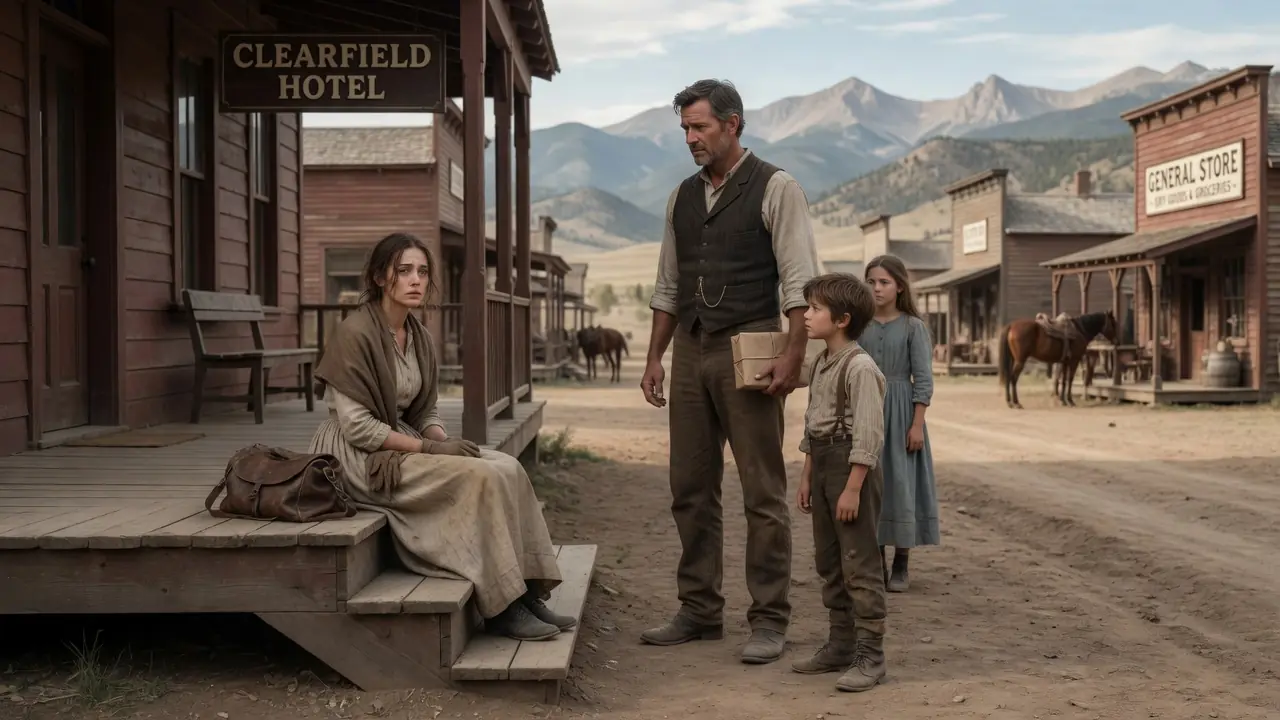
She was sitting on the front steps of the Clearfield Hotel on a Tuesday afternoon in October with a single leather bag beside her and the expression of someone who had run out of options and was not yet ready to admit it.
Her hair was coming loose from its pins. Her dress, linen, beige, travel-worn, had seen better days and better weeks.
She had come from Tennessee following her uncle, the last family she had. He had written her in January.
“Come west,” he had said. “There is room here. There is a life worth building.”
She had packed everything she owned into the leather bag, sold the rest, and boarded a train going west. Her uncle had died two weeks before she arrived, pneumonia, quick at the end. He had left nothing behind except an unfiled claim and a small debt at the general store.
She had nowhere to go back to.
She had nothing to go back to.
So she sat on the hotel steps in Clearfield, Colorado, doing the arithmetic of a life that had run out of numbers.
It was then that a boy of about nine stopped directly in front of her, looked at her with the direct gaze of a child who had not yet learned that staring is impolite, and said, “Why are you sad?”
And before she could answer, a man’s voice said, “Owen.”
She looked up.
The man was tall, dark-haired with gray at the temples, wearing a dark waistcoat over a linen shirt with the sleeves rolled to the elbow. He had the look of someone who works outdoors and has stopped noticing it. He was holding a list and a package from the general store, and he gave Owen a look that had worn a groove into both of them. The same look, probably, for three years running.
“Owen,” he said again.
“She looks sad, Papa,” the boy said without moving.
“People are allowed to be sad,” the man said. “It’s not our business.”
“But we could make it our business,” Owen said.
The girl, younger, dark braid, watching everything, said nothing. She had stopped walking and was looking at Eliza with the steady attention of someone who takes in more than she gives back.
Eliza looked at the three of them.
“I’m all right,” she said.
Which was not true, but was the most available answer.
The man looked at her the way a rancher looks at weather, reading what was actually there, not what he would prefer to find.
“Daniel Holt,” he said.
“This is Owen. That’s Lucy.”
“Eliza Marsh,” she said, and shook his hand.
“You’re not from Clearfield,” he said.
“Tennessee,” she said. “I came to find my uncle.”
Something shifted in his face. Not pity, something quieter. The recognition of a man who knows what it is to have something not be where you expected it.
“Did you find him?” he said.
She looked at the street.
“He died before I arrived,” she said.
Owen had stopped fidgeting. Lucy had moved slightly closer to her father’s side.
“I’m sorry,” Daniel Holt said.
And he meant it. She could hear the weight of it, the difference between condolence spoken by someone who has also lost something real and condolence spoken by someone who has not.
“Is there somewhere you’re staying?” he said.
She looked at the hotel behind her, then back at him.
“I’m working on that,” she said.
She had four dollars and thirty cents. The hotel cost two dollars a night. She had enough for two nights, which gave her two days to find work. Not impossible, but close enough to impossible that the distinction felt academic.
She had not told Daniel Holt any of this.
She spent the afternoon doing what she could. The general store needed no one. The restaurant was fully staffed. The schoolhouse already had a teacher.
The laundry at the edge of town was a possibility. The woman who ran it, a Mrs. Pierce, said she might have work next week, not this week, and looked at Eliza’s hands with the assessment of someone measuring the difference between a woman who had done laundry and a woman who hadn’t.
Eliza had done laundry. She had done most things.
She had run her family’s house since she was fourteen, after her mother died. Cooking, mending, accounts, the endless practical management of a life without anyone ever asking if she wanted to be the one doing it.
She was back in her room doing the arithmetic again when there was a knock at the door.
She opened it.
Owen Holt was standing in the hallway holding a covered dish.
“Papa made stew,” he said. “He said you probably hadn’t eaten.”
Behind him in the hallway, at a careful distance that made clear he had sent the boy ahead rather than knock himself, Daniel Holt was looking at the wall.
“He didn’t have to do that,” she said.
“I know,” Owen said. “He does things he doesn’t have to do. Lucy says it’s because Mama isn’t here anymore, and he doesn’t know what to do with the extra.”
He delivered this with the seriousness of a nine-year-old who considers it important information.
Down the hallway, Daniel Holt closed his eyes briefly.
Eliza took the dish.
She stayed a second night. And a third, because Mrs. Pierce sent word that she could start at the laundry on Thursday, which meant Eliza needed to be in Clearfield on Thursday, which required money she didn’t quite have.
Resolved when she came downstairs Wednesday morning and was told by the hotel clerk that three more nights had been paid for.
She found Daniel at the feed store.
“You didn’t have to do that,” she said.
“I know,” he said.
He was loading sacks and did not stop working.
“I’ll pay you back,” she said.
“You don’t have to,” he said.
“I will anyway,” she said.
He stopped loading. He looked at her directly, not measuring her this time, just looking.
“All right,” he said. “You will.”
It was not a dismissal. It was the acknowledgement of a man who understood that accepting help and accepting charity were different things, and who respected the difference without making a point of it.
She worked at the laundry Thursday through Saturday. It was hard and hot, and she was good at it. Mrs. Pierce told her Saturday she could come back next week. Not a solution, but a direction.
Daniel came by the laundry on Saturday afternoon with Owen and Lucy.
He said he was passing.
The laundry was not on the way to anywhere he had mentioned going.
Owen told her, while his father talked to Mrs. Pierce, that Lucy had asked at breakfast whether the lady from Tennessee was going to stay.
“What did your father say?” Eliza asked.
Owen thought about it.
“He said he didn’t know,” Owen said. “But he said it like he was hoping you would.”
He went back to watching the street with the serenity of a child who had delivered his message and considered his work done.
Lucy spoke to her for the first time on a Sunday.
Daniel had brought them to church. Eliza had gone alone and found them two rows ahead. Afterward, Daniel had introduced her to Reverend Cole and several townspeople with the ease of a man who had decided something without announcing it.
They walked back along the main street, all four of them, in the way that happens when nobody has planned it and everyone has accepted it.
Lucy walked beside her. She was quiet for a long time.
Then, “Do you know how to braid hair?”
“Yes,” Eliza said.
“Papa tries,” Lucy said. “He practices on the horses’ tails, but it’s not the same.”
Eliza looked at Daniel, who was walking ahead with Owen and had either not heard this or was pretending he had not with impressive commitment.
“I could show you,” Eliza said.
“Yes,” Lucy said, with the calm authority of a six-year-old who knows what she wants.
That afternoon, she sat on the hotel porch and braided Lucy’s hair while Owen explained, at considerable length, the complete history of every horse on his father’s ranch. Daniel sat in the third chair and said almost nothing, which she had learned was not absence, but attention.
He was listening to everything.
When it was time to leave, Lucy held her hand briefly before letting go. Daniel looked at his daughter’s braid, then at Eliza.
He said nothing.
But on the walk back to their wagon, Owen said at full volume, “Papa, can she come to supper?”
And Daniel said, “Owen,” in the voice fathers use when a child has said the true thing at the wrong moment.
Eliza looked at the mountains and said nothing.
And felt something she had not felt in a very long time.
The sensation of possibly being somewhere she was supposed to be.
The invitation came from Owen.
Not officially. Owen had been told after the Sunday walk that he was not to invite Eliza to supper without asking first. He had technically followed this rule by asking his father Monday morning, and Daniel had said, “We’ll see.”
Which Owen had interpreted as yes.
Eliza arrived at the Holt Ranch Wednesday evening to find the table set for four and Lucy arranging wildflowers in a jar with the focused concentration of someone executing a plan.
“Owen said you were coming,” Lucy said.
“Owen told me the same thing,” Eliza said.
From the kitchen, Daniel said, “I’m sorry about this.”
“Don’t be,” she said, and meant it.
The ranch house had been built by someone who knew what they were doing. Solid, well-made, everything in its place. It was also the kind of house managed for two years by a man alone, which meant it was functional and slightly cheerless in the way of places that have forgotten what it feels like to have someone care about them beyond the minimum.
Supper was good. Daniel cooked without fuss, competently, without drawing attention to the competence. Owen talked throughout. Lucy watched Eliza with the steady attention she had apparently decided to give her.
Daniel said measured things at the right moments.
After supper, the children were sent to bed with a firmness that suggested he had something to say. He sat across from her at the kitchen table with his coffee and said, “I want to ask you something directly because I don’t know another way.”
She waited.
“How long are you planning to stay in Clearfield?”
She looked at her cup.
“I don’t know,” she said honestly. “I don’t have anywhere else to be.”
He nodded once, slowly, working through something.
“That’s not a bad answer,” he said, which was not what she expected.
“Why?” she said.
He looked at his coffee.
“Because I have a question I’m not ready to ask yet,” he said. “And I need you to still be here when I am.”
He asked her to come to the ranch the following Saturday. Not for supper, he was specific. He wanted to show her something.
He said this with the expression of a man who had rehearsed what he wanted to say and was not entirely sure it would survive contact with the actual moment.
She came on Saturday.
He showed her the ranch, the north pasture, the fence lines, the barn, the kitchen garden that had gone to seed because he could not manage everything and the cattle had to come first. He showed her the apple tree on the east side that his wife had planted the first year.
He showed her all of it without explanation, as if the showing were itself the explanation.
Then they sat on the porch, Owen and Lucy visible in the yard working on something involving a rope that appeared to be a project of some importance.
Daniel turned his coffee cup in his hands.
“I’m going to say something,” he said. “And I want you to know that you can say no, and I will accept that, and nothing between us changes.”
She waited.
“I need help with this ranch,” he said. “Not just the practical things, though those too.”
“I need someone who knows how to make a house feel like a home. Someone Owen will listen to. Someone Lucy can learn from.”
He looked at the mountains.
“I need someone who can be here, properly here. Permanently.”
She was very still.
“I’m not talking about hired help,” he said. “I’m talking about something real, something permanent.”
He looked at her directly.
“I’m talking about being a family.”
The Colorado afternoon held them both.
“I know you don’t know me well enough to answer that yet,” he said. “I’m not asking for the answer today. I’m telling you what I’m thinking because you’ve been honest with me since the first day, and it seemed right to be honest with you.”
She looked at this man, careful, direct, thoroughly decent, who had sent his son with stew and paid a hotel bill without announcement and shown her a dead kitchen garden as if it were a confession.
“Daniel,” she said. “I’ll think about it.”
“That’s all I’m asking,” he said.
And he meant every word of it.
The complication arrived on Monday morning.
His name was Ned Hargrove, forty years old, owner of the feed supply operation on the south end of Clearfield, recently widowed himself and not shy about it.
He appeared at the laundry while Eliza was working with the easy confidence of a man who had been told by enough people that he was a good catch that he had started to believe it without verification.
He was pleasant. He was prosperous. He asked if she might like to come to the Henderson social on Friday with the practiced charm of someone who had done this before and expected it to work.
She thanked him and said she would think about it.
Mrs. Pierce, who had been pressing shirts three feet away, said nothing until he left.
“Ned Hargrove,” she said then.
“Mhm,” Eliza said.
“Good man,” Mrs. Pierce said. “Solid. Well-regarded. His late wife was a friend of mine.”
She paused.
“He would take care of you.”
Eliza kept working.
“The whole town thinks Daniel Holt is too settled in his ways to take another wife,” Mrs. Pierce said with the directness of a woman who considers tact an inefficiency. “They think he’ll run that ranch alone until the children are grown.”
She looked at Eliza over the shirts.
“I’m not saying they’re right. I’m saying that’s what people think.”
Eliza thought about it all afternoon.
She thought about Ned Hargrove, who was solid and pleasant and would take care of her. She thought about what it meant to be taken care of by someone you had chosen because he was solid and pleasant versus someone you had chosen because of something more specific.
A dead kitchen garden shown like a confession.
A coffee cup turned in careful hands.
A boy who brought stew to a hotel door.
She thought about what she had told herself in the hotel room in her first week, that she was afraid of wanting this too much, of saying yes to the wrong thing because it was available.
Ned Hargrove was available.
He was the safe version of the question, and she understood, standing at the laundry press with the Tuesday light coming through the window, that safe and right were not always the same word.
She had made that mistake before in a smaller way, and she was not going to make it again.
She thought about Daniel’s proposal for another week.
Not the practical question. The practical question had been clear since the first day. On one side, the laundry, a hotel room, four dollars and thirty cents, arriving in Clearfield with no one waiting. On the other, a ranch, a house, two children who had already decided, and a man who showed a dead garden the way other men show their heart.
The hard question was whether she was saying yes to Daniel Holt or yes to not being alone anymore. Whether there was a difference. Whether it mattered.
She had been alone a long time. Not always physically, but alone in the way of someone who is always holding things together for someone else. Never the person being held.
She was afraid that wanting would make her take something that wasn’t quite right and tell herself it was enough.
On Thursday, she went to the ranch to return a book.
Lucy was on the porch attempting to mend a piece of cloth with concentration that exceeded her skill. She looked up.
“Are you going to stay?” Lucy said.
“I’m thinking about it,” Eliza said.
“Owen thinks you will,” Lucy said. “He says Papa looks different when you’re here.”
“Different how?” Eliza said.
Lucy considered this with the seriousness she brought to most things.
“Less like he’s holding everything by himself,” she said.
She went back to her mending.
Eliza sat on the porch step and looked at the mountains and understood, with the quiet certainty that arrives when a child says the true thing without knowing it, that the question she had been carrying all week was the wrong one.
The right question was simpler.
Did she want to hold things together with someone instead of alone?
The answer had been yes for a long time. She had just been afraid to say it out loud because saying it out loud made it real.
And real things could be lost.
She found Daniel at the north fence on Friday morning.
She had not planned to go looking for him. She had planned to go to the laundry. But she had walked three blocks and stopped and turned around because she had the answer, and holding it one more day felt like a waste of time neither of them needed to waste.
He saw her coming across the field and stopped working and waited with the patience of a man who had decided not to assume anything.
She stopped a few feet from the fence.
“I’ve been thinking about what you said,” she said.
“I know,” he said.
“I want to say yes,” she said. “But I need to say something first.”
He waited.
“I’m not doing this because I have nowhere else to go,” she said. “I have the laundry. I had another offer this week from a man the whole town considers a reasonable choice.”
She looked at him directly.
“I’m saying yes because of Owen explaining the horses for forty minutes and because Lucy asked me to braid her hair and because you showed me a dead kitchen garden like it was the most important thing on the property.”
She paused.
“I’m saying yes because of you, not because of the alternative.”
He looked at her for a long moment.
Then, “I need to tell you something.”
She waited.
“When I saw you on those hotel steps,” he said, “Owen asked why you were sad, and I told him it wasn’t our business. I walked away believing that. I got to the end of the street and stopped because I kept thinking about the day I met my wife and how I almost didn’t say anything and how different everything would have been.”
He looked at the fence post.
“I turned around. I came back, and Owen had already started talking to you.”
The almost smile arrived.
“He’s been trying to give me a second chance ever since.”
She saw this man with his fence post and his gray temples and his boy who brought stew to strangers.
“Yes,” she said simply, completely. “Yes.”
They married in December in the Clearfield Church. Owen was the most pleased person in attendance and made no effort to conceal it. Lucy wore the ribbon Eliza had put in her braid and stood very straight with the gravity of someone participating in something she had been working toward.
Daniel stood at the altar and watched Eliza walk toward him and thought about a Tuesday afternoon and a woman on hotel steps and a boy who asked the wrong question at exactly the right moment.
The practical work began in January.
There was the ranch to learn. Fence lines and cattle patterns and which pasture held through a dry summer and which did not. There were the children’s rhythms to understand, the unspoken rules of a household that had developed its own grammar over two years without her.
Owen taught her things about the horses with the seriousness of someone conferring professional knowledge.
Lucy taught her, without saying so, exactly where her mother had stood in the kitchen and what that meant.
Eliza learned.
She was good at learning. She had been learning how to hold things together since she was fourteen. And the difference now was that someone was holding things alongside her.
The kitchen garden was her first project. October’s planting turned and ordered, put right for the winter varieties and the spring growth that would follow.
Daniel came out one evening and watched.
“My wife planted the apple tree,” he said. “First thing she did when we got here.”
“I know,” Eliza said. “You showed it to me.”
“She should be known about,” he said, “by the children, by you.”
“Then we make sure she is,” Eliza said. “We tell the stories. We keep the tree.”
Something settled in him that had not been settled in two years.
In May, Lucy stood under the apple tree while it bloomed and looked up at the flowers with the expression of a child seeing something she has been told about for the first time.
“Mama planted that,” Owen told her. “First year.”
“I know,” Lucy said. “Eliza told me.”
On the porch that evening, all four of them sat with the chairs full, the Colorado mountains doing what they always did. Daniel looked at his children and then at Eliza, her hair coming loose from its pins the way it always did by evening, reading her book in the chair beside him, entirely at home.
He did not say anything.
He did not need to.
She looked up, met his eyes, and went back to her book.
The Colorado evening held them all, and for the first time in two years, the holding felt like enough.