The laughter rolled across the dusty auction field outside Des Moines, Iowa, louder than the auctioneer’s portable speaker. Forty-two seized tractors stood in crooked rows behind the crowd, their paint bleached by weather, their tires soft, and their exhaust pipes stained with rust. Several had missing side panels, while others carried faded inventory numbers from a failed agricultural-equipment dealership. To most bidders, the machines looked like expensive graves waiting for someone foolish enough to climb inside.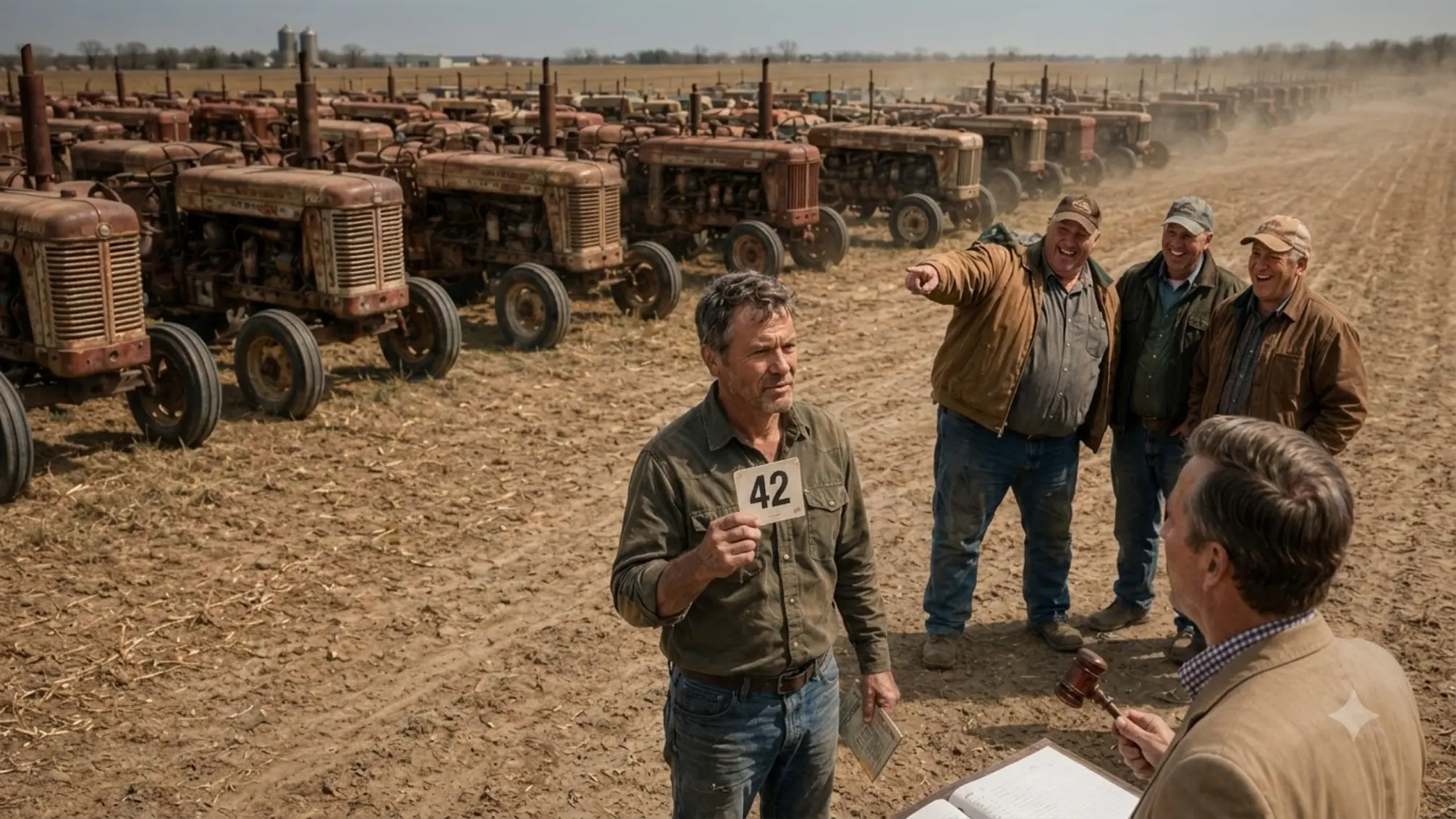
Caleb Mercer held bidder card number 42 at shoulder height and ignored the men laughing behind him. At forty-two, he had the weathered face of someone who had spent more years repairing machinery than discussing it. His red plaid work shirt was faded at the elbows, his jeans carried old grease stains, and a folded inspection report rested in his left hand. What the wealthy farmers saw as ruined equipment, Caleb saw as forty-two nearly identical symptoms.
The loudest man in the crowd was Douglas Crane, owner of more than six thousand acres and three grain-storage facilities across central Iowa. Douglas wore an expensive work jacket that had never touched an engine and pointed at Caleb as though the struggling single father were part of the entertainment. Beside him, several older farmers laughed because Douglas controlled valuable leasing contracts and because laughing with him was safer than becoming his next target. None of them had crawled beneath the tractors before the auction began.
Caleb had.
He arrived before sunrise with a flashlight, a pressure gauge, and permission to conduct only an external inspection. The county prohibited bidders from starting the seized machines because the dealership’s legal case remained under review. Caleb could not remove components, open sealed fuel systems, or use diagnostic equipment, but nobody stopped him from listening. He tapped housings, studied exhaust residue, checked control positions, and photographed identical marks on every tractor.
All forty-two machines had been serviced by Prairie Crown Equipment during the final year before the dealership collapsed. According to the auction packet, each tractor had been returned by customers after suffering sudden fuel-pressure failures. Prairie Crown claimed the engines had sustained extensive internal damage and replaced them temporarily with newer machines. When the company’s financing fraud surfaced, banks seized everything on the property, including the tractors awaiting supposed engine replacement.
The auction company listed them as nonoperational salvage.
Caleb suspected they had never needed new engines.
“Lot seventeen,” the auctioneer announced, lifting his wooden gavel. “Forty-two agricultural tractors sold together, as-is, where-is. No warranties, no returns, and no guarantee of operational condition. Opening bid, twenty thousand dollars.”
Silence followed.
Douglas raised two fingers. “Five thousand.”
The auctioneer frowned. “Mr. Crane, the opening request is twenty.”
“You’ll be paying someone to haul them away next week. Take five.”
Several men laughed again.
The auctioneer looked toward the bank representative, who reluctantly nodded.
“Five thousand offered. Do I hear six?”
Caleb raised card 42.
“Six thousand.”
Douglas turned and stared at him. “You bidding on the whole row?”
Caleb said nothing.
“Seven,” Douglas called.
“Eight,” Caleb replied.
The numbers climbed slowly. Douglas did not want the tractors, but he wanted to punish Caleb for challenging him publicly. He owned enough machinery to plant his acreage twice over, yet he kept bidding because the crowd was watching. Caleb understood the tactic and kept his face expressionless.
At fifteen thousand dollars, Douglas hesitated.
He looked at the rusty tractors, then at Caleb’s worn boots.
“Twenty,” Douglas said.
A murmur passed through the crowd.
Caleb’s bank had approved him for only thirty-five thousand dollars. That money was supposed to replace the failing combine on his eighty-acre farm, repair the roof over his workshop, and cover seed until harvest. Spending it on forty-two seized tractors could destroy the home where he was raising his twelve-year-old daughter alone.
He raised the card.
“Twenty-one.”
Douglas smiled. “Twenty-five.”
Caleb looked toward the edge of the field.
His daughter, Hannah, stood beside their old pickup holding a metal toolbox against her legs. She had dark-blonde hair tied beneath a faded cap and wore the same serious expression her mother used to make whenever Caleb considered a reckless repair. Hannah knew exactly how much money they had and exactly what failure would cost.
She also knew what Caleb had found.
That morning, she had crawled beneath tractor number nine and noticed a thin line scratched into the fuel-return housing. The same mark appeared on tractor sixteen, then twenty-three, then every machine they checked. It looked like the mark left by an improperly installed retaining ring.
Hannah met his eyes and nodded once.
Caleb raised the card again.
“Twenty-six.”
Douglas’s smile vanished.
“Thirty.”
The crowd became silent.
Caleb felt sweat gather beneath his collar despite the cool spring wind. Thirty thousand dollars would leave almost nothing for transportation, parts, taxes, or the farm. If his diagnosis was wrong, he would lose more than money.
He would lose Hannah’s home.
The auctioneer looked at him. “Thirty thousand offered. Do I hear thirty-one?”
Caleb raised card 42.
“Thirty-one.”
Douglas studied him for several seconds, searching for hesitation. Caleb gave him none. The wealthy farmer finally shoved both hands into his jacket pockets.
“Let the fool have them.”
The gavel struck.
“Sold for thirty-one thousand dollars to bidder forty-two.”
Some men applauded sarcastically. Others whistled as Caleb lowered his card. Douglas walked past him and stopped close enough that only the front row could hear.
“I’ll buy your farm for half its value when the bank calls,” he said.
Caleb folded the inspection report. “You should save your money.”
“For what?”
“Rental fees.”
Douglas laughed in his face and walked away.
Hannah reached Caleb after the crowd dispersed toward the next lot. “We have four thousand dollars left.”
“I know.”
“The transport company wants six.”
“I know.”
“And we still need parts.”
Caleb looked at the tractors stretching across the field. “Then we don’t hire the transport company.”
“How do we move forty-two tractors that don’t start?”
“We start them here.”
The auction agreement gave buyers seventy-two hours to remove purchased equipment. After that, storage charges would begin at two hundred dollars per tractor each day. Caleb had three days to repair enough machines to drive or tow the others from the property.
He opened the inspection report on the hood of his pickup.
Prairie Crown technicians had written nearly identical notes for every tractor: low rail pressure, unstable fuel delivery, repeated engine shutdown, suspected injector-pump damage. Yet the machines came from five manufacturers, seven production years, and multiple previous owners. Forty-two tractors developing the same expensive internal failure within fourteen months was not merely unlikely.
It was impossible without a shared cause.
Caleb had worked for Prairie Crown eighteen years earlier, before opening a modest repair shop on his farm. He knew the dealership’s former service director, Martin Voss, as a man who earned bonuses whenever customers purchased replacement machinery. Martin often described old tractors as “dead money” and encouraged technicians to recommend complete engine replacements instead of time-consuming repairs.
Caleb had left after refusing to sign a fraudulent inspection.
Now he wondered whether Prairie Crown’s collapse had exposed only part of the scheme.
Hannah opened the toolbox. “Which one first?”
“Number nine.”
“Because I found the scratch?”
“Because it has the easiest access panel.”
They pushed a portable workbench beside the tractor and removed the fuel-return housing. Caleb expected to find a damaged retaining ring, but the truth was worse. Someone had installed a thin aftermarket washer behind the pressure-regulator spring, increasing resistance just enough to destabilize fuel flow under load.
The computer interpreted the pressure fluctuation as a dangerous pump failure and shut down the engine.
Hannah held the washer beneath the sunlight.
“This doesn’t belong there.”
“No.”
“Could it have been a mistake?”
“Not on forty-two machines.”
Caleb removed the washer, inspected the spring, cleaned the valve, and reassembled the housing. The tractor’s battery was nearly dead, so they connected jumper cables to the pickup and waited. Several auction workers watched from a distance, expecting nothing.
Caleb climbed into the seat.
The starter turned twice.
The engine coughed.
Then the tractor roared to life.
Black exhaust burst from the stack before clearing into a steady gray haze. Hydraulic pressure rose, warning lights disappeared, and the engine settled into a deep, even rhythm. Hannah raised both fists while the auction workers stared at the supposedly ruined machine.
Caleb checked the time.
Nine minutes.
Douglas had not yet left the property. He stood near a trailer three lots away and turned when the engine started. His smile disappeared as Caleb drove tractor number nine across the field and parked it beside the pickup.
One repaired.
Forty-one remained.
Caleb shut it down and opened the next housing. The same washer waited inside. Tractor sixteen started after eleven minutes, tractor twenty-three after eight, and tractor thirty after fifteen because the valve required cleaning.
By noon, six tractors were running.
Word spread through the auction grounds.
Farmers abandoned other lots and gathered around Caleb’s work area. The same men who had laughed now watched him remove tiny washers from machines they had considered scrap. Some asked questions, but Caleb kept working.
Douglas forced his way through the crowd.
“What did you do?”
“Corrected the fuel regulator.”
“You said the engines were good?”
“I never said anything to you.”
Douglas looked at the running tractors. “How much do those washers cost?”
“About twelve cents each.”
The crowd reacted with disbelief.
Douglas’s face reddened. “You paid thirty-one thousand dollars because of twelve-cent washers?”
“I paid thirty-one thousand because nobody else looked.”
The former Prairie Crown service director, Martin Voss, was not present at the auction, but his name appeared on several inspection documents. Caleb photographed every unauthorized washer before removal and placed each one inside a numbered evidence bag. Hannah recorded the tractor serial numbers, service dates, and names of the technicians listed on the files.
She understood immediately why her father was being careful.
“This is fraud.”
“It may be.”
“They told owners the engines were destroyed.”
“And offered replacement tractors.”
“Then kept these after the customers couldn’t pay?”
Caleb looked toward the auction office. “We finish documenting before we accuse anyone.”
By sunset, they had restarted fourteen tractors.
Caleb used four of them to tow several nonoperational machines to a rented field two miles away, reducing the number still trapped on the auction property. Friends from neighboring farms arrived with chains, trailers, fuel cans, and food after hearing what had happened.
Not everyone came to help.
Some came because planting season was approaching and replacement tractors had become difficult to find. A late shipment delay had left dealerships without enough new machinery, while several farmers were already struggling with breakdowns.
One man asked Caleb whether he would sell tractor nine.
“Not today.”
“I’ll give you twenty thousand.”
Douglas interrupted. “I’ll give thirty.”
The offer nearly equaled what Caleb paid for the entire lot.
Hannah looked at her father, waiting.
Caleb wiped grease from his hands. “Neither of you inspected it.”
“We know it runs now,” Douglas said.
“You know it started. It still needs brakes, fluids, tires, and a complete safety inspection.”
“I’ll take the risk.”
“I won’t.”
Douglas stepped closer. “You’re a broke farmer with forty-two tractors and four thousand dollars. Don’t pretend you can afford principles.”
Caleb’s voice lowered. “That attitude is why those machines ended up here.”
Douglas glared at him. “You think restarting a few engines makes you some kind of genius?”
“No. It makes me responsible for what happens next.”
Caleb refused every purchase offer until each tractor passed inspection. He had seen too many sellers disguise temporary repairs and transfer danger to desperate buyers. He would not become another version of Prairie Crown.
The second day brought rain.
Mud spread across the field while Caleb and Hannah worked beneath a portable canopy. They discovered worn hoses, contaminated filters, weak batteries, and neglected fluid levels, but the engines remained structurally sound. Local mechanics volunteered after finishing their own shifts, and a parts supplier extended Caleb thirty days of credit.
By midnight, twenty-eight tractors were operational.
Hannah fell asleep inside the pickup wearing Caleb’s jacket. He carried her to the passenger seat, covered her with a blanket, and returned to work. Raising her alone had taught him that exhaustion was not an emergency; it was simply another condition to manage.
Hannah’s mother, Laura, had died five years earlier after a sudden illness. She had kept the farm accounts, negotiated equipment purchases, and possessed the patience Caleb often lacked. After her death, he nearly sold the property because every room reminded him of her.
Hannah stopped him.
She was seven years old when she placed both hands on the kitchen table and said, “Mom didn’t work this hard so we could give it away.”
Caleb stayed.
He repaired machinery for neighbors, planted his acreage, packed school lunches, learned to braid hair, and rebuilt a life around responsibilities that did not pause for grief. The farm barely earned enough, but Hannah grew up knowing that her father never disappeared when something became difficult.
That lesson stood behind every tractor he refused to abandon.
On the third morning, a black SUV entered the auction field. Two state investigators stepped out with a representative from the agricultural equipment finance division. They had received Caleb’s photographs, service documents, and numbered bags containing the unauthorized washers.
Martin Voss arrived twenty minutes later with an attorney.
He walked toward Caleb while investigators examined tractor thirty-seven.
“You had no right to dismantle those systems,” Martin said.
“I own the tractors.”
“You altered evidence connected to a bankruptcy proceeding.”
“I documented every part before removal.”
Martin’s attorney touched his arm, warning him to stop.
Caleb held up a service sheet. “Your signature is on thirty-one of these inspections.”
“I approved recommendations from certified technicians.”
“Did all thirty-one tractors suffer identical pump failures?”
“Possibly.”
“Across five manufacturers?”
Martin looked toward the investigators. “This man is trying to increase the resale value of junk by creating a conspiracy.”
Hannah stepped forward holding a plastic evidence bag.
“Then why does every tractor have the same washer installed backward?”
Martin glanced at her and then at the bag.
His expression changed for only a second.
The investigator noticed.
The scheme unraveled quickly. Prairie Crown technicians had installed the washers during routine servicing, causing tractors to fail weeks later. The dealership then claimed the engines required replacements costing tens of thousands of dollars. Farmers who could not afford repairs traded in their “destroyed” machines at extremely low values and financed newer tractors through Prairie Crown’s partner lender.
The old machines were supposed to receive inexpensive repairs before resale.
But Prairie Crown’s debts collapsed the business before that stage could occur.
The tractors were seized while still carrying the planted defects.
Martin had not merely misdiagnosed them.
He had designed the failure.
Investigators escorted him from the auction field before noon.
Caleb did not watch.
He was beneath tractor forty-two, removing the final washer.
When the engine started, the remaining crowd applauded. Forty-two tractors that had been labeled salvage now stood running in two long rows. Their paint remained faded and their bodies still carried years of work, but their engines had never been dead.
Douglas Crane approached again.
This time, he was not laughing.
“How many are you selling?”
“Eventually, perhaps twelve.”
“I need six.”
“You own newer tractors than these.”
“Two electronic control modules failed yesterday. The dealership says replacements won’t arrive for three weeks.”
Planting would begin in less than ten days. Missing that window could reduce yields across thousands of acres.
Caleb folded his arms. “You told me I’d lose my farm.”
Douglas looked toward the men gathered behind him. “I was wrong.”
“That isn’t what you came to say.”
Douglas swallowed his pride. “I need to rent six tractors.”
“Now you believe they’re worth using?”
“I believe they run.”
Caleb looked at the wealthy farmer who had mocked him in front of everyone. He could refuse and enjoy watching Douglas face the consequences. He could charge an abusive rate or demand a public humiliation.
Instead, he thought about the farm workers whose paychecks depended on those fields being planted.
“Standard county rental rate,” Caleb said. “You cover fuel and damage.”
Douglas appeared surprised. “That’s all?”
“You apologize to Hannah.”
Douglas stared at him.
“She was standing there when you said we’d lose our home.”
The wealthy farmer removed his cap and faced the girl.
“I was cruel because I thought your father was making a mistake,” he said. “He understood something I didn’t. I’m sorry.”
Hannah considered him with Laura’s same patient seriousness.
“Don’t laugh at poor people for taking chances,” she said. “Sometimes chances are all they have.”
Douglas nodded. “You’re right.”
Caleb rented him six tractors.
Within two weeks, thirty of the repaired machines were working across central Iowa. Caleb leased them to small farms at rates lower than dealership prices, with maintenance included. He reserved several for emergency replacements whenever a farmer suffered a breakdown during planting.
The twelve best machines were restored completely.
Caleb replaced tires, repaired seats, rebuilt electrical systems, changed fluids, repainted body panels, and issued written inspection records. He sold six and kept six for a cooperative rental fleet.
By harvest, the tractors had generated enough income to repay his loan, repair the barn roof, replace his combine, and establish a college fund for Hannah.
The bank never called for his farm.
Instead, the bank manager asked whether Caleb wanted financing to expand his equipment cooperative.
He accepted only after reading every line with Hannah.
The fraud investigation resulted in restitution claims for dozens of farmers who had been deceived by Prairie Crown. Some recovered money; others regained equipment that had been taken through fraudulent trade-ins. Martin Voss lost his licenses and later received a prison sentence for financial fraud and equipment tampering.
Caleb testified without exaggeration.
He explained the washers, the pressure changes, and the pattern in the service records. He did not call himself a hero or claim he had saved anyone. He said only that machinery deserved honest diagnosis because the families depending on it could not afford lies.
The county invited him to speak at an agricultural safety meeting.
He brought washer number nine inside a small evidence box.
“The difference between junk and valuable equipment was twelve cents,” he told the room. “But the difference between seeing that and missing it was whether someone bothered to look.”
Douglas sat in the front row.
He no longer laughed.
A year after the auction, Caleb opened Mercer Farm Equipment Cooperative inside an abandoned grain warehouse. The business repaired older tractors, provided affordable rentals, and trained young mechanics who could not afford technical college.
Hannah designed the cooperative’s sign.
It showed bidder card 42 above the words:
DON’T CONFUSE NEGLECTED WITH WORTHLESS.
She spent afternoons learning diagnostics, rebuilding carburetors, and organizing maintenance records. Caleb insisted she finish her homework before touching tools, though she frequently argued that electrical diagrams counted as science assignments.
The original tractor number nine remained on their farm.
Its paint was still partly rusted because Hannah asked him not to erase every scar. They restored the engine, brakes, seat, and lights but left one faded section untouched.
“It should remember where it came from,” she said.
Caleb understood.
At the next county auction, he and Hannah stood near another row of seized equipment. Several farmers approached them for advice before bidding. Nobody laughed when Caleb crouched beneath a machine or tapped a housing with his wrench.
Douglas arrived and held out a cup of coffee.
“I’m looking at that old combine,” he said.
Caleb studied it. “Hydraulic pump sounds weak.”
“So it’s junk?”
Caleb looked at him.
Douglas smiled. “Wrong word.”
“Very wrong.”
Together, they walked toward the combine.
The forty-two tractors had not made Caleb wealthy overnight. They gave him something more durable: control over his skills, a business built around honest work, and proof that Hannah’s faith in him had not been misplaced.
The men at the auction believed he thought he could fix everything.
Caleb never believed that.
Some engines were destroyed. Some frames were unsafe. Some machines had worked until there was nothing responsible left to save.
But those forty-two tractors were not dead.
They had been deliberately silenced, misdiagnosed, and discarded by people who profited from convincing others that repair was impossible.
Caleb did not prove every broken thing could be saved.
He proved something simpler.
Before laughing at the man buying the junk, make sure he has not already discovered what everyone else was too arrogant to inspect.